

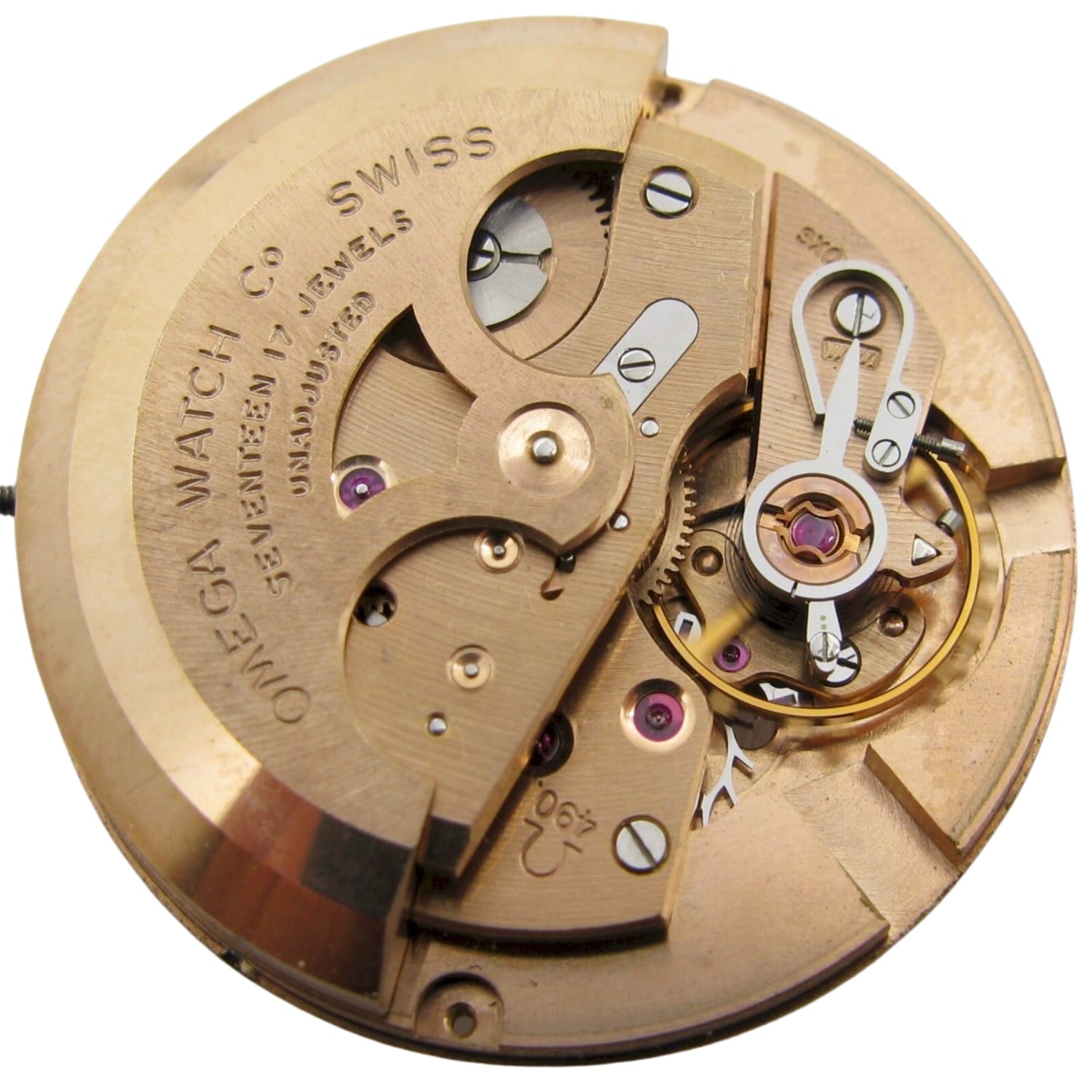
The Omega caliber 490 represents a pivotal advancement in Omega’s automatic movement technology, marking the brand’s first foray into bidirectional winding systems with a full 360-degree rotor for sub-seconds configurations. Introduced in 1956, the 490 belongs to the revolutionary 470/490/500 series designed by Edouard Schwaar, whose engineering brilliance created movements that would define Omega’s automatic offerings throughout the late 1950s and into the 1960s. This 28mm diameter movement was specifically engineered for small seconds display, distinguishing it from its center-seconds sibling, the caliber 500, while sharing the same robust architecture and winding efficiency that established Omega as a leader in automatic watchmaking.
HISTORY & DEVELOPMENT
The Edouard Schwaar Revolution
The Omega 490’s development traces directly to Marc Favre, a renowned Swiss movement manufacturer whose innovative designs caught Omega’s attention in the mid-1950s. Edouard Schwaar, working for Marc Favre, designed the groundbreaking caliber 470 series beginning in 1955, which Omega adopted as a replacement for their earlier bumper automatic movements. The success of these movements proved so significant that Omega subsequently acquired Marc Favre manufacturing in 1955, incorporating Schwaar’s expertise directly into their operations.
The caliber 490, introduced in 1956, was part of this second wave of Schwaar-designed movements. While the smaller 25mm caliber 470 and 471 served as the foundation, the 490 expanded the architecture to a larger 28mm diameter specifically to accommodate sub-seconds functionality. This size increase allowed for optimal gear train spacing and improved positional stability compared to smaller movements.
Bidirectional Winding Innovation
Prior to the 470/490 series, Omega’s automatic movements relied on unidirectional bumper winding mechanisms, where a semicircular rotor oscillated back and forth. The 470 and 490 represented Omega’s first full-rotor automatic movements with bidirectional winding, meaning the rotor could wind the mainspring whether rotating clockwise or counterclockwise. This innovation significantly improved winding efficiency, requiring less wrist movement to maintain power reserve and establishing a design philosophy Omega would continue for decades.
According to period documentation, the 470 and 490 were revolutionary in their use of a reverser wheel system that captured energy from both rotational directions and directed it to wind the mainspring. This engineering represented a major technical achievement and positioned Omega competitively against other manufacturers adopting similar technologies.
Production and Market Position
The caliber 490 remained in production from 1956 through approximately 1965, powering numerous Omega watches including Seamaster models and elegant dress watches. Serial numbers dating from 1954-1958 are commonly found on 490 movements, reflecting the typical lag between movement production dates and final watch assembly. The movement proved popular enough that over 1 million units of the 470/490/500 series were produced between 1955 and 1960 alone.
TECHNICAL DETAILS
Movement Architecture
The Omega 490 is a self-winding automatic movement with a 28mm (12.4 lignes) diameter and 5.55mm height, providing substantial stability and reliability due to its generous proportions. The movement features a Swiss lever escapement with 17 jewels positioned from the balance wheel through the gear train. This jewel count was strategically chosen as a balance between quality and cost, with the 17-jewel configuration meeting Swiss standards for fully functional automatic movements while remaining accessible for mid-range watches.
The sub-seconds display at 6:00 distinguishes the 490 from the center-seconds caliber 500, requiring a different gear train configuration where the fourth wheel carries the seconds hand rather than extending through the center of the movement. This traditional sub-seconds layout appealed to collectors preferring classic watch aesthetics over the more modern center-seconds arrangements.
Winding System and Power Reserve
The 490’s bidirectional automatic winding system employs a full-rotor design that rotates 360 degrees in either direction. The rotor drives a pair of reverser wheels (also called rocker wheels) that work in tandem to ensure winding occurs regardless of rotation direction. When the rotor turns counterclockwise, the left reverser wheel drives the reduction wheel; when it turns clockwise, the right reverser wheel drives the same reduction wheel in the same direction, cleverly converting bidirectional motion into unidirectional mainspring winding.
The movement stores approximately 46 hours of power reserve when fully wound, providing nearly two full days of operation. This respectable reserve meant owners could remove the watch overnight and have it running the next day without immediate winding. The 19,800 vibrations per hour (2.75 Hz) beat rate represents a moderate frequency typical of quality movements from this era, balancing precision with power consumption.
Shock Protection and Precision
The caliber 490 incorporates Incabloc shock protection on the balance wheel pivots, featuring the distinctive lyre-shaped spring system that protects the delicate balance staff from impact damage. This Swiss-made shock absorber became standard on quality movements and significantly improved reliability for wristwatches subject to daily wear and occasional drops.
The movement was available in both unadjusted and adjusted versions, with some examples marked “Adjusted 2 Positions” on the rotor or movement plates. These adjusted versions underwent additional regulation to improve timekeeping accuracy across different positions, though they did not reach the chronometer certification level achieved by higher-grade movements in the 500 series.
The lift angle of 49 degrees is critical information for watchmakers using timing machines, consistent with other Omega movements from this family. This specific angle allows accurate amplitude measurements when servicing and regulating the 490.
Construction Quality
The 490 features traditional Swiss finishing with brass plates, copper gilt plating on bridges, and polished screws. The movement’s generous 28mm diameter allowed Omega’s engineers to create well-spaced gear trains with optimal ratios, contributing to reliability and ease of service. The bronze alloy rotor bearings represented a cost-effective solution compared to jeweled bearings, though this design choice would later prove to be a wear point requiring attention during service.
VARIANTS & RELATED CALIBERS
The Omega 490 belongs to an extensive family of related movements that Omega produced throughout the late 1950s and early 1960s. Understanding these variants helps collectors identify specific capabilities and quality levels.
The 470/490/500 Series Family
| Variant | Diameter | Key Differences |
|---|---|---|
| Cal. 470 | 25mm | Center seconds, 17 jewels, first bidirectional full-rotor |
| Cal. 471 | 25mm | Center seconds, 19-20 jewels, higher grade |
| Cal. 490 | 28mm | Sub-seconds, 17 jewels, bidirectional winding |
| Cal. 491 | 28mm | Sub-seconds, 19 jewels, higher grade |
| Cal. 500 | 28mm | Center seconds (sweep seconds), 17 jewels |
| Cal. 501 | 28mm | Center seconds, 19-20 jewels, swan neck regulator |
| Cal. 502 | 28mm | Center seconds with date, 17 jewels |
| Cal. 503 | 28mm | Center seconds with date, 19-20 jewels |
| Cal. 504 | 28mm | Center seconds with date, 24 jewels, chronometer |
| Cal. 505 | 28mm | Center seconds, 24 jewels, chronometer |
Caliber 490 vs. 491
The most directly comparable movement to the 490 is the caliber 491, which features the same 28mm diameter and sub-seconds layout but with 19 jewels instead of 17. The jewel count difference represents the primary distinction between these calibers, with the 491 offering additional jeweling that theoretically reduces friction and wear. However, practical performance differences between properly maintained examples are minimal, making the 17-jewel 490 an excellent value proposition.
Center Seconds vs. Sub-Seconds
The caliber 500 represents the center-seconds equivalent of the 490, featuring an identical base architecture but with the seconds hand mounted centrally rather than at 6:00. The gear train differs substantially between these configurations, as the center-seconds version requires the fourth wheel to extend through the center of the movement. Omega offered both configurations to appeal to different aesthetic preferences and watch case designs.
Higher Grade Variants
The caliber 501 (19-20 jewels) and 505 (24 jewels, chronometer grade) represent premium versions of the center-seconds architecture, featuring swan neck micrometer regulators for fine adjustment and superior timekeeping. These movements underwent additional regulation and featured higher-quality components, commanding premium prices in period Omega watches, particularly the prestigious Constellation line.
IDENTIFICATION & MARKINGS
Locating the Caliber Number
The caliber number 490 is engraved on the movement’s main plate or bridges, visible when the watch case is opened. Some movements may also display the jewel count (“17 Jewels” or “17 Pierres”) and “Swiss Made” markings. Movements intended for the American market often feature three-letter import codes such as “OXG” due to US customs regulations and Norman Morris’s domestic casing operations.
Movement Markings
Authentic Omega 490 movements display several identifying marks:
- Omega symbol (Ω) prominently engraved on the movement
- “Omega” text on bridges or the main plate
- “17 Jewels” indicating jewel count
- “Adjusted” or “Adjusted 2 Positions” on higher-grade examples
- Incabloc symbol near the balance cock, confirming shock protection
- Serial number engraved on the movement for dating purposes
Distinguishing from Similar Calibers
The most reliable methods to differentiate the 490 from related movements include:
- Sub-seconds hand location: Confirms 490 or 491 (not 500/501 with center seconds)
- Jewel count marking: 17 jewels indicates 490; 19 jewels indicates 491
- Diameter measurement: 28mm confirms 490/491 series (not 25mm 470/471)
- Rotor design and markings: Some rotors display adjustment grades or chronometer status
Serial Number Dating
Serial numbers found on caliber 490 movements typically range from approximately 14,500,000 through 16,500,000, corresponding to production years from 1954-1958. However, these dates reflect movement production rather than final watch assembly, which could occur years later. The 1956 introduction date of the caliber 490 explains why some serial numbers predating this year appear on 490 movements—Omega sometimes applied sequential serial numbers across caliber families.
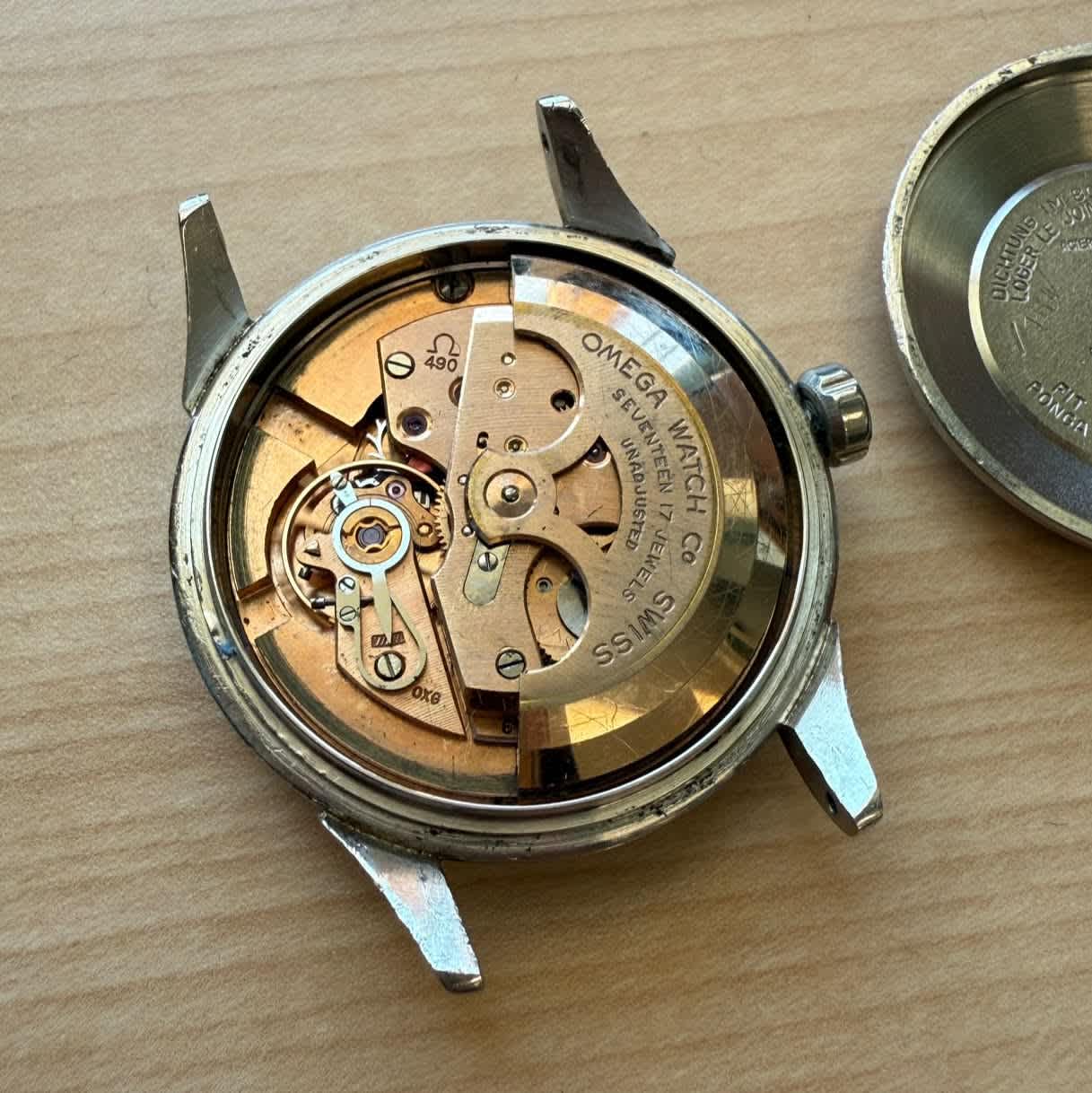
1954 Omega Automatic Watch Cal. 490 17 Jewels Wristwatch 34mm S.S. Black Dial
COLLECTOR NOTES
Service and Parts Availability
The Omega 490 enjoys good service availability compared to many vintage movements, benefiting from the large production quantities and widespread use in Seamaster and dress watch models. Watchmakers familiar with vintage Omega movements generally consider the 490 series highly serviceable due to straightforward construction and well-documented repair procedures.
Parts availability remains reasonably good through specialized suppliers, vintage watchmakers, and donor movements. Common service parts including mainsprings, balance staffs, and stems can be sourced from multiple suppliers. The winding stem (part number 1106) fits across the entire 490/491/500/501/502/503/504/505 family, ensuring excellent availability. Complete balance assemblies with Incabloc shock protection are also obtainable, though original Omega parts command premium prices.
Omega officially ceased supporting movements of this vintage for routine service decades ago, but independent watchmakers maintain expertise and parts stocks necessary for proper maintenance. Service costs for a caliber 490 typically range from $300-600 depending on required parts and the watchmaker’s location.
Reliability and Common Issues
The caliber 490’s reputation for reliability is well-deserved when properly maintained, with many examples still functioning accurately after 60-70 years. The robust 28mm diameter construction and generous proportions contribute to long-term durability and resistance to wear. One collector’s 1958 Omega powered by a 490 continues keeping excellent time with regular service, testament to the movement’s longevity.
Common wear points and issues include:
- Bronze rotor bearing wear: The non-jeweled bronze bushings supporting the rotor can develop wear over time, causing excessive rotor wobble and winding inefficiency. This is the most significant design limitation of the 490 compared to movements with jeweled or ball-bearing rotors.
- Rotor pinion wear: The combined bushing and gear that presses into the rotor can wear, requiring replacement of the entire rotor assembly
- Mainspring weakness: Original mainsprings lose tension after decades, requiring replacement during service
- Dried lubricants: Neglected movements suffer from hardened oils causing increased friction and poor amplitude
- Balance staff damage: Despite Incabloc protection, worn shock springs or impacts can still damage balance pivots
- Crown and stem wear: The winding mechanism can develop play or resistance over time
The bronze rotor bearing issue deserves special attention, as it represents the primary design compromise of this movement family. Omega chose bronze alloy bearings for cost efficiency, but these bushings wear faster than jeweled bearings, especially when service intervals are extended. Watchmakers servicing 490 movements should carefully inspect rotor bearing condition and advise replacement if significant wear is present.
Value Considerations
Watches powered by the Omega 490 occupy an attractive position in the vintage market, offering Swiss automatic movement quality at accessible prices compared to more celebrated Omega calibers. Values typically range from $800 to $2,500 depending on condition, case material, model, and provenance.
Value factors affecting 490-powered watches:
- Case material: Stainless steel most common; 14K gold-filled or solid gold cases command premiums
- Model designation: Seamaster models generally more desirable than unmarked dress watches
- Dial condition: Original dials with good patina valued over refinished examples
- Service history: Recently serviced movements preferred by collectors
- Completeness: Original hands, crown, crystal enhance value
- Case condition: Unpolished or lightly polished cases more desirable
- Documentation: Original boxes and papers significantly increase value
Reference models frequently housing the 490 include the FX 6040, FX 6249, FX 6266, and FX 6282, primarily US-market models cased by Norman Morris. These typically feature 33-34mm stainless steel or gold-filled cases with various dial configurations including honeycomb, crosshair, textured, and tapestry patterns.
Collector Appeal
The Omega 490 attracts collectors for several compelling reasons:
- Historical significance: First bidirectional full-rotor automatic in the 28mm sub-seconds format
- Designer provenance: Edouard Schwaar’s innovative engineering
- Classic aesthetics: Sub-seconds layout appeals to traditional watch enthusiasts
- Serviceability: Straightforward construction and available parts
- Affordability: Entry point into quality vintage Omega automatic collecting
- Proven reliability: Decades of successful operation when maintained
The movement’s 46-hour power reserve and 19,800 vph beat rate create a pleasant, audible tick that collectors appreciate. The 28mm diameter makes the movement visually substantial and allows for attractive finishing that belies the 17-jewel grade. Many collectors specifically seek sub-seconds Omega automatics for their traditional appearance and the 490 delivers this aesthetic in a well-engineered, affordable package.