

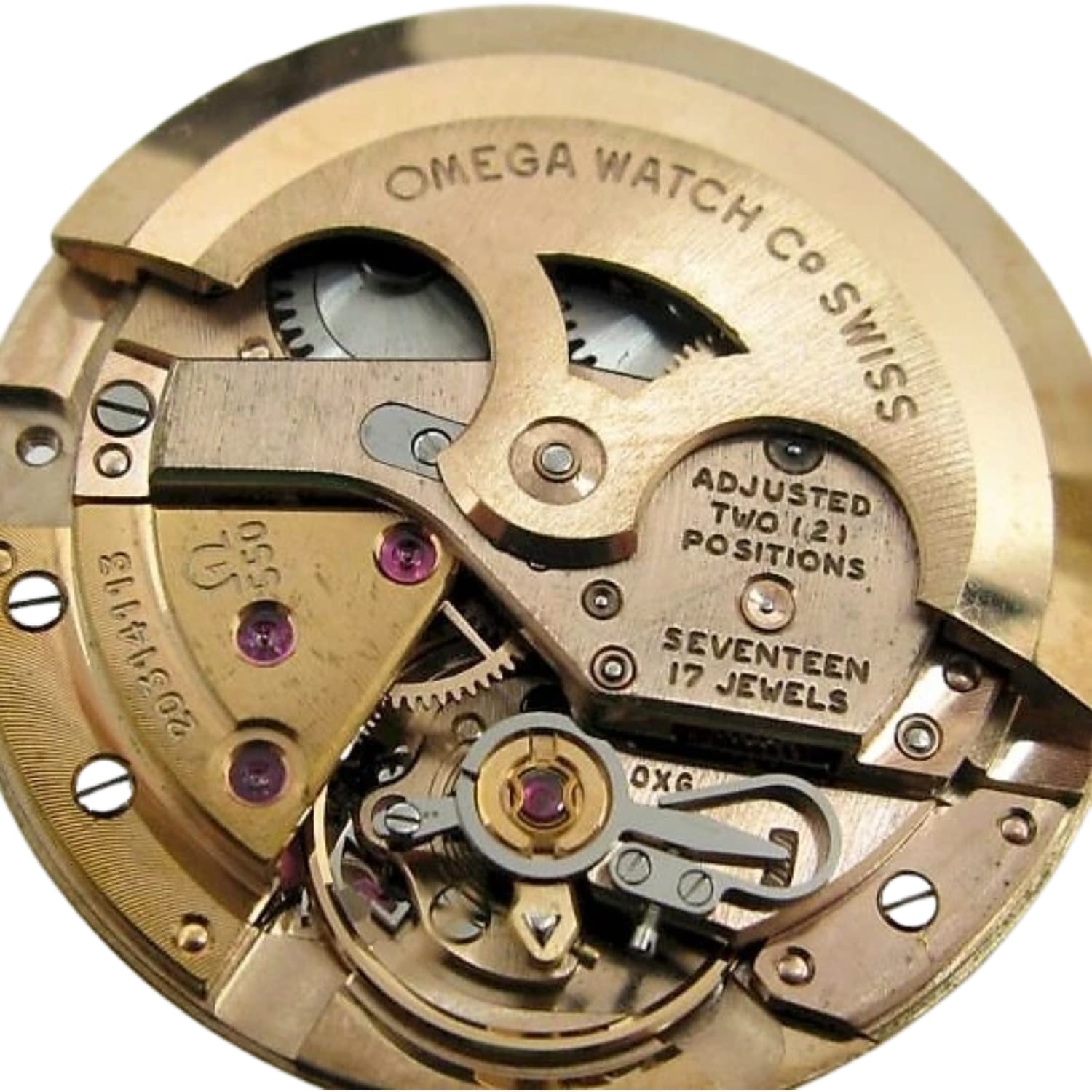
Omega 550
- Launch Year: 1958
|
Brand |
Omega |
|
Caliber Number |
550 |
|
Production Start |
1958 |
|
Production End |
1969 |
|
Lignes |
12.5" |
|
Diameter |
28.4 mm (mounting diameter 27.9mm) |
|
Height |
4.50mm |
|
Power Reserve |
50 hours |
|
Frequency |
19,800 vph / 2.75 Hz |
|
Jewel Count |
17 |
|
Escapement |
Swiss Lever |
|
Anti-Shock Device |
Incabloc |
|
Lift Angle |
49 degrees |
|
Hand Count |
3 |
|
Manufacture Region |
Switzerland |
|
Functions |
Time, Center-sweep seconds, Automatic winding (bidirectional) |
Omega 550 Description
The Omega caliber 550 represents a watershed moment in Omega’s horological history, marking the company’s transition from bumper automatic movements to modern full-rotor automatic winding systems. Introduced in 1958 as the successor to the Marc Favre-designed caliber 470/490 series, the 550 established an architectural platform that would dominate Omega’s production for over a decade and spawn one of the most successful movement families in Swiss watchmaking history.
Developed by movement manufacture Marc Favre (which SSIH acquired in 1955 to secure exclusive production rights for Omega), the 550 achieved several critical improvements over its predecessors: 1mm reduction in height (to 4.5mm), four additional hours of power reserve (reaching 50 hours), enhanced reliability through refined automatic winding mechanics, and production efficiencies that allowed Omega to manufacture movements at unprecedented scale.
The 550 served as the foundation caliber for Omega’s entire automatic lineup during the 1960s, including the legendary Seamaster 300 dive watches, Constellation chronometers, and countless dress watches that established Omega as a dominant force in mid-century horology. The base 550 featured 17 jewels, no date complication, center-sweep seconds, swan-neck regulator (on early examples), and Omega’s sophisticated bidirectional automatic winding system with dual ratchet wheels.
HISTORY & DEVELOPMENT
Origins and Marc Favre Partnership
The story of the caliber 550 begins with Marc Favre & Co., an independent movement manufacturer based in Biel/Bienne, Switzerland (the same city as Omega). Marc Favre had already established a reputation for innovative automatic movements, including supplying calibers to Universal Genève and other prestigious brands. In the early 1950s, Omega began sourcing movements from Marc Favre, starting with the caliber 470 series introduced around 1953-1955.
The caliber 470 family proved highly successful, featuring Omega’s first full-rotor automatic movements with 360-degree bidirectional winding (replacing the earlier bumper automatics). Recognizing the strategic value of Marc Favre’s technical expertise and manufacturing capabilities, SSIH (Société Suisse pour l’Industrie Horlogére, Omega’s parent company) acquired Marc Favre in March 1955, fully integrating the company by 1958.
Robert-Marc Favre (son of the founder) later became Administrative Delegate of Omega and Administrative Director of SSIH, reflecting the high esteem with which the Favre technical team was regarded.
Development of the 550 Series (1956-1958)
Following the acquisition, Marc Favre’s engineers worked within Omega to develop a next-generation automatic movement that addressed limitations of the 470 series. Key development goals included:
- Height reduction: The 470 measured 5.55mm high; the new movement needed to fit slimmer case designs trending in the late 1950s
- Power reserve extension: From 46 hours to 50+ hours
- Production optimization: Streamlined manufacturing for higher volumes
- Reliability improvements: Enhanced automatic winding system durability
- Platform architecture: Design flexibility to accommodate date complications and chronometer variants
The resulting caliber 550 launched in 1958, measuring 28.4mm diameter and 4.5mm height—a full millimeter thinner than the 470 while delivering superior performance.
Production Period and Evolution (1958-1969)
| Year Range | Significant Events |
|---|---|
| 1958 | Initial production begins; 550 appears in Seamaster and early Constellation models |
| 1959 | Introduction of variants 551 (24J chronometer), 552 (24J), 560 (17J with date) |
| 1960-1962 | Peak production; 550 becomes Omega’s standard automatic movement |
| 1963-1966 | Further variants introduced: 561, 562 (date versions), refined rotor design |
| 1966 | Quick-set date variants 563, 564, 565 and day-date 750, 751, 752 introduced |
| 1967-1969 | Production continues; cost-saving measures introduce simplified finishing |
| 1969 | Production ends as Omega transitions to new caliber families ahead of quartz crisis |
Key Milestones:
- 1958: Caliber 550 replaces 470 series as Omega’s primary automatic movement
- 1959: 551 chronometer variant achieves remarkable COSC certification rates for Constellation line
- 1960-1966: The 550 series powers iconic Seamaster 300 references (CK 14755, 165.024) and Constellation “pie-pan” models
- 1966: Quick-set date mechanism introduced in 563/564/565, representing major technical advancement
- Late 1960s: Movement finishing quality declines as cost-cutting measures implemented in anticipation of quartz revolution
- 1969: Production ceases; Omega transitions to new caliber architectures and prepares for quartz era
Notable Watch References Featuring Caliber 550:
- Omega Seamaster 300 ref. 14755 (1961-1963): Early dive watch powered by 552 variant
- Omega Seamaster 300 ref. 165.024 (1964-1970): Iconic 42mm dive watch with cal. 552
- Omega Seamaster 165.002 (1960s): Dress Seamaster with cal. 550
- Omega Seamaster 14774 SC-62 (1960s): 34mm dress model
- Omega Constellation “Pie-Pan” (1960s): Flagship chronometer with cal. 551
- Omega Seamaster De Ville 165.020 (1963-1968): Dress watch with cal. 552
- Various USA-cased models (LU6304, LL6066): American market watches with cal. 550
TECHNICAL DETAILS
Winding System: The 550 employs Omega’s sophisticated bidirectional automatic winding system featuring a full-rotor oscillating weight with 360-degree rotation. Unlike earlier bumper movements that used limited-angle rotors striking spring-loaded stops, the 550’s rotor turns freely in both directions, with ingenious gear reduction translating both clockwise and counterclockwise motion into unidirectional mainspring winding.
The automatic winding mechanism centers on a complex winding gear assembly (part 550-1464) comprising two winding wheels positioned on either side of a winding wheel core, upon which two satellite pinions are mounted. This sophisticated arrangement:
Clockwise rotor rotation: The rotor pinion drives the superior winding wheel, which engages the superior satellite pinion to rotate the winding wheel core. This transmits rotation to the automatic ratchet wheel.
Counterclockwise rotor rotation: Both winding wheels engage, with the inferior winding wheel driven via the intermediate wheel. The inferior satellite pinion now locks, again rotating the winding wheel core in the same winding direction.
The system employs dual ratchet wheels stacked coaxially:
- Main ratchet wheel (upper): Primarily serves hand-winding function via crown
- Automatic ratchet wheel (lower): Driven by automatic winding mechanism and coupled to main ratchet
This dual-ratchet design allows simultaneous hand-winding and automatic winding without interference, while a mainspring bridle (slipping spring) at the barrel prevents overwinding by allowing controlled mainspring slip at full power.
Regulation Mechanism: Early 550 movements (1958-early 1960s) featured Omega’s prestigious swan-neck regulator (col de cygne), identical to the 470/505 chronometer calibers. This sophisticated adjustment mechanism uses a tempered steel spring shaped like a swan’s neck to provide fine, precise rate adjustment via a threaded screw that pushes or releases the regulator index.
Later production 550 movements transitioned to simpler regulator designs as cost-optimization measures were implemented during the mid-to-late 1960s. The swan-neck regulator remained standard on chronometer-grade 551 variants throughout production.
Balance and Hairspring: The 550 features a large four-arm Glucydur (beryllium-bronze) balance wheel approximately 11mm in diameter. This copper-beryllium alloy (approximately 98% copper, 2% beryllium) provides:
- Excellent thermal stability across temperature ranges
- Non-magnetic properties critical for chronometer certification
- Precipitation-hardening characteristics for long-term dimensional stability
- Low density allowing larger diameter without excessive inertia
The balance is paired with a Breguet overcoil hairspring manufactured from Nivarox alloy (iron-nickel-beryllium-titanium-silicon). The Breguet overcoil configuration, with its elevated and curved outer coil, allows the hairspring to “breathe” concentrically during oscillation, improving isochronism and positional performance.
The conservative 19,800 vph (2.75 Hz) beat rate represents Omega’s philosophy of prioritizing reliability and power reserve over higher frequency. This slower rate reduces wear on pivots, consumes less power (enabling the exceptional 50-hour reserve), and provides stable, predictable timekeeping across the movement’s operational lifespan.
Construction and Architecture: The 550 employs classical Swiss construction with multiple bridges securing the gear train:
- Train bridge: Secures escape wheel, fourth wheel, and third wheel
- Balance cock: Supports upper balance pivot with Incabloc shock protection
- Automatic bridge: Houses entire automatic winding system including rotor bearing
- Automatic upper bridge: Covers winding gear assembly
The center-seconds display uses an indirect drive system where the fourth wheel (seconds wheel) meshes with a center-seconds pinion fitted with a friction spring. This spring-loaded design prevents the seconds hand from stopping when the balance is disturbed and allows hand-setting without stopping the entire gear train.
Rotor Design and Evolution: The 550 family experienced a significant rotor design change during the mid-1960s:
Early design (1958-mid 1960s): Sharp, angular rotor profile with chamfered edges and decorative texturing. The rotor pivot area featured complex machining with sharp transitions.
Later design (mid-late 1960s): Simplified, rounded rotor profile lacking earlier chamfering and decorative elements. This cost-reduced design appeared from approximately 1966-1969.
The rotor mounts on a rotor axle (part 550-1400) press-fitted into the automatic bridge. This axle represents the 550 family’s primary design weakness—see Known Issues section below.
Finishing and Aesthetic: The 550 exhibits Omega’s characteristic “rose gold” or copper-toned finish on bridges and plates. Metallurgical analysis confirms this finish consists of brass-like beryllium-bronze components with thin copper electroplating, serving both functional (corrosion resistance) and aesthetic purposes.
Finishing quality varies by production period:
- 1958-1963: Excellent finishing with straight graining on plates, Geneva stripes on bridges, highly polished screws, chamfered edges
- 1964-1966: Very good finishing maintained on most components
- 1967-1969: Noticeable quality reduction as cost-cutting measures implemented; simpler rotor design, reduced chamfering, less refined decorative texturing
PERFORMANCE SPECIFICATIONS
Amplitude: A healthy, fully serviced caliber 550 should exhibit amplitude between 280-320 degrees when fully wound and positioned dial-up at room temperature. The automatic movements typically show slightly lower amplitudes than manual-wind calibers due to additional friction from the automatic winding system.
Position-Specific Amplitude Expectations:
| Position | Expected Amplitude | Notes |
|---|---|---|
| Dial up | 280-315 degrees | Optimal position; reference measurement |
| Dial down | 275-310 degrees | Typically 5-10 degrees lower than dial-up |
| Crown up | 265-295 degrees | Lowest amplitude; maximum friction |
| Crown down | 270-300 degrees | Moderate reduction from dial-up |
| Crown left/right | 270-305 degrees | Variable based on pivot condition |
Critical Amplitude Thresholds:
- 250-280 degrees: Movement requires service soon; dried lubricants likely
- 220-250 degrees: Immediate service required; significant wear or contamination
- Below 220 degrees: Severe problems; movement may not run reliably
Effect of Automatic Bridge Installation: A common diagnostic observation: amplitude typically drops 30-50 degrees when the automatic winding bridge is installed compared to the movement running without automatic works. Excessive amplitude loss (>50 degrees) indicates problems with the automatic winding system—most commonly worn rotor axle bearing, binding winding gear satellites, or excessive friction in the automatic transmission.
Beat Error: Acceptable beat error should remain within 0.0 to 0.5 milliseconds. The 19,800 vph frequency produces tick intervals of approximately 3.03 milliseconds, making beat errors above 1.0 ms audibly noticeable and affecting isochronism.
Positional Variance: Well-regulated 550 movements typically exhibit positional rate variations of 4-8 seconds per day across all positions. Chronometer-grade 551 variants achieve tighter tolerances of 2-6 seconds total positional variance.
Expected positional behavior:
- Dial-up: Fastest rate (reference position)
- Dial-down: 2-4 seconds slower than dial-up
- Crown-up: 5-8 seconds slower (most conservative rate)
- Crown positions: 3-6 seconds variance from dial-up
Accuracy Standards:
| Caliber Variant | Standard | Daily Rate Tolerance |
|---|---|---|
| 550 (17J) | Omega factory standard | ±3 to ±5 seconds/day dial-up |
| 551 (24J Chronometer) | COSC certified | -4 to +6 seconds/day across 5 positions |
| 552 (24J) | Omega factory standard | ±3 to ±5 seconds/day dial-up |
| 560, 562 (date variants) | Omega factory standard | ±3 to ±5 seconds/day dial-up |
| 561 (24J date chronometer) | COSC certified | -4 to +6 seconds/day across 5 positions |
Modern expectations for vintage 550 movements after proper service:
- Excellent: ±4 seconds per day across positions
- Good: ±6 seconds per day
- Acceptable: ±10 seconds per day
- Requires attention: >±12 seconds per day
The caliber 551 achieved exceptional chronometer certification rates during the 1960s, with Omega sending batches of 100,000 movements for COSC testing—all meeting standards twice as stringent as typical chronometer certification.
REGULATION & ADJUSTMENT
Swan-Neck Regulator Mechanism (Early 550, all 551): The swan-neck regulator provides the finest regulation capability in Omega’s vintage lineup. The system consists of:
- Swan-neck spring: Tempered steel spring piece fastened at one end to the balance cock
- Adjusting screw: Threaded screw passing through the swan-neck spring
- Regulator index: Traditional index with curb pins that control hairspring effective length
- Threaded post: The screw rests on this post attached to the regulator index
Adjustment procedure:
- Remove balance cock to access regulator
- Locate adjusting screw passing through swan-neck spring
- Clockwise rotation: Screw advances through threads, pushing against post, moving regulator index toward “+” (faster rate)
- Counterclockwise rotation: Screw retracts, allowing swan-neck spring to pull regulator toward “-” (slower rate)
- Make small adjustments (1/8 to 1/4 turn increments)
- Check rate on timegrapher; repeat as needed
Mechanical advantage: The screw thread pitch (estimated 80-100 threads per inch) provides exceptional precision. One full rotation produces approximately 0.01 inches (0.25mm) of index movement, translating to roughly 10-15 seconds per day rate change.
Standard Regulator Mechanism (Later 550, 552, 560, 562): Later production and non-chronometer variants use a simplified regulator index without swan-neck mechanism. Adjustment requires:
- Remove balance cock
- Use precision screwdriver or regulator tool
- Gently move regulator index directly toward “+” (faster) or “-” (slower)
- Adjustment is more sensitive; small movements yield larger rate changes
- Verify rate after each adjustment
Beat Error Correction: The 550 series uses a moveable stud carrier allowing beat error adjustment. The procedure requires careful manipulation:
- Remove balance cock and balance assembly
- Loosen hairspring stud carrier screw slightly
- Shift stud laterally in small increments (0.1mm) in direction that reduces beat error
- Goal: Center impulse roller within pallet fork slot at balance neutral position
- Retighten stud carrier
- Verify beat error on timegrapher (<0.5 ms target)
- Repeat if necessary
Timegrapher Settings: For accurate measurement, configure timegrapher with:
- Lift angle: 49 degrees
- Beat rate: 19,800 vph (auto-detect typically accurate)
- Measurement time: Minimum 30 seconds for stable reading
SERVICEABILITY & MAINTENANCE
Service Interval:
- Regular wear (automatic winding engaged): 5-7 years
- Occasional wear: 7-10 years
- Storage/collection pieces: Every 10 years minimum regardless of use
Vintage movements dormant for decades may require immediate service as lubricants degrade regardless of operation.
Parts Availability: Excellent. The 550 family’s massive production scale (likely millions of movements across all variants) ensures strong parts availability. Components interchange extensively within the 550/560/563/564/565/600/610/611/613/750/751/752 family, providing numerous sourcing options.
Commonly Available Parts:
Parts With Limited Availability:
- Complete balance assemblies (with hairspring)
- Winding gear satellite pinions (individual)
- Rotor axle bearings (often require bridge replacement)
- Date mechanism parts (for 560, 561, 562 variants)
- Swan-neck regulator complete assemblies
Service Cost Range (2024-2025 estimates):
| Service Type | Cost (USD) | Cost (GBP) | Cost (EUR) |
|---|---|---|---|
| Basic service (clean, oil, regulate, no parts) | $300-450 | £240-360 | €280-420 |
| Full overhaul (with common parts replacement) | $500-750 | £400-600 | €470-700 |
| Rotor axle repair/replacement | +$80-200 | +£65-160 | +€75-190 |
| Balance staff replacement | +$100-180 | +£80-145 | +€95-170 |
| Complete barrel replacement | +$50-100 | +£40-80 | +€47-95 |
| Omega factory service (complete restoration) | $550-750 | £440-600 | €520-700 |
Omega’s official service pricing for vintage automatic “time-only” movements (which includes the 550) is approximately $550 USD for complete overhaul, case refinishing, and crystal/gasket replacement.
Required Tools:
Essential:
- Precision screwdrivers (0.6-1.6mm blade widths)
- Movement holder with universal fixtures
- Rodico cleaning putty
- Brass/nylon tweezers (multiple sizes)
- Loupe (10x minimum, 20x recommended)
- Soft brushes for cleaning
- Pegwood or sharpened toothpicks
- Demagnetizer
- Timegrapher (calibrated to 49° lift angle, 19,800 vph)
Specialized:
- Mainspring winder (for barrel service)
- Balance spring manipulation tools
- Hairspring stud adjustment tool
- Incabloc spring installation tool
- Automatic bridge alignment fixtures
- Rotor axle extraction/installation tooling
- Ultrasonic cleaner (optional but recommended)
- Watch cleaning solution (L&R #566 or equivalent)
Recommended Lubricants by Position:
The original Omega service manual recommended “Syntalube” which corresponds to Moebius 9010 in modern equivalents. Application must be extremely sparing; over-lubrication is among the most common service mistakes and degrades timekeeping significantly.
Service Notes and Best Practices:
- Let down mainspring power completely before disassembly to prevent damage
- Automatic bridge removal first: Remove automatic works before accessing main plate
- Rotor axle inspection critical: Check for wear tracks on automatic bridge surface
- Satellite pinion lubrication: Must oil satellite pinion holes in winding gear core during assembly; extremely difficult to access once installed
- Center-seconds friction spring: Extremely delicate; handle with care during removal/installation
- Incabloc spring installation: These springs unlock and pop out easily; insertion requires correct orientation and gentle pressure
- Automatic ratchet wheel stacking order: Main ratchet (upper) sits freely on automatic ratchet (lower); incorrect stacking prevents winding
- Hairspring truing: Movement must be perfectly flat during timing; hairspring catching balance cock is common assembly error
- Hand-winding resistance normal: Automatic movements exhibit more crown resistance than manual-wind due to automatic transmission engagement
KNOWN ISSUES & FAILURE POINTS
Rotor Axle Wear (Critical Design Flaw): The caliber 550 family suffers from a fundamental design flaw in the rotor axle (part 550-1400). This axle is press-fitted into the automatic bottom bridge and cannot be lubricated during routine service. Over years of operation, the axle bearing surface wears progressively, causing:
Symptoms:
- Rotor wobbles visibly during operation
- Rotor rubs against case back or main plate
- Scraping or grinding sound during rotor movement
- Wear tracks visible on automatic bridge surface
- Dramatic amplitude loss (50-100 degrees) when automatic bridge installed
Cause: The tapered axle design prevents effective bushing repair. Attempts to tighten worn bushings fail because reinserting the tapered axle immediately removes any correction applied.
Solutions:
- Complete automatic bridge replacement: Only permanent fix; requires sourcing NOS or good used bridge with unworn axle
- Temporary bushing repair: Watchmakers can achieve short-term improvement, but wear typically recurs within months
- Rotor axle replacement with improved design: Some specialists machine upgraded axle assemblies
This flaw likely contributed to Omega discontinuing the 550 series in 1969. The issue affects ALL 550-series movements (550, 551, 552, 560, 561, 562, 563, 564, 565, 750, 751, 752) as they share the same automatic bridge architecture.
Winding Gear/Reversing Wheel Failure: The complex winding gear assembly (550-1464) can develop several problems:
Satellite pinion wear: The two satellite pinions mounted in the winding wheel core experience high loads and wear over time. Worn pivots cause binding and inefficient automatic winding.
Winding wheel bearing wear: The brass bushing in which the reversing wheel pivots can wear, creating play and reducing winding efficiency.
Symptoms:
- Automatic winding doesn’t engage
- Rotor spins freely but doesn’t wind movement
- Heavy resistance during hand-winding
- Amplitude significantly lower with automatic bridge installed
Repair: The winding gear is a complex sealed unit. Specialist tools exist to open and service these assemblies, but many watchmakers opt for complete replacement.
Mainspring Barrel Issues: The large barrel (designed for 50-hour power reserve) can develop problems:
Dry mainspring grease: Decades-old grease hardens, causing the mainspring to scrape audibly against barrel walls. Symptoms include grinding feeling during winding and poor power delivery.
Mainspring set (deformation): Old mainsprings lose elasticity and develop permanent set, reducing power reserve and causing erratic timekeeping.
Bridle slip spring failure: The automatic mainspring bridle (slipping spring) can break or lose tension, preventing the movement from accepting full wind without damage.
Fix: Complete mainspring replacement with proper barrel cleaning and fresh lubrication. The slipping spring requires careful installation to achieve correct slip torque.
Center-Seconds Friction Spring Fragility: The center-seconds mechanism uses a delicate friction spring (tensioning spring) that applies pressure to the center-seconds pinion. This spring:
- Breaks easily if mishandled during service
- Loses tension over time, causing stuttering seconds hand
- Difficult to source as replacement part
- Critical for proper seconds hand operation
Symptoms: Stuttering, jumping, or stopping seconds hand while hour/minute hands continue.
Balance Staff Wear: The balance staff, particularly the upper pivot, experiences wear over decades of operation:
Symptoms:
- Excessive endshake (vertical play)
- Poor amplitude in vertical positions
- Visible pivot damage under loupe
- Positional variance exceeding 15 seconds/day
Fix: Balance staff replacement (part 550-1321) requires specialized skills and equipment. The process involves removing the hairspring and roller, extracting the old staff, and riveting the new staff to the balance wheel while maintaining perfect concentricity.
Hairspring Damage: The Breguet overcoil hairspring, while technically superior to flat springs, is more fragile:
Common damage:
- Overcoil deformation from impact
- Lateral fractures at overcoil bend
- Hairspring rubbing balance cock or regulator
- Magnetization causing coils to stick
Symptoms: Erratic timing, position-dependent stopping, sudden rate changes.
Fix: Minor adjustments for rubbing, demagnetization for magnetic issues, or complete hairspring replacement for fractures. Hairspring work requires master-level watchmaking expertise.
Incabloc Shock Spring Issues: The Incabloc shock protection system uses delicate springs that can:
- Fatigue and break after decades of use
- Pop out during service if handled incorrectly
- Lose tension, reducing shock protection effectiveness
Installation technique: These springs insert vertically then lock by moving horizontally. Many watchmakers struggle with this assembly.
Movement Finishing Degradation (Late Production): Movements from 1967-1969 exhibit noticeably reduced finishing quality compared to earlier examples:
- Simplified rotor design lacking chamfering
- Reduced decorative texturing
- Less refined bridge finishing
- Cost-reduced components
This doesn’t affect functionality but impacts collector value.
Signs of Improper Previous Service:
| Issue | Indication | Impact |
|---|---|---|
| Over-oiled components | Visible oil puddles, oil on balance rim | Attracts dust, degrades timekeeping |
| Wrong lubricants | Thick greases on pivots, wrong viscosity oils | Increased friction, poor amplitude |
| Damaged automatic bridge | Deep wear tracks from worn rotor axle | Indicates long-term neglect |
| Bent or misaligned rotor | Rotor rubs case back or main plate | Prevents proper automatic winding |
| Missing or broken friction spring | Stuttering seconds hand | Common amateur service error |
| Incorrect mainspring | Wrong dimensions or type (manual vs. auto) | Poor power reserve, incorrect function |
| Mixed caliber parts | Components from 551, 552, 560-565 installed | May work but affects authenticity |
PARTS INFORMATION & DIAGRAMS
The caliber 550 family exhibits extensive parts interchangeability across variants, providing excellent sourcing flexibility.
Major Components and Cross-Compatibility:
Parts Sourcing Resources:
For genuine Omega parts and compatible components, consult these suppliers:
Specialized Vintage Parts Suppliers:
- Perrin Watch Parts – Genuine Omega NOS inventory
- Cousins UK – Generic and Omega-compatible parts
- Gleave & Co. (UK) – Vintage Omega specialists
- Watch Material – Movement parts and tools
- VenWatches – OMEGA original parts
- Star Time Supply – Genuine Omega inventory
- Ofrei – Comprehensive parts catalog
- Otto Frei – General watchmaking supplies
eBay Search Terms for Parts Sourcing:
COMPATIBILITY
Dial Feet and Spacing: The 550 series uses standard Omega dial foot spacing for mid-size automatic movements. Dial feet positions vary slightly based on case design, but typical spacing measures approximately 24-27mm center-to-center.
Dial diameter typically ranges from 27.5-29.5mm depending on watch model. The movement mounting diameter of 27.9mm allows accommodation of various dial sizes with appropriate movement rings or spacers.
Critical compatibility note: Dials must be specifically manufactured for the 550 series or compatible 600-series calibers. The dial feet position database (Ranfft) provides reference positions but watchmakers should always verify fit before installation.
Hand Sizes:
| Hand | Specification | Notes |
|---|---|---|
| Hour hand pipe (ID) | 1.50mm typical | Friction fit on cannon pinion tube |
| Minute hand pipe (ID) | 0.80mm typical | Friction fit on cannon pinion |
| Seconds hand pinion | 0.17-0.20mm | Mounts on fourth wheel center-seconds pinion |
Hand lengths vary by dial size and case design. Typical ranges:
- Hour hand: 6-8mm
- Minute hand: 9-11mm
- Seconds hand: 11-14mm
Case Compatibility:
Diameter Range: The 550 fits cases from 33mm to 42mm diameter:
- 33-35mm: Standard dress watch size for 1960s models
- 34-36mm: Most common Seamaster and Constellation cases
- 36-39mm: Larger dress watches and sport models
- 40-42mm: Seamaster 300 dive watches (ref. 165.024)
Case Height/Thickness: The movement’s 4.5mm height allows remarkably slim case designs. Complete watch thickness typically ranges from 10-13mm including crystal and case back, making the 550 ideal for elegant dress watches.
Case Materials: The 550 appeared in diverse case materials:
- Stainless steel (most common)
- Gold-filled (10k, 14k)
- Solid gold (14k, 18k)
- Gold-capped (gold bezel with stainless back)
- Two-tone combinations
Crown and Stem Compatibility:
- Stem: Omega 550-1106 (part number 72205501106)
- Stem length: 17.5mm as supplied; requires cutting to case-specific length
- Thread tap: Standard Omega crown threading
- Crown diameter: Typically 5.0-6.5mm depending on case design
Stem trimming is essential; virtually all 550 stems require shortening to achieve proper fit in the specific case.
Movement Rings/Spacers: Most 550 installations require movement rings (also called movement holders or spacers) to properly secure the movement within the case and achieve correct spacing between movement and case back. Ring thickness varies by case design, typically 0.5-2.0mm.
Crystal Requirements: Most 550-era watches use acrylic (plexiglass) crystals with Omega logo etched at center. Crystal diameter varies by case (typically 28-38mm). Some models feature integrated date magnifiers.
IDENTIFICATION & MARKINGS
Movement Markings:
The caliber number “550” (or variant number 551, 552, 560, 561, 562) appears engraved on the train bridge (gear wheel bridge). This is the primary identification feature distinguishing variants within the family.
Additional markings found on authentic 550 movements:
Serial Number Dating:
Omega serial numbers appear on the movement and case, allowing production year determination:
| Serial Range | Approximate Year |
|---|---|
| 17,000,000 – 18,999,999 | 1958-1959 |
| 19,000,000 – 21,999,999 | 1960-1962 |
| 22,000,000 – 24,999,999 | 1963-1965 |
| 25,000,000 – 27,999,999 | 1966-1968 |
| 28,000,000 – 29,999,999 | 1969 |
Visual Identification Key Points:
- Full rotor automatic (360-degree rotation, not bumper-style)
- Center-sweep seconds with friction spring visible
- Dual ratchet wheel system (stacked configuration)
- Complex winding gear with satellite pinions
- Large Glucydur balance (copper-toned, four arms)
- Incabloc shock protection on balance pivots
- Copper/rose-gold finish on bridges and plates
- Bidirectional winding wheels visible under automatic bridge
How to Distinguish Caliber Variants:
Later quick-set variants (563, 564, 565) and day-date variants (750, 751, 752) are easily identified by visible quick-set mechanisms and day displays.
Rotor Design Identification:
Early rotor (1958-mid 1960s):
- Sharp, angular profile
- Pronounced chamfering on edges
- Decorative texturing and fine finishing
- Complex machining at pivot area
Later rotor (mid-late 1960s):
Signs of Service or Modification:
| Observation | Indication |
|---|---|
| Polished/refinished bridges | Amateur service; destroys originality |
| Wear tracks on automatic bridge | Worn rotor axle; requires attention |
| Missing friction spring | Improper service; causes seconds hand issues |
| Wrong mainspring | Manual-wind spring in automatic movement |
| Mixed caliber parts | Parts from 551, 552, 560-565 may be interchangeable but affect authenticity |
| Non-Omega screws | Wrong head style or size indicates amateur work |
| Over-oiled components | Excessive lubrication visible |
COLLECTOR CONSIDERATIONS
Value Drivers and Desirability:
The caliber 550 family occupies a respected position in vintage Omega collecting, though the base 550 (17-jewel, no-date) commands less premium than chronometer variants or watches with prestigious case designs.
Hierarchy of Desirability (550 Family):
- Caliber 551 Constellation “Pie-Pan”: Most prestigious; chronometer-certified, exceptional finishing, iconic dial design. Values: $1,500-4,000 depending on condition
- Caliber 552 Seamaster 300 (dive watches): Iconic professional watches; strong collector demand. Ref. 165.024 values: $5,000-12,000+ depending on originality
- Caliber 561 Constellation (date chronometer): High-grade movement; less common than 551. Values: $1,200-2,500
- Caliber 550/552 Standard Seamasters: Solid collectible watches; accessible entry point. Values: $400-1,200
- Date variants (560, 562): Practical complications add value over time-only. Values: $500-1,500
- USA-cased models: American market variants in gold-filled cases. Values: $600-1,500
Movement Quality Perception:
The 550 series receives high marks from collectors and watchmakers for:
- Robust construction: “Bullet-proof” reliability per professional watchmakers
- Longevity: Movements run decades without major problems even with dried lubricants
- Serviceability: Excellent parts availability and straightforward service
- Performance: Consistent timekeeping across positions
Collector Opinion (from Omega Forums): “The 551 movement was the pinnacle of Omega’s no-date achievement. The Constellation 551 range is highly prized and yet the 552 is the same movement, just not chronometer-rated. As we know, what determines accuracy 50 years on is less whether a movement was COSC spec in its day than how well it’s been looked after.”
Watch Model Desirability (550-Powered Watches):
Highly Sought After:
- Seamaster 300 ref. 14755 (cal. 552)
- Seamaster 300 ref. 165.024 (cal. 552)
- Constellation “Pie-Pan” (cal. 551)
- Seamaster De Ville (cal. 552)
Collectible:
- Standard Seamaster automatics (cal. 550, 552)
- Constellation standard dials (cal. 551)
- USA-cased models in gold-filled (cal. 550)
User Watches (Affordable Entry):
Red Flags and Authenticity Concerns:
Originality Assessment:
Can Be Replaced Without Value Loss:
- Mainspring (service component)
- Balance staff (if properly replaced with correct part)
- Incabloc jewels and springs (service components)
- Crystal (if replaced with period-correct Omega crystal)
- Strap/bracelet (original adds value but aftermarket acceptable)
- Gaskets and crown (service items)
Should Remain Original:
- Case (polishing acceptable if conservative)
- Dial (refinishing severely impacts value)
- Hands (replacement acceptable only with correct Omega period hands)
- Movement finishing (bridges should remain unpolished)
- Screws (original Omega screws strongly preferred)
- Rotor (correct early vs. late design for production period)
Special Considerations:
Seamaster 300 Variants: These professional dive watches command premium prices when fully original with:
- Correct bakelite bezel insert
- Original lume plots matching hands
- Proper case with sharp edges
- Original Omega-signed crown
- Extract from Archives documentation
Constellation Chronometer Variants: The 551-powered Constellations remain highly collectible when featuring:
- Original “pie-pan” dial configuration
- Constellation star emblem on case back
- Sharp, unpolished case with clear observatory medallion
- Original bracelet or documented-original strap
Market Value Ranges (2024-2025):
| Watch Configuration | Condition | Typical Range (USD) |
|---|---|---|
| Seamaster 300 ref. 165.024 (cal. 552) | Excellent, original | $6,000-12,000+ |
| Constellation Pie-Pan (cal. 551) | Excellent, original | $1,800-4,000 |
| Seamaster standard (cal. 550/552) | Excellent | $600-1,200 |
| Seamaster De Ville (cal. 552) | Excellent | $800-1,500 |
| USA-cased gold-filled (cal. 550) | Very good | $600-1,200 |
| Generic Seamaster (cal. 550) | Good | $400-800 |
Values represent fully serviced, authentic examples in specified condition with original dials and hands. Prices vary significantly based on dial condition, case sharpness, service history, and market trends.
REFERENCE MATERIALS
Technical Documentation:
Original Omega caliber 550 service manuals remain scarce in public circulation but occasionally surface through:
- Omega Archives (contact through Omega boutiques)
- Technical databases (Ranfft, EmmyWatch)
- Watchmaker resource sites (Watch Repair Talk, NAWCC forums)
- Private collections of professional watchmakers
Recommended Books:
- Omega: A Journey Through Time by Marco Richon (Muratime editions)
- Comprehensive caliber development history
- Production details for 550 series
- Omega Watches by Bart, Brosens, Declercq & De Maeyer
- Technical specifications and identification guidance
- Reference database for models and calibers
- Omega Saga by Marco Richon
- Historical context and SSIH corporate history
- Serial number dating tables
Online Resources and Databases:
- Ranfft Watch Movement Database – ranfft.org/caliber/8476-Omega-550
- EmmyWatch Movement Database – emmywatch.com/db/movement/omega–550
- 17Jewels.info – Movement archive database
- Production periods and technical details
- Omega Watch Forums – omegaforums.net
- Watch Repair Talk Forums – watchrepairtalk.com
- Mitka’s Vintage Watch Service – mitka.co.uk
Video Resources:
- “17 Movements That Use the Same Parts as Omega Caliber 550” – Comprehensive family overview
- “Omega 550 Automatic Disassembly” – Service procedure walkthrough
- “Omega Caliber 551 Assembly & Lubrication” – Detailed assembly guide
- “Vintage Omega 550 Restoration” – Complete restoration project
Parts Suppliers (See Parts Information section for full details):
RELATED CALIBERS
The caliber 550 spawned one of the most extensive movement families in Omega’s history. Below are direct variants and related calibers.
No-Date Automatic Variants (550 Platform):
Date Variants (560 Series):
Quick-Set Date Variants (563 Series):
Day-Date Variants (750 Series):
| Related Caliber | Key Difference |
|---|---|
| Cal. 750 | 17 jewels, day-date display, quick-set introduced 1966 |
| Cal. 751 | 24 jewels, day-date, chronometer certified |
| Cal. 752 | 24 jewels, day-date, non-chronometer |
Manual-Wind Derivatives (600 Series):
The 550 platform inspired Omega’s manual-wind 600 series, which removed the automatic winding mechanism while retaining the basic architecture:
| Related Caliber | Key Difference |
|---|---|
| Cal. 600 | Manual wind, no date, swan-neck regulator |
| Cal. 601 | Manual wind, no date, standard regulator |
| Cal. 602 | Manual wind, no date, 24J chronometer (very rare) |
| Cal. 610 | Manual wind, date at 3:00 |
| Cal. 611 | Manual wind, semi-quick-set date |
| Cal. 613 | Manual wind, quick-set date |
Predecessor Calibers:
Successor Calibers:
The 550 series ended production in 1969 without a direct successor as Omega transitioned to entirely new movement families including:
- Cal. 1000 series: New generation automatic movements (1970s)
- Cal. 1400 series: Thin automatics
- Quartz calibers: Electronic movements replacing mechanical production
Manufacturing Notes:
All 550-series calibers (550-565, 750-752) and the related 600-series manual-wind movements (600-613) represent Omega in-house manufacture based on Marc Favre’s designs. After the 1955 SSIH acquisition, all production occurred at Omega’s Biel/Bienne facilities in Switzerland, allowing complete quality control and long-term parts supply commitments.
The family’s commercial success resulted in production estimated in the millions of units across all variants during the 1958-1969 period, making it one of the most successful movement platforms in Swiss watchmaking history.