

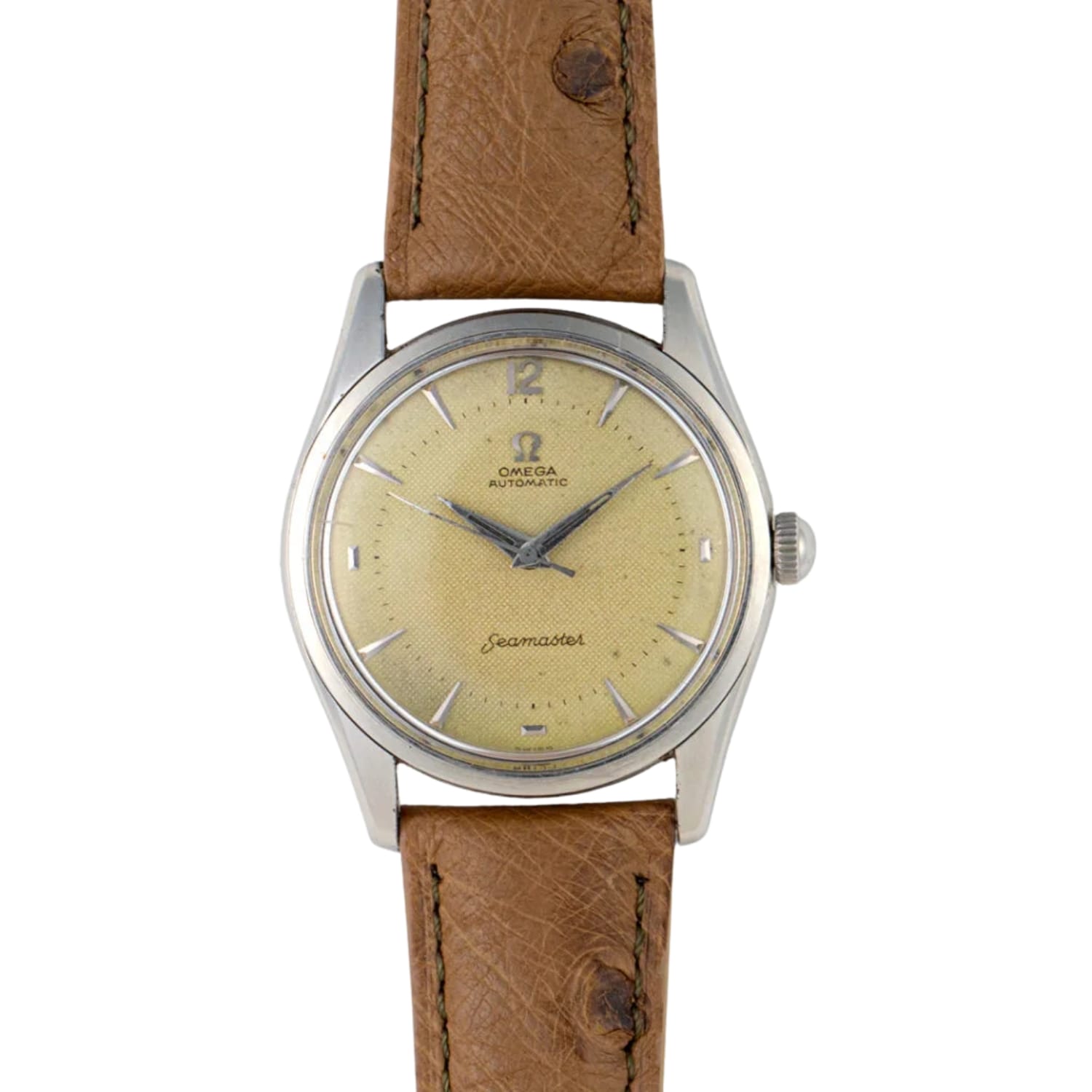
The Omega Seamaster CK 2869 represents a distinctive and underappreciated chapter in mid-1950s Seamaster evolution, distinguished by its unique combination of elegant proportions, experimental waterproofing technology, and remarkable dial diversity. Introduced in 1954, this reference occupies a fascinating transitional position—bridging the robust, oversized “Jumbo” Seamasters of the late 1940s-early 1950s with the more refined, compact dress-sport models that would dominate the 1960s. With its svelte 34mm case, slim 7.3mm profile, and pioneering Naiad crown system, the CK 2869 embodies Omega’s commitment to engineering innovation while pursuing aesthetic refinement.
What elevates the CK 2869 beyond its contemporaries is its status as the only Seamaster model to feature the distinctive “pipe and tack” Naiad crown—a sophisticated waterproofing system typically reserved for the prestigious Constellation line. This technical distinction reflects Omega’s ambitious efforts to develop alternatives to screw-down crown architecture, employing internal gaskets that theoretically sealed more effectively under pressure. While the Naiad system ultimately proved less reliable than screw-down technology and was phased out by the late 1950s, its presence on the CK 2869 imbues the reference with historical significance as a documented example of Omega’s experimental engineering during the brand’s golden age.
For collectors, the CK 2869 offers exceptional value proposition: an authentic mid-1950s Seamaster with Constellation-caliber movements (500/501), unique dial variations including rare crosshair configurations, and accessible pricing that belies its historical importance and mechanical excellence.
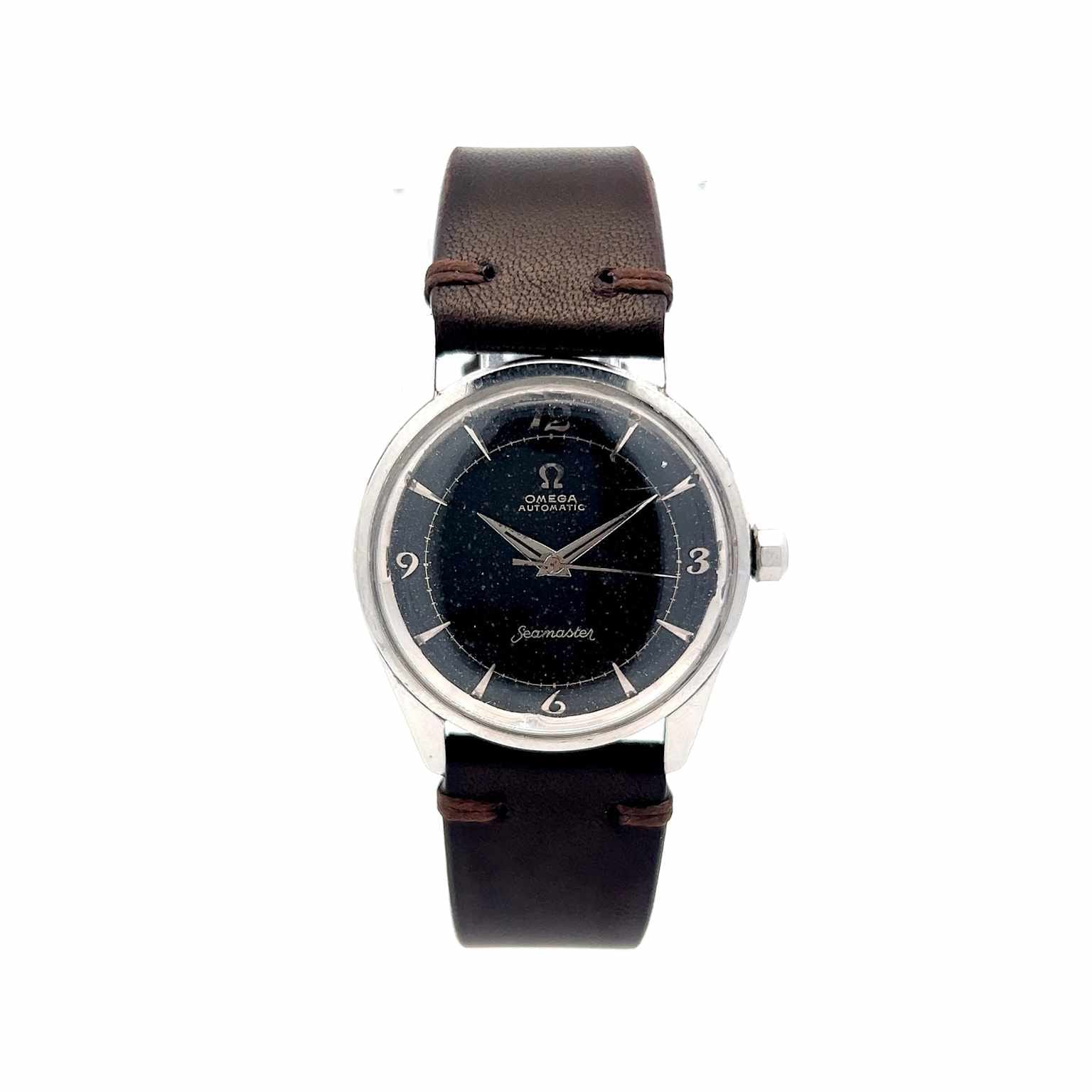
Vintage 1958 Omega Seamaster Ref 2869 Stainless Steel
Historical Context and Technical Innovation
The Mid-1950s Seamaster Evolution
By 1954, the Omega Seamaster collection had achieved six years of market success since its 1948 introduction, establishing itself as the brand’s flagship sports-oriented line. The early “Jumbo” references like the CK 2494 had proven the viability of larger automatic watches, but evolving consumer preferences and competitive pressures from other Swiss manufacturers necessitated product line diversification. Omega responded by developing references that maintained Seamaster’s functional DNA while adopting more refined proportions suitable for both casual and business attire.
The CK 2869 emerged from this strategic repositioning as a “compact Seamaster”—a watch that preserved the collection’s water-resistant construction and automatic movement sophistication while presenting dimensions (34mm × 40.5mm × 7.3mm without crystal) that aligned with contemporary dress watch standards. This sizing decision reflected market intelligence suggesting that many consumers desired Seamaster reliability without the visual heft of 36mm Jumbo models.
The Naiad Crown Innovation
The most technically significant feature distinguishing the CK 2869 from its Seamaster siblings is its Naiad crown system. Omega first employed the Naiad designation in 1937 on a watch bearing that name, featuring an early waterproof snap-back case and crown with internal gaskets sealing against the stem tube. The technology was subsequently refined throughout the 1940s and applied to first-generation Seamaster 300 diving watches in the early 1950s.
The Naiad system operates through internal gaskets that compress against the crown tube as water pressure increases, theoretically creating progressively stronger seals at greater depths. Unlike screw-down crowns that require manual threading to achieve compression, Naiad crowns push-on and rely on hydrostatic pressure to activate sealing. This design offered theoretical advantages in user convenience—no threading required—and potential for slimmer crown profiles that complemented dressy case architectures.
However, the Naiad system exhibited a critical flaw: at shallow depths and atmospheric pressure, the gaskets provided minimal sealing effectiveness. Watches submerged briefly during hand washing or exposed to rain could experience moisture ingress despite the sophisticated gasket arrangement. Additionally, aging gaskets lost elasticity and sealing capacity, requiring regular replacement that owners often neglected. By the late 1960s, Omega abandoned Naiad technology in favor of reliable screw-down crowns, acknowledging that user perception and real-world performance favored the mechanical simplicity of threaded seals over pressure-activated systems.
The CK 2869’s inclusion of the Naiad crown—described explicitly as “just like the Omega Constellation”—signals its positioning as an elevated Seamaster variant rather than a basic sports model. This crown type, with its distinctive 5mm diameter, 2.7mm thickness, and signed Omega logo (sometimes with a small symbol in the center), provides immediate visual identification and historical provenance.
Some CK 2869 examples feature standard dome crowns rather than Naiad types, suggesting production variations or service replacements over decades of use. Collectors seeking authenticity should prioritize examples retaining original Naiad crowns with appropriate Omega signing.
Production Timeline and Serial Number Analysis
Omega introduced the CK 2869 in 1954, with production concentrated between that year and approximately 1958. Movement serial numbers provide reliable dating precision:
| Movement Serial Range | Approximate Year |
|---|---|
| 14,000,000 – 14,999,999 | 1954-1956 |
| 15,000,000 – 15,999,999 | 1956-1958 |
Examples bearing serial numbers around 15,031,155 (as documented in dealer inventories) date to 1958, representing late production before the reference’s discontinuation. By the late 1950s, Omega transitioned to updated Seamaster architectures featuring different case proportions and fully modern screw-down crowns, phasing out the CK 2869’s experimental Naiad system.
Technical Specifications
Case Dimensions and Architecture
The Omega Seamaster CK 2869 exhibits proportions carefully calibrated to balance elegant wearability with functional presence:
| Specification | Measurement |
|---|---|
| Case Diameter | 34mm (excluding crown) |
| Case Diameter with Crown | 37mm |
| Lug-to-Lug Distance | 40.5mm |
| Case Thickness (excluding crystal) | 7.3mm |
| Case Thickness (with crystal) | 10-11mm |
| Lug Width | 19mm |
| Bezel Type | Fixed, polished, very thin |
| Crystal Material | Acrylic (plexiglass), high dome with metal tension ring |
| Water Resistance | ~30 meters (100 feet) nominal |
The 34mm case diameter positions the CK 2869 as a mid-sized watch by 1950s standards—smaller than the 36mm “Jumbo” references but larger than dress watches typically measuring 32-33mm. This Goldilocks sizing ensures the watch presents masculine presence without appearing oversized on smaller wrists, while remaining substantial enough for contemporary wear.
The case thickness of just 7.3mm (excluding crystal) represents remarkably slim architecture for an automatic watch. This svelte profile results from the caliber 500/501’s efficient layout and the snap-back case construction, which avoids the additional height required by screw-back systems. With the domed acrylic crystal included, total thickness measures 10-11mm—slim enough to slip comfortably under dress shirt cuffs while maintaining robust visual character.
One unusual specification distinguishing the CK 2869 from most vintage Omega references is its 19mm lug width rather than the more standard 18mm. This non-standard measurement can complicate strap selection, as most vintage-style straps are produced in 18mm and 20mm widths. Collectors should verify lug width when sourcing replacement straps to ensure proper fit.
Case Construction and Design Elements
Snap-Back Architecture: Unlike screw-back Seamasters like the CK 2494, the CK 2869 employs snap-back case construction for movement access. The caseback presses firmly into the case body, compressing a flat gasket (0.9mm or 1mm thick) to create a water-resistant seal. This construction method provides adequate protection for daily wear and incidental water exposure while simplifying servicing—watchmakers can access the movement without requiring specialized case wrenches.
The caseback exterior features engraved text reading “SEAMASTER” at the top and “WATERPROOF” at the bottom, confirming the watch’s lineage and functional mandate. The interior surface bears the case reference number (typically “2869-x SC,” where “x” indicates sub-reference variants) alongside the Omega logo in its triangular frame.
Bezel Design: The CK 2869’s bezel represents both an aesthetic strength and practical vulnerability. Described as “very thin,” the polished steel bezel creates visual refinement and elegant proportions. However, this slim design leaves the bezel susceptible to damage, loss, or removal over decades of wear. Documentary evidence—including video analysis and dealer listings—confirms that missing bezels constitute an epidemic problem among surviving CK 2869 examples.
Collectors evaluating potential purchases should carefully verify bezel presence, as replacement bezels are difficult to source and missing bezels significantly impact both aesthetics and value. The bezel’s thinness means that even present examples may exhibit dents, dings, or deformation from impacts—condition assessment should include close examination of bezel integrity.
Lug Architecture: The CK 2869 features downturned, faceted lugs that curve gracefully toward the wrist. These sculpted lugs provide architectural interest while ensuring comfortable wrist conformity despite the watch’s relatively compact lug-to-lug measurement of 40.5mm. The lugs exhibit polished top surfaces contrasting against brushed or satin-finished case flanks, creating visual depth through mixed finishing.
Naiad Crown: As discussed, the Naiad crown constitutes the CK 2869’s most distinctive technical feature. The crown measures 5mm in diameter with 2.7mm thickness—proportions substantially slimmer than typical Seamaster crowns. The signed Omega logo and occasionally a small central symbol confirm authenticity. The “pipe and tack” construction refers to the crown’s internal architecture: a tubular pipe extending into the case connects to a gasket system that provides waterproofing through pressure-activated sealing.
Movement Specifications: The Early 500 Series
The CK 2869 housed two closely related calibers from Omega’s celebrated early 500 series automatic movements—representing significant upgrades from the bumper technology that powered first-generation Seamasters.
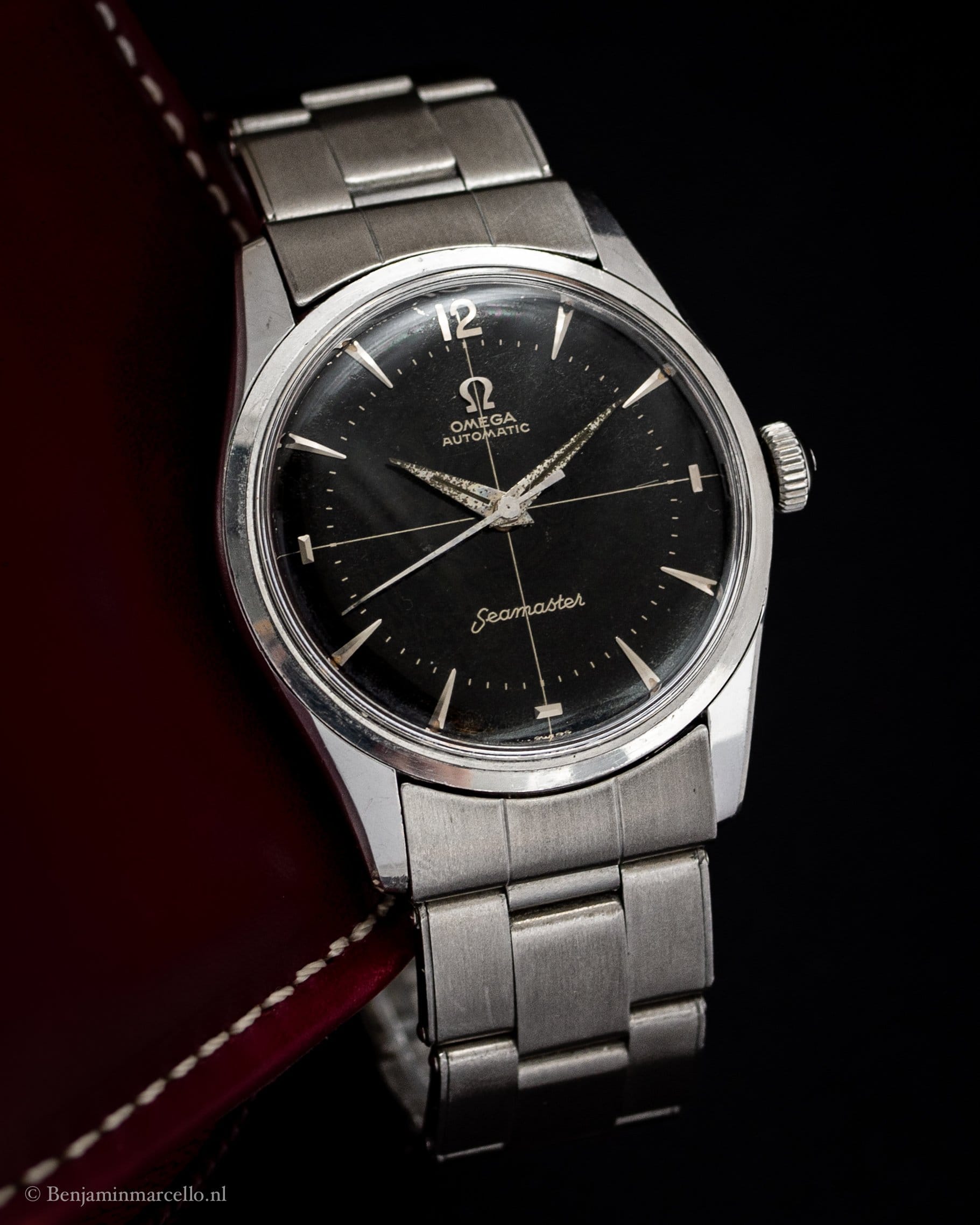
Omega Seamaster 2869 automatic black cross-hair dial
Caliber 500
Introduction: 1956
Jewel Count: 17
Type: Automatic with center seconds
Key Features: Full-rotor automatic winding, Incabloc shock protection
The caliber 500 represents the entry-level configuration within the early 500 series, providing reliable automatic winding through a full 360-degree rotor rather than the limited-arc bumper mechanism used in earlier Seamasters. With 17 jewels strategically positioned at high-friction points, the caliber 500 delivers consistent timekeeping and approximately 42-44 hours of power reserve.
The movement’s architecture demonstrates Omega’s mastery of automatic winding design: a large rotor efficiently captures kinetic energy from wrist movement, transmitting power through a reduction gear train to wind the mainspring bidirectionally. This full-rotor system winds substantially more efficiently than bumper technology, requiring less aggressive wrist motion to maintain full wind.
Caliber 501
Introduction: 1955 (19-jewel); 1957 (20-jewel)
Jewel Count: 19 or 20
Type: Automatic with center seconds
Key Features: Swan neck micrometer regulator, additional jeweling on automatic bridge, superior finishing
The caliber 501 constitutes the elevated variant within the early 500 series, incorporating refinements that position it between the workhorse caliber 500 and the premium caliber 505 (24 jewels). Initially released in 19-jewel configuration for Constellation references in 1955, the caliber 501 received an additional jewel in 1957, bringing the total to 20.
The distinguishing technical feature of the caliber 501 is its swan neck micrometer regulator—a precision adjustment mechanism that provides exceptionally fine regulation capability. This elegant regulator, visible through display casebacks on Constellation models (though not present on the CK 2869’s solid caseback), allows watchmakers to adjust rate with micrometer precision by manipulating the regulator’s swan neck spring, which in turn moves the index pin along the balance spring.
The caliber 501’s additional jeweling appears on the automatic winding bridge, where extra bearings reduce friction in the rotor system and improve winding efficiency. This enhanced jeweling contributes to smoother winding action and extended service intervals relative to the 17-jewel caliber 500.
Performance Characteristics
Both calibers 500 and 501 share fundamental specifications:
- Diameter: Approximately 27.9mm (12 lignes)
- Frequency: 18,000 vibrations per hour (2.5 Hz)
- Power Reserve: 42-44 hours
- Escapement: Lever escapement with monometallic balance
- Balance Spring: Self-compensating flat hairspring
- Shock Protection: Incabloc on bearing jewels
- Regulation: Micrometer regulator (501) or standard regulator (500)
The early 500 series movements earned acclaim for their exceptional finishing—cosmetic and functional treatments rarely seen outside luxury manufacturers’ premium offerings. The movements feature sun grinding, snailing (circular graining), and high polish on visible surfaces, with chamfered (beveled) and polished edges on bridges contributing to refined aesthetics. Most components exhibit copper plating over beryllium bronze alloy base metal, creating warm tones that contrast beautifully against rhodium-plated surfaces.
Collectibility and Service Considerations
While the caliber 501 theoretically represents the superior movement due to its swan neck regulator and additional jeweling, practical differences in timekeeping performance between 500 and 501 are minimal for non-chronometer examples. Both movements provide excellent daily reliability when properly maintained.
Collectors should be aware that parts availability for early 500 series movements is declining, particularly for the automatic winding system’s reduction wheels and rotor assemblies. Omega has exhausted stocks of certain 501-specific components and may substitute parts from other calibers during factory service. This scarcity elevates the importance of purchasing examples with complete, functional movements and establishing relationships with watchmakers experienced in vintage Omega calibers.
A critical authentication concern: Because calibers 500, 501, and 503 share identical dial foot apertures, unscrupulous dealers have historically swapped Seamaster dials with more valuable Constellation dials to create frankenwatches. Collectors should verify that dial style, case reference, and movement caliber align with documented original configurations.
Visual Design and Dial Variations
The Omega CK 2869 manifests exceptional dial diversity—a characteristic explicitly noted in technical documentation as producing “many variations, some quite unique”. This variety creates significant collecting interest while also necessitating careful authentication, as multiple genuinely original configurations coexisted alongside restored and refinished examples.
Dial Finishes and Textures
Two-Tone Silvered Dials: The most prevalent finish, two-tone silvered dials feature contrasting textures or tones between the central dial area and outer chapter ring. These dials typically exhibit matte or brushed central zones with slightly different finishes on perimeter sections, creating subtle visual depth. Age-appropriate patination develops warm cream, champagne, or light caramel tones that enhance vintage character.
Black Dials: Less common than silvered variants, black dials provide maximum contrast and sportier aesthetics. Original black dials from the 1950s frequently develop “tropical” patination—a chemical transformation that gradually shifts black lacquer to chocolate brown, tobacco, or bronze tones through UV exposure and aging. Far from being considered damage, tropical dial development is highly prized by collectors for its organic beauty and proof of authenticity.
Distinguishing intentional tropical dials from faded or damaged examples requires examining aging patterns: genuine tropical patination develops evenly across the dial surface with consistent tonal shift, while damaged dials exhibit splotchy, irregular discoloration.
Crosshair Dials: Among the most distinctive CK 2869 dial variants, crosshair (or “cross-hair”) designs feature thin lines radiating from the center, creating quadrants that divide the dial surface. These lines may be gilt (gold-toned), silver, or contrasting colors, adding visual interest and geometric organization. Crosshair dials are relatively rare within CK 2869 production and command premiums when found in original condition.
Some crosshair examples combine the linear pattern with two-tone finishing or subtle sunburst effects, creating layered visual complexity. The crosshair design was not unique to the CK 2869—similar treatments appeared on Constellation “pie pan” dials and other Omega references from the mid-1950s—but its presence on the compact Seamaster creates distinctive character.
Numeral and Index Configurations
The CK 2869 appeared with multiple hour marking arrangements:
Full Arabic Numerals: Some examples feature applied Arabic numerals at all twelve hour positions, creating maximum legibility and vintage character. The numerals are typically executed in gilt finish, applied to the dial rather than printed.
Mixed Arabic and Baton: Alternative configurations feature Arabic numerals at key positions (6 and 12, or 3-6-9-12) with applied baton or arrow markers at remaining hours. This hybrid approach balances legibility at cardinal positions with cleaner aesthetics elsewhere.
Applied Baton Markers: The most minimalist configuration features applied steel or gilt baton markers at all hour positions without Arabic numerals. These clean indices create dressy refinement while maintaining adequate legibility.
Applied Arrow/Dart Indices: Some dial variants feature distinctive arrow or dart-shaped hour markers with luminous plots, creating a sportier aesthetic aligned with the Seamaster’s functional mandate. These markers typically appear in gilt finish with aged luminous material filling, adding three-dimensional depth.
Hands and Luminous Material
Original CK 2869 hands exhibit consistent styling across dial variants:
Dauphine Hands: Universal across CK 2869 production, dauphine (also termed “dolphin”) hands feature the classic tapered profile with pointed tips and faceted surfaces. The hands appear in steel, gilt, or rhodium finishes depending on dial configuration, with gilt hands complementing gilt markers and steel hands pairing with silvered dials.
The dauphine hands typically feature smooth profiles with subtle curvature rather than flat silhouettes—a distinction important for authentication, as incorrect replacement hands often exhibit flat, generic profiles.
Luminous Application: Many CK 2869 hands feature luminous material inset along the hand centers, with matching luminous plots on hour markers. The luminous compound—radium on early 1954-1956 examples transitioning to tritium by 1957-1958—has aged to cream, tan, or light brown tones after 70 years. Neither radium nor tritium exhibits functional luminescence after decades of decay, so glowing lume should not be expected on authentic vintage examples.
Interestingly, some CK 2869 examples feature non-luminous hands and markers, creating cleaner dial aesthetics. These configurations were intentional design choices rather than degraded lume plots, and collectors valuing purist aesthetics may prefer non-luminous examples.
Case Material Variations
Stainless Steel
Documentary evidence confirms that the CK 2869 was produced almost exclusively in stainless steel, with one source explicitly stating: “This case model is quite common and I have only seen them in solid stainless steel”. Steel construction aligned with the Seamaster’s positioning as a durable tool-watch and provided accessibility relative to precious metal alternatives.
Stainless steel CK 2869 watches exhibit varying degrees of wear consistent with 70+ years of use—case scratches, polishing evidence, and bezel damage are normal and expected. The most desirable examples retain sharp lug edges, crisp case facets, and original factory finishing without excessive polishing that has rounded edges or thinned case walls.
Gold-Plated Variants
While steel dominates production, isolated examples in gold-plated or gold-capped configurations may exist as special orders or regional market variants. These are substantially rarer than steel versions and should be approached with documentation requirements when possible.
Sub-Reference Variations
The CK 2869 reference encompasses multiple sub-references indicated by suffix numbers, typically formatted as “2869-x SC” (where “SC” denotes snap-back construction and “x” represents the specific variant):
Reference 2869-1 SC: Among the most commonly documented sub-references, featuring various dial configurations including crosshair variants. Examples from 1954-1955 production.
Reference 2869-2 SC: Alternative sub-reference with documented examples featuring grey-white aged dials and mixed Arabic/baton configurations. Production circa 1956.
Reference 2869-9 SC: Less commonly encountered, documented with specific dial styles and late production dating (1958-1959).
The suffix system employed by Omega during this period was not comprehensively published, and many sub-reference distinctions remain incompletely cataloged. The suffix typically indicated dial configurations, hand styles, or production batches rather than fundamental case architecture changes.
Collecting Guidance and Authentication
Common Issues and Vulnerabilities
The CK 2869’s seven-decade lifespan and specific design characteristics create several predictable issues that collectors must evaluate:
Missing Bezels: The most pervasive problem, with documentary evidence explicitly warning that “the bezel on this watch is very thin” and recommending buyers “make sure that the bezel is there”. Video analysis shows examples with and without bezels, confirming the widespread nature of bezel loss. Missing bezels compromise both aesthetics and value, and sourcing correct replacement bezels is extremely difficult.
Missing Case Clamp and Screw: The movement securing system employs a case clamp and screw that hold the caliber in position within the case. Over decades of service, these small components are frequently lost or discarded by careless watchmakers. Buyers should specifically verify that “both the case clamp and the screw for the case clamp are they inside the watch” before completing purchases.
Replaced Crowns: Original Naiad crowns with Omega signing and appropriate pipe-and-tack architecture are frequently replaced during service with generic push-on crowns or incorrect screw-down types. Authentic Naiad crowns should measure 5mm diameter × 2.7mm thickness and feature the Omega logo with possible small central symbol. Unsigned crowns or incorrectly proportioned examples indicate replacement.
Refinished Dials: As with all vintage Omega references, dial refinishing represents a common issue. Refinished dials appear too pristine for their age, with overly white or silver backgrounds, sharp printing without period-appropriate aging, and uniform coloration lacking natural patination gradients. Collectors should compare suspect examples against verified original dials from multiple authoritative sources.
Incorrect Hands: Replacement dauphine hands may exhibit wrong profiles (flat rather than curved), incorrect finishes (mismatched to dial markers), or improper luminous material (bright white rather than aged cream/tan). Proper authentication requires comparing hand style, luminous aging, and fit to documented original examples.
Tropical Dial Authentication
Given the desirability of tropical black dials, collectors must distinguish authentic aging from artificial alteration or damage:
Authentic Tropical Patination:
- Develops evenly across entire dial surface
- Creates consistent color shift from black to chocolate, tobacco, or bronze
- Maintains sharp printing and marker attachment
- Shows matching aged luminous material on markers and hands
- Exhibits no splotchy or irregular discoloration patterns
Artificial or Damaged Dials:
- Exhibit uneven color zones with dark spots or patches
- Show fading concentrated around markers (moisture damage)
- Display inconsistent aging between dial center and periphery
- Reveal lifted or damaged printing
- Present bright white lume on supposedly aged dials
Market Considerations and Valuation
The Omega CK 2869 occupies an accessible entry point into vintage Seamaster collecting, with steel examples typically ranging from $600-$1,200 depending on condition, dial configuration, originality, and completeness:
Value Drivers:
- Original dial with attractive, even patination
- Uncommon dial variants (crosshair, tropical, unique configurations)
- Original Naiad crown with proper Omega signing
- Complete bezel in undamaged condition
- Unpolished case with sharp edges and crisp faceting
- Complete movement with case clamp and screw present
- Caliber 501 (20-jewel) over caliber 500 (17-jewel)
- Full service history and documentation
Value Detractors:
- Missing or damaged bezel (significant impact)
- Refinished or service replacement dials
- Incorrect or replacement hands
- Non-original crown (especially non-Naiad types)
- Missing case clamp/screw
- Over-polished case with soft edges
- Non-functional or incomplete movement
- Artificial tropical coloring or dial damage
Typical Price Ranges:
| Configuration | Condition | Typical Range (USD) |
|---|---|---|
| Steel, standard two-tone dial, missing bezel | Fair | $400-$600 |
| Steel, standard dial, complete with bezel | Good | $600-$800 |
| Steel, black/tropical dial, complete | Very Good | $800-$1,200 |
| Steel, crosshair dial, original Naiad crown | Excellent | $1,000-$1,500+ |
Exceptional examples with complete originality, rare dial variants, proper Naiad crowns, and comprehensive documentation can exceed these ranges, particularly when offered through reputable dealers or auction houses.
Authentication Best Practices
- Verify Bezel Presence: Carefully inspect for complete, undamaged bezel before serious consideration.
- Confirm Naiad Crown: Authenticate crown type, dimensions (5mm × 2.7mm), and Omega signing.
- Examine Movement: Open caseback to verify correct caliber (500 or 501), confirm case clamp and screw presence, and assess movement condition.
- Assess Dial Authenticity: Compare printing style, marker application, aging patterns, and luminous material against documented original examples.
- Evaluate Hands: Verify proper dauphine profile (curved, not flat), correct finishing matching dial, and age-appropriate luminous aging.
- Check Case Condition: Examine lug sharpness, case facets, and finishing to assess polishing history.
- Request Service History: Documentation of servicing provides valuable provenance and confirms mechanical integrity.
- Consult Specialists: When evaluating significant purchases, consult vintage Omega experts through forums like OmegaForums.net or submit inquiries to Omega’s Extract from the Archives service.
Conclusion
The Omega Seamaster CK 2869 represents a compelling convergence of mid-1950s Swiss watchmaking innovation, experimental engineering, and accessible luxury. Introduced in 1954 as Omega refined the Seamaster collection toward more versatile proportions, the CK 2869 distinguished itself through its elegant 34mm case, remarkably slim 7.3mm profile, and pioneering Naiad crown system borrowed from the prestigious Constellation line. These characteristics position the reference as both a legitimate Seamaster with functional water resistance and a dressy timepiece suitable for formal contexts—versatility that few vintage sports watches achieve.
The CK 2869’s technical narrative—particularly its status as the only Seamaster to feature pipe-and-tack Naiad crowns—provides historical resonance beyond its modest dimensions. This crown system, representing Omega’s ambitious attempt to develop pressure-activated waterproofing alternatives to screw-down architecture, ultimately proved less reliable than mechanical threading but demonstrated the brand’s willingness to pursue engineering innovation even when incremental improvements risked failure. The Naiad system’s discontinuation by the late 1960s makes the CK 2869 a documented artifact of this experimental period, offering tangible connection to Omega’s golden age of horological development.
The remarkable dial diversity—from elegant two-tone silvered finishes to rare crosshair designs, from desirable tropical black patination to pristine gilt configurations—ensures that collectors can pursue aesthetic preferences while benefiting from the mechanical excellence of calibers 500 and 501. Whether drawn to the refined simplicity of baton markers, the vintage character of aged luminous plots, or the geometric sophistication of crosshair patterns, the CK 2869 offers configurations to satisfy varied tastes at price points ($600-$1,200 for quality examples) substantially below comparable Constellation references.
For collectors seeking entry into vintage Seamaster ownership, the CK 2869 delivers authentic 1950s craftsmanship, engaging mechanical quality through early 500 series movements, and the satisfaction of owning a reference distinguished by unique technical features rather than mainstream popularity. Understanding the specifications, variations, common issues (particularly missing bezels), and authentication considerations outlined in this reference guide empowers informed acquisition decisions and deeper appreciation for this underappreciated Omega reference.
For additional information on vintage Omega Seamaster watches, consult authoritative resources including OmegaForums.net, Omega Enthusiast Ltd., and Vintage Masters.