

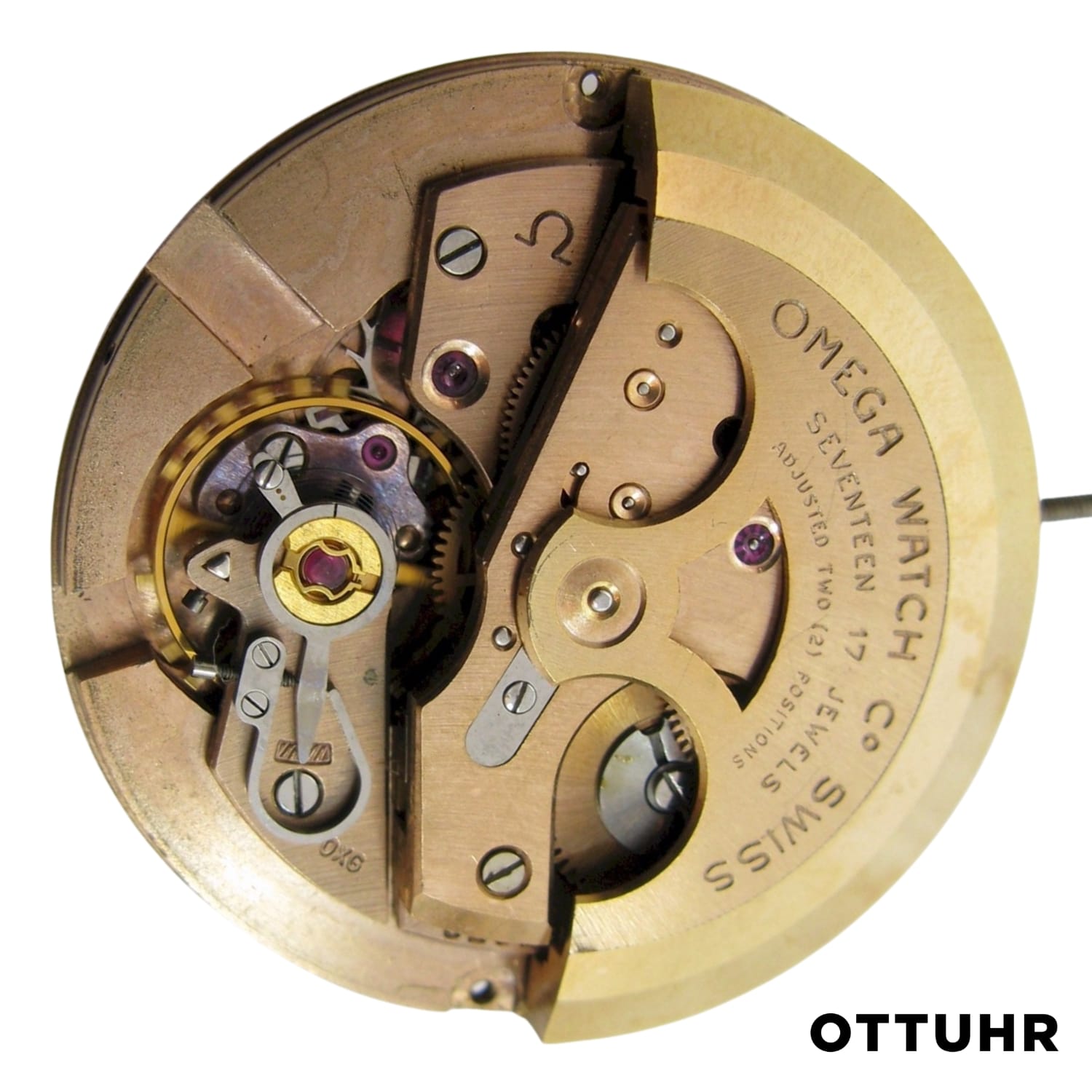
The Omega Caliber 500 is the movement that ended bumper automatics at Omega and introduced the full-rotor automatic winding system that would define the brand’s mechanical watches for the next 15 years. As one of the first Omega calibers with bi-directional winding, the 500 represented a significant technical leap forward in winding efficiency and reliability. This movement powered some of the most collectible vintage Omega references ever produced, including the early Seamaster 2846 and the first full-rotor Constellation models. Between 1955 and 1960, Omega produced approximately 1,075,000 units of the caliber 500 specifically, with the broader 500 series family (including variants 501, 502, 503, 504, and 505) reaching a staggering 5.8 million movements by 1969.
The caliber 500 is a three-hand time-only automatic movement designed as a workhorse caliber for Omega’s mid-range sport and dress watches. With 17 jewels, 19,800 vph frequency, and 46 hours of power reserve, the movement strikes a balance between technical competence and accessible pricing. The 17-jewel configuration was specifically targeted at the United States market, where tariffs on imported watches were calculated based on jewel count, making 17-jewel movements significantly more affordable to import than their 19 or 20-jewel counterparts. The caliber 500 earned a reputation among watchmakers as robust, serviceable, and reliable, though not as refined as the higher-grade 501, 504, or 505 variants that featured additional jeweling and enhanced finishing.
With 1,075,000 units produced between 1955 and 1960, the caliber 500 is common relative to other vintage Omega movements, though not as prevalent as its successor, the caliber 501, which saw wider distribution. Serial number ranges for caliber 500 movements fall between approximately 15,000,000 and 17,000,000, corresponding to production years 1955-1960. The movement’s relative abundance makes it an accessible entry point for vintage Omega collectors, particularly in Seamaster references. However, finding caliber 500 movements in fully original, unserviced condition with intact factory finishing has become increasingly difficult. The rotor bearing, a brass bushing that the steel rotor axle rotates in, is a known wear point, and many examples have been serviced with replacement parts or modified rotor assemblies. Despite the large production numbers, the caliber 500 should be considered uncommon in excellent original condition, and scarce in chronometer-adjusted grades (which are exceptionally rare and possibly misidentified, as most chronometer-grade examples from this era used the higher-jeweled 501, 504, or 505 calibers).
The caliber 500 occupies a stable position in the vintage Omega collector market. Demand is driven primarily by interest in the watch models it powers, particularly the Seamaster 2846 and early pie-pan Constellation references. Collectors seek caliber 500 movements for their historical significance as the first full-rotor Omega automatic, and values have risen steadily over the past decade as vintage Omega collecting has grown. Specific variants with unusual dial configurations, double-signed dials, or intact box and papers command premiums. The caliber 500 does not command the same premiums as higher-grade movements like the 505 or chronometer-grade bumper calibers, but well-preserved examples in desirable case references consistently sell in the $1,500 to $3,000 range depending on case material and dial condition. The movement’s serviceability and parts availability also support stable collector interest, as these watches can still be worn and maintained without excessive difficulty.
Historical Context, Provenance, and Manufacturing Details
Omega developed the caliber 500 series in response to two distinct pressures. First, the brand needed to modernize its automatic winding technology. By the early 1950s, bumper automatic systems were recognized as inefficient, noisy, and prone to mechanical wear. Bumper systems used a weighted rotor that oscillated through a limited arc, with spring-loaded buffers stopping the rotor at each end of its travel. This design was mechanically simple but transferred less energy to the mainspring and subjected the buffer springs to repeated shock. Second, Omega needed to develop a movement family that could be produced in multiple grades and configurations to serve different market segments and price points. The solution was a modular caliber family built around a common base plate, with variations in jeweling, complications, and adjustment grades.
Marc Colombe, working under technical director Henri Gerber, designed the caliber 500 series with several key innovations. The full rotor could rotate continuously in both directions, with an automatic winding mechanism that transferred energy to the mainspring regardless of rotor direction. This bi-directional winding system was Omega’s first, and it significantly improved winding efficiency compared to bumper systems. The movement architecture used a two-piece construction, with the automatic winding mechanism mounted as a separate module on top of the base movement. This modular approach simplified manufacturing and servicing, as the automatic module could be removed to access the gear train and escapement.
Predecessor and Successor
The caliber 500 replaced the bumper automatic calibers 342, 343, 344, 351, 352, 353, and 354, which had powered Omega’s automatic watches since 1943. These bumper calibers were well-regarded but represented aging technology by the mid-1950s. The caliber 500 offered superior winding efficiency, quieter operation, and a more robust mechanical design. The caliber 500 was itself succeeded by the caliber 550 series, introduced in 1959 and produced into the 1970s. The 550 series featured updated construction, refined finishing, and improved shock protection, though it retained the fundamental architecture established by the 500.
Manufacturing Context
The caliber 500 is an in-house manufacture movement, designed, produced, and assembled entirely by Omega at its facilities in Biel/Bienne, Switzerland. This was standard practice for Omega during the 1950s, when the brand still manufactured its own base movements rather than sourcing ébauches from suppliers like ETA or Peseux. Omega’s vertical integration during this period extended from movement design and component manufacturing through to final assembly and regulation. The company produced its own balance wheels, hairsprings, escapements, and gear trains, ensuring quality control over every aspect of production. By the early 1980s, Omega had transitioned to using ETA-based movements with Omega modifications and finishing, ending the era of pure in-house caliber production. The caliber 500 thus represents the final generation of Omega’s independent movement manufacturing before the brand’s integration into what would become the Swatch Group.
Factory and Location
All caliber 500 movements were produced at Omega’s main manufacturing facility in Biel/Bienne, Switzerland. There were no changes in production location over the caliber’s lifespan. Omega maintained complete vertical integration during this period, with component manufacturing, assembly, regulation, and quality control all conducted at the Biel facility.
Horological Context
The caliber 500 sits at an interesting inflection point in 20th-century horological history. Introduced in 1955, the movement arrived just as automatic winding technology was maturing and Swiss watchmaking was entering its golden age of technical refinement. The mid-1950s saw intense competition among Swiss brands to develop efficient automatic winding systems, with Rolex’s perpetual rotor, IWC’s Pellaton system, and Zenith’s full-rotor designs all vying for market acceptance. Omega’s bi-directional winding system, introduced with the caliber 500, positioned the brand competitively in this landscape. The movement was neither groundbreaking nor revolutionary, but it was competent, reliable, and scalable across Omega’s product range. As a workhorse caliber, the 500 exemplifies the Swiss watchmaking philosophy of the 1950s: solid engineering, reliable performance, and designs that prioritized serviceability and longevity over horological innovation.
Construction and Architecture
Plate and Bridge Layout
The caliber 500 uses a traditional three-quarter plate construction with separate bridges for the train wheels, pallet cock, balance cock, and sweep seconds pinion. The main plate is brass with rhodium plating, providing a neutral-toned base that resists corrosion. The automatic winding mechanism is constructed as a separate upper module that mounts on top of the base movement, secured by two bridges: the upper bridge for the automatic device (part 1031) and the lower bridge for the automatic device (part 1033). This two-piece construction allows the rotor module to be removed independently for servicing without disassembling the entire movement. The modular design also enabled Omega to produce manual-winding variants by simply omitting the automatic module, creating calibers like the 490 (sub-seconds manual wind) using the same base architecture.
Balance Wheel
The caliber 500 uses a standard bimetallic balance wheel with timing screws for rate adjustment. The balance is not a Glucydur beryllium-bronze alloy (which was reserved for higher-grade calibers), but rather a nickel or brass-based balance typical of mid-grade Swiss movements from the 1950s. The balance features adjusting screws positioned around the rim, allowing watchmakers to fine-tune the moment of inertia and correct rate variations across positions. The balance diameter and inertia specifications are not documented in available sources, but the system is designed for two-position adjustment (horizontal positions only), which was standard for non-chronometer-grade movements of this era.
Balance Spring (Hairspring)
The hairspring is a Nivarox alloy, likely Nivarox 2, which was the standard hairspring material for mid-grade Swiss movements during the 1950s. The spring features a flat configuration without a Breguet overcoil, which was typical for non-chronometer-grade calibers. The hairspring is attached to the balance staff via a collet (part 1318) and secured to the balance cock via a stud (part 1317) held in a stud-holder (part 1363). The inner terminal curve and spring dimensions are not documented, but the configuration is standard for Swiss lever movements of this grade and period.
Escapement Type
The caliber 500 uses a Swiss lever escapement with a jeweled pallet fork. The escape wheel (part 1305) is pivoted in jewels on both the upper and lower plates (jewel references 4068). The pallet fork (part 1316) features two pallet jewels: the entry pallet jewel (part 1314) and the exit pallet jewel (part 1313). These are synthetic ruby jewels mounted in the pallet fork arms. The pallet staff (part 1312) is jeweled in the upper and lower bearings (jewel reference 4067). The escapement design is conventional Swiss lever with a club-tooth escape wheel, standard for movements of this era and grade. No special innovations or modifications are present in the escapement design.
Shock Protection System
The caliber 500 uses Incabloc shock protection on the balance staff pivots. Incabloc was the premium shock protection system of the era, known for superior quality control and serviceability compared to competitor systems like KIF or Etachoc. The system consists of a jeweled bearing housed in a spring-mounted chaton that can deflect axially when subjected to shock, protecting the delicate balance staff pivots from breakage. The caliber 500 features Incabloc protection on both the upper balance bearing (parts 1345 and 1347) and lower balance bearing (part 1346). The cap jewels for the balance are referenced as part 1342 (lower) and part 1343 (upper). Incabloc protection is also applied to other critical pivot points, including the pallet staff and escape wheel pivots, though this was not universal across all production runs.
Regulator Type
The caliber 500 uses a standard index regulator (Bosley regulator) with curb pins that adjust the effective length of the hairspring. The regulator (part 1331 or 1333, depending on configuration) features a lever arm engraved with rate adjustment markings, typically “A/R” (Advance/Retard) or “F/S” (Fast/Slow). Some caliber 500 examples feature a two-piece regulator (part 1333), which allows finer adjustment by incorporating a split design. A regulator pointer (part 1332) provides visual reference for the regulator position. The regulator is secured by an adjusting spring (part 1356) that holds the curb pins in position against accidental movement. Unlike higher-grade Omega calibers, the 500 does not feature a swan-neck fine regulator, which was reserved for chronometer-adjusted movements.
Mainspring Material and Type
The mainspring is a white alloy steel spring designed for automatic winding. The mainspring dimensions are 1.70mm width x 0.100mm thickness x 9.0mm length (approximately 14 inches uncoiled), referenced as Dennison specification WA31. The spring features a slipping bridle attachment, which allows the mainspring to slip against the barrel wall when fully wound, preventing over-tensioning. This is critical for automatic movements, which continuously wind the mainspring as the rotor rotates. The mainspring is housed in the barrel (part 1200, barrel with arbor complete), with the barrel arbor referenced as part 1204.
Gear Train Details
The caliber 500 uses a standard four-wheel gear train: center wheel, third wheel, fourth wheel, and escape wheel. The center wheel (part 1224, center wheel with cannon pinion) is directly driven by the mainspring barrel and makes one revolution per hour. The cannon pinion (part 1218) is friction-fit to the center wheel arbor and drives the hour wheel (part 1231) via the minute wheel (part 1246). The third wheel (part 1240) and fourth wheel (part 1243) transmit power from the center wheel to the escape wheel. The jeweling configuration for the gear train includes jewels for the third wheel (upper and lower, reference 4069) and fourth wheel (upper reference 4146, lower reference 4140). The sweep seconds pinion (part 1250) is mounted co-axially with the fourth wheel and drives the center seconds hand. A friction spring (part 1255) holds the sweep seconds pinion in position. Gear ratios are not documented in available sources, but the configuration is standard for a 19,800 vph movement.
Finishing Quality and Techniques
The caliber 500 is a basic-grade movement with functional finishing appropriate for a mid-market automatic. The movement features machine-applied Côtes de Genève on the rotor and visible bridges, though the striping is relatively shallow and lacks the depth and hand-finishing seen on higher-grade calibers. The base plate features circular perlage (circular graining), which is purely functional and serves to break up reflections while providing a uniform appearance. Anglage (beveling of edges) is minimal and appears only on the larger bridges, with no hand-polished bevels on screw heads or component edges. The rotor is signed “Omega Watch Co., Swiss, Seventeen Jewels” and features radial Côtes de Genève finishing. The finishing quality is consistent with the movement’s grade: clean, functional, and attractive under casual inspection, but not refined to the level of chronometer-grade or haute horlogerie movements. The movement was not offered in adjusted grades (two-position, five-position, or chronometer), which further distinguishes it from the higher-grade 501, 504, and 505 variants.

Cross-Reference Data
Alternative Caliber Names (Rebranded Versions)
The Omega Caliber 500 was not sold under alternative brand names or rebranded for other manufacturers. Omega maintained exclusive use of this caliber designation within its own product line.
Base Caliber vs. Elaborated Versions
The caliber 500 served as the base configuration for a family of related movements with varying jewel counts, complications, and adjustment grades:
The primary differences between variants are jewel count and complication features. Higher jewel counts typically indicate additional jeweling on the automatic winding mechanism, particularly the rotor bearing, reverser wheels, and reduction gear. The caliber 505, with 24 jewels, represents the peak of the 500 series and was frequently chronometer-adjusted.
Compatible Case References by Brand
Case numbers ending in “SC” designate “seconde au centre” (center seconds), indicating center-seconds movement configuration. The 2846 and 2848 case backs are often dual-stamped, as the same case could accommodate both center-seconds and sub-seconds movements depending on dial foot positions. Case materials include stainless steel (ST prefix), gold-capped (KO for yellow gold cap, KP for pink gold cap), and solid gold (OJ for 14k yellow, OT for 18k yellow, BA for 18k yellow under later coding system).
Dial Compatibility Note
The caliber 500 uses a dial configuration with two dial feet positioned at approximately 1:30 and 7:30 (or similar asymmetric positions), standard for Omega movements of this era. This dial foot configuration is shared across the 500 series variants (500, 501, 502, 503, 504, 505), meaning dials are mechanically interchangeable between these calibers. However, caliber 502 (with date) requires a dial with a date window, typically at 3:00. Critically, the shared dial foot positions between Seamaster and Constellation models powered by the 500 series have enabled dial swaps, and collectors must verify dial authenticity by checking for period-correct printing, proper aging, and case-to-dial fit. Sub-seconds calibers (490, 491) use different dial configurations and are not interchangeable with center-seconds variants.
Crown and Stem Specifications
The TAP 10 threading system (0.90mm thread diameter) is standard across most Omega calibers from the 1950s through 1970s, providing some parts interchangeability. Replacement crowns are available from aftermarket suppliers, but genuine Omega crowns are preferred for maintaining originality.
Identification Marks
Caliber Number Location
The caliber number “500” is engraved on the underside of the rotor, visible when the rotor is in the 6:00 to 9:00 position. The caliber designation appears alongside the Omega logo and the individual movement serial number. The number is engraved, not stamped, with crisp, even depth typical of factory markings.
Logo and Brand Marks
The rotor is signed “Omega Watch Co., Swiss, Seventeen Jewels” in a consistent font and layout specific to the caliber 500. The Omega logo appears on the rotor, typically positioned at the top center. The case back interior should be stamped with case reference numbers (e.g., “2846” or “2846-2848 SC”) and metal content markings (e.g., “Acier Inoxydable” for stainless steel, or gold purity marks for precious metal cases). Quality stamps such as “Fab Suisse” or “Swiss Made” appear on case backs and dials.
Date Codes
The caliber 500 does not use alphanumeric date codes. Production dating is determined via the movement serial number, which follows Omega’s sequential numbering system. Serial numbers for caliber 500 movements fall approximately between 15,000,000 and 17,000,000, corresponding to production years 1955-1960. The serial number is engraved on the movement main plate or under the balance cock, depending on production period.
Finishing Marks
Expected finishing patterns include machine-applied Côtes de Genève on the rotor and upper automatic winding bridges, with circular perlage on the base plate and lower bridges. The Côtes de Genève striping should be consistent in spacing and depth, with clean, parallel lines. The perlage should show uniform circular patterns without smearing or irregular spacing. Lower-grade finishing is expected for the caliber 500 compared to chronometer-grade movements, so collectors should not expect hand-polished bevels or haute horlogerie-level finishing.
Jewel Markings
Jewel settings in the caliber 500 are pressed jewels (chaton-mounted) for critical pivot points, including the balance staff, pallet staff, and escape wheel. The balance staff jewels are protected by Incabloc shock protection, which uses spring-mounted gold chatons with cap jewels. Higher-grade variants (504, 505) feature additional jeweling on the automatic winding mechanism, visible as jeweled bearings on the reverser wheels and reduction gears. The jewel count “Seventeen Jewels” is clearly marked on the rotor.
Adjustment Markings
The caliber 500 was not typically produced in chronometer-adjusted grades. If adjustment markings such as “Adjusted” or “Chronometer” appear on a caliber 500 movement or dial, this should be carefully verified, as the standard chronometer-grade calibers from this era were the 501, 504, and 505. Adjusted movements would typically show additional markings indicating the number of positions adjusted (e.g., “2 Positions” or “5 Positions”).
Correct Serial Number Formats and Locations
Movement serial numbers are eight-digit numbers engraved on the movement plate, typically visible when the rotor is removed or under the balance cock. Serial numbers for caliber 500 movements fall in the following ranges by production year:
| Serial Number Range | Production Year |
|---|---|
| 15,000,000 – 15,999,999 | 1956-1958 |
| 16,000,000 – 16,999,999 | 1958-1959 |
| 17,000,000 – 17,999,999 | 1960 |
Serial numbers should match period-correct ranges for the caliber 500 production window (1955-1960). Serial numbers outside these ranges indicate either misdated movements or potential authentication issues.
Expected Engravings and Stampings
Legitimate caliber 500 movements feature the following engravings:
- Rotor: “Omega Watch Co., Swiss, Seventeen Jewels” with Omega logo and caliber number “500”
- Movement plate: Movement serial number (8 digits)
- Case back interior: Case reference numbers, metal content markings, and possibly “Patent Applied” or “Patent” depending on production year
- Dial: “Omega Automatic” or “Omega Seamaster” with “Swiss” or “Swiss Made” designation
Engravings should show consistent depth, clean edges, and period-correct fonts. Deep, irregular, or poorly aligned engravings may indicate refinishing or fakery.
Font and Marking Style by Production Era
Font styles remained consistent across the caliber 500 production run (1955-1960), as the movement family did not undergo significant rebranding during this period. The Omega logo on the rotor uses the classic “winged Omega” design standard for the 1950s. Dial fonts vary by model line (Seamaster vs. Constellation) and dial style, but should be period-correct for mid-1950s Omega production. Later service replacements, particularly dials, may show incorrect fonts or printing styles that do not match original specifications.
Part Information

Core Movement Components
Winding and Setting Components
Automatic Winding Components
Shock Protection and Regulator Components
Jewels and Bearings
Sourcing Notes
Parts availability for the Omega Caliber 500 is moderate but declining. The rotor bearing bushing (housed in the lower bridge for automatic device, part 1033) is a critical wear component and is still available from Omega and aftermarket suppliers, though finding original Omega parts requires careful sourcing. The rotor axle (part 1400) is also available from specialty suppliers. Mainsprings (WA31) remain readily available from multiple sources, including generic replacements that meet original specifications. Balance complete assemblies, hairsprings, and escape wheels are more difficult to source, as these are movement-specific and no longer produced. Watchmakers commonly source these components from donor movements.l
Common failure points include the rotor bearing bushing (brass wears against steel axle, causing excessive play and noise), the setting lever spring (part 1132, subject to fatigue), and the click spring (part 1105, can weaken over time). Generic replacements are acceptable for some components (mainsprings, jewels, screws), but critical components like the balance complete, pallet fork, and escape wheel should be original Omega parts when possible to maintain authenticity and performance.
Many parts are interchangeable across the 500 series and related calibers (330, 470, 490, 491), which improves sourcing options. Parts suppliers such as Ofrei, Perrin Watch Parts, Cousins UK, and Omega authorized service centers maintain stocks of common components.
Performance Data
Manufacturer Specifications
Omega’s factory specifications for the caliber 500 were modest by chronometer standards, reflecting the movement’s positioning as a mid-grade workhorse caliber:
The caliber 500 was not marketed or regulated as a chronometer-grade movement. Chronometer-adjusted variants within the 500 series family typically used the higher-jeweled 501, 504, or 505 calibers. Standard factory regulation aimed for acceptable timekeeping in horizontal positions (dial-up, dial-down), with no formal adjustment for vertical positions (crown-up, crown-down, crown-left, crown-right). Chronometer-grade movements, by contrast, were adjusted to five or six positions and tested against COSC (Contrôle Officiel Suisse des Chronomètres) standards.
Observed Performance (Field Data)
Based on collector reports, watchmaker observations, and timing data from serviced examples, the caliber 500 exhibits the following performance characteristics:
Typical Accuracy Range: Well-maintained, recently serviced examples typically achieve +5 to +15 seconds per day in horizontal positions. Some examples perform better (approaching +2 to +5 seconds per day), particularly if carefully regulated and maintained, while neglected or poorly serviced movements can drift to +/- 20-30 seconds per day or worse. Accuracy degrades significantly in vertical positions (crown-up, crown-down), with rate variations of 10-20 seconds per day compared to horizontal positions being common.
Common Performance Issues:
- Rotor bearing wear causes excessive noise, reduced winding efficiency, and eventual rotor drag on the movement plate or case back. This is the most frequently reported issue with the caliber 500 family.
- Dried or contaminated lubricants in the escapement and gear train reduce amplitude and degrade timekeeping. Service intervals of 5-7 years are recommended to maintain performance.
- Weakened or broken click springs (part 1105) prevent proper mainspring tensioning, causing the watch to stop or run erratically.
- Magnetization of the balance spring degrades timekeeping accuracy, causing the watch to gain time significantly (often +60 seconds per day or more). Demagnetization restores normal performance.
Amplitude: Fully wound examples in good condition typically show amplitudes of 250-280 degrees in horizontal positions (dial-up, dial-down). Amplitude drops to 220-240 degrees in vertical positions (crown-up, crown-down). Amplitudes below 220 degrees indicate the need for service, as reduced amplitude affects positional rate stability and can prevent complications (such as date changes on Cal. 502) from functioning reliably. Amplitude typically decreases by 20-30 degrees as the power reserve depletes from fully wound to the final 6-8 hours of reserve.
Performance Degradation: As the movement ages without service, rate stability degrades before absolute accuracy. A caliber 500 that has not been serviced in 10-15 years may still keep reasonable time in the dial-up position but show significant rate variations across positions, with vertical position rates diverging by 20-30 seconds per day from horizontal rates. Amplitude degradation accelerates this process, as dried lubricants increase friction and reduce energy transfer from the mainspring to the escapement.
Serviceability: The caliber 500 responds well to professional service. A complete overhaul (disassembly, cleaning, lubrication, regulation, and replacement of worn components) typically restores performance to near-original specifications, with well-serviced examples achieving +5 to +10 seconds per day accuracy in horizontal positions. The movement’s robust construction and parts availability make it an excellent candidate for long-term ownership and regular maintenance.