

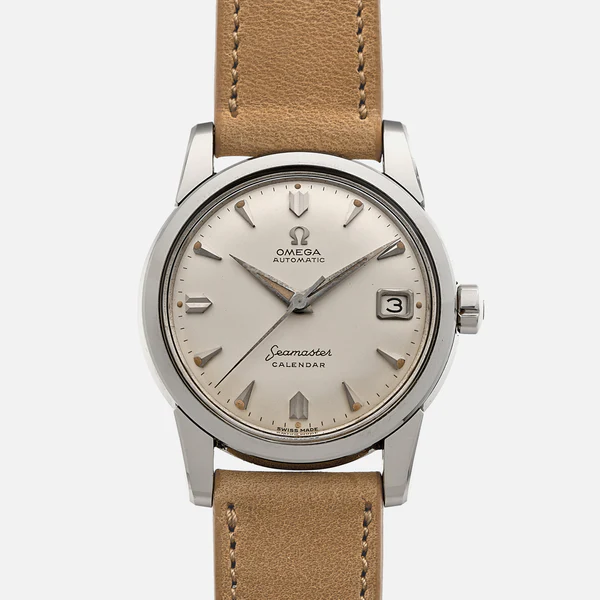
The Omega Seamaster Calendar 2849 is one of the definitive sports-dress watches of the late 1950s. Introduced shortly after the launch of Omega’s 500-series movements, this reference exemplifies the “Golden Age” of Omega design with its robust case architecture and advanced mechanical heart.
Known among collectors for its distinctive “beefy lugs”—thick, substantial lugs that give the 34mm case a commanding wrist presence—the 2849 bridges the gap between the earlier bumper-automatic era and the slimmer, more refined Seamaster De Ville lines that followed in the 1960s. For the vintage enthusiast, the 2849 represents the archetypal 1950s Seamaster: tough, elegant, and mechanically over-engineered.
History & Production Period
The reference 2849 was produced from approximately 1956 to 1960.
It was introduced to house the new Caliber 503, Omega’s first full-rotor automatic movement with a date complication. This was a significant technical leap from the earlier “bumper” automatic movements (like the Cal. 353/355) found in previous Seamaster Calendar models (e.g., ref. 2627). The transition to a full 360-degree rotor improved winding efficiency and allowed for a slimmer movement profile, although the 2849 case remained pleasingly stout.
This reference was sold globally and served as a core model in Omega’s international catalog. It is the direct Swiss-market counterpart to US-market references (like the KX6082), featuring the higher-jewel-count movements that were standard for the rest of the world.
Technical Specifications
| Specification | Measurement |
|---|---|
| Case Diameter | 34mm (excluding crown) |
| Lug-to-Lug | 42mm |
| Lug Width | 18mm |
| Case Thickness | ~12mm (including crystal) |
| Crystal | Armoured hesalite (acrylic) with tension ring |
| Water Resistance | originally “Waterproof” (snap-back with O-ring) |
| Reference Variations | 2849-1, 2849-2, 2849-SC, etc. |
The “beefy lug” case is the defining physical characteristic of the 2849. The lugs are broad, chamfered, and curve downward, creating a larger footprint on the wrist than the 34mm diameter suggests.
Movements: Caliber 503
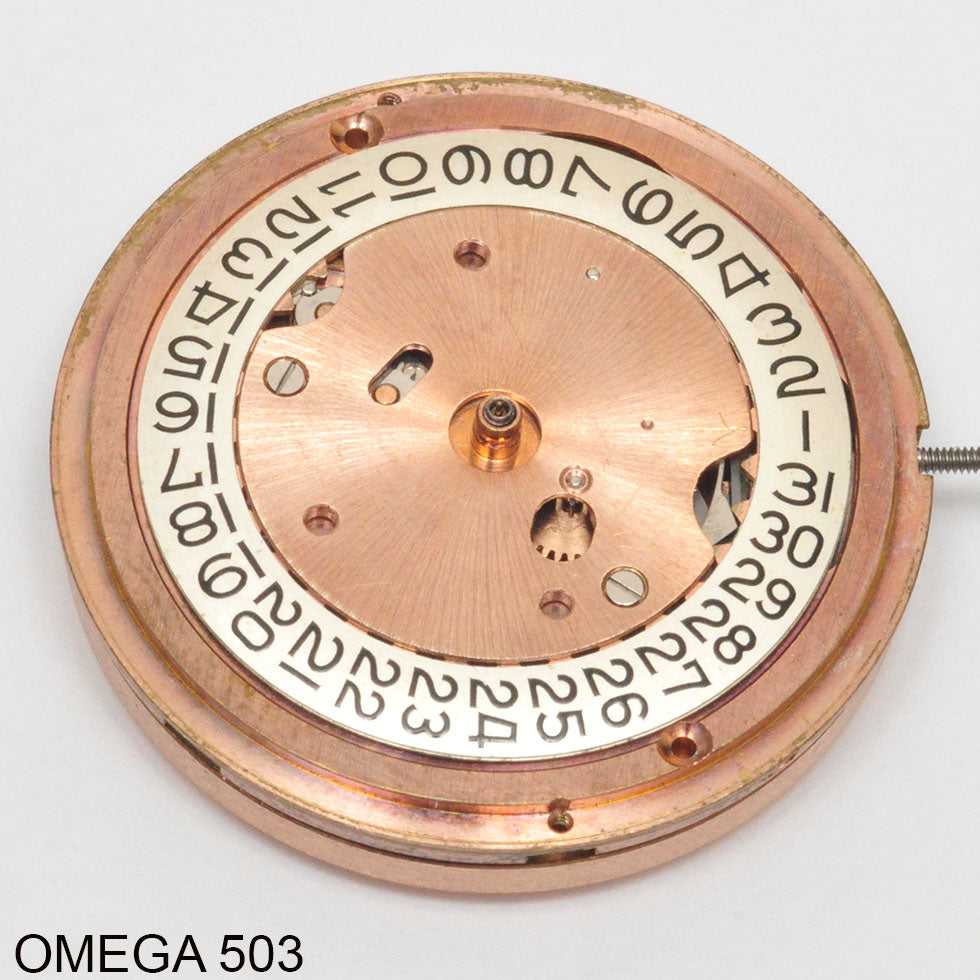
The heart of the reference 2849 is the Omega Caliber 503.
- Type: Automatic, full-rotor
- Jewels: 20 jewels
- Frequency: 19,800 A/h (2.75 Hz)
- Power Reserve: ~46 hours
- Features: Date complication (slow change), Incabloc shock protection
- Significance: The Caliber 503 is the date-equipped version of the famous Caliber 501. It is widely regarded as one of Omega’s finest production movements, known for its rose gold-plated (beryllium bronze) finish and robust construction.
- Note: Unlike the US-market Caliber 502 (17 jewels), the Caliber 503 used in the 2849 features 20 jewels, reflecting its “Swiss domestic” or “Rest of World” specification which wasn’t subject to American import tariffs.
Dial Variations
The 2849 was offered with several dial configurations, all retaining the classic 1950s aesthetic.
- Colors:
- Silver/White: The most common configuration. These often feature a sunburst or matte finish that ages to a warm cream or champagne patina.
- Black: Rare and highly sought after. Original black dials from this era are glossy (gilt) or matte. Caution: The vast majority of black dials seen on the market today are redials/refinished.
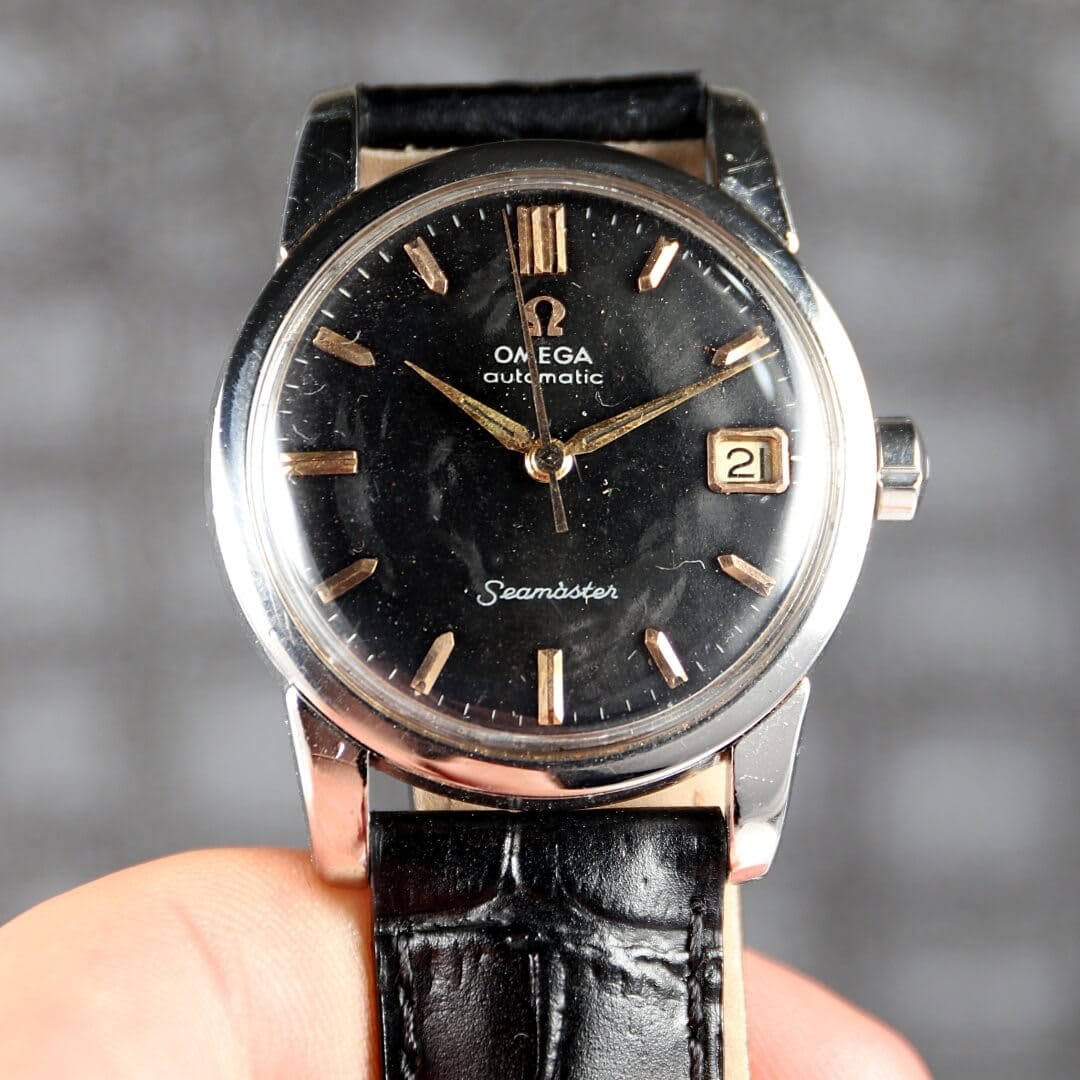
Omega Seamaster 2849-2SC, 1958
- Two-Tone: Some examples feature a “bullseye” or two-tone sector design, though this is less common on the 2849 than on earlier bumper models.
- Markers:
- Date Window: Located at 3 o’clock. Early examples often feature a distinct applied metal frame (window) around the date aperture, adding a level of finish that disappeared in later, cheaper production models.
- Hands: Dauphine hands (pitched/faceted) are the standard for this reference. They were typically luminous (radium in early models, transitioning to tritium) or plain metal depending on the specific dial code.
Case & Bezel Variations
The 2849 reference code covers multiple case materials:
- Stainless Steel (2849-SC): The most utilitarian and common version. Features a fully polished bezel and upper lugs, with brushed sides on some examples (though often fully polished).
- Gold-Capped (Gold Shell): A thick layer of 14k gold fused to a stainless steel base. Unlike thin plating, gold capping is durable and can last decades. These models have a steel caseback. You can identify them by looking at the back of the lugs—you will see the line where the gold shell ends and the steel base begins.
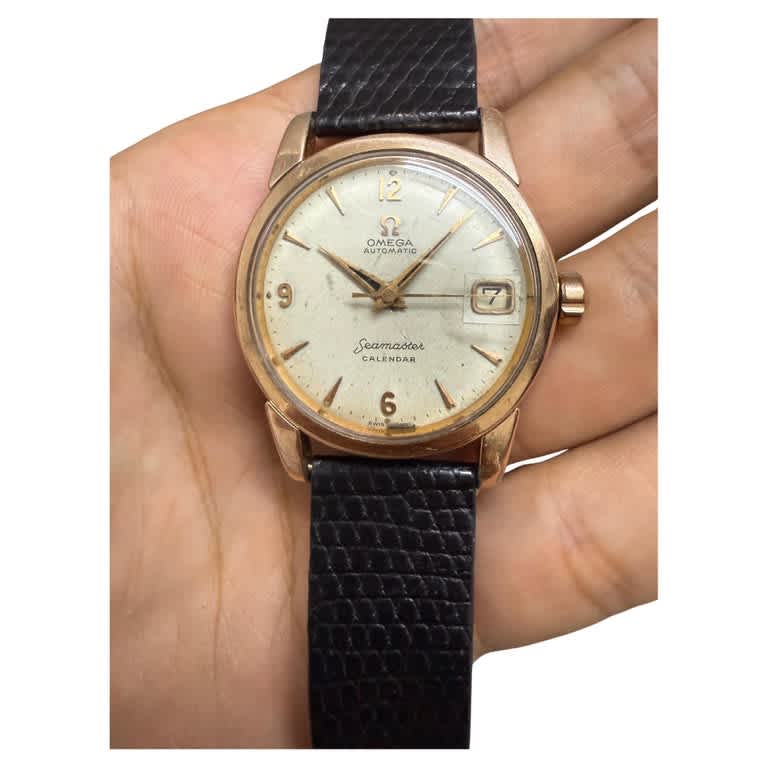
Omega Seamaster Calendar Gold Capped Vintage Ref. 2849-5SC
- Solid Gold (Rare): Solid 14k or 18k gold versions exist (often stamped OT 2849 or similar), though these are significantly rarer and command a high premium.
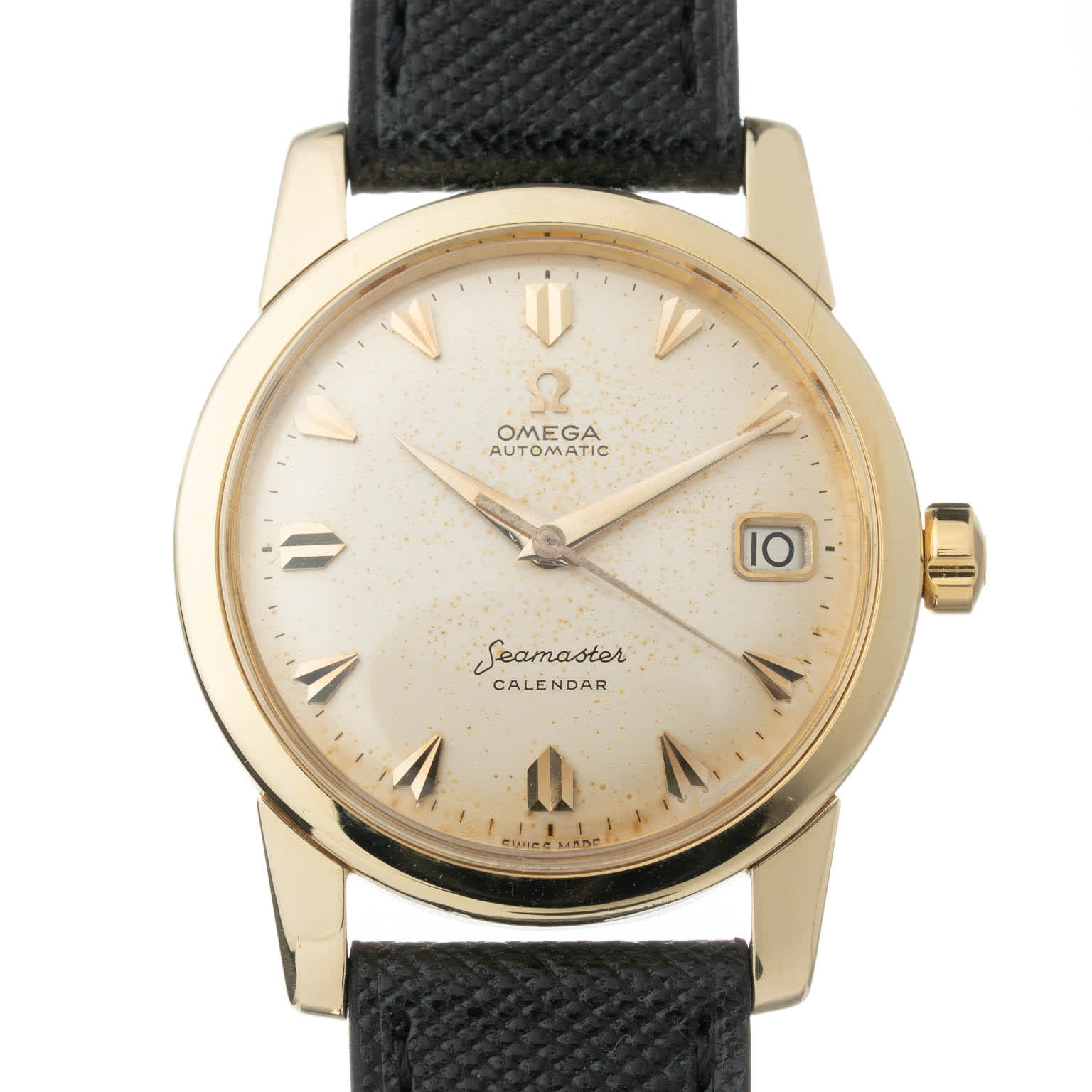
Vintage Omega Seamaster 14k Solid Gold with beefy lugs 2849
Caseback:
The caseback is a snap-on type, not screw-down. It typically features the “Seamaster” hippocampus logo engraved in the center, or a plain back with “Seamaster” and “Waterproof” engraved around the edge on earlier examples.
Bracelet & Strap Options
- Leather Strap: Most 2849s were sold on leather straps, which remain the most classic look for the watch. 18mm lug width allows for versatility.
- Beads of Rice (BOR) Bracelet: The quintessential vintage Omega bracelet. A period-correct No. 12 beads-of-rice bracelet with correct end links (often #570 or similar straight/curved ends) is a highly desirable pairing that completes the vintage aesthetic.
Identifying Original vs. Replaced Parts
- Crown: Should be the correct “clover” style or scalloped Omega crown. It is a specific “split-stem” or standard stem design depending on the exact sub-reference, but it must be signed with the Omega logo.
- Crystal: Original crystals are signed with a tiny Greek letter Omega (Ω) in the very center of the plexiglass (visible with a loupe). Replacement crystals often lack this or have the wrong profile. The 2849 requires an armoured crystal with a tension ring (silver or gold tone) to secure the dial and provide water resistance.
- Dial:
- Check for the “SWISS MADE” text at the bottom. If it is missing or “SWISS MOVT,” it is likely a redial.
- Inspect the “S” in Seamaster. The “Coat Hanger S” (where the S looks like a coat hanger) is common on earlier versions.
- The date window should be properly aligned. Poorly refinished dials often have date windows that crowd the minute track or markers.
- Case Polishing: The “beefy lugs” are the first casualty of over-polishing. Original lugs should have a defined chamfer (bevel) on the outer edge. If the lugs look rounded like a melted bar of soap, the watch has been heavily polished.
Collector Notes & Market Context
The Seamaster 2849 is considered a “blue chip” vintage Omega—a staple reference that is always in demand due to its size and build quality.
- Value:
- Stainless Steel: Excellent condition examples range from $1,200 – $1,800. Rougher examples can be found for under $1,000.
- Gold Capped: Often trade at a slight discount or parity to steel due to modern preference for white metals, typically $1,100 – $1,600.
- Solid Gold: Significantly higher, usually $3,500 – $5,000+ depending on karat and condition.
- Desirability: Collectors prioritize “sharp” cases (unpolished lugs) above almost all else. A sharp case with a slightly spotted original dial is worth more than a polished case with a perfect dial.
- Pitfall: The snap-back case offers less water resistance than screw-back models (like the 2975). Sweat ingress often corrodes the movement or the inside of the caseback edges. Always inspect the movement for rust and the case seal area for pitting.