

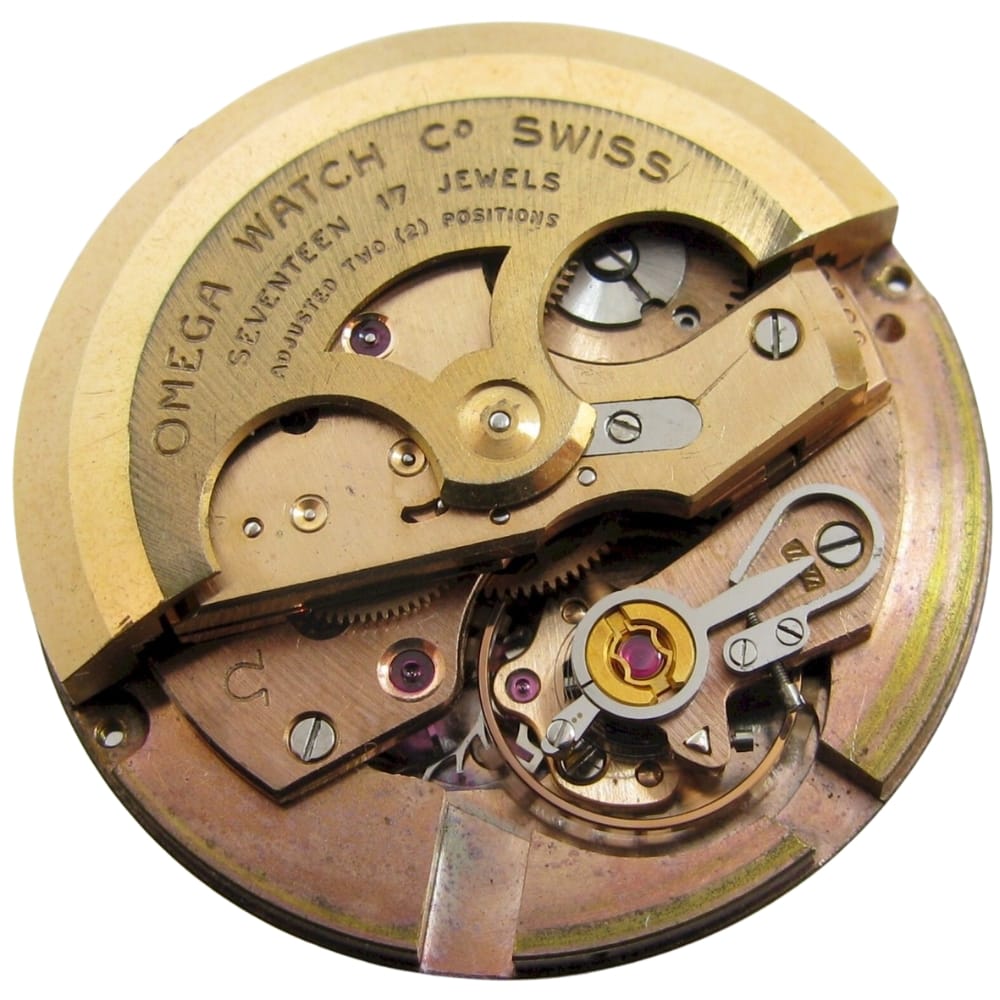
The Omega 503 occupies a problematic position in the hierarchy of early 500-series movements. While it shares the same fundamental architecture as the celebrated 501 and 505 calibers, the 503’s status as a date movement without chronometer certification, combined with widespread dial-swapping between Seamaster and Constellation models, makes authentication challenging and collecting risky.
This caliber represents Omega’s first generation of full-rotor automatic date movements, replacing the bumper automatic systems that preceded it. The 503 was designed by Edouard Schwaar as part of the 470/490/500 series family, with more than a million movements in this family produced between 1955 and 1960. The 503 specifically features a date complication and Omega’s innovative semi-quickset date mechanism, a backward-roll method that was among the first attempts by any manufacturer to provide faster date adjustment without full 24-hour hand rotations.
Approximately 163,000 Caliber 503 movements were produced during its four-year run. Of this total, only a small percentage received chronometer certification and were fitted to Constellation models. The vast majority powered Seamaster Calendar and Geneve models, making this fundamentally a mid-tier workhorse caliber rather than a prestige movement. Availability today is uncommon rather than scarce, collector demand remains moderate, and the caliber offers no discernible technical advantage over the simpler, more reliable 501.
The 503 currently occupies an ambiguous position in the collector market. Prices for Seamaster Calendar references with Cal. 503 typically range from $600 to $2,600 depending on condition, case material, and dial originality. The prevalence of redials, case over-polishing, and movement swaps between Seamaster and Constellation models means collectors should approach 503-powered watches with heightened scrutiny. Demand is stable but not rising, and specific variants command premiums only when provenance and originality are beyond question.
Historical Context, Provenance, and Manufacturing Details
The Caliber 503 was introduced in 1956 as part of Omega’s transition from bumper automatic movements to modern full-rotor winding systems. This development addressed the market’s demand for more efficient automatic winding coupled with calendar functionality. The bumper movements of the 1940s and early 1950s, including the 351 and 352 series, suffered from limited winding efficiency and fragility. The 500 series solved these issues with a bi-directional rotor system capable of continuous 360-degree rotation.
The 503 evolved directly from the Caliber 501, which had been released in 1955 as Omega’s first full-rotor automatic movement. Where the 501 provided time-only functionality, the 503 added a date complication with a semi-quickset mechanism. This date-setting innovation allowed users to advance the date by repeatedly cycling the hands backward from midnight to approximately 9 PM, then forward again past midnight, causing the date to click forward with each cycle. This method, while tedious compared to later quickset systems, was significantly faster than advancing 24 hours per date change.
The Caliber 503 was eventually succeeded by the Caliber 504, which appeared in 1957. The 504 represented the first chronometer-certified date movement in the Constellation range and featured 24 jewels compared to the 503’s 19 or 20. For non-chronometer applications, the mid-500 series calibers (550, 560, 561, 564) gradually replaced both the 501 and 503 beginning in 1959, offering improved performance, refined architecture, and better long-term parts availability.
The 503 was manufactured entirely in-house at Omega’s Bienne facility. This was not an ebauche-based caliber; Omega designed, tooled, and produced every component internally. The movement belonged to a broader family that included calibers 470, 471, 490, 491, 500, 501, 502, 503, 504, and 505, all designed by Edouard Schwaar. Schwaar’s architecture prioritized manufacturing efficiency, reliability, and chronometric performance, with the 500-series movements representing Omega’s answer to Rolex’s dominance in the automatic chronometer market during the 1950s.
The 502, a variant of the 503, warrants specific mention. The Caliber 502 was functionally identical to the 503 but featured only 17 jewels instead of 19 or 20. This jewel reduction was not a downgrade; it was a deliberate modification to reduce U.S. import duties, which were calculated based on jewel count. Caliber 502 movements bear the marking “OXG” on the balance bridge, indicating certification for the U.S. market. International versions used the 503 designation and lacked this marking.
The 503 positioned Omega within the top tier of mass-produced Swiss watchmakers during the 1950s, immediately below haute horlogerie houses like Patek Philippe, Vacheron Constantin, and Audemars Piguet. Omega competed directly with Rolex in the luxury sports watch segment, and the 500-series movements were engineered to match or exceed Rolex’s standards for accuracy, durability, and finishing at comparable price points.
Construction and Architecture

Plate and Bridge Layout
The Caliber 503 employs a three-quarter plate construction with separate bridges for the balance, escapement, and automatic winding system. The mainplate and bridges are fabricated from beryllium bronze alloy, a material selected for its rigidity, dimensional stability, and resistance to deformation under temperature variation. Omega applied copper electroplating over the bronze alloy, a finishing technique that produces the distinctive rose-gold appearance characteristic of 500-series movements. This plating was sometimes misleadingly marketed as “rose gold” in period advertising, though it was purely a copper galvanic deposit.
The movement features a modular architecture that separates the timekeeping train from the automatic winding mechanism. The rotor and winding system mount to a dedicated bridge that can be removed independently, facilitating service and repair. This modularity also enabled Omega to produce both automatic (503) and manual-wind (caliber 620, 613) variants from similar base architectures.
Balance Wheel
The 503 utilizes a monometallic Glucydur balance wheel, a two-armed design manufactured from beryllium bronze. Glucydur, an alloy of beryllium, copper, and iron, was engineered to eliminate the need for bimetallic temperature compensation while providing superior resistance to deformation, enhanced anti-magnetic properties, and immunity to oxidation. The balance features adjustable screws around its rim, though these screws are functionally redundant given the monometallic construction and serve primarily aesthetic or traditional purposes.
The Glucydur balance production process required 17 additional manufacturing steps compared to traditional nickel balances, increasing production costs by more than 400 percent. Omega absorbed this cost to achieve optimal temperature stability and long-term chronometric performance.
Balance Spring (Hairspring)
The 503 employs a flat Nivarox balance spring, a self-compensating alloy consisting of cobalt (42-48%), nickel (15-25%), chromium (16-22%), with trace amounts of titanium and beryllium. Nivarox, developed by Straumann and commercialized by Nivarox-FAR in the 1930s, provided superior anti-magnetic properties, oxidation resistance, and thermoelastic stability compared to earlier Elinvar alloys.
The hairspring configuration is flat rather than Breguet overcoil. While a Breguet overcoil theoretically provides superior positional accuracy, Omega’s use of a flat spring combined with the swan-neck regulator achieved comparable chronometric performance at significantly reduced manufacturing complexity.
Escapement Type
The movement employs a straight-line Swiss lever escapement with jeweled pallet stones and an impulse jewel mounted in the balance roller. Energy is released at 19,800 beats per hour (2.75 Hz), a frequency considered fast-beat by 1950s standards though modest by modern criteria. The escapement components, including the escape wheel, pallet fork, and impulse jewel, are meticulously finished with polished functional surfaces to minimize friction and maximize efficiency.
Shock Protection System
The 503 incorporates Incabloc shock protection on both the balance staff pivots and the pallet fork pivots. The Incabloc system, patented in 1934 by Georges Braunschweig and Fritz Marti, employs a lyre-shaped spring that allows jewel bearings to shift slightly during impact, absorbing shock and protecting the delicate balance staff from breakage. When the shock dissipates, the spring returns the bearing to its correct position, restoring normal function.
The Incabloc system in the 503 is of superior quality compared to contemporary alternatives, providing robust protection against the knocks and jolts of daily wear. This shock resistance was critical for a sports watch like the Seamaster, which was marketed for active use.
Regulator Type
The 503 features Omega’s swan-neck micrometer regulator, a precision adjustment mechanism that manipulates the effective length of the balance spring to control rate. The swan-neck design employs a curved spring that presses against a regulator index, allowing fine adjustment via a micrometer screw. This system provides superior adjustment precision compared to simple index regulators and became a hallmark of higher-grade Omega movements.
The swan-neck regulator version fitted to the 503 differs slightly from the later iteration used in mid-500 series calibers (561, 564). Early 500-series regulators feature a distinct profile and mounting arrangement, making them non-interchangeable with later versions.
Mainspring Material and Type
The mainspring is manufactured from white alloy steel, a high-carbon stainless material engineered for consistent torque delivery over the full 46-hour power reserve. The spring features a slipping bridle attachment rather than a fixed anchor, allowing the mainspring to slip against the barrel wall when fully wound. This slipping action is essential in automatic movements, where the rotor continues winding even after the mainspring reaches maximum tension. Without slipping, the mainspring would damage itself or the winding mechanism.
The mainspring for calibers 470, 471, 490, 491, 500, 501, 502, 503, 504, and 505 is identical and interchangeable, carrying part designation 770/27 or WA31 (Dennison width 3, strength 11, length 14 inches / metric width 1.2 mm, strength 0.1 mm). Genuine Omega mainsprings and aftermarket Swiss-made equivalents from Generale Ressorts remain available.
Gear Train Details
The 503 employs an indirect center seconds configuration, a design innovation that isolates the seconds hand from the primary gear train. This arrangement eliminates the need to jewel the center seconds pinion, reducing cost and complexity while maintaining accuracy. The gear train consists of four wheels: barrel, center, third, and fourth (escape pinion), with the indirect seconds mechanism driven off the fourth wheel via a reduction gear.
The date mechanism integrates a date driving wheel that engages the date ring once every 24 hours. The semi-quickset function operates through a corrector yoke that engages when the hands are rotated backward past approximately 9 PM, allowing the date corrector to advance the date when the hands subsequently pass midnight. This mechanism must not be engaged between 10 PM and 2 AM, as the automatic date-change mechanism is already engaged during this window, and simultaneous engagement can damage the corrector yoke, date driving wheel teeth, or date corrector lever.
Finishing Quality and Techniques
The 503 features excellent cosmetic and functional finishing, a hallmark of early 500-series movements. Bridges exhibit Cotes de Geneve (Geneva stripes), a decorative pattern created by rotating abrasives that produce parallel wave-like striping. The mainplate displays circular perlage (circular graining), a stippling pattern achieved with a rotating peg that reduces light reflection and traps dust particles. Anglage (beveled edges) is applied to bridge edges, with corners rounded and polished to a high luster.
Functional surfaces, including wheel teeth, pinions, and pivots, receive meticulous polishing to minimize friction and wear. The escape wheel teeth are highly polished, as are the pallet stones and impulse jewel. This attention to functional finishing distinguishes Omega’s 500-series movements from many contemporaries that focused exclusively on cosmetic decoration visible through the caseback.
The copper plating applied to beryllium bronze components serves both aesthetic and functional purposes. It enhances corrosion resistance, reduces surface oxidation, and provides a visually distinctive appearance that became synonymous with vintage Omega quality.
The 503 does not carry adjustment markings beyond basic regulation. Non-chronometer versions lack inscriptions such as “Adjusted to Five Positions and Temperatures,” which appear only on chronometer-certified movements like the 501 chronometer and 505. This absence of adjustment markings is a primary authentication feature distinguishing non-chronometer 503 movements from their certified counterparts.

Omega Watches Advertisement 1950s Omega 18K Gold Seamaster
Cross-Reference Data
Alternative Caliber Names (Rebranded Versions)
| Manufacturer | Caliber Designation | Notes |
|---|---|---|
| Omega | Caliber 502 | U.S. export version with 17 jewels (reduced from 20 to minimize import duties); features “OXG” marking on balance bridge |
Base Caliber vs. Elaborated Versions
Compatible Case References by Brand
Dial Compatibility Note
The Caliber 503 shares identical dial foot positions with the Caliber 501, 502, 504, and 505, enabling dial interchange between these movements. This compatibility created widespread fraud, as Seamaster dials could be swapped onto Constellation movements and vice versa. Collectors must verify case reference, movement markings, and rotor inscriptions to confirm authenticity. Constellation rotors carry chronometer adjustment markings (“Adjusted to Five Positions and Temperatures”), while Seamaster rotors typically lack these inscriptions.
Date window position is consistent across all 503 applications, located at 3 o’clock with a white date wheel featuring black numerals.
Crown and Stem Specifications
Identification Marks
Caliber Number Location
The caliber number “503” is engraved on the train bridge (mainplate side), typically located between the third and fourth wheel positions. On some examples, the caliber number may also appear stamped on the rotor bridge, though this varies by production period.
Logo and Brand Marks
Authentic movements bear the inscription “Omega Watch Co.” and “Swiss” on the train bridge or balance cock. The rotor carries the Omega logo and may include adjustment markings on chronometer versions. Non-chronometer examples lack “Adjusted” or “Adjusted to Five Positions and Temperatures” inscriptions.
Date Codes
The 503 does not employ date codes. Production dating relies on serial number ranges stamped on the movement.
Finishing Marks
Expect Cotes de Geneve (Geneva stripes) on bridges, circular perlage on the mainplate, and anglage (beveled edges) on bridge corners. Copper electroplating over beryllium bronze components produces a rose-gold hue. The distinctive swan-neck regulator and Glucydur balance with visible rim screws are characteristic features.
Jewel Markings
Jewel settings are either pressed directly into the plate or mounted in brass chatons (gold-colored bezels). Higher-grade chronometer versions may feature gold-colored chatons on certain pivot jewels, though this is not universal. Incabloc shock springs are visible at the balance staff jewel settings, identifiable by the lyre-shaped spring and conical jewel holders.
Adjustment Markings
Non-chronometer 503 movements lack adjustment markings. Chronometer-certified examples carry “Adjusted” or “Adjusted to Five Positions and Temperatures” inscriptions on the rotor or balance cock. Collectors should verify these markings correlate with case reference (Constellation vs. Seamaster) and dial characteristics to detect fraudulent modifications.
Correct Serial Number Formats and Locations
Serial numbers are engraved on the movement between the lugs on the watch case (typically between 12 o’clock lugs) or on the movement itself. Caliber 503 production corresponds to serial number ranges approximately 14,800,000 to 18,000,000, spanning production years 1956 through 1961.
Serial Number Ranges by Production Year:
- 1956: 15,000,000 to 15,999,999
- 1957: 15,000,000 to 15,999,999 (overlap)
- 1958: 16,000,000 to 16,999,999
- 1959: 17,000,000 to 17,999,999
- 1960: 17,000,000 to 17,999,999 (overlap)
- 1961: 18,000,000 to 18,999,999
Serial numbers should be cleanly engraved with consistent depth and spacing. Hand-stamped or poorly formed numbers suggest case refinishing or fakery.
Expected Engravings and Stampings
Authentic 503 movements display:
- “Omega Watch Co.” on train bridge
- “Swiss” on train bridge
- Caliber number “503” on train bridge
- Jewel count “19 JEWELS” or “20 JEWELS” on train bridge
- Serial number on movement or case
- Omega logo on rotor
Chronometer versions add “Adjusted” or “Adjusted to Five Positions and Temperatures” on the rotor.
Font and Marking Style by Production Era
Early 503 production (1956-1957) features serif fonts with deeper engraving. Later production (1958-1960) transitioned to slightly shallower engravings with refined letter spacing. Rotor engravings are typically bolder and more pronounced than train bridge markings. Collectors should compare fonts and engraving depth against confirmed authentic examples when evaluating suspicious movements.
Part Information

Part Numbers
Core Movement Components:
Automatic Winding System Components:
Incabloc Shock Protection:
| Part Name | Part Number | Notes |
|---|---|---|
| Incabloc Cap Jewels | Standard Incabloc for Cal. 503 | Upper and lower balance staff cap jewels |
| Incabloc Shock Springs | Standard Incabloc for Cal. 503 | Lyre-shaped springs |
Sourcing Notes
Still Available:
- Mainsprings remain widely available from Generale Ressorts, Otto Frei, and aftermarket suppliers
- Balance staffs (part 1321) available from Perrin Watch Parts and specialty suppliers
- Stems (part 1106) available from watchmaking suppliers
- Generic Swiss Incabloc components fit standard specifications
Commonly Fail and Need Replacement:
- Rotor bearing (bronze bushing/pinion): The bronze alloy bearing wears over time, causing rotor wobble and caseback rubbing. This is the single most common failure in 503 movements. Replacement requires pressing out the worn pinion and installing a new unit, a delicate operation requiring specialized tools.
- Reduction wheel: The click mechanism creates localized wear on reduction wheel teeth, particularly in neglected movements. Worn reduction wheels exhibit chipped or flattened teeth visible under magnification.
- Date mechanism components: Date corrector yoke, date driving wheel, and date jumper spring suffer wear in movements where semi-quickset function was used improperly (engaged during restricted hours).
Acceptable Generic Replacements:
- Mainsprings: Generic Swiss-made mainsprings from Generale Ressorts provide equivalent performance to NOS Omega parts
- Incabloc components: Generic Incabloc cap jewels and shock springs match factory specifications
- Balance staffs: Aftermarket balance staffs (part 1321) from reputable suppliers are acceptable substitutes
Parts No Longer Available or Extremely Scarce:
- Rotor assemblies with “Adjusted” or chronometer markings (NOS exhausted; Omega substitutes non-adjusted rotors during service)
- Bearing assemblies for rotor (early 500-series replaceable units; limited NOS inventory)
- Dial spacers and original date wheels (discontinued; watchmakers fabricate replacements)
Performance Data
Manufacturer Specifications
Observed Performance (Field Data)
Typical Accuracy Range for Well-Maintained Examples:
Well-serviced, non-chronometer Caliber 503 movements typically achieve accuracy between +5 and +20 seconds per day in standard wearing positions. Chronometer-certified examples, when properly maintained, achieve -2 to +8 seconds per day. Performance degrades significantly in neglected movements with worn pivots, contaminated lubrication, or magnetization.
Common Performance Issues and Their Causes:
- Excessive Rate Variation (> +30 seconds/day): Caused by worn balance staff pivots, contaminated escapement jewels, dried lubricants, or magnetization.
- Low Amplitude (< 200 degrees): Indicates mainspring weakness, excessive friction in the gear train, or automatic winding system malfunction. Low amplitude accelerates escapement wear and degrades accuracy.
- Rotor Noise and Caseback Rubbing: Bronze rotor bearing wear allows excessive rotor play, causing audible scraping and visible rub marks on caseback. This issue requires rotor bearing replacement, not mere cleaning.
- Date Change Failure: Date fails to advance or advances sluggishly due to worn date driving wheel, weakened date jumper spring, or corrector yoke damage from improper semi-quickset use.
- Inconsistent Running (Stops Intermittently): Caused by magnetization, escapement contamination, or balance staff pivot damage. Requires demagnetization, cleaning, and potentially pivot replacement.
Expected Amplitude:
Fully wound, serviced 503 movements exhibit amplitude between 250 and 280 degrees in dial-up position. Amplitude decreases to approximately 220-240 degrees as the power reserve depletes to 50 percent. Amplitude below 200 degrees indicates servicing is required.
How Performance Degrades as Movement Ages:
Without regular servicing, 503 movements experience predictable degradation patterns:
- Years 0-5: Movement maintains factory specifications with minimal rate drift
- Years 5-10: Lubricants begin drying; amplitude decreases 10-15 degrees; accuracy drifts to +15 to +25 seconds per day
- Years 10-15: Pivot wear becomes measurable; amplitude drops below 230 degrees; accuracy exceeds +30 seconds per day; automatic winding efficiency decreases
- Years 15+: Without intervention, pivot wear accelerates, amplitude collapses below 200 degrees, rotor bearing wear causes caseback rubbing, and date mechanism malfunctions become common
Regular servicing every 5-7 years arrests this degradation. Neglected movements require pivot polishing or balance staff replacement, rotor bearing replacement, and complete overhaul to restore acceptable performance.
Production Total: Approximately 163,000 to 169,000 pieces
Scarcity Rating: Uncommon
Collector Recommendation: The Caliber 503 occupies a secondary position among early 500-series movements. Collectors focused on Omega’s finest work should prioritize the 501 chronometer (19 jewels), 504 (rare date chronometer), or 505 (24-jewel flagship). The 503 serves best as an entry point to early automatic Omega calibers or as a workhorse movement in well-preserved Seamaster Calendar models. Authentication challenges and limited chronometer availability diminish its investment appeal relative to mid-500 series calibers (561, 564) with superior parts availability and unambiguous provenance