

Last updated ~ February 2, 2026
Brand
Production Period
1964–1971
Model Line
Case Shape
Round
Diameter
35mm
Lug to Lug
43mm
Lug Width
18mm
Case Thickness
11mm
Case Back
Snap-On
Caliber
Crystal
Bezel
Dive
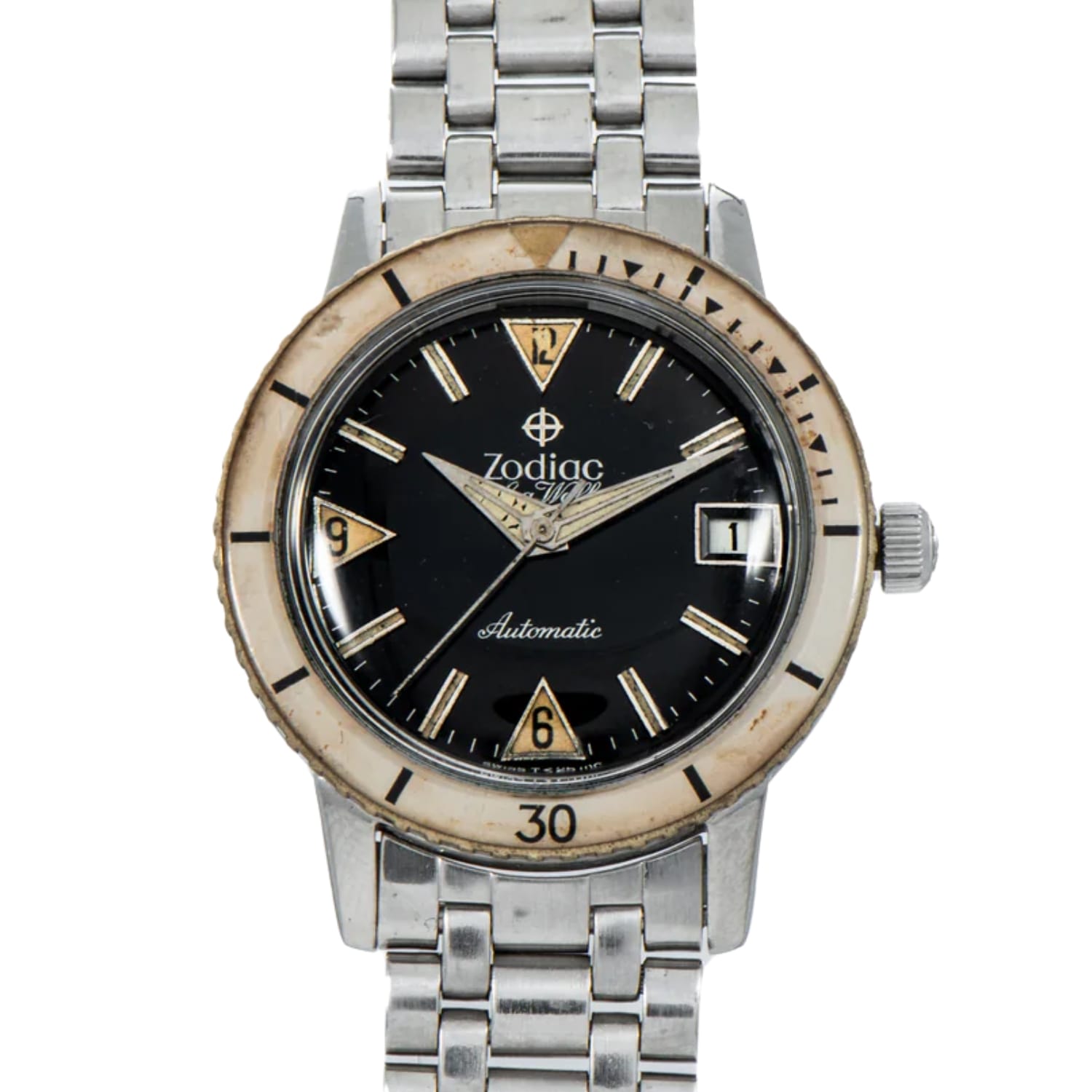
The Zodiac Sea Wolf 722-946B represents the second generation of one of the world’s first commercially available dive watches, competing directly with the Rolex Submariner and Blancpain Fifty Fathoms from the same era. Introduced around 1964, the 722-946B brought a defining feature to the Sea Wolf line: a push-in quickset date complication, a genuinely innovative mechanism for its time, and the introduction of colorful Bakelite bezels that gave Zodiac a distinct visual identity in the crowded dive watch market of the 1960s.
The 722-946B served as Zodiac’s mass-market dive watch, a tool designed for the emerging recreational diving boom of the 1960s and marketed heavily to U.S. military personnel at post exchanges throughout the Vietnam War era. While never officially issued, these watches became popular among military salvage divers and underwater demolition teams who appreciated their water resistance, legibility, and affordability. The reference number breaks down as follows: the “722” prefix indicates the Sea Wolf family with the caliber 72 (date version), while the “946” identifies the specific model configuration. The “B” suffix likely denotes the Bakelite bezel variant, though documentation confirming this designation remains sparse.
Production numbers for the 722-946B are not manufacturer-confirmed, but serial number ranges and collector research suggest somewhere between 15,000 and 25,000 examples were produced during the reference’s seven-year run. The watch falls into the “uncommon” scarcity category: not rare enough to command premium prices, but significantly harder to find in truly original condition than production numbers might suggest. Most examples show signs of hard use, polished cases, or replacement parts. The Bakelite bezels, while beautiful, proved brittle and prone to cracking, chipping, and fading, making intact examples particularly desirable.
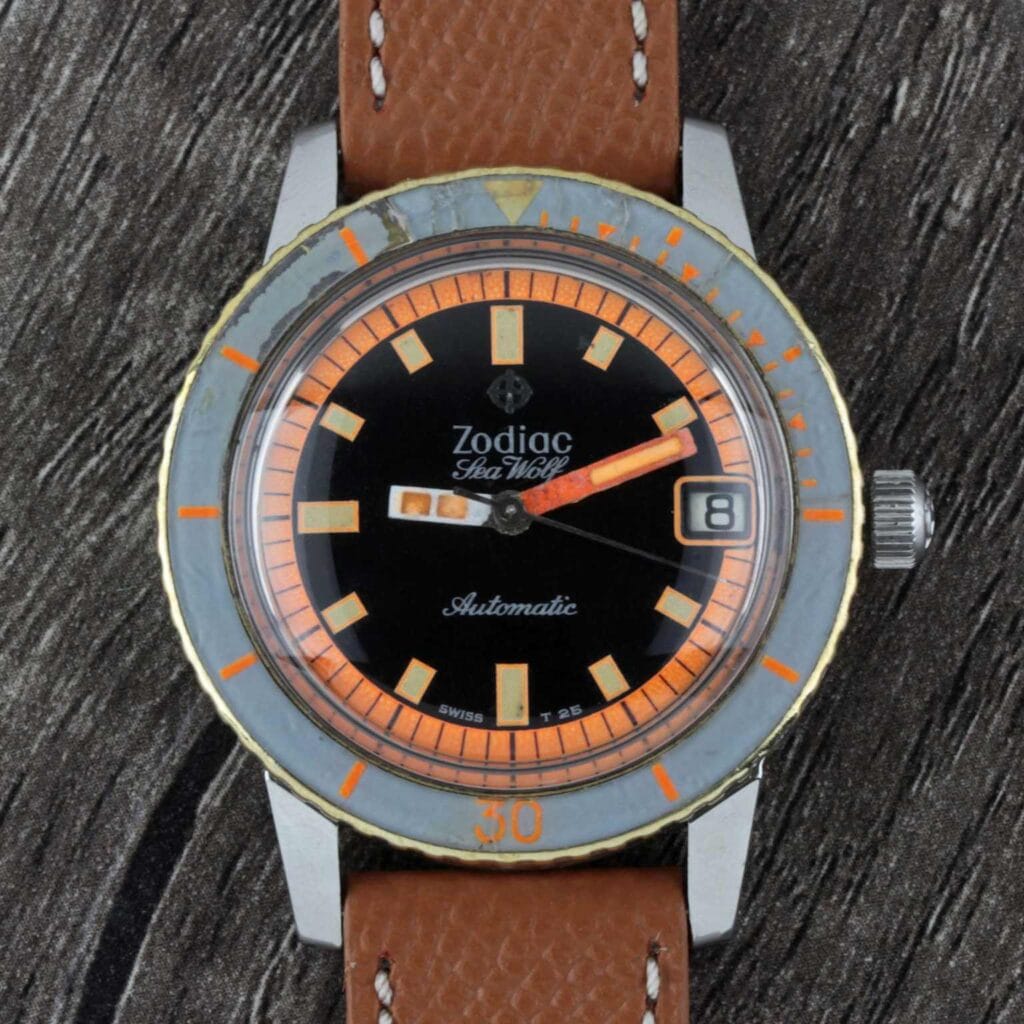
In the current collector market, the 722-946B occupies an increasingly attractive position. Values have risen steadily over the past five years as collectors recognize Zodiac’s historical importance and appreciate the watch’s wearable proportions. Standard black-dial examples with intact Bakelite bezels trade between $1,400 and $2,200, depending on condition. Tropical dials (where the original black finish has aged to brown) command $1,800 to $2,950. The rare “exotic” or “orange dial” variants with orange chapter rings can reach $3,500 to $4,500 in excellent condition. Examples with original JB Champion bracelets add $300 to $500 to values. The market favors unpolished cases, original crowns, and uncrazed Bakelite bezels.
HISTORICAL CONTEXT, PROVENANCE, AND MANUFACTURING DETAILS
The 722-946B emerged during a transformative period for Zodiac. The brand, founded in 1882 by Ariste Calame in Le Locle, Switzerland, had established itself as a producer of reliable, affordable timepieces. The original Sea Wolf debuted at the 1953 Basel Fair alongside the Blancpain Fifty Fathoms, making it one of the first purpose-built dive watches with a rotating bezel. Recent scholarship challenges the 1953 date, with evidence suggesting the Sea Wolf may have actually launched in 1957 or 1958, but the watch’s pioneering status remains undisputed.
By the early 1960s, Zodiac recognized the need to update the Sea Wolf line. The first-generation models used A. Schild manual-wind calibers with added automatic modules, but reliability issues and the absence of a date function limited appeal. In a collaborative effort with Doxa, Eberhard, Favre-Leuba, and Girard-Perregaux, Zodiac helped develop modifications to the A. Schild 1687/1688 base caliber, creating the automatic Zodiac caliber 70 (no-date) and 72 (date) movements around 1962. These new calibers featured 21 jewels, 21,600 vph frequency, and 40-hour power reserves.
The 722-946B represents the second major evolution of the Sea Wolf design. Where earlier models featured engraved metal bezels or painted brass inserts, the 722-946B introduced Bakelite bezel inserts in various colors: black, gray, light blue, dark blue, white, and occasionally orange. The Bakelite material, an early synthetic plastic, allowed for vibrant colors but proved less durable than modern materials. The watch also debuted the innovative push-in quickset date mechanism: pushing the crown inward (rather than pulling it out) advanced the date, a clever engineering solution that predated many mainstream quickset implementations.
The 722-946B succeeded earlier references like the 702-916 and 722-916 (non-date models) and ran concurrently with other variants like the 722-946 (possibly a metal bezel version, though documentation conflates these references). The reference eventually evolved into later 1970s models with different case designs and the higher-beat caliber 86/88 movements. Zodiac manufactured all Sea Wolf watches in Switzerland, with cases likely produced by multiple suppliers rather than a single manufacturer. The snap-back case design, marked “20 ATM” and “Especially Water Tested” on the interior, used a compression gasket system that achieved 200-meter water resistance despite the push-pull crown, a noteworthy technical achievement for the era.
The broader context matters: the 722-946B competed in a crowded field. By 1964, Rolex had established the Submariner as the premium choice, Blancpain targeted professional divers, and Omega introduced the Seamaster 300. Zodiac positioned the Sea Wolf as the working person’s dive watch: Swiss-made quality at a fraction of the price, sold through department stores and military exchanges rather than jewelry stores. This democratic approach built a loyal following but ultimately hurt the brand’s prestige. When the quartz crisis devastated Swiss watchmaking in the 1970s, Zodiac lacked the luxury positioning to weather the storm. The brand declared bankruptcy in 1997 before being acquired by Fossil Group in 2001.
CONSTRUCTION AND ARCHITECTURE
The 722-946B exemplifies 1960s dive watch design: functional, compact, and legible. The 35mm stainless steel case measures 11mm thick (including the domed acrylic crystal) and wears larger than its diameter suggests due to the 43mm lug-to-lug distance and prominent bezel. The case construction uses a two-piece design with a mid-case and snap-back caseback, secured by a compression gasket rather than a screw-down system. The caseback typically bears the Zodiac signature in script, the reference number (often 722-946), a serial number, and the marking “20 ATM” or “20 ATM Especially Water Tested.”
The bezel assembly represents the watch’s most distinctive feature. The Bakelite insert, held by a stainless steel bezel ring, rotates bidirectionally (unlike modern unidirectional systems) with a smooth action and no clicking. The bezel markings include hash marks at five-minute intervals, additional minute markers for the first 15 minutes, and a single “30” numeral at the 6 o’clock position. This “30” appears right-side-up when the bezel is at rest, rendering it upside-down when rotated, a quirky design choice that became a Zodiac trademark.
Bakelite bezels came in multiple colors, with black and gray being most common. Light blue, dark blue, and white bezels appear less frequently and command premiums. The material’s main drawback: brittleness. Bakelite cracks easily, crazes over time, and fades when exposed to sunlight. Many original bezels have disintegrated entirely, leading collectors to seek replacement bezels from donor watches. Some 722-946B examples feature metal bezels, either original variants or replacements. The metal-bezel versions typically show engraved markings rather than painted numerals.
The dial configuration on the 722-946B follows the Sea Wolf template. A glossy black lacquer finish dominates most examples, though tropical variants with aged brown patina have become highly collectible. Applied hour markers at all positions except 3 and 6 provide depth. The 12, 3, 6, and 9 o’clock positions feature large applied triangular frames filled with tritium luminous material, with Arabic numerals printed in negative space within the lume. A date window interrupts the dial at 3 o’clock, typically with a white date wheel, though some examples show black wheels. The 6 o’clock position displays “Sea Wolf” in script above “Automatic” and the water resistance rating “20 ATM” or “20 ATM 660FT.”
Hand styles vary across production runs. The most common configuration uses dauphine-shaped hour and minute hands with tritium lume inserts and a straight baton seconds hand, also lumed. Some examples feature rarer “shovel” hands (so-called for their squared-off tips) or different proportions. All original hands should show aged tritium, typically turning cream or light tan over decades. Bright white lume indicates replacement or refinishing.
The crown measures approximately 5mm in diameter, featuring a signed Zodiac logo and a push-pull operation. Despite the non-screw-down design, the crown’s compression gasket system achieved reliable water resistance when maintained. The push-in quickset date mechanism distinguishes the 722-946B from earlier references: pushing the crown inward (toward the case) advances the date without pulling the crown to any position. This innovative system simplified date setting but required careful handling, as forcing the crown could damage the mechanism.
The crystal uses domed acrylic (plexiglass) rather than sapphire, appropriate for the era and contributing to the watch’s vintage charm. Acrylic scratches easily but polishes readily and won’t shatter like mineral or sapphire crystals. The high dome provides excellent legibility at angles and resists cracking under pressure changes during diving.
Original bracelets for the 722-946B typically came from JB Champion or C&I, both American bracelet manufacturers that supplied many Swiss brands during the 1960s. The JB Champion bracelet uses a “jubilee” or five-link design with hollow links and a stamped clasp bearing the Zodiac signature. These bracelets stretch over time and rarely survive in excellent condition. The C&I bracelets use a similar construction. Original bracelet examples add significant value, as most 722-946B watches have been separated from their bracelets over decades.
Dial and Bezel Variants
| Configuration | Characteristics | Relative Rarity |
|---|---|---|
| Black dial, black Bakelite bezel | Standard production, glossy finish | Common |
| Black dial, gray Bakelite bezel | Aged black bezel or original gray variant | Common |
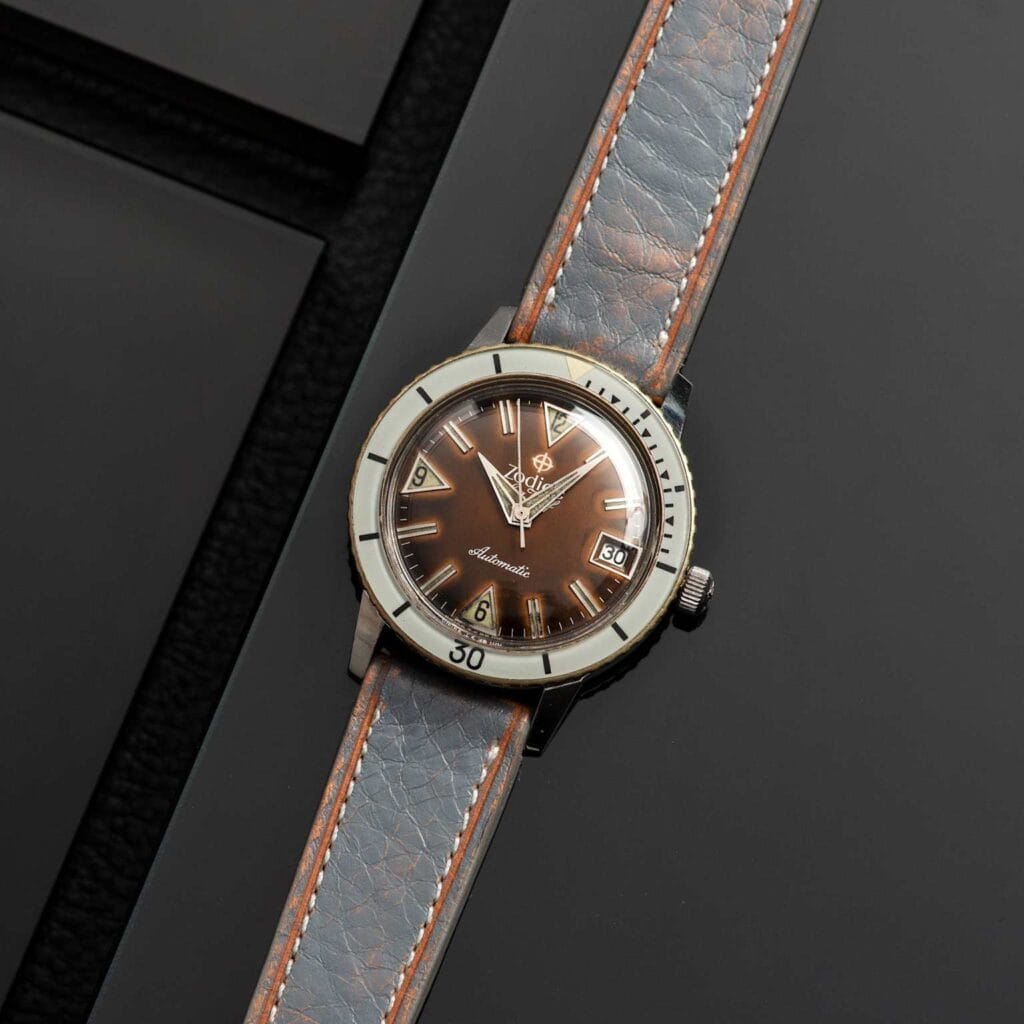
| Tropical brown dial, gray bezel | Natural aging, even patina desirable | Uncommon |
| Black dial, light blue bezel | Original color variant | Scarce |
| Black dial, white/cream bezel | May be faded from original color | Scarce |
| “Exotic” orange dial | Orange chapter ring, black outer dial | Rare |
| Tropical exotic dial | Orange chapter aged to yellow/cream | Rare |
| Gold-plated bezel variants | 10K or 14K gold bezel on steel case | Rare |
CROSS-REFERENCE DATA
| Similar Reference | Manufacturer | Notes |
|---|---|---|
| 722-916 | Zodiac | No-date version of the same-generation Sea Wolf, metal rotating bezel, otherwise identical case and caliber 70 movement |
| 722-946 | Zodiac | Date version, possibly metal bezel variant though references are conflated in period documentation |
| 702-916 | Zodiac | Earlier no-date Sea Wolf with metal bezel, slightly different case proportions |
| 722-906 | Zodiac | Date version with different dial configuration, same case family |
| 722-964B | Zodiac | Orange “exotic” dial variant with orange chapter ring, highly collectible |
| 762-966 | Zodiac | Later day-date complication, different case design |
MOVEMENTS & CALIBERS
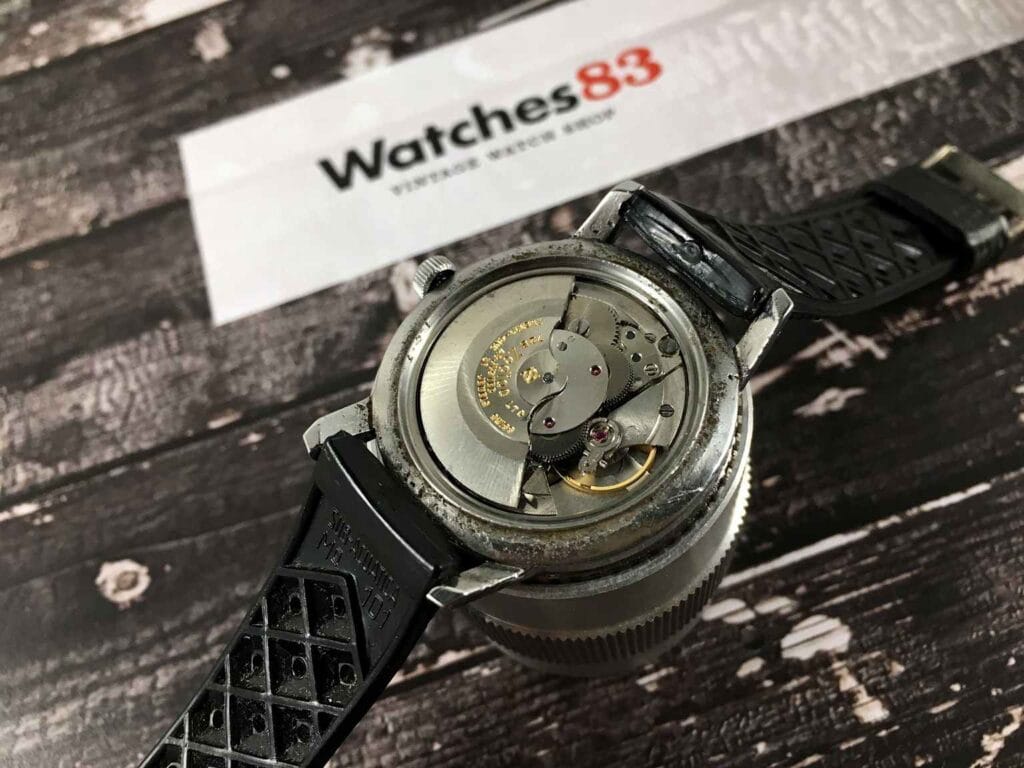
The 722-946B uses the Zodiac caliber 72B exclusively throughout production, a 21-jewel automatic movement based on the A. Schild 1687/1688 manual-wind caliber with an added automatic winding mechanism. The automatic module uses a “magic lever” or “excenter” system with a single gear stage and ball-bearing rotor, a design that would later appear in Seiko automatic movements of the 1970s. The movement measures 11.5 lignes (25.6mm) in diameter and approximately 5.1mm in height.
Technical specifications:
- 21 jewels (17-jewel base movement plus 4 jewels in the automatic mechanism)
- 21,600 vibrations per hour (3 Hz frequency)
- 40-hour power reserve
- Sweep seconds hand
- Date complication with quickset via crown push-in
- Hacking feature (seconds stop when crown is pulled)
The caliber 72B family includes several variants, with the 72B designation indicating the date complication. Related movements include the caliber 70 (automatic, no date), 74 (automatic calendar), 75 (automatic with 24-hour display and date), and 76 (automatic day-date). All derive from the same A. Schild base with different module configurations.
The quickset date mechanism represents the caliber 72B’s most distinctive feature. Rather than using a pull-out crown position to advance the date (as in most movements), the 72B uses a push-in system: pressing the crown toward the case engages a pusher that advances the date wheel. This clever design eliminates the need for an intermediate crown position but requires care, as excessive force can damage the pusher mechanism or date wheel. The date should not be adjusted between approximately 9:00 PM and 3:00 AM, when the date change mechanism is engaged.
Movement finishing remains utilitarian: signed Zodiac rotor, basic decoration, and functional aesthetics rather than haute horlogerie embellishment. The movements prove robust and serviceable, with parts still available through Zodiac specialists and aftermarket suppliers. Service intervals should follow standard practices: 5-7 years for complete overhauls, with gasket replacement at each service to maintain water resistance.
IDENTIFYING ORIGINAL vs. REPLACED PARTS
The 722-946B’s affordability and long service life mean most examples show modifications, replacements, or refinishing. Knowing what to examine protects collectors from overpaying for compromised examples.
Dial authenticity: Original dials display several tells. The black lacquer should show a glossy, mirror-like finish, though tropical examples will have aged to brown. The Zodiac signature appears in flowing script, never block letters. “Sea Wolf” at 6 o’clock uses the distinctive period script. Applied hour markers should sit flush and even, with no lifting at edges. The tritium lume in the markers and triangular positions should show even aging: cream, tan, or light brown coloration. Bright white lume indicates replacement or restoration. Refinished dials often show inconsistent printing, incorrect fonts, or poorly aligned markers.
Tropical dials require careful inspection. Authentic tropical aging shows even color transition across the entire dial, typically from black to chocolate brown. The patina should appear natural and organic, not artificial. Suspicious examples include dials with uneven coloring, obvious discoloration rings, or tropical aging that stops abruptly at marker positions. Some refinishers create fake tropical dials using heat or chemical treatments. Compare suspect examples against documented authentic tropical dials in dealer listings or auction archives.
Hands: Original hands should match the dial’s tritium age. Cream or tan lume in both hands and dial markers indicates originality. Mismatched aging (white lume in hands, aged lume in dial, or vice versa) suggests replacement. The hand style should be appropriate: dauphine shapes with lume cutouts for hour and minute hands, straight baton for seconds. Some examples feature shovel hands, which remain correct but less common. Replacement hands often show incorrect shapes, sizes, or lume application patterns.
Bezel: Authenticating Bakelite bezels poses challenges given their fragility and the prevalence of replacements. Original Bakelite should show appropriate wear: fine surface scratches, possibly minor chips at edges, and fading if exposed to sunlight. The bezel should fit snugly in its retaining ring without excessive play. Printed numerals and markings should appear period-correct. Many examples have replacement bezels from donor watches, which remain acceptable if they’re genuine Zodiac Bakelite rather than modern reproductions. Metal bezel examples should show engraved rather than painted markings.
Crown: Original crowns measure approximately 5mm, feature the Zodiac logo, and show appropriate wear. Replacement crowns often come from generic suppliers and may lack proper signing or show incorrect proportions. The crown should operate smoothly: push-pull for time setting, push-in for quickset date. Binding, grinding, or resistance suggests incorrect replacement or worn parts.
Case condition: The 722-946B’s case design includes mixed finishing: polished bezel sides and case edges, with brushed midcase sides. Many examples have been polished during service, removing material and softening edges. Original cases show crisp, defined edges between surfaces and maintain full thickness. Over-polished examples display rounded case edges, thinned lugs, and blurred transitions between finished surfaces. The case should measure 11mm thick including crystal. Thinner measurements indicate excessive polishing.
Crown tube and case back: The snap-back should display proper markings: Zodiac script signature, reference number, serial number, and water resistance notation. The gasket should be intact and pliable (though this requires opening the case). Inside the case back, watchmakers often scratch service dates or marks. Some examples show “722-946” stamped inside, indicating the case model. The crown tube should be original and properly fitted, with no gaps or misalignment.
Bracelet: Original JB Champion or C&I bracelets show characteristic construction: hollow links with stamped components, Zodiac-signed clasp, and specific link designs. The JB Champion name often appears stamped inside the clasp. These bracelets stretch with age and wear, showing gaps between links. Replacement bracelets range from period-correct alternatives to modern reproductions. Original bracelets add significant value, but most collectors accept period-appropriate alternatives or leather straps.
COLLECTOR NOTES & MARKET CONTEXT
The 722-946B occupies a sweet spot in vintage dive watch collecting: historically significant, attractively priced, and wearable. Market dynamics have shifted over the past five years as collectors recognize Zodiac’s pioneering role and appreciate compact vintage proportions.
Current market positioning: Expect to pay $1,400-$2,200 for standard black-dial examples with intact Bakelite bezels in good condition. Tropical dials command $1,800-$2,950. Rare “exotic” orange dial variants reach $3,500-$4,500. Examples with original bracelets add $300-$500. Unpolished cases, original crowns, and uncrazed bezels drive premiums. Box and papers remain extremely rare and can add 20-30% to values.
Configurations that drive premiums: Tropical dials, particularly examples with even, attractive aging, command strong premiums. The orange “exotic” dial variants (reference sometimes listed as 722-964B, though documentation varies) rank among the most desirable, combining rarity with distinctive aesthetics. Colored Bakelite bezels, particularly light blue and white variants in good condition, attract collector interest. Gold-plated bezel variants on steel cases remain rare and sought-after. Unpolished cases with sharp edges and full thickness represent increasingly scarce finds.
Common pitfalls: Over-polished cases remain the most common issue, reducing value and originality. Refinished or reprinted dials appear frequently, often difficult to detect without experience. Replacement bezels, particularly modern reproductions, compromise collectibility. Frankenwatches combining parts from multiple references or brands circulate in the market. The quickset date mechanism can malfunction if mishandled, requiring expensive repair. Many examples show service-replacement crowns, crystals, or case gaskets. Buy from reputable dealers or request expert inspection before purchasing.
Box and papers: Original boxes, papers, and warranty cards remain extraordinarily rare for the 722-946B. Zodiac used simple cardboard boxes with minimal documentation during the 1960s. Military exchange purchases often came with generic receipts rather than brand documentation. Examples with original presentation materials command significant premiums but require careful authentication. Period Zodiac documentation should match the watch’s era and specifications.
WEARABILITY & LIFESTYLE FIT
Daily wearer viability: The 722-946B proves surprisingly practical as a daily wearer despite its 60-year age. The 35mm case suits contemporary tastes for smaller watches, wearing comfortably on wrists from 6.25 to 7.5 inches. The 43mm lug-to-lug prevents overhang on smaller wrists while maintaining wrist presence. The 11mm thickness allows the watch to slip under dress shirt cuffs easily. The acrylic crystal scratches more readily than sapphire but polishes easily with polywatch compound. Service availability through independent watchmakers remains good, with parts accessible through specialist suppliers.
Dress watch appropriateness: The glossy black dial, compact proportions, and vintage aesthetic allow the 722-946B to work in smart casual and business casual contexts. The colorful Bakelite bezel on some variants and tool-watch design language limit formal wear appropriateness. Black or gray bezel examples prove more versatile. The vintage aesthetic pairs well with heritage style: selvedge denim, Oxford cloth button-downs, chinos, and casual sport coats. The watch reads as a knowing choice rather than ostentation.
Sport and tool watch suitability: As designed, the 722-946B functions as a capable recreational dive watch. The 200-meter water resistance handles swimming, snorkeling, and recreational diving comfortably within modern depth limits. The rotating bezel tracks elapsed time effectively despite the bidirectional action. Legibility remains excellent thanks to high-contrast dial, large luminous markers, and domed crystal. However, collectors should note: aged gaskets compromise water resistance until serviced, the acrylic crystal scratches easily, and the Bakelite bezel risks damage from impacts. Most collectors treat the 722-946B as a daily desk-diver rather than subjecting it to genuine aquatic use.
Water resistance in practice: The 20 ATM (200-meter) rating remains impressive for a push-pull crown design from the 1960s. The compression gasket system achieves this rating through precise case machining and gasket compression. However, 60-year-old gaskets have deteriorated in most examples. Before water exposure, the watch requires professional service with gasket replacement and pressure testing. Even after service, avoid submerging the watch beyond casual swimming. The push-in quickset date mechanism adds vulnerability, as water pressure could engage the pusher. Treat the 722-946B as splash-resistant rather than dive-capable until professional service confirms water resistance.
Comfort factors: The 35mm steel case weighs approximately 60-70 grams without bracelet, 90-110 grams with original JB Champion bracelet. The weight feels substantial without being burdensome. The case proportions and moderate thickness create excellent balance on the wrist. The lugs curve subtly, improving comfort. Original bracelets, while charming, stretch and pull hair. Most collectors prefer leather straps, NATOs, or modern bracelets. The 18mm lug width fits standard strap dimensions. The watch sits close to the wrist thanks to moderate thickness and curved case design.
Strap versatility: The 18mm lug width accepts any standard strap. NATO straps complement the vintage dive watch aesthetic, with olive, black, and gray proving popular choices. Leather straps, particularly vintage-style tan or brown leather, suit the watch’s heritage character. Tropic-style rubber straps evoke period-correct dive watch presentation. Modern mesh bracelets work well with the 35mm case. Avoid heavy or thick straps that overpower the compact case. The watch’s proportions favor straps in the 2-3mm thickness range.
The Zodiac Sea Wolf 722-946B represents an increasingly compelling value in vintage dive watches. It delivers Swiss quality, historical significance, and attractive proportions at prices that remain accessible to enthusiastic collectors rather than exclusively wealthy investors. As more collectors recognize these attributes, the window for entry-level prices continues to narrow. For collectors seeking a wearable piece of horological history without Rolex premiums or Omega stratification, the 722-946B rewards research, patience, and selective buying.
One thought on “Zodiac Sea Wolf 722-946B”
Thank you for this very through and in-depth article. Just bought a 722-946B with box and papers and used this article to help authenticate with the seller. Really appreciate it!