


Last updated ~ April 10, 2026
Brand
Production Period
1967–1975
Model Line
Case Shape
Oval
Diameter
34mm
Lug to Lug
44mm
Lug Width
20mm
Case Thickness
8mm
Case Back
Snap-On
Caliber
Crystal
Bezel
Smooth
The Universal Genève 842133 represents a unique outlier in the brand’s storied catalog: an uncompromisingly elegant dress watch that prioritizes design refinement over complication, arriving during the brand’s most adventurous stylistic period. While Universal Genève earned the epithet “watch couturier” for its chronographs, the 842133 demonstrates that the Geneva maker possessed equal mastery in distilling watchmaking to its purest form, a time-only watch whose convex, bathtub-shaped case hugs the wrist with almost sculpture-like precision.
The 842133 occupies a singular place in Universal Genève’s 1970s output: a dress watch unencumbered by date windows, rotating bezels, or subdials, delivering nothing but essential timekeeping housed in a distinctly modern case profile that anticipated design trends by decades. The model reveals a brand confident enough to experiment with proportion and form when many peers retreated into conservative aesthetics. Collectors have informally christened it the “Bathtub,” a nickname capturing both the case’s deeply convex profile and the watch’s rare ability to sit on the wrist with organic, almost sculptural presence.
Production numbers for the 842133 remain undocumented by Universal Genève, but available evidence suggests limited manufacturing. Serial number data from the late 1960s through mid-1970s indicates the reference appeared during UG’s broader expansion into dress watches, suggesting production likely numbered in the hundreds rather than thousands. The watch remains distinctly uncommon in the contemporary market; examples surface sporadically through specialist dealers and auctions, with no supply pattern evident. Relative scarcity stems not from recognized rarity at time of production but rather from low original popularity and significant attrition, combined with the reference’s late-cycle positioning before the brand contracted severely during the Quartz Crisis.
Collector standing for the 842133 has evolved markedly in recent years as appreciation for Universal Genève’s 1970s dress watch experiments has deepened. The reference no longer languishes as an obscure footnote but occupies a position of growing interest among sophisticated collectors who recognize its design integrity and horological straightforwardness. The “Bathtub” designation itself signals collector community adoption, a naming convention typically reserved for references with devoted followings. Current demand appears stable to modestly rising, with examples priced typically between $1,000 and $1,500 USD depending on condition and dial variant. Specific dial configurations—particularly the glossy mirror-finish black dials manufactured by the respected Singer dial maker—command appreciation above baseline pricing, though the reference has not yet achieved the investment intensity surrounding the brand’s chronographs.
Historical Context & Manufacturing Details
The Universal Genève 842133 emerged during a fascinating moment in the brand’s trajectory, a window when the company possessed the confidence and resources to invest in design experimentation while simultaneously confronting existential market pressures. The late 1960s and early 1970s represented perhaps the final golden age for mechanical watch development before quartz irrevocably reshaped industry priorities. Universal Genève, positioned historically as a manufacture focused on complications—the Compax, Uni-Compax, and Tri-Compax chronographs that defined its reputation—began exploring alternative design languages for time-only watches, a strategic diversification that would ultimately prove insufficient to ensure survival but produced remarkable specimens in the interim.
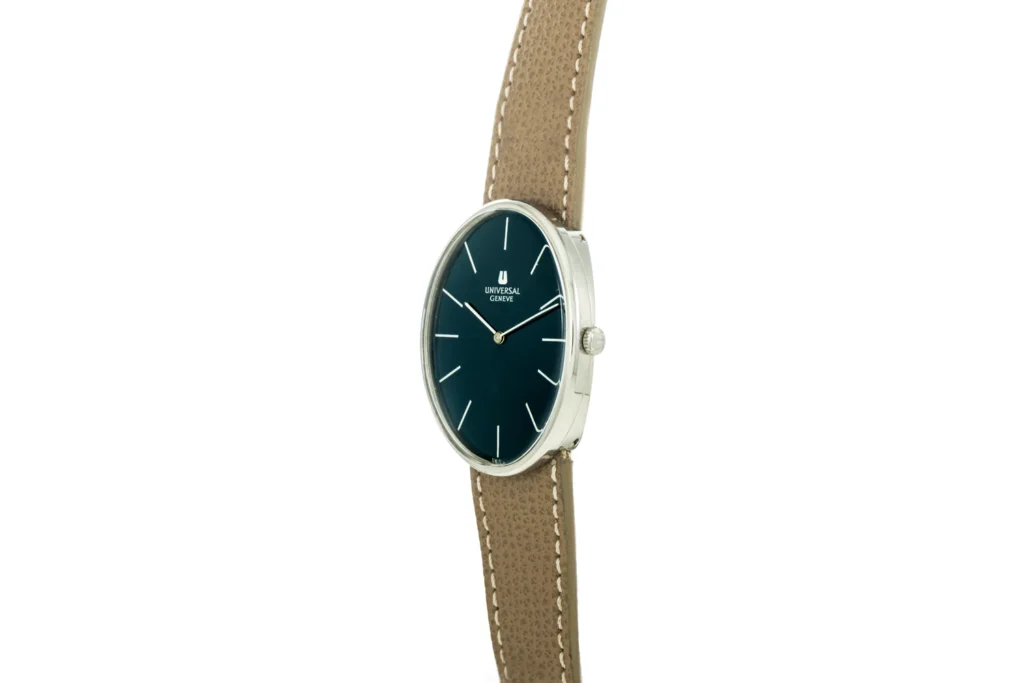
The 842133 entered production circa 1967, precisely as the brand was expanding its dress watch offerings beyond the ultra-slim models like the 842101. This reference exemplifies Universal Genève’s ambition to compete across multiple watch categories, from aviation chronographs to dress watches, reflecting a vintage-era manufacturing philosophy that prioritized breadth of design innovation. The convex oval case shape, combined with the minimalist dial approach, positioned the 842133 as a distinctly European dress watch alternative to the rectangular, integrated-bracelet designs gaining traction from Patek Philippe (Reference 3919) and other Geneva makers.
Development History
The 842133 resulted from Universal Genève’s deliberate pivot toward exploring case geometries beyond the round, tonneau, and cushion profiles that dominated 1960s watchmaking. Contemporary market analysis and design philosophy within the manufacture suggested that dress watches could benefit from the same experimental rigor applied to chronograph complications. The convex oval silhouette drew inspiration from architectural and automotive design of the era, principles UG had previously applied to the Polerouter and Aero-Compax cases. Development likely occurred between 1965 and 1966, with market introduction following by late 1966 or early 1967.
No documentation exists regarding the specific impetus for the convex oval shape, but context suggests the design emerged from internal prototyping rather than response to competitor offerings. The 842133 shares no direct heritage with other oval-cased Universal Genève references; instead, it represents an entirely new case geometry exclusive to this dress watch line, suggesting a deliberate commitment to differentiation. Production continued through the mid-1970s, likely terminating around 1974 or 1975 as the brand contracted during the Quartz Crisis and shifted resources toward electronic movements. The reference was never revived post-crisis.
Manufacturing Context
The 842133 arrived as a quiet addition to Universal Genève’s expanding dress watch catalog rather than a flagship release. Unlike the Polerouter or Compax, which received official marketing emphasis, the 842133 appears to have been positioned as a refined alternative for customers seeking understated elegance—essentially a prestige piece within the brand’s time-only offerings. This positioning explains the reference’s contemporary obscurity and modern collector status as a “hidden gem” rather than a celebrated classic.
The convex oval case represented a manufacturing novelty for Universal Genève, requiring bespoke tooling and case components. The “hidden lug” or “holey lug” construction, where lugs are concealed on the reverse of the case and accessible only via small holes for strap lugs, constitutes an advanced case-making technique that added manufacturing complexity and production cost. This design choice directly influenced the watch’s exclusivity; hidden lugs were far less common than visible lugs, requiring more precise machining and assembly discipline. The feature also immediately signals the 842133’s design intentionality—this was not a repurposed case from another model, but a purpose-built execution for this specific reference.
Factory & Production Location
The 842133 was manufactured in Geneva, reflecting Universal Genève’s status as a Genève-registered manufacture with production facilities in the Swiss capital. The movement—the caliber 1-42—was produced in-house by UG. The case construction, however, involved external suppliers consistent with Swiss watch industry practice of the era. No maker’s marks appear on stainless steel cases as a rule, making definitive case maker attribution impossible; however, the sophisticated hidden lug construction and engineering precision point toward one of the major Geneva or La Chaux-de-Fonds case makers active in the period, likely firms such as Gindraux, Spillman, or similar high-end producers.
Dial production involved the Singer manufacture, a renowned independent dial maker headquartered in La Chaux-de-Fonds that produced dials for Rolex, Omega, and other prestige brands. Singer’s involvement signals the reference’s positioning as a quality piece; the manufacture would not engage with lower-tier watch producers. Dial production occurred in La Chaux-de-Fonds, while final assembly and casing operations occurred in Geneva at Universal Genève’s facilities.
Horological Significance
The 842133 occupies a transitional and somewhat paradoxical position in watch history. It represents neither a breakthrough innovation nor a celebrated evolutionary refinement of an established design language. Instead, it exemplifies the mechanical watch industry’s final creative flourish before quartz dominance fundamentally altered manufacturing priorities. The reference demonstrates horological significance not through technical achievement but through design philosophy: it proves that in the final years before technological disruption, Swiss manufactures continued investing in mechanical watch artistry and case construction complexity despite mounting awareness that their industry faced existential pressure.
Historically, the 842133 bridges two distinct eras of Universal Genève identity. It arrives after the brand’s legendary chronograph output (Compax, Tri-Compax) had established its reputation but before the brand’s contraction into quartz production and eventual acquisition. The reference represents the company’s attempt to diversify into a broader market segment while maintaining technical and aesthetic standards. In this sense, it functions as a transitional piece that reveals how traditional manufactures adapted their portfolios in response to market fragmentation. The 842133 ultimately proved commercially unsuccessful—it survives in limited numbers and occupies no canonical position in UG histories—yet its design integrity and technical execution ensure it remains remarkable among collectors who appreciate mechanical watchmaking freed from performance marketing narratives.
Construction & Architecture
The Universal Genève 842133 presents a design philosophy fundamentally distinct from the brand’s sport and chronograph models: the elimination of functional embellishment in service of proportional purity. The case emphasizes three-dimensional form over two-dimensional decoration; the convex profile creates a watch that interacts with the wrist and light in unexpected ways, catching and reflecting illumination across the curved casework in a manner that photographs inconsistently but rewrites itself through viewing angles and movement. This optical dynamism compensates for the absolute minimalism of the dial, which contains no applied elements, no complications, no visual flourishes beyond precisely printed text and indices.
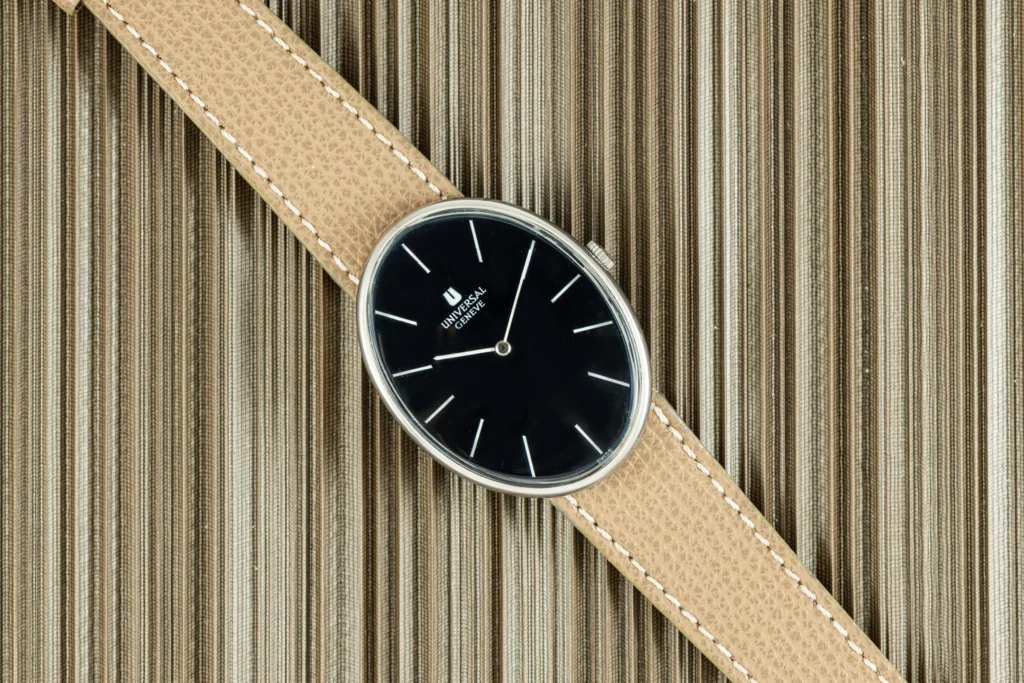
The hidden lug construction—invisible except for small perforations on the case back—fundamentally reshapes the watch’s visual proportions. Lugs represent the visual anchors connecting case to wrist; by concealing them, the 842133 presents the illusion of a case floating against the wrist, unmoored from conventional watch architecture. This design choice profoundly influences how the reference sits and feels, creating an intimate relationship between wearer and case that distinguishes it from conventional lug-equipped watches. The effect proves deeply polarizing among collectors: some experience it as the watch’s defining elegance, while others find the hidden lug arrangement awkward and functionally limiting.
Case Design
The case exemplifies Swiss dress watch sensibilities of the late 1960s: a deliberately non-round silhouette executed with precision engineering and aesthetic intention. The oval profile measures 34 millimeters across the widest point (horizontally) and 44 millimeters from lug to lug (vertically), creating proportions approximately 60:40 in the horizontal axis. This elongation deliberately elongates the dial visually, compensating for the 34-millimeter width that would otherwise read diminutively in absolute terms. The vertical height of 44 millimeters places the watch at the boundary between dress watch and sport watch sizing conventions; it reads larger on the wrist than the raw diameter suggests, a feat accomplished through proportional sophistication rather than raw size.
Case thickness measures 8 millimeters, a dimension that bridges vintage thinness (the brand’s ultra-slim dress watches measured 6-6.5 millimeters) and more contemporary heft. The 8-millimeter profile allows adequate movement space while maintaining dress watch elegance, a calculated compromise reflecting the manual-wind 1-42 caliber’s moderate height.
The convex profile constitutes the case’s defining characteristic: the case back and dial surfaces both curve outward, creating a watch that protrudes from the wrist with pronounced three-dimensionality. This curvature requires sophisticated case construction, as the convex shape creates stresses along the case band (the sides connecting front and back) that pure geometry distributes unevenly. The 842133’s case design addresses this through precise case metal thickness variation and professional execution; the case has proven durable through decades despite the engineering challenges the convex shape presents.
The stainless steel construction specified throughout available examples suggests the reference was exclusively produced in steel; no examples in gold, gold-plated, or alternate metals have surfaced in research, indicating stainless steel may have been the sole offering. The case finishing presents a combination of brushed surfaces on the case back and sides, with the lugs and certain case-front surfaces exhibiting a finer finish suggesting different polishing stages. The hidden lug system required additional manufacturing steps: the main case body incorporates small perforations on the rear to accept the strap lugs, which attach via conventional pins that rest within the case openings rather than spanning traditional lug structures.
Dial Variations
The 842133 was offered in discrete dial variants, though definitive documentation of the complete range remains unavailable. Known configurations include:
Black Dial: The most commonly encountered variant features a high-gloss black lacquer or enamel surface with pronounced mirror-like reflectivity. This finish creates substantial visual dynamism; illumination conditions dramatically alter appearance, from deep black in shadow to reflective surfaces that reveal surrounding environments. The finish is particularly striking when combined with the convex dial surface, which curves outward toward the viewer, magnifying the mirror effect. This dial variant was produced by the Singer manufacture, as confirmed through rear dial markings visible on examined examples.
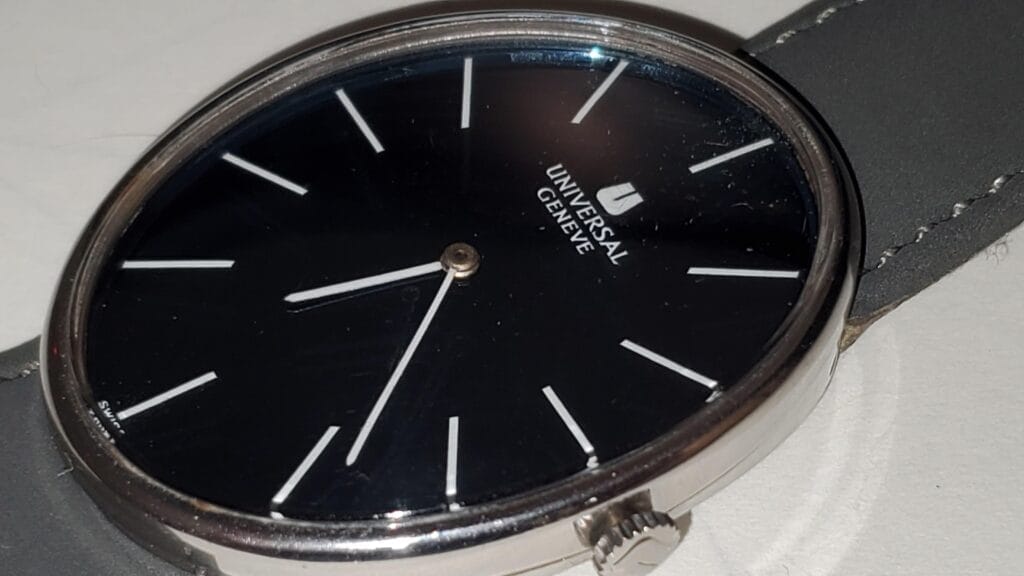
Blue Dial: At least one documented example exhibits a deep glossy blue surface with similar mirror-like properties to the black variant, produced circa 1967 by Singer. The blue dial variant appears significantly less common than black, suggesting limited production or regional market exclusivity.
Brown/Dark Dial: References in dealer inventory descriptions mention brown or dark-finish variants, though photographic confirmation remains limited. These may represent either service replacement dials or aging of original black dials, a distinction requiring hands-on examination.
All known dials feature printed white baton indices and printed white text, with no applied or applied-pattern indices documented. The white printing provides stark contrast against the dark dial finishes, creating legibility despite the dial’s curved reflective surface. Text includes the brand name “UNIVERSAL GENÈVE,” “SWISS MADE,” reference number “842133,” and sometimes additional markings indicating dial maker Singer. No luminous material appears on original dials; the absence of lume represents a deliberate aesthetic choice consistent with dress watch conventions of the era, where lume was considered unnecessary for non-sport applications.
The dial back markings typically include Singer’s name or logo, confirming dial maker attribution. Caseback reference stampings include the model number (842133) and serial number, following Universal Genève’s standard practice.
Hands
The 842133 employed simple baton-style hands with proportions appropriate to the 34-millimeter case. Documentation confirms white-finished hands with no luminous material, consistent with the dial’s non-luminous design philosophy. Hand dimensions appear notably delicate, with the hour hand measuring approximately 7-8 millimeters in length and the minute hand extending approximately 12-13 millimeters, proportions designed to read clearly against the dark dial while maintaining visual harmony with the diminutive case dimensions.
The hands exhibit polished or semi-polished finishing on examples examined through dealer photography, consistent with dress watch conventions. No alternative hand styles have been documented across examined examples, suggesting hand consistency throughout production. The stick hands themselves contain no lume or radium, distinguishing them from contemporary sport watches that incorporated radioactive luminous material. This design choice definitively positions the 842133 as a dress watch with no functional pretension toward darkness visibility, a refinement that some collectors appreciate as design honesty while others view as a practical limitation in a manual-wind piece.
Crown
The 842133 features a signed crown measuring approximately 4.5-5 millimeters in diameter, consistent with dress watch conventions of the period. The crown exhibits push-pull design rather than screw-down construction, a choice appropriate to the reference’s dress watch positioning where water resistance demands proved minimal. The crown is polished or satin-finished to match the case, and bears the Universal Genève logo or “U” stamp, confirming authenticity on correctly matched examples.
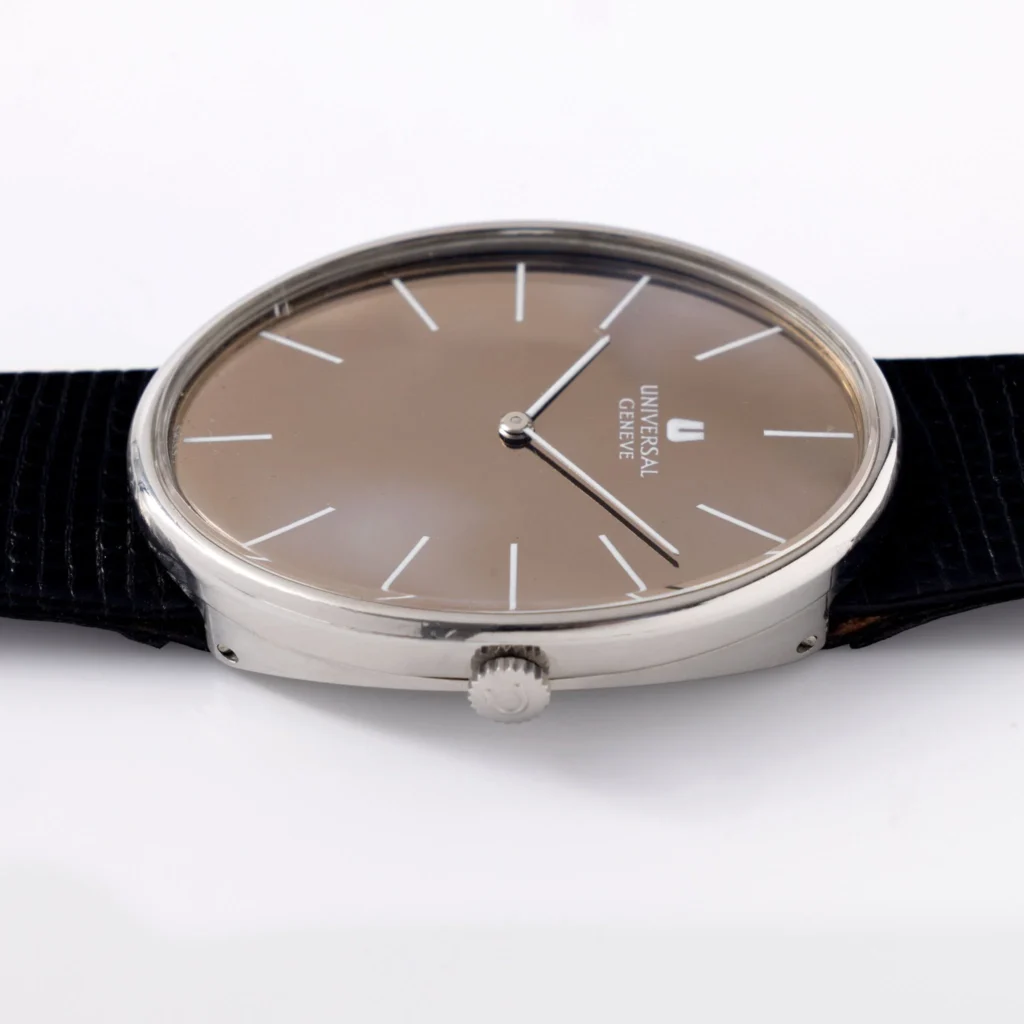
Crown construction appears straightforward, with no distinctive engineering features documented across available examples. The crown integrates into the case band at approximately the 3 o’clock position without screw-down tube elements or crowning mechanisms, maintaining the case’s clean aesthetic. No crown variations have been documented across production examples.
Crystal
The 842133 utilized acrylic plexiglass crystals throughout production, a material appropriate to vintage dress watches of the era when sapphire crystal remained rare and expensive. Acrylic crystals exhibit moderate scratch resistance compared to sapphire but offer superior impact resistance and refractivity properties that many collectors prefer for vintage watches. The crystal shape appears flat or nearly flat rather than domed, consistent with dress watch convention; photographic evidence suggests minimal curvature, though the curved dial underneath creates optical effects that may suggest doming where none exists.
The crystal mounting integrates into the case via conventional friction or gasket fitting; no beveled or chamfered crystal edges have been documented. Original crystals remain common on examined examples, suggesting either robust crystal durability through typical wear or collector prioritization of original component retention.
Bracelet & Strap Options
The 842133 was offered with leather strap options primarily, though bracelet configurations appear to have existed. Research confirms 20-millimeter lug width, suggesting period-appropriate leather strap fitment with 20-millimeter width at the case lugs tapering to narrower widths at the pin buckle. Known strap materials include crocodile leather and calf leather in black, brown, and other colors, consistent with Universal Genève’s standard dress watch strap offerings of the period.
Hidden lug construction provided flexibility in strap configuration that visible-lug watches could not match; any 20-millimeter strap design could potentially fit through the concealed lug perforations, enabling collectors to experiment with strap styles across different configurations. This strap versatility constitutes a practical advantage of the hidden lug system, offsetting its architectural complexity.
Bracelet configurations, if offered, remain undocumented in research; no original Universal Genève bracelet references have been confirmed for the 842133. Historical context suggests leather straps were the primary original fitment, with bracelets reserved for premium models.
Sub-Reference Summary Table
Research has not identified documented sub-references within the 842133 designation. The reference number appears to remain constant throughout production, with variations limited to dial color and potentially minor case finishing details. This represents either comprehensive standardization of the design or limitation of available research documentation.
| Reference | Case Material | Dial | Bezel | Strap | Notes |
|---|---|---|---|---|---|
| 842133 | Stainless Steel | Black glossy | Fixed | Leather 20mm | Singer dial maker |
| 842133 | Stainless Steel | Blue glossy | Fixed | Leather 20mm | Singer dial maker, rare |
| 842133 | Stainless Steel | Brown glossy (undocumented) | Fixed | Leather 20mm | Possible variant, limited evidence |
Reference Key, Variations & Sub-References
Understanding the 842133 requires grasping how Universal Genève encoded information into reference numbers and how production variations affected component pairing authenticity. The five-digit reference system employed by UG post-1940 encoded specific attributes into the number itself, though the exact cipher for the 842133 remains incompletely documented. Decoding this nomenclature allows collectors to distinguish period-correct configurations from assembled watches, service replacements, and unauthenticated combinations.
Taxonomy & Nomenclature Decoding
The Universal Genève 842133 follows the five-digit referencing system established circa 1940, a significant departure from earlier random four-digit assignment. The structure encoded case specifications, complications, and material information into discrete positions, though documentation of the exact breakdown for dress watch references remains limited compared to chronograph models.
Analysis of Universal Genève five-digit references suggests a structure where the first three digits (842) indicate the case family or series, the fourth digit (1) may indicate case shape or material type, and the final digit (3) potentially specifies bezel type or other configuration. For the 842133 specifically, the “84” prefix appears associated with dress watch cases generally, while “21” may indicate an oval or ellipse body style, and “33” potentially identifies fixed bezel configuration. However, this breakdown remains inferential, as Universal Genève published no systematic reference decoding that has survived.
The “842” grouping itself connects to other contemporary dress watches including the 842101 (Altesse ultra-slim), 842111 (White Shadow variant), and 842123 (later 1970s dress watch). These references suggest the 84xxxx series designated dress watch cases exclusively, distinguishing them from chronograph references (typically 8850xx ranges) and other complications.
No identified suffix or designation follows the 842133 base reference, unlike some Universal Genève models that employed suffixes indicating bracelet type or regional market variants. This suggests the reference remained stable throughout production, or variations were documented through internal manufacturing codes rather than external reference suffixes.
The Mark (MK) System
Universal Genève did not employ formalized Mark (MK) systems comparable to Rolex’s conventions; instead, production variations appear to have been managed through undocumented internal codes and production batch designations. However, observable differences across examined examples suggest at least two manufacturing periods or dial variants within the production run.
Early Production (circa 1967-1970): Examples from this period exhibit black or blue dials with Singer markings, relatively crisp printing, and pristine dial finishes suggesting minimal aging beyond expected patina. Crown stamps appear more sharply defined, case finishing more uniform. These characteristics suggest earlier manufacturing when quality control remained consistent.
Later Production (circa 1970-1975): Later examples exhibit slight variations in text spacing, printing density, and dial finish consistency, suggesting either aging of original dials or minor production refinements. Some later examples show evidence of lighter printing density, potentially indicating changes in manufacturing suppliers or dial production techniques.
These variations remain poorly documented and represent inferences based on limited examined examples rather than confirmed production history. Collectors should not use assumed “marks” as definitive authentication tools without expert examination.
Sub-References & Transitional Models
The 842133 appears to have remained consistent throughout production without identified transitional references or hybrid configurations. Unlike some Universal Genève models that utilized movement cross-generation (old movement in new case or vice versa), the 842133 appears to have maintained consistent pairing of the caliber 1-42 movement with the 842133 case throughout its production run.
However, the reference occupies a transitional moment in UG’s broader design evolution: it represents the brand’s final dress watch innovation before the Quartz Crisis forced retrenchment. In this sense, the entire 842133 production run constitutes a “transitional” period where mechanical dress watch development continued even as industry fundamentals shifted irreversibly toward electronic movements.
“Franken” watches combining 842133 cases with non-original movements or vice versa represent potential complications in the modern market. The availability of compatible manual-wind movements from other UG calibers and other manufacturers means incorrect component combinations occasionally surface. Collectors should verify movement serial numbers match case serials, confirm dial references match case references, and ensure all stampings present internally (movement bridges, jewels, balance) correspond to period-correct specifications.
Case & Component Codes
The caseback of the 842133 carries standardized Universal Genève stampings that include the reference number and serial number. The serial number appears above or beside the reference designation, following the format of other UG dress watches. No identified sub-reference codes distinguish variants on the caseback; the reference 842133 remains consistent.
Bracelet and end-link pairings are not applicable to the 842133, as original bracelets have not been documented. Leather strap fitment utilized standard 20-millimeter width, compatible with period Universal Genève strap options and modern aftermarket straps of the same dimension.
Crown stampings typically include a “U” logo or the Universal Genève name, confirming original crown attribution when present and properly executed.
Material & Production Batches
Stainless steel composition remains undocumented for the 842133, though Universal Genève employed Staybrite, Enversteel, or standard stainless steel designations on casebacks during this era. Most 842133 examples carry a “STAINLESS STEEL” marking without further alloy specification, suggesting standard mid-grade stainless steel rather than specialized compositions.
No documented batch-specific traits or material variations have been identified across examined examples. Unlike some vintage references where specific serial ranges exhibited particular aging characteristics (tropical dials, spider-leg hour markers, specific patina patterns), the 842133 appears relatively consistent in material aging across known examples.
Caliber Overview & Production Periods
The caliber 1-42 was Universal Genève’s refined evolution of the simpler caliber 42, which itself descended from the company’s earlier caliber 820. The 1-42 represents the culmination of this caliber family’s development, incorporating refinements accumulated through decades of production while maintaining essential simplicity. This movement powered numerous Universal Genève dress watches throughout the 1960s and 1970s, including the 842101 and 842111, making it one of the manufacture’s most widely distributed mechanical calibers despite its lack of complications.
The 1-42 was manufactured entirely in-house by Universal Genève, reflecting the company’s traditional status as a manufacture capable of movement production. Production of the 1-42 likely spanned the 1960s through the mid-1970s, correlating with the production period of the dress watches it equipped. The movement was entirely mechanical, encountering no electronic or quartz variants throughout its tenure.
| Caliber | Production Years | Origin | Movement Type |
|---|---|---|---|
| 1-42 | 1960s-1975 | Universal Genève (in-house) | Manual wind, time-only |
Technical Specifications
The caliber 1-42 exemplifies mechanical simplicity executed to exacting standards. The movement measures 8¾ lignes in diameter (approximately 19.8 millimeters), a dimension that determines the minimum case size capable of accommodating the caliber. The height measures 2.45 millimeters, enabling integration into slender dress watches—a critical virtue for watches like the 842133 where overall case thickness contributes to visual proportions.
The movement oscillates at 21,600 vibrations per hour (3 Hz), a standard frequency for mid-century Universal Genève calibers. This frequency represented a compromise between accuracy and power reserve; higher frequencies demanded greater power consumption while lower frequencies reduced accuracy potential. The power reserve reaches 43 hours from a complete mainspring wind, a figure sufficient for typical daily wear with weekend neglect accounted for without requiring constant winding.
The movement contains 17 jewels (ruby and/or synthetic rubies), distributed strategically to reduce friction at critical pivot points. The jewel count reflects practical optimization rather than arbitrary luxury signaling; 17 jewels represented the rational maximum for a time-only movement of this architecture, beyond which diminishing returns would accrue.
| Specification | Detail |
|---|---|
| Caliber | Universal Genève 1-42 |
| Frequency | 21,600 vph (3 Hz) |
| Power Reserve | 43 hours |
| Jewels | 17 |
| Diameter | 8¾ lignes (19.8 mm) |
| Height | 2.45 mm |
| Escapement | Swiss lever |
| Balance | Glucydur (bimetallic screw) |
| Shock Protection | Incabloc |
| Winding | Manual (crown wind) |
| Complications | None (time-only) |
Key Features & Complications
The caliber 1-42 contains no complications in the horological sense: no chronograph function, no date indication, no second time zone. The movement measures, displays, and indicates only hours and minutes via its central hands; no subsidiary dial or complication indicators exist. This represents not a limitation but a deliberate design choice that emphasizes reliability, accuracy, and winding convenience over functional expansion.
However, the movement does incorporate hacking seconds—a feature allowing the seconds hand to stop when the crown is pulled, enabling precise time setting without requiring the full watch to be removed from the wrist. This practical feature, standard on many vintage manual-wind movements, proves convenient for collectors and wearers despite the movement’s time-only status.
No quick-set date function exists (as the movement contains no date mechanism), and no other adjustable elements are present beyond the crown winding and time-setting function. The movement lacks chronometer certification or COSC testing, reflecting its positioning as a reliable mass-production caliber rather than a precision chronometer. In practical service, well-maintained 1-42 movements typically achieve accuracy within 10-15 seconds per day, satisfactory for dress watch use.
The movement has no complications to age, malfunction, or require specialized service; routine cleaning and re-oiling represent the entirety of required maintenance beyond rare component replacement due to wear.
Caliber Evolution & Variants
The 1-42 itself represents a descendant of earlier Universal Genève manual-wind calibers, particularly the caliber 42 from which it directly evolved. The primary distinction between the 42 and 1-42 involves the hairspring stud configuration. The base caliber 820 employed a fixed hairspring stud with Girocap setting; the caliber 42 refined this with a mobile hairspring stud-holder, and the 1-42 further developed this architecture, though differences between the 42 and 1-42 remain poorly documented in surviving records.
A contemporary variant, the 2-42, represents a later evolution that replaced the Incabloc shock protection with KIF Satellor protection and modified the escapement setting from Girocap to Universal designation. However, no evidence suggests the 2-42 was fitted to 842133 watches; the 1-42 represents the standard throughout documented examples.
No dated variants of the 1-42 itself have been identified—the movement remained consistent throughout its production life, suggesting Universal Genève prioritized stability in this fundamental caliber.
Movement Markings & Identification
Authentic 1-42 movements carry clear, crisp identification markings that serve as primary authentication elements. The movement designation “UNIVERSAL GENEVE 1-42” appears stamped on the balance cock or movement bridge, executed in professional block lettering. The positioning of this marking varies slightly across production examples but typically appears on the upper bridge adjacent to the balance assembly.
The movement serial number appears separately, usually stamped on the movement pillar or another bridge element. This serial number should correlate with the case serial number within reasonable tolerance—movements and cases were typically manufactured within the same general time period and assigned sequentially, though exact matching remains rare due to assembly flexibility. Severe divergences (case serial significantly earlier or later than movement serial by more than 2-3 years) warrant authentication scrutiny.
Additional markings may include adjustment notations: “Adjusted to X positions” (typically 3, 4, or 5 positions), indicating the degree of thermal and positional adjustment performed at manufacture. Marks indicating adjustment to temperature extremes (typically 5°C, 55°C, or similar thermal extremes) may appear for higher-quality examples.
No chronometer certification engravings appear on the 1-42, as the movement never submitted to COSC testing. Swiss Adjustment Bureau (Bureau de Contrôle) markings are absent for the same reason.
Service markings occasionally appear on movements that have undergone professional repair or restoration; these typically comprise watchmaker initials or shop marks and generally reduce value, as they indicate post-manufacture intervention.
Authentication Guide
Authenticating the 842133 requires systematic evaluation across multiple components, as no single element provides definitive proof of authenticity or originality. The vintage mechanical watch market contains numerous examples of mixed components, service replacements, and refinished elements; the 842133’s relative obscurity and limited production history mean few reference standards exist for comparison. Authentication demands examining dials, case, movement, hands, crown, and supporting documentation in concert, evaluating whether each component aligns with documented period-correct specifications and whether the overall watch presents internal consistency across manufacturing details.
Dial Authentication
The dial represents the 842133’s most immediately visible component and often the primary authentication challenge for collectors. Original dials present specific characteristics that distinguish them from service replacements, refinished examples, and outright reproductions.
Correct Dial Characteristics: Original dials exhibit high-gloss black or blue lacquered finishes with pronounced mirror-like reflectivity, a visual quality difficult to replicate through simple repainting. The glossy surface developed through application of heavy lacquer layers, burnished during manufacture, creating a depth of finish that distinguishes it from flat paint applications. This glossy finish should exhibit light iridescence or color-shifting properties when observed under varied illumination, a consequence of the mirror-finish surface capturing and refracting light across its curved contour.
The printing quality on original dials appears crisp and consistent, with clean font definition and uniform ink saturation across all text elements. The “UNIVERSAL GENÈVE” script appears confident and sharply delineated; the “SWISS MADE” text exhibits equal clarity. Reference number “842133” presents without printing errors or alignment issues. The Singer dial maker mark or signature should appear on the dial’s reverse surface (visible when the case is opened), typically stamped or engraved in small lettering.
Refinished Dials: Service-replacement or refinished dials exhibit characteristic flaws distinguishing them from originals. Refinished dials typically present overly uniform color without the iridescent properties of original lacquer; the finish appears flat rather than deep and reflective. Refinishing often obscures or eliminates the dial maker mark on the rear, as refinishing operations focused on the visible dial surface. Text printing on refinished dials frequently appears slightly blurred compared to originals, owing to potential paint buildup or overpainting that softens original text definition. The font weight may appear heavier than original examples, suggesting modern repainting with different printing techniques.
New lume applied to vintage-era dials (LumiNova, Chromalight, or modern luminous compounds) immediately disqualifies a dial as original to the 842133, which was manufactured without any luminous material by design.
Font & Logo Authentication
The Universal Genève brand logo evolved across production years; however, the 842133’s brief production window (circa 1967-1975) limits this variation. During this period, Universal Genève employed the simplified shield logo with the “U” designation, not the later modern logo designs. The logo’s specific font weight, serif characteristics, and size should remain consistent with examples from the late 1960s and early 1970s.
The text “SWISS MADE” on original 842133 dials presents in simple block lettering without serifs, a style appropriate to the period. No French text (“FAIT EN SUISSE”) should appear, as the 842133 was marketed as an English-market piece.
The reference number “842133” appears in crisp numerals, typically of moderate size, positioned discreetly on the dial rather than prominently. Font characteristics should exhibit period-appropriate style consistent with other UG dress watches of the era.
No subsidiary text should appear beyond the brand name, “SWISS MADE,” and reference number; extraneous markings indicate service or unauthorized modification.
Hands Authentication
Period-correct hands for the 842133 exhibit simple baton geometry with polished or semi-polished finishing. The hands should present in white or off-white color without any luminous material. The proportions should align with the 34-millimeter case dimensions: hour hands measuring approximately 7-8 millimeters in length and minute hands extending approximately 12-13 millimeters.
The hands should exhibit no damage, bending, or modification; original 842133 hands rarely survive unscathed, making period-correct replacement hands a common discovery on examined examples. However, replacement hands should match the original proportions and style exactly; oversized hands or modern stick-hand designs (common in post-1970s aftermarket hands) immediately indicate non-period fitment.
Lume on hands disqualifies them as original to the 842133, which employed non-luminous hands by design.
Crown Authentication
The crown represents a frequently replaced component on vintage watches; however, correct replacement crowns exist and identification of period-correct examples proves straightforward. Original 842133 crowns exhibit signed Universal Genève markings, typically a “U” logo or the brand name in miniature lettering. The crown measures approximately 4.5-5 millimeters in diameter with push-pull (non-screw-down) design.
Crown finishing should match the case—typically satin or polished stainless steel without special plating or gold-tone finishing. Replacement crowns in different materials (typically generic crowns in dissimilar metals or finishes) immediately indicate non-original fitment.
The crown tube should integrate smoothly with the case band at the 3 o’clock position without visible gaps or misalignment; poor fit suggests a replacement crown sourced from a different case type.
Case Authentication
The 842133 case presents specific characteristics that distinguish authentic examples from misidentified or incorrect watches.
Correct Case Characteristics: The case measures 34 millimeters width by 44 millimeters lug-to-lug with pronounced convex profile on both dial and case back surfaces. The convex curvature should be evident and substantial—this is not a subtle curve but rather a pronounced three-dimensional bulge. The case shape presents as distinctly oval when viewed from above, with slightly rounded sides rather than sharp edges.
The case material throughout should be stainless steel; no examples in gold or gold-plating have been documented, suggesting steel was the exclusive offering. The caseback exhibits brushed stainless steel finishing appropriate to the era, with the serial number and reference number stamped clearly and sharply on the external surface. The lug structure incorporates small circular perforations on the case back (the “holey lug” system), visible upon inspection.
Case Polishing and Reshaping: Severe case polishing, where previous owners or refinishers have removed metal to eliminate scratches, alters case geometry in detectable ways. Polished cases exhibit softened edges and reduced lug thickness; the convex curvature becomes less pronounced as metal removal flattens the previously curved surfaces. The lug perforations (holes) may become enlarged or irregular if aggressive polishing has modified the case architecture.
Legitimate use patina—light scratches, minor dents, expected wear to case surfaces—does not affect authentication. However, deliberate reshaping through metal removal represents a significant modification that impairs authenticity.
Bezel Authentication
The 842133 presents a fixed, non-rotating bezel, eliminating concerns about bezel authenticity or replacement common to sport watch references. The bezel forms an integral part of the case construction and cannot be removed or replaced without major case modification.
The bezel surface should be smooth and consistent with the case finish, exhibiting no grooves, click mechanisms, or rotating elements. The bezel edge should present crisply without wear patterns suggesting rotation.
Summary
Multiple authentication concerns compound to suggest a problematic watch; a single anomaly may reflect legitimate variation or service history, but repeated issues warrant rejection or significant value reduction.
Critical Red Flags:
- Serial number on case does not correspond to movement serial number within 2-3 year range
- Dial exhibits modern LumiNova or tritium lume (original 842133 dials are non-luminous)
- Hands display luminous material (original hands are non-luminous)
- Dial printing appears blurred, excessively sharp, or exhibits different font than documented examples
- Crown markings absent, illegible, or indicating different manufacturer
- Movement stamping illegible, dated outside reasonable window, or stamped in non-standard format
- Case shows evidence of severe polishing with softened edges and flattened convex profile
- Case back serial and reference numbers misaligned, damaged, or missing entirely
- Dial back markings (Singer maker mark) absent, indicating possible refinishing
- Crystal appears modern (multi-coated, overly clear compared to period acrylic aged appearance)
- Multiple components exhibit divergent aging patterns (pristine dial with heavily patinated hands, etc.)
Minor Considerations:
- Service replacement hands or crown (common and generally acceptable if period-style replacements)
- Light case scratches consistent with normal wear
- Expected dial aging with minor patina or spotting
- Movement service markings indicating professional repair
Wearability & Collector Standing
The 842133 occupies a distinctive position within vintage Universal Genève appreciation: a dress watch simultaneously comfortable and conceptually challenging, accessible in price yet sophisticated in execution. The watch functions superbly as a daily wearer for collectors seeking genuine vintage mechanical content with modern wearability standards, yet the unconventional case geometry and minimalist design divide opinion sharply. Some collectors experience the 842133 as the essence of understated elegance; others find it awkward and functionally compromised.
The watch’s practical utility as a timekeeping instrument exceeds casual perception. The manually-wound 1-42 movement proves durable and reliable, requiring routine service every 5-10 years but otherwise performing faithfully through decades of use. The movement’s lack of complications eliminates failure points; worn mainsprings, escapement wear, and general friction degrade performance gradually rather than catastrophically. The watch experiences no date-wheel jamming, no calendar mechanism malfunction, no complications complicating diagnosis or repair.
Water resistance proves negligible—the crown lacks screw-down design and the case exhibits no special sealing, limiting the 842133 to splash protection and accidental wetting avoidance. Submersion in water risks serious damage, eliminating usage during swimming, bathing, or water contact sports.
Case Size & Modern Wearability
The 842133 measures 34 millimeters in width—a dimension that reads as distinctly small by contemporary standards where 40-42 millimeter cases dominate fashion. However, the 44-millimeter lug-to-lug length and pronounced convex profile create visual presence exceeding the raw diameter. The elongated proportions (height-to-width ratio approximately 1.3:1) stretch the visual footprint vertically, compensating for the modest width and creating a watch that wears substantially larger than pure numbers suggest.
The case profile—bulging forward and backward—creates substantial wrist presence; the watch occupies volume rather than lying flat, a three-dimensional quality that distinguishes it immediately from flat-profile dress watches. This convexity appeals strongly to collectors who appreciate kinetic presence but challenges those expecting conventional case geometry.
On small to average wrists (approximately 6-7 inches), the 842133 wears comfortably without appearing diminutive, particularly when paired with appropriate leather straps that integrate the watch into the wrist profile. On larger wrists (7.5 inches and beyond), the 34-millimeter width may read as proportionally modest, appealing to collectors specifically seeking vintage proportions rather than contemporary conventions.
The 8-millimeter thickness provides appropriate visual proportion; the watch does not appear thin to the point of fragility, nor does it protrude awkwardly from the wrist beneath typical dress shirt cuffs. This measured thickness enables practical wearability without visual eccentricity.
Durability & Practical Considerations
The 842133’s stainless steel construction provides adequate durability for daily wear when exercised with appropriate care. Stainless steel resists corrosion and maintains appearance through normal use; however, the polish and brushed finishes require occasional attention to prevent accumulation of residual oxidation in case crevices.
The case exhibits no special reinforcement; the dial sits conventional distance from the crystal, lacking sapphire protection and exhibiting minimal dust protection. The hidden lug system, while design-forward, does complicate strap changes; collectors must disassemble the case (or understand the lug hole configuration) to exchange straps. This represents a functional limitation more than a durability concern but requires understanding and acceptance.
The acrylic crystal proves durable but susceptible to scratching; however, acrylic scratches polish out cleanly using standard procedures, a practical advantage over sapphire’s superior scratch resistance but catastrophic crack susceptibility. The crystal replacement proves inexpensive and straightforward when necessary.
The caseback removes via standard screw-down or friction fit, enabling access to the movement for service without special tools. This traditional construction enables easy professional maintenance without case-specific complexity.
Comfort & Ergonomics
The hidden lug design fundamentally alters ergonomic experience compared to conventional watches. The lugs, concealed beneath the case, create visual illusion of the case floating against the wrist unmoored from strap connections. This aesthetic property paradoxically impacts comfort negatively; the watch concentrates flexing and motion stresses onto narrow strap anchor points rather than distributing them across visible lug surfaces. Collectors report that the hidden lug system occasionally causes perceived instability or unease when the watch shifts unexpectedly during wear.
The convex case profile—while visually striking—creates unexpected comfort properties. The bulging forward and backward creates pronounced contact across the wrist, concentrating pressure into a smaller contact patch than flat-case watches. Some collectors find this concentrated contact confortable and secure; others experience it as overly prominent or uncomfortable during extended wear.
The leather strap fitment, typical for the 842133, provides greater comfort adjustability than bracelet configurations. The suppleness of leather enables micro-adjustment through wear patterns, conforming gradually to individual wrist topography in ways that bracelets cannot replicate.
Collector Sentiment & Reputation
The 842133 occupies an underrated position within Universal Genève collector consciousness. The reference achieves no canonical status comparable to the Compax or Polerouter; instead, it survives as a “hidden gem”—a watch appreciated by sophisticated collectors sensitive to design quality and manufacturing integrity but overlooked by generalist vintage watch buyers seeking recognizable names and established prestige.
Dealers and specialist retailers frequently describe the 842133 using consistent language emphasizing “unusual,” “interesting,” and “wearable”—terminology suggesting appreciation for eccentricity combined with practical functionality. The informal “Bathtub” nickname itself signals collector adoption and affection; references gain nicknames only when they acquire devoted followings.
Criticism typically centers on three concerns: the case size’s perceived modesty by contemporary standards, the impractical hidden lug strap-change system, and the minimalist dial’s limited visual interest compared to dial variations in other dress watches. Defenders counter that these perceived limitations constitute deliberate design choices enhancing coherence and aesthetic purity.
The watch appeals primarily to collectors with established sophistication—those who appreciate mechanical watchmaking fundamentals, value design coherence, and eschew marketing narratives about prestige and brand heritage. Entry-level collectors more frequently gravitate toward chronographs or celebrity-associated pieces; the 842133 rarely functions as a gateway piece into the brand.
Rarity & Availability
The 842133 remains uncommon in the contemporary market, with sporadic appearances through specialist dealers and occasional auction house sales. No consistent supply pattern emerges from available research; examples surface irregularly, suggesting low ongoing discovery and retention rather than steady production availability.
Production numbers remain unconfirmed, but serial number data and historical context suggest production likely numbered in the hundreds rather than thousands—certainly a minor reference within Universal Genève’s broader catalog. The reference’s late positioning (1967-1975) during the brand’s contraction and the subsequent Quartz Crisis limited manufacturing run length and post-production survival.
Geographic distribution appears weighted toward European markets where the watch was presumably marketed; American examples appear less frequent, suggesting limited North American distribution. Asian and other regional markets show minimal representation in available research, though this may reflect limitation of research sources rather than actual market distribution.
Specific dial variants command differential pricing based on perceived rarity. Black dials (the most common documented variant) price at approximately $1,000-1,400 depending on condition. Blue dials command premiums of $200-400 above black dial examples, reflecting perceived rarity. Brown or exotic dial variants (undocumented in research) would presumably achieve higher values, though insufficient examples exist to establish reliable pricing.
Popularity & Collector Following
The 842133 attracts a small but dedicated collector following comprising several discrete groups: Universal Genève brand specialists who catalog the manufacture’s dress watch innovations, minimalist watch enthusiasts appreciating reduced design language, and proportional design enthusiasts sensitive to case geometry’s psychological impact.
The reference has experienced modest appreciation in collector interest over the past 5-10 years as Universal Genève’s broader 1960s-1970s output achieved increased recognition. The reference’s featured appearances in contemporary dealer inventories (HODINKEE, Bulang & Sons, Analog:Shift, etc.) signal growth in collector demand and dealer recognition, though the watch remains far from mainstream vintage watch consciousness.
Collector demographic appears skewed toward experienced enthusiasts rather than entry-level collectors; the 842133’s lack of complication, iconic status, or celebrated celebrity association limits appeal to newcomers to the hobby. The watch demands appreciation for restraint and design subtlety—qualities developed through extended collecting experience rather than instinctive novice preference.
The reference has not achieved cult following status comparable to other underrated vintage pieces (certain Seiko divers, Omega variants, etc.), suggesting ceiling to its collector appeal. However, rising interest in Universal Genève broadly and increasing appreciation for 1970s design language suggest potential for continued growth in collector interest.