


Last updated ~ April 11, 2026
Brand
Production Period
1964–1968
Model Line
Case Shape
Round
Diameter
42mm
Lug to Lug
48mm
Lug Width
20mm
Case Thickness
14mm
Case Back
Screw-Down
Caliber
Crystal
Bezel
Tachymeter
The first Speedmaster Professional, and the watch worn on the Moon
The Omega Speedmaster Professional reference 105.012 occupies a singular position in horological history: it is the watch that went to the Moon. Both Neil Armstrong and Buzz Aldrin carried ST 105.012 Speedmasters during the Apollo 11 mission on July 20, 1969. Armstrong left his aboard the Lunar Module Eagle as a backup timing device after the onboard Bulova clock malfunctioned; Aldrin wore his on the surface, making it the first wristwatch worn on the Moon. Aldrin’s watch was subsequently stolen and its whereabouts remain unknown. Armstrong’s, serial 24,002,981, resides at the Smithsonian National Air and Space Museum.
Beyond the lunar connection, the 105.012 introduced two defining firsts in the Speedmaster lineage: the asymmetric case with integrated crown and pusher guards that has defined every Speedmaster Professional since, and the “Professional” designation on the dial. It is the genetic origin of the modern Moonwatch form factor. Every Speedmaster Professional produced in the six decades since descends directly from the 105.012’s case architecture.
For dealers and serious collectors, the 105.012 is the apex of the Speedmaster value hierarchy among standard-production references, pricing above the 105.003 “Ed White,” above the 145.012, and well above any 145.022 variant. It is powered exclusively by the Caliber 321 column-wheel chronograph, the same Lemania-derived movement that simultaneously resided in Patek Philippe, Vacheron Constantin, and Breguet instruments.
Four sub-references were produced between 1964 and 1968, with total output estimated at 24,000 to 24,500 units. The -63 is the rarest, with likely fewer than 2,000 examples made. The -65 is the most historically significant, containing the “Moon-Spec” configuration matching Armstrong’s personal watch. The -66 is the most commonly encountered and the only sub-reference sourced from two separate case manufacturers.
Collector note: Common designations include “Pre-Moon” (any Cal. 321-powered Speedmaster Professional predating the post-Apollo 145.022 marketing), “the Real Moonwatch” (distinguishing it from the 145.022, which Omega commercially marketed as the Moonwatch despite never reaching the lunar surface), “the Alpha” (coined by Revolution Watch to denote the originator of the modern Professional blueprint), “Moon-Spec” (the specific 105.012-65 thin-case/B2.MK2 dial combination matching Armstrong’s watch), and “CB Case” (105.012-66 examples with La Centrale Boites casework). The “Ed White” nickname belongs to the 105.003, not the 105.012; Ed White wore two 105.003-63 watches during his Gemini IV spacewalk on June 3, 1965, as confirmed by Omega.
Historical context and manufacturing
Why Omega built the 105.012
By 1964, the Speedmaster had been in production for seven years. The CK2915, CK2998, 105.002, and 105.003 all shared a fundamental case limitation: the crown and chronograph pushers sat exposed on a symmetrical case flank, vulnerable to accidental actuation and physical damage during rigorous professional use. For a watch increasingly finding its way onto the wrists of military pilots, racing drivers, and NASA astronauts, this was a meaningful design weakness.
Omega addressed it by integrating crown and pusher guards directly into the case middle, creating an asymmetrical profile with a thickened right flank. The lyre-shaped lugs, with their characteristic beveled twisting form, replaced the straight lugs of all previous Speedmaster references. The case diameter grew from 39.7mm on the 105.003 to 42mm, and the lug width increased from 19mm to 20mm. These were not cosmetic changes; they were engineering responses to field feedback about operational durability.
The “Professional” inscription on the dial was an Omega marketing decision that predated any NASA involvement. Early 1964 production examples carry the text before the watch had ever entered space. The frequently repeated claim that “Professional” was added in response to NASA qualification is incorrect; some early -63 dials were 105.003-type blanks with “Professional” added as a separate overprint pressing. The distinction matters because it establishes that Omega conceived this watch as a professional-grade instrument on its own terms, not as a reaction to space program endorsement.
The 105.012 as catalog expansion
The 105.012 did not replace the 105.003. Both references were designed to coexist in the catalog: the 105.003 as the established straight-lug design, the 105.012 as the new-generation professional chronograph. This parallel production ran far longer than collectors typically appreciate. Cases bearing the 105.003-65 stamp have been found with movement serials dating to 1967, and Omega’s own records show the last 105.003s left the factory in 1969, meaning four distinct Speedmaster Professional references overlapped at retail during 1968.
Catalog position
| Reference | Production | Case | Movement | Lug Type | Key Distinction |
|---|---|---|---|---|---|
| 105.003 | 1963-1969 | 39.7mm, 19mm lugs | Cal. 321 | Straight | Last pre-Professional; “Ed White” |
| 105.012 | 1964-1968 | 42mm, 20mm lugs | Cal. 321 | Lyre (asymmetric) | First Professional; the Moon reference |
| 145.012 | 1967-1969 | 42mm, 20mm lugs | Cal. 321 | Lyre | Taller pushers; last Cal. 321 reference |
| 145.022 | 1968-1988 | 42mm, 20mm lugs | Cal. 861 | Lyre | Cam-switched; commercial “Moonwatch” |
The 105.012’s relationship to the 145.012 is particularly close. Both share case design, dial architecture, and the Caliber 321. The 145.012 refines the pushers with taller caps and threaded attachment into the case middle, providing more positive action through EVA gloves. The 145.012 is the final Caliber 321 Speedmaster reference. Michael Collins wore a 145.012 during Apollo 11. The two references are sufficiently similar in appearance that distinguishing them at a glance requires attention to pusher height and caseback stampings.
Manufacturing and production location
Omega has been headquartered at its Bienne (Biel) facility since 1882, and watch assembly during the 105.012’s production was performed there. Caliber 321 movements were manufactured by Lemania at its Villeret facility, consistent with the SSIH group’s (Societe Suisse pour l’Industrie Horlogere) division of labor between Omega, Lemania, and Tissot.
Case production was contracted externally. Huguenin Freres (HF) supplied cases for the -63, -64, -65, and approximately one-third of -66 production. La Centrale Boites (CB), based in Bienne, supplied the remaining two-thirds of -66 cases during 1967-1968. This dual-manufacturer arrangement is unique in Speedmaster Professional history and created a documented case variant of significant collector consequence.
Period advertising and marketing
Before NASA qualification, Omega positioned the Speedmaster as a professional instrument for motorsport, aviation, and technical occupations. A 1958 print advertisement billed it as a “high-precision wrist computer” suitable for scientists, engineers, and athletes. Omega’s position as Official Olympic Timekeeper reinforced this precision-instrument identity.
Post-qualification, the strategy pivoted sharply. A 1968 double-page spread paired the Speedmaster Professional alongside the Seamaster 300 and other sports models with explicit NASA invocation. By 1969-1970, Omega was running advertisements invoking the Moon landing at the retail price of $235, roughly two weeks of the average American salary. One well-known circa-1970 advertisement carried the headline “NASA select second best?”, positioning any consumer’s purchase as identical to the flight-qualified specification. This campaign remains one of the most effective integrations of technical achievement with retail marketing in watch industry history.
Original circa-1970 Omega “NASA select second best?” advertisement
NASA qualification and flight history
Beginning in 1964, NASA astronaut Deke Slayton and engineer James H. Ragan issued a specification to ten watch manufacturers requesting chronographs for mission use. Four responded: Omega, Longines, Rolex, and Hamilton. Hamilton was disqualified for submitting a pocket watch. The remaining three were subjected to eleven qualification test procedures: high-temperature exposure (93 degrees C for 48 hours, followed by 30 minutes at 71 degrees C), low-temperature exposure (-18 degrees C), vacuum, humidity, corrosion resistance, oxygen atmosphere, shock (multiple 40g impacts), linear acceleration (up to 12g), pressure extremes, vibration across multiple frequency ranges, acoustic noise (130 dB), and radiation.
NASA completed testing by early March 1965 and declared the Omega Speedmaster “Flight Qualified for all Manned Space Missions” on March 1, 1965. The formal announcement followed on June 1, 1965. The watch that underwent and passed these tests was the ST 105.003, NASA item number 6049. The 105.012, designated NASA item 6126, was authorized for mission use based on the 105.003’s qualification without undergoing separate independent testing.
The first official NASA-issued Speedmaster flight was Gemini III (March 23, 1965), on the wrists of Gus Grissom and John Young, both wearing the 105.003. Wally Schirra had become the first person to wear a Speedmaster in space on October 3, 1962 (Mercury-Atlas 8), but on his personally purchased CK2998, predating NASA program involvement.
Important note: The caseback text “FLIGHT-QUALIFIED BY NASA FOR ALL MANNED SPACE MISSIONS” does not appear on any 105.012 variant. This engraving first appeared in late 1969 on the ST 145.022-69. All 105.012 casebacks carry only the seahorse medallion and “SPEEDMASTER” text on the exterior. Any 105.012 with a NASA-inscribed caseback has received a post-production replacement.
Production timeline
Introduction and sub-reference structure
Total production across all four sub-references is estimated at 24,000 to 24,500 units. The suffix number (-63, -64, -65, -66) is stamped inside the caseback and corresponds to a case year designation, not necessarily the actual production year. This distinction causes persistent confusion in collector literature, particularly for the -63, which despite its case stamp was first delivered in early 1964.
Serial number ranges by sub-reference
Omega Speedmaster serial numbers are found on the movement, specifically on the escape wheel bridge, as an eight-digit number. The caseback does not carry an external serial on the 105.012. The movement serial is the definitive dating tool.
| Sub-Reference | Movement Serial Range | Notes |
|---|---|---|
| 105.012-63 | 20,520,XXX to 20,526,XXX | Very small production; rarest sub-reference |
| 105.012-64 | 20,527,XXX to 22,825,XXX | Overlaps with concurrent 105.003-64 production |
| 105.012-65 | 22,825,XXX to 24,527,XXX (core); 24,533,XXX to 24,537,XXX (late B3) | Armstrong’s watch: serial 24,002,981 |
| 105.012-66 | 24,066,XXX to 26,554,XXX | Overlaps with 145.012-67 production start |
Serial ranges are approximate guides only. Omega drew movements from production pools not always in strict numerical sequence. An Extract of Archives from the Omega Museum remains the only authoritative means of confirming exact production date and first point of sale.
The -63 sub-reference (earliest production, 1964)
The rarest of the four, with a serial range spanning only a few thousand units. Despite the -63 case stamp, first deliveries occurred in early 1964 per research compiled in Moonwatch Only. The -63 dials are the only 105.012 examples produced without T SWISS MADE T tritium markings, reflecting the transitional phase from radium to tritium lume in 1963-1964. Movement configuration on early -63 examples often features the symmetric chronograph coupling bridge common to earlier Speedmaster movements, though asymmetric bridge specimens are now known to exist. A -63 with the symmetric clutch bridge is the more historically significant configuration for collectors.
The -64 sub-reference (1964-1966)
Serials span 20,527,XXX through approximately 22,825,XXX, covering production broadly from 1965 through 1966. These are the first 105.012s to consistently carry T SWISS MADE T tritium markings. The -64 is rarer than the -65 and -66 and typically commands a premium of approximately $500 to $1,000 over comparable later examples.
The -65 sub-reference (Q1 1966 to Q1 1967)
The sub-reference of greatest historical significance. Serial numbers run from roughly 22,825,XXX through 24,527,XXX. Collector research, most thoroughly compiled by Chronoholic, has identified two distinct iterations within the -65 production run.
Early examples (Q1-Q2 1966) feature the MK1 caseband profile (3.85mm band thickness) and the B2.MK1 dial, where “Professional” was applied as a second pressing over an existing 105.003-type dial base. Subtle inconsistencies of ink weight and font alignment are visible across known examples, a direct artifact of the two-stage printing process.
From approximately March to August 1966 (serials ~22,827,XXX through ~24,004,XXX), the case transitions to the MK1.5 “Thin Case” produced by Huguenin Freres, with a measurably thinner middle band (3.42mm versus 3.85mm) and a slightly wider lug footprint. Simultaneously, the B2.MK2 dial appears, executed in a single pressing with consistent serif typography and uniform “Professional” positioning. Armstrong’s serial 24,002,981 falls precisely at the intersection of the MK1.5 case and B2.MK2 dial, a combination designated the “Moon-Spec” 105.012-65. This configuration was produced for only approximately 90 days during mid-1966.
From mid-August 1966, production returned to the MK1 caseband and the B2.MK2 dial was permanently discontinued. Late -65 examples (serials 24,533,XXX through 24,537,XXX) carry the B3 Spaced T dial, bridging into the -66 configuration.
The -66 sub-reference (1967-1968)
The most commonly encountered sub-reference. Serials run from approximately 24,066,XXX through 26,554,XXX. The -66 is distinguished externally by a single-step caseback bevel, replacing the double-step bevel found on all -63, -64, and -65 examples. This is the most straightforward visual differentiator between -65 and -66 without opening the case.
The -66 is unique in the Speedmaster lineage for employing two case manufacturers simultaneously: Huguenin Freres (HF) and La Centrale Boites (CB). Approximately two-thirds of -66 cases came from CB. The distinction and its collector implications are covered in the case construction section below.
Construction and architecture
Case design
The 105.012 case is three-body construction in stainless steel, measuring 42mm in diameter (41.7mm excluding the crown), approximately 14mm in thickness, and 48mm lug-to-lug with a 20mm lug width. The integrated crown guard and pusher protection band on the right flank creates the asymmetric profile that distinguishes this reference from every preceding Speedmaster. The lugs are twisted lyre style, sweeping outward and downward, and would become the visual signature of the Speedmaster Professional lineage through the present day.
The case diameter increase from 39.7mm (105.003) to 42mm was not trivial; it fundamentally changed the watch’s wrist presence and legibility while maintaining a compact 48mm lug-to-lug that wears smaller than the diameter suggests.
Original pushers measure approximately 5mm wide by 2.7mm tall, commonly described as “mushroom” pushers, with notably thick necks. Service replacement pushers have slimmer necks; this distinction is one of the fastest authenticity checks on the watch. The 145.012 uses taller pushers at 5mm x 3.5mm, so taller pushers on a 105.012 indicate parts substitution from the later reference.
Case band variations within the 105.012-65
Collector research has identified a subtle but measurable case band profile change during the -65 production run. The MK1 case band measures 3.85mm in thickness and was used on early -65 examples and all -63 and -64 sub-references, produced by Huguenin Freres. From approximately March through August 1966 (serials ~22,882,XXX through ~24,004,XXX), the MK1.5 “Thin Case” appears, measuring 3.42mm and featuring a wider footprint at the base of the lugs. Armstrong’s watch (serial 24,002,981) is confirmed as a MK1.5 Thin Case example. The standard MK1 profile returns from approximately mid-August 1966 through the end of -65 production and continues into the -66.
The HF vs. CB case distinction (105.012-66 only)
The dual-manufacturer arrangement on the -66 created a physical variant that has become increasingly important to collectors. The two case types can be distinguished by examining the upper surface of the lyre lugs: CB cases present a polished facet ridge, a visible sharp line at the junction between two polishing planes, giving the lugs a more angular profile. HF cases show a smoother, more continuous lug transition without this ridge.
CB cases carry a “CB” stamp inside the caseback within a cartouche. Omega’s service department historically polished away the CB facet ridge during routine maintenance, treating it as a cosmetic defect rather than a distinguishing manufacturing characteristic. An unpolished CB case retaining its original intact facet lines is therefore uncommon and represents a direct physical record of factory-original condition. Neither HF nor CB commands a confirmed premium over the other for equivalent condition, but within the CB population, intact-facet examples represent a distinct desirability tier.
Caseback engravings and stampings
All 105.012 casebacks share a common exterior: the Omega Hippocampus (seahorse) medallion engraved center, “SPEEDMASTER” arcing above, Omega logo below. The reference designation is stamped on the inside only, not externally. The seahorse engraving can become worn and faint on heavily used examples.
The -63, -64, and -65 sub-references all carry a double-step caseback bevel (two concentric beveled ledges leading to the caseback surface). The -66 carries a single-step bevel. Interior stamps read “S 105.012-XX” (with the “S” prefix) on -63, -64, and early -65 examples through approximately serial 24,014,XXX. From that serial onward through the end of -65 production, the “S” prefix is dropped. All -66 examples omit the prefix. CB cases additionally carry the CB manufacturer stamp in a separate cartouche.
Dial variants
The 105.012 dial is a matte black stepped construction, commonly called the “step dial” or “pie pan dial.” The central dial surface is recessed relative to the outer minute and seconds track, creating a visible ledge that enhances depth and legibility. The three sub-registers occupy fixed positions: 12-hour totalizer at 6 o’clock, 30-minute counter at 3 o’clock, running seconds at 9 o’clock. The applied metal Omega logo (AOL) at 12 o’clock is consistent across all four sub-references and is a definitive distinguishing feature: every correct 105.012 dial carries the three-dimensional applied symbol, never a printed one. The printed logo did not appear until the 145.022 and Caliber 861 era.
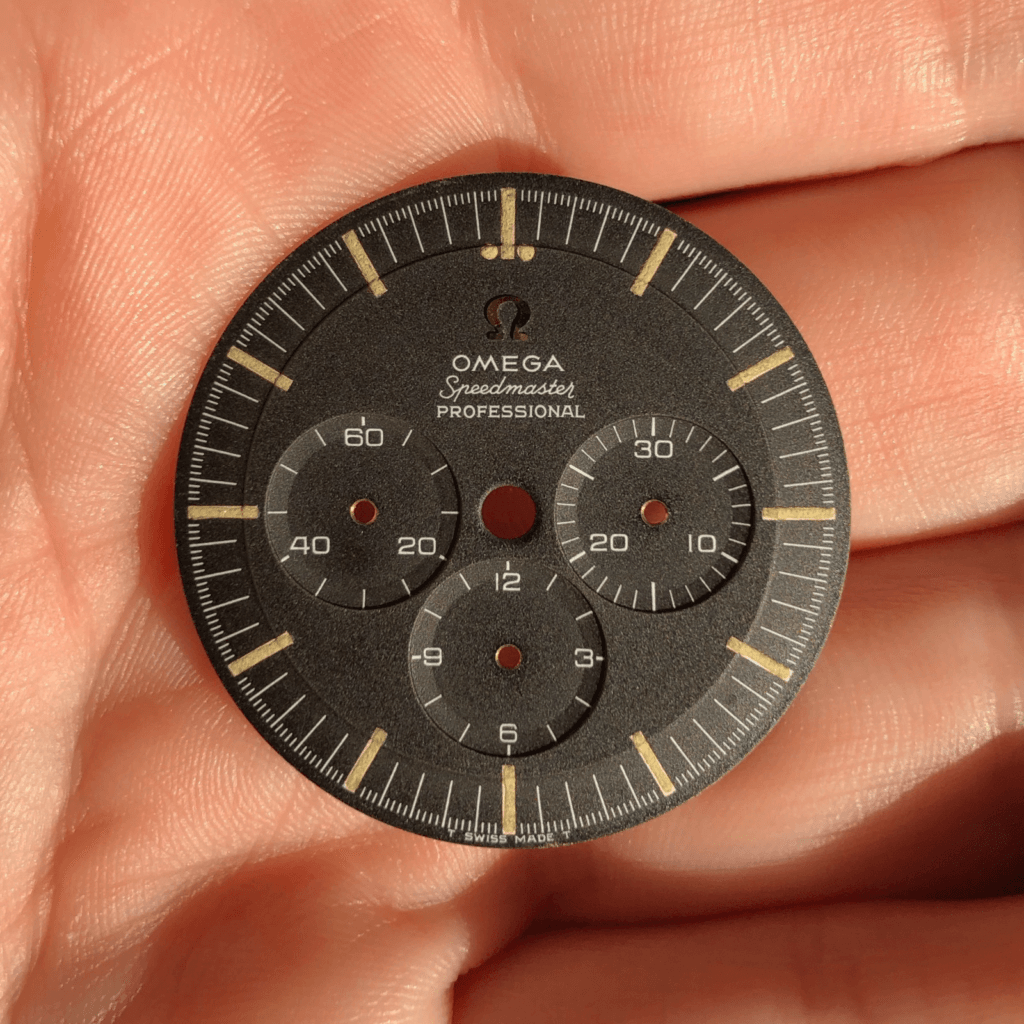
Four dial designations are documented, corresponding to distinct production windows and printing methods. Unlike the Rolex 1680, where Mark designations follow a rough chronological sequence tied to serial ranges, the 105.012 dial taxonomy reflects changes in printing methodology and dial supplier tooling.
B1 (No-T) identification: – The sole dial without tritium designation; carries “SWISS MADE” only at 6 o’clock, no T markers – Found exclusively on the -63 sub-reference (serials 20,520,XXX to 20,526,XXX) – Reflects the industry-wide transition from radium to tritium lume in 1963-1964 – Single-stage print process – The rarest dial variant across the entire 105.012 production
B2 MK1 (Close T) identification: – “T SWISS MADE T” in close-spaced configuration with taller font and minimal serifs – Two-stage print: the base dial is essentially a pre-Professional 105.003 blank to which “PROFESSIONAL” was added as a separate second pressing, creating perceptible variation in ink consistency, positioning, and occasionally shade across individual examples – OMEGA logotype uses a sans-serif font with equal-length strokes on the E and a middle stroke on the G that extends past the center of the letter – Bottom stroke of the E is pinched toward its tip – Non-uniform placement of “PROFESSIONAL” text is the direct artifact of the two-stage process and the single fastest visual identifier under loupe – Found on -64 through early -65 examples
B2 MK2 (Close T) identification: – “T SWISS MADE T” in close-spaced configuration but with shorter font and pronounced serifs; print positioned lower relative to MK1 – Single-stage print: entire dial printed in one pressing, producing consistent “PROFESSIONAL” positioning across all examples – OMEGA logotype carries pronounced serifs; the E has a shorter middle stroke; the G horizontal bar terminates at the letter’s center point rather than extending past it – Produced in a narrow window from approximately April through August 1966 (serial range ~22,827,XXX to ~24,004,XXX) – Armstrong’s watch carries a B2.MK2 dial. This is the “Moon-Spec” dial. – Distinguishable from B2.MK1 under loupe by sub-dial numeral differences: the numeral “2” has a more pronounced curve and shorter overhang; the “3” shows more uniform width across upper and lower portions; the “4” in the running seconds register has a wider flat upper portion with a taller leg
B3 (Spaced T) identification: – “T SWISS MADE T” with wider spacing between the T markers and the SWISS/MADE text – Single-stage print – Typographic identifiers: G with medium-length horizontal bar, S with smaller upper curve, M with pointed first stroke, r with flat terminal curl – Found on late -65 examples (serials 24,533,XXX to 24,537,XXX) and all -66 production – This configuration continues into the 145.012
Smooth sub-dial variant: A rare dial exists on some -64 and -65 examples where the sub-register recesses have a smooth finish rather than the standard cross-hatched (engine-turned) surface. These are exceptional outliers and authenticity should be verified through the Omega Extract of the Archives.
Close-up comparison of B2 MK1 and B2 MK2 dials side by side, showing the OMEGA logotype serif differences, “Professional” text positioning, and sub-dial numeral differences
Luminescence: tritium markings and aging
All 105.012 dials from the -64 onward use T SWISS MADE T tritium markings at 6 o’clock. The -63 predates full adoption of T markings. Tritium has a half-life of approximately 12.3 years; a 1960s 105.012 dial has passed through more than five half-lives, meaning functional glow in darkness is essentially absent.
Under UV illumination at 365-400nm, original aged tritium produces no significant glow, or at most a brief, faint response that fades immediately once the UV source is removed. Modern photoluminescent lume (Superluminova and related compounds) produces bright, sustained glow that persists after the light source is withdrawn. Any dial that glows meaningfully under UV has been relumed.
In natural light, authentic original tritium appears as cream, ivory, or warm beige patina, ranging from light beige on well-preserved examples to deep pumpkin or amber on those with more thermal or humidity cycling. The patina must be consistent across all lume plots on the dial and should match the hands. This consistency of aging across components, analogous to the “coherence” concept in vintage Rolex collecting, is the strongest single indicator of an untampered watch. A 105.012 where the case wear, dial patina, hand aging, and bezel fade all tell the same story will always command more than one where individual components are correct but visibly assembled from different lives.
Hands
The correct handset for the 105.012 is white-painted baton hands with tritium fill for hours and minutes, white-painted stick hands on the sub-registers, and a “drop-end” (also called “spade” or “teardrop”) chronograph center seconds hand with a lume-filled upper spear and rounded counterweight. No broad-arrow or alpha hand configurations appear on 105.012 production. Baton hands are the sole correct set.
The drop-end chronograph hand is the critical identifier. The square-end or flat-end hand that appeared on 145.012 and 145.022 production is the most common service substitution found on 105.012 examples. Hands are physically interchangeable across all Cal. 321 and Cal. 861 references, so the wrong chronograph hand in a 105.012 case is not a mechanical impossibility but a clear sign of service work or parts assembly.
With age, the tritium in the hand lume plots develops the same cream-to-amber patina as the dial. Minor color differences between hands and dial are acceptable, as lume was applied at different times with slightly different thicknesses. Dramatic mismatches (bright white hands against deep ochre dial plots, or the reverse) indicate component replacement.
Crown
The correct crown for all 105.012 sub-references is the “flat foot” type with the Omega symbol (skinny logo) on the crown face. Original crowns have a thick, pronounced neck at their base. Service replacement crowns have thinner necks. Crown replacement is extremely common on serviced examples due to the crown’s exposure and susceptibility to thread wear with decades of use.
Crystal
The 105.012 uses a domed Hesalite (acrylic) plexiglass crystal with the Omega logo embossed at its center, catalogued as the “Type A2” low-dome variant. Acrylic was the deliberate choice for NASA qualification: in the event of an impact, Hesalite cracks rather than shattering into potentially lethal fragments in the zero-gravity environment of a spacecraft. It also scratches rather than cracks in vacuum conditions. Hesalite scratches with routine contact but polishes cleanly with PolyWatch or equivalent. Over-polishing during service can reduce the visibility of the embossed Omega logo and alter the dome profile.
Bezel
The bezel consists of a stainless steel support ring fitted with a black anodized aluminum insert bearing silver-screened lettering. The tachymeter scale is graduated from 60 to 500 units per hour (Base 500). The word “TACHYMETRE” (French spelling) carries an acute accent over the E. The insert measures approximately 39.7mm in diameter and 1.85mm in thickness.
The collector designation “DON” (Dot Over Ninety) refers to the decimal subdivision reference dot placed diagonally above the “O” in the number “90” on the scale. A secondary dot appears diagonally below the “O” in “70.” The DON insert was produced from approximately 1961 through 1970 and is correct for every 105.012 sub-reference. After approximately 1969-1970, the insert shifted to DN90 (dot next to 90, repositioned to the lower right), which is not correct for any 105.012.
DON typographic authentication details: – “TACHYMETRE” with heavy acute accent on E – Flat-topped “A” (not pointed) – Closed, elongated “C” in TACHYMETRE – Numeral “7” in “70” carries an initial vertical serif dash at top left – Numeral “3” carries a serif – Central graduation dash on the scale is slightly shorter than flanking dashes – Large, tall font across the full scale – Dot above 90 is perfectly round, precisely centered, and proportionally sized
“Thin font” examples (crisp, fine lettering from a fresh print die) command a premium over examples where the die was worn. Natural fading of the black aluminum insert toward grey or brown is authentic and expected on examples with significant wrist time.
Bracelet and endlink references
Original bracelets for the 105.012 are flat-link construction with folded metal plates and semi-expanding links in three-row configuration (two narrow outer links flanking a wide center link). The 1039 bracelet uses internal expanding springs in the links; to size it, a middle plate is slid out to unhook individual links rather than using push-pins or screws.
| Bracelet Ref. | End Link | Production Period | Applicable Sub-References | Identification Notes |
|---|---|---|---|---|
| 7912/16 | 16 (20mm) | 1964 | -63, very early -64 | Earliest correct bracelet; clasp date-stamped Q/YY |
| 1506/16 | 16 (20mm) | 1964-1966 | -63, -64, -65, -66 | Most commonly encountered original on -64 and -65 |
| 1039/516 | 516 (20mm) | Q4 1966 to early 1972 | -65, -66 | Most prevalent; Aldrin’s bracelet dated 2/67 with 516 end links |
| 1116/575 | 575 (20mm) | 1968-1972 | -66 | Documented for late -66 through 145.012 |
All bracelets carry a production date stamp on the clasp in quarter/year format (e.g., “4/66” = Q4 1966). The 1039 clasp is stamped “ST 117 STEEL 1039” with the Omega signature. Manufacturing date typically runs one to two years ahead of watch head production date on correct examples. USA-market watches sometimes carried 47 end-links rather than the standard 516.
Collector note: Original period bracelets for the 105.012 are described by contemporary dealers as “impossible to find in good condition.” All folded-link bracelets from this era are prone to stretch and fatigue. Even a stretched example contributes more to a complete set than an absent bracelet, but stretch must be factored into condition assessment. A clasp date that postdates the watch head is commonly explained by service replacement and is acceptable when the replacement is still period-correct.
The tropical phenomenon
The 105.012-65 in particular is associated with some of the most dramatic tropical dial examples in the entire Speedmaster lineage. Tropical coloration ranges from warm honey/amber to deep chocolate-brown, produced by the interaction of original dial lacquer with UV light and humidity over decades. Watches worn daily in warm, sun-exposed climates are disproportionately represented among known tropical examples.
Authentic tropical dials show the color change uniformly across the dial surface with intact lacquer and consistent patination across lume plots, hands, and dial surface. Brown coloration concentrated around seams, the crystal gasket area, or the crown tube suggests moisture ingress rather than UV-induced tropical fading. Tropical 105.012 examples command significant premiums, particularly when the patina is even and the dial lacquer remains glossy and continuous.
Example of a 105.012-65 with tropical dial showing warm amber/brown color change and matching tritium patina on hands
Full variant matrix
| Period / Sub-Ref | Serial Range | Case Bevel | Case Mfr | Clutch Bridge | Dial | T-Mark | Caseback Stamp | Primary Bracelet(s) |
|---|---|---|---|---|---|---|---|---|
| -63 (1964) | 20,520,XXX to 20,526,XXX | Double | HF | Symmetric (common) or asymmetric | B1 No-T | “SWISS MADE” | S 105.012-63 | 7912/16 |
| -64 (1964-1966) | 20,527,XXX to 22,825,XXX | Double | HF | Asymmetric | B2 MK1 Close T | T SWISS MADE T (close) | S 105.012-64 | 7912/16, 1506/16 |
| -65 early (Q1-Mar 1966) | 22,825,XXX to ~22,882,XXX | Double | HF (MK1 case) | Asymmetric | B2 MK1 Close T | T SWISS MADE T (close, taller) | S 105.012-65 | 1506/16 |
| -65 mid “Moon-Spec” (Apr-Aug 1966) | ~22,827,XXX to ~24,004,XXX | Double | HF (MK1.5 thin) | Asymmetric | B2 MK2 Close T | T SWISS MADE T (close, serif) | S 105.012-65 (to ~24,014,XXX) | 1506/16 |
| -65 late (Aug 1966-Q1 1967) | ~24,004,XXX to 24,527,XXX | Double | HF (MK1 returns) | Asymmetric | B2 MK1 (reverts) | T SWISS MADE T (close) | 105.012-65 (no S) | 1506/16; 1039/516 |
| -65 terminal (Q1 1967) | 24,533,XXX to 24,537,XXX | Double | HF | Asymmetric | B3 Spaced T | T SWISS MADE T (spaced) | 105.012-65 | 1039/516 |
| -66 HF (1967-1968) | 24,066,XXX to 26,554,XXX | Single | HF | Asymmetric | B3 Spaced T | T SWISS MADE T (spaced) | 105.012-66 | 1039/516; 1116/575 |
| -66 CB (1967-1968) | ~24,066,XXX to ~26,554,XXX | Single | CB | Asymmetric | B3 Spaced T | T SWISS MADE T (spaced) | 105.012-66 + CB | 1039/516; 1116/575 |
The -65 and -66 serial ranges overlap because Omega allocated movements from common production pools without strict reference-specific sequencing. Only opening the caseback and reading the reference stamp resolves which sub-reference a given watch belongs to.
Movements and calibers
Caliber 321: the column-wheel chronograph
Every 105.012 is powered by the Omega Caliber 321, and the movement’s architecture is inseparable from the watch’s collector significance and market premium. The 321 is not merely the correct movement for the reference; it is one of the primary reasons collectors pay a substantial premium over the mechanically simpler 145.022/Cal. 861 alternative. The column wheel’s rotating pillars trip the chronograph functions with mechanical precision and tactile engagement that cam-operated movements cannot replicate, and the Breguet overcoil hairspring provides chronometric advantages over flat springs.
| Specification | Value |
|---|---|
| Caliber designation | Omega 321 (Lemania CH27 C12 / Lemania 2310 ebauche) |
| Type | Manual-wind, column wheel, lateral clutch chronograph |
| Diameter | 27.00mm |
| Height | 6.74mm |
| Jewels | 17 |
| Frequency | 18,000 vph (2.5 Hz) |
| Power reserve | Approximately 44 hours |
| Balance spring | Breguet overcoil |
| Shock protection | Incabloc |
| Escapement | Swiss lever |
| Lift angle | 40 degrees |
| Functions | 60-second chronograph, 30-minute counter at 3, 12-hour totalizer at 6, running seconds at 9 |
| Production period | 1946 to 1968 |
The 321’s origins trace to the Lemania 27 CHRO C12, designed by Albert-Gustave Piguet at Lemania in 1942 and commercially introduced as the Lemania 2310. Omega adopted the caliber in 1946 with upgraded finishing versus the base Lemania ebauche. The movement received a galvanic copper/rose gold coating, a production detail that is itself an authentication marker (as discussed in the authentication section). The 321 also powered the CK2915 (1957), CK2998, 105.002, 105.003, and 145.012. Its ebauche was simultaneously used by Patek Philippe (caliber CH27-70 in the reference 5070), Vacheron Constantin, Breguet, and Audemars Piguet.
The early clutch bridge variation
105.012-63 examples frequently carry the “symmetric” clutch bridge, a configuration common to earlier Speedmaster movements. Subsequent sub-references consistently use the “asymmetric” bridge. Some -63 examples have been observed with the asymmetric bridge, indicating the transition was not absolute. A -63 with the symmetric clutch bridge is the more historically significant configuration.
Caliber comparison with successor
| Feature | Cal. 321 (105.012) | Cal. 861 (145.022 successor) |
|---|---|---|
| Chronograph switching | Column wheel (monobloc) | Cam and shuttle |
| Frequency | 18,000 vph | 21,600 vph |
| Balance spring | Breguet overcoil | Flat |
| Clutch | Horizontal (lateral) | Horizontal (lateral) |
| Production | 1946-1968 | 1968 onward |
| Serviceability | ~$2,000 at Omega, 9-month turnaround | Widely serviceable, lower cost |
Omega discontinued the 321 in 1968. Its replacement, the Caliber 861 (Lemania 1873 base), was simpler to produce and service, timed to meet surging post-Apollo demand. In 2019-2020, Omega re-introduced the Caliber 321, reverse-engineered from the second-generation 321 found in Gene Cernan’s Speedmaster 105.003 held at the Omega Museum in Bienne.
Authentication guide
Authentication priorities in order of fraud frequency and value impact
- Movement: A 105.012 containing a Caliber 861 is either a major service error or a franken assembly. The 321 runs at 18,000 vph versus the 861’s 21,600 vph, audible as a slower tick. Movement serial must fall within the correct range for the caseback reference stamp.
- Dial: Correct step construction, applied Omega logo, and correct variant designation for the sub-reference. Refinished dials are common and cut value severely.
- Case: Bevel type (double vs. single) must match the sub-reference. Pusher profile and caseback stampings are the fastest external checks.
- Hands: Drop-end chronograph hand is definitively correct; square-end indicates service swap from 145.012/145.022.
- Bezel: DON configuration with correct typographic characteristics. Reproductions are widespread and have accumulated enough age to resist casual visual authentication.
- Bracelet: Cross-reference bracelet model and clasp date against production period.
Dial authentication
The single most consequential authenticity question after movement identity is whether the dial is original. A refinished dial presents as overly crisp and bright, with white text inconsistent with the age of the case and movement. Under loupe, examine the transitions between printed text and dial surface. Original dials show slight consistency variations in the minute track printing; refinished examples have an artificially uniform appearance. The step transition from outer track to recessed center should be sharply defined on original dials and can show softening where refinishing compound has partially filled the ledge.
The applied Omega logo should be three-dimensional with precise solder points at its base. Examine the solder joints under magnification; aftermarket replacements show coarser attachment. UV testing is definitive for lume authentication (as described in the luminescence section above). The tritium patina consistency between dial plots and hands remains the strongest overall indicator of an untampered watch.
Case authentication
On an unpolished 105.012, polishing damage manifests as loss of edge definition on the lug profile, rounding of the bevel between caseback and case sides, blurring of the transition between polished chamfers and brushed flanks, and softening of the crown guard shoulders. On CB -66 cases, destruction of the lug facet ridge is the primary and irreversible indicator of aggressive polishing.
An overpolished case shows uniformly bright surfaces without visual contrast between finishing planes. The hippocampus circle on the caseback exterior should be sharp and precise. The MK1.5 thin case variant on mid-production -65 examples can be confirmed by caliper measurement of the caseband (3.42mm versus the standard 3.85mm).
Movement authentication
The vintage Caliber 321 carries a distinctive warm copper-colored finish across its bridges and plates, the result of period copper plating. The modern 2020 Omega Caliber 321 reissue uses Sedna gold plating, a different, warmer gold hue. Any movement displaying silver, rhodium, or modern gold finish in a purportedly original 105.012 is not a period-correct 321.
The Omega name is signed on the main plate and the serial is engraved on the escape wheel bridge. An absent or blank number bridge is a definitive indicator the movement has been worked on as a parts source. USA-market examples often carry an “OXG” import code on the movement bridge.
The column wheel is machined from a single piece (monobloc). Column wheel teeth should be complete and undamaged; this part is no longer available from Omega. The coupling arm and lateral clutch are the most critical irreplaceable functional components. The Extract of Archives from the Omega Museum remains the only definitive confirmation tool for movement-case concordance. If Omega declines to provide information or returns no match, this is a strong indicator the movement has been placed in an incorrect case.
Bezel authentication
The DON bezel commands $2,000-$3,000 standalone for good originals, which has driven extensive reproduction activity. Two known high-quality replica types circulate. The “Canadian” type presents overly thick font without serifs on the “3” and incorrectly placed dots, failing under loupe on font weight and serif analysis. The “San Francisco” type collapses on font comparison and dot proportions relative to the scale markings. Because reproductions have circulated long enough to accumulate patina, UV-aged appearance alone is insufficient to authenticate. The relationship between printing elements, serifs, and dot positioning under loupe remains the most reliable test.
Common frankenwatch configurations
Dial swaps with 105.003 and 145.012: Dial feet and apertures are physically compatible across the 105.003, 105.012, 145.012, and early 145.022. A 105.003 dial in a 105.012 case is detectable by the absence of “PROFESSIONAL.” A 145.012 dial shows subtly shorter minute indices at the outer step. 145.022 transitional dials (step dial with AOL) show even shorter minute indices after the step transition.
Hand cross-reference: The square-end chronograph seconds hand from 145.012/145.022 production appears frequently in 105.012 cases as a service replacement. This is the single most common parts substitution on the reference. The drop-end hand is definitively correct.
Movement swaps and the Lemania problem: The Cal. 321 shares its Lemania architecture with movements branded for Patek Philippe, Audemars Piguet, Vacheron Constantin, and others. Lemania movements transplanted into Speedmaster cases present in a different finish color (not copper tone) and carry Lemania rather than Omega signatures. The Extract of Archives is the only definitive resolution.
The 145.0012 service case: Omega supplied service case reference 145.0012 for Cal. 321 movements requiring case replacement. Watches assembled in this service case using 105.012 movements are occasionally presented as original. The caseback reference is immediately identifiable on opening.
Authentication note: The concept of coherence applies directly to the 105.012. A watch where the case wear pattern, dial patina, hand lume color, bezel fade, and bracelet stretch all tell a consistent story of six decades of shared use is worth materially more than one where each component passes individual authentication but the assembly has clearly been composed from multiple donors. The combination of an unpolished case (HF with clean lug geometry, or CB with intact facet ridge), original mushroom pushers and flat-foot crown, correct-era DON bezel, original step dial with consistent tritium patination across hands and markers, and a period-appropriate bracelet with matching clasp date constitutes a reference-grade 105.012 configuration.
Market positioning and pricing
The premium structure
The 105.012 market is driven by three overlapping factors: the Apollo 11 documentary connection, the Caliber 321’s mechanical prestige, and the scarcity of truly original examples after six decades of service, parts swapping, and component degradation.
Within the reference, the highest demand concentrates on the 105.012-65 “Moon-Spec” batch (B2.MK2 dial + MK1.5 thin case, serials ~22,827,XXX through ~24,004,XXX), which carries a documentary connection to the specific specification worn by Armstrong. These were produced during a 90-day window in mid-1966, and knowledgeable collectors pay a confirmed premium for examples with verified production dates from the Omega Museum.
The -63 commands attention as the original asymmetric Professional Speedmaster with the “SWISS only” dial and likely fewer than 2,000 units produced. The -66 CB case with intact facet edge represents a distinct condition tier within its sub-reference, though it does not reliably command a premium over equivalent HF examples.
The DON bezel adds $1,700-$4,000 to value depending on condition and font quality. Tropical dials from any sub-reference command significant premiums. Complete sets (box, papers, correct period bracelet, Extract of Archives) contribute 30-50% above watch-only pricing. Cal. 321 service at Omega Bienne costs approximately $2,000 with a nine-month turnaround; examples clearly needing service are priced accordingly, and the service timeline is a practical consideration that affects liquidity.
Current market pricing (USD, collector-to-collector, mid-2025)
| Sub-Reference | Fair | Good | Very Good | Excellent |
|---|---|---|---|---|
| 105.012-63 (SWISS only) | $3,800 | $6,400 | $11,500 | $18,000 |
| 105.012-64 | $3,500 | $6,400 | $11,500 | $18,000 |
| 105.012-65 | $3,500 | $6,400 | $11,500 | $18,000 |
| 105.012-66 | $3,800 | $6,400 | $11,500 | $20,000 |
Exceptional examples with tropical dials, documented provenance, or confirmed Moon-Spec configuration can command 100% or more over standard excellent pricing. Dealer asking prices for correctly presented -66 examples with Extracts reach $20,000.
Five-year price trend
The 105.012 followed the broader vintage watch market trajectory through the pandemic era, but with notable resilience at the top end. In 2017, typical sales ran $7,500-$8,300 for correct examples. The 2019-2021 period saw significant appreciation driven by the Apollo 11 50th anniversary, Omega’s relaunch of the Caliber 321, and increased media attention; some examples peaked well above $20,000.
The 2021-2023 correction brought moderate retreat from peak levels market-wide, but the 105.012 demonstrated the quality-sensitivity pattern visible across all vintage collecting categories: franken and restored examples lost ground sharply, while correct, original examples held value with minimal erosion. By 2023-2025, UK dealer pricing has settled around GBP 12,000 (~$15,000-$16,000) for standard correct examples. The market is now acutely quality-aware, and the spread between a franken 105.012 and a reference-grade original has widened considerably.
Rarity and survival rates
With approximately 24,000-24,500 total units produced 57-63 years ago, survival with fully original components is rare. Most dealer-offered examples fall into the “fair” to “good” category. Fully original, unpolished, all-correct examples with matching patina across all components represent a small fraction of total survivors. The Caliber 321 itself was produced in an estimated 18,000 to 20,000 total units across its full 22-year run across all Omega and non-Omega applications, confirming that 321-equipped watches collectively represent a scarce pool.
Comparative pricing
| Reference | Approx. Price (Excellent) | Key Differentiator |
|---|---|---|
| 105.012 | $11,500-$20,000 | The Moon reference; Cal. 321; first asymmetric Professional |
| 105.003 “Ed White” | $8,000-$15,000 | Straight-lug; Cal. 321; pre-Professional |
| 145.012 | $8,000-$14,000 | Final Cal. 321; taller pushers |
| 145.022-68 (transitional) | $8,000-$10,500 | Step dial with Cal. 861; closest visual match |
| 145.022 (standard) | $4,000-$7,000 | Cal. 861; greatest supply; most accessible entry |
Wearability and collector standing
Case size and modern wearability
The 42mm diameter, 14mm thickness, and 48mm lug-to-lug configuration performs well across a broad range of wrist sizes. The lyre lugs curve downward and conform naturally to wrist curvature, reducing effective perceived size relative to straight-lug designs of the same diameter. On a 7-7.5 inch wrist the 105.012 feels appropriately proportioned, and the compact lug-to-lug keeps it practical on wrists from around 6.5 inches upward. The asymmetric crown guard does not intrude on the back of the hand. Several published wrist reviews describe the watch as wearing smaller than its 42mm specification suggests, with the lyre lugs credited for the compact feel.
Durability and practical considerations
The 105.012 is effectively not water resistant by modern standards. Vintage seals have degraded over six decades; even a recently serviced example provides only nominal splash resistance. Submersion and significant rain exposure should be avoided without exception. The Hesalite crystal scratches with routine contact but polishes cleanly, and unlike sapphire, will not shatter on impact.
The Cal. 321 winding mechanism is smooth and the column-wheel chronograph action has a tactile character that modern cam-switched calibers do not replicate. This is not nostalgia; the mechanical feel of engaging a column wheel chronograph is qualitatively different from a cam system. The primary practical constraint for regular wear is service cost and turnaround: approximately $2,000 per service with a nine-month Omega wait. Many experienced collectors rotate the 105.012 with other pieces rather than wearing it exclusively.
Collector sentiment
The 105.012 sits at the apex of the Speedmaster value hierarchy among all non-exceptional references. It prices above the 105.003, above the 145.012, and well above any 145.022. Within the 145.022 group, the transitional -68 with applied logo and DON bezel is the closest approach but trades at less than 60% of a comparable 105.012.
Omega has historically marketed the 145.022 with Cal. 861 as “the first watch worn on the Moon,” a claim accurate only in the sense that a Speedmaster Professional was worn on the Moon, not that the 145.022/861 combination was. This distinction is well understood by serious collectors and drives the persistent premium. For buyers who prioritize the Caliber 321 specifically, the 105.012 and 145.012 represent the only period-correct Speedmaster Professional expressions.
The 145.022 does offer genuine practical advantages: greater parts availability, lower service costs, more bracelet options, and a much wider selection of original good-condition examples. A 145.022-69 with DON bezel in excellent condition at approximately $10,500 delivers much of the visual authenticity of the Pre-Moon era at roughly half the price. The 105.012 is for the buyer who wants the actual historical artifact, not the commercially marketed descendant.
The succession: references 145.012 and 145.022
The reference 145.012, introduced in 1967, was a refinement rather than a redesign. It shares the 105.012’s case architecture, dial construction, and Caliber 321 movement but incorporates taller pusher caps with threaded attachment into the case middle, improving action through EVA gloves. The 145.012 was the final Caliber 321 Speedmaster reference, produced through 1968 with some examples delivered in 1969. It accompanied astronauts on Apollo 7 through 11; Michael Collins wore one in lunar orbit during Apollo 11.
The reference 145.022 entered production in 1968 and introduced the Caliber 861, replacing the column wheel with a cam-switching mechanism and raising the frequency to 21,600 vph. Initial “transitional” 145.022-68 examples retained the step dial and applied Omega logo of the Cal. 321 models but housed the new movement, giving them a visual continuity that many collectors value as the closest accessible approximation to the Pre-Moon aesthetic. From 1969 onward, the dial adopted a printed Omega logo, the bezel changed from DON to DN90, and the caseback received the engraving “THE FIRST WATCH WORN ON THE MOON,” a commercially motivated inscription applied to a reference that had never itself reached the lunar surface.
The 145.022 would remain in production through 1988 (as the 145.0022). Its case architecture, dial layout, and overall proportions are continuous with the 105.012 lineage.