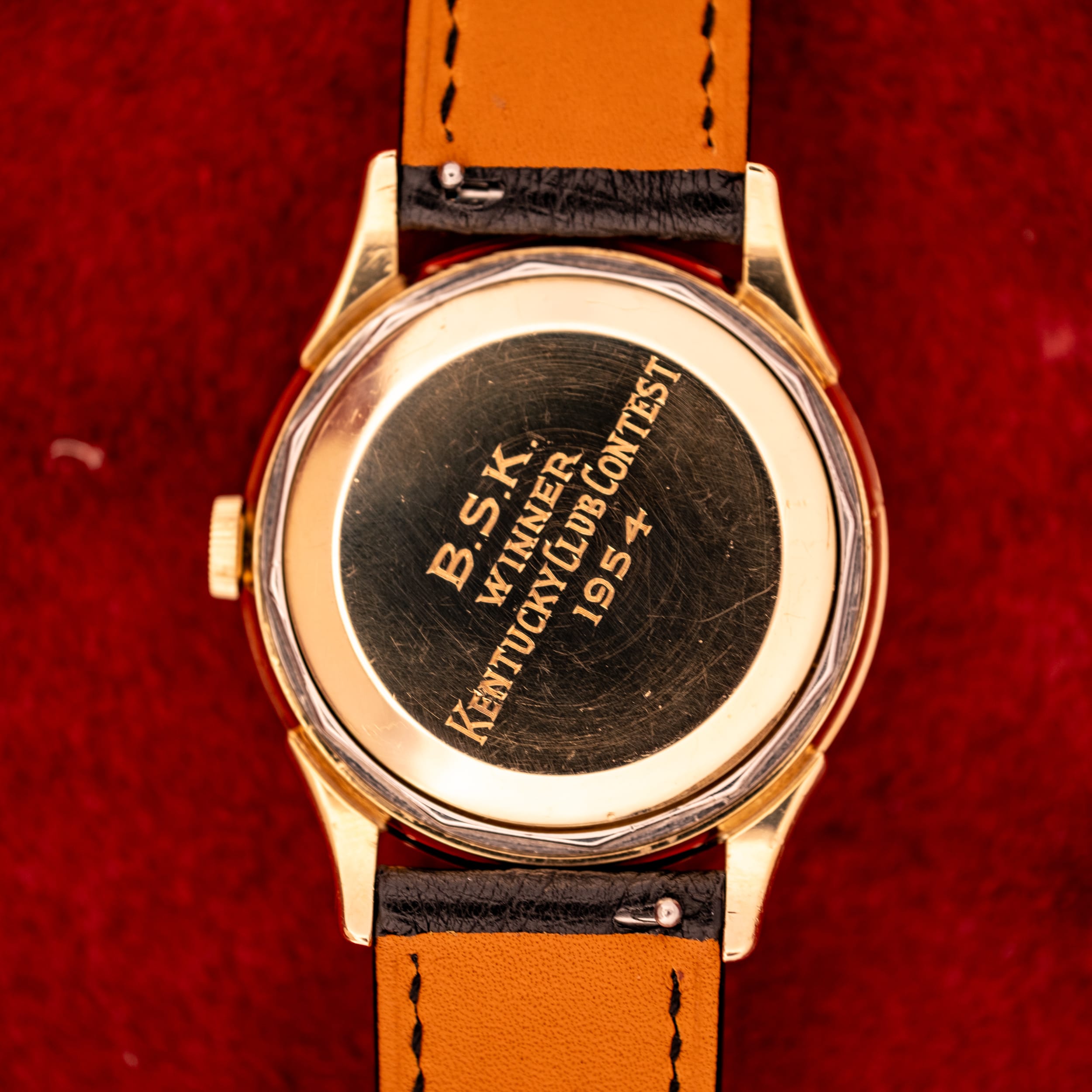
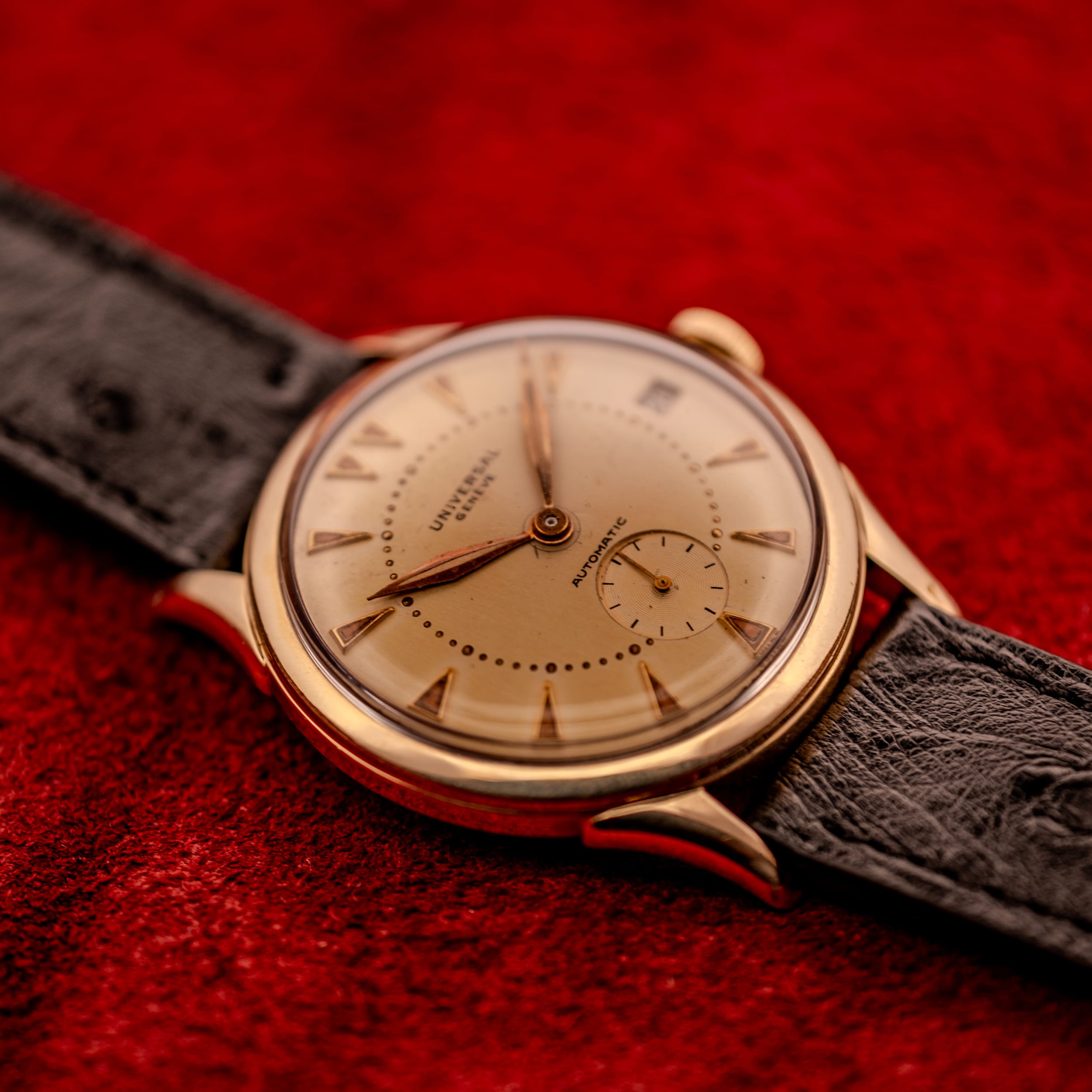
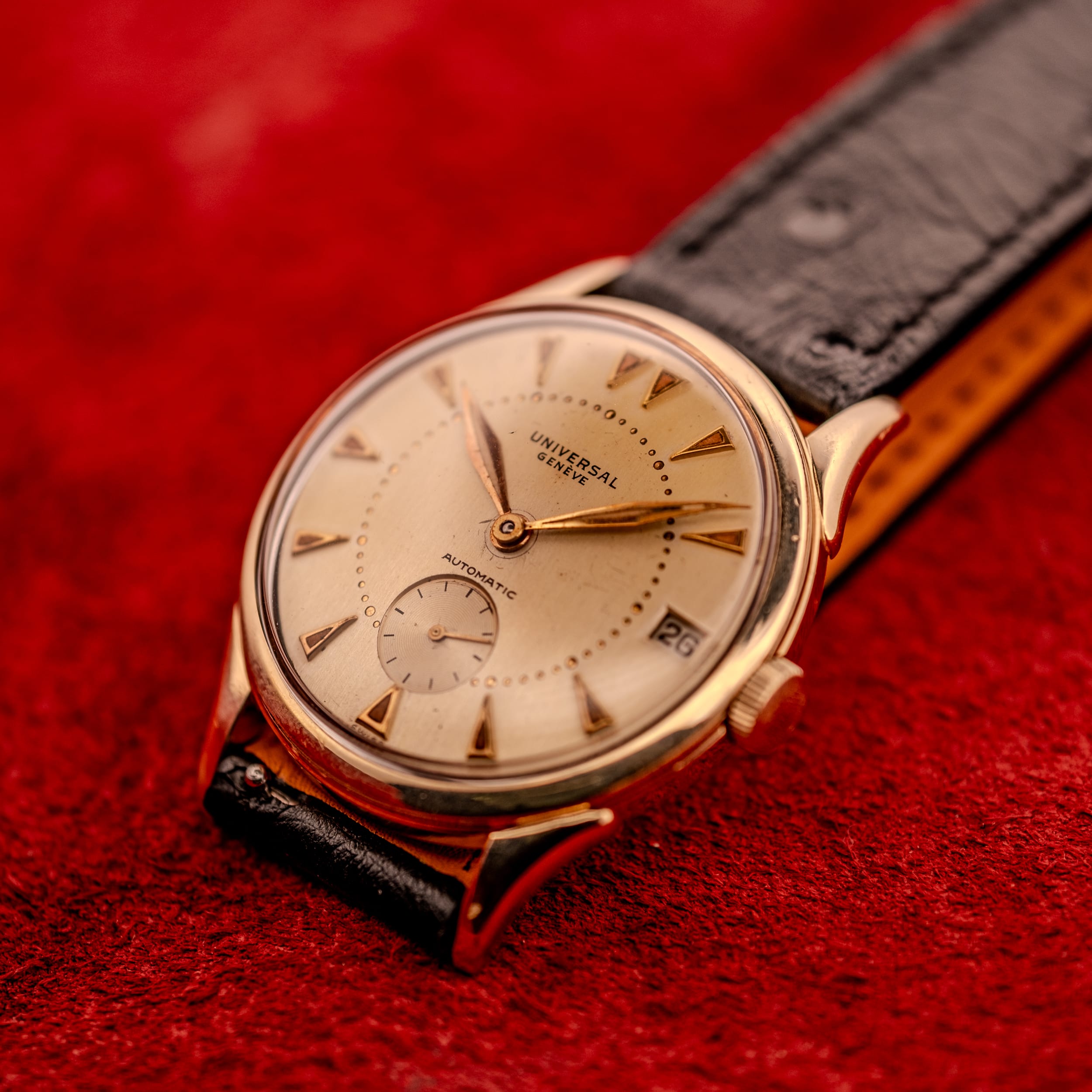
Engraved on the outer caseback, in period serif: B.S.K. WINNER KENTUCKY CLUB CONTEST 1954. That one line of period personalization anchors the entire watch to a specific year, a specific city, and a specific moment when a Swiss-finished bumper movement and an American-stamped Wadsworth case met in the middle for the US market. To us, this is one of the quietly charming Universal Geneves we have handled this year, in our opinion the kind of piece a collector finds once and never forgets, with a caliber 138C bumper that runs as cleanly today as the catalogue promised in 1954.
Universal Geneve in 1954 was a fully independent Genève manufacture, finishing every caliber it built and selling at the price point of Omega and Longines while delivering work that today reads closer to Patek and Audemars from the same year. The brand spent the late 1940s and early 1950s perfecting bumper automatics in the 138 family, the calibers that taught Universal everything it would later pour into the 1954 Polerouter and the Polerouter Microtor. The 138 family is the bumper line that came before the Polerouter, and the distinction matters to collectors who care what was actually beating inside the case.
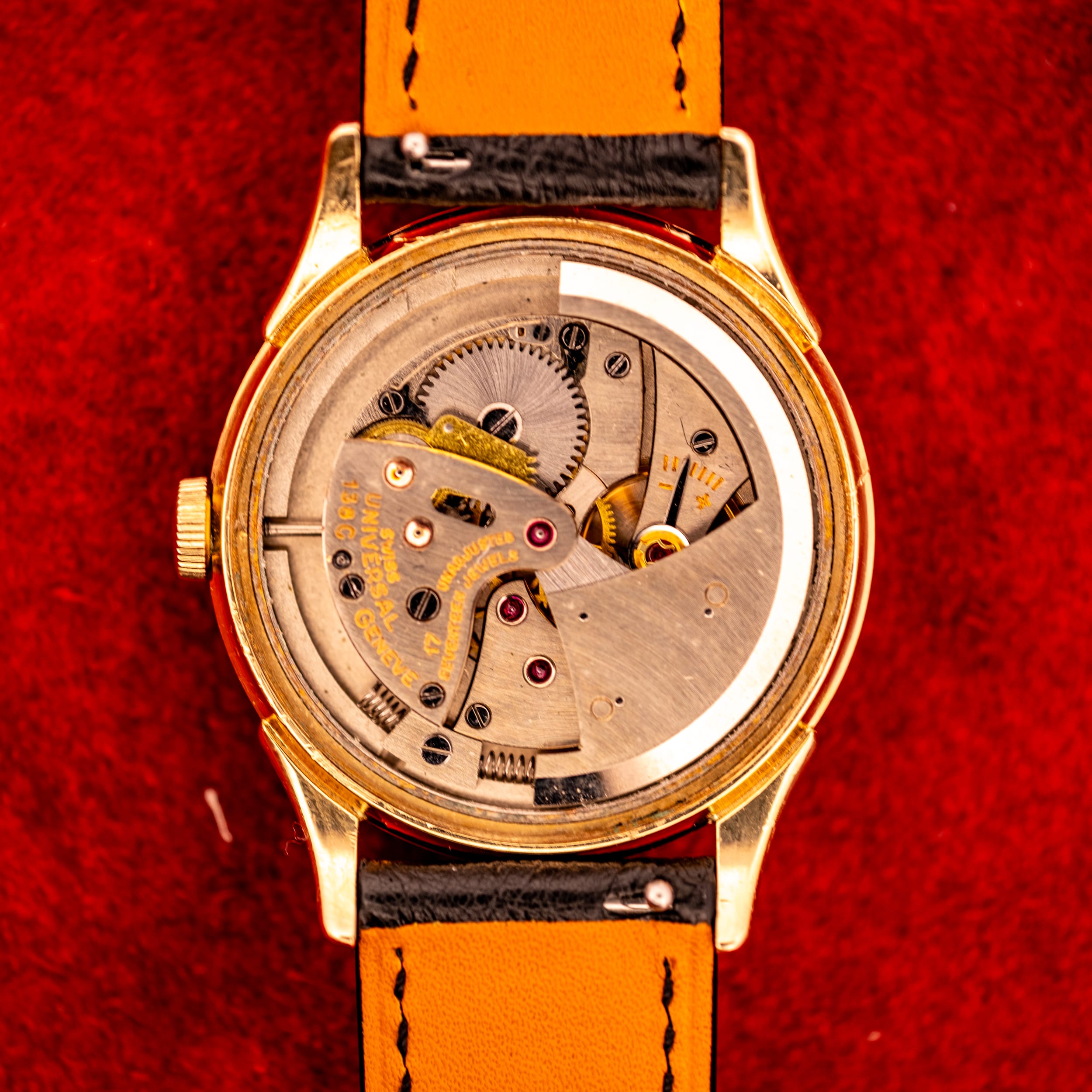
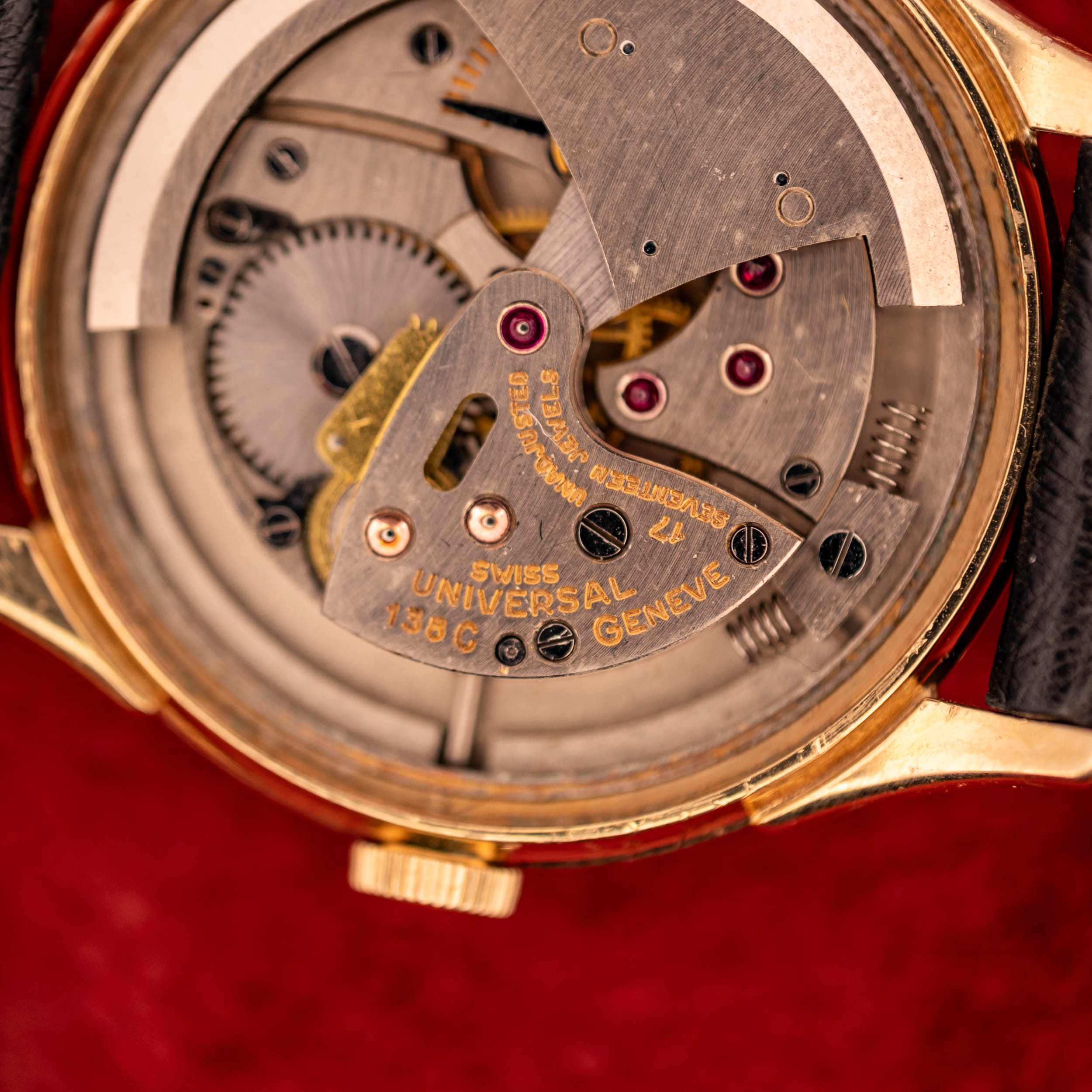
The caliber is the Universal Geneve 138C, in production from 1948 through 1955 and signed across the bridge exactly that way. Our service photograph shows the bridge stamped SWISS / UNIVERSAL GENEVE / 138C with seventeen jewels visible across the train. The 138C is a bumper automatic, meaning the winding mass is a half-rotor that swings against two spring buffers on either side of its arc rather than rotating a full three hundred and sixty degrees, the architecture that defined Universal automatics across the 1940s and early 1950s before the brand pivoted to full-rotor and microrotor designs. The movement runs at 18,000 vibrations per hour with a roughly thirty-six hour power reserve, the bumper weight is signed UNIVERSAL GENEVE across its curve, and the 138C adds a calendar wheel and a sub-seconds register at six. The caseback engraving fixes this example firmly to 1954, the same year Universal launched the Polarouter and effectively closed the bumper chapter. To us, the 138C is the caliber that finished the prewar Universal idea and handed the brand to its postwar identity. (OTTUHR)
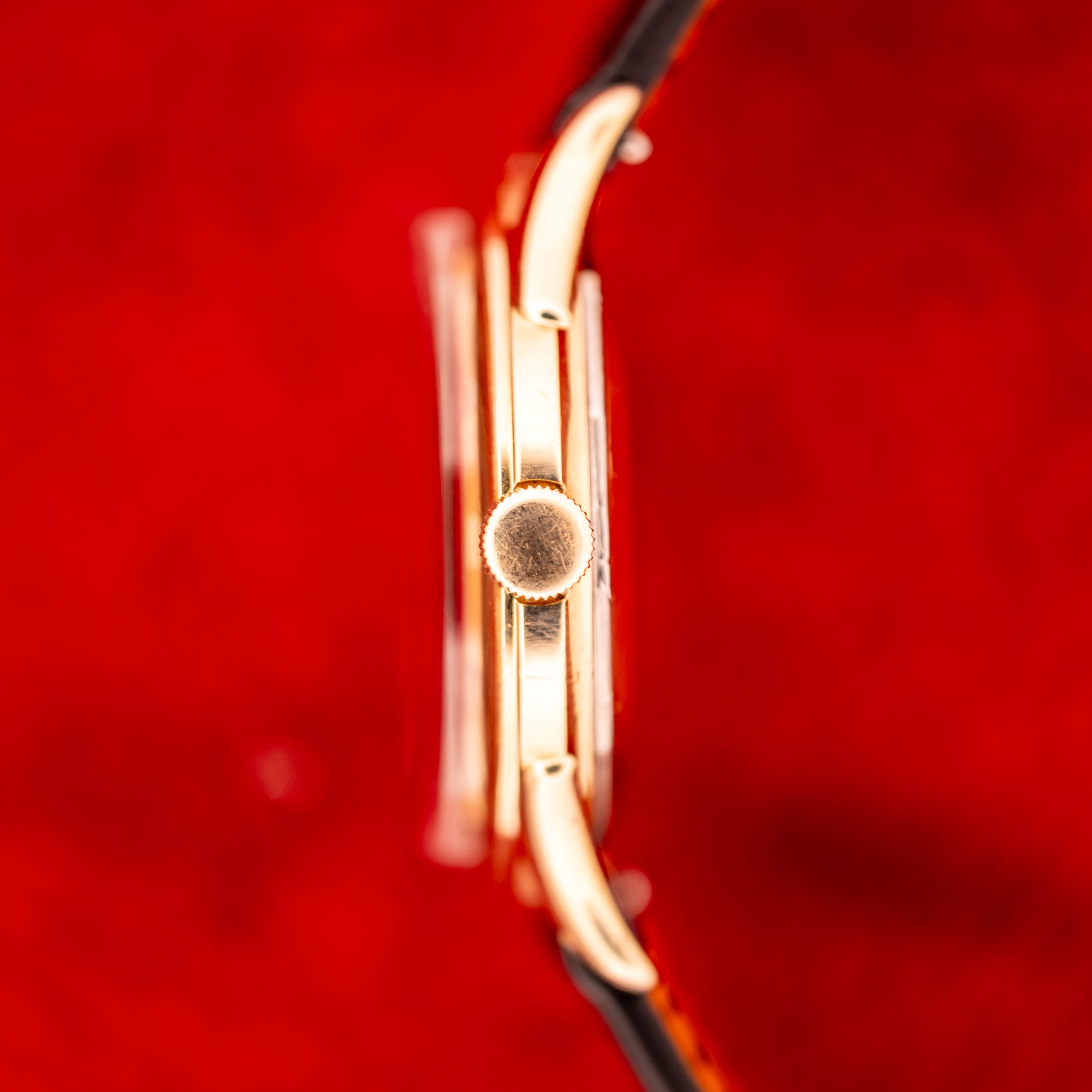
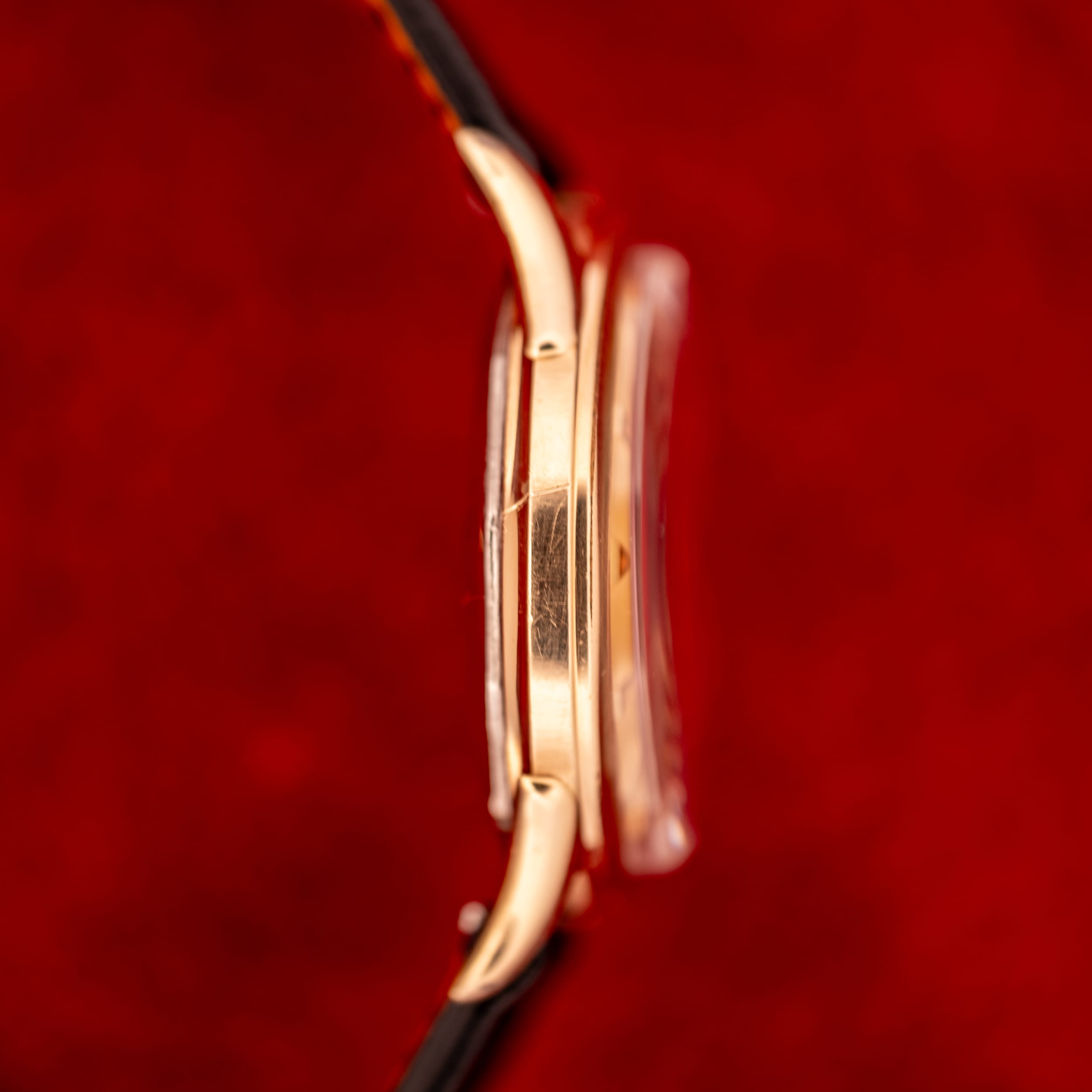
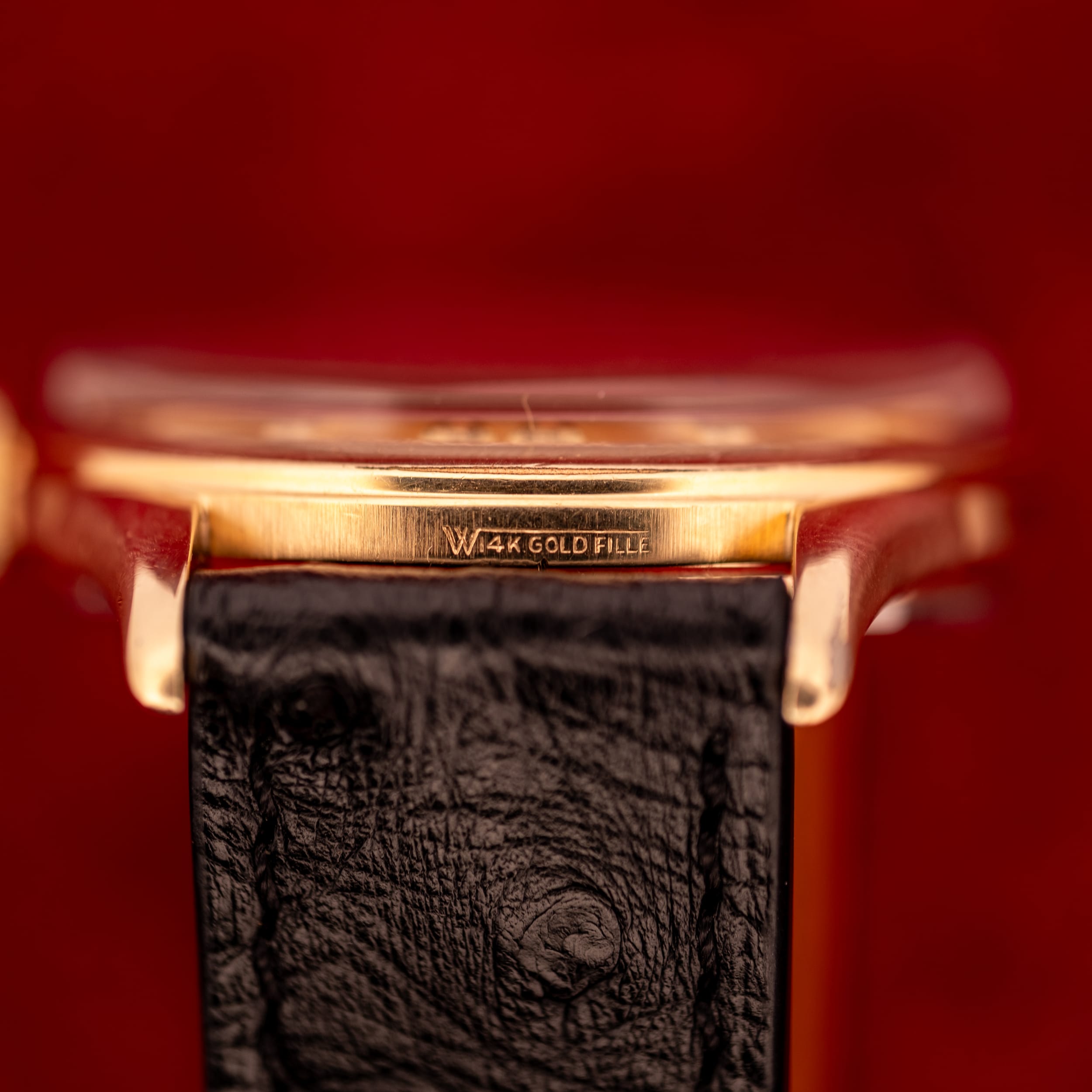
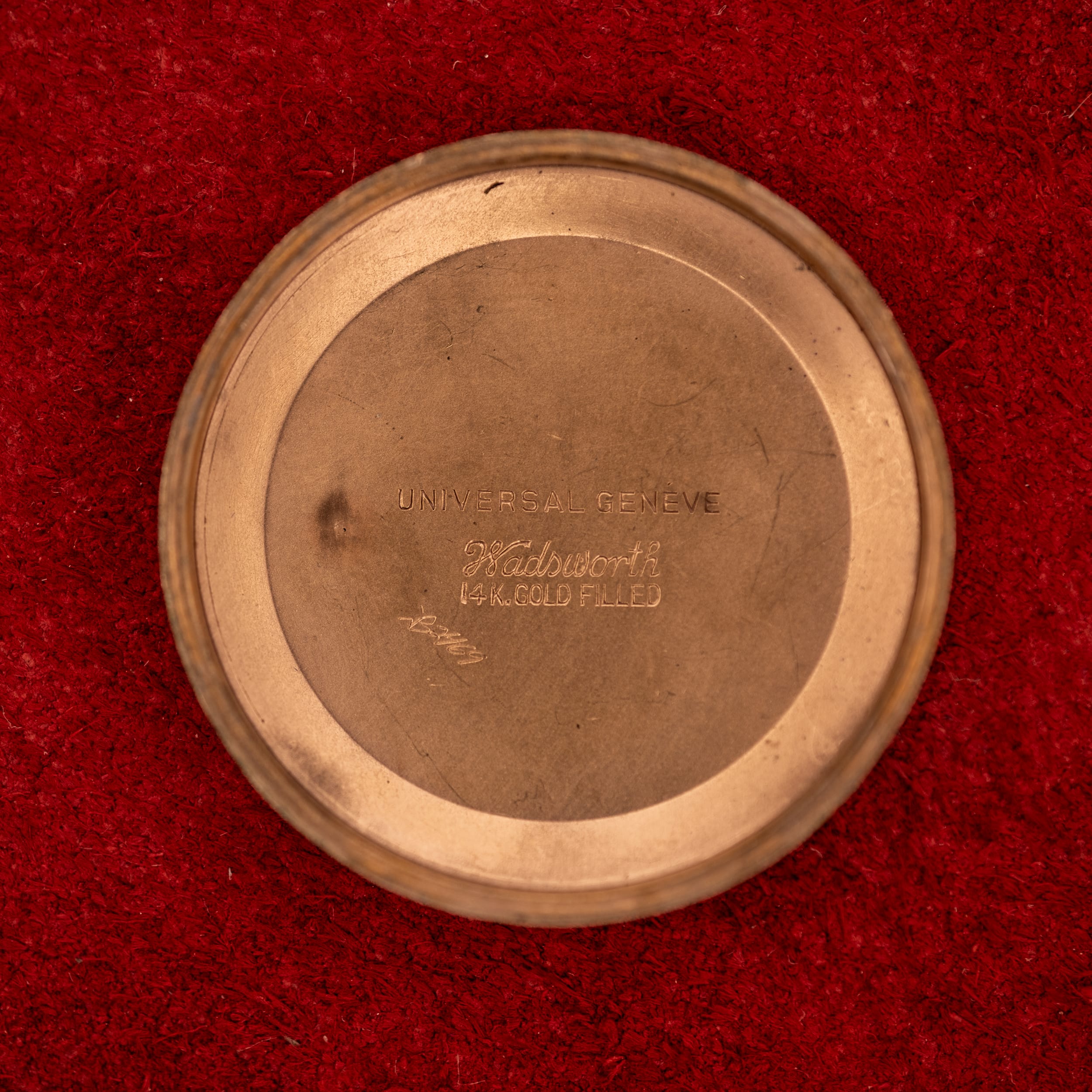
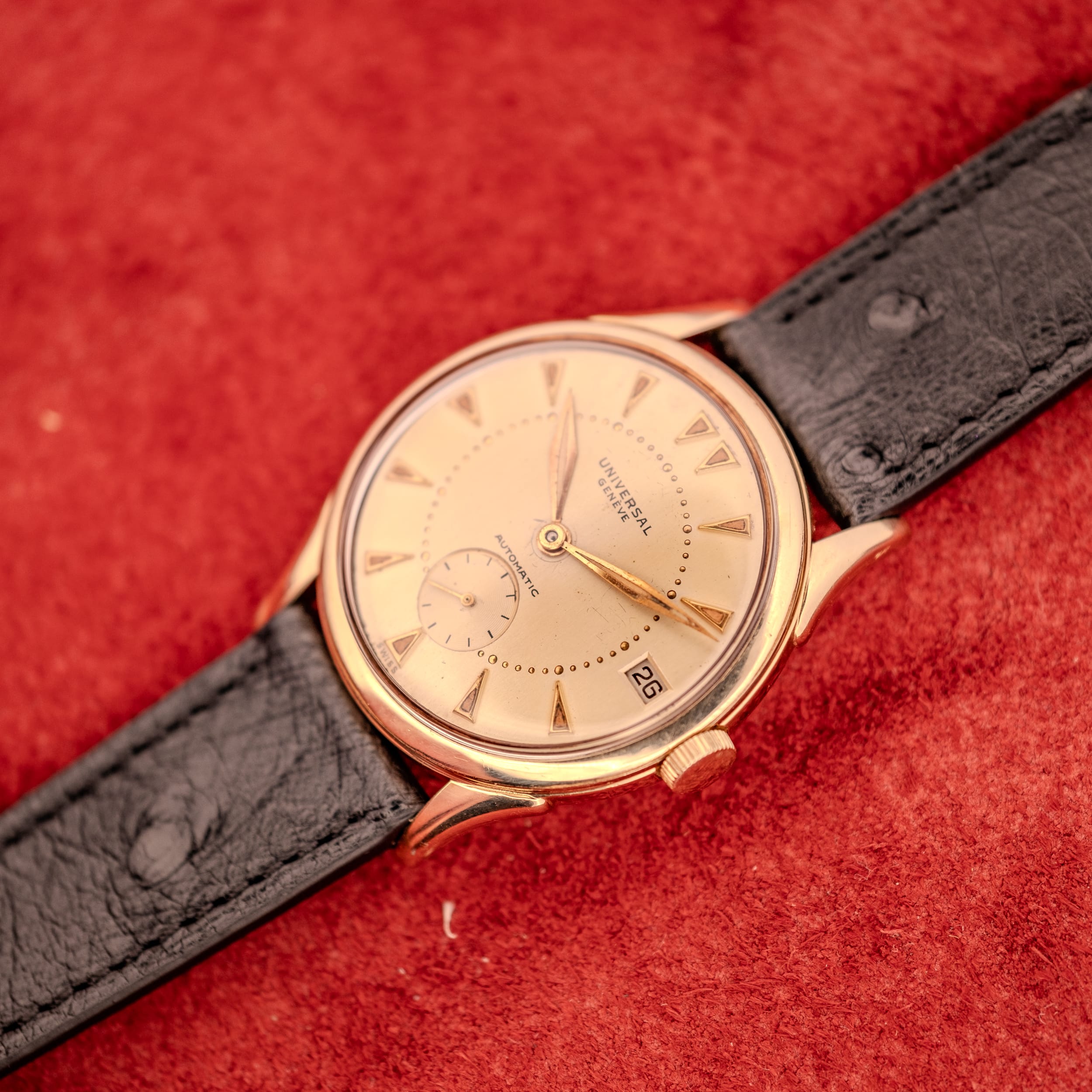
The case is where the American chapter lives. A round 14k gold-filled outer case measures 34mm across with a 41mm lug-to-lug span and an 18mm lug width, long scrolling tear-drop lugs flowing from the case band rather than sitting on top of it. The outer caseband is stamped W 14K GOLD FILLED, the W being the maker mark of the Wadsworth Watch Case Company of Dayton, Kentucky, who supplied gold-filled and solid gold cases to most of the Swiss brands selling into the American market through the 1950s. Gold-filled means a thick layer of solid 14k gold metallurgically bonded to a base metal core, the build that wears across decades rather than rubs off across years, not to be confused with the thinner plated finishes that came in later. Open the back and the inner caseback is stamped UNIVERSAL GENEVE / Wadsworth / 14K GOLD FILLED. The outer caseback carries a period hand engraving reading B.S.K. / WINNER / KENTUCKY CLUB CONTEST / 1954, dated provenance that fixes the production year exactly and gives the watch a story most pieces of this period do not have.
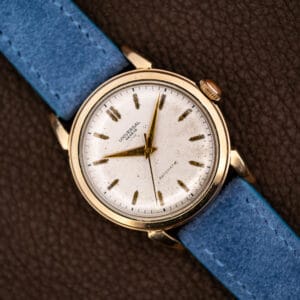
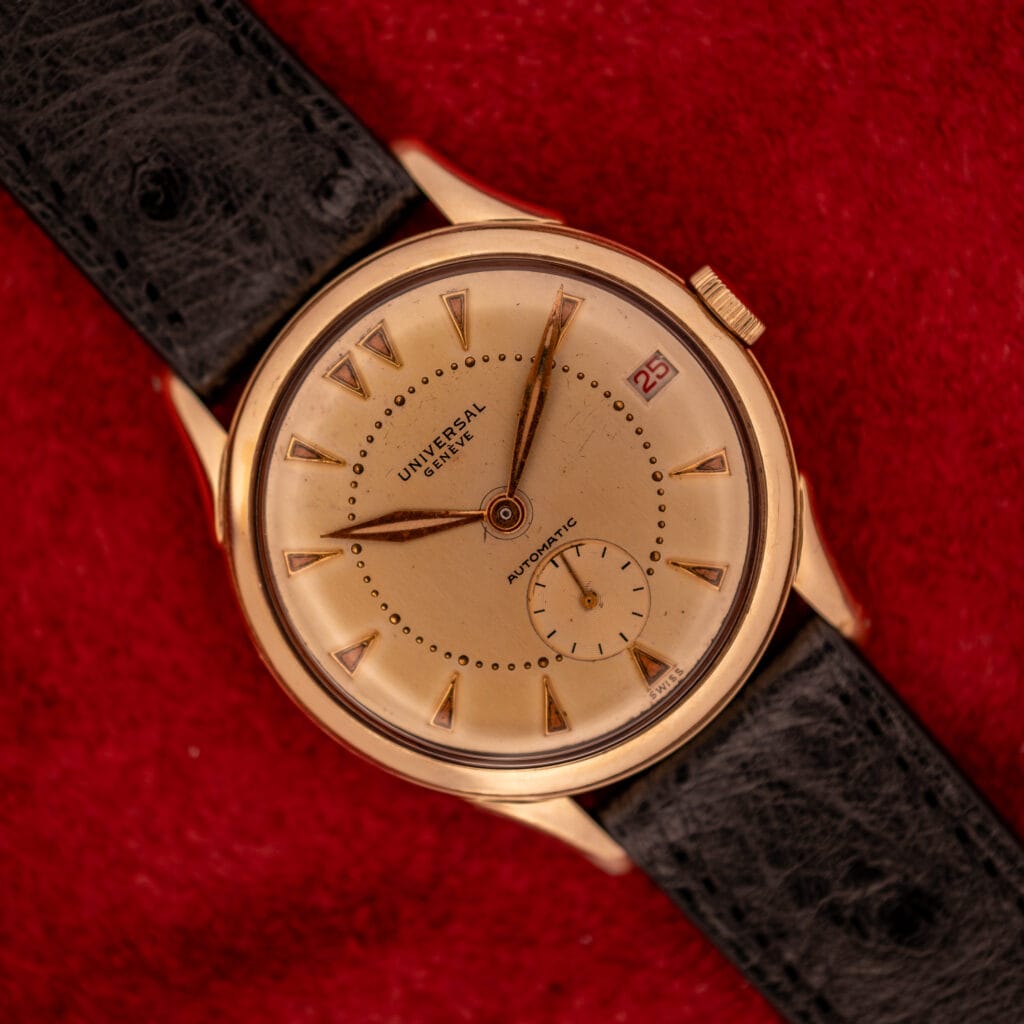
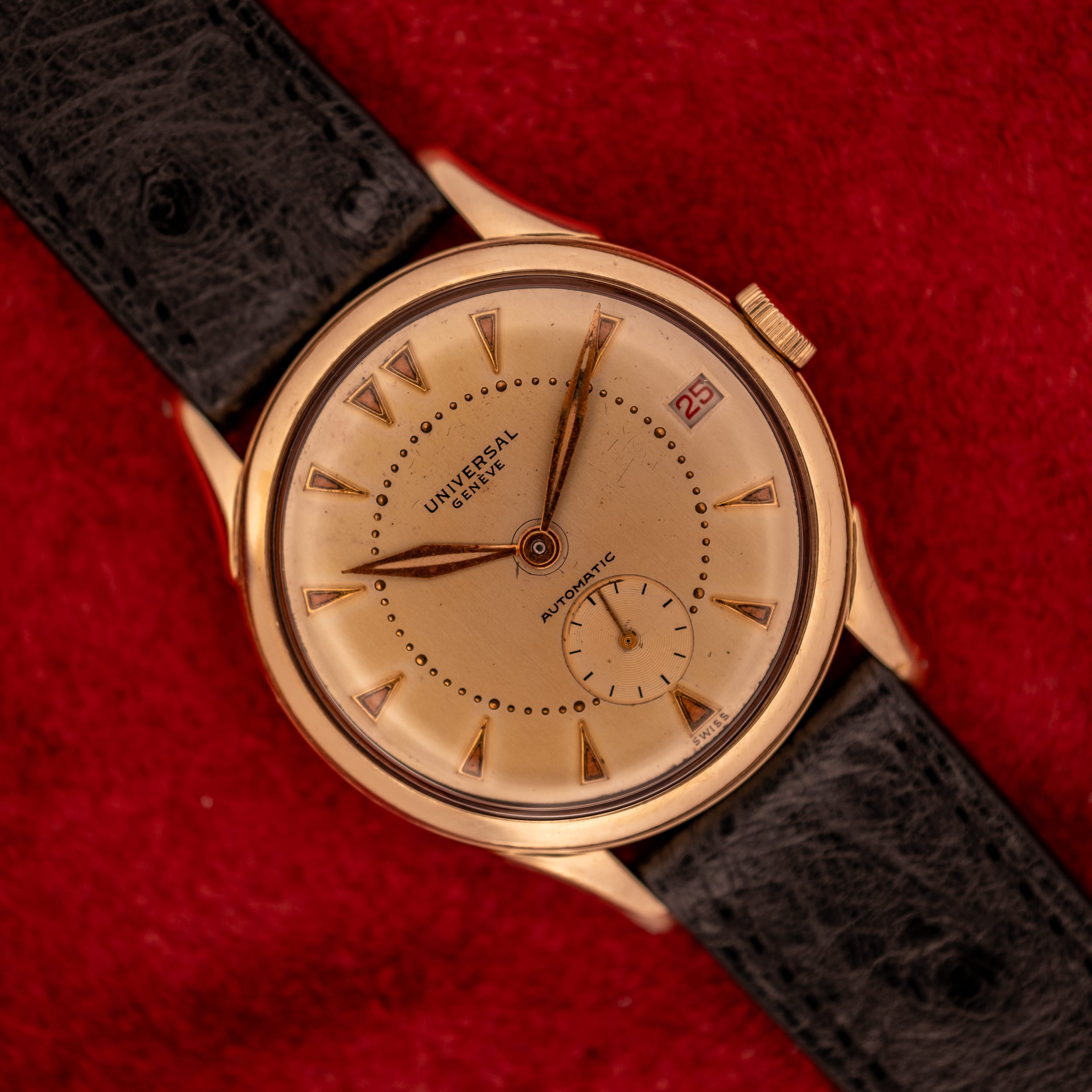
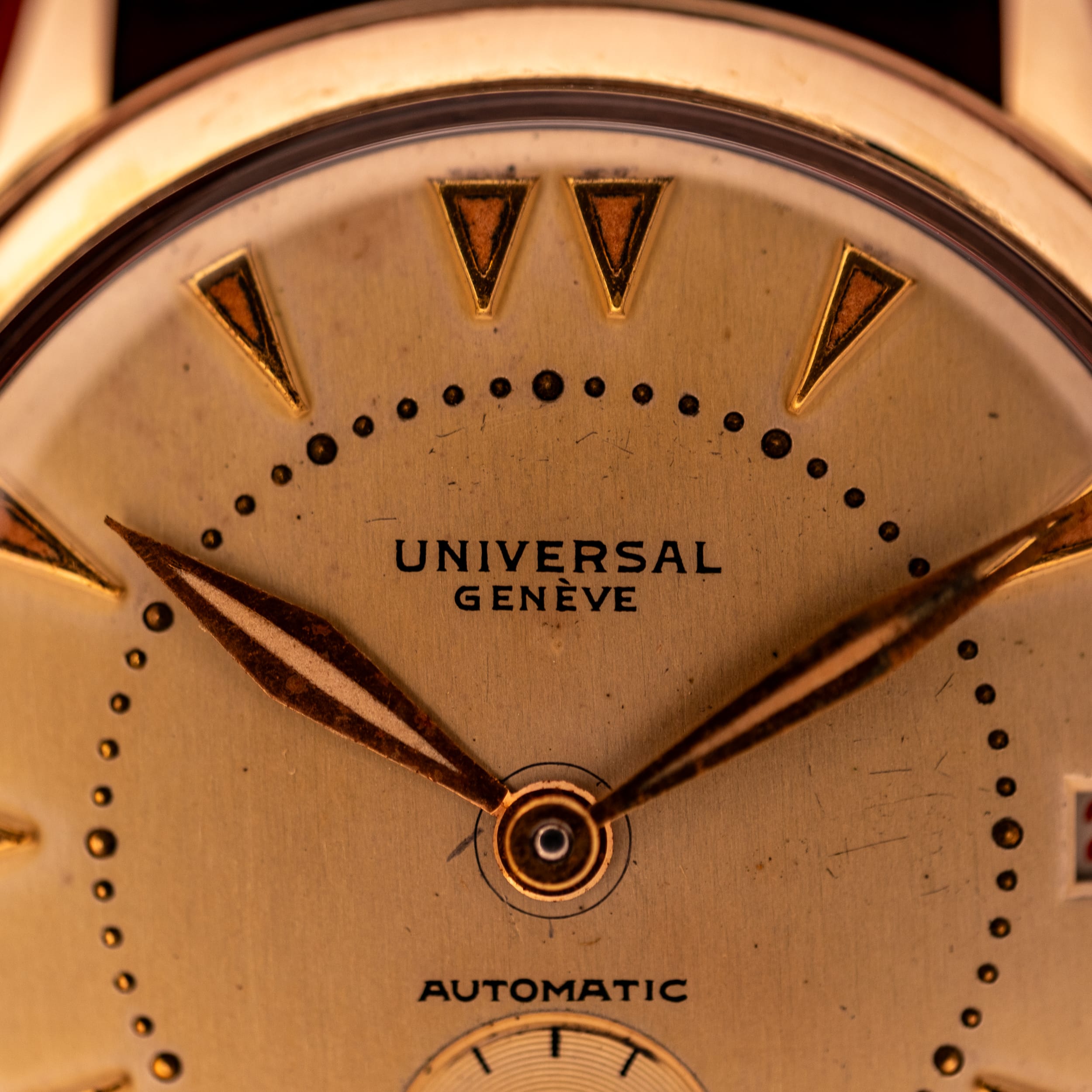
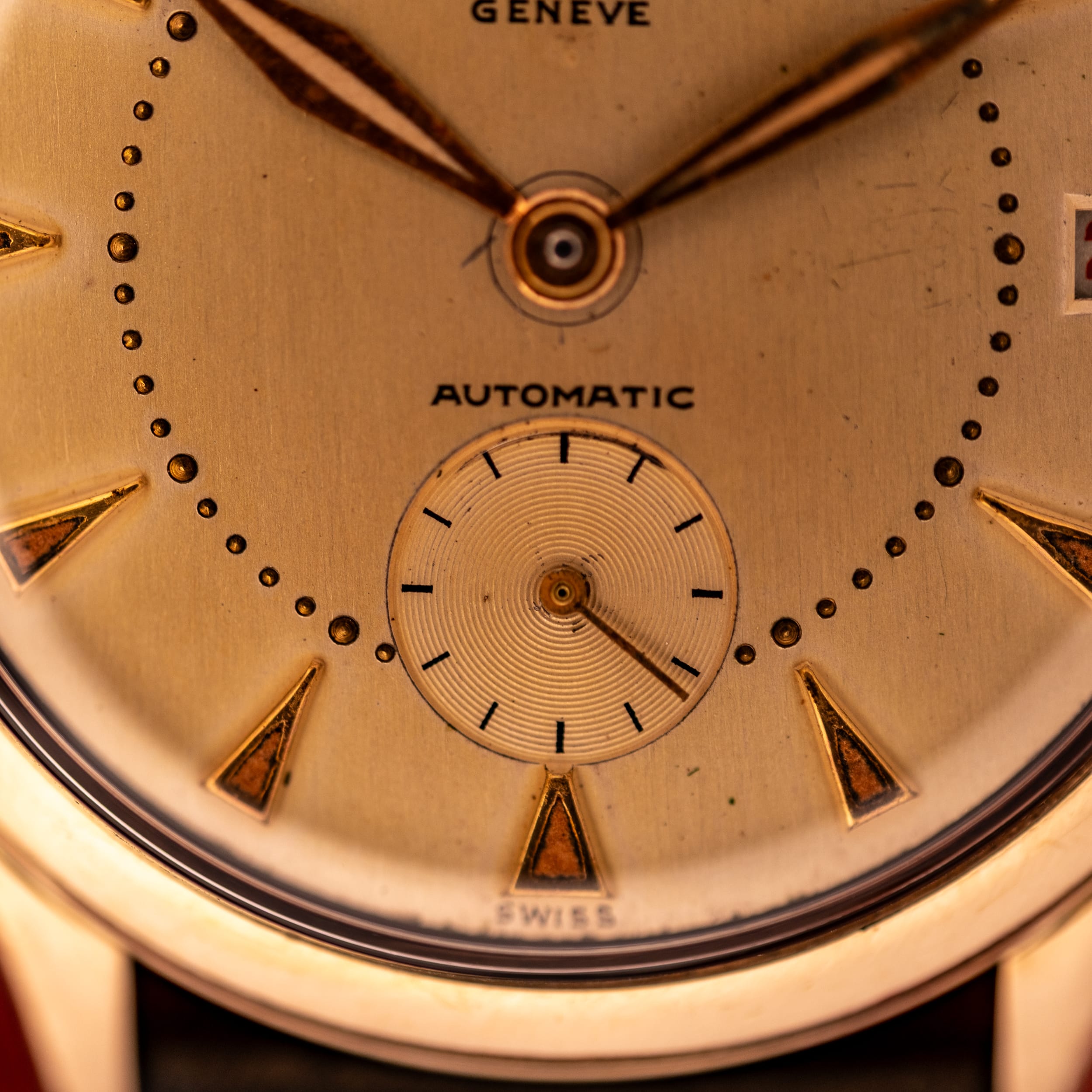
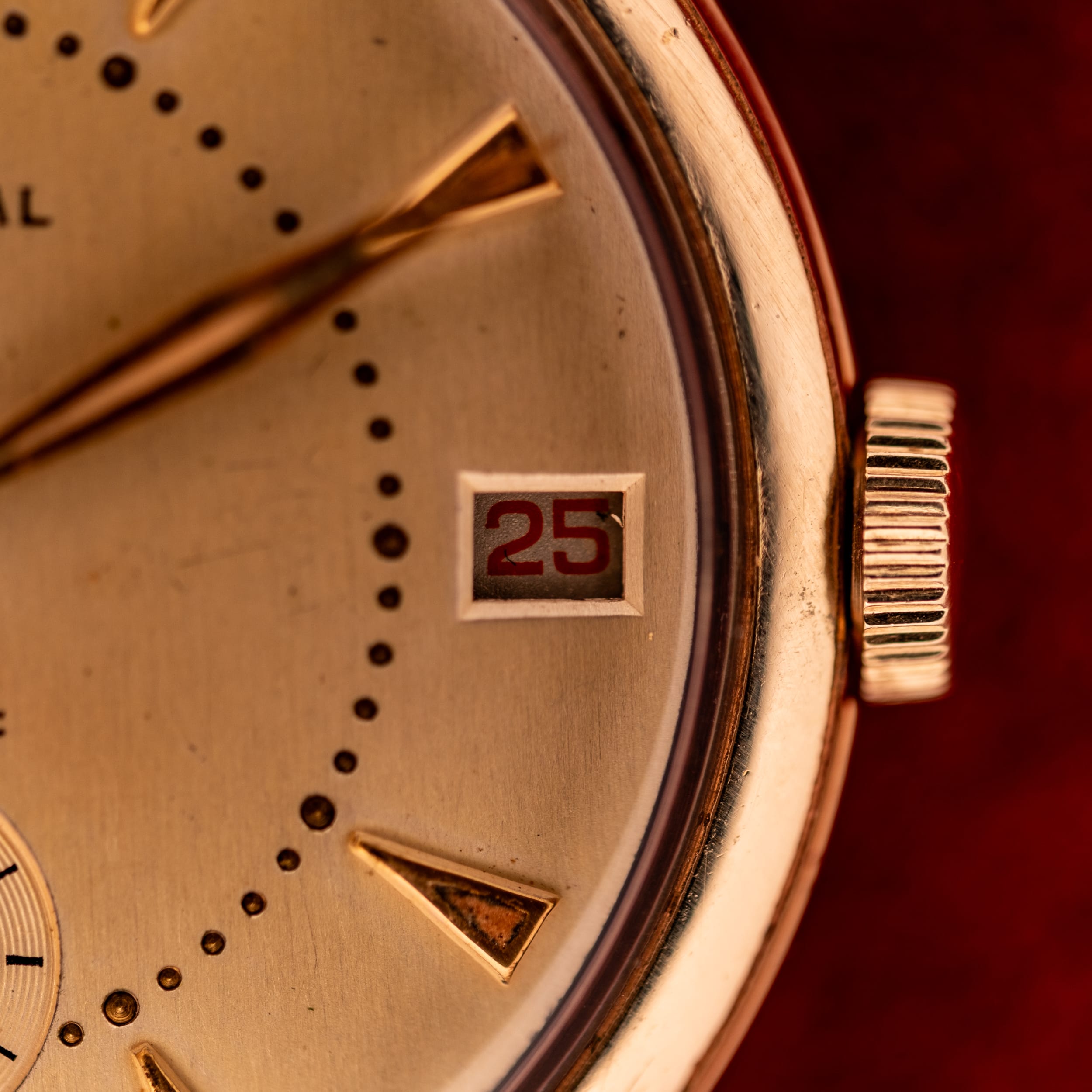
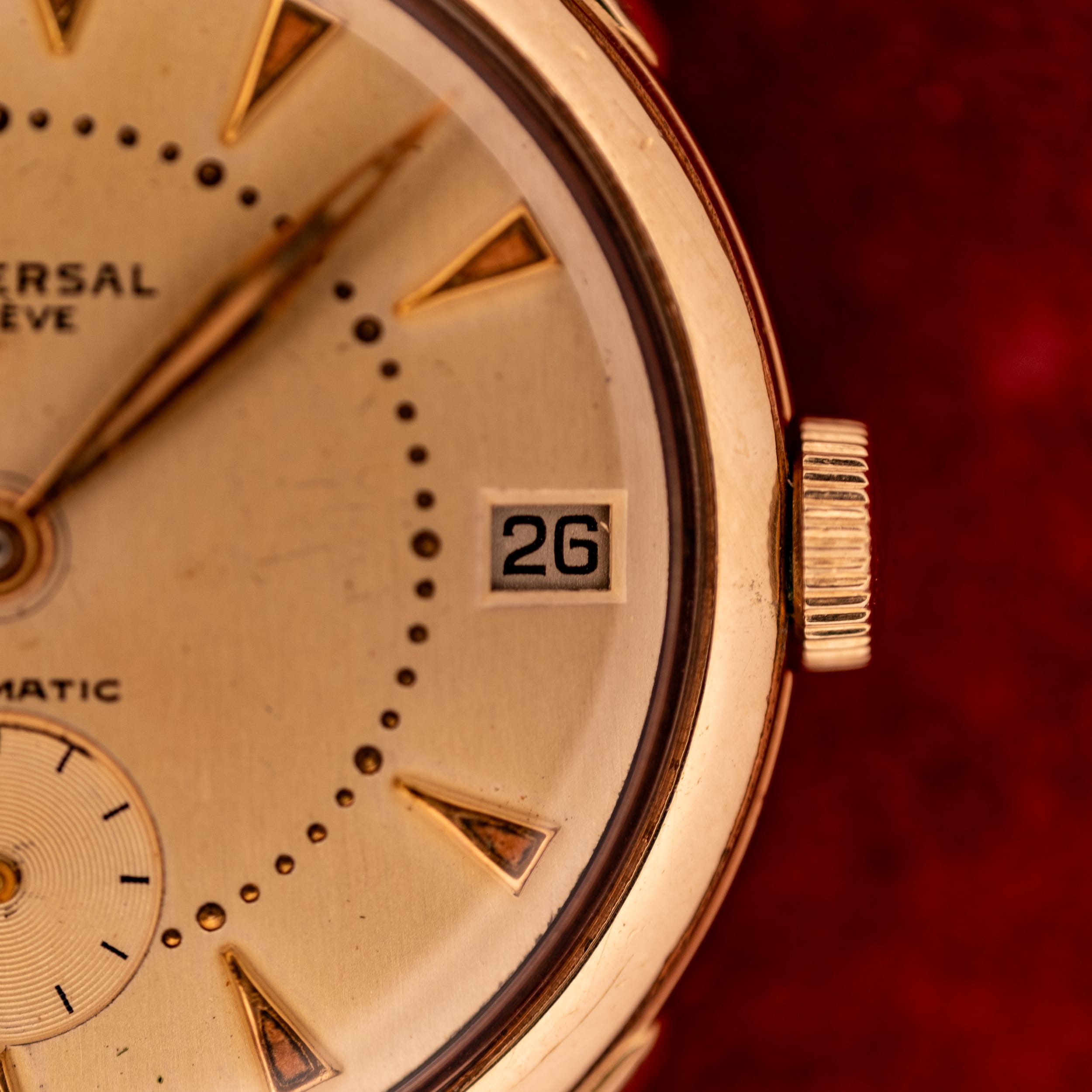
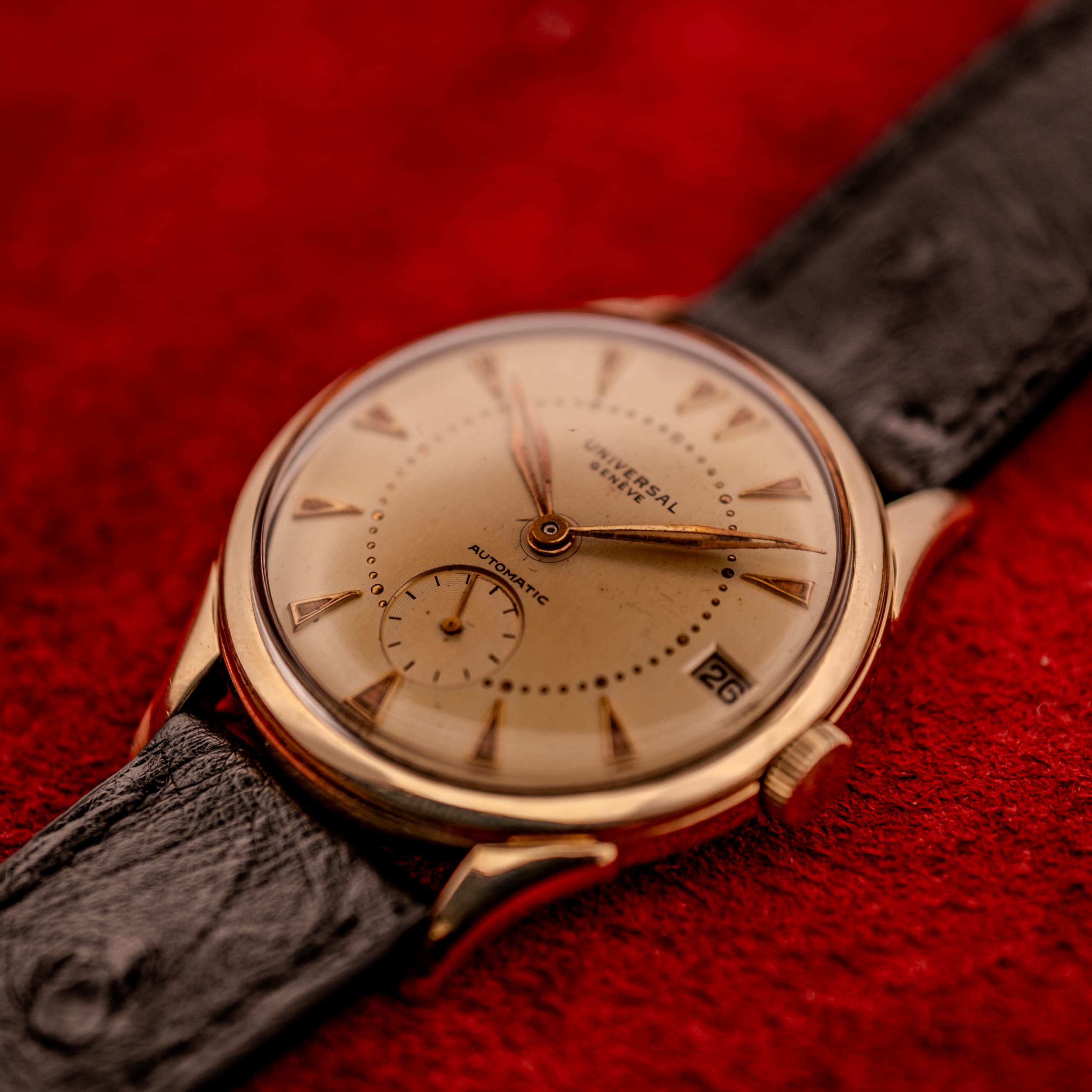
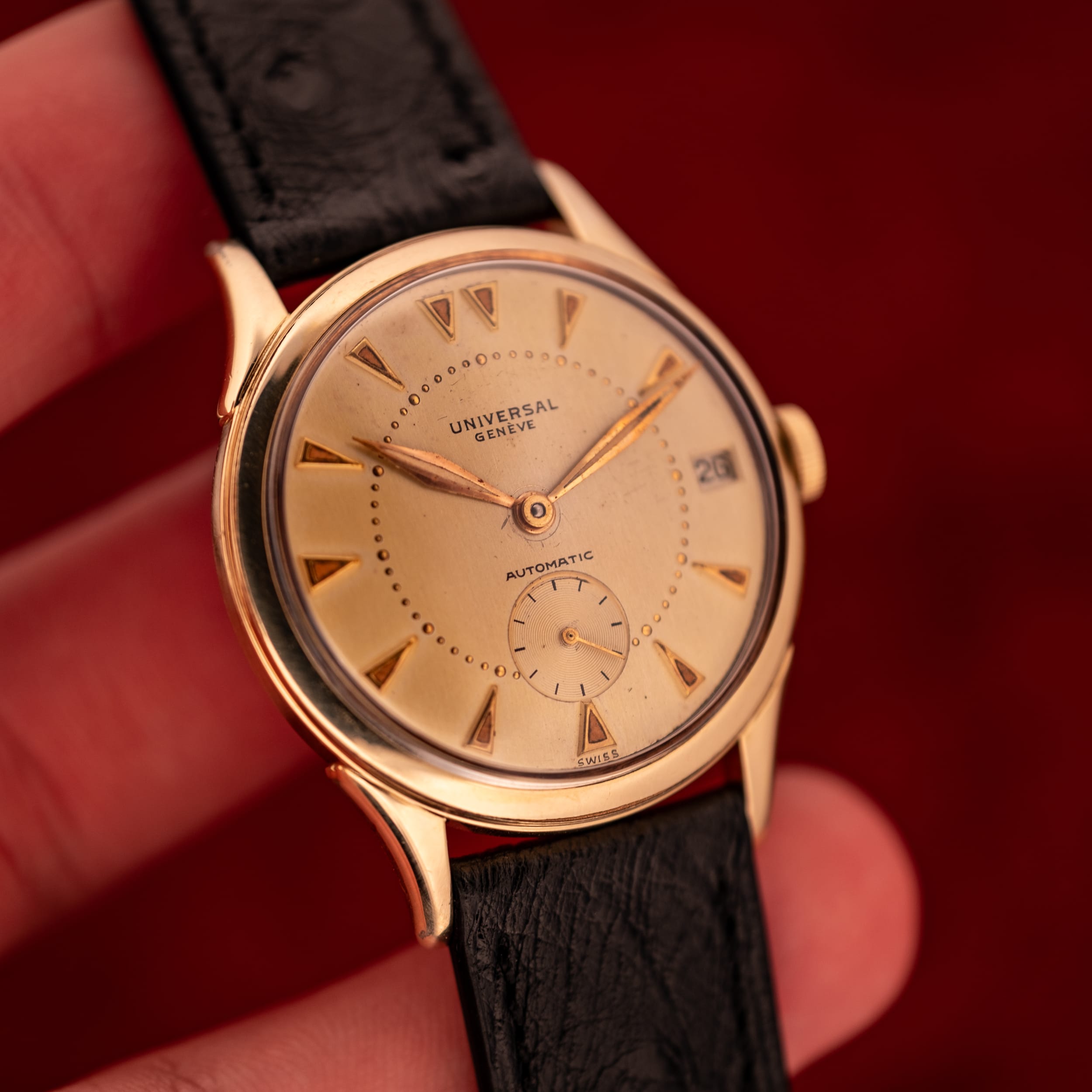
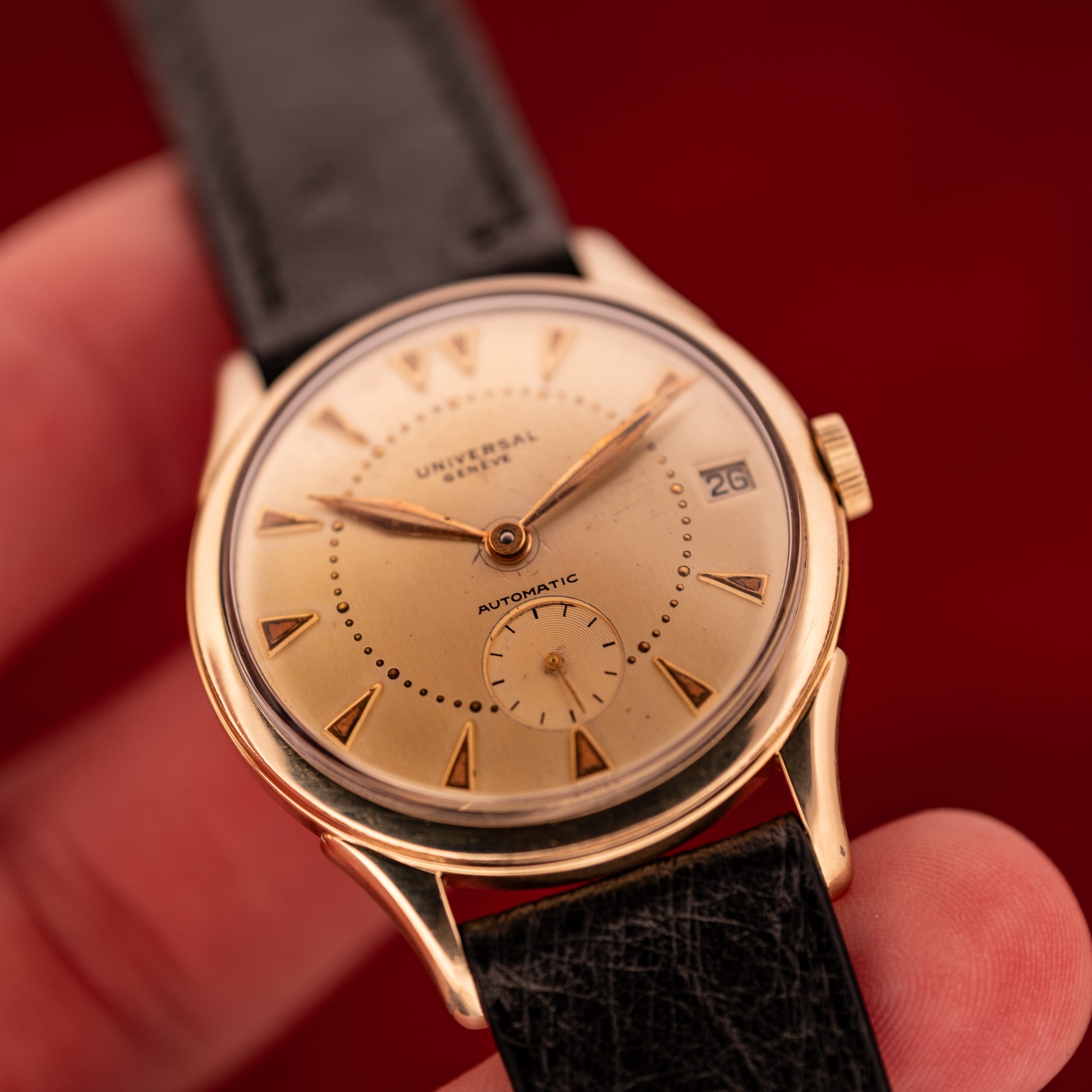
The dial is the headline. A factory champagne sunburst field carries the printed wordmark UNIVERSAL / GENÈVE upper center exactly as the manufacture printed it, accent grave on the second E intact, with the printed AUTOMATIC text below the cannon pinion. Applied faceted gold dart markers ring every hour position with applied dart pairs at twelve, each marker carrying an inset central well that has aged to a warm honey-brown across seven decades, and the sub-seconds register sits in a recessed snailed circle at six. SWISS prints at the lower edge below the seconds well with no T markers flanking it, exactly as a 1954 Universal Geneve dial should read. The date window cuts cleanly at three and reveals a roulette pattern with alternating red and black numerals across the wheel, the convention Rolex first put on the 1945 Datejust and a handful of Swiss manufactures adopted across the early 1950s. The factory dauphine handset is gold-toned and slim, the matched original pair with no replacement. Light spotting and warm oxidation across the champagne field reads as honest age, and the dial remains factory original and unrefinished in every meaningful respect. To us, a roulette date on a factory champagne Universal Geneve is one of those mid-1950s details that quietly tells a collector the watch was correct on day one.
The crown is the original Universal Geneve fluted gold-toned component with the period-correct toothed edge intact and operates with the positive engagement a properly serviced 138C should give. The acrylic crystal sits clear above the dial with the doming that lets the champagne sunburst catch warm light.
We have paired the watch with one of our black ostrich leather straps and an OTTUHR signed buckle. The black grain reads as a counterweight to the warm gold case and the champagne dial, and the texture gives the package the formal weight a mid-1950s Wadsworth-cased dress automatic deserves on the wrist.
Serviced in-house at OTTUHR and backed by our 2-year mechanical warranty, this is the kind of mid-1950s Universal Geneve we get genuinely excited about. Factory original champagne dial, factory handset, original signed crown, intact case stampings, a Wadsworth 14k gold-filled body engraved as a 1954 Kentucky Club Contest prize, and the Universal-signed bumper caliber 138C running cleanly. For the collector who values originality over polish, who reads patinated dials as character rather than damage, and who wants a piece of Genève watchmaking with an American provenance story attached, this is exactly the kind of watch we love bringing in.