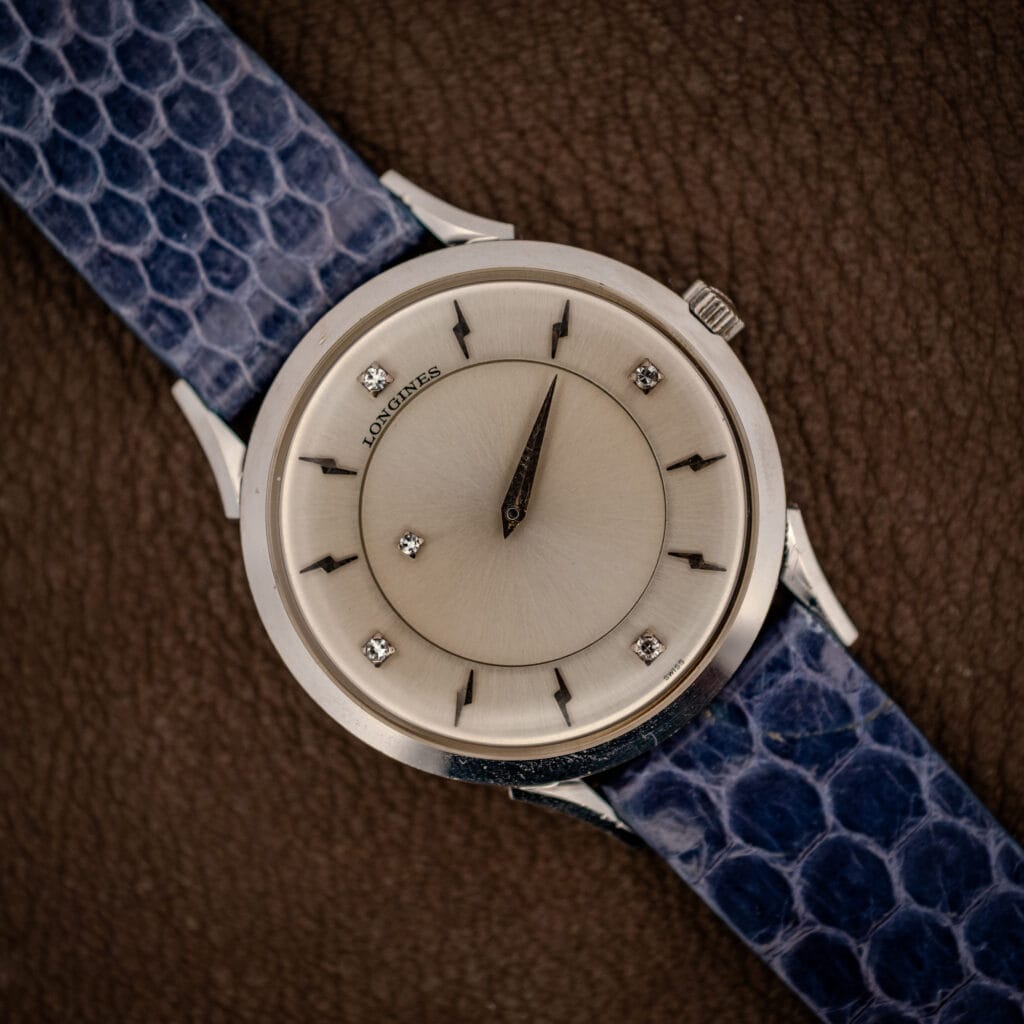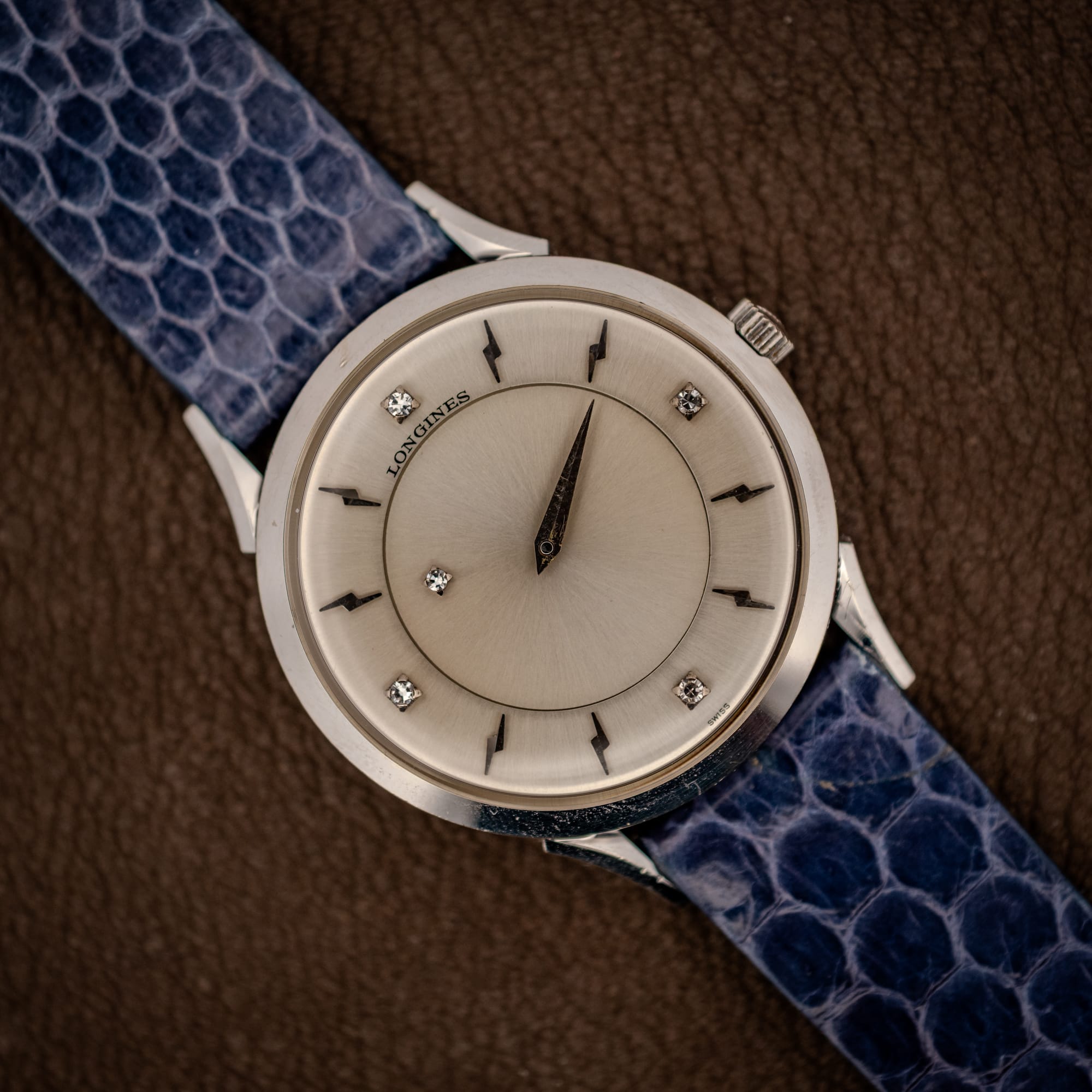
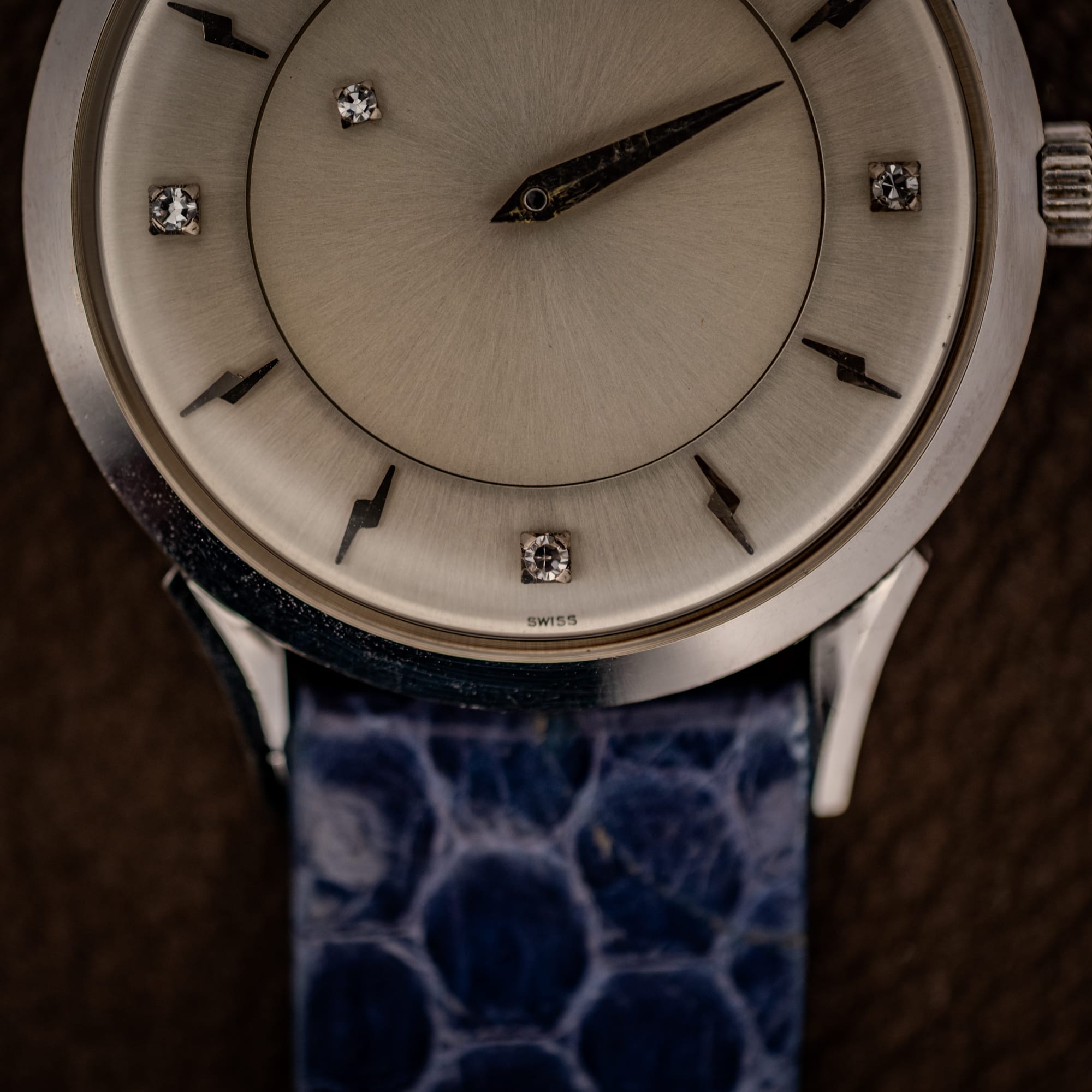
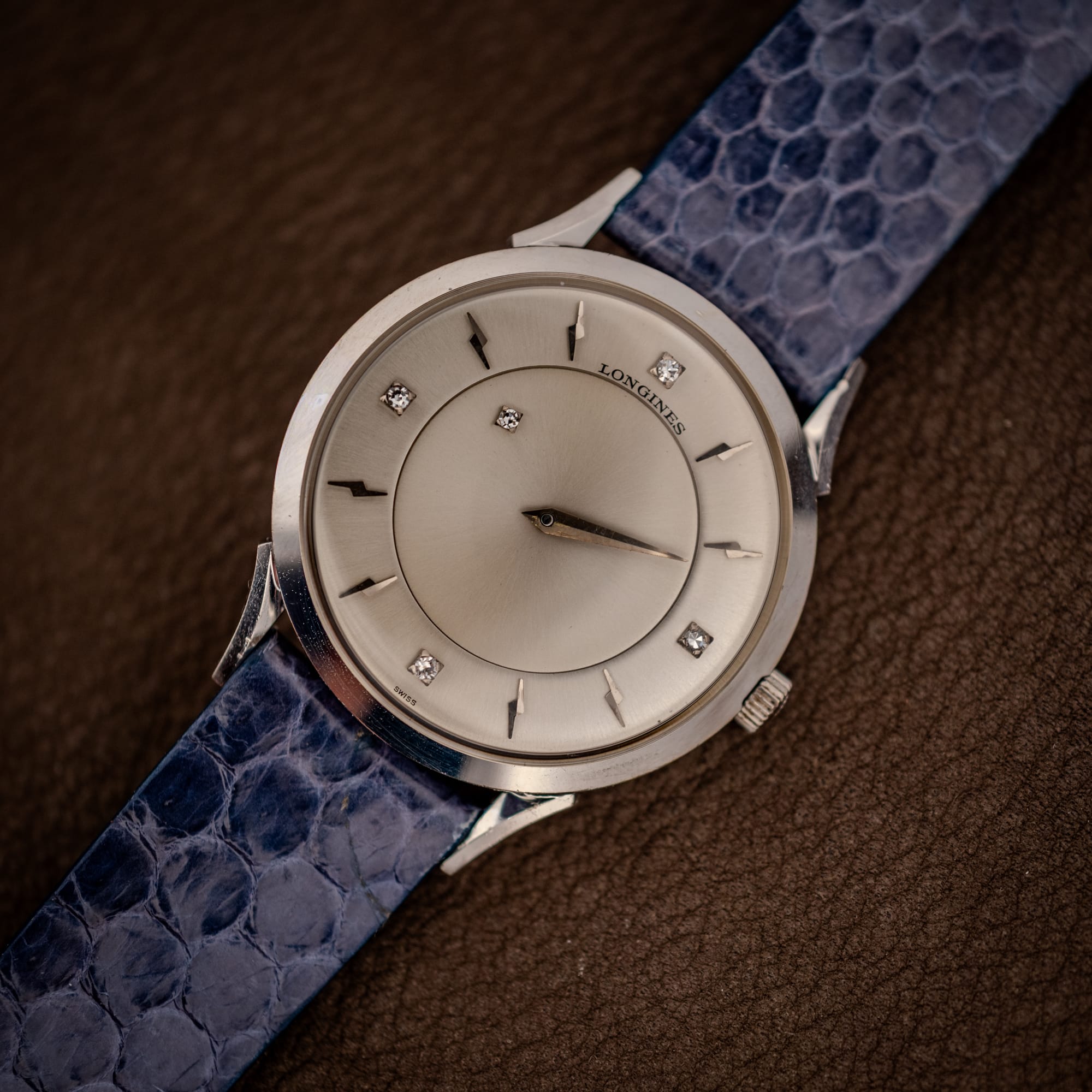
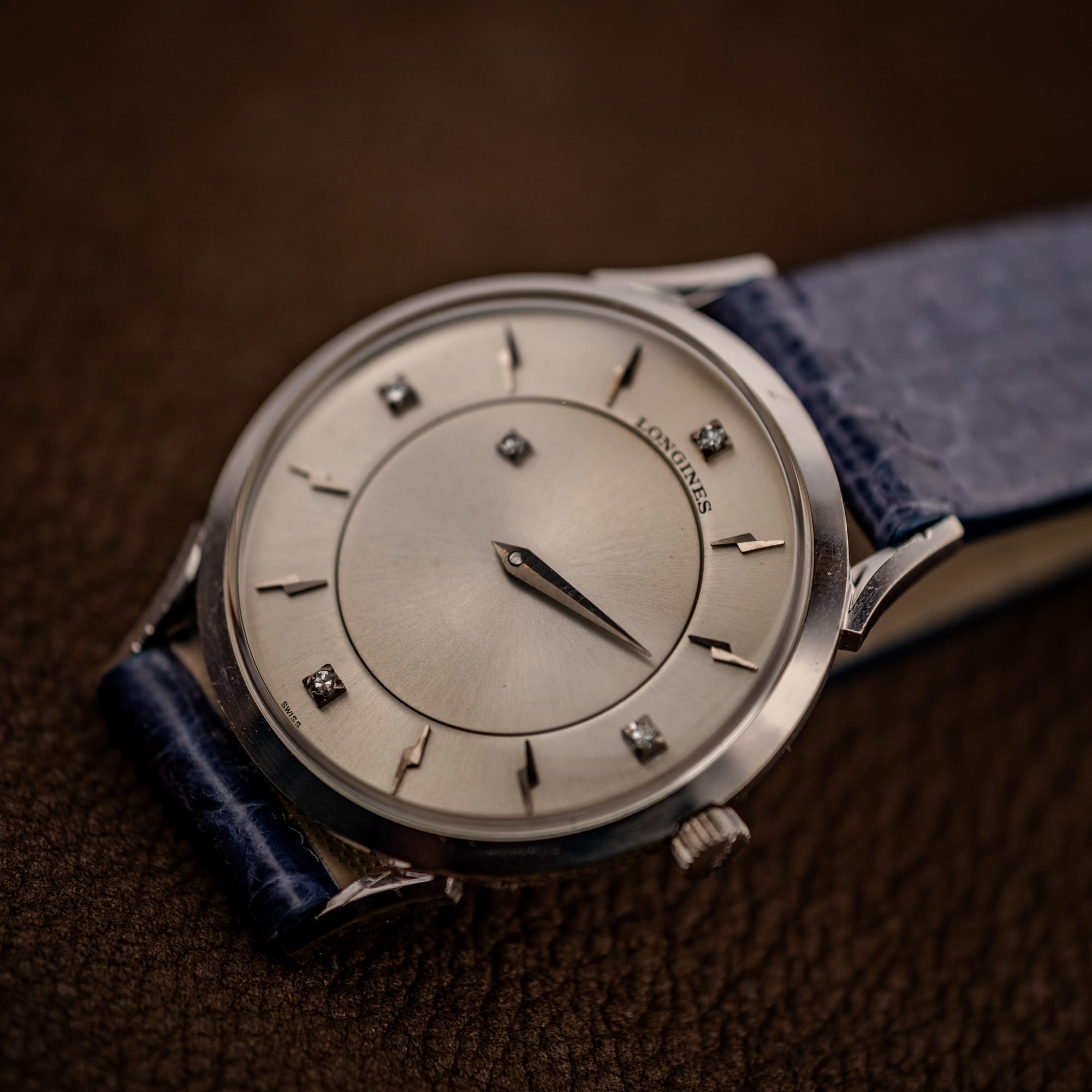
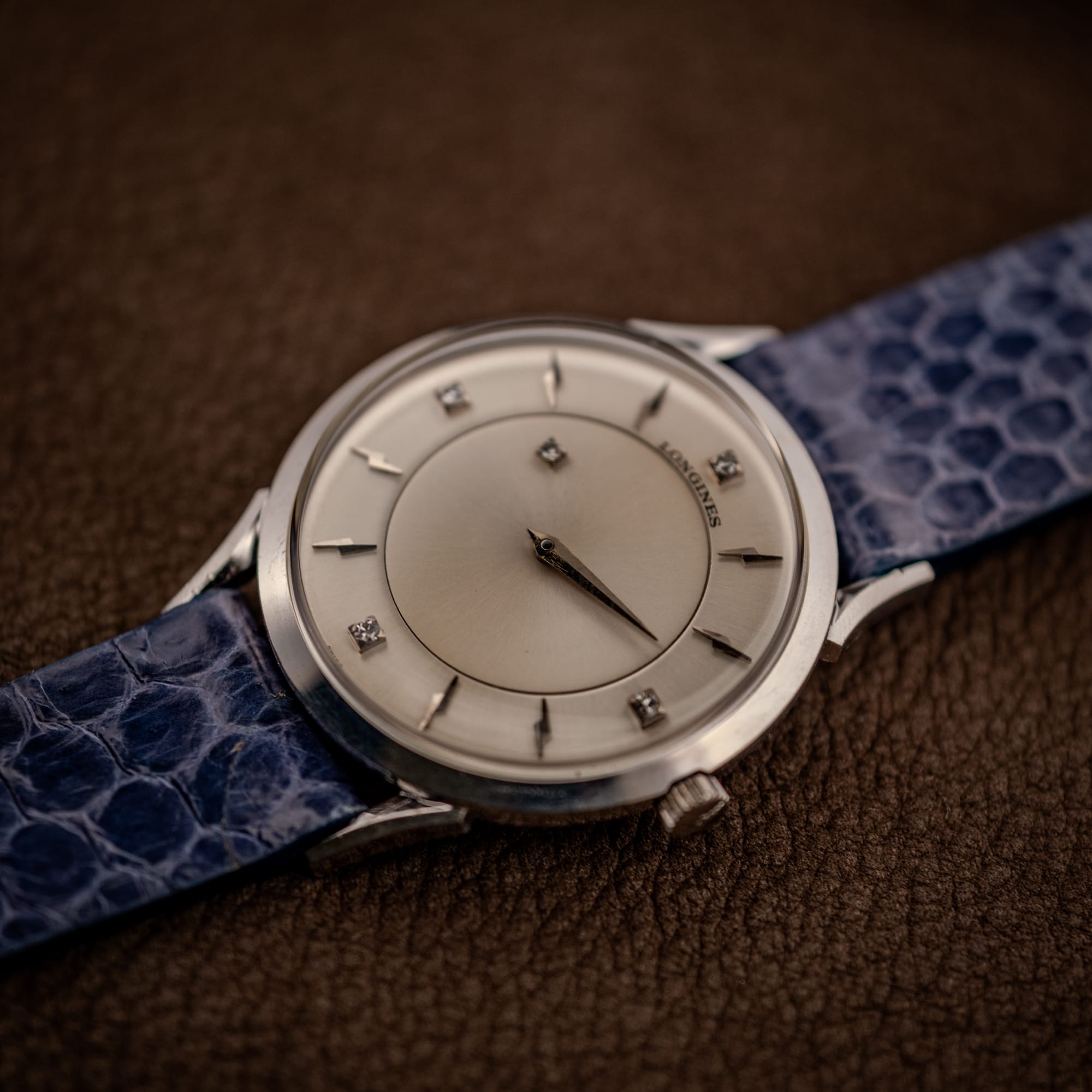
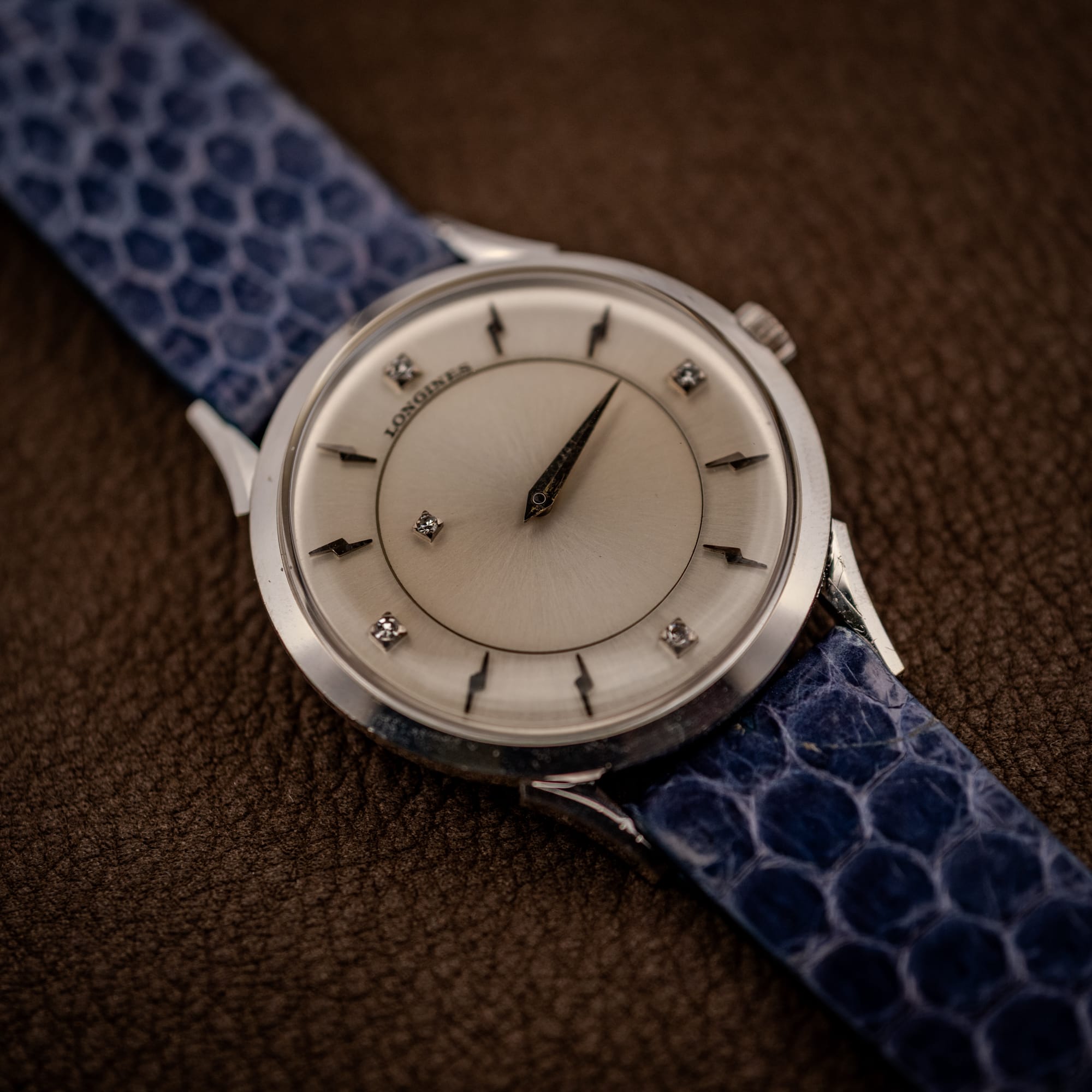
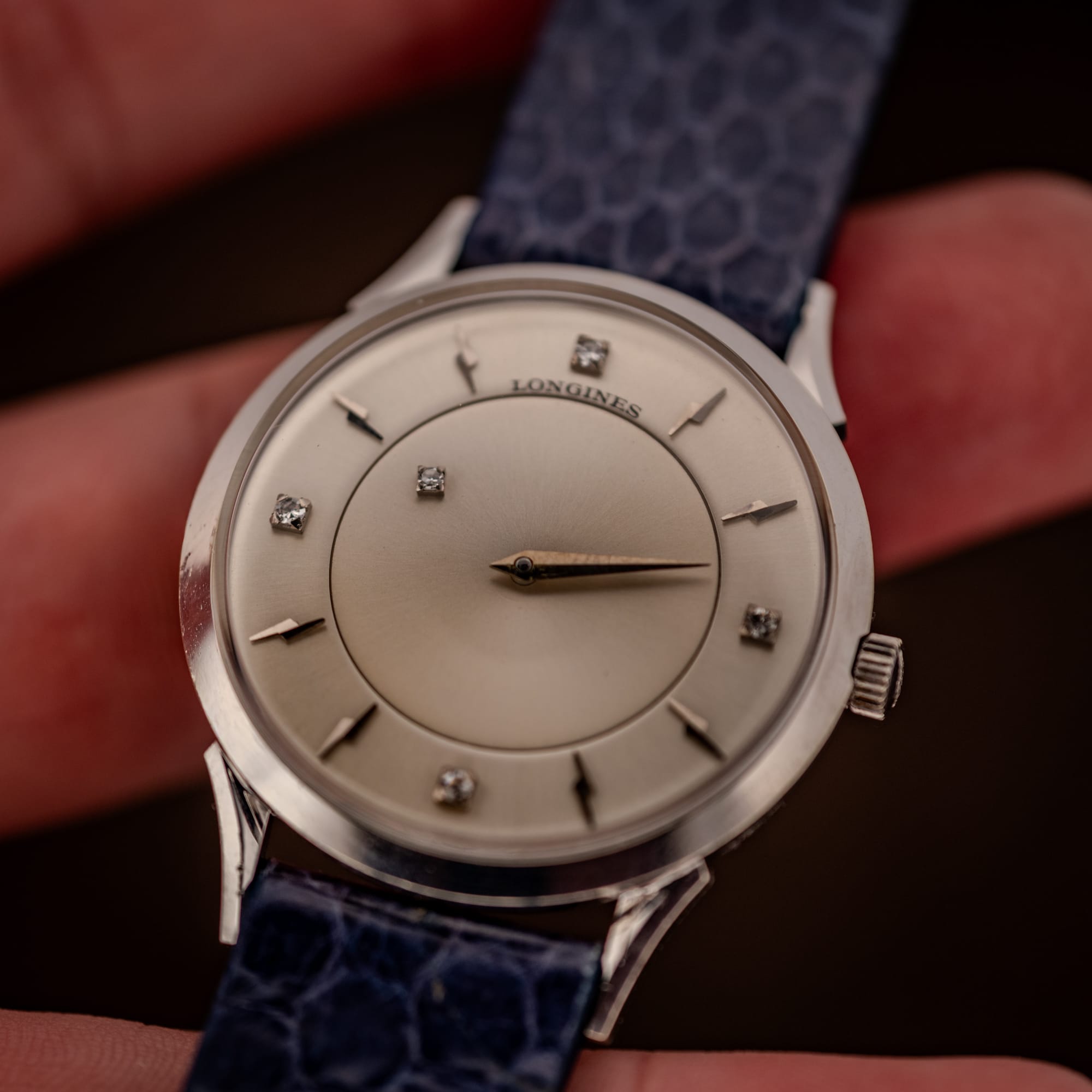
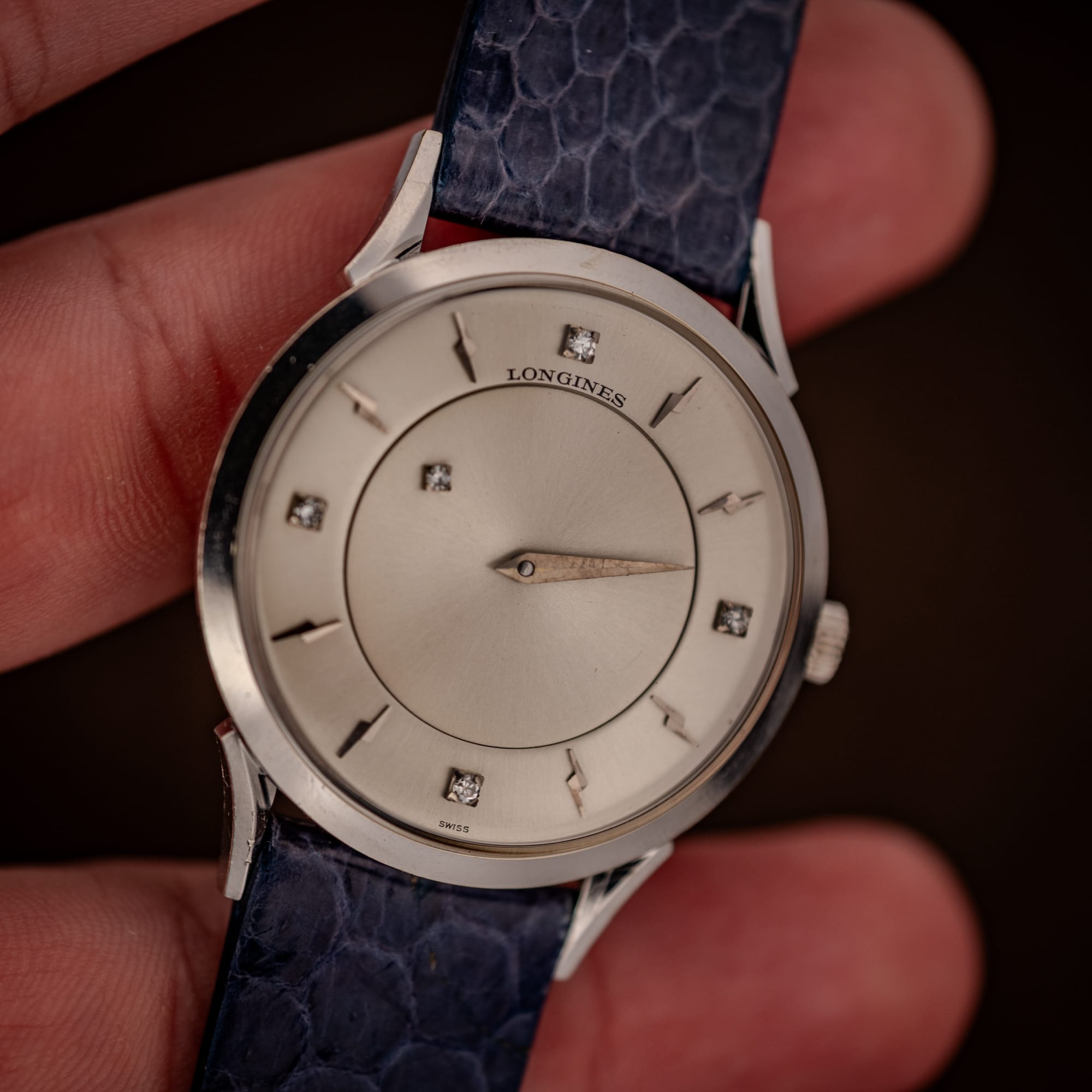
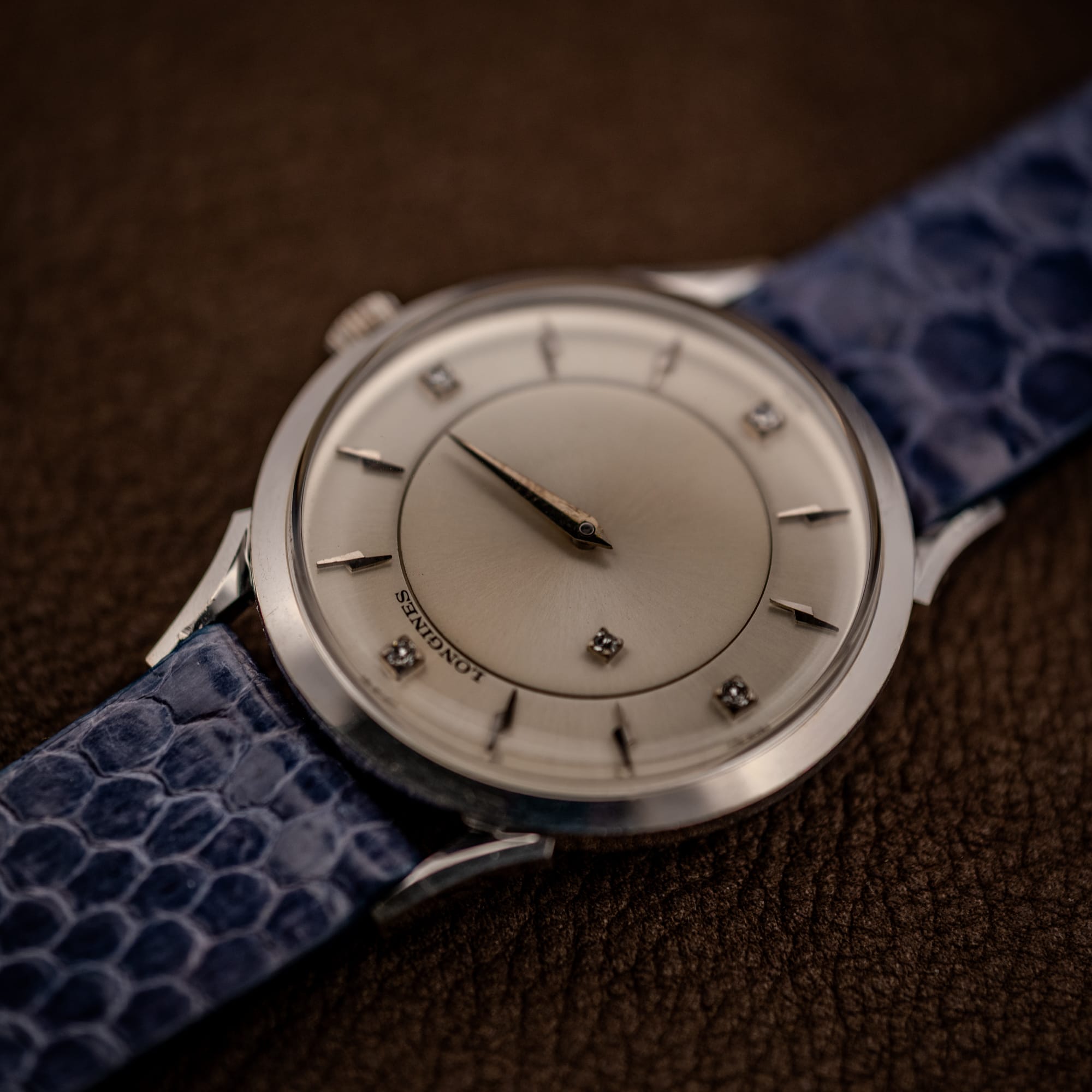
Most Longines from the 1950s ask you to admire their restraint. This Longines mystery dial asks you to look twice. The two hands sit out over an open silver field with nothing visibly connecting them to the movement below, drifting around the dial as if no one had told them they were supposed to be attached to anything. In our opinion it is one of the more quietly clever things the brand put its name to in the decade, and the solid 14k white gold case and four diamonds make clear it was never meant to be a shy watch.
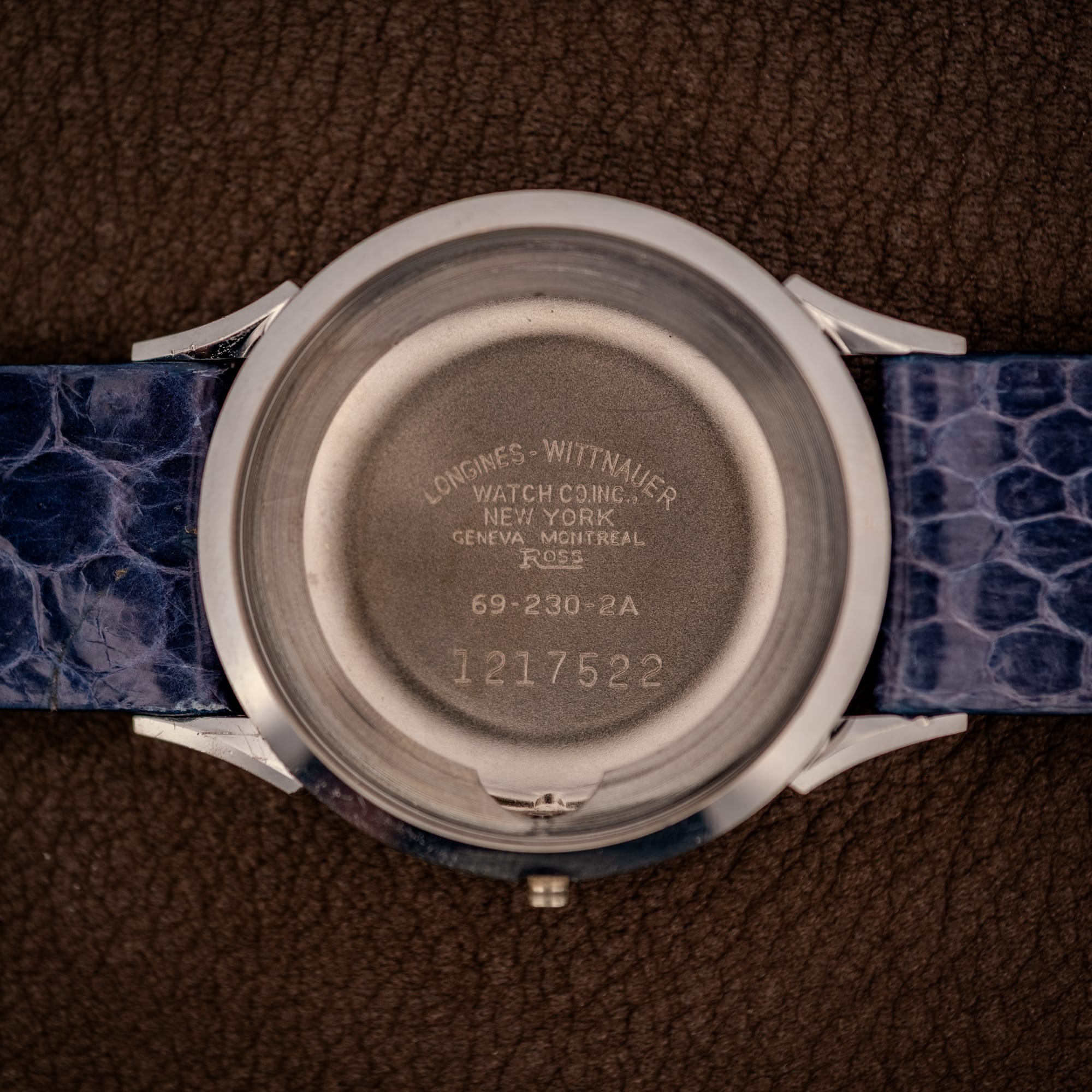
The trick is older and simpler than it looks. A mystery dial carries its indicators on a clear revolving disc driven from the center, so the hands ride the glass rather than a visible pinion and appear to hover above the dial. Mid-century buyers, deep in their fascination with the modern and the mechanical, loved it. The inside of the caseback records who built this one for that audience: it reads LONGINES – WITTNAUER WATCH CO INC, NEW YORK, GENEVA MONTREAL. Longines reached American buyers for most of the twentieth century through the Longines-Wittnauer Watch Company, its long-standing United States agent, and bought Wittnauer outright in 1950. Watches built for that market were frequently cased on American soil, which is why a Swiss movement sits here inside an American-made solid gold case.
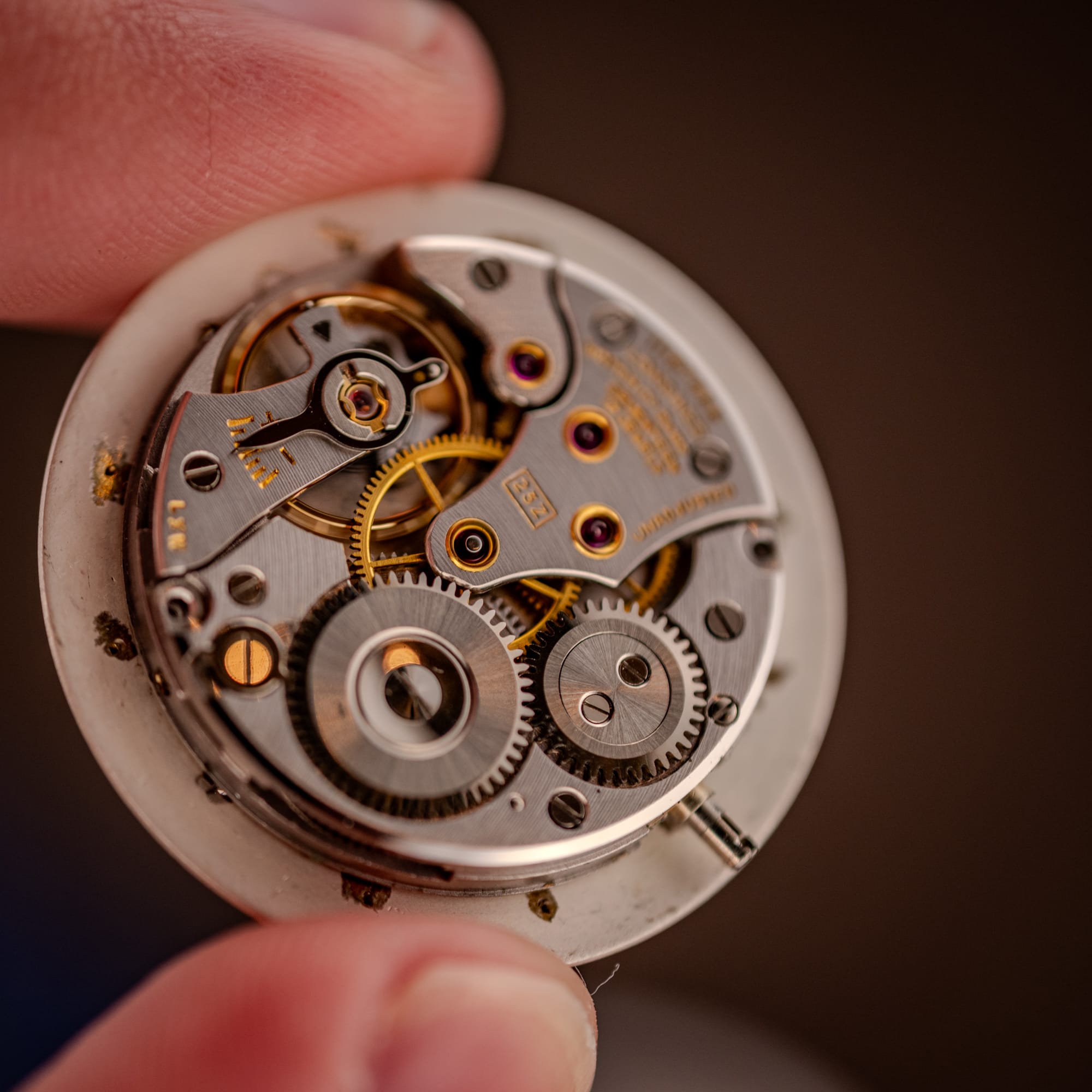
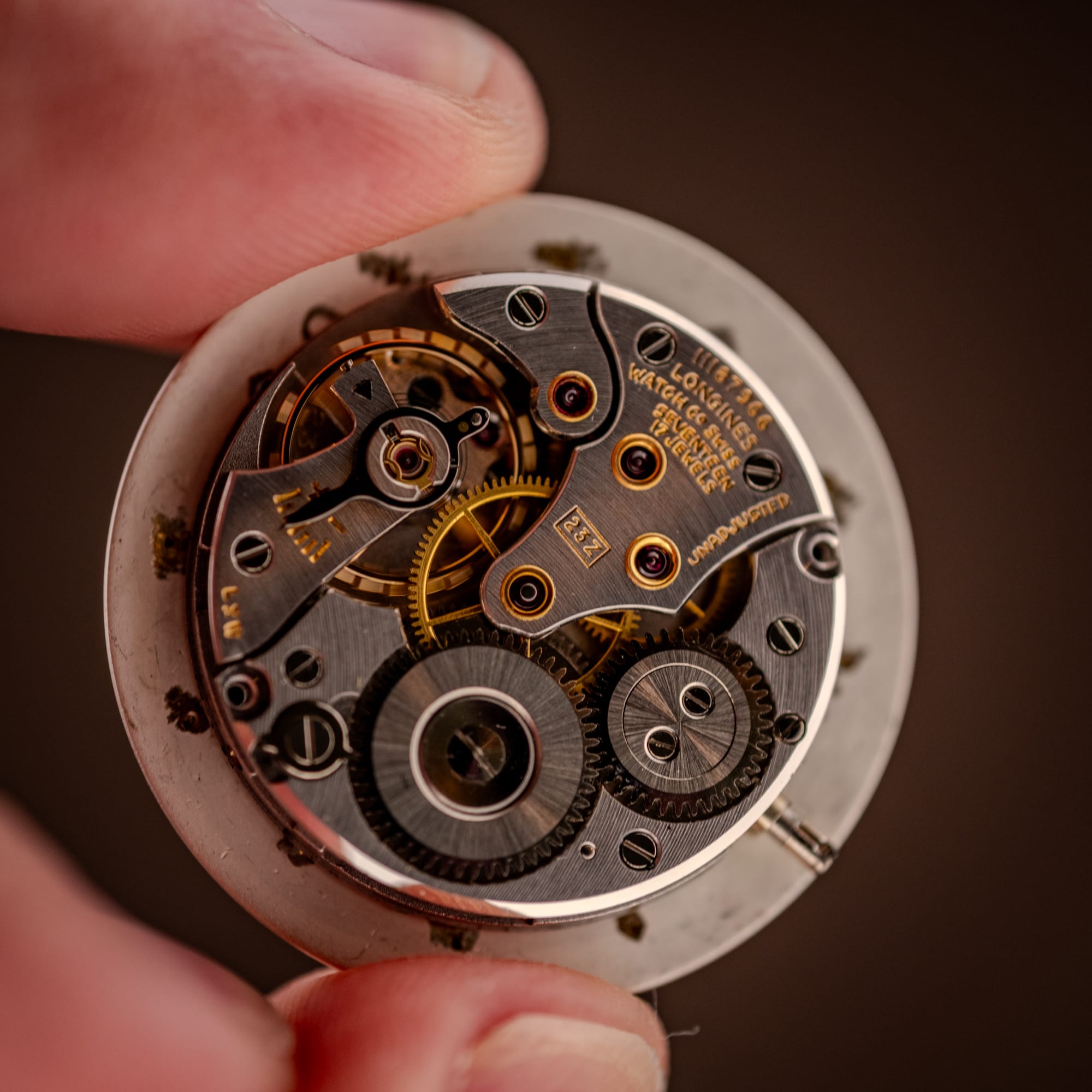
Behind the dial runs the Longines caliber 23Z, a 17-jewel manual-wind movement that the bridge stamps plainly as LONGINES WATCH CO SWISS, SEVENTEEN 17 JEWELS, and, just as plainly, UNADJUSTED. We will not dress that last word up: this is an honest American-market dress grade, not a chronometer, and it never pretended otherwise. What it does carry is real pedigree. Longines introduced the 23Z in 1948 and built it in-house, the way the brand made its own movements through this period before the industry consolidated and the great names began sharing ebauches. The version sent across the Atlantic, this one, was specified with a Breguet hairspring. The movement serial places this example in the mid-1950s.
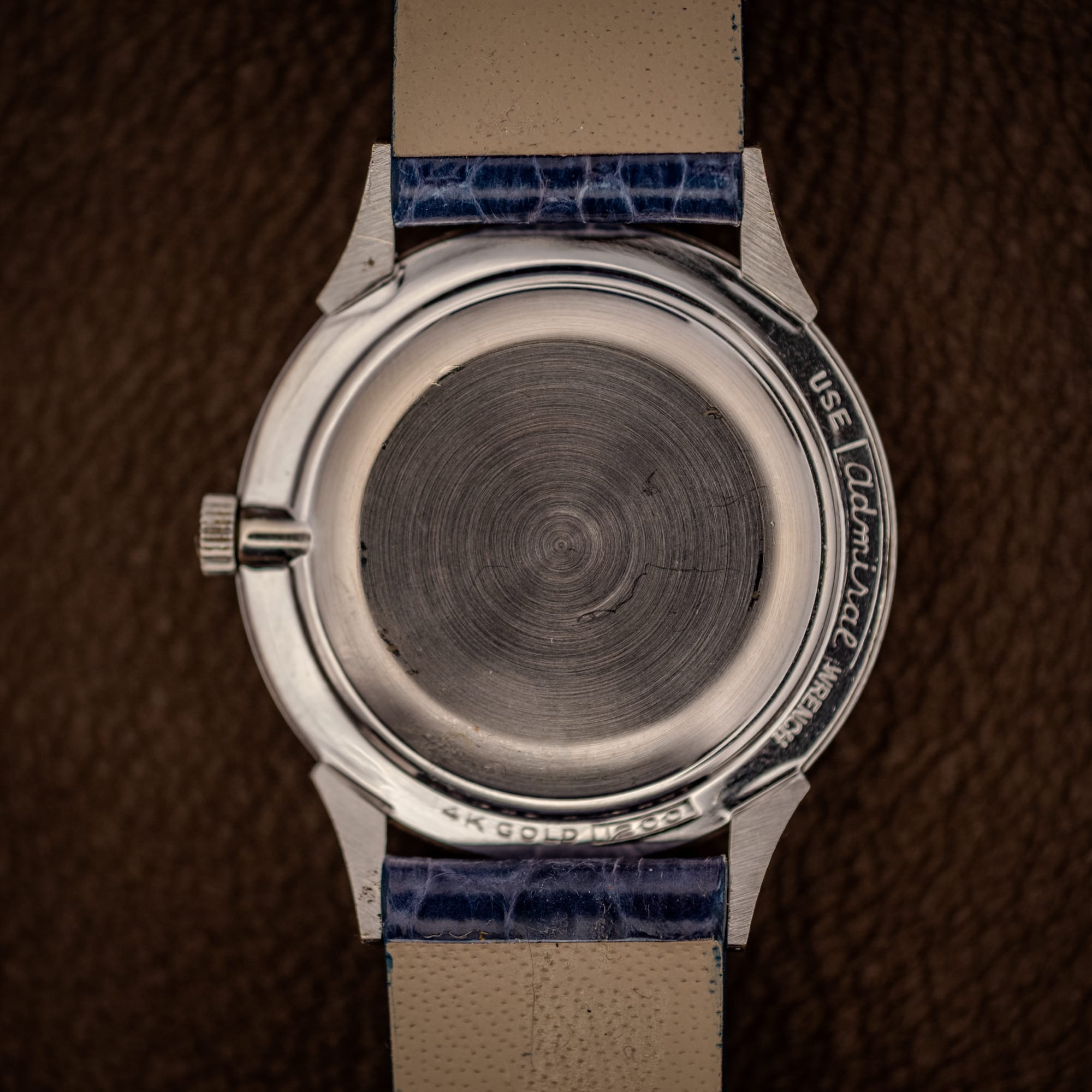
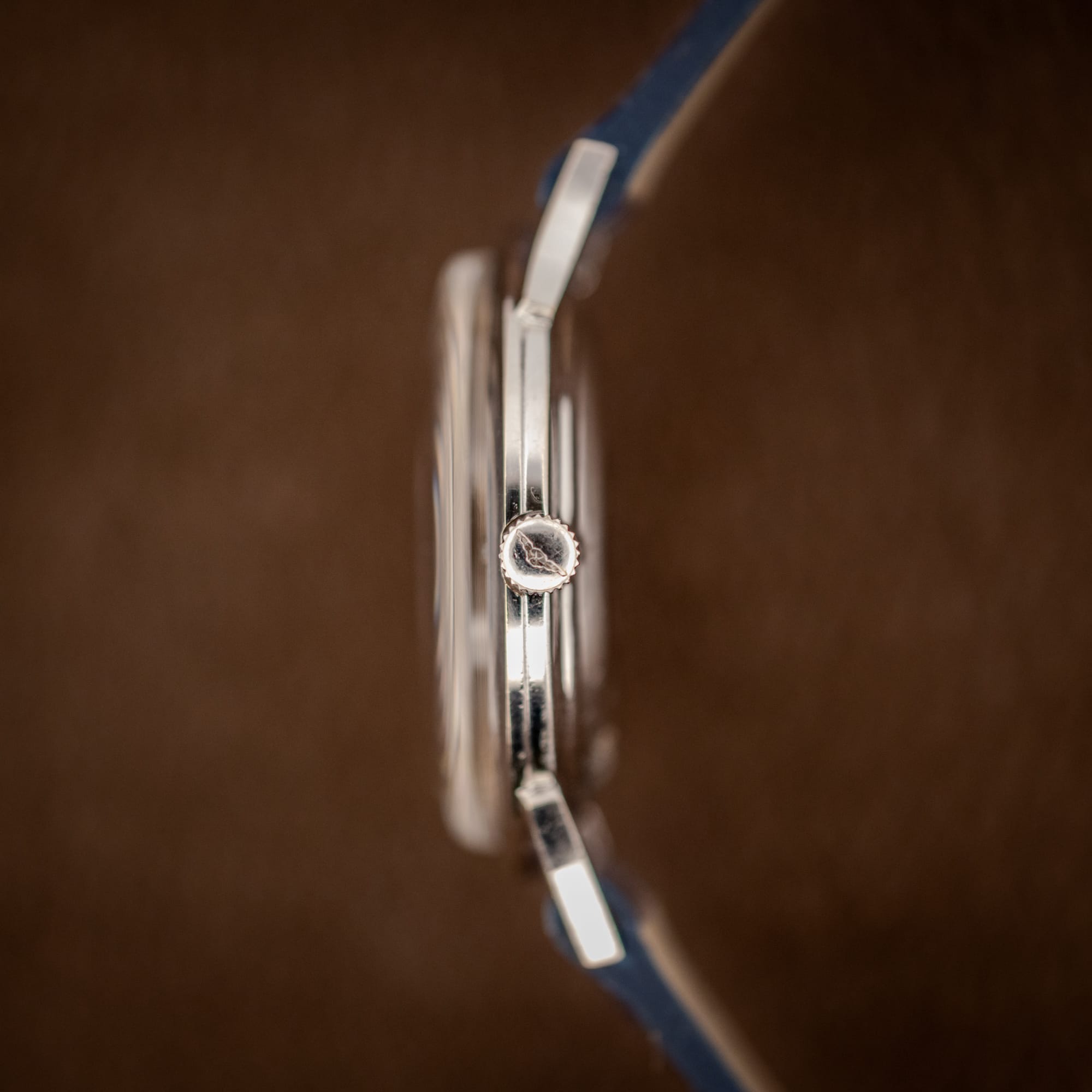
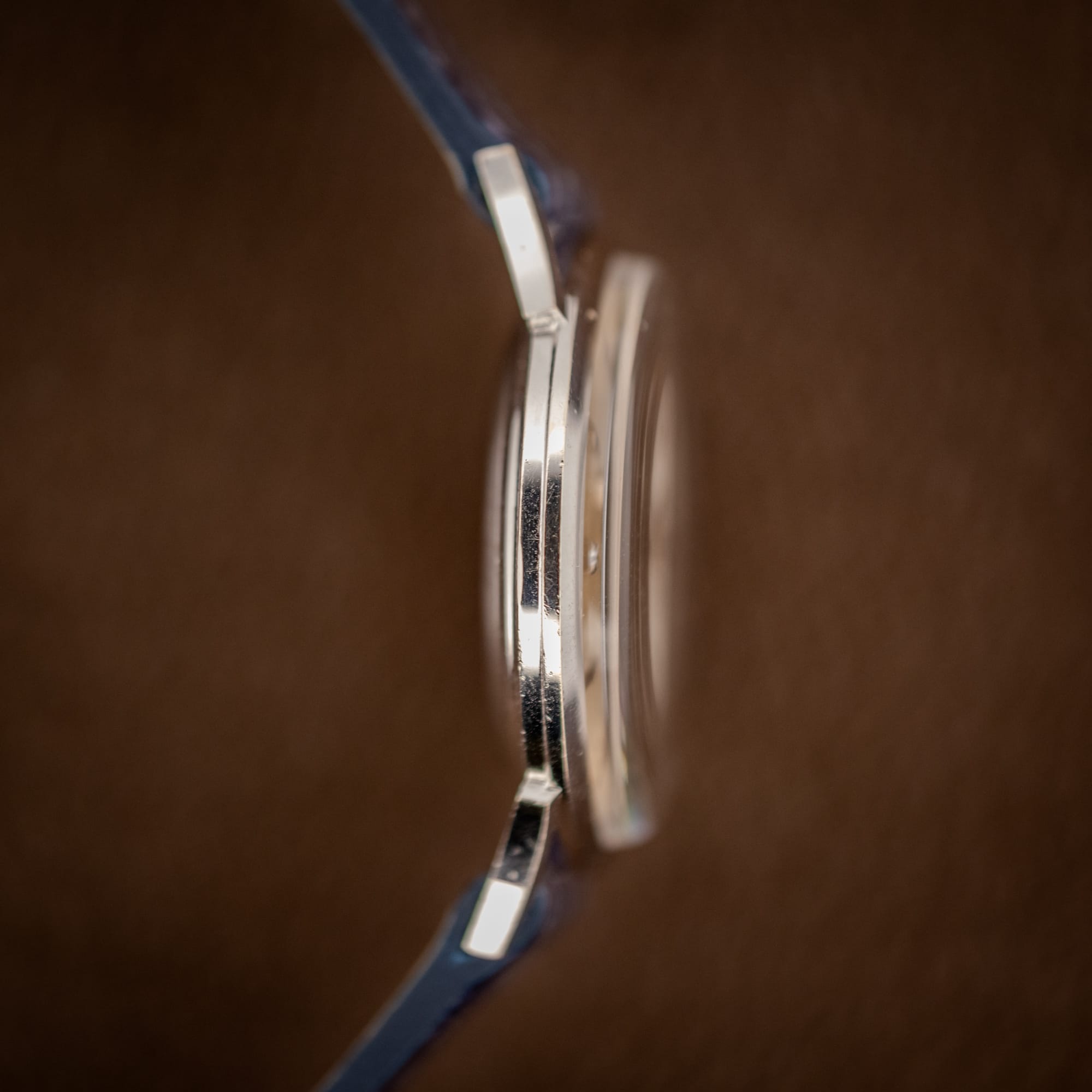
The case is where the value sits. It is solid 14k white gold, not gold filled and not plated, a genuine precious-metal case at a moment when most American-market Longines wore a thick layer of gold over base metal instead. It measures 34mm across and 41mm from lug to lug, with 18mm between the faceted, gently horned lugs that give it more wrist presence than the diameter suggests. The outer back is stamped 14K GOLD with a case number and the old instruction to use the maker’s wrench; lift it and the inner cover carries the Longines-Wittnauer signature, the reference 69-230-2A, and a case serial of 1217522. There are honest hairlines across the back and soft wear to the high points, the marks of a watch that was worn rather than stored, and nothing we would polish away.
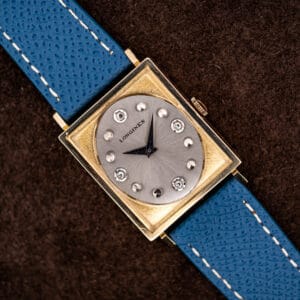
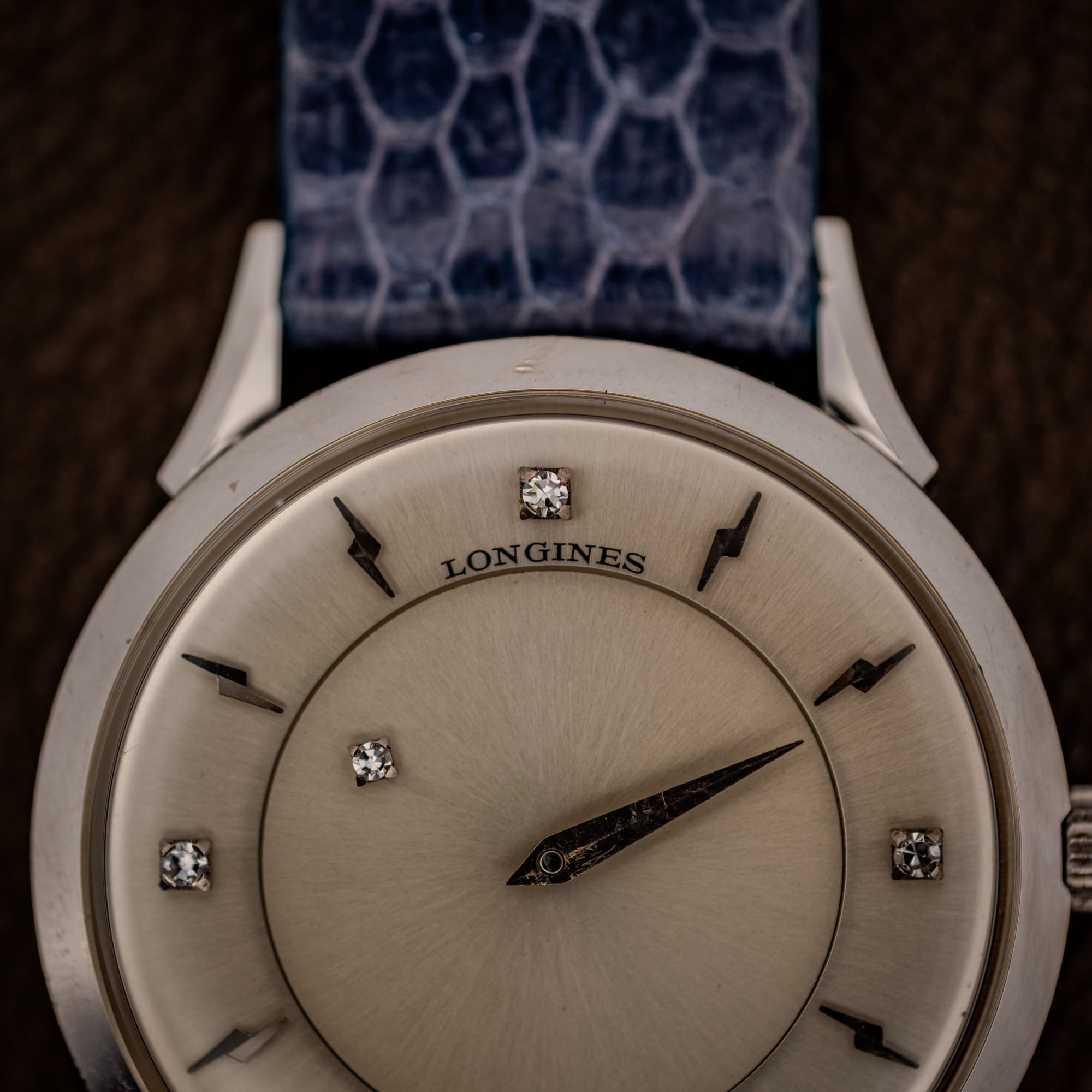
The dial earns the second look it asks for. It is a two-tier silver sunburst, the brushed outer chapter stepped down to the spinning inner disc, signed LONGINES beneath twelve and SWISS at the base. Faceted lightning-bolt markers ring the outer track, and four round diamonds in white-gold settings mark the quarters, catching light against the matte silver. The two dauphine hands, gold-toned, float across the open center, and the hour hand has picked up a little spotting over seventy years that we read as the texture of an original dial rather than a flaw to apologize for. There is no seconds hand and no clutter, just two hands crossing a field of silver with nothing apparently holding them up.
It comes on a blue snakeskin strap closed with a buckle, a cool and slightly unexpected pairing that picks up the white of the gold and the flash of the diamonds without competing with either. The strap shows gentle wear of its own and is easily swapped against the 18mm lugs if a new owner wants a different look.
Serviced in-house at OTTUHR and backed by our 2-year mechanical warranty, it is ready to wear rather than admire in a drawer. For the collector who would rather own a watch that does something than one that merely sits still, this is the Longines mystery dial to reach for. Compact, characterful, and quietly theatrical, it keeps its secret in plain sight.