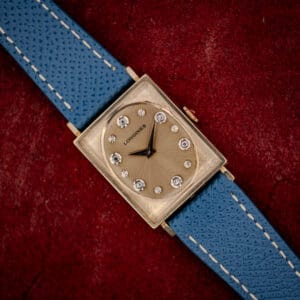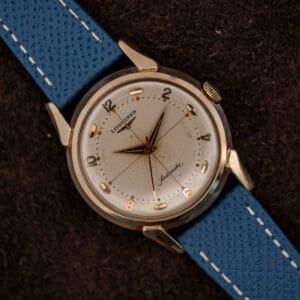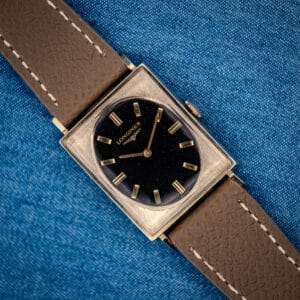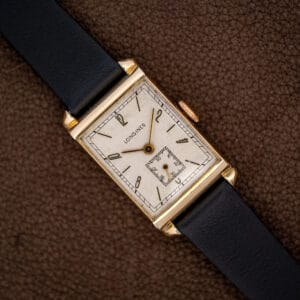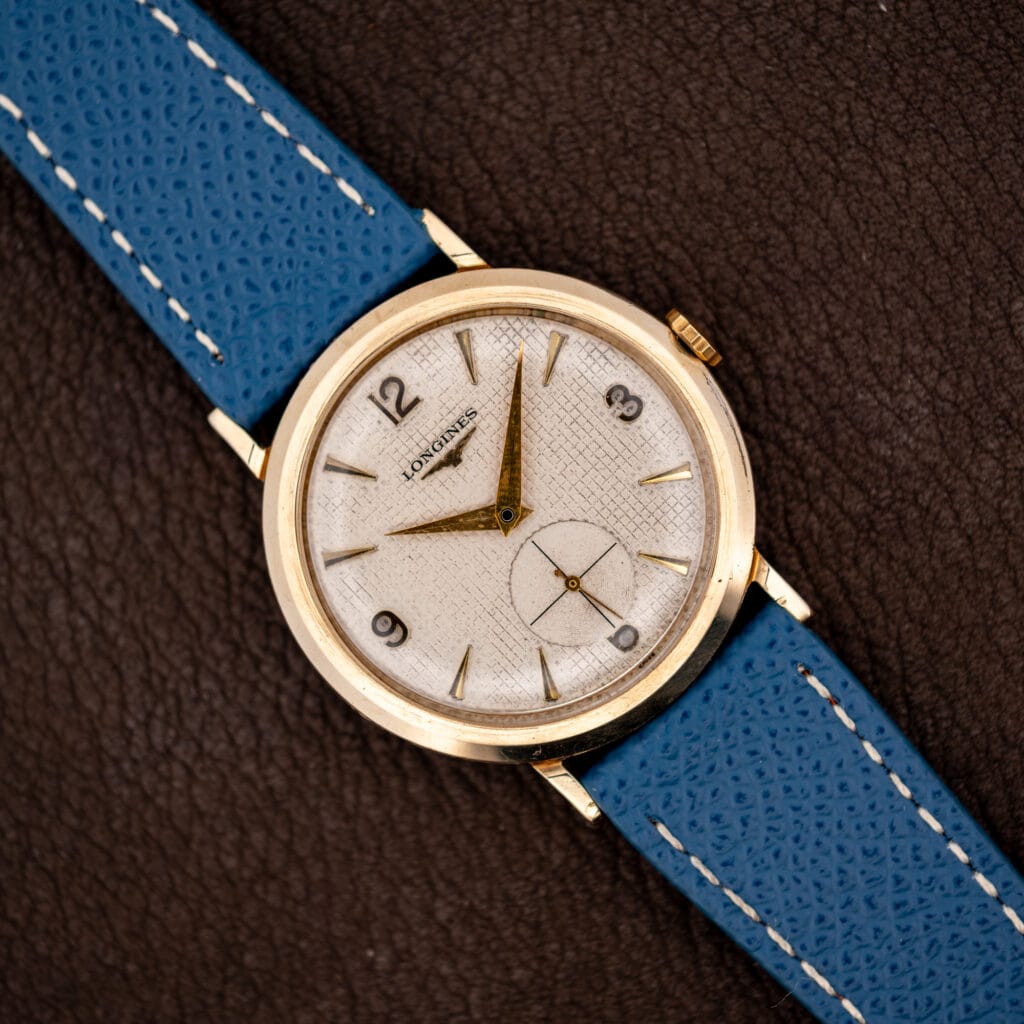
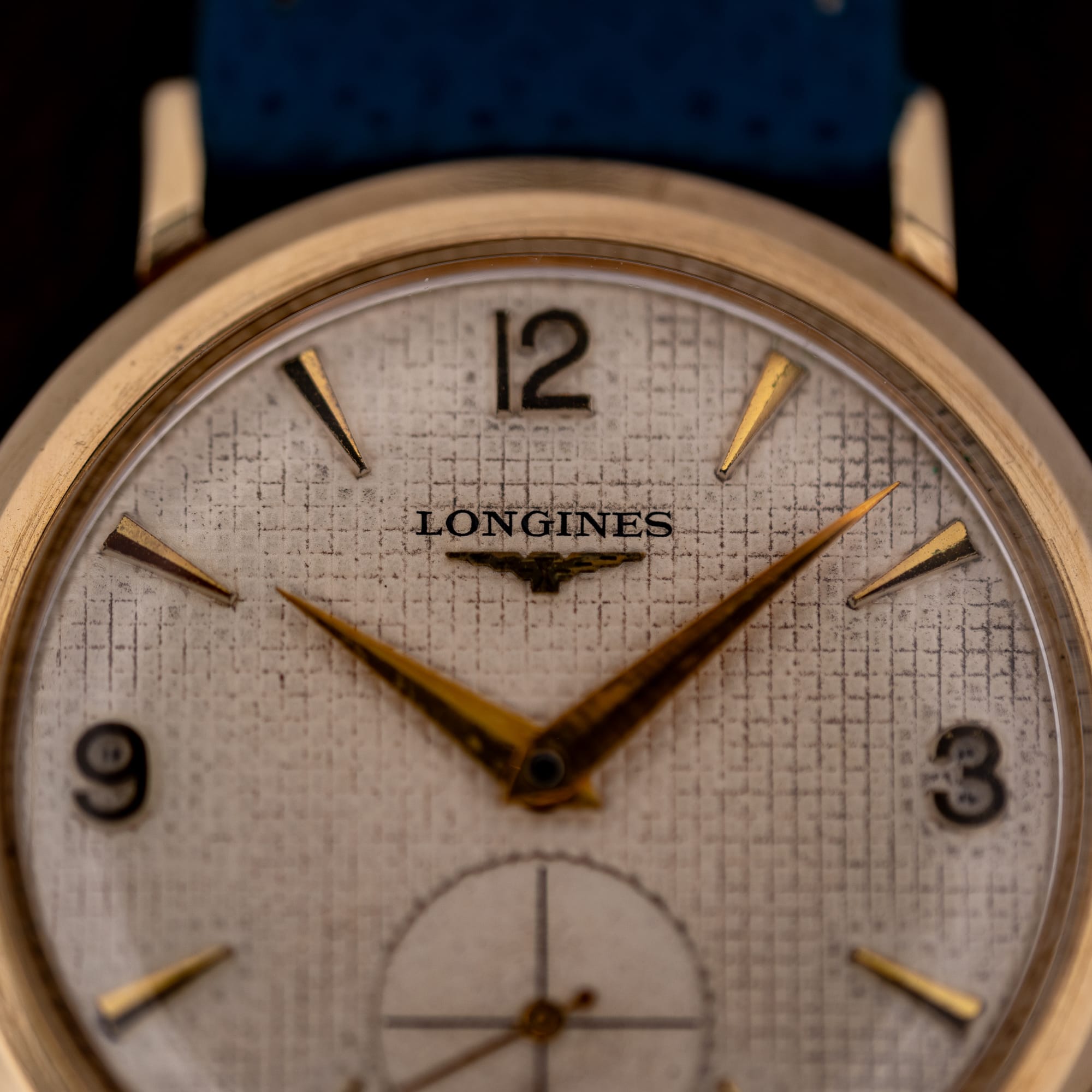
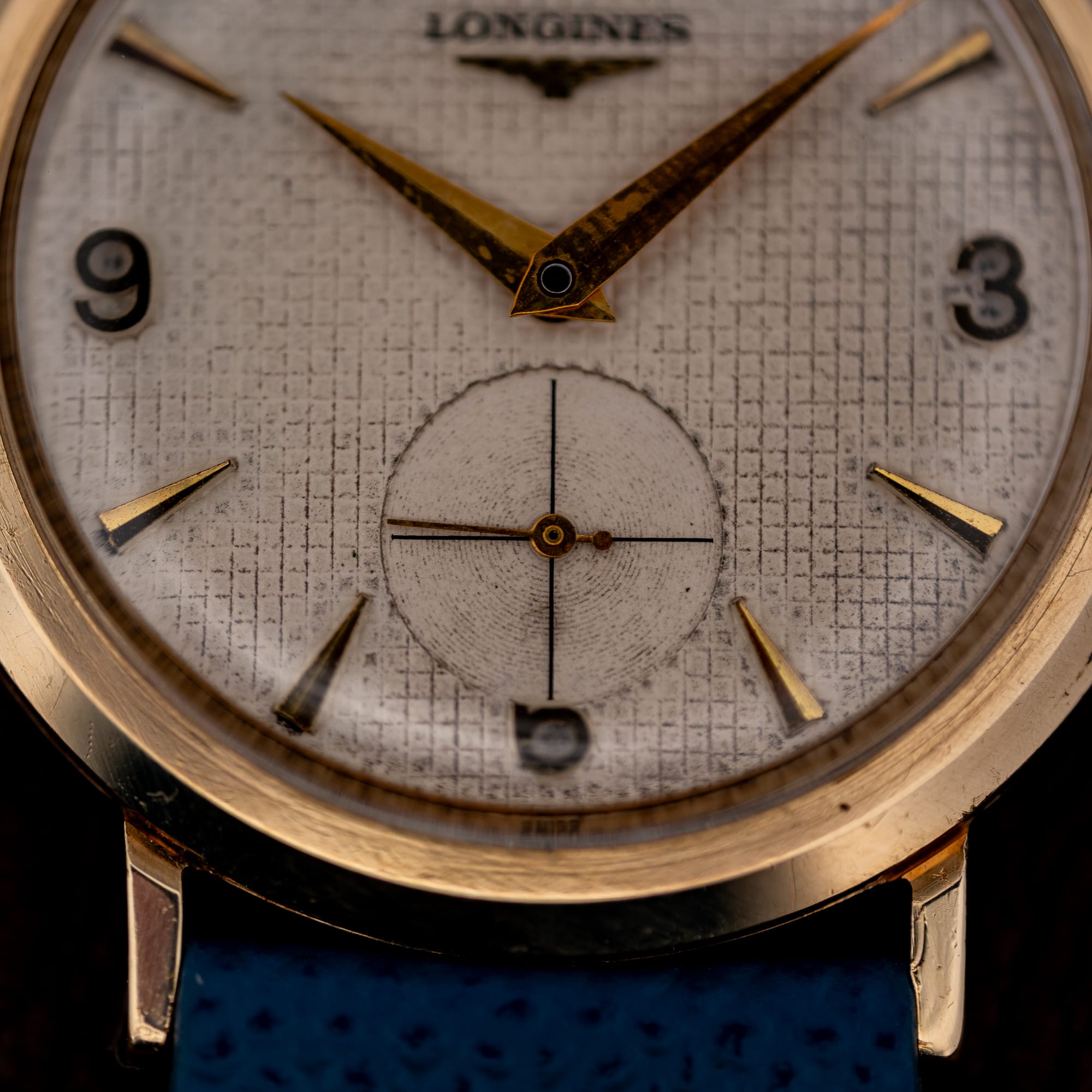
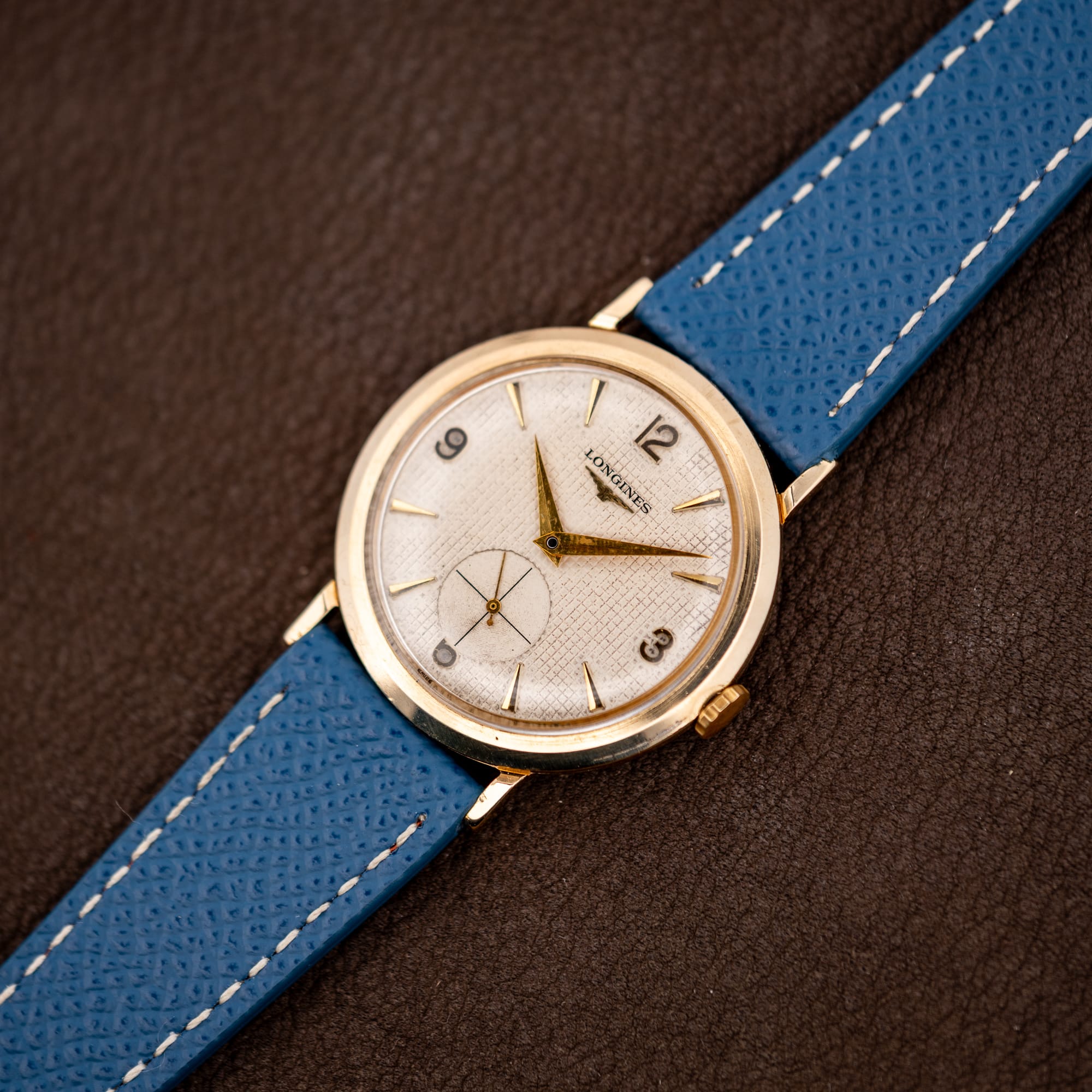
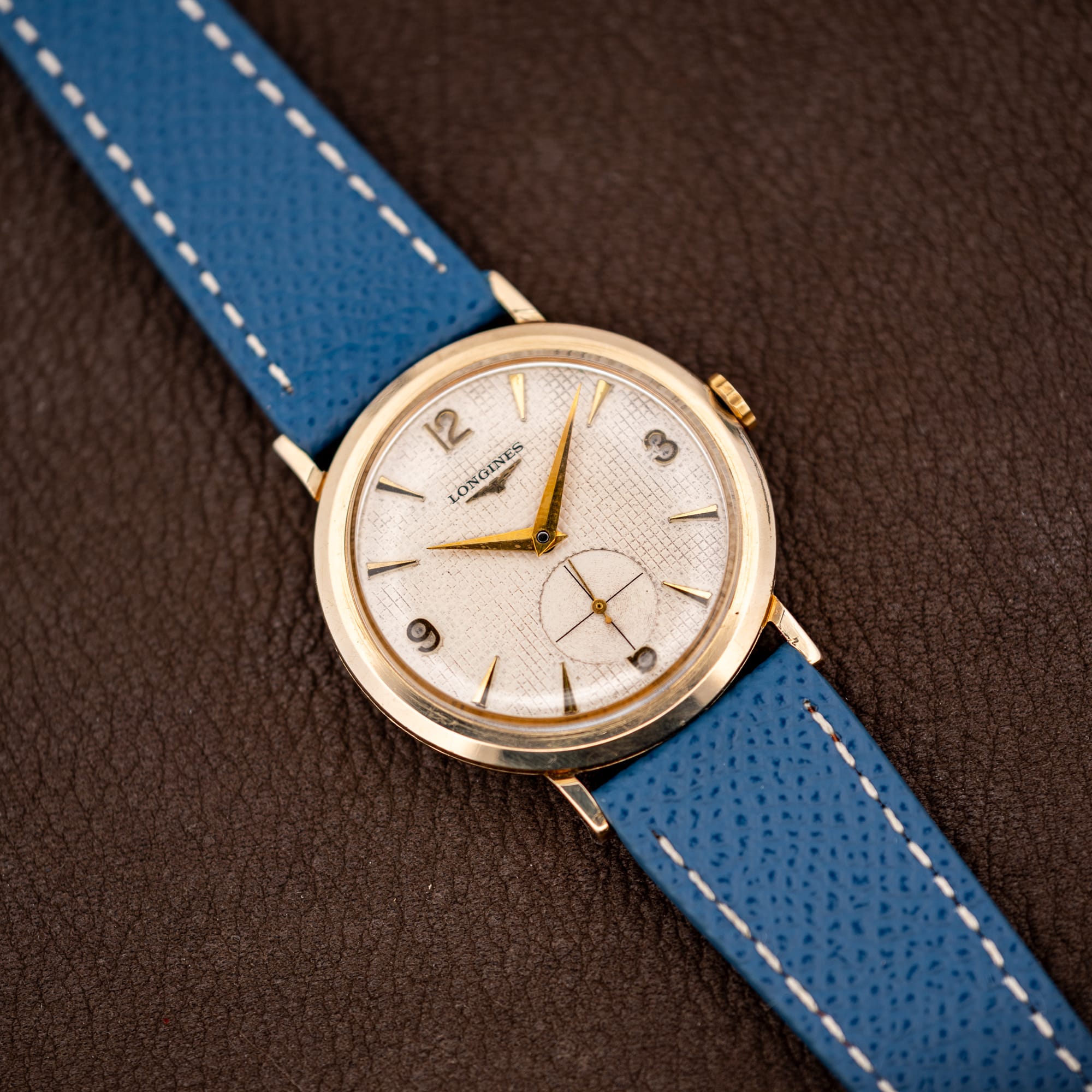
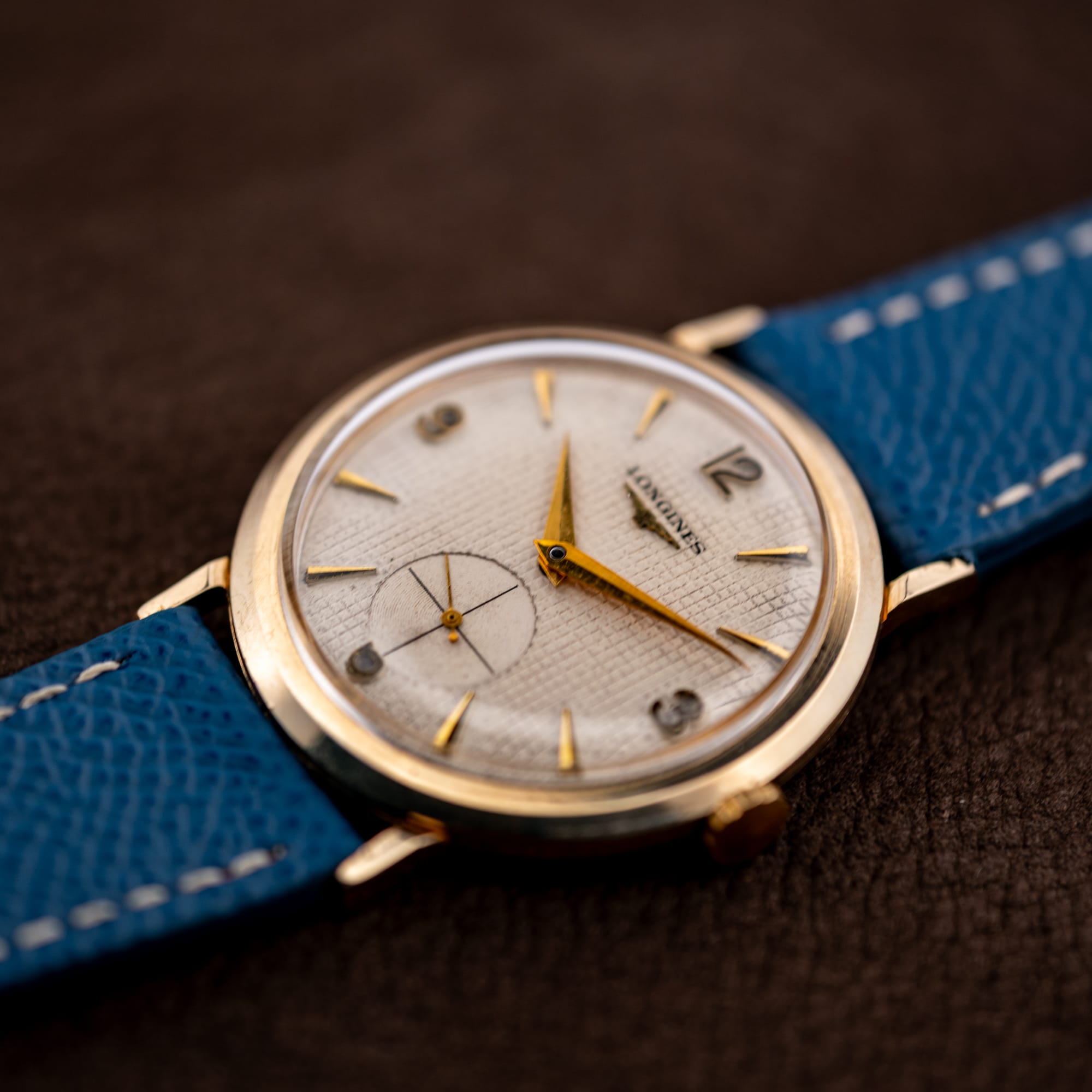
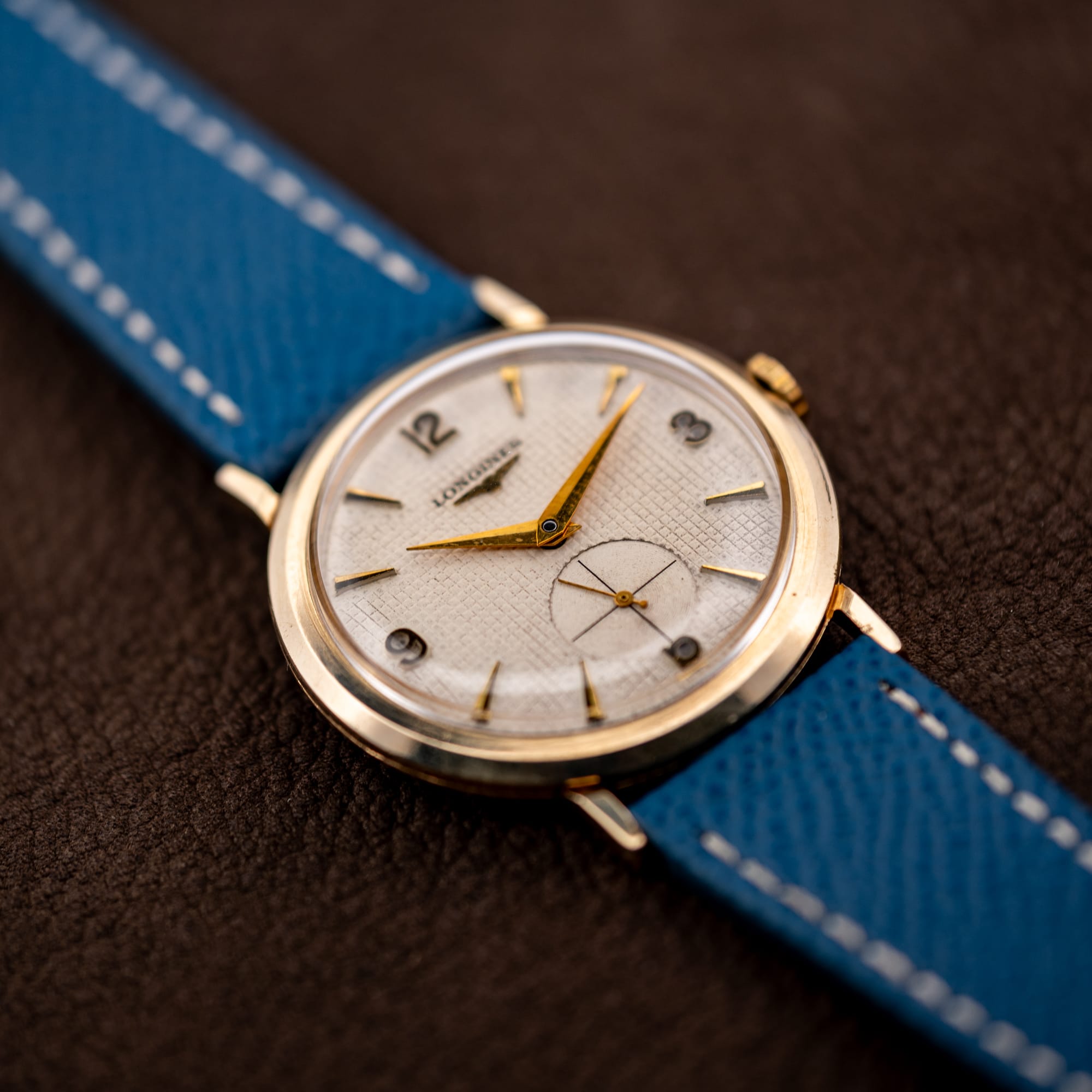
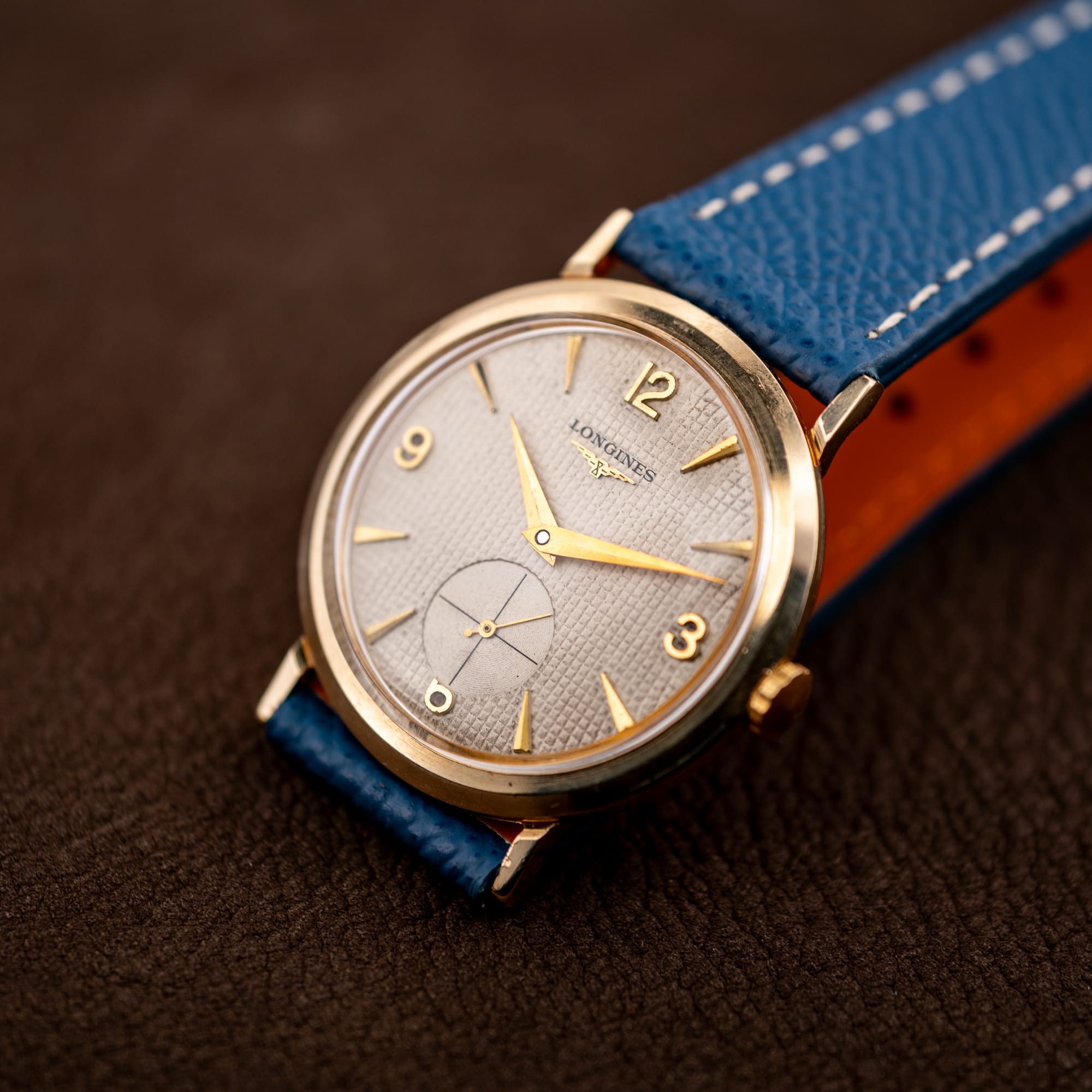

At arm’s length this dial reads as a plain silvered face, quiet enough to disappear under a shirt cuff. Move in closer and it resolves into a grid, two sets of finely ruled lines crossing at right angles, laying small squares edge to edge across the whole surface. Collectors call this a Longines waffle dial, and the name only earns itself once you are near enough to see the weave.
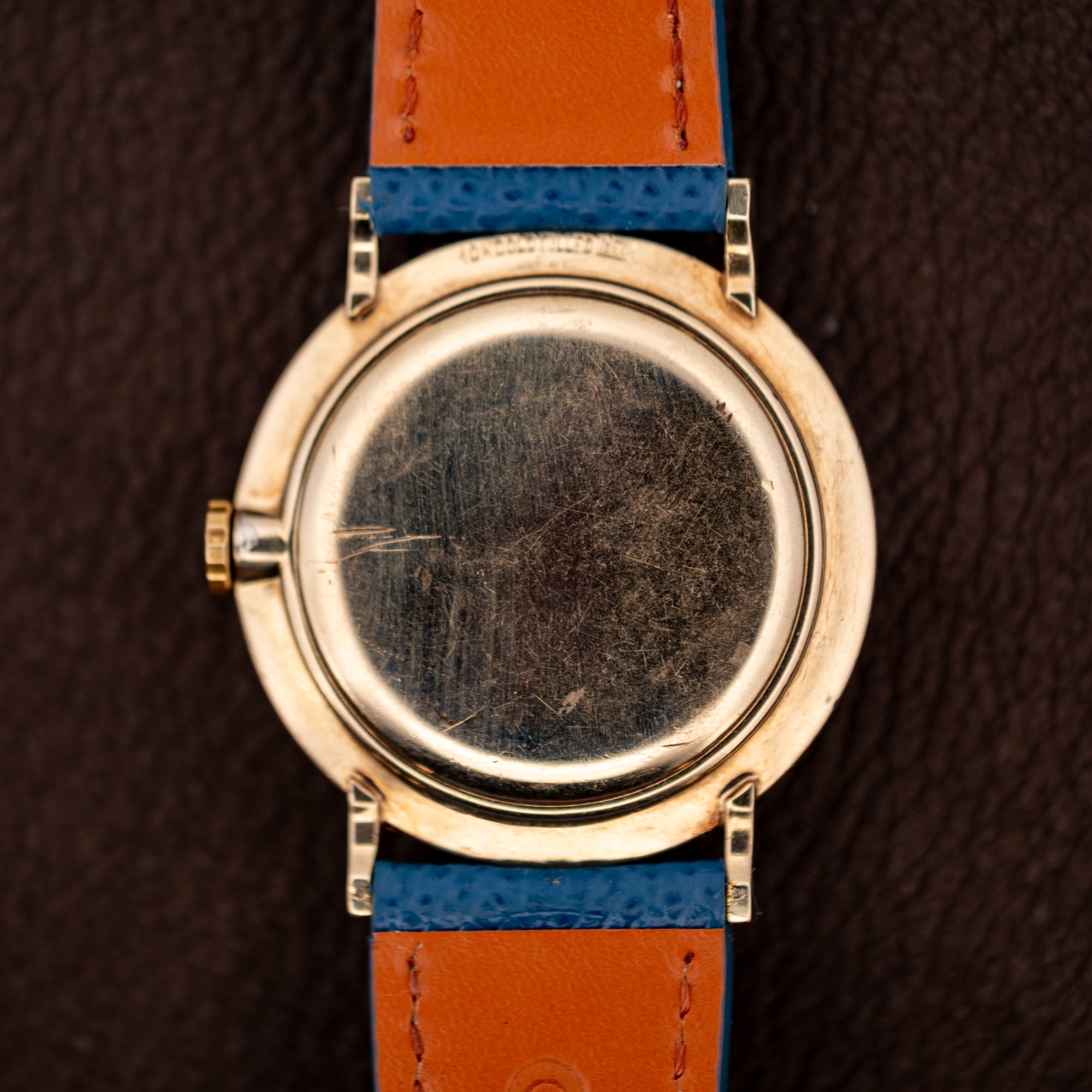
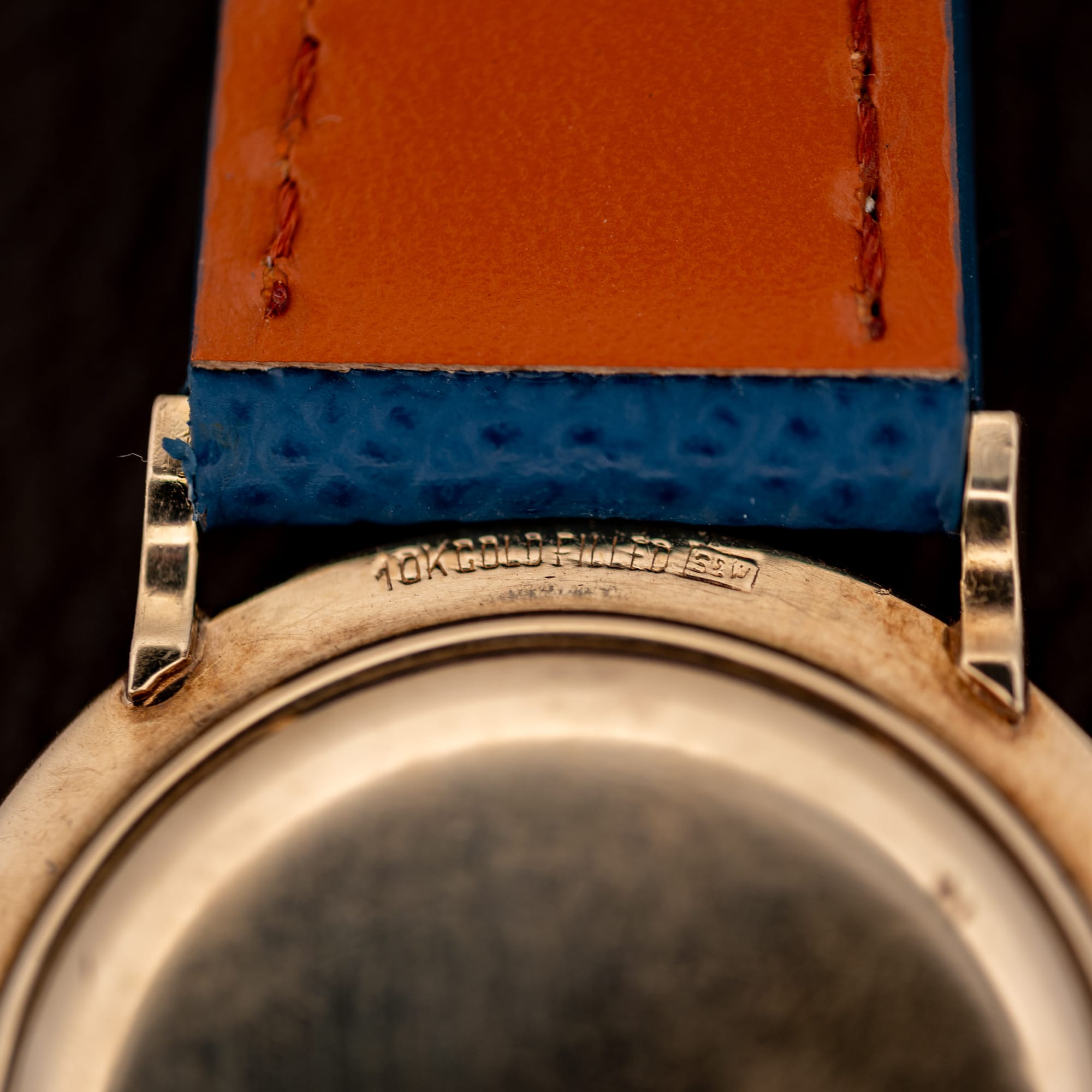
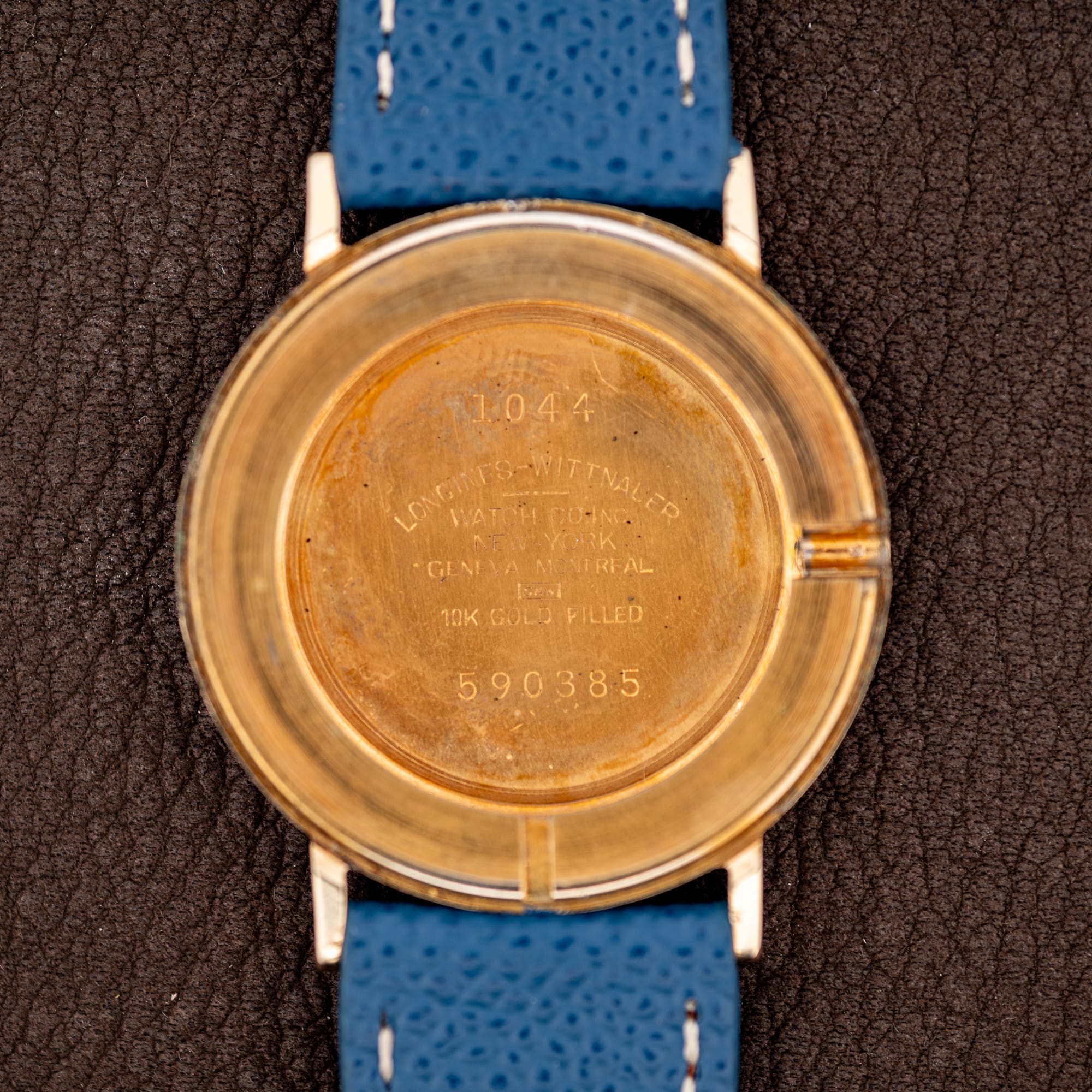
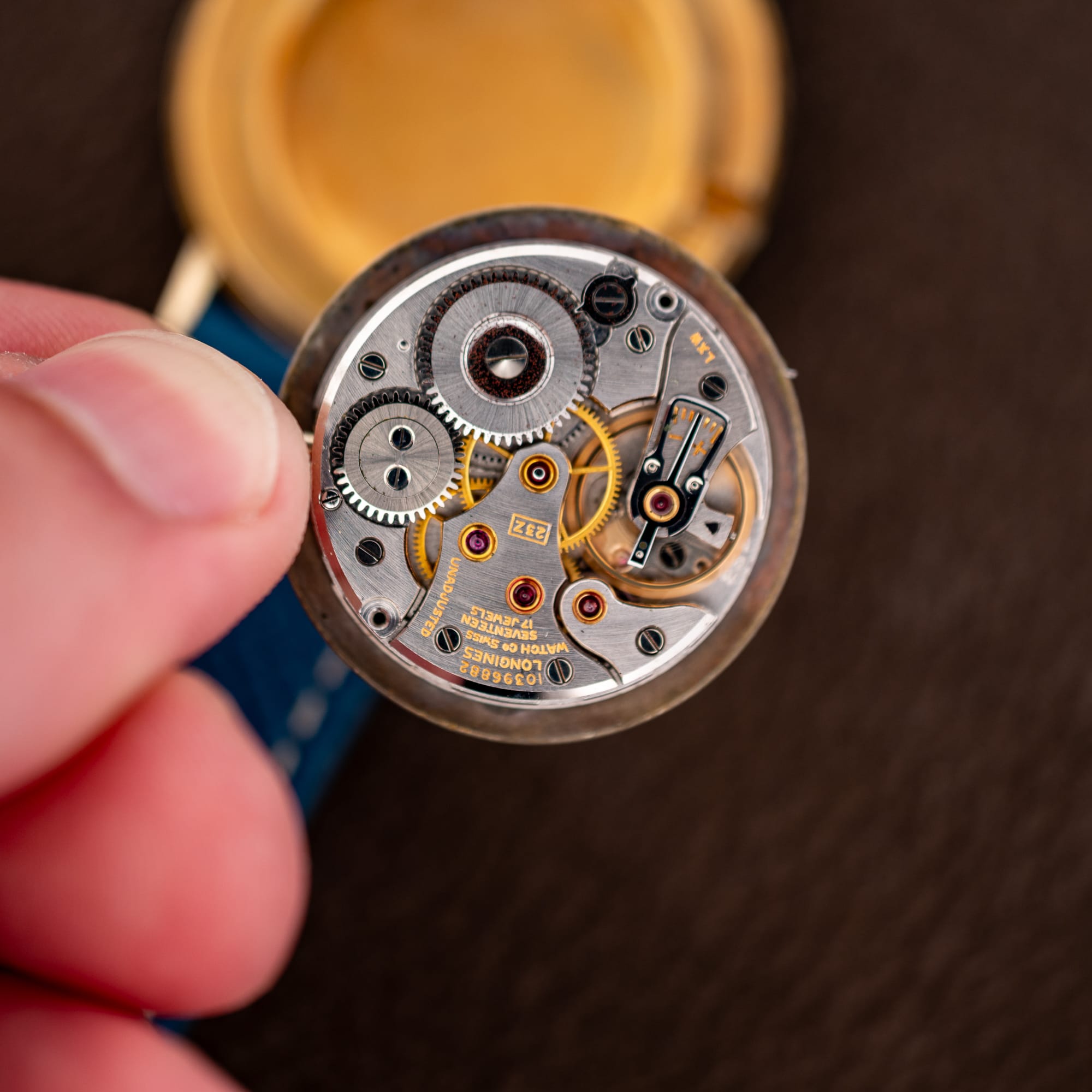
The story we find more interesting sits on the other side. Lift the back and the inside is stamped LONGINES-WITTNAUER over New York, Geneva and Montreal, with the reference 1044 struck above it and 590385 below. The dial and the movement are Swiss. The gold filled case holding them is not, and that was deliberate.
Longines-Wittnauer was an American company rather than a Swiss one, the New York house that had sold Longines exclusively in the United States since the 1860s. Tariff law of the period treated a movement and its case as two separate dutiable goods, so a case bought in America carried no import duty at all. Longines-Wittnauer worked that gap: movements and dials shipped bare from Saint-Imier, cases commissioned from American makers, the two married in New York before going out to jewelers across the United States and Canada. Solid gold models generally kept their Swiss cases. Below that tier, this watch included, cases were routinely finished on this side of the ocean.
Once that is clear, two more marks stop being trivia. The movement is signed UNADJUSTED, which on an imported Swiss movement of this era says nothing about how well it was built and everything about the customs schedule, because duty scaled with the number of adjustments declared. Many movements marked that way were adjusted regardless, some by the importer’s own watchmakers once the duty was paid. The jewel count reads SEVENTEEN, and the rate climbed sharply above seventeen jewels. Three stampings, one explanation.
Which returns us to the waffle dial, because that texture came out of the same industrial logic. It was struck rather than cut, a steel die pressed into the brass blank so the metal deformed instead of being carved away, the surface then silvered, printed and fitted with its applied markers. Guilloche by press rather than by hand. What the grid does is optical. A sunburst throws one bright band that sweeps across a dial as the wrist turns, while a crosshatch runs in two directions at once and breaks that reflection apart, giving back a soft even glow that brightens and dims with the angle instead of flashing. The small seconds register interrupts it deliberately, the grid stopping dead at its edge and giving way to fine concentric rings under a crosshair.
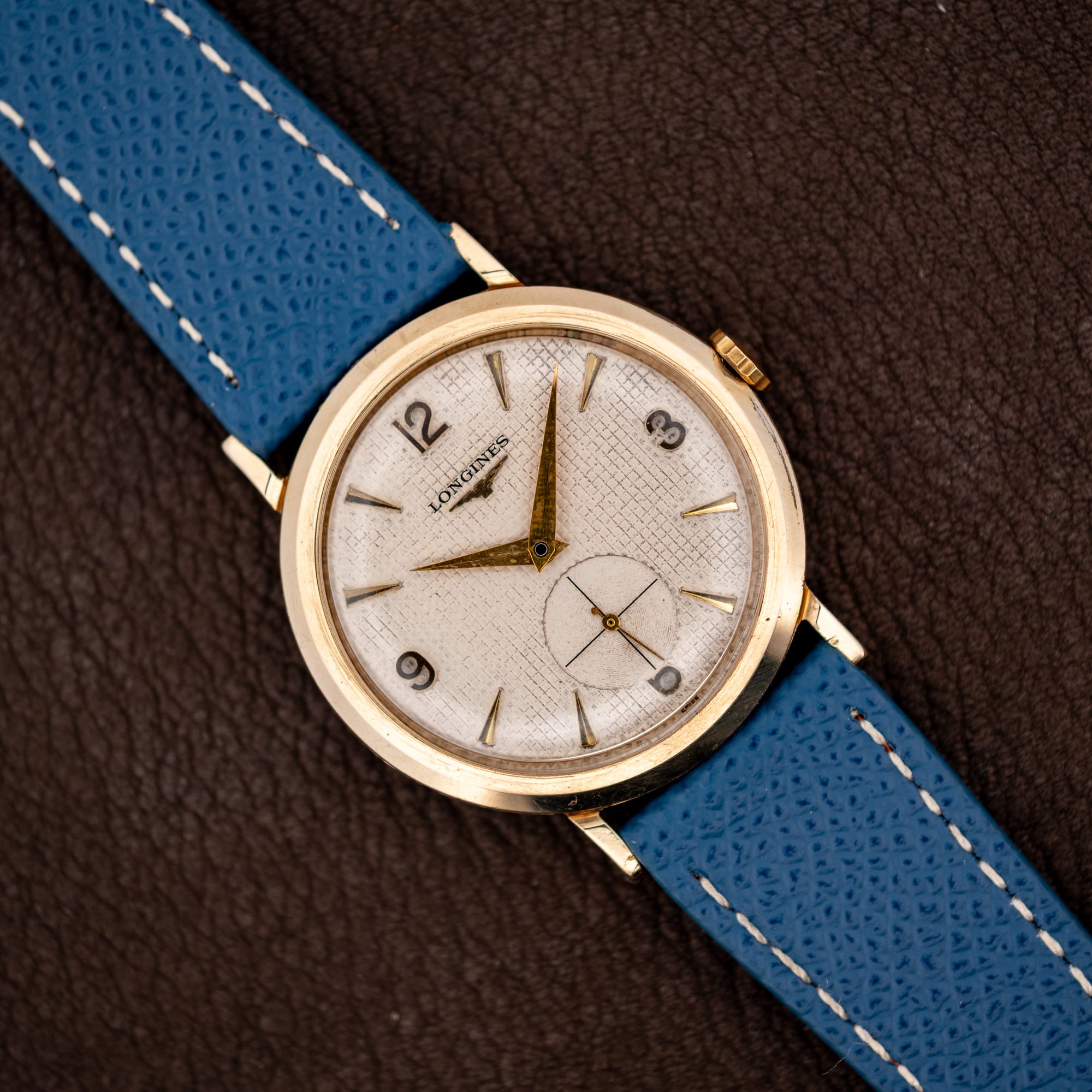
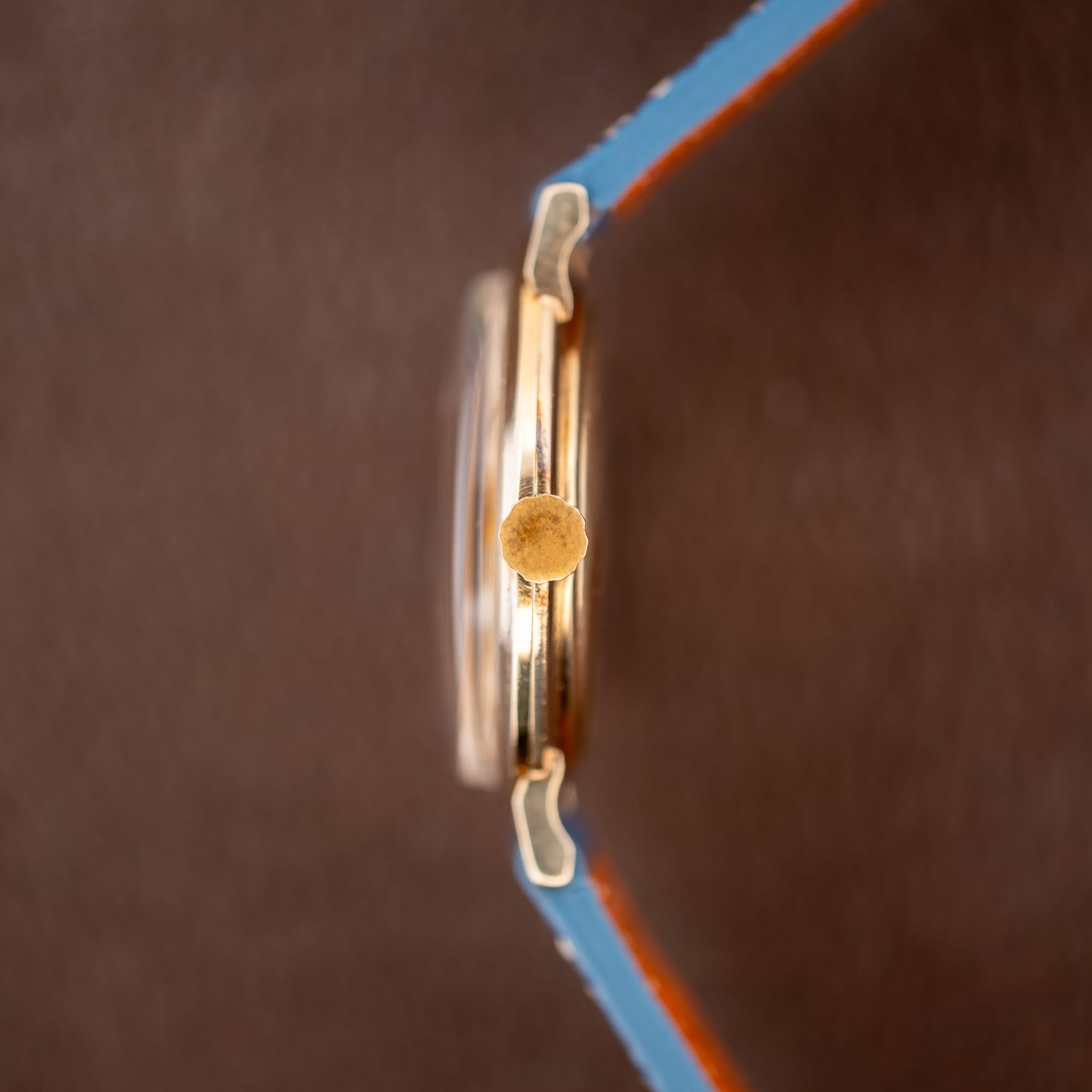
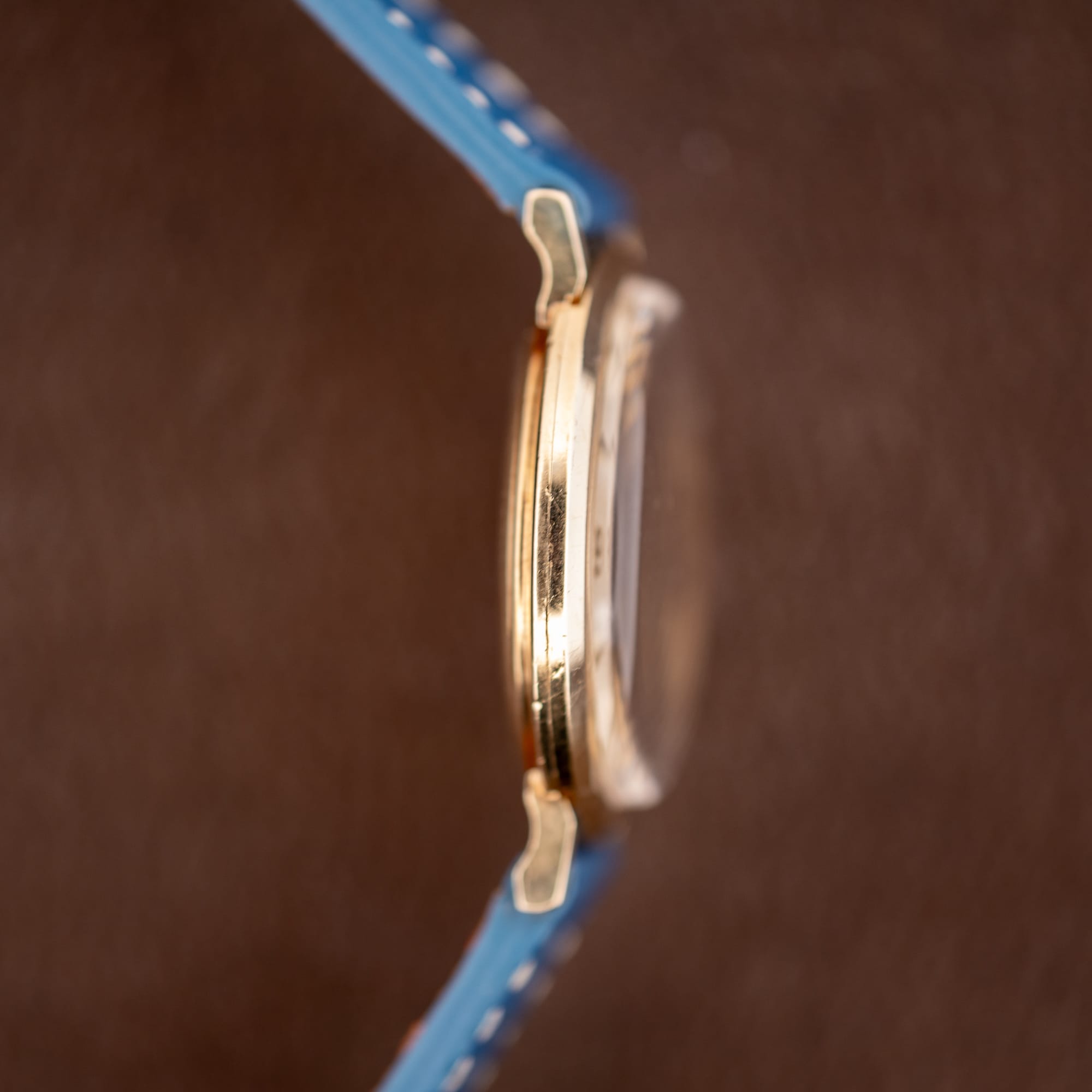
The particulars, briefly. A 32.5mm round case in 10k gold filled, 38mm lug to lug, faceted lugs flaring out to catch light along their edges, a domed crystal and a fluted crown. Applied gold batons hold eight of the hours, Arabic numerals mark twelve, three, nine and six, and gold dauphine hands run above. Inside is Longines’ caliber 23Z, seventeen jewels, hand wound at 18,000 vibrations an hour and numbered 10396882, which places its manufacture in 1957. The outer back is plain and unengraved, softened by decades of cuffs, while the dial has gathered a fine scatter of speckling toward its edges, the ordinary record of a silvered surface nobody has refinished.
Longines still holds the ledgers for every movement it built between 1867 and 1969, so the exact production date of this one can be requested from Saint-Imier for nothing. Serviced in-house at OTTUHR and backed by our 2-year mechanical warranty, fitted to a blue leather strap on an OTTUHR buckle. A watch built to look plain, that tells the truth only to whoever leans in.