

Last updated ~ February 2, 2026
Brand
Production Period
1962–1971
Model Line
Case Shape
Round
Diameter
36mm
Lug to Lug
43mm
Lug Width
18mm
Case Thickness
13mm
Case Back
Screw-Down
Caliber
Crystal
Bezel
Smooth
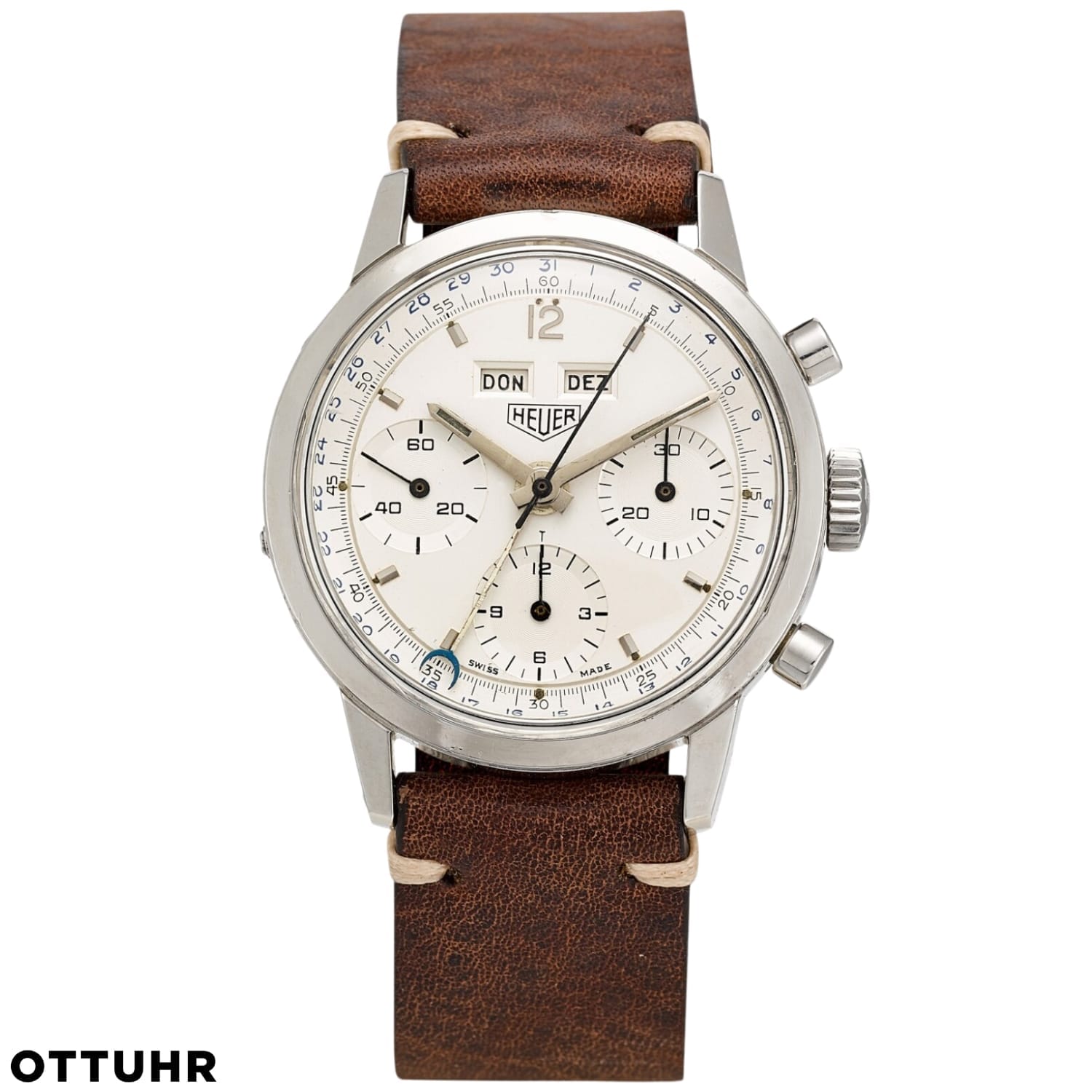
The Heuer 2547S represents the most complicated watch in the entire 1960s Carrera lineup, predating the Carrera name itself by nearly a year. Introduced around 1962 as a waterproof triple calendar chronograph with the reference number inherited from Heuer’s 1940s triple calendar line, this watch would later be christened the “Carrera 12 Dato” in catalogs despite never wearing the model name on its dial. The 2547S stands as Heuer’s answer to the great triple calendar chronographs of the era, offering day, date, and month complications alongside a 12-hour chronograph function, all housed in a case that would define the aesthetic language of the legendary Carrera series.
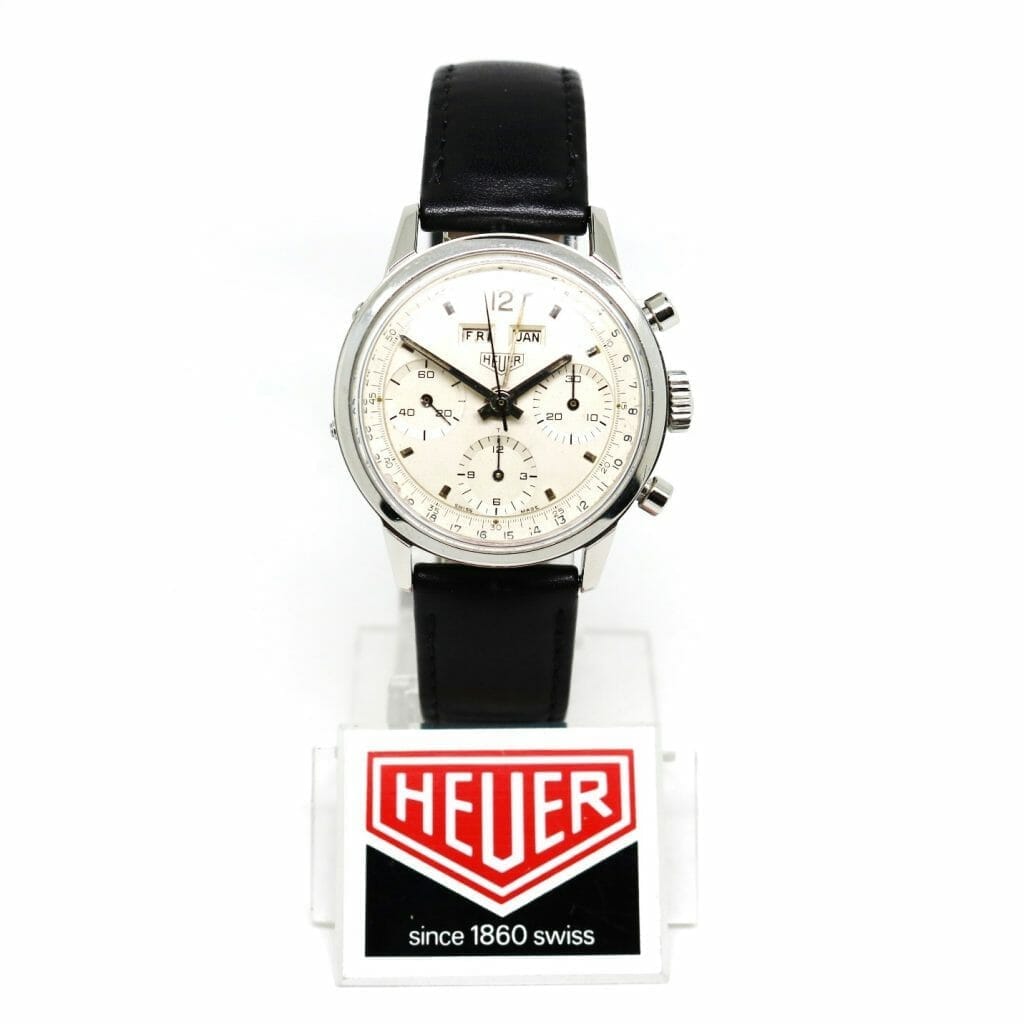
The 2547S exists in two distinct executions. The first execution (circa 1962-1966) features wider, faceted lugs similar to those that would grace the first Carreras, a screw-back waterproof case, round pushers, plain steel hands, and typically a blue crescent-tipped date hand. The second execution (circa 1966-1971) moved to thinner lugs, a monocoque snap-back case, fluted pushers, hands with black striping for improved legibility, and a red crescent-tipped date hand. Both versions maintain the 36mm case diameter and distinctive triple calendar dial architecture that makes the 2547 instantly recognizable.
Production numbers for the 2547S remain undocumented by Heuer, but all available evidence points to extremely limited production. The 2547N black dial variant is documented with only five known examples, suggesting the white dial 2547S, while more common, was produced in similarly modest quantities. Serial numbers observed on the market typically fall in the 100XXX range for late 1960s examples, indicating production numbered in the hundreds rather than thousands. The watch qualifies as rare within the vintage Heuer collecting community, with examples appearing perhaps 10-15 times per year across major dealers, auction houses, and private sales.
Collector demand for the 2547S has remained steady over the past decade, with the watch positioned as a sophisticated alternative to the more widely recognized standard Carreras. Values for clean examples on strap range from approximately $8,000-12,000, with first execution screw-back models commanding a premium of 20-30% over second execution examples. The addition of an original Gay Freres bracelet with HEL endlinks can add $4,000-6,000 to the value. Unpolished cases, original dials with matching patina between hands and markers, and complete service history all drive significant premiums. The 2547NS reverse panda variant (white subdials on black dial) ranks among the most desirable configurations, approaching $20,000-30,000 when offered with full documentation.
Historical Context, Provenance, and Manufacturing Details
The 2547 reference number originated in Heuer’s 1940s triple calendar chronograph program, first appearing around 1944-1945 as a waterproof triple calendar chronograph powered by the newly introduced Valjoux 72C movement. These early 2547 models featured 37.5mm cases with screw-back construction, round pushers, wide syringe hands, and radium luminous material, retailing for 385 CHF in 1946. The reference served as one of Heuer’s most expensive and complicated offerings during the post-war period, targeting customers who valued both chronograph functionality and perpetual calendar complications in a single wristwatch.
When Heuer redesigned the triple calendar chronograph around 1962, the company retained the 2547 reference number but updated the case design to align with the aesthetic direction Jack Heuer was developing for the forthcoming Carrera line. The first execution 2547S adopted the angular, faceted lugs that would debut on the Carrera 2447 in 1963, creating a visual continuity between Heuer’s sport chronographs and its most complicated model. However, the 2547 required a thicker case to accommodate the Valjoux 72C movement’s additional calendar mechanism, resulting in approximately 13mm thickness versus the standard Carrera’s 12mm. The case also lacked the tension ring below the crystal that became a Carrera signature, as the additional dial complexity made this feature impractical.
The 2547S was manufactured at Heuer’s facilities in Switzerland, with cases produced by Ervin Piquerez SA (EPSA) and possibly other suppliers. Piquerez, the renowned case manufacturer responsible for many iconic Heuer cases of the 1960s, produced the screw-back waterproof cases used in the first execution 2547S. The second execution moved to monocoque construction, likely sourced from multiple suppliers as Heuer expanded production during the late 1960s. Dials were manufactured by Singer, the same supplier that produced dials for early Rolex Daytonas and Omega Speedmasters, explaining the visual similarities in typography and register design across these legendary chronographs.
The decision to market the 2547S as the “Carrera 12 Dato” beginning around 1966 reflected Heuer’s desire to leverage the Carrera brand’s growing motorsport cachet. The watch appeared in the 1966-67 Heuer catalog alongside standard Carreras, though it never received dial printing identifying it as a Carrera. This marketing approach positioned the 2547 as a dressy complication watch with sporting pedigree, targeting customers who wanted Heuer’s chronograph expertise combined with calendar functionality suitable for business and formal occasions. The 2547S competed directly with Rolex’s reference 6234 triple calendar chronograph (produced 1956-1961 with an estimated 2,300 steel examples), Omega’s triple calendar models, and other high-end calendar chronographs of the period.
Production ceased around 1971 as Heuer shifted focus to automatic chronographs following the introduction of the Calibre 11 in 1969. The triple calendar complication, always a niche offering given its price premium and service complexity, no longer aligned with Heuer’s increasingly tool-watch oriented brand positioning. No direct successor replaced the 2547S, making it the final chapter in Heuer’s triple calendar chronograph story that began in the early 1940s.
Construction and Architecture
The 2547S case measures 36mm in diameter, 43mm lug to lug, and approximately 13mm in thickness. These dimensions make it identical to early Carrera chronographs in width and lug-to-lug measurement but notably thicker due to the calendar mechanism. The case is constructed from stainless steel with a polished finish throughout, though some variants may show brushed elements on the lug tops depending on execution and potential refinishing.
First execution cases (circa 1962-1966) feature wider, more substantial lugs with pronounced faceting and sharp edges. These “fat lugs” measure approximately 4-5mm wide at the case junction and taper gracefully to the strap attachment point. The case back is a screw-back design with a polygonal edge requiring a case wrench for removal, typically engraved “Heuer – Stainless Steel – Waterproof” in a circular pattern. The pushers are round, polished cylinders that extend cleanly from the case band at 2 and 4 o’clock. This first execution case provides genuine water resistance, though the specific rating was never formally published by Heuer. Based on construction and contemporary waterproof chronograph standards, a depth rating of 30-50 meters would be reasonable when gaskets are fresh.
Second execution cases (circa 1966-1971) feature thinner lugs measuring approximately 3mm wide at the case junction, with less pronounced faceting than first execution models. The case back is monocoque (single-piece) construction with a snap-fitting back that requires a case knife for removal. These cases lack the waterproof designation and should not be exposed to water beyond incidental splash resistance. The pushers evolved to fluted (ribbed) design, providing improved grip and a more sporty aesthetic. The crown on both executions is unsigned and measures approximately 5.5mm, consistent with period Heuer chronographs.
The dial architecture defines the 2547S. The base plate is either silver/white (2547S designation) or black (2547N designation), with applied hour markers at all positions except 11, 12, and 1 o’clock, where the day and month apertures are positioned. These applied markers are polished steel batons with lume plots in tritium, aging to cream or light brown patina over time. The dial features pronounced beveling outside the hour markers, creating topographical depth that separates timekeeping from calendar functions. Three engine-turned registers sit at 3, 6, and 9 o’clock, with the 3 o’clock position displaying a 30-minute chronograph counter, the 6 o’clock position showing a 12-hour totalizer, and the 9 o’clock position housing the running seconds subdial.
The calendar display consists of three elements. Day of the week appears in a window at approximately 11:30, month appears in a window at approximately 12:30, and date is indicated by a centrally mounted hand with a crescent-shaped tip reaching to an outer date track printed on the dial perimeter. Early examples (first execution) typically feature a blue outer date track with a blue crescent-tipped date hand. Later examples (second execution) typically show a blue date track with a red crescent-tipped date hand. The date track features Arabic numerals for all 31 days printed in either blue or black depending on dial color and execution.
Hands evolved across the production run. First execution models feature plain polished steel hour and minute hands with lume plots, consistent with early Carrera chronographs. The central chronograph seconds hand is a simple stick design. Second execution models adopted hands with black striping down the center, improving legibility against both light and dark dial backgrounds. This design change appeared across the Carrera line in the late 1960s as Heuer prioritized functionality.
The crystal is acrylic (plastic/hesalite) with a domed profile, measuring approximately 31.3mm in diameter. Unlike standard Carreras, the 2547 lacks the painted tension ring visible below the crystal, as the calendar tracks occupy this visual space. Replacement crystals for the 2547S must account for the correct curvature and diameter to maintain proper proportions.
Case manufacturing reveals interesting details. The interior of the case back on monocoque examples often shows the marking “2923,” which collectors sometimes misidentify as a reference number. This is actually a parts designation indicating the case back is designed for Valjoux 72C movements (thicker than standard Valjoux 72), allowing watchmakers to distinguish the correct replacement part. The actual reference number, 2547, appears engraved between the lugs at 6 o’clock alongside the serial number.
The 2547S was offered exclusively on leather straps from the factory, with 18mm lug width accepting standard period Heuer straps. However, the watch could be special-ordered with a Gay Freres “Beads of Rice” bracelet featuring unique HEL (Heuer Edouard Leonidas) endlinks sized at 18.8mm rather than the standard 18mm. These bracelets, now highly collectible, feature the HEL stamp on the endlinks and a signed Heuer deployant clasp. Original examples in good condition command $4,000-6,000 independently, making them nearly as valuable as some complete vintage Heuer chronographs.
Sub-Reference Variants
| Sub-Reference | Dial Configuration | Case Type | Production Period | Key Identifying Features |
|---|---|---|---|---|
| 2547S First Execution | White/silver dial, white registers | Screw-back, wide lugs | 1962-1966 | Blue date hand, blue date track, plain steel hands, round pushers |
| 2547S Second Execution | White/silver dial, white registers | Monocoque, narrow lugs | 1966-1971 | Red date hand, blue date track, striped hands, fluted pushers |
| 2547N | Black dial, white registers (reverse panda) | Monocoque, narrow lugs | 1968-1971 | Red date hand, blue date track, striped hands, extremely rare with ~5 known examples |
| 2547SN | White dial, black registers (panda) | Monocoque, narrow lugs | 1968-1971 | Red date hand, blue date track, striped hands, considered rarest configuration |
Cross-Reference Data
The Zodiac variants merit special attention. These watches are mechanically and visually identical to Heuer 2547 models, manufactured by Heuer but branded for Zodiac’s distribution channels. They share the same cases (including the “2547” reference number engraved between the lugs), the same movements, the same dials with only the brand name changed, and even the same fluted pushers found on Heuer models. For collectors seeking the 2547 experience at a discount, Zodiac examples trade for approximately 50% less than equivalent Heuer-branded models, representing exceptional value.
Movements & Calibers
The 2547S was powered by two closely related movements during its production run: the Valjoux 72C (early production, first execution models) and the Valjoux 723 (later production, second execution models).
Valjoux 72C (VZHC – Valjoux Zähler Heure Calendrier)
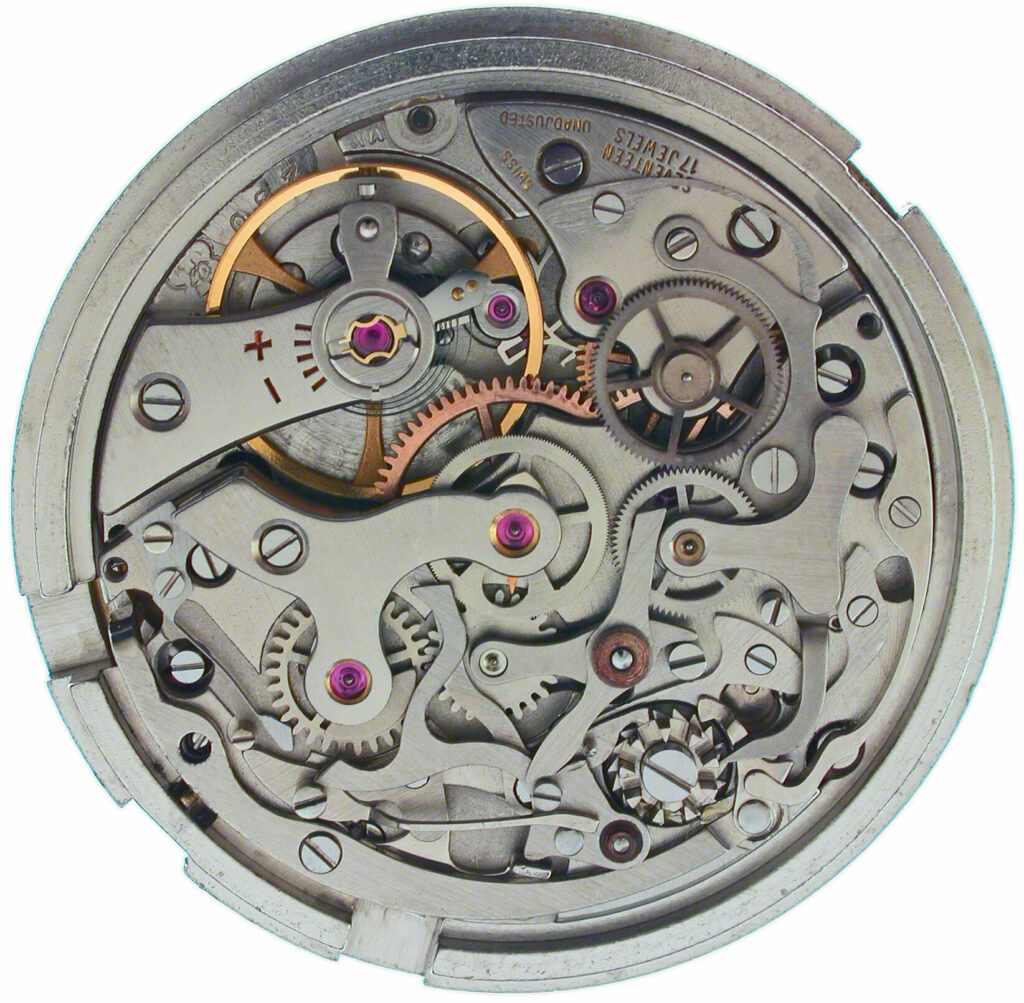
Introduced around 1946 and produced through 1974, the Valjoux 72C represents the calendar-equipped variant of the legendary Valjoux 72 chronograph movement. Key specifications include:
- Diameter: 29.5mm (13 ligne)
- Height: 6.95mm (versus 6.5mm for base Valjoux 72)
- Jewels: 17
- Frequency: 18,000 vph (2.5 Hz)
- Power reserve: 48 hours
- Construction: Column wheel chronograph with 9-column wheel
- Winding: Manual, clockwise crown rotation
- Chronograph capacity: 12 hours via counters at 3 and 6 o’clock, plus running seconds at 9 o’clock
The calendar mechanism adds day and month complications displayed via discs visible through dial windows at 11:30 and 12:30, with date indicated by a central hand pointing to an outer track. All three calendar functions are independently adjustable via pushers on the left side of the case. The pusher at 10 o’clock advances both day (with a deeper press using the double-jointed lever in later versions) and month. The pusher at 8:30 advances the date. Early 72C movements (1940s production) used a single-jointed lever requiring the hour hand to be advanced to change the day, while later versions (1950s-60s) adopted a double-jointed lever allowing direct day adjustment.
The movement features a Breguet overcoil hairspring in early examples, later simplified to a flat hairspring in some production runs. The bridge is signed “Ed. Heuer & Co.” or “Heuer-Leonidas” depending on production period, with “17 Rubis” indicating jewel count. The movement serial number typically ranges from 500XXX to 520XXX for late 1960s production.
Valjoux 723
The Valjoux 723 is functionally identical to the 72C with updated designation. Heuer transitioned to this movement around 1967-68 as Valjoux refined its nomenclature system. All specifications match the 72C, including diameter, height, jewel count, frequency, and complications. The movement is sometimes designated as “Valjoux 72C/723” in documentation, reflecting their interchangeable nature.
Collectors examining a 2547S should verify the movement matches the expected caliber for the watch’s production period and that the Heuer bridge signature is present and correctly formed. The movement should be clean, with no rust or corrosion on the bridge work, properly functioning chronograph reset (all hands returning precisely to zero), and smooth calendar advancement when pushers are operated. The column wheel mechanism should provide crisp start/stop action with no hesitation.
Service intervals for the Valjoux 72C/723 typically occur every 5-7 years depending on usage. These movements are well-supported by watchmakers, with parts availability generally good through specialist suppliers. However, calendar components, particularly the day and month discs, can be challenging to source in correct languages and fonts for specific markets. A competent watchmaker familiar with vintage chronographs can service these movements, though triple calendar chronographs require additional expertise beyond standard chronograph servicing.
Identifying Original vs. Replaced Parts
Authentication of the 2547S requires careful examination across multiple components. The following guidance helps collectors distinguish original from replaced, refinished, or incorrect parts.
Dial Authentication
Original 2547S dials exhibit specific characteristics that refinished or replacement dials often lack:
- Printing quality: Original dials feature crisp, consistent printing with no bleeding or fuzzy edges. The “Heuer” shield logo and text should be perfectly aligned and correctly proportioned. The date track numerals should be evenly spaced and uniformly sized.
- Dial finish: White/silver dials on original 2547S examples show a subtle texture when examined under magnification, not a high-gloss smooth finish. Refinished dials often appear too glossy or perfectly smooth, as the refinisher applies new lacquer over the original surface.
- Applied markers: Check the relationship between the dial surface and applied markers. If you observe any paint color on the sides or bases of hour markers, the dial has been refinished after the markers were applied (the correct sequence is base plate, then paint, then applied markers). Use magnification to inspect the feet of each marker where they pass through the dial.
- Lume consistency: The tritium lume on hands and dial markers should exhibit identical aging and patina color. Original tritium typically ages to cream, light tan, or light brown depending on storage conditions. If the hands show bright white or dramatically different color lume compared to the dial markers, either the hands or dial (or both) have been replaced or re-lumed. “Pumpkin” orange patina is desirable and indicates favorable aging.
- Sub-dial alignment and printing: The three subdials should be perfectly aligned with consistent spacing to the dial edge. The numerals within each subdial should use consistent fonts and positioning. Check that the “3” numerals on the outer minute track match the “3” numerals on the subdials in both font and proportion.
- Calendar windows: The day and month windows should be cleanly cut with no chipping or irregular edges. The discs visible through these windows should show appropriate aging consistent with the rest of the watch.
- Swiss Made designation: Vintage 2547S dials typically include “Swiss” or “Swiss Made” printed at 6 o’clock below the subdial. Absence of this marking may indicate a refinished dial, as refinishers often omit this detail.
Hands Authentication
Period-correct hands vary by execution. First execution models should have plain polished steel hands with lume plots but no striping. Second execution models should feature hands with black painted stripes running down the center. The date hand should have a blue crescent tip on first execution models and a red crescent tip on second execution models. Replacement hands from other Heuer chronographs will often fit the 2547S mechanically but will not be visually correct.
Case Originality
Unpolished cases command significant premiums. Original cases retain sharp, defined edges on the faceted lugs with crisp transitions between polished surfaces. Polished cases show rounded lug edges, loss of definition in the faceting, and thinning of the lugs overall. Compare the case to documented examples and pay special attention to the lug profile when viewed from the side. The sharp angles should be preserved.
Check for case reference “2547” engraved between the lugs at 6 o’clock. This should appear alongside the serial number (typically 5-6 digits for late 1960s production). The engraving should be consistent in depth and character style with period Heuer engraving practices.
Crown and Pushers
The crown should be unsigned and measure approximately 5.5mm in diameter. Replacement crowns from other watches may fit but will often show incorrect sizing or style. First execution models should have round, smooth pushers while second execution models should have fluted (ribbed) pushers. Mixing these styles indicates replacement parts.
Bracelet Authentication
If a Gay Freres bracelet is present, verify the HEL endlinks are correctly stamped and sized at 18.8mm (slightly wider than standard 18mm endlinks). The bracelet should have minimal stretch, a signed Heuer deployant clasp, and consistent patina matching the watch case. Original bracelets are extremely valuable and frequently separated from watches, so their presence should be documented and verified.
Movement Verification
Remove the case back and verify the movement bridge is signed “Ed. Heuer & Co.” or “Heuer-Leonidas” with correct period typography. The movement should be a Valjoux 72C or 723 depending on production era. Some 2547 watches in circulation started life as Zodiac or other brand models and were later converted to Heuer by swapping dials and bridges. Check that the dial brand matches the movement signature. Compare the movement serial number to documented ranges for the watch’s case serial number era.
Collector Notes & Market Context
The Heuer 2547S occupies a unique position in the vintage chronograph market. It lacks the mainstream recognition of the standard Carrera 2447 or Autavia, yet its technical complexity, rarity, and historical significance make it a compelling target for knowledgeable collectors who appreciate Heuer’s full range of achievements.
Current Market Positioning
As of 2024-2025, clean 2547S examples on leather straps trade in the $8,000-12,000 range depending on execution, condition, and dial configuration. First execution screw-back models with wide lugs command premiums of 20-30% over second execution monocoque models due to their earlier production, waterproof construction, and more substantial case design. The addition of an original Gay Freres bracelet with HEL endlinks adds $4,000-6,000 to the value, potentially bringing a complete set to $12,000-18,000.
The 2547N reverse panda variant (black dial with white subdials) is exceptionally rare, with documented examples selling in the $16,000-20,000+ range when offered with original dials and unpolished cases. The 2547SN panda configuration (white dial with black subdials) is considered even rarer, with examples commanding $20,000-30,000 when they surface. These variants appeal to collectors seeking the reverse panda aesthetic popularized by other legendary chronographs while accessing a less competitive market segment.
Zodiac-branded 2547 models offer exceptional value, trading at approximately 50% of equivalent Heuer-branded examples despite being mechanically identical. A collector willing to accept the Zodiac dial can acquire the same case, movement, and complications for $4,000-6,000, making these among the best values in vintage calendar chronographs.
Most Sought-After Configurations
- First execution screw-back models with wide lugs, blue date hand, and unpolished cases showing sharp lug definition
- 2547SN panda dial variant with black subdials on white dial
- 2547N reverse panda variant with white subdials on black dial
- Any 2547 with original Gay Freres HEL bracelet and matching patina
- Examples with original box, papers, or retailer documentation (Garrard & Co., Abercrombie & Fitch, etc.)
Common Pitfalls When Purchasing
- Dial refinishing: The 2547S is particularly vulnerable to dial refinishing due to the complexity of the calendar printing. Many examples show re-done dials where the refinisher successfully reproduced the basic layout but failed to match original printing quality, fonts, or color depth. Always examine dial printing under magnification and compare to documented original examples.
- Mismatched hands: Collectors sometimes encounter 2547S examples with hands sourced from other Heuer chronographs. While these may function correctly, they won’t be period-correct for the specific execution. Verify hand style (plain vs. striped) and date hand color (blue vs. red) match the watch’s production period.
- Polished cases: Over-polishing destroys the sharp lug faceting that defines the 2547S aesthetic. Cases that have been aggressively polished lose dimension and visual impact. Only consider heavily polished examples if dial and movement are exceptional and the price reflects the compromised case.
- Incorrect movements: Some 2547 watches in circulation started as Zodiac or other brand examples and were later converted by swapping dials. Verify the movement bridge signature matches the dial branding and that the movement is genuinely a Valjoux 72C or 723.
- Missing or incorrect calendar discs: The day and month discs should be in the correct language for the intended market (English, French, German, Spanish, etc.) and should feature period-correct fonts. Replacement discs from later movements may fit mechanically but will be visually incorrect.
What Drives Premiums
- Unpolished cases with sharp, defined lug faceting and no evidence of previous polishing
- Original dials with matching patina between hands and markers, no refinishing, crisp printing
- First execution screw-back cases with wide lugs and round pushers
- Original Gay Freres bracelets with HEL endlinks
- Box and papers, particularly original purchase documentation from period retailers
- Rare dial configurations (2547N reverse panda, 2547SN panda)
- Complete service history from competent watchmakers with documentation
Market Trends
The vintage Heuer market has experienced volatility over the past decade, with values rising significantly through 2019-2021, then moderating in 2022-2024. The 2547S has remained relatively stable within this broader trend, supported by genuine scarcity and strong appreciation from knowledgeable collectors rather than speculative buying. Demand appears concentrated among serious Heuer collectors building comprehensive collections rather than casual buyers seeking investment pieces.
TAG Heuer’s successful re-issues of vintage-inspired Carrera models, particularly the Dato variants introduced in 2021 and 2024, have renewed collector interest in the original 2547S. This “halo effect” brings new buyers to the vintage market who discover the original after experiencing the modern interpretation.
Wearability & Lifestyle Fit
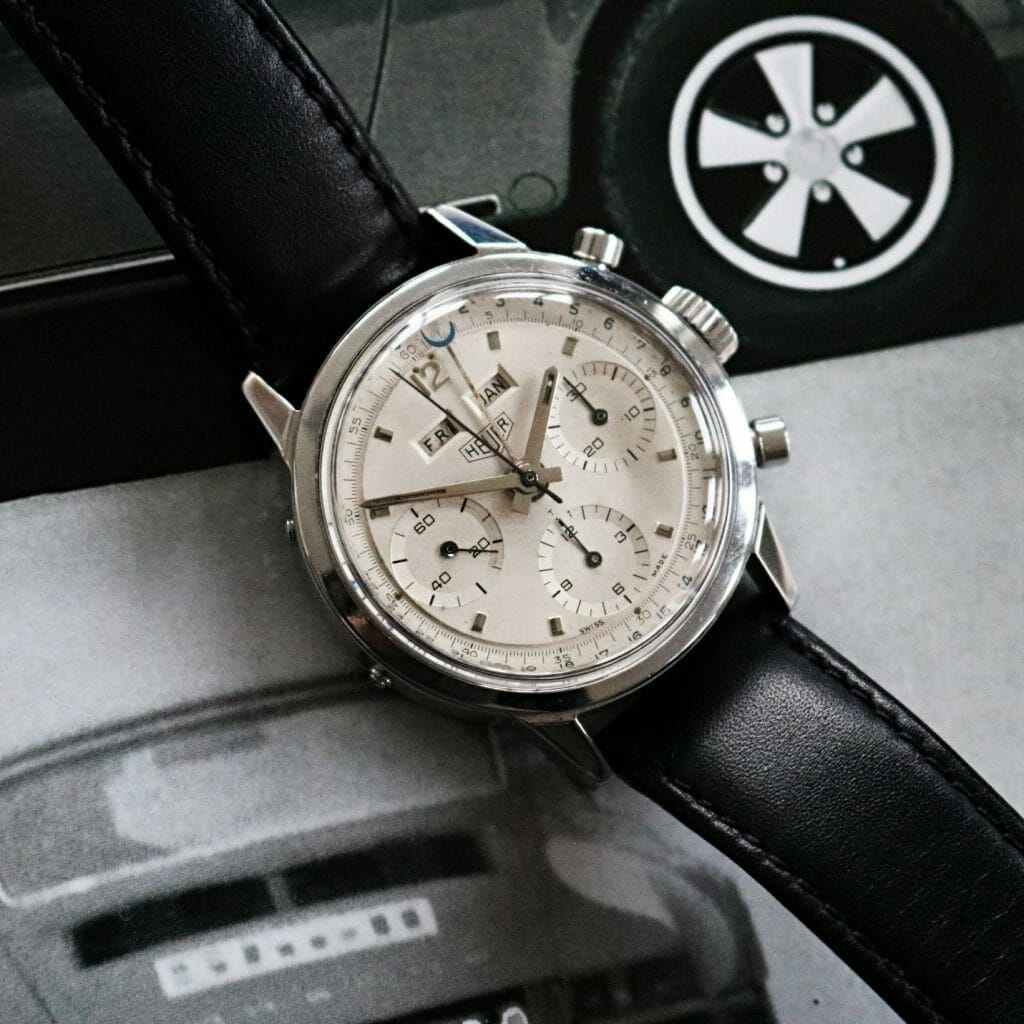
The 2547S presents as a sophisticated complication watch suitable for business, formal, and casual wear, though its triple calendar functionality and delicate movement require more careful handling than modern tool watches.
Daily Wearer Viability
The 2547S can serve as a daily wearer with appropriate precautions. The 36mm case size wears comfortably on wrists from 6.5 to 7.5 inches, appearing neither too small nor oversized by contemporary standards. The 43mm lug-to-lug measurement suits most wrist shapes, while the relatively short lugs prevent overhang even on narrower wrists. However, the 13mm thickness and domed acrylic crystal create a taller profile than modern dress watches, requiring cuff clearance consideration when wearing formal shirts.
The manual-wind movement requires daily winding to maintain accuracy and prevent the calendar mechanism from stopping mid-cycle (winding should occur at the same time each day, ideally in the morning). The 48-hour power reserve provides some buffer if a day is missed, but allowing the calendar to stop introduces complexity when resetting, as all three calendar functions must be individually advanced using the side pushers.
Water resistance is a critical consideration. First execution screw-back models offer genuine water resistance when gaskets are fresh, suitable for handwashing and brief rain exposure. Second execution monocoque models offer minimal water resistance and should be treated as splash-resistant only. Neither execution should be worn while swimming, showering, or in any situation involving water immersion. The acrylic crystal is vulnerable to scratching from daily wear, though replacement crystals are available and installation is straightforward.
Dress Watch Appropriateness
The 2547S excels as a dress watch. The 36mm steel case, sophisticated dial complexity, and calendar complications position it squarely in the tradition of mid-century dress chronographs. The white dial variants (2547S, 2547SN) particularly suit business and formal contexts, pairing naturally with suits, dress shirts, and formal footwear. The polished steel case and hands catch light beautifully, while the calendar complications provide conversational interest and practical utility.
However, the watch’s thickness (13mm) exceeds typical dress watch standards, potentially creating cuff clearance issues with French cuff or formal shirt cuffs. Collectors wearing the 2547S in formal contexts should consider strap selection carefully, with dark brown or black leather straps on signed buckles appearing most appropriate.
Sport/Tool Watch Suitability
The 2547S is not a tool watch by modern standards despite its chronograph functionality. The non-waterproof second execution models and limited water resistance of first execution models preclude serious sporting use. The acrylic crystal scratches easily, the polished steel case shows every mark, and the triple calendar mechanism requires careful handling to avoid damage. The watch was designed as a sophisticated complication chronograph for road rallying and timing applications where the user would not face significant physical risk or environmental exposure.
Water Resistance in Practice
First execution screw-back models, when serviced with fresh gaskets and pressure tested, likely achieve 30-50 meters water resistance based on construction and contemporary waterproof chronograph standards. This is sufficient for handwashing, rain exposure, and incidental splash contact but not swimming or water sports.
Second execution monocoque models should be treated as non-waterproof. Avoid all water contact beyond incidental hand washing (with crown pushed in fully). Do not wear in rain, shower, or pool environments. The snap-back case design provides minimal sealing even with fresh gaskets.
All 2547S models should be pressure tested after any case opening or service to verify water resistance integrity.
Comfort Factors
The 2547S wears comfortably for its era. The 36mm case and 43mm lug-to-lug dimensions feel balanced on most wrists, while the relatively light weight (approximately 80-85 grams on leather strap) prevents fatigue during extended wear. The 13mm thickness and domed crystal create a noticeably tall profile that some wearers find charming and others find excessive compared to modern integrated-lug sport chronographs.
The manual-wind crown operation is smooth and satisfying, requiring approximately 35-40 full rotations to achieve full wind from stopped. The chronograph pushers provide crisp actuation with clear tactile feedback, though first execution round pushers can be slippery when operated with wet or sweaty fingers. Second execution fluted pushers offer improved grip.
The leather straps (18mm) wear comfortably and allow the watch to conform to wrist shape throughout the day. The Gay Freres bracelet option, while extremely desirable for collectors and completists, adds considerable weight and wrist presence while reducing overall comfort for extended wear. Many collectors keep original bracelets for special occasions and display, wearing the watch on quality aftermarket or period leather straps for daily use.
Strap Versatility
The 18mm lug width accepts a wide range of vintage and modern straps. Period-correct options include Heuer-signed leather straps from the 1960s-70s (difficult to find in good condition), vintage racing straps with perforations and contrasting stitching, and simple dress straps in brown or black leather.
Modern strap options include premium leather from Camille Fournet, Jean Rousseau, or smaller artisan makers, vintage-style rally straps from Hirsch or Fluco, and NATO-style straps for casual wear (though NATO straps are anachronistic for a 1960s dress chronograph). The blue date track on most 2547S dials pairs beautifully with blue leather straps, creating visual harmony between dial and strap.
Avoid straps wider than 18mm at the lugs, as they will not fit. Some collectors report that period Heuer straps measure slightly narrower than 18mm (approximately 17.5mm), creating small gaps when modern 18mm straps are installed. Test fit before purchasing expensive straps.