

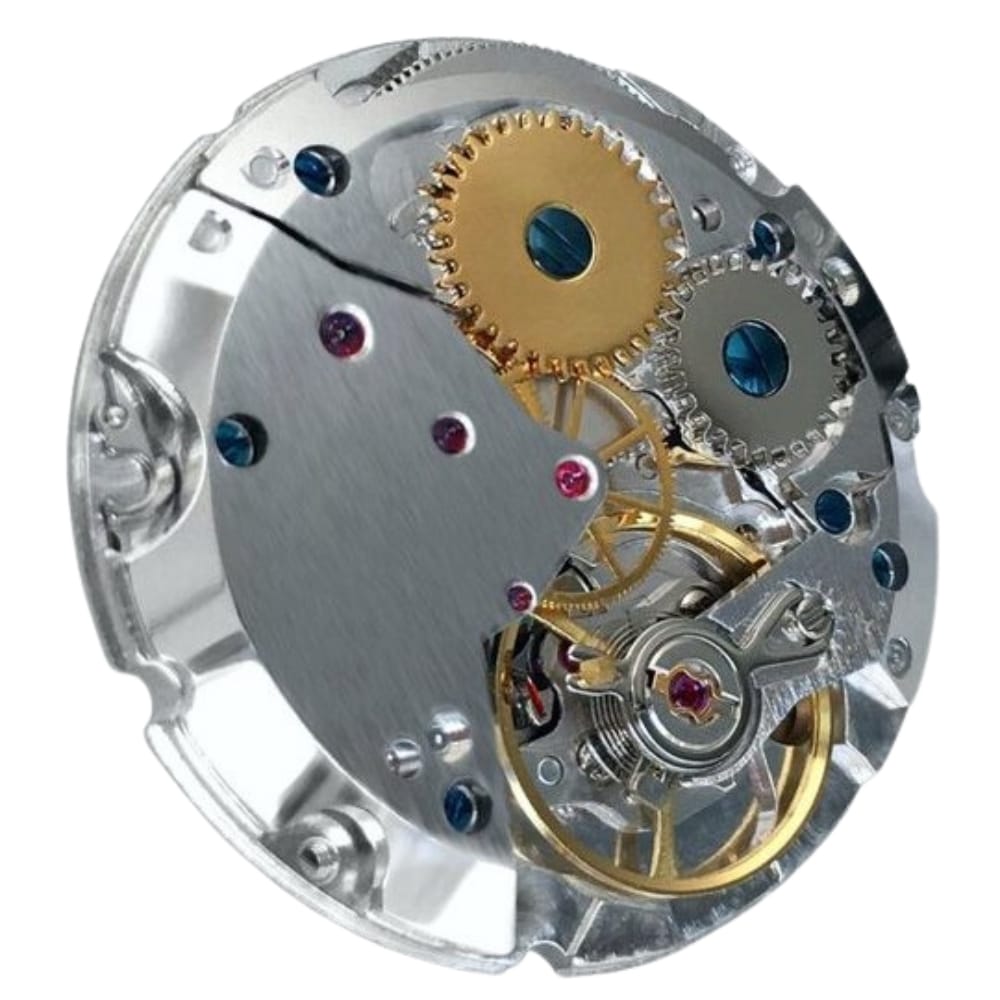
The Landeron 21 represents a footnote in horological history: a modern Swiss movement produced for only two years by a company attempting to resurrect one of the most famous names in chronograph manufacturing. Unlike the legendary vintage Landeron chronograph calibers (the 48, 51, 148, 248) that powered millions of watches from the 1930s through 1970s, the L21 is a contemporary manual-wind time-and-date movement functionally equivalent to the ETA 2804-2, produced between approximately 2020 and 2022 before vanishing from the company’s catalog.
The L21 emerged from Landeron Swiss Movements GmbH, a company founded in 2007 as Depa Luxury Distribution that acquired the dormant Landeron brand rights in 2015 and rebranded itself as Landeron Swiss Movements in September 2022. The movement was developed as part of a broader catalog of modern Swiss calibers offered to independent watch brands facing restricted access to ETA movements after 2020, when Swiss competition regulations (COMCO) forced ETA to prioritize Swatch Group brands. The L21 filled a niche for affordable Swiss manual-wind movements with date complications at a time when ETA 2804-2 availability was severely constrained.
Production volume for the L21 remains undocumented, but evidence suggests limited manufacturing runs. The caliber appeared on the Landeron Swiss Movements website in 2020 and was used by at least three watch brands: Nivada Grenchen (Antarctic 35mm collection, with 54+ references documented), Excelsior Park (EP 884-SI series), and Praesidus (A-11 Type 44). By 2022, the L21 was no longer listed on the company’s public catalog, suggesting either discontinuation or a shift to private-label production. Total production likely numbered in the low thousands rather than tens of thousands, making the L21 uncommon but not rare in the technical sense. Surviving examples remain in active use in watches retailing between $555 and $995 USD.
The L21 occupies an ambiguous position in the collector market. It carries the Landeron name but shares no technical DNA with the historic Landeron movements collectors seek. The caliber is essentially a contemporary Swiss movement produced during a brief window when independent movement suppliers attempted to fill gaps left by ETA’s market withdrawal. Collector interest is minimal, as the movement lacks the historical significance, innovative engineering, or proven longevity that drives demand for vintage calibers. Watches equipped with the L21 are purchased for their design and brand heritage (particularly the Nivada Grenchen Antarctic re-editions), not for the movement itself. No premium attaches to L21-equipped watches in the secondary market, and replacement movements (ETA 2804-2 or Sellita SW215-1) are readily available should servicing become uneconomical.
Historical Context, Provenance, and Manufacturing Details
The Landeron 21 exists because of two unrelated historical events: the collapse of the original Landeron factory in 1983 and the European competition ruling against ETA in 2020.
Charles Hahn & Cie, the company known as Landeron, was founded in Le Landeron, Switzerland in 1873 by brothers Charles Alfred and Aimé Auguste Hahn. The factory became a founding member of Ebauches SA in 1926 and pioneered cam-switching chronograph mechanisms with the groundbreaking Caliber 47 in 1937, followed by the legendary Caliber 48 that produced over 3.5 million units through 1970. Landeron attempted to pivot to electric movements in 1961 (Caliber 4750) and was designated as Ebauches SA’s center for electronic movement development through the 1970s, but the quartz revolution rendered these efforts obsolete. The factory closed abruptly in 1983 during the industry-wide collapse.
The Landeron name remained dormant for 32 years until Depa Luxury Distribution GmbH, a company founded in 2007 in Kaiseraugst, Switzerland, acquired the brand rights in 2015. Depa positioned itself as a movement supplier offering Swiss-made calibers to independent watch brands. The company operated facilities in Kaiseraugst (near Basel) and La Chaux-de-Fonds, utilizing partnerships with German machining specialist Chiron Group for component production (Landeron later acquired Chiron’s manufacturing center in 2023).
The L21 was developed as part of a multi-caliber catalog introduced around 2018-2020 that included manual-wind, automatic, and chronograph movements ranging from simple three-handers to tourbillon complications. The L21 specifically targeted the 11.5 ligne manual-wind segment dominated by the ETA 2804-2, offering brands a “Swiss Made” alternative when ETA movements became unavailable after COMCO regulations restricted ETA sales outside Swatch Group starting in 2020. The movement appeared in product listings by 2020 but was removed from public catalogs by 2022, suggesting either commercial failure, technical issues, or a strategic shift to focus on chronograph movements (the company’s historical specialty).
The L21 is not an in-house manufacture movement. It is an ebauche-based caliber closely related to the ETA 2804-2 architecture, sharing the same 11.5”’ footprint, 3.35mm height, 28,800 vph frequency, jewel count, date position, and hand specifications. Whether Landeron Swiss Movements manufactured components in-house, assembled purchased ebauches, or contracted production to a third-party supplier remains unclear. The movement’s striking similarity to the ETA 2804-2 suggests it may be either a licensed clone, a reverse-engineered equivalent, or an assembled movement using ETA-compatible parts. No patents or technical innovations distinguish the L21 from its ETA counterpart.
The L21 had no direct predecessor or successor within Landeron’s modern catalog. It emerged as a catalog item and disappeared within two years. The original Landeron company never produced a Caliber 21, the numbering appears arbitrary rather than sequential. The movement’s commercial successor is effectively the Sellita SW215-1, which filled the same market niche with greater manufacturing scale and brand recognition.
Construction and Architecture
The Landeron 21 follows the established ETA 2800 family architecture, a design lineage dating to 1982 that standardized compact manual-wind and automatic movements around an 11.5 ligne (25.6mm) diameter platform. The construction details below are derived from the ETA 2804-2 technical specifications and observed similarities in L21-equipped watches, as Landeron Swiss Movements never published detailed technical documentation.
Plate and Bridge Layout
The L21 uses a traditional three-quarter plate construction with separate bridges for the barrel, train wheels, balance, and escapement. The main plate (part 100 in ETA nomenclature) is jeweled with pressed settings rather than gold chatons, consistent with standard-grade Swiss production. The barrel bridge (part 105) is a single piece secured with three screws, while the train wheel bridge (part 110) covers the center wheel, third wheel, and fourth wheel, mounted with two screws. The balance bridge (part 121) incorporates the regulator and stud support, secured with a single screw. This layout prioritizes manufacturing efficiency and serviceability over decorative finishing, the movement is designed for disassembly and maintenance by competent watchmakers rather than specialist manufacture technicians.
Plate material is brass with rhodium plating, standard for contemporary Swiss movements in this grade. Finishing is utilitarian: circular graining (perlage) on visible plate surfaces, brushed or Geneva stripes on bridges, and beveled edges on higher-grade variants (though no evidence suggests Landeron offered elaborated grades of the L21).
Balance Wheel
The L21 employs a Glucydur-type annular balance wheel (ETA part 721), a copper-beryllium alloy balance with no timing screws. This is a free-sprung balance design in spirit but uses an index regulator rather than adjustable mass screws on the rim. The balance diameter is approximately 9.5-10mm (typical for 11.5”’ movements), with mass concentrated in the rim for stable oscillation. The annular design (weight in the rim, open center) provides better isochronism than older screw-balance designs and reduces sensitivity to temperature variation, though it lacks the fine adjustment capability of traditional screw balances used in higher-grade movements.
The balance operates at 28,800 vph (4 Hz), requiring eight beats per second. This frequency is higher than the 21,600 vph (3 Hz) standard in entry-level movements, providing smoother seconds hand motion and theoretically better chronometric performance.
Balance Spring (Hairspring)
The hairspring is a Nivarox alloy (likely Nivarox 1 or 2), a cobalt-nickel-chromium-titanium-beryllium alloy developed in the 1930s that resists magnetism and temperature variation. The spring features a flat spiral with approximately 13-14 coils (standard for this frequency and balance mass), terminating in a standard collet attachment at the inner end and a stud attachment at the outer end. The spring does not use a Breguet overcoil (terminal curve) in standard grade, limiting isochronism performance compared to higher-grade movements. Length and thickness are optimized for 28,800 vph oscillation with the Glucydur balance mass.
Nivarox alloys are self-compensating for temperature variation across typical wearing ranges (roughly 5-35°C), eliminating the need for bimetallic balance compensation used in pre-1930s movements. The spring’s magnetic resistance helps maintain rate stability near electronic devices, though modern smartphones and laptops can still induce temporary rate deviations if the watch is in direct contact.
Escapement Type
Swiss lever escapement with club-tooth escape wheel (ETA part 705), the universal standard for mechanical wristwatches since the 1950s. The escape wheel has 15 teeth engaging a straight-line lever (pallet fork, part 710) with two pallet stones (impulse jewels). The escapement geometry uses a 10-degree impulse angle and 50-degree lift angle, the latter being the critical specification for timing machine calibration.
The pallet stones are synthetic ruby (aluminum oxide) jewels press-fitted into the pallet fork slots. In standard-grade movements, these are often lower-quality synthetic stones compared to the selected ruby jewels used in chronometer grades. The pallet fork pivots on jeweled bearings at both ends, with the lower pivot protected by the shock system and the upper pivot running in a jewel set in the pallet bridge.
The escapement is not adjusted for draw, drop, or lock in standard-grade L21 movements, these parameters are set during manufacturing and not individually optimized.
Shock Protection System
The L21 uses Incabloc Novodiac shock protection on the balance staff pivots (top and bottom) and likely on the pallet fork pivots, though ETA documentation shows standard jewels for pallet pivots in the 2804-2. Incabloc Novodiac is a lower-cost variant of the classic Incabloc system, introduced to compete with economy shock systems in standard-grade movements.
The Novodiac system uses a lyre-shaped spring (flatter and less pronounced than classic Incabloc) that holds the jewel setting in position. When the movement experiences shock, the conical balance staff pivot can displace the jewel setting upward or sideways within limits defined by the spring, absorbing impact energy and preventing pivot damage. After the shock, the spring returns the jewel to its original position. The top shock assembly (part 3024) uses a shouldered press-fit design, while the bottom assembly (part 3025) uses a cylindrical press-fit.
Novodiac offers adequate protection for normal wearing conditions but is considered less robust than classic Incabloc or the competing KIF system used in higher-grade Swiss movements. The system is designed for ease of manufacture and serviceability rather than maximum shock resistance. Watchmakers report Novodiac jewels as interchangeable with classic Incabloc jewels of the same dimensions, though some sources dispute perfect compatibility.
Regulator Type
The L21 uses an Etachron index regulator (ETA parts 303/5, 307/1, or 375 depending on variant), a micrometric regulator system developed by ETA in the 1970s. The Etachron combines the regulator index (the movable curb pins that change the effective hairspring length) with the stud support (the anchor point for the outer end of the hairspring) in a single unit mounted on the balance bridge.
The regulator features a movable index arm with two curb pins that bracket the hairspring approximately 5-6 coils from the stud end. Moving the index toward the stud shortens the effective hairspring length, increasing rate (making the watch run faster). Moving away lengthens the spring and slows the rate. The Etachron system includes a micrometric screw adjustment that allows fine rate changes of approximately 2-3 seconds per day per turn, plus a pointer indicating the fast/slow direction (though some L21 variants may use pointer-free regulators as indicated by ETA part options).
The integrated stud support is a spring-loaded eccentric mount that allows the watchmaker to adjust the hairspring’s centerline relative to the balance staff, correcting beat error (the difference in timing between tick and tock). This adjustment is critical during assembly and servicing but should not require changes during normal operation.
Mainspring Material and Type
The mainspring (ETA part 770 for 2801-series movements) is a Nivaflex alloy barrel spring, a cobalt-nickel-iron-chromium-titanium alloy developed by Nivarox in the 1940s to replace carbon steel mainsprings. Nivaflex mainsprings are “white metal” alloys that resist setting (permanent deformation) and provide consistent torque across the winding range, improving isochronism compared to older steel springs.
The spring dimensions are 1.23mm height, 0.134mm thickness, 400mm developed length (uncoiled), with 10.50 turns when fully wound (based on ETA 2801-2 specifications). The spring uses a slipping bridle attachment at the barrel arbor (inner end), allowing over-winding without spring breakage, the outer end is fixed to the barrel wall. This is a standard manual-wind configuration, the slipping bridle provides tactile feedback when the mainspring is fully wound (increased resistance at the crown) but does not prevent continued winding force from being applied.
Nivaflex mainsprings have excellent power reserve stability and do not require lubrication at the barrel arbor (though some watchmakers still apply minimal grease). The spring will typically last 10-15 years in service before losing sufficient elasticity to affect power reserve noticeably.
Gear Train Details
The L21 uses a four-wheel train (barrel, center, third, fourth) with indirect center seconds drive, standard for manual-wind movements with central seconds hands. Gear ratios are optimized for 28,800 vph frequency:
- Barrel (part 180/1): Contains mainspring, rotates once per full power reserve (36 hours minimum), drives center wheel via teeth on barrel perimeter.
- Center wheel (part 210): Rotates once per hour, mounted on the cannon pinion (part 242) that carries the minute hand. Drives third wheel.
- Third wheel (part 227): Intermediate wheel that transfers motion from center to fourth wheel. Rotates multiple times per hour (exact ratio not documented but typically 8:1 or similar).
- Fourth wheel (part 227/3): Rotates once per minute, carries the central seconds hand in indirect-drive configuration. Drives escape wheel (15 teeth).
The indirect seconds drive uses a separate fourth wheel with extended arbor that passes through the center of the main plate to carry the seconds hand on the dial side. This design adds a jewel bearing (for the fourth wheel’s upper pivot) but provides better seconds hand concentricity and easier hand fitting compared to direct-drive designs.
All gear wheels are brass with machined or stamped teeth (no gold wheels in standard grade). Pivot points run in jewel bearings (17 jewels total across the movement, including escapement jewels).
Finishing Quality and Techniques
The L21 receives standard-grade finishing appropriate for its market position as an affordable Swiss movement:
- Main plate: Circular graining (perlage) on visible surfaces, machine-applied. Hidden surfaces show machining marks without decorative finishing.
- Bridges: Brushed linear finish or minimal Geneva stripes (Côtes de Genève), machine-applied. Edges are deburred but not hand-beveled (anglage).
- Screws: Blued steel screws or bright steel screws depending on grade, with slot heads (no polished heads or beveled slots).
- Balance cock: May feature decorative engraving or etching with Landeron logo and caliber designation.
- Jewel settings: Pressed jewels without gold chatons or decorative settings.
No evidence suggests Landeron offered elaborated or chronometer-grade versions of the L21. The movement is manufactured to ETA’s standard grade specifications: adjusted in two positions (dial up, crown down), using Novodiac shock protection, with Etachron regulator and standard-grade components. Expected accuracy is +12 to +30 seconds per day new, though some user reports indicate better performance (+5 to +15 seconds/day) in well-regulated examples.
Finishing does not change across the production run (2020-2022) as far as documented examples show. The movement prioritizes reliability and serviceability over aesthetics, consistent with its intended use in mid-market watches ($500-1000 retail) where case and dial design drive purchase decisions rather than movement finishing.
Cross-Reference Data
No evidence indicates the L21 was sold under alternative brand names or private labels. The movement appears exclusively as “Landeron 21” or “L21” in documented examples.
Base Caliber vs. Elaborated Versions
No elaborated, adjusted, or chronometer-grade versions of the L21 are documented. Unlike ETA, which offers 2804-2 in Standard, Elaboré, Top, and Chronometer grades, Landeron Swiss Movements appears to have produced only a single standard-grade version. All L21 movements share the same 17-jewel count, Novodiac shock protection, and Etachron regulation.
Compatible Case References by Brand
| Brand | Reference Numbers | Production Years | Notes |
|---|---|---|---|
| Nivada Grenchen | 35001M01-35014M41 (54+ references in Antarctic 35mm and Super Antarctic 35mm lines) | 2023-2024 | 35mm diameter cases, various dial colors and strap options. Date window at 3:00. Manual wind. |
| Excelsior Park | EP 884-SI-01 through 884-SI-04 | 2024 | 37.2mm diameter, some models have date function removed despite L21 date capability. |
| Praesidus | A-11 Type 44 (various editions including Tom Rice, Patina, Watch Observer collaborations) | 2024-2025 | 32mm diameter, military field watch design. Date function not used (phantom date position on crown). |
Dial Compatibility
The Landeron 21 uses the same dial foot positions as ETA 2804-2 and Sellita SW215-1, allowing interchangeability with dials designed for those movements. Dial feet are located at standard ETA 11.5”’ positions (measurements not published but available in ETA technical documentation).
Date window must be positioned at 3:00 (90-degree position) to align with the date ring. Date aperture requires approximately 3.0mm x 1.5mm opening for proper digit visibility. Date change occurs semi-instantaneously between 11:30 PM and 12:30 AM.
Hands specifications match ETA 2804-2: hour hand 1.50mm tube diameter, minute hand 0.90mm tube diameter, seconds hand 0.25mm tube diameter (center post). Hand lengths and styles are case-dependent, but standard proportions for 35-37mm cases would be approximately 9-10mm hour hand, 13-14mm minute hand, 12-13mm seconds hand (measured from center to tip).
Crown and Stem Specifications
Generic ETA-compatible stems and crowns can be used for L21 servicing, as the movement shares the 2804-2 stem specifications.
Identification Marks
Authentic Landeron 21 movements can be identified by the following characteristics, based on observed examples in Nivada Grenchen, Excelsior Park, and Praesidus watches, supplemented by ETA 2804-2 comparison (as detailed manufacturer documentation for L21 marking practices does not exist).
Caliber Number Location
The caliber designation “L21” or “LANDERON 21” should appear engraved on the balance cock (part 121) or the main plate visible through the display caseback (if equipped). Some variants may show “LANDERON SWISS MOVEMENTS” text alongside the caliber number. The engraving is typically machine-stamped rather than hand-engraved, with consistent font and depth.
Logo and Brand Marks
Authentic movements should display:
- Landeron logo (typically a stylized “L” or full “LANDERON” text) on the balance cock or visible bridge.
- “SWISS MADE” or “SWISS” marking on the main plate or balance cock, required for Swiss Made certification.
- Jewel count marking “17 JEWELS” or “17 RUBIS” near the balance cock.
The absence of “ETA” or “SELLITA” markings distinguishes the L21 from its equivalents. However, due to the movement’s close similarity to ETA 2804-2, it is theoretically possible for an ETA movement to be misrepresented as a Landeron (or vice versa) during resale. Verification requires comparison of bridge shapes, engraving style, and component markings visible under magnification.
Date Codes
No evidence indicates the L21 uses date code systems comparable to vintage Landeron movements or modern Rolex calibers. Production run was too short (2020-2022) to require complex dating systems. Serial numbers, if present, would be movement-specific rather than date-encoded.
Finishing Marks
Expected finishing patterns for authentic L21 movements:
- Circular graining (perlage) on the main plate, visible through display casebacks: regular concentric circles approximately 0.8-1.0mm diameter, machine-applied with consistent overlap pattern.
- Linear brushing or minimal Geneva stripes on bridges: parallel lines running lengthwise along bridge surfaces, machine-applied.
- No hand-executed anglage (beveled edges) on standard-grade L21 movements, edges show machine chamfering only.
Finishing quality should be consistent with mid-grade Swiss industrial production, superior to Chinese movements but below manufacture-grade Swiss calibers. Any evidence of hand-finishing (polished bevels, internal angles, black-polished edges) would indicate either mislabeling or a special-grade variant not documented in available sources.
Jewel Markings
Jewel settings in the L21 are pressed (friction-fit) synthetic ruby jewels without decorative chatons. The jewels should appear:
- Transparent red color (synthetic corundum/aluminum oxide), not opaque or plastic.
- Press-fitted directly into plate or bridge with minimal metal surrounding (no gold or brass chaton rings).
- Uniform size and color across the movement (indicating batch manufacturing rather than hand-selection).
Higher jewel counts (19+ jewels) indicate Sellita SW215-1 rather than Landeron L21, as Landeron produced only 17-jewel versions.
Adjustment Markings
Standard-grade L21 movements carry no adjustment markings, as they are regulated but not chronometer-certified. The absence of markings such as:
- “ADJUSTED” or “ADJUSTED TO X POSITIONS”
- “CHRONOMETER” or “CHRONOMETRE”
- COSC certification numbers or symbols
confirms standard-grade production consistent with the movement’s market positioning.
Correct Serial Number Formats and Locations
Landeron Swiss Movements’ serial number practices for the L21 are not documented in available sources. If serial numbers are present (likely engraved on the main plate edge or under the balance cock), they would probably follow Swiss standard formats:
- 6-8 digit numeric sequence (e.g., 1234567)
- Possibly prefixed with letter codes (e.g., L21-123456)
- Location: main plate edge (visible when movement is removed from case) or on a bridge
No public serial number registries exist for L21 movements, making serial-based dating or authentication impossible without manufacturer cooperation.
Expected Engravings and Stampings
Authentic L21 movements should show:
- Sharp, consistent-depth engravings for text and numbers (machine-stamped, not hand-engraved).
- Caliber number, jewel count, country of origin (Swiss Made), and brand name clearly legible under 5-10x magnification.
- No spelling errors, inconsistent fonts, or misaligned stampings (which would indicate counterfeits or refinished movements).
Comparison with documented examples in Nivada Grenchen and Praesidus watches (available in manufacturer photos and user reviews) provides the most reliable authentication reference.
Font and Marking Style by Production Era
Given the short production run (2020-2022), no significant font or marking variations are expected across the L21’s lifespan. Any noticeable changes in engraving style, logo design, or stamping depth would suggest either:
- Different manufacturing batches using alternative tooling
- Movements produced at different facilities (Kaiseraugst vs. La Chaux-de-Fonds)
- Contracted production by third-party ébauche suppliers
Without access to movement samples from different production periods, documenting such variations is impossible. Collectors and watchmakers should compare markings against documented examples from known-authentic sources rather than relying on generalized descriptions.
Part Information

Part Numbers and Interchangeability
The Landeron 21’s parts interchangeability with ETA 2804-2 components is probable but not officially confirmed. Landeron Swiss Movements did not publish parts catalogs or service documentation for public distribution. The following table provides ETA 2804-2 part numbers as reference, as these components are likely compatible with L21 movements given the identical specifications.
Critical Components (ETA 2804-2 Part Numbers)
Sourcing Notes
Parts Availability:
- ETA 2804-2 parts remain available from Swiss parts suppliers (Cousins UK, Ofrei, Beco-Technic, etc.) as of January 2026, though ETA officially phased out the caliber for non-Swatch Group customers after 2021.
- Sellita SW215-1 parts are readily available and may be compatible with L21 movements, though jewel count differences (19 vs. 17) indicate some component variations.
- Landeron Swiss Movements’ current parts support for the L21 is unknown. The company’s website lists contact information but does not provide public parts ordering. Watchmakers report difficulty obtaining Landeron-branded replacement parts as of 2024-2025.
Components That Commonly Fail:
Based on ETA 2804-2 service experience (directly applicable to L21):
- Mainspring: Loses elasticity after 10-15 years, reducing power reserve and amplitude. Replacement required during major service.
- Balance staff pivots: Susceptible to damage from shocks that exceed Novodiac protection limits (drops onto hard surfaces from >1 meter). Broken pivots are common in abused movements.
- Click spring: Weakens over time, causing winding mechanism to slip. Inexpensive replacement.
- Date jumper spring: Can lose tension, causing date change issues. Replacement recommended during service if date function is sluggish.
- Pallet fork and escape wheel: Rarely fail unless contaminated by debris or rust. Replacement necessary if teeth are damaged.
Acceptable Generic Replacements:
- Mainsprings: Generic Nivarox or Nivaflex mainsprings for ETA 2801/2804 are acceptable if dimensions match (1.23 x 0.134 x 400mm).
- Shock absorbers: Standard Incabloc Novodiac units for ETA 11.5”’ movements are compatible.
- Springs and screws: Most generic Swiss movement springs and screws in correct dimensions work as replacements.
- Winding stems: Generic ETA-compatible TAP 10 stems can be cut to length.
Components That Require OEM Parts:
- Balance complete (wheel, staff, spring assembled): Frequency-specific, requires OEM or professionally matched components.
- Escapement (pallet fork and escape wheel as matched pair): Geometry-critical, generic parts may not provide correct lift angle or impulse timing.
- Date indicator: Font and window position must match dial, generic indicators may not align properly.
Watchmakers facing unavailable L21 parts should consider complete movement replacement with ETA 2804-2 or Sellita SW215-1, both of which fit the same case dimensions and dial foot positions.
Performance Data
Manufacturer Specifications
Landeron Swiss Movements did not publish comprehensive performance specifications for the L21. The following data is derived from the Grail Watch Reference listing and comparison with ETA 2804-2 specifications:
The discrepancy in power reserve claims (36 hours for L21 vs. 42-50 hours for ETA 2804-2) may indicate:
- Different mainspring specifications (shorter developed length or thinner gauge in L21)
- More conservative manufacturer claims by Landeron
- Measurement differences (fully wound to complete stop vs. fully wound to amplitude drop below acceptable threshold)
No evidence indicates the L21 was offered in elaborated, top, or chronometer grades. All documented examples use standard-grade components (Novodiac shock protection, two-position adjustment, no COSC certification).
Observed Performance (Field Data)
User reports and professional reviews of L21-equipped watches provide the following performance data:
Accuracy Range (Well-Maintained Examples):
- Nivada Grenchen Antarctic 35mm owners report accuracy of +5 to +15 seconds per day after break-in period, significantly better than the standard-grade specification of +12 to +30 seconds/day.
- Praesidus A-11 Type 44 reviews note “tried-and-tested movement” with satisfactory timekeeping but no specific accuracy figures published.
- One user comparing L21 to Sellita SW210 (automatic equivalent) described the L21 as “running much better” than the +/-20 seconds/day specification, suggesting regulation to +10 to +15 seconds/day is achievable.
These results indicate the L21 receives better regulation during assembly than minimum standard-grade requirements, or that the movements benefit from stricter quality control during the short production run.
Common Performance Issues and Causes:
- Winding resistance: Multiple users report the L21 winding crown feels “resistant” or “not as smooth” as Sellita SW210 or ETA movements, particularly when approaching full wind. This likely indicates tighter tolerances in the barrel arbor/mainspring interface, higher friction in the keyless works (winding pinion/sliding pinion engagement), or inadequate lubrication during assembly. The issue does not appear to affect functionality but reduces the tactile quality of the winding experience.
- Crown operation: Some users describe “difficult crown pulling” when switching between winding and setting positions. This suggests the yoke spring tension (part 435) or setting lever detent (part 445/2) may be over-specified, requiring excessive force to engage the setting mechanism. Proper servicing with appropriate lubrication should resolve this issue.
- Date function: Excelsior Park deliberately removed the date function from some L21-equipped models despite the movement’s date capability, suggesting either reliability concerns or design preference. No specific date malfunction reports were found in user reviews.
Expected Amplitude:
- Fully wound: 270-290 degrees (typical for standard-grade ETA-equivalent movements)
- End of power reserve (36 hours): 180-220 degrees (movement will continue running but accuracy degrades significantly below 200-degree amplitude)
Amplitude below 250 degrees when fully wound indicates a movement requiring service (dried lubricants, worn pivots, or weak mainspring).
Age-Related Performance Degradation:
Given the L21’s recent production (2020-2022), no long-term aging data exists. However, based on ETA 2804-2 service experience:
- First 5 years: Minimal degradation if properly assembled and lubricated. Accuracy should remain within +/-15 seconds/day in well-regulated examples.
- 5-10 years: Lubricant degradation begins, particularly in the escapement and high-speed train wheels. Power reserve may decrease by 10-15% (36 hours to 30-32 hours). Accuracy may drift to +/-20 to +30 seconds/day.
- 10+ years: Service mandatory. Dried lubricants cause increased wear on pivots and escapement. Power reserve drops below 30 hours. Accuracy degrades to +/-30 to +60 seconds/day or worse. Risk of catastrophic failure (broken balance staff, worn escape wheel teeth) increases significantly.
Recommended service interval: 5-7 years for daily-wear watches, 7-10 years for occasional-wear pieces stored in dry, stable conditions. These intervals match standard Swiss movement service recommendations and assume the L21 uses similar lubricants and material quality as ETA 2804-2.
Performance Comparison to Competitors:
- vs. ETA 2804-2: Functionally equivalent performance. No documented advantage or disadvantage in accuracy, reliability, or longevity.
- vs. Sellita SW215-1: SW215-1 benefits from established service network and parts availability. Performance is comparable, though Sellita’s two additional jewels (19 vs. 17) provide no practical advantage in this caliber family.
- vs. Seiko NH35 (automatic): NH35 offers automatic winding and lower cost but lower frequency (21,600 vph vs. 28,800 vph), shorter power reserve (41 hours but lower amplitude curve), and inferior finishing. L21 provides smoother seconds hand motion and better chronometric potential.
The L21’s primary advantage over competitors is its “Swiss Made” designation, which carries marketing value in the $500-1000 watch segment despite offering no functional superiority over Sellita or ETA equivalents