

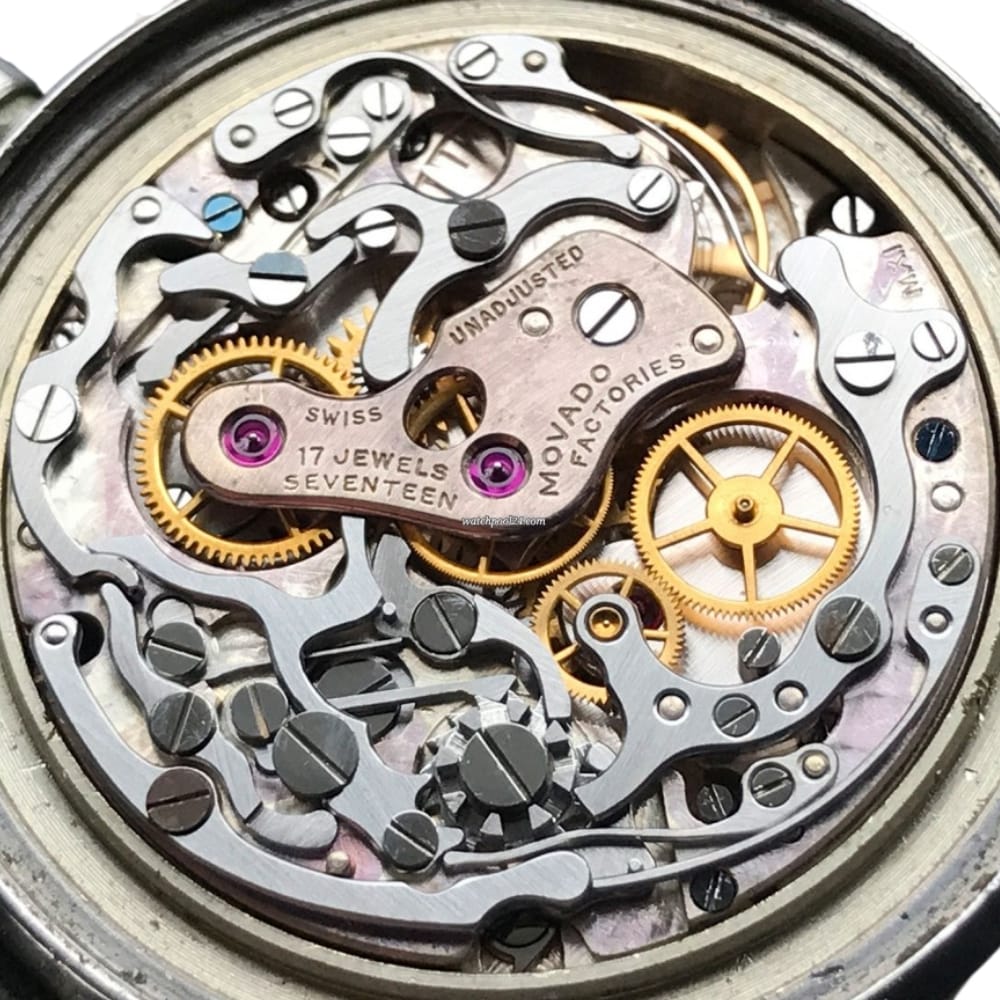
The Movado M95 occupies a peculiar position in horological history: it represents the world’s first commercially successful modular chronograph, designed by Frédéric Piguet in the late 1930s, yet it remains overshadowed by the brands it competed against. While collectors chase Rolex Daytonas, Omega Speedmasters, and Heuer Carreras, the M95 powered watches that were cased by François Borgel, the same maker responsible for the legendary Patek Philippe 1463, and retailed by Cartier, Tiffany & Co., and Van Cleef & Arpels. This was not a second-tier movement relegated to budget offerings. This was Movado’s flagship chronograph caliber for three decades.
The M95 is an in-house three-register chronograph with column wheel control and horizontal clutch engagement, featuring an unusual inverted pusher layout where the bottom pusher starts and stops the chronograph while the top pusher resets. This reversed operation, combined with the movement’s modular architecture, distinctive serpentine subdial hands, and François Borgel waterproof cases, makes the M95 instantly recognizable to those who know. The caliber was introduced in 1939 as an evolution of the M90, adding a 12-hour totalizer to create a complete three-register layout capable of measuring elapsed time up to 12 hours. Production continued until the early 1970s, when Movado’s 1969 merger with Zenith shifted the company’s focus toward the El Primero.
Estimating total M95 production is challenging due to limited manufacturer records, but the best available data suggests fewer than 20,000 Super Sub-Sea chronographs (the sport-oriented M95 variant) were produced across all dial and case configurations between 1946 and 1970. If we conservatively estimate that Super Sub-Sea models represented 40-50% of total M95 output, total production likely ranged between 35,000 and 50,000 units across the entire 31-year production run. Serial number analysis places alphanumeric M95 examples in the range of A94001 to A104999, suggesting batches of approximately 10,000 units using this numbering system. The M95 is uncommon rather than rare. Well-preserved examples in François Borgel cases appear at auction and through specialized dealers several times per year, but truly exceptional pieces with original dials, unpolished cases, and complete provenance remain scarce.
Collector interest in vintage Movado chronographs has accelerated significantly over the past five years, driven by broader market appreciation for overlooked mid-century chronographs and growing recognition of the M95’s technical and historical significance. Steel M95 chronographs in François Borgel cases with original dials now command $4,000 to $7,000, while gold examples range from $8,000 to $15,000. Cartier-signed or Tiffany-signed examples trade at meaningful premiums, sometimes reaching $15,000 to $25,000 for exceptional pieces. Military-issued examples for the Norwegian Air Force or U.S. Army Air Forces are particularly sought after, with authenticated examples fetching strong prices when they appear. Demand is rising and supply is constrained, positioning the M95 as one of the more compelling value propositions in vintage chronograph collecting relative to its Swiss contemporaries.
Historical Context, Provenance, and Manufacturing Details
Movado developed the M95 in direct response to the limitations of its earlier M90 caliber, which debuted in 1938 as the company’s first in-house chronograph movement. The M90 was a two-register design capable of measuring elapsed minutes and seconds but lacked a 12-hour totalizer, limiting its utility for longer timing applications. One year later, in 1939, Movado introduced the M95, adding a third register at 6 o’clock to display elapsed hours up to 12. This upgrade transformed the caliber into a full-featured chronograph suitable for professional timing applications, from aviation and motorsport to scientific measurement.
The M95 was not, strictly speaking, an entirely in-house design. The base timekeeping movement was developed by Frédéric Piguet, the renowned ébauche manufacturer based in Le Brassus, and the chronograph module was designed to mount atop this base. This modular construction, where a separate chronograph mechanism is layered over a time-only movement, was revolutionary when introduced and would influence chronograph design for decades. The M95 is widely recognized as the first commercially successful modular chronograph, predating later modular designs from Dubois Dépraz and other ébauche suppliers. While modular chronographs are sometimes dismissed today as inferior to integrated designs, this perspective ignores the practical advantages they offered: ease of servicing, flexibility in complication assembly, and lower manufacturing costs without sacrificing reliability or precision.
Movado produced the M95 at its facilities in La Chaux-de-Fonds, Switzerland, where the company had operated since its founding in 1881. Production remained concentrated in this location throughout the caliber’s lifespan, with no evidence of manufacturing shifts to other facilities. The caliber underwent minor refinements during its 31-year production run, including improvements to finishing quality, adjustments to jewel settings, and modifications to the chronograph module’s components, but the fundamental architecture remained unchanged.

The M95 was eventually succeeded by movements sourced through Movado’s 1969 merger with Zenith, which gave the company access to the El Primero, the first integrated high-frequency automatic chronograph. By the early 1970s, Movado had ceased production of the M95, transitioning its chronograph offerings to Zenith-derived calibers. This shift marked the end of Movado’s independent chronograph manufacturing, a casualty of industry consolidation and the quartz crisis that would nearly destroy Swiss mechanical watchmaking by the mid-1970s.
The M95 sits at a fascinating inflection point in chronograph history. It represents the culmination of traditional mechanical chronograph development before the arrival of high-frequency automatic movements, yet it introduced modular construction principles that would dominate affordable chronograph production for the next 50 years. It was neither groundbreaking nor transitional, it was the mature refinement of pre-war chronograph technology executed at a level that competed directly with Rolex, Omega, and Universal Genève.
Construction and Architecture
The M95 employs a modular two-level architecture consisting of a base timekeeping movement with a separate chronograph module mounted above the dial side. The base movement features a traditional three-quarter plate construction in rhodium-plated brass, with separate cocks for the balance and escape wheel. The chronograph mechanism, including the column wheel, horizontal clutch, and operating levers, is housed in a secondary module that integrates with the base movement through a center-mounted driving wheel. This modular approach allows the chronograph components to be serviced or replaced without disturbing the timekeeping train, a significant practical advantage for watchmakers working with the caliber.

The overall architectural philosophy prioritizes serviceability and reliability over decorative finishing or miniaturization. The plates are substantial, the bridge screws are generously sized, and component spacing allows clear access to critical adjustment points. This is a watchmaker’s movement, designed for long-term durability and ease of maintenance rather than visual spectacle.
Balance Wheel
The M95 utilizes a screwless monometallic balance wheel, a design choice that reflects the transition from older bimetallic temperature-compensating balances to modern alloys that inherently resist thermal expansion. The balance diameter is substantial for a 12-ligne movement, contributing to stable amplitude and consistent timekeeping. The balance is not adjusted via timing screws; instead, rate regulation is accomplished through an index regulator acting on the outer terminal of the balance spring. This simplified construction reduces manufacturing cost while maintaining adequate adjustment range for timing purposes.
Balance Spring (Hairspring)
The caliber employs a self-compensating Breguet overcoil hairspring, a sophisticated design that improves isochronism and concentricity compared to flat hairsprings. The Breguet overcoil, where the outer terminal curve of the spring is raised and bent inward, ensures the spring breathes concentrically as it expands and contracts, minimizing positional rate variation. The material is likely Nivarox or a similar ferro-nickel-chromium alloy, standard for Swiss movements of this period, providing resistance to temperature variation, magnetism, and corrosion. The combination of a monometallic balance and self-compensating hairspring eliminates the need for traditional bimetallic temperature compensation while delivering stable rate performance across normal wearing temperatures.
Escapement Type
The M95 uses a Swiss straight-line lever escapement with jeweled pallet stones and an impulse jewel on the balance roller. This is the standard Swiss lever escapement design, refined over more than a century to deliver reliable performance with minimal friction. The escape wheel and pallet fork are polished steel, and the jewel settings for the pallet stones are pressed rather than mounted in gold chatons, reflecting the caliber’s positioning as a functional tool rather than a haute horlogerie piece. The lift angle is 52 degrees, the commonly accepted value for Swiss lever escapements of this generation, though Movado does not appear to have published official specifications.
Shock Protection System
The M95 incorporates Incabloc shock protection at the balance pivots, protecting the delicate balance staff from damage during impacts. Incabloc was the dominant shock protection system in Swiss watchmaking during the M95’s production period, and its presence here is expected rather than noteworthy. The Incabloc spring is the classic lyre-shaped design, easily identified and serviced. Some later M95 examples may feature KIF Parechoc shock protection, though Incabloc appears to be far more common based on observed examples.
Regulator Type
Rate adjustment is accomplished through a traditional index regulator, also called a regulator index or raquette, which acts on the outer terminal of the balance spring to effectively lengthen or shorten its active length. Rotating the regulator toward the fast end (marked “A” for “Avance” on French movements) shortens the effective spring length, increasing frequency and causing the watch to run faster. Moving the regulator toward the slow end (marked “R” for “Retard”) lengthens the spring and slows the rate. This system provides adequate adjustment range for timing purposes, though it is less precise and more prone to disturbance than free-sprung designs with adjustable balance weights.
Mainspring Material and Type
The M95 mainspring measures 1.30 x 0.110 x 400 x 11.0 mm and is identified by Généralités Ressorts reference GR3288. This is a manually-wound spring with a sliding bridle attachment to prevent overwind damage when the mainspring reaches full tension. The material is a white alloy spring, likely Nivaflex or similar cobalt-nickel-chromium alloy, chosen for consistent torque delivery and resistance to permanent set. The spring provides approximately 45 hours of power reserve when fully wound, a respectable figure for a chronograph of this generation.
Gear Train Details
The M95 gear train follows standard Swiss practice with a four-wheel layout: barrel, center wheel (driving the minute hand), third wheel, fourth wheel (driving the running seconds hand at 9 o’clock), and escape wheel. The center wheel is directly driven by the barrel, a common configuration in manually-wound movements. The running seconds display is indirectly driven from the fourth wheel via an intermediate wheel, allowing the seconds hand to be positioned at 9 o’clock rather than center-mounted. The chronograph mechanism operates through a horizontal clutch that engages the chronograph seconds wheel with the fourth wheel when the start pusher is pressed. This clutch design allows the chronograph to start smoothly without inducing a rate jump when engaged, though it requires more vertical space than a vertical clutch.
Finishing Quality and Techniques
The M95 is finished to a professional-grade standard consistent with mid-tier Swiss chronographs of the 1940s-1960s. The movement is rhodium-plated, giving it a bright, silvery appearance that contrasts with the gilded movements seen in earlier watchmaking periods. Bridges and plates feature a combination of circular graining (perlage) on the underside of bridges and Geneva stripes (Côtes de Genève) on larger visible surfaces. The Geneva striping is executed with a relatively coarse pattern typical of commercially finished movements, lacking the fine, tightly-spaced striping seen in haute horlogerie pieces but executed cleanly and consistently. Edges are beveled but not polished to a mirror finish, screw heads are polished flat, and jewel settings show clean seating without excess shellac or misalignment. The chronograph components, including the column wheel and operating levers, are well-finished with polished functional surfaces and clean edges.
There is no evidence that Movado produced chronometer-certified or adjusted-grade versions of the M95. Some examples are marked “Adjusted to 2 Positions,” indicating rate testing in two positions (likely horizontal dial-up and vertical crown-down) but this falls short of full chronometer adjustment across five positions and three temperatures. The finishing quality remained relatively consistent throughout the M95’s production run, with no significant upgrades or downgrades documented.
Cross-Reference Data

Alternative Caliber Names (Rebranded Versions)
The M95 was sold under multiple brand names through Movado’s retailer partnerships and corporate affiliations. These are functionally identical movements with different dial signatures and case stampings.
| Manufacturer | Caliber Designation | Notes |
|---|---|---|
| Movado | M95, 95M | Standard designation used throughout production |
| Zenith | Zenith-Movado, Movado by Zenith | After 1969 merger, some dials signed both Zenith and Movado |
| Cartier | Movado M95 (Cartier dial signature) | Retailed through Cartier, dial signed Cartier at 12 o’clock |
| Tiffany & Co. | Movado M95 (Tiffany dial signature) | Retailed through Tiffany, dial signed Tiffany & Co. |
| Van Cleef & Arpels | Movado M95 (VCA dial signature) | Retailed through Van Cleef & Arpels, rare |
Base Caliber vs. Elaborated Versions
The M95 did not feature multiple elaboration grades or chronometer-certified variants. All M95 examples share the same base architecture, jewel count, and finishing quality. The M90, the two-register predecessor, is mechanically related but lacks the 12-hour totalizer.
| Variant Name | Differences | Jewel Count | Functions |
|---|---|---|---|
| M90 | Two-register chronograph (no hour counter) | 17 | 30-minute chronograph, running seconds |
| M95 | Three-register chronograph with hour counter | 17 | 30-minute chronograph, 12-hour totalizer, running seconds |
Compatible Case References by Brand
The M95 was cased in a wide variety of case styles and materials throughout its production run. François Borgel cases are the most desirable, but many other case manufacturers supplied Movado during this period.
| Brand | Reference Numbers | Production Years | Notes |
|---|---|---|---|
| Movado | 19038 | 1940s-1960s | François Borgel steel case, most common reference |
| Movado | 19018 | 1940s-1960s | François Borgel steel case, variant dial configurations |
| Movado | 19068 | 1950s-1960s | Panda dial, steel case |
| Movado | 49036 | 1940s-1960s | 14K yellow gold case |
| Movado | 49020 | 1940s | 14K yellow gold, Cartier-signed dial |
| Movado | 9038 | 1950s | 18K yellow gold case |
| Movado | 95-224-568 | 1960s | 14K gold Sub-Sea chronograph |
| Movado | 95-704-541 | 1960s | Super Sub-Sea chronograph, 40mm compressor case |
Dial Compatibility
M95 dials feature three subdial configurations: running seconds at 9 o’clock, 30-minute totalizer at 3 o’clock, and 12-hour totalizer at 6 o’clock. Dial foot positions vary by case design, with François Borgel cases using a specific foot spacing that differs from non-Borgel cases. Date windows are not present on any original M95 configuration; the caliber lacks a date complication. Collectors and restorers should note that serpentine subdial hands at 3 and 6 o’clock are a characteristic feature of many M95 examples, and these hands are difficult to source as replacements. Straight stick hands are also correct on some variants.
Crown and Stem Specifications
Specific crown and stem threading for the M95 is not well-documented in publicly available sources, and specifications likely vary by case manufacturer. François Borgel cases use proprietary stem dimensions matched to Borgel’s waterproof crown system. Standard Swiss stem threads such as TAP 10 (0.90 mm) are common for non-Borgel cases, but watchmakers should measure the specific case rather than assuming compatibility. The setting mechanism uses a traditional keyless works design with a yoke-style clutch for hand setting.
Identification Marks
The M95 caliber designation is engraved on the main plate, typically visible when the movement is removed from the case. The engraving may read “M95,” “95M,” or “Cal. 95M” depending on production period. On some examples, particularly earlier production, the marking may be small and require magnification to read clearly. The caliber number is not stamped on the dial side or visible through the caseback without opening the watch.
Logo and Brand Marks
Movado’s “M” logo is applied to most M95 dials, positioned either at 12 o’clock or integrated into the “Movado” script signature. The movement itself may feature “Movado” engraving on the chronograph module or main plate, though this is not universal. Retailer-signed examples (Cartier, Tiffany, etc.) retain the “M” logo on the dial even when the primary signature is the retailer’s name. Swiss-made (“Swiss” or “Swiss Made”) is typically printed at 6 o’clock below the 12-hour subdial.
Date Codes
Movado used a serial number system that changed over the M95’s production period. Early examples (pre-1966) use a six-digit numeric serial number stamped on the inside of the caseback or movement. After 1966, Movado transitioned to an alphanumeric system with a letter prefix followed by five digits (e.g., A10XXXX). The letter prefix does not directly correlate to production year, and Movado’s dating system is imprecise for M95 examples. Serial numbers fall within the range A94001 to A104999 for alphanumeric examples, suggesting batches of approximately 10,000 units.
Marks
M95 movements feature rhodium plating, giving them a bright silvery appearance. Circular perlage (circular graining) is applied to the underside of bridges, and some examples show Geneva stripes (Côtes de Genève) on larger bridge surfaces. The quality and density of these finishes vary slightly across production years but remain consistent overall. The chronograph module, including the column wheel, is visibly polished on functional surfaces.
All M95 movements contain 17 jewels, marked on the dial as “17 Jewels” or “17 Rubis”. Jewel settings are pressed directly into the plates and bridges rather than mounted in screwed gold chatons, which is typical for this grade of movement. The balance jewels are protected by Incabloc shock springs, identifiable by the lyre-shaped spring visible at the balance cock.
Some M95 examples are marked “Adjusted” or “Adjusted to 2 Positions” on the movement. This indicates the movement was rate-tested in two positions (typically dial-up and crown-down) and adjusted to maintain acceptable rate variation. This is not a chronometer certification, which requires testing in five positions and three temperatures. Most M95 movements carry no adjustment markings at all.
Correct Serial Number Formats and Locations
M95 serial numbers are stamped on the movement plate or engraved on the inside of the caseback, depending on case construction. François Borgel cases typically carry the serial number on the movement rather than the case. Serial number format transitioned from six-digit numeric (e.g., 101415) to alphanumeric with letter prefix (e.g., A10XXXX) around 1966. Known alphanumeric serial ranges include A94001 through A104999, though gaps in this range are common.
Expected Engravings and Stampings
Authentic M95 movements should display:
- Caliber designation: “M95,” “95M,” or “Cal. 95M”
- Jewel count: “17 Jewels” or “17 Rubis”
- Movado signature: “Movado” or “M” logo
- Swiss origin: “Swiss” or “Swiss Made”
- Serial number: Six-digit numeric or alphanumeric (letter + five digits)
François Borgel cases feature “FB” stamping on the case lugs or case back, along with metal purity marks (stainless steel, 14K, 18K). Military-issued examples carry additional engravings identifying the issuing military branch, such as Norwegian Air Force (NAF) markings or U.S. Army Air Forces designations.
Font and Marking Style by Production Era
Early M95 examples (1940s-early 1950s) feature crisp, machine-engraved markings with sharp edges and consistent depth. Later production (1960s-early 1970s) shows similar engraving quality, with no significant stylistic shifts documented. Dial printing remained consistent throughout production, with applied markers and printed text executed to high standards. Movado’s “M” logo remained unchanged, and retailer signatures (Cartier, Tiffany) followed each retailer’s house style rather than Movado-specific formatting.
Part Information

Part Numbers
The following part numbers are derived from technical documentation for the M90 and M95 calibers. Interchangeability notes reflect commonality between the two movements and availability of generic replacements.
| Part Name | Part Number | Interchangeability Notes |
|---|---|---|
| Mainspring | GR3288 (1.30 x 0.110 x 400 x 11.0 mm) | Compatible with M90, 90M, 9M, 115, 122, 150, 1005 |
| Balance Complete | Not documented | M95-specific, limited availability |
| Hairspring | Not documented | M95-specific, requires expert fitting |
| Escape Wheel | 8000 series (per diagram) | Shared with M90 |
| Pallet Fork | 8002 series (per diagram) | Shared with M90 |
| Crown Wheel | 8070 series (per diagram) | Shared with M90 |
| Ratchet Wheel | Not documented | Shared with M90 |
| Click Spring | Not documented | Generic replacement available |
| Setting Lever Spring | Not documented | Generic replacement available |
| Chronograph Module Components | 8000-8700 series (per diagram) | M95-specific, limited availability |
Detailed parts diagrams for the M95 are available through vintage technical manuals and specialized suppliers such as Passion Chrono and watchmaker reference databases. The parts catalog distinguishes between base movement components (shared with M90) and chronograph-specific parts unique to the M95.
Sourcing Notes
Mainsprings for the M95 remain available from specialized suppliers including Emmy Watch and Gregoriades, identified by GR reference GR3288. These springs are compatible across multiple Movado calibers, ensuring supply for the foreseeable future. Balance wheels, hairsprings, and chronograph module components are significantly more difficult to source, as they are movement-specific and no longer in production. Watchmakers typically salvage these parts from donor movements when servicing M95 calibers.
Common failure points include worn chronograph levers, damaged column wheel teeth, and worn horizontal clutch components. These parts are difficult to replace and often require fabrication or donor movements. Generic replacement parts such as click springs, setting levers, and minor springs can be adapted from other Swiss movements of similar size.
Balance staffs, pallet forks, and escape wheels occasionally appear through vintage parts suppliers, but availability is unpredictable. Collectors and watchmakers should secure spare parts when opportunities arise, as the M95 parts supply will only become more constrained over time.
Performance Data
Manufacturer Specifications
Movado did not publish detailed performance specifications for the M95 in widely available marketing materials, and official timing standards for the caliber remain undocumented. Based on movement architecture, jewel count, and construction quality, the M95 was likely specified to achieve the following performance when new:
- Accuracy (new): ±10 to ±15 seconds per day, depending on adjustment quality and position
- Positions tested: 2 positions (dial-up, crown-down) for adjusted examples; no positional testing for standard examples
- Temperature compensation: Self-compensating hairspring provides stability across normal wearing temperatures (10°C to 40°C)
- Isochronism: Breguet overcoil hairspring reduces rate variation between fully wound and nearly unwound states
These figures are consistent with mid-tier Swiss chronographs of the 1940s-1960s that were not chronometer-certified.
Observed Performance (Field Data)
Field reports from collectors, watchmakers, and auction houses provide insight into typical M95 performance in practice. A well-maintained M95 that has been recently serviced can be expected to perform as follows:
- Typical accuracy range: +3 to +10 seconds per day for well-maintained examples in good condition
- Common performance issues: Worn chronograph components causing erratic start/stop behavior; weak mainspring resulting in reduced power reserve; magnetization causing fast running (easily corrected with demagnetization); worn balance pivots causing positional rate variation
- Expected amplitude: 240-270 degrees when fully wound in horizontal position; 200-230 degrees near end of power reserve; amplitude below 200 degrees indicates service required
- Performance degradation: M95 movements in original, unserviced condition (30-50+ years since last service) typically run +20 to +60 seconds per day due to dried lubricants, worn pivots, and magnetization accumulation
The M95 benefits from regular servicing every 5-7 years to maintain optimal performance. The chronograph mechanism, due to its mechanical complexity and exposure to shock loads during operation, requires particular attention during service to ensure smooth operation and proper reset function. Watchmakers report that the M95 is relatively straightforward to service compared to integrated chronographs, thanks to its modular construction.
Rate stability is good for a movement of this generation, with most examples holding consistent daily rates within ±5 seconds across normal wearing positions once properly adjusted. The self-compensating Breguet hairspring contributes to this stability, minimizing rate variation caused by temperature changes. Isochronism (consistency of rate as the mainspring unwinds) is adequate but not exceptional; well-adjusted examples show 3-8 seconds variation between fully wound and near-depleted power reserve states.
The M95 was never intended to compete with chronometer-grade movements from Rolex, Omega, or Patek Philippe in terms of ultimate precision. Its design priorities were reliability, serviceability, and functional chronograph performance at a price point below luxury chronometers. Within those parameters, the M95 succeeds. It is a robust, well-engineered chronograph that performs its function reliably when properly maintained, and it does so with engineering elegance that collectors have come to appreciate decades after production ceased.