

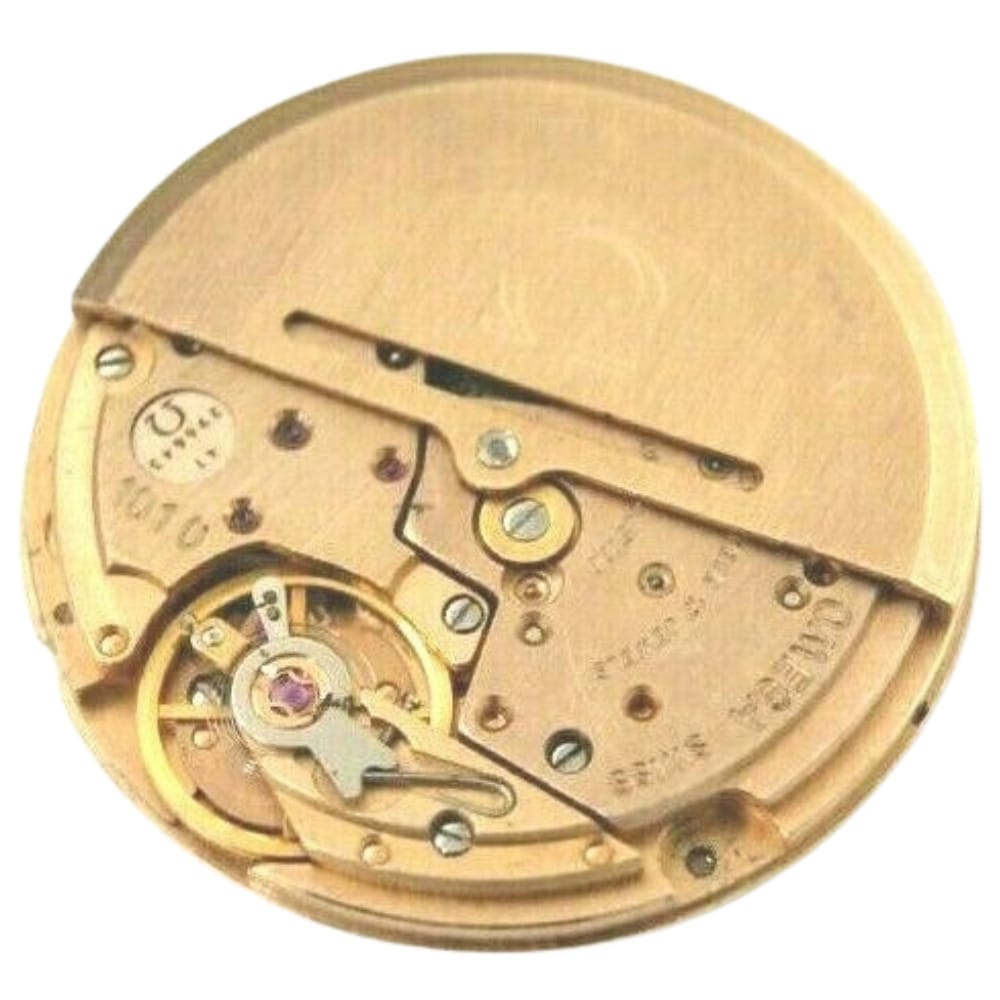
The Omega 1010 represents Omega’s redemption story. Introduced in 1972, the 1010 was engineered to correct the significant reliability issues that plagued the earlier Caliber 1000, 1001, and 1002 movements. While those initial high-beat calibers suffered from problematic automatic winding mechanisms and self-lubrication systems that became infamous among collectors and watchmakers, Omega went back to the drawing board and essentially redesigned the entire movement using mathematical modeling. The result was a thin, high-beat caliber that powered everyday Seamasters, Genevas, and De Villes through the 1970s and early 1980s.
The Caliber 1010 is a date-only, automatic movement with integrated winding mechanism, beating at 28,800 vph with a 42-48 hour power reserve. At just 4.25mm thick, it allowed Omega to produce slimmer cases than the earlier 5xx series movements while operating at a significantly higher frequency. The movement features hacking seconds and a quickset date function, conveniences that were becoming standard expectations by the early 1970s. Its reputation among collectors and watchmakers is mixed but improving: those who remember the troublesome 1000 series often paint the entire family with the same brush, but experienced watchmakers recognize that the 1010 series, when properly serviced, is a dependable and accurate movement.
Omega produced approximately 178,000 units of the Caliber 1010 during its 12-year production run from 1972 to 1984. This figure places the caliber in the “common” category for vintage Omega movements. The 1010 was used across multiple watch lines, most famously in the Seamaster 120 “Baby Ploprof” (ref. 166.0250), but also in numerous Seamaster, Geneve, and De Ville references with case numbers in the 166.xxxx series. Serial number ranges span from approximately 34,000,000 (1972) to 46,000,000 (1984), making dating relatively straightforward.
The Caliber 1010 occupies an interesting position in the current collector market. Watches powered by the 1010 are neither rare nor particularly sought-after compared to earlier 5xx-series calibers, which enjoy stronger collector demand. The Baby Ploprof 166.0250 commands prices from $3,500 to $7,900 depending on condition and originality, while more common Seamaster and Geneve examples with the 1010 can be found for $600-$1,200. Demand is stable rather than rising. Collectors who understand the distinctions between the problematic early 1000 series and the improved 1010 series are willing to pay fair prices for well-maintained examples, but the lingering reputation issues prevent these movements from commanding premiums.
Historical Context, Provenance, and Manufacturing Details
The Caliber 1010 was developed in response to one of Omega’s most significant technical failures. When the company launched the Caliber 1000 series in 1968-1969, it represented Omega’s entry into the high-beat movement era, with a new 28,800 vph frequency that promised greater accuracy and stability. However, the original design suffered from fundamental flaws in its automatic winding mechanism and self-lubrication system, creating reliability nightmares for owners and watchmakers. By 1972, Omega had concluded that incremental fixes were insufficient.
The 1010 was introduced in 1972 as a comprehensive redesign. Omega’s engineering team developed the new caliber using mathematical modeling, a methodology they described in technical documentation as allowing them to optimize “the chief features of the various movement parts” under “better-controlled conditions than previously”. While the 1010 retained some visual similarities to the 1000, it was fundamentally reconceived, with most parts redesigned and incompatible with the earlier caliber. Even components like the winding stem were altered with slightly different dimensions. The technical guide explicitly states: “if this new caliber presents obvious similarities to caliber 1000, it has nevertheless been entirely reconceived and can in no way be compared with it”.
The Caliber 1010 served as the base grade in a family of related movements introduced simultaneously in 1972. The elaborated versions included the Caliber 1011 (23 jewels, chronometer-certified), Caliber 1012 (23 jewels, date-only without chronometer certification), and day-date variants numbered 1020, 1021, and 1022. A manual-wind version, the Caliber 1030, was also produced, identical to the 1010 but without the automatic winding module. All shared the same base architecture and many interchangeable parts.
Omega manufactured the Caliber 1010 in-house at its Bienne, Switzerland facilities. This was a fully Omega design and production effort, not an ebauche-based movement. The 1010 has no relationship to ETA or other third-party suppliers, unlike later Omega calibers of the 1980s and 1990s that would increasingly rely on ETA base movements. Production continued until 1984, when Omega began transitioning toward ETA-based calibers and ultimately quartz movements as the Swiss watch industry adapted to the quartz crisis. The 1010 series represented the end of an era: Omega’s last generation of fully in-house, affordable mechanical movements before the company restructured under SSIH (later Swatch Group) ownership.
The Caliber 1010 eventually gave way to no direct successor. Instead, Omega’s strategy shifted in the 1980s toward ETA-based movements for non-chronograph models. Calibers like the 1481 (based on ETA 2481) and later the 1120 (based on ETA 2892-A2) filled the role of everyday automatic movements in Omega’s lineup. The transition marked a fundamental change in Omega’s manufacturing philosophy, moving from vertically integrated production to strategic use of shared platforms that could be elaborated and decorated to Omega’s standards.
Construction and Architecture

Plate and Bridge Layout
The Caliber 1010 utilizes a traditional three-quarter plate construction with a separate barrel bridge and balance cock. The base plate and bridges are brass with a distinctive copper-alloy finish that gives the movement its characteristic rose-gold appearance. This finish was standard for Omega movements of the era and should not be confused with actual precious metal plating. The architecture prioritizes thinness: at 4.25mm, the 1010 is notably slimmer than the earlier 5xx-series movements (which measured 5.0-5.5mm) while maintaining structural rigidity.
The barrel bridge (part 1001) is secured with screws and features an elongated slot to accommodate the wig-wag pinion used in the automatic winding system. This design choice, while mechanically sound, requires careful reassembly during service to ensure proper engagement. The movement features a modular calendar mechanism on the dial side, with the date indicator, driving wheels, and quickset mechanism accessible after dial removal.
Balance Wheel
The Caliber 1010 employs a Glucydur balance wheel with timing screws. Glucydur, a beryllium-bronze alloy, is non-magnetic and highly resistant to temperature-induced deformation. The balance features multiple timing screws around its perimeter, allowing for fine adjustment of poise and rate. The balance diameter is optimized for the 28,800 vph frequency, larger than would be required for a slower-beat movement to maintain adequate amplitude through the full power reserve.
Balance Spring (Hairspring)
The hairspring is Nivarox, the industry-standard Swiss alloy known for its thermal stability and anti-magnetic properties. The spring features a Breguet overcoil, an elevated outer terminal curve that improves isochronism by ensuring the spring breathes concentrically as it expands and contracts. The stud holder (part 1363) is mounted on the balance cock and can be adjusted for beat error correction.
Escapement Type
The 1010 uses a Swiss lever escapement with jeweled pallet stones and an impulse jewel on the balance roller. The escape wheel has 15 teeth, standard for this frequency and gear train ratio. The escapement operates with a lift angle of 52°, a specification that must be programmed into timing machines for accurate rate and amplitude measurements. The pallet fork pivots run in jeweled holes to reduce friction and wear.
Shock Protection System
Incabloc shock protection is fitted to both the balance staff pivots (upper and lower). The upper Incabloc assembly (part 1347) and lower assembly (part 1346) use the classic Incabloc spring and jewel design, where conical jewels are held by a lyre-shaped spring that allows axial movement under shock while maintaining constant endshake. This generation of Incabloc is robust and serviceable, though replacement jewels and springs must be correctly matched to the caliber.
Regulator Type
The 1010 employs a traditional index regulator system with a regulator pointer (part 1332) that can be moved along a graduated scale marked with plus and minus indicators. The regulator acts on the effective length of the hairspring by positioning two pins (the regulator pins) that limit the spring’s active coils. A micrometric adjustment screw (part 2832) is integrated into the regulator assembly, allowing fine-tuning without moving the main regulator arm. This screw turns clockwise to increase rate (making the watch run faster) and counterclockwise to decrease rate.
Mainspring Material and Type
The mainspring is manufactured from Neotal, a white-alloy material that Omega described as “self-lubricated”. This terminology is somewhat misleading: the spring still requires proper lubrication at the barrel arbor pivots and hook, but the Neotal alloy was formulated to reduce friction between coils as the spring winds and unwinds. The mainspring dimensions are 0.95mm height x 0.12mm thickness x 500mm length x 11.7mm inner diameter. The spring is secured to the barrel arbor with a fixed attachment (not a slipping bridle), and the outer end hooks to the barrel wall in the traditional manner.
Gear Train Details
The gear train follows the classic Swiss four-wheel configuration: mainspring barrel, center wheel (carrying the minute hand), third wheel, fourth wheel (carrying the seconds hand), and escape wheel. The standard gear ratios for a 28,800 vph movement apply: the center wheel makes one revolution per hour, the third wheel turns 8 times per center wheel revolution, the fourth wheel turns 7.5 times per third wheel revolution (60 times per hour), and the escape wheel turns 10 times per fourth wheel revolution. The center wheel drives the motion works on the dial side to operate the hour hand at the correct 12:1 reduction.
A critical servicing consideration on the 1010 is the cannon pinion tension. The cannon pinion is a friction-fit tube that rides on the center wheel arbor, carrying the minute hand. If the tension is too loose, the hands will slip or fail to advance during date changes. If too tight, setting the time becomes stiff and can damage the minute wheel teeth. Properly adjusting this friction fit requires experience and is a common failure point on neglected examples.
Finishing Quality and Techniques
The Caliber 1010 received functional-grade finishing appropriate for a workhorse movement in Omega’s mid-range lineup. The bridges and base plate exhibit a copper-alloy finish with light polishing but no haute horlogerie decoration. Perlage (circular graining) is absent or minimally applied. The movement does not feature Côtes de Genève, snailing, or hand-beveled edges. Screw heads are flat and unpolished. This finishing level was standard for the caliber across all jewel counts: even the 23-jewel elaborated versions (1011, 1012) show similar utilitarian finishing.
The movement’s aesthetic relies on its distinctive rose-gold coloring and the visual interest of the automatic winding components visible through the case back. For collectors, the lack of decorative finishing is not a deficiency but rather an honest representation of the caliber’s positioning as a reliable, everyday movement rather than a prestige piece.
Cross-Reference Data
Alternative Caliber Names (Rebranded Versions)
The Caliber 1010 was used exclusively in Omega-branded watches. Unlike some Omega calibers that were supplied to sister brands under different designations, the 1010 remained proprietary to Omega. No rebranded versions exist.
Base Caliber vs. Elaborated Versions
The distinction between base and elaborated versions centers on jeweling in the automatic winding mechanism and chronometer certification. The additional six jewels in the 23-jewel variants are installed in the reversing wheels and reduction gears of the automatic winding train, theoretically improving longevity and efficiency. In practice, watchmakers report that the performance difference between 17 and 23-jewel versions is minimal if the movement is properly maintained.
Compatible Case References by Brand
Case references beginning with “166” overwhelmingly use 1010-series movements. The casing diameter specification is 27.90mm, meaning cases were designed specifically for this caliber family. Mixing calibers between case references is sometimes possible but not recommended without verifying dial foot positions and stem height compatibility.
Dial Compatibility Note
Dials for the Caliber 1010 have dial feet positioned to match the movement’s layout, with the date window at 3 o’clock (standard) or 6 o’clock (less common) depending on case reference. The dial feet spacing and locations are specific to the 1010 series and differ from earlier 5xx-series calibers and later ETA-based movements. When sourcing replacement dials, verify the caliber compatibility explicitly marked by the supplier. Date wheels are available with white backgrounds and black numerals or black backgrounds with white numerals, depending on dial color.
Crown and Stem Specifications
| Component | Specification |
|---|---|
| Stem Thread Diameter | 0.90mm (TAP 10) |
| Stem Part Number | 1106 |
| Crown Thread | TAP 10 = 0.90mm |
| Setting Mechanism | Yoke/clutch lever system |
The 0.90mm thread (TAP 10) is a standard size used across many Swiss movements, making generic crowns and stems relatively easy to source. However, Omega-specific stem dimensions must be respected: the 1010 stem is not interchangeable with the earlier 1000-series stem despite similar threading. When replacing crowns, verify the crown’s internal thread matches TAP 10 specifications and that the pendant tube diameter suits the case tube.
Identification Marks
Caliber Number Location
The caliber number “1010” is engraved on the movement plate, visible from the dial side when the dial is removed. On some variants, additional markings may appear on the automatic winding bridge or balance cock, but the primary identification is always on the base plate.
Logo and Brand Marks
The movement features the Omega logo prominently on the automatic winding bridge or rotor. Earlier production examples may show a larger Omega logo compared to later variants. The Swiss cross or “Swiss Made” marking should appear on the movement plate or balance cock. Quality stamps, if present, will indicate jewel count (e.g., “17 JEWELS” or “23 JEWELS”).
Date Codes
Omega did not use a systematic date code system on the Caliber 1010. Movement age must be determined from the watch’s serial number, which is engraved on the case (not the movement). Serial numbers in the range of 34,000,000-35,999,999 indicate 1972 production, progressing to 46,000,000-47,999,999 by 1984.
Finishing Marks
Expect to see the characteristic copper-alloy finish on all brass components. The bridges should show consistent coloring without excessive darkening or corrosion. Original movements will have light tool marks from manufacture and assembly but should not show signs of excessive refinishing, which would indicate amateur intervention or attempts to disguise damage.
Jewel Markings
The 17 jewels in the base Caliber 1010 are press-fit into the brass plates, not set in chatons. This is typical for mid-grade movements and does not indicate inferior quality. The 23-jewel elaborated versions (1011, 1012) include six additional jewels in the automatic winding mechanism, also press-fit. Original jewels are typically ruby (synthetic corundum) with minimal visible inclusions under magnification.
Adjustment Markings
Chronometer-certified variants (1011, 1021) should display adjustment markings indicating testing in multiple positions and temperature ranges. These markings, if original, will be crisp and consistent with Omega’s standards of the era. Non-chronometer versions will not carry such markings.
Correct Serial Number Formats and Locations
Movement serial numbers do not appear on the Caliber 1010 itself. Serial numbers are case-based and appear on the case back interior (between the case and movement). Format: eight-digit numbers with no letters, following Omega’s sequential numbering system. Be cautious of serial numbers that have been polished away, re-engraved, or that do not align with the case reference’s known production period.
Expected Engravings and Stampings
Legitimate engravings should include: caliber number (1010), jewel count (17 or 23), Omega logo, country of origin (Swiss Made or similar), and possibly a movement reference code. Engravings should be machine-applied with consistent depth and crisp edges. Hand-engraved markings (other than watchmaker service notations) are suspect.
Font and Marking Style by Production Era
Early production (1972-1975) movements tend to have slightly bolder stampings compared to later examples (1980-1984), but this variation is subtle. The Omega logo style remained consistent throughout production. Major font changes or style discrepancies suggest replacement parts or refinishing.
Part Information

Essential Movement Components
Critical Service Parts
The date corrector lever (part 1562 or 1568) is a notorious failure point, commonly made of plastic and subject to wear. Replacement cost from Cousins UK exceeds £70, making it one of the most expensive simple components in the movement. The cannon pinion tensioning is not a parts issue per se, but improper adjustment during service is a primary cause of post-service problems.
Sourcing Notes
Parts availability for the Caliber 1010 is moderate and declining. Omega ceased official parts support for movements of this vintage decades ago. Generic suppliers (Cousins UK, Ofrei, Perrin, Watch Material) carry common service parts like mainsprings, balance staffs, cannon pinions, and shock jewels. Specialized components like the date corrector lever, automatic winding parts, and complete balance assemblies are increasingly difficult to source and expensive when available.
Generic mainsprings from suppliers like Ranfft/GR are acceptable replacements if Omega original stock (NOS) is unavailable. Balance staffs and cannon pinions have acceptable generic alternatives. However, rotor assemblies, bridges, and caliber-specific gears should ideally be genuine Omega parts or harvested from donor movements.
Common failure components requiring replacement: date corrector lever (plastic wears out), cannon pinion (requires re-tensioning), mainspring (loses temper over time), balance staff (damage from drops or improper handling), and automatic winding mechanism components (wear from lack of lubrication).
Performance Data
Manufacturer Specifications
Omega’s technical documentation for the Caliber 1010 specifies the following performance standards:
- Accuracy (New): Not explicitly stated for the base 1010; chronometer-certified versions (1011, 1021) would meet COSC standards of -4/+6 seconds per day
- Positions Tested: The movement can be regulated in multiple positions, though the base 1010 is typically adjusted in 2-3 positions
- Temperature Compensation: The Glucydur balance wheel and Nivarox hairspring provide passive temperature compensation across typical wearing temperatures
- Isochronism: The movement is designed to maintain consistent rate across the power reserve range, though amplitude drop is expected as the mainspring unwinds
- Minimum Power Reserve: 48 hours per technical documentation, though 42 hours is commonly cited
The lift angle of 52° must be set on timing equipment for accurate measurements.
Observed Performance (Field Data)
Field reports from collectors, watchmakers, and auction houses provide a realistic picture of Caliber 1010 performance in well-maintained examples:
Accuracy Range: Well-serviced examples typically run between -5 and +10 seconds per day across all positions. Exceptional examples can achieve +2/-3 seconds per day. Accuracy degrades if service intervals are exceeded or if the movement has wear in the escapement or automatic winding mechanism.
Common Performance Issues: The cannon pinion tension is the most frequently reported problem post-service. If set too loose, the minute hand slips or fails to advance during date changes. If too tight, time-setting becomes stiff and can shear teeth on the minute wheel. This issue is a servicing challenge, not inherent to the design, but it affects user experience significantly.
The quickset date mechanism can jam or fail if operated between 8 PM and 2 AM, when the date change lever is engaged with the date wheel. This is a design limitation common to quickset movements of the era: users must avoid quickset operation during the “danger zone” hours to prevent damage to the date corrector lever or date indicator teeth.
Automatic winding efficiency is adequate but not exceptional. The wig-wag pinion system, while robust when properly maintained, requires correct lubrication and engagement to function smoothly. Neglected automatic mechanisms may wind sluggishly or fail entirely, though this is usually a maintenance issue rather than a fundamental design flaw.
Expected Amplitude: Fully wound, a healthy Caliber 1010 should show amplitudes of 280-310° in the dial-up position. As the power reserve depletes, amplitude drops to approximately 220-240° at 40+ hours. Amplitude below 200° when fully wound indicates worn pivots, dried lubricants, or damaged escapement components.
Performance Degradation Over Time: The synthetic lubricants used in 1970s Omega movements degrade over 5-10 years, becoming sticky or evaporating entirely. This accelerates wear and reduces amplitude. The thin design of the 1010 means that worn pivot holes can develop quickly if service is deferred. Collectors report that movements serviced every 5-7 years maintain good performance, while those left unserviced for 15+ years often require significant parts replacement.