

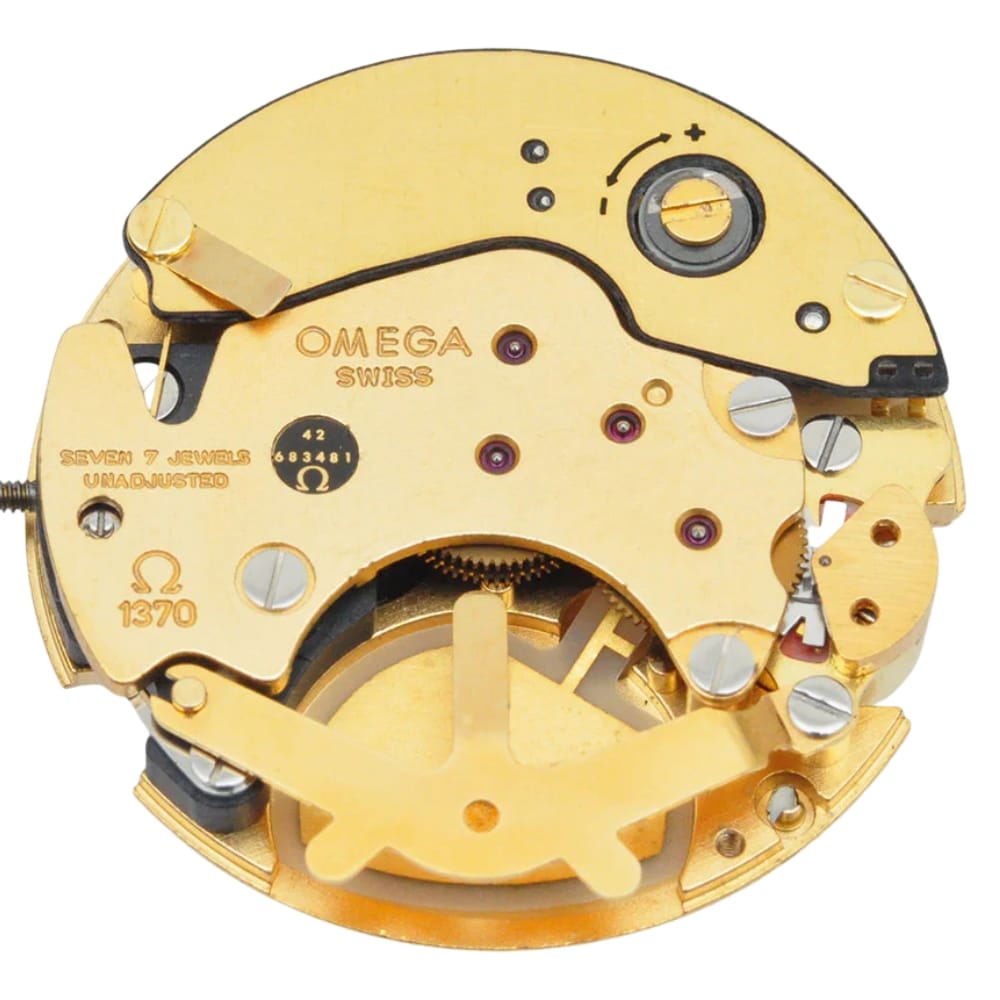
The Omega caliber 1370 represents a pivotal moment in Swiss quartz watchmaking: a fully in-house developed movement that proved Omega could compete with Japan and America without compromising on Swiss engineering principles. While the Beta 21 consortium had been a costly experiment and the 1310 MegaQuartz a technological showcase, the 1370 was Omega’s first practical, cost-effective quartz caliber designed for volume production. This was the movement that would carry Omega through the darkest years of the quartz crisis, appearing in everything from dress watches to sports models throughout the late 1970s and early 1980s.
The 1370 is instantly recognizable by its unique push-button crown system, a design philosophy Omega pursued across several quartz calibers during this era. The crown pulls out one click to adjust the hour hand independently (useful for time zone changes and date setting), while a button recessed into the center of the crown controls minute and second adjustments. Press briefly to advance the seconds hand by two seconds, hold for five seconds then release and press again to activate rapid minute advancement. This unconventional system reflects Omega’s belief that quartz accuracy would make time adjustments rare enough that a traditional crown was unnecessary.
Production estimates for the 1370 are difficult to pin down precisely. Based on serial number analysis, approximately 50,000 to 75,000 units were produced between 1975 and 1982, though this figure should be considered a rough estimate derived from observed serial ranges rather than manufacturer confirmation. The 1370 sits firmly in the “common” category among vintage Omega quartz movements. These watches appear regularly in the secondary market, typically priced between $200 and $600 depending on condition and reference. The caliber’s commonality works in collectors’ favor: parts remain available through specialty suppliers, and watchmakers familiar with vintage quartz movements can service them without excessive difficulty.
Collector interest in the 1370 remains stable rather than rising. Unlike mechanical Omega calibers from the same era, the 1370 occupies a curious middle ground: too common to be rare, too old to be easily serviceable by battery-only technicians, and too quartz to attract serious collector premiums. That said, well-preserved examples in original condition, particularly those with interesting dial variations or unusual case designs like the C-shape references, command respectable prices among vintage quartz enthusiasts. The 1370’s significance lies not in rarity but in historical context: it represents Omega’s successful transition from mechanical to quartz production during one of watchmaking’s most turbulent decades.
Historical Context, Provenance, and Manufacturing Details
The development of the caliber 1370 cannot be separated from Omega’s rocky relationship with quartz technology in the 1970s. The Beta 21 movement, introduced in 1970 as a joint venture between 20 Swiss manufacturers, had been technically impressive but commercially disastrous. Operating at 8,192 Hz with a complex vibration motor design, the Beta 21 (which Omega branded as caliber 1300 and 1301) was expensive to produce, difficult to service, and quickly outpaced by simpler, cheaper Japanese quartz movements.
Omega’s response was the caliber 1310 MegaQuartz, released in 1973 as the brand’s first fully in-house quartz movement. The 1310 represented a philosophical shift: instead of matching Japanese cost structures, Omega would compete on quality and Swiss finishing. The 1310 operated at the now-standard 32,768 Hz frequency, featured 8 jewels, and incorporated innovations like independent hour hand adjustment and push-button time correction. Watches powered by the 1310 were marketed with claims of 5 seconds per month accuracy and resistance to shocks, magnetism, and temperature variations. Production of the 1310 continued until approximately 1978.
The caliber 1370, introduced around 1975, evolved directly from the 1310’s architecture but with critical simplifications aimed at broader market penetration. Where the 1310 had been positioned as a premium offering with day-date complications and 8 jewels, the 1370 stripped away the day display, reduced jewel count to 7, and employed a more compact 25.60mm diameter (versus the 1310’s 29mm). The result was a movement that could fit into smaller, more traditional case designs while maintaining the 1310’s signature features: the push-button crown control system, independent jump-hour hand adjustment, and 32,768 Hz quartz regulation.
Caliber 1370 was manufactured entirely in-house at Omega’s facilities in Switzerland. This was not an ebauche-based movement, though interestingly, the basic architecture was shared with Tissot’s caliber 2031. Both Omega and Tissot were part of SSIH (Société Suisse pour l’Industrie Horlogère SA) during this period, allowing for movement platform sharing across brands. The Tissot 2031 is essentially a slightly simplified or differently finished version of the 1370, lacking some of Omega’s quality control standards and finishing details but functionally nearly identical.
The 1370 represents a transitional design in Omega’s quartz evolution. It preceded the later 1380 series (which added day-date functionality and operated from 1979 to 1986), and eventually gave way to ETA-based quartz movements as the Swatch Group consolidated movement production in the 1980s and beyond. The 1370’s production run overlapped with the final years of Omega’s mechanical golden age and the early Swatch Group era, making these watches interesting artifacts of horological industrial consolidation.
Construction and Architecture
The caliber 1370 employs a modular three-plate construction typical of early Swiss quartz movements. The main plate (part 1370-9000) serves as the foundation, with a separate train wheel bridge (part 1370-9005) securing the gear train and a hand-setting stem bridge (part 1370-9007) covering the motion works. Plates are brass with nickel plating, offering adequate protection against oxidation while keeping production costs reasonable. The architecture is decidedly functional rather than decorative: these movements were designed to be sealed inside cases and never admired through exhibition casebacks.
The electronic module (part 1370-9600), which houses the integrated circuit and quartz crystal, mounts to the main plate via four screws and functions as a self-contained unit. This modular design simplified manufacturing and, theoretically, repair: a failed electronic module could be swapped rather than requiring complete movement replacement. In practice, sourcing replacement modules four decades later presents challenges, though they do appear occasionally through parts suppliers.

Motor and Stepper Mechanism
At the heart of the 1370 sits a single-coil stepping motor (part 1370-9400) that converts electrical pulses from the quartz oscillator into mechanical rotation. The motor consists of a stator, rotor, and coil assembly. Unlike mechanical movements where the escapement regulates gear train speed, the quartz crystal and integrated circuit generate precisely timed electrical pulses (one per second) that cause the rotor to advance in discrete steps. Each pulse rotates the rotor 180 degrees, which through gear reduction drives the second hand forward one second.
The contactor (part 1370-9615) solders directly onto the circuit board and serves as the electrical connection point between the battery and the electronic module. A separate connector (part 1370-9619) links the module to other components. The quartz earth connector (part 1370-9661) provides grounding to minimize electromagnetic interference.
Gear Train Details
The 1370’s gear train follows conventional quartz architecture with some unique Omega touches. The second wheel (part 1370-9242) drives directly from the motor rotor via the intermediate wheel (part 1370-9247). The center wheel (part 1370-9240) drives the minute hand, while the third wheel (part 1370-9208) provides the reduction necessary for proper hand speed ratios. The minute wheel (part 1370-9221) meshes with the center tube (part 1370-9030) to transmit motion to the minute hand.
For date-equipped versions, the hour wheel (part 1370-9244) carries a finger that advances the date indicator driving wheel (part 1370-9232) once per 24-hour rotation. The date indicator maintaining plate (part 1370-9020) holds the date disc in position with appropriate spring tension. Date indicators came in various colors depending on dial specifications (part 1370-9235BL references a black date disc, for example).
The clutch wheel (part 1370-9101) and setting wheel (part 1370-9217) enable hand setting. When the crown is pulled to position 2, the setting lever (part 1370-9102) moves the clutch wheel into engagement with the setting mechanism, allowing the hour hand to jump forward or backward without affecting the minute or second hands. This independent hour hand adjustment was one of Omega’s key features during the 1970s quartz era, marketed specifically to frequent travelers.
Push-Button Crown Control System
The 1370’s most distinctive mechanical feature is its push-button crown system, controlled via setting lever spring (part 1370-9107, listed as “double function spring”). The button recessed into the crown’s center actuates a logical circuit within the electronic module that sends specific commands to the motor.
Push-button functions operate as follows:
- Brief press (less than 1 second): Advances second hand by 2 seconds
- Press and hold (1-5 seconds): Stops second hand (hacking function for precise time setting)
- Press and hold for 5 seconds, release, then immediately press again: Activates rapid minute hand advancement (approximately 1 complete dial rotation per 2 minutes)
The push-button mechanism requires careful calibration. The button must physically press deep enough into the case to contact the circuit board switch, but not so aggressively as to damage delicate electronic components. This explains why many surviving 1370-powered watches have non-functional push-button systems: decades of use wear down the mechanical contact points, and previous repair attempts sometimes damage the circuit board pads.
Power Supply and Battery System
The 1370 is powered by a single SR1130W (also known as 389 or 390) 1.55V silver oxide battery. This button cell measures 11.6mm in diameter by 3.1mm in height. The battery installs with the positive terminal facing up, secured by a battery clamp (part 1370-9033) and bridle (part 1370-9616, also called battery bridle +).
Battery installation requires care. The bridle is a spring-loaded component that can be easily damaged if handled roughly. A correctly installed battery makes contact with both the positive terminal (via the bridle) and negative terminal (via the movement plate), completing the circuit that powers the electronic module. Omega’s original manual claimed “more than one year” of battery life, but in practice, a fresh SR1130W typically provides 18 to 24 months of operation. Some collectors report shorter battery life with modern cells compared to original 1970s batteries, possibly due to differences in silver oxide formulation or increased current draw as electronic components age.
Trimmer and Regulation
The 1370 incorporates a trimmer (adjustable capacitor) on the electronic module that allows for fine-tuning of the quartz oscillator frequency. The trimmer can adjust timekeeping by approximately plus or minus 10 seconds per month. This adjustment should only be attempted by qualified watchmakers, as over-adjustment can damage the circuit or move the calibration beyond the trimmer’s range.
If the trimmer cannot bring the watch to acceptable accuracy, the electronic module itself has likely degraded and requires replacement. Common symptoms of electronic module failure include erratic timekeeping, second hand stuttering or stopping, or complete failure to run despite a fresh battery.
Finishing Quality and Techniques
The 1370 features no decorative finishing. Plates are nickel-plated brass with a utilitarian matte surface. No Cotes de Geneve, no perlage, no anglage, no polished bevels. This was standard practice for quartz movements in the 1970s: with no expectation of being viewed through a display caseback, manufacturers focused resources on functionality and reliability rather than aesthetic flourishes.
That said, component manufacturing quality remains high. Gear teeth show precise cutting, pivot points are properly jeweled where needed, and overall tolerances reflect Swiss manufacturing standards of the era. When compared to contemporary Japanese quartz movements, the 1370 demonstrates more robust construction and higher-quality materials, even if surface finishing is absent.
Cross-Reference Data
Alternative Caliber Names and Related Movements
The Tissot 2031 shares the same basic architecture as the Omega 1370, both being products of SSIH’s shared movement development. The 2031 appears in Tissot watches from approximately 1978-1979 and uses the same 32,768 Hz frequency and similar mechanical construction. Parts interchangeability between 1370 and 2031 has not been systematically documented, but collectors report success using certain Tissot 2031 components in 1370 movements when Omega-branded parts are unavailable.
Compatible Case References by Brand
Serial numbers for 1370-powered watches fall primarily in the 40,000,000 to 44,000,000 range, corresponding to production years between 1977 and 1982. A watch with serial number 43,691,619 dates to approximately 1979, while serial 40,632,622 dates to approximately 1976.
Dial Compatibility and Case Specifications
Dial foot positions on the 1370 follow standard Swiss layouts for the era. Date windows, when present, appear at 3:00. The movement accepts dials with two dial feet positioned at opposite sides of the dial perimeter. Dial fasteners (part 1370-9034) secure the dial to the movement.
Crystal types vary by reference. The 196.0121 uses an acrylic crystal with Omega’s logo embossed in the center. This logo, visible at certain angles, serves as a quick authenticity check: its presence indicates an original Omega crystal. Later references and service replacements may use mineral glass without the logo.
Crown and Stem Specifications
The stem (Omega part 1370-9100, alternate numbering 5567 or 401-9100) comes in different lengths depending on case design. The TAP 10 thread is standard for Omega quartz movements of this era. Original crowns feature the Omega logo and an integrated push-button mechanism. The push-button requires a separate spring system that operates independently of the stem, explaining why crown replacements often result in non-functional push-button operation unless the entire crown assembly is properly matched.
Identification Marks
Caliber Number Location
The caliber number “1370” is engraved on the main plate, typically visible near the balance cock area or along the edge of the electronic module. On fully assembled movements, the number may be partially obscured by the train wheel bridge or electronic module, requiring partial disassembly to read clearly.
Logo and Brand Marks
Authentic Omega caliber 1370 movements display the following markings:
- Omega symbol (Ω) stamped on the main plate
- “OMEGA” text engraved on the main plate
- “SWISS” or “SWISS MADE” designation
- “SEVEN 7 JEWELS” or “7 JEWELS” jewel count marking
- “UNADJUSTED” marking (quartz movements were not adjusted in multiple positions like mechanical chronometers)
Some movements display additional numerical codes whose meaning is not universally documented. For example, “4 0” appears on certain 1370 movements, but its significance remains unclear.
Date Codes and Serial Numbers
Omega serial numbers appear on the movement and/or case back. For the 1370 production period (1975-1982), serial numbers fall into these approximate ranges:
- 1975: 39,000,000 – 39,999,999
- 1976: Not clearly documented (gap in records)
- 1977: 40,000,000 – 40,999,999
- 1978: 41,000,000 – 41,999,999
- 1979: 42,000,000 – 43,999,999
- 1980: 44,000,000 – 44,999,999
- 1981-1982: 44,000,000+ (overlapping ranges due to production variations)
Serial numbers for 1370-powered watches should match the production timeline above. A watch with a 1370 movement but a serial number outside this range warrants careful authentication: either the movement has been swapped, the case is incorrect, or the watch is not genuine.
Finishing Marks and Expected Characteristics
No decorative finishing appears on caliber 1370 movements. Expect to see:
- Nickel-plated brass plates with matte industrial finish
- No Cotes de Geneve, perlage, or other decorative patterns
- Functional rather than aesthetic component arrangement
- Seven jewels (typically four wheel jewels, two pallet jewels, one impulse jewel) set in pressed settings rather than gold chatons
The absence of decorative finishing is not a sign of inauthenticity, it simply reflects 1970s quartz manufacturing philosophy.
Correct Serial Number Formats and Locations
Movement serial numbers are engraved on the movement plate, often near the edge or under a bridge. Case serial numbers appear on the case back, either on the exterior or interior depending on case design. Both numbers should follow the eight-digit format typical of Omega’s 1970s-1980s production (e.g., 43691619).
Expected Engravings and Stampings
Legitimate 1370 movements should display clean, evenly-spaced engravings with consistent depth. The Omega symbol should be crisp and properly proportioned. Any smudged, asymmetrical, or suspiciously shallow engravings suggest either poor refinishing work or counterfeit components.
Reference numbers on case backs follow the format XXX.XXXX (e.g., 196.0121). The case back should also display metal purity markings if gold-plated (e.g., “10k RGP” for 10-karat rolled gold plate, “20 MICRON” for gold plating thickness). Stainless steel case backs are marked “STAINLESS STEEL” or “STAINLESS STEEL BACK”.
Font and Marking Style by Production Era
Omega’s engraving style remained relatively consistent throughout the 1970s, but minor variations occurred as tooling and equipment changed. Early 1970s engravings tend to be slightly deeper and more pronounced compared to later 1970s production, which shows shallower, more refined markings. These differences are subtle and require direct comparison between examples to appreciate.
Part Information

Part Numbers
Sourcing Notes
Parts availability for the caliber 1370 sits in a challenging middle zone. The movement is old enough that many components are discontinued by Omega’s official service network, but common enough that specialty parts suppliers maintain limited stock. Major suppliers like Watch Material, Gleave & Co., Boley, and Scotch Watch list various 1370 components, though availability fluctuates.
Critical electronic components present the greatest challenge. The electronic module (part 1370-9600) rarely appears for sale, and when available, commands premium prices relative to the watch’s overall value. Failed motors or damaged circuit boards often mean replacing the entire electronic module rather than individual components. Some collectors and watchmakers report success sourcing used modules from donor movements, but this approach requires patience and luck.
Mechanical components fare better. Wheels, springs, stems, and other traditional watch parts remain sporadically available through parts dealers. The battery clamp (9033) and bridle (9616) appear frequently, as these components wear out over time and require replacement during service.
Commonly failing components include:
- Battery bridle: Can be bent or weakened through repeated battery changes
- Electronic module: Capacitor failure, circuit degradation, or solder joint failures after 40+ years
- Push-button mechanism: Worn contact points or damaged circuit board pads
- Motor coil: Rarely fails, but when it does, typically requires full electronic module replacement
Acceptable generic replacements exist primarily for the battery (any quality SR1130W from Renata, Energizer, or Maxell works fine). No other components should be substituted with generic parts, as the 1370’s specific architecture and tolerances require matched Omega or Tissot components.
Performance Data
Manufacturer Specifications
Omega’s original specifications for the caliber 1370 claim:
- Accuracy: Approximately 5-15 seconds per month when new and properly regulated
- Power reserve: 24 months (2 years) with original battery
- Operating temperature: Standard quartz range, approximately -10°C to +60°C
- Shock resistance: Marketed as shock-resistant, though specific ratings were not published
- Magnetic resistance: Basic quartz-level resistance (less critical than mechanical movements due to absence of hairspring)
These specifications assume a fresh battery, properly adjusted trimmer, and movement in good condition. Actual performance varied depending on manufacturing tolerances and individual component quality.
Observed Performance (Field Data)
After four to five decades of service, typical caliber 1370 performance characteristics show:
Accuracy Range:
Well-maintained examples with fresh batteries and functioning electronic modules typically achieve 15-30 seconds per month, slightly worse than original specifications but still respectable. Movements requiring service or exhibiting age-related component degradation may show accuracy of one to several minutes per month, or complete failure.
Common Performance Issues:
- Second hand stuttering or stopping: Usually indicates low battery, but can also signal motor coil failure or electronic module degradation
- Erratic timekeeping: Often caused by failed capacitors in the electronic module or poor battery contact
- Non-functional push-button: Mechanical wear in the crown assembly or damaged circuit board contact pads
- Complete failure to run: Battery exhaustion, electronic module failure, or corroded electrical contacts
Battery Life:
Modern SR1130W batteries in well-maintained 1370 movements typically provide 18-24 months of operation, though some collectors report as little as 10-16 months. Reduced battery life compared to original specifications likely results from aged electronic components drawing slightly more current, or differences between 1970s battery chemistry and modern silver oxide cells.
Service Intervals:
Unlike mechanical movements requiring 3-5 year service intervals, quartz movements generally run until battery replacement is needed. However, 1370 movements benefit from occasional cleaning and lubrication of mechanical components (gear train, motion works), ideally every 10-15 years. Full electronic service, including capacitor replacement or module repair, falls outside most watchmakers’ capabilities and typically requires sourcing a replacement module.
Performance Degradation:
Fifty-year-old 1370 movements show predictable age-related changes. Electronic modules experience capacitor drift, causing timekeeping to deteriorate beyond trimmer adjustment range. Mechanical components develop increased friction as original lubricants dry out, though this affects quartz movements less dramatically than mechanical movements. Battery contacts corrode, particularly if a battery has leaked, creating intermittent electrical connections.
The most common complaint from collectors: the push-button crown system stops working. Sometimes this results from a replaced crown that lacks the proper internal spring mechanism, but more often it stems from worn contact points on the circuit board or damaged push-button actuator components. Repairing this requires specialized knowledge of vintage quartz electronics and access to correct replacement parts, both of which are increasingly difficult to find.