

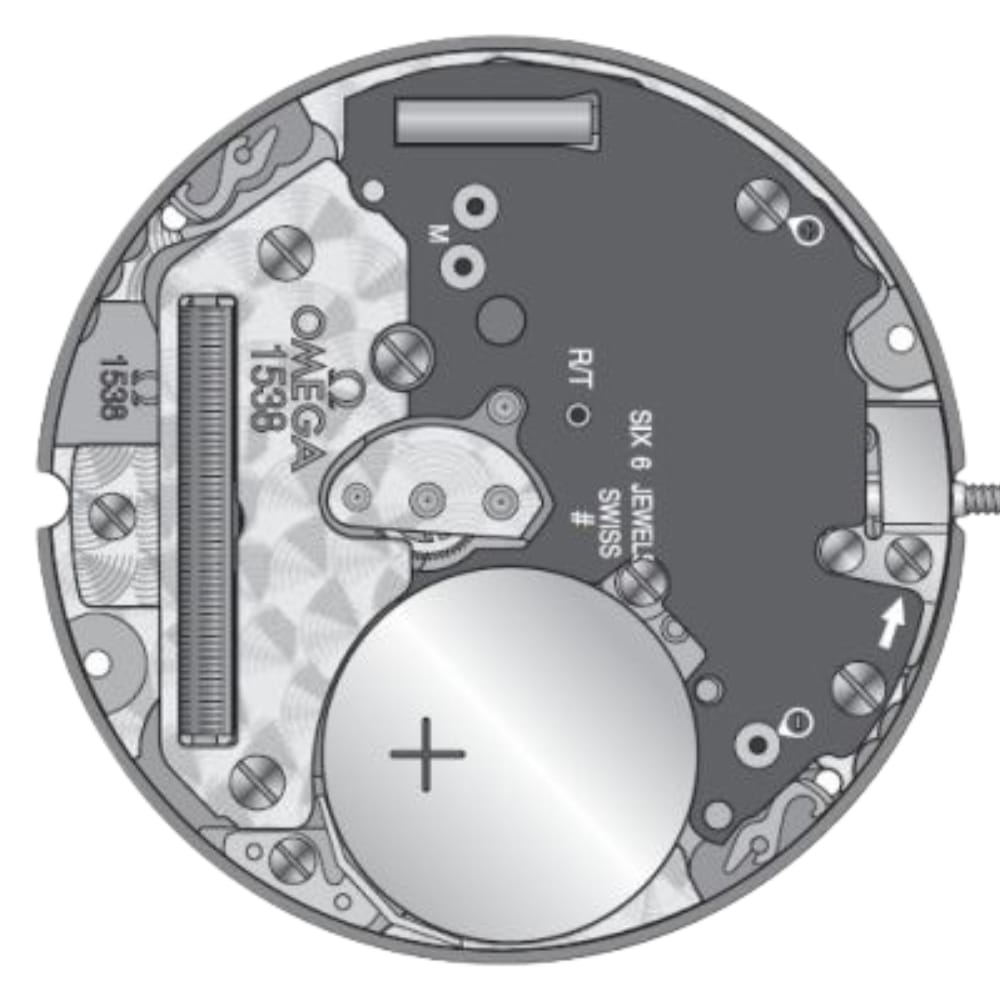
The Omega 1538 powered the quartz version of Pierce Brosnan’s “GoldenEye” Seamaster, making it perhaps the most famous affordable quartz movement to appear on screen in the 1990s. While mechanical Seamasters command the attention of most collectors, the 1538 represents a pragmatic workhorse that kept Bond watches running for years without service, a practical advantage that Omega marketed but collectors often overlooked.
The caliber 1538 is Omega’s branded version of the ETA 255.461 ebauche, distinguished by rhodium plating, circular graining, and gilded engraving that elevate it above the brass-plated ETA equivalent. Its standout feature is the jumping hour hand mechanism (position 2 on the crown), which allows independent hour adjustment in one-hour increments without disturbing the minutes or seconds, making it functionally superior to most quartz watches of its era that offered only quickset date. The caliber replaced the earlier 1438 (also ETA 255.461-based) in 1993 and evolved through four distinct versions (A, B, C, D) with progressive improvements to seconds hand jump accuracy and RoHS compliance.
Production numbers for the 1538 are difficult to estimate with precision because Omega used it across multiple model lines simultaneously. Based on serial number ranges, approximately 1 million Omega watches per year were produced in the mid-1990s (serial range 54-59 million from 1993-1998), with quartz models representing an estimated 15-20% of production during this period. The 1538 appeared in Seamaster Professional 300M quartz models (41mm and 36mm), Seamaster Professional 200M “Pre-Bond” models, and later Aqua Terra quartz variants from 2002-2007. Conservative estimates suggest 50,000-80,000 caliber 1538 movements were produced across all variants and years. Scarcity: Common. These movements remain readily available in the secondary market, and replacement ETA 255.461 movements can be purchased new for approximately $120.
Collector interest in caliber 1538 watches is modest but stable. The GoldenEye connection provides cultural cachet, particularly for the full-size 2541.80.00 reference, which trades in the $1,200-$2,500 range depending on condition. Midsize versions typically command $800-$1,500. The jumping hour hand feature adds modest value among collectors who appreciate functional complications. Demand is stable but not rising. Quartz Seamasters occupy a value niche: too modern to be vintage collectibles, too quartz to attract mechanical purists, but practical enough to serve as affordable entry points into Omega ownership. Versions with intact original movements (versus ETA replacements) do not command meaningful premiums, as the only visual difference is the Omega branding on the module, invisible during normal wear.
Historical Context, Provenance, and Manufacturing Details
Omega introduced the caliber 1538 in 1993 as part of the relaunch of the Seamaster Professional 300M line, coinciding with the brand’s aggressive push into popular culture through the James Bond franchise. The movement addressed a straightforward market need: buyers wanted the Seamaster aesthetic without mechanical service intervals or the cost premium of automatic movements. In 1993, a quartz Seamaster retailed for approximately 60% of its mechanical equivalent, a significant price advantage that appealed to younger buyers and tool watch enthusiasts who prioritized function over horological tradition.
The 1438 preceded the 1538, itself an Omega-branded ETA 255.461 that debuted around 1992-1993 in Pre-Bond Seamaster 200M models. Sources conflict on the technical differences between 1438 and 1538, with some suggesting they are functionally identical and others noting minor module revisions. What is certain: both are based on the same ETA 255.461 ebauche, both share dial feet positions (1:30 and 7:30), and both are directly interchangeable in compatible cases. The 1438 was phased out by the mid-1990s in favor of the 1538 designation, likely to align caliber numbering with the new Seamaster 300M case references.
The ETA 255.461 itself originated in ETA’s late-1980s push to develop compact, feature-rich quartz movements with complications beyond basic timekeeping. The 10.5-ligne size (23.30mm) struck a balance between fitting 36-41mm cases while leaving room for date mechanisms and additional gearing. ETA positioned the 255.461 as a premium ebauche with date, sweep seconds, and provisions for modular additions (time zone function, EOL indicator). The architecture proved successful: brands including Omega, Longines, Bulova, and numerous others adopted variations of the 255.xxx family throughout the 1990s.
Omega sourced the base ETA 255.461 movement and applied its own finishing and branding. The plates received rhodium plating (versus brass on standard ETA versions), circular graining patterns reminiscent of Côtes de Genève, and gilded engravings reading “OMEGA” and the caliber number. Nickel damascening (also called damaskeening) appears on the movement plate, creating a decorative pattern that distinguishes Omega modules from generic ETA equivalents when viewed through a display caseback (though most 1538 watches feature solid casebacks). These finishing steps were performed at Omega facilities in Bienne, Switzerland, where the movements were assembled into cases.
The caliber 1538 replaced no single predecessor cleanly. Instead, it consolidated Omega’s quartz strategy across the Seamaster line, replacing the 1438 in some references and the thermally compensated 1441 in others, the latter decision being controversial among collectors who prize the 1441’s superior accuracy. The 1441, based on ETA 255.561 and produced 1987-1988, featured thermal compensation for frequency stability across temperature ranges, achieving accuracy of approximately ±10 seconds per year versus ±15-20 seconds per year for the non-compensated 1538. Omega discontinued the 1441 due to cost considerations, and the 1538 became the standard quartz caliber for Seamaster models through the late 1990s and early 2000s.
By the mid-2000s, Omega began transitioning its Aqua Terra line toward entirely mechanical offerings, and quartz versions were quietly discontinued around 2007-2008. The caliber 1538 was not directly replaced; instead, Omega shifted focus to its Co-Axial mechanical movements, positioning the brand as a mechanical manufacture rather than a quartz producer. Today, Omega offers limited quartz models, and none use the 1538 designation.
Horological context: The 1538 represents late-era Swiss quartz refinement, appearing two decades after the quartz crisis devastated Swiss mechanical watchmaking. By the 1990s, Swiss brands had stabilized by positioning quartz as practical and affordable while reserving mechanical movements for prestige models. The 1538 fits this strategy: competent, reliable, decorated enough to justify a Swiss premium over Japanese competitors, but not innovative. Its jumping hour hand mechanism, while useful, was not groundbreaking (ETA offered this feature across its 255.xxx family). The 1538 is a workhorse, not a pioneer.
Construction and Architecture
Plate and Bridge Layout: The caliber 1538 uses a modular quartz architecture with a brass base plate and separate bridges for the gear train and setting mechanism. The electronic module (Omega part 9600) mounts to the plate and drives the stepping motor via 60 impulses per minute (one per second). The module features a nickel damascened cover plate with circular graining patterns and rhodium plating, distinguishing it visually from the brass-plated ETA equivalent. The bridge layout follows standard ETA 255.461 architecture: a single wheel train bridge covers the third and fourth wheels, while the minute wheel assembly sits under a separate bridge on the dial side. This construction allows modular assembly and simplified servicing, as failed electronic modules can be replaced without disturbing the mechanical gear train.
Balance Wheel: Not applicable. Quartz movements replace the balance wheel and hairspring with a quartz crystal oscillator and integrated circuit. The 1538 uses a 32,768 Hz quartz crystal (tuning fork type) trimmed to frequency during manufacture using laser ablation techniques. The crystal’s frequency derives from 2^15 = 32,768, allowing simple binary division circuits to generate a precise 1 Hz signal for the stepper motor.
Balance Spring (Hairspring): Not applicable (quartz movement).
Escapement Type: The 1538 employs a stepper motor-driven escapement rather than a traditional Swiss lever design. The electronic module generates 60 pulses per minute, each pulse energizing a coil that magnetically advances the rotor (and thus the gear train) by one step. This is a standard quartz escapement design, functionally identical across most analog quartz movements. The seconds wheel received technical modifications through versions B, C, and D to improve the accuracy and smoothness of the seconds hand jump, with version D incorporating a magnet to stabilize the seconds wheel during impulses and reduce play in the wheel engagement. These refinements addressed collector complaints about seconds hands that did not align precisely with dial markers, a common issue with early quartz movements.
Shock Protection System: Incabloc shock protection is listed in parts catalogs for the balance complete assembly (part 721/1254), though the relevance of shock protection in a quartz movement is minimal compared to mechanical movements, as there is no balance staff to protect. The Incabloc designation likely refers to the jeweled bearings used in the gear train (the movement contains 6 jewels total), which benefit from shock protection to prevent staff breakage during impacts.
Regulator Type: Not applicable. Quartz movements do not use index regulators or free-sprung systems. Frequency regulation occurs at the factory via laser trimming of the quartz crystal to achieve the target 32,768 Hz oscillation. Omega specifications indicate the movement should achieve -0.5 to +0.7 seconds per day accuracy, which translates to approximately ±13 ppm frequency deviation. This is typical for non-thermally compensated quartz movements. Field reports suggest well-maintained examples commonly achieve 1-2 seconds per month deviation, consistent with ±20 ppm quartz crystal tolerance.
Mainspring Material and Type: Not applicable. The 1538 uses a battery (Renata 373 or 395, depending on case) rather than a mainspring to store energy. Battery capacity is 29-30 mAh for the 373 (9.5mm diameter, 1.6mm height) and higher for the 395 (9.5mm diameter, 2.6mm height), providing 42 months of continuous operation under normal conditions. The movement consumes approximately 1.20 μA during normal operation, with consumption increasing when the End of Life (EOL) indicator activates.
Gear Train Details: The 1538 uses a standard quartz gear train with four wheels (seconds, third, fourth, and escape/rotor wheel driven by the stepper motor) plus the dial-side minute wheel, hour wheel, and date mechanism. Gear ratios are not documented in available technical literature, but they follow standard analog quartz conventions: the rotor turns once per second (driven by the stepper motor), and successive wheels reduce this to the minute hand (one rotation per hour) and hour hand (one rotation per 12 hours). The seconds hand mounts directly to the seconds wheel via a direct-drive configuration, ensuring the hand moves in discrete one-second jumps. The date mechanism uses a driving wheel (part 2556), intermediate date wheel (part 2543), and additional intermediate wheel (part 2543/2) to advance the date indicator (part 2557/1) once per 24-hour cycle. The jumping hour hand mechanism employs an hour corrector wheel (part 9700) and spring clip (part 9702) that allows the hour hand to be advanced independently in one-hour increments when the crown is pulled to position 2.
Finishing Quality and Techniques: The 1538 receives decorative finishing appropriate for a mid-tier Swiss quartz movement. The electronic module cover features circular graining (circular perlage patterns) and rhodium plating, creating a silvery finish that contrasts with the brass base plate visible underneath. Gilded engravings spell “OMEGA” and the caliber number, applied via stamping or engraving techniques. The level of finishing places the 1538 above generic ETA modules (which use simple brass plating) but below high-grade mechanical movements that feature hand-applied anglage, polished bevels, and snailing. This is functional decoration: it looks tidy and justifies the Omega branding, but it does not approach the finishing seen on even entry-level mechanical Omega calibers like the 1120 (based on ETA 2892-A2). No variations in finishing exist across production eras or elaboration levels; all 1538 movements received identical decorative treatment regardless of watch reference or price point.
Cross-Reference Data
Alternative Caliber Names (Rebranded Versions)
Base Caliber vs. Elaborated Versions
Compatible Case References by Brand
| Brand | Reference Numbers | Production Years | Notes |
|---|---|---|---|
| Omega | 2541.80.00 | 1993-1997 | Seamaster Professional 300M, 41mm, blue dial, “GoldenEye” Bond model |
| Omega | 2223.80.00 | 1993-2005 | Seamaster Professional 300M, 36.25mm, blue dial |
| Omega | 2561.80.00 | 1993-2005 | Seamaster Professional 300M, 36.25mm, blue dial |
| Omega | 2562.80.00 | 1993-2005 | Seamaster Professional 300M, 36.25mm, blue dial |
| Omega | 396.1042 | ~1987-1993 | Seamaster Professional 200M “Pre-Bond”, 36mm |
| Omega | 396.1052 | ~1987-1993 | Seamaster Professional 200M “Pre-Bond”, 36mm, may use Cal 1438 |
| Omega | 396.1502 | ~1987-1993 | Seamaster Professional 200M “Pre-Bond”, 36mm |
| Omega | 196.1501 | ~1993-2000 | Seamaster Professional, case reference variant |
| Omega | 196.1502 | ~1993-2000 | Seamaster Professional, 36mm |
| Omega | 196.1522 | ~1993-2000 | Seamaster Professional, 36mm |
| Omega | 196.1523 | ~1993-2000 | Seamaster Professional |
| Omega | 2517.50 | 2002-2007 | Aqua Terra Quartz, 39.2mm, black dial |
| Omega | 2518.30 | 2002-2007 | Aqua Terra Quartz, 36mm, silver dial |
Dial Compatibility Note
The caliber 1538 uses dial feet positions at 1:30 and 7:30, identical to the ETA 255.461 standard and the predecessor Omega 1438. Dials designed for the 1438 fit the 1538 without modification. The date window appears at 3:00 on all standard configurations. Hand sizes are 1.20mm (minute), 0.70mm (hour), and 0.20mm (seconds), with H2 and H3 height variants available depending on dial thickness. Collectors attempting dial swaps should verify hand height compatibility: H2 hands (standard) fit dials with typical thickness, while H3 hands accommodate thicker or applied-marker dials.
Crown and Stem Specifications
Identification Marks
Caliber Number Location: The caliber number “1538” is engraved on the electronic module cover plate, visible when the movement is removed from the case. On versions A, B, C, and D, the variant letter does not appear on the module itself; variant identification requires checking the date code stamp (located on the movement plate) and cross-referencing with Omega technical documentation. The date code format is week/year (e.g., 47/04 indicates week 47 of 2004).
Logo and Brand Marks: “OMEGA” appears in gilded engraving on the electronic module cover plate, centered and clearly legible. The module also features a Swiss cross or “SWISS MADE” marking, though placement varies by production batch. On movements produced after RoHS compliance (versions C and D), additional markings may appear indicating environmental certifications, though these are not visually prominent.
Date Codes: The 1538 uses Omega’s standard date code system: a two-digit week number followed by a two-digit year (format: WW/YY), stamped on the movement plate near the balance cock area. Examples: “47/04” (week 47, 2004), “42/07” (week 42, 2007). These codes allow precise dating of the movement and identification of technical variants (e.g., version B introduced at date code 10/04, version D introduced at 42/07). Date codes do not always align with case serial numbers, as movements were sometimes held in inventory before casing.
Finishing Marks: Authentic 1538 movements display circular graining (perlage) on the electronic module cover plate, applied in concentric circular patterns radiating from the center. The rhodium plating should appear uniform and silvery, not yellowed or tarnished. Poorly refinished or counterfeit modules often show irregular perlage patterns or brass undertones visible through thin plating. The gilded “OMEGA” engraving should be sharp and deeply cut; weak or shallow engravings suggest aftermarket replacement modules or refinishing.
Jewel Markings: The 1538 contains 6 jewels, located in the third wheel, fourth wheel, and pallet arbor positions (specific jewel locations are not documented in available technical guides). Jewels are pressed into the base plate and bridges rather than set in gold chatons, consistent with mid-tier quartz construction. No jewel count markings appear on the movement itself; catalogs and documentation list the jewel count as 6 universally across all versions.
Adjustment Markings: Not applicable. Quartz movements are not adjusted in multiple positions like chronometer-grade mechanical movements. The 1538 is factory-calibrated via laser trimming of the quartz crystal and requires no further adjustment during its service life. No adjustment markings (e.g., “5 positions,” “chronometer”) appear on the movement.
Correct Serial Number Formats and Locations: Omega serial numbers appear on the case, not the movement. Serial numbers for watches containing caliber 1538 fall in the following ranges based on production year:
- 1993: 54,000,000 – 54,999,999
- 1994-1995: 55,000,000 – 55,999,999
- 1998: 56,000,000 – 59,999,999
- 2000: 61,000,000 – 64,999,999
- 2002: 66,000,000 – 67,999,999
- 2005: 72,000,000 – 77,999,999
- 2006-2007: 78,000,000 – 80,999,999
Serial numbers are engraved on the inside of the caseback (between the lugs) on older models or laser-etched on the outside of the caseback on newer models (post-2000). The format is a continuous 8-digit number with no letters or prefixes (e.g., 54123456).
Expected Engravings and Stampings: Authentic 1538 movements should display the following engravings:
- “OMEGA” in gilded letters on the electronic module
- Caliber number “1538” engraved on the module (variant letter A/B/C/D does not appear)
- Date code in WW/YY format on the movement plate
- “SWISS” or “SWISS MADE” marking
- Jewel count (6) may appear on some production batches but is not universal
Engravings should be crisp, uniform in depth, and properly aligned. Authentic Omega engravings use a consistent serif font style; irregular or sans-serif fonts suggest counterfeit or replacement parts.
Font and Marking Style by Production Era: Omega maintained consistent engraving styles throughout the 1538 production run (1993-2007). No significant font changes occurred between versions A, B, C, and D. RoHS versions (C and D) may include additional environmental compliance markings stamped near the battery compartment, but these are subtle and do not alter the primary “OMEGA” branding style. Collectors should be cautious of movements with laser-etched (rather than engraved) “OMEGA” markings, as genuine 1538 modules use traditional engraving techniques.
Part Information

Part Numbers
Sourcing Notes
Parts Still Available:
- Electronic module (9600): Available from Omega service centers via movement exchange. Omega policy typically replaces the entire movement rather than servicing individual modules. Cost: approximately CHF 300-400 for complete movement exchange through authorized service centers.
- Base ETA 255.461 movement: Available new from ETA distributors for approximately $120-150 USD, providing an affordable replacement option. Generic ETA movements lack Omega branding but are functionally identical and fully compatible with 1538 cases and dials.
- Standard mechanical parts (wheels, springs, stems): Available through general watch parts suppliers (Ofrei, Cas-Ker, etc.) as ETA 255.461 parts. These interchange directly with Omega 1538 components.
Parts That Commonly Fail:
- Electronic module: The circuit can fail due to battery leakage, corrosion, or component degradation after 20-30 years of service. Symptoms include erratic timekeeping, failure to start with fresh battery, or broken battery terminal connections.
- Coil: Open or shorted coils result in complete stoppage. Coil resistance should measure 1.3-1.8 kΩ; readings outside this range indicate failure.
- Battery terminals: Corrosion or broken solder joints at the battery contacts cause intermittent operation or complete failure. This is the most common failure mode when watches have been stored with dead batteries.
Acceptable Generic Replacements:
- ETA 255.461 or 255.462 complete movements: Fully interchangeable with caliber 1538. The only difference is cosmetic (no Omega branding on the module). Most watchmakers recommend this replacement for out-of-warranty repairs, as the cost is significantly lower than Omega’s movement exchange program.
- ETA E64.111: Some sources suggest this movement is compatible with 255.461 cases, though dimensions should be verified before attempting a swap (23.3mm vs. potential slight variations). This is a less certain replacement option.
Parts Not Replaceable:
- Quartz crystal: Integrated into the electronic module and not serviceable separately. Module replacement is required for crystal failures (extremely rare).
Performance Data
Manufacturer Specifications
Observed Performance (Field Data)
Typical Accuracy Range for Well-Maintained Examples:
Collector reports and watchmaker observations indicate the caliber 1538 typically achieves 1-2 seconds per month deviation in well-maintained examples, translating to approximately 12-24 seconds per year or ±0.8-1.6 seconds per week. This is consistent with ±20 ppm quartz crystal tolerance and aligns with Omega’s published specification of -0.5 to +0.7 seconds per day (maximum cumulative error of ±15 seconds per month). The movement is not thermally compensated, so accuracy degrades slightly in extreme temperature environments (below 0°C or above 40°C), though most wearers will not notice this effect during normal use.
Common Performance Issues and Their Causes:
- Erratic Timekeeping (Gaining or Losing Minutes Per Day): Usually indicates a failing electronic module or low battery voltage. If replacing the battery does not resolve the issue, the module requires replacement.
- Failure to Start with Fresh Battery: Most commonly caused by corroded battery terminals or a failed coil. Measure coil resistance (should be 1.3-1.8 kΩ); readings outside this range confirm coil failure. Corrosion at the battery terminals can often be cleaned, but severed terminal connections require module replacement.
- Intermittent Stopping: Check battery voltage (should be 1.55V nominal) and movement consumption (should be ~1.20 μA). Consumption significantly above specification indicates internal short circuits or contaminated gear train causing excessive friction.
- Seconds Hand Not Aligning with Dial Markers: This is a known issue with versions A, B, and C, addressed in version D with improved seconds wheel and intermediate wheel designs (Kit 7221530D9999). The seconds hand jumps may appear to lag or lead the dial markers by 0.5-1.0 seconds. This is a cosmetic issue and does not affect accuracy. Collectors seeking perfect alignment should seek version D movements (date code 42/07 or later).
- Date Not Advancing or Jumping at Wrong Time: Typically caused by worn date driving wheel (part 2556) or misaligned date mechanism after dial removal/installation. The date should change between midnight and 2:00 AM. If the date changes during daylight hours, the hour hand has been improperly set (not aligned with AM/PM cycle). When using the jumping hour hand feature to change time zones backward, the hour hand must pass 7:00 PM for the date to decrement correctly.
- EOL Indicator Not Activating: The EOL indicator should trigger when battery voltage drops below 1.30V, causing the seconds hand to jump in 4-second intervals rather than 1-second intervals. If the watch stops abruptly without triggering the EOL indicator, the battery has failed suddenly (defective battery) or the EOL circuit has malfunctioned. Most commonly, users simply fail to notice the 4-second jumps, as they can be subtle if not observing the watch continuously.
Expected Amplitude:
Not applicable (quartz movement).
Performance Degradation Over Time:
Quartz movements age differently than mechanical movements. The electronic components (integrated circuit, stepper motor coil) degrade slowly over 20-30 years, with most failures occurring due to battery leakage causing corrosion rather than inherent component failure. Well-maintained 1538 movements from the 1990s often still perform within factory specification if they have been kept clean and free of battery leakage. The most critical maintenance practice is replacing batteries promptly when the EOL indicator activates (4-second jumps) and not allowing dead batteries to sit in the watch for extended periods, as leaking batteries destroy modules. Unlike mechanical movements, which lose amplitude and accuracy gradually as lubricants degrade, quartz movements either work within specification or fail completely. There is no gradual accuracy degradation under normal conditions.