

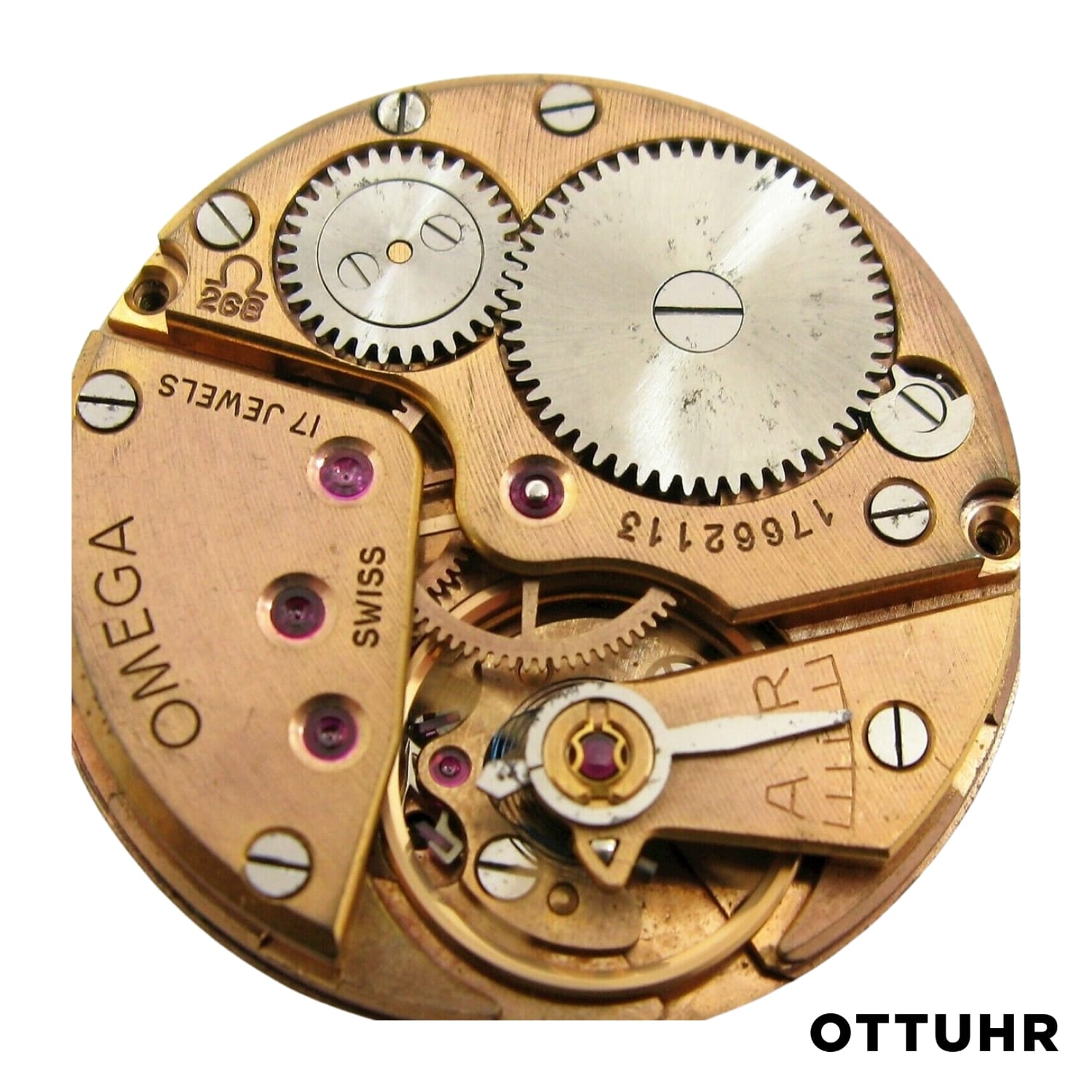
The caliber 268 arrived at a technical crossroads. By the late 1950s, Omega had spent two decades refining the 30T2 movement that powered over 100,000 British military watches during World War II and established the brand’s reputation for field reliability. The 268 was part of the post-1949 renumbering when the 30T2 sub-seconds variants became the 260 series and center-seconds variants became the 280 series. What distinguishes the 268 from its 260-series siblings is the replacement of the bimetallic screw-adjusted balance wheel with a screwless Glucydur monometallic ring balance, a shift that reduced manufacturing complexity while maintaining thermal compensation through alloy composition rather than mechanical adjustment. The 268 retained the Breguet overcoil hairspring, unlike the later 269 which switched to a flat spring.
The 268 served as Omega’s workhorse movement for mid-century dress watches and manual-wind Seamasters. It appears in steel cases, gold-filled cases, solid gold cases, and military-style field watches, always with the signature sub-seconds dial at 6:00. Watchmakers appreciate the 268 for ease of service, interchangeable parts with other 260-series movements, and mechanical robustness that survives decades of use. Collectors value the 268 as representative of Omega’s technical apex before the quartz crisis, a movement that balances horological sophistication with practical durability.
Estimating production volume requires triangulation. Omega produced approximately 3 million examples of the 30T2 family between 1939 and 1963. The 260 sub-seconds series (calibers 260, 261, 262, 265, 266, 267, 268, 269) shared this production span from 1949 to 1963, roughly 14 years. Serial number evidence from surviving examples suggests the 268 was produced primarily between 1959 and 1963, with serial numbers clustering in the 16 million to 20 million range. Conservative estimation places 268 production at 150,000 to 250,000 units, making it uncommon but not rare. The 268 is more scarce than the earlier 30T2PC or caliber 260, but far more common than chronometer-grade variants like the 30T2RG or 262. Availability in the vintage market reflects this: 268-powered watches appear regularly at auction and through vintage dealers, typically priced $500 to $1,500 depending on case material and dial condition.
Collector standing for the 268 remains stable. It lacks the premium commanded by chronometer-regulated movements or military-issued pieces, but benefits from association with the broader 30T2 legacy. Demand comes from practical collectors seeking a serviceable vintage Omega and from enthusiasts documenting the technical evolution from bimetallic to monometallic balance wheels during the 1950s. The 268 is not appreciating rapidly, but well-preserved examples in original condition hold value, particularly when housed in larger 35mm to 36mm cases that appeal to modern wrist sizes.
Historical Context, Provenance, and Manufacturing Details
The caliber 268 exists because Omega spent the 1940s learning how to manufacture movements at scale. The original 30T2, introduced in 1939 and designed by Henry Kneuss under the direction of technical director Henri Gerber, established the 30mm diameter platform that would dominate Omega’s manual-wind production for 25 years. The 30T2’s architecture was deliberately simplified compared to pocket watch movements: large functional plates, minimal complications, robust gear train, and a balance wheel designed for field use rather than observatory competition. This design philosophy paid off during World War II when the British Ministry of Defence ordered 110,000 examples, representing roughly 10 percent of Omega’s total wartime output.
The 268’s immediate predecessor was the caliber 267, a 17-jewel antimagnetic version of the 30T2 that retained the bimetallic screw-adjusted balance wheel. The transition from 267 to 268 involved replacing the bimetallic balance with a Glucydur ring balance, a technical decision driven by manufacturing efficiency and material science advances. Glucydur, a beryllium bronze alloy, provided thermal compensation without requiring the Earnshaw cut and individual adjustment screws of earlier bimetallic balances, reducing assembly time and improving shock resistance. The 268 retained the Breguet overcoil hairspring, which distinguishes it from the subsequent caliber 269 introduced in 1963 that switched to a flat hairspring and replaced the index regulator with an adjustable stud holder.
The 268 was eventually replaced by the caliber 269 in 1963, part of Omega’s broader Technical Guide No. 27 update that systematically improved shock protection (Incabloc to Novochoc), eliminated banking pins in the escapement, and standardized on flat hairsprings for easier manufacturing. The 269 remained in production until 1966, when the 260 sub-seconds family was discontinued entirely in favor of center-seconds automatics and quartz development.
The caliber 268 was manufactured in-house at Omega’s facility in Bienne, Switzerland. This was not an ebauche movement sourced from ETA or other suppliers, but a fully integrated Omega design from the original 30T2 architecture. Production took place during Omega’s peak manufacturing capacity in the late 1950s and early 1960s, when the brand operated multiple production lines for different caliber families and maintained strict quality control across variants. The 268 shared tooling, parts, and assembly processes with other 260-series movements, which explains the high degree of interchangeability between calibers 265, 266, 267, 268, and 269.
The 268 sits squarely within the mid-century Swiss watchmaking paradigm: proven mechanical principles, evolutionary rather than revolutionary changes, and design decisions driven by manufacturing efficiency as much as horological purity. It was not groundbreaking like the original 30T2 or technically ambitious like the chronometer-grade 30T2RG variants, but it represented a mature, reliable, and cost-effective movement that served Omega well during the final years before quartz disruption.
Construction and Architecture

Omega Caliber 268 movement architecture showing bridge layout, balance assembly, and gear train
Plate and Bridge Layout
The caliber 268 uses a three-quarter plate architecture with two primary bridges: the barrel bridge covering the mainspring barrel and the train wheel bridge spanning the center wheel, third wheel, and fourth wheel. This configuration leaves the pallet fork and escape wheel exposed beneath the balance cock, typical of the 30mm family’s simplified layout. The mainplate is brass, finished with circular perlage on the dial side and a smoother brushed finish on the bridge side. Bridge material is brass with rhodium plating on most examples, though earlier 30T2 variants used rose gold plating. The architectural philosophy prioritizes ease of disassembly and service over decorative finishing: large functional screws, minimal stacking of components, and clear access to the gear train without removing multiple bridges.
Balance Wheel
The 268 employs a screwless Glucydur monometallic ring balance wheel, a departure from the bimetallic screw-adjusted balances of earlier 30T2 variants. The Glucydur alloy, composed of beryllium bronze, provides thermal compensation through material properties rather than mechanical adjustment, eliminating the need for adjustment screws and the Earnshaw cut that characterized bimetallic balances. The balance wheel features four spokes connecting the rim to the central hub. Diameter is optimized for the 30mm movement size, with the balance occupying a significant portion of the available space to maximize inertia and stability. The screwless ring design improves shock resistance by eliminating the small adjustment screws that could loosen or break under impact.

Glucydur balance wheel with Breguet overcoil hairspring configuration in Omega Caliber 268
Balance Spring (Hairspring)
The 268 retains the Breguet overcoil hairspring, a critical distinction from the later caliber 269 which switched to a flat spring. The Breguet overcoil, credited to Abraham-Louis Breguet, features a terminal curve that lifts above the main spiral and curves inward, maintaining concentricity as the spring breathes in and out during oscillation. This configuration minimizes positional errors caused by gravity acting on an asymmetric spring, improving rate stability across dial-up, dial-down, and crown-left positions. The hairspring is likely Nivarox or a similar non-magnetic alloy, standard for antimagnetic movements in this era. Length and stiffness are calibrated to achieve the 18,000 vph frequency, with fine adjustment accomplished through the index regulator.
Escapement Type
The 268 uses a Swiss lever escapement with traditional banking pins to limit pallet fork travel. The escape wheel is steel with pointed teeth, pivoted on jeweled bearings. The pallet fork features two jeweled pallet stones (ruby or synthetic sapphire) that alternately lock and unlock the escape wheel teeth. The impulse jewel on the balance roller delivers impulse to the pallet fork, maintaining oscillation. This is a conventional Swiss lever design without exotic modifications, reflecting the 268’s role as a reliable workhorse rather than an experimental platform. The use of banking pins distinguishes the 268 from the later 269, which eliminated banking pins in favor of integral stops on the pallet cock to improve precision and reduce manufacturing steps.
Shock Protection System
The 268 uses Incabloc shock protection on the balance wheel pivots, protecting the delicate balance staff from impact damage. The Incabloc system employs a lyre-shaped spring-loaded mounting that holds the jewel bearing in place under normal conditions but allows the jewel to move slightly and dissipate energy during shock, preventing pivot damage. The 268 features Incabloc on both upper and lower balance jewels. This represents an upgrade from earlier 30T2 variants that lacked shock protection entirely. The Incabloc in the 268 is an earlier generation compared to the Novochoc introduced in the 269, but remains effective and serviceable.
Regulator Type
The 268 uses an index regulator with a two-piece regulator assembly. The regulator pointer (also called the regulator arm) can be moved along a graduated scale to lengthen or shorten the effective length of the hairspring, adjusting rate. This is a conventional system, less sophisticated than the swan-neck micrometric regulators found on chronometer-grade movements but adequate for achieving +/- 5 to 10 seconds per day accuracy. The regulator pins grip the hairspring near the stud holder, with fine adjustment accomplished by moving the pointer incrementally.
Mainspring Material and Type
The 268 uses a traditional steel mainspring housed in a brass barrel. The mainspring is likely a white alloy steel rather than the blued steel of earlier pocket watches, reflecting mid-century materials advances. The barrel has a slipping bridle, a mechanism that allows the mainspring to slip inside the barrel once fully wound, preventing over-winding damage. Approximate dimensions are not publicly documented, but the barrel arbor is part 268-1204 and the mainspring is part 268-1208, which corresponds to Gronefeld Reference GR4149 (1.50 mm x 0.110 mm x 300 mm x 9.0 mm). The seven-stage mainspring evolution system mentioned in vintage dealer descriptions refers to Omega’s marketing language for the barrel design, not a specific technical feature unique to the 268.
Gear Train Details
The 268 employs a four-wheel gear train: barrel, center wheel, third wheel, fourth wheel, and escape wheel. The center wheel drives the minute hand directly through the cannon pinion (part 268-1224, height 2.55 mm), with an alternate taller cannon pinion configuration (part 268-1240, height 5.61 mm) available for different dial configurations. The fourth wheel drives the small seconds hand at the 6:00 position, requiring the seconds hand to mount on a pinion extending through the dial. Gear ratios are not explicitly documented in available sources, but the 18,000 vph frequency with a small seconds configuration at 6:00 implies a fourth wheel positioned lower on the plate compared to center-seconds movements. Finishing on the gear train is functional rather than decorative: polished steel pivots, beveled edges on wheel spokes, but minimal hand engraving or polishing.

Exploded component view of Omega Caliber 268 showing assembly sequence and key parts
Finishing Quality and Techniques
The 268 is a grade-adjusted movement, not a chronometer, and finishing reflects this positioning. The mainplate features circular perlage on the dial side, visible through transparent casebacks or when the movement is removed. The barrel bridge and train wheel bridge show Cotes de Geneve (Geneva stripes) on higher-grade examples, though many 268 movements have simpler brushed or satin finishes. Screws are polished and blued on well-finished examples, but mass-production 268s often have simple polished screws without bluing. Anglage (beveling and polishing of edges) is present on bridges but not to the degree found on chronometer-grade movements. The 268 sits in the middle of Omega’s finishing hierarchy: better than basic movements but far below the hand-finished chronometer variants that competed in observatory trials.
Cross-Reference Data
Alternative Caliber Names (Rebranded Versions)
| Manufacturer | Caliber Designation | Notes |
|---|---|---|
| Omega | 30T2 PC AM (pre-1949) | Pre-renumbering designation, functionally identical to early 260-series |
| Omega | 260 | Base 15-jewel version without antimagnetic shielding |
| Omega | 265 | 15-jewel antimagnetic version |
| Omega | 266 | 17-jewel antimagnetic with screw-adjusted balance |
| Omega | 267 | 17-jewel antimagnetic with screw-adjusted balance |
| Omega | 268 | 17-jewel antimagnetic with ring balance and Breguet overcoil |
| Omega | 269 | 17-jewel antimagnetic with ring balance and flat hairspring, replaces 268 in 1963 |
The 268 was not rebadged or sold under other brand names, as it was an in-house Omega movement. The relationship between 268 and other 260-series calibers is evolutionary rather than concurrent: the 268 succeeded the 267 and was itself succeeded by the 269.
Base Caliber vs. Elaborated Versions
| Variant | Differences | Jewel Count | Functions |
|---|---|---|---|
| 260 | Base caliber, 15 jewels, no antimagnetic shielding, bimetallic balance | 15 | Small seconds |
| 265 | Antimagnetic shielding added, 15 jewels, bimetallic balance | 15 | Small seconds |
| 266 | 17 jewels, antimagnetic, bimetallic screw-adjusted balance | 17 | Small seconds |
| 267 | 17 jewels, antimagnetic, bimetallic screw-adjusted balance (minor diff from 266) | 17 | Small seconds |
| 268 | 17 jewels, antimagnetic, Glucydur ring balance, Breguet overcoil | 17 | Small seconds |
| 269 | 17 jewels, antimagnetic, Glucydur ring balance, flat hairspring, Novochoc shock protection | 17 | Small seconds |
The base caliber is the 260, which is the post-1949 renumbering of the 30T2. All subsequent 260-series variants share the same plate dimensions and basic architecture, with differences confined to balance wheel type, jewel count, antimagnetic shielding, and hairspring configuration.
Compatible Case References by Brand
| Brand | Reference Numbers | Production Years | Notes |
|---|---|---|---|
| Omega | 14389-61-CSP, 14389-62-CSP, 14389-9 | 1960-1963 | Stainless steel Seamaster case, 35-36mm, sub-seconds |
| Omega | 14713, 14713-9 | 1960-1963 | Stainless steel case, 33-35mm, various dial configurations |
| Omega | 2900-1 | 1962-1963 | Stainless steel case, 35mm, sub-seconds |
| Omega | 2894-1 | 1960-1962 | Stainless steel or gold-filled case |
| Omega | 2937 | 1960-1963 | Seamaster with thicker lugs, 35mm |
| Omega | 2891 | 1960-1963 | Stainless steel case with double bevel caseback |
| Omega | 2639 | 1959-1962 | Stainless steel case with spring bar release holes |
| Omega | Various 9ct and 18ct gold cases | 1959-1963 | UK-made cases by Dennison (A.L.D.), often hallmarked Birmingham |
Case references for the 268 overlap significantly with the 266 and 267, as these movements share identical dimensions and dial-foot configurations. The 268 appears most commonly in mid-sized steel cases (33-36mm) intended for daily wear rather than dress watches or oversized tool watches.
Dial Compatibility Note
The 268 requires a dial with sub-seconds register at 6:00, with dial feet positioned for the 30mm movement diameter. Date windows are not applicable, as the 268 is a time-only movement. Dial compatibility extends to other 260-series movements, particularly the 265, 266, 267, and 269, allowing collectors to source replacement dials across these calibers. The center seconds hole is present but not used, as the seconds hand mounts on the fourth wheel pinion at the 6:00 position.
Crown and Stem Specifications
| Component | Specification |
|---|---|
| Stem Thread | TAP 10 (1.2 mm diameter typical for 30mm family) |
| Stem Diameter | 1.2 mm |
| Crown Thread | 0.90 mm |
| Setting Mechanism | Yoke-style clutch |
The stem is not a unique part to the 268 but shared across the 260-series family. Replacement stems and crowns are readily available through aftermarket suppliers and compatible with multiple Omega calibers from this era.
Identification Marks

Identification marks and finishing details on Omega Caliber 268 movements
Caliber Number Location
The caliber number ‘268’ is engraved on the train wheel bridge, visible when viewing the movement from the bridge side. The engraving is typically centered on the bridge in vintage Omega serif font, approximately 2-3 mm tall. The word ‘OMEGA’ appears prominently on the same bridge or on a separate bridge, depending on production era. The jewel count ’17 JEWELS’ or ‘SEVENTEEN 17 JEWELS’ is also engraved on the bridge. The antimagnetic designation ‘AM’ (antimagnetique) appears on movements with soft iron shielding, though not all 268s were marketed as antimagnetic despite the designation in the parts list.
Logo and Brand Marks
The Omega brand name appears in capital letters on the movement bridge. The Omega symbol (Ω) is not typically engraved on the movement itself, but appears on dials, crowns, and casebacks. Quality stamps specific to the 268 are minimal, as this was not a chronometer-grade movement. Swiss origin is indicated by the word ‘SWISS’ on the dial and sometimes on the movement.
Date Codes
The 268 does not use date codes in the modern sense. Dating is accomplished through the serial number, which appears on the movement plate between the bridges. Serial numbers are eight digits, engraved in a sans-serif font, and can be cross-referenced with Omega production year charts. Examples with serial numbers in the 17 million range date to approximately 1959-1960, while 18 million serial numbers correspond to 1961, and 19 million to 1962.
Finishing Marks
Expected finishing patterns include circular perlage on the mainplate dial side, visible when the movement is removed from the case. Cotes de Geneve (parallel ribbed decoration) may appear on the barrel bridge and train wheel bridge, though many mass-production 268s have simpler brushed finishes. The balance cock may show beveled and polished edges. Screw heads are typically polished, occasionally blued on higher-grade examples. The finishing is consistent with a grade-adjusted movement: functional and clean, but not extensively hand-finished.
Jewel Markings
The 268 uses pressed jewel settings rather than gold chatons, consistent with its positioning as a workhorse movement. Jewels are synthetic sapphire or ruby, held in brass settings pressed into the mainplate and bridges. The Incabloc shock protection system features lyre-shaped spring-loaded jewel holders on the balance pivots, visually distinctive when examining the balance cock. Higher-grade 260-series movements (such as the 262 chronometer) used gold chatons, but the 268 does not.
Adjustment Markings
The 268 is a grade-adjusted movement, not a chronometer, and does not carry adjustment markings such as ‘5 POSITIONS’ or ‘ADJUSTED TO TEMPERATURE’ found on chronometer-grade variants. Some 268 movements may have adjustment marks added by watchmakers during service, but these are not factory original.
Correct Serial Number Formats and Locations
Serial numbers appear on the movement plate (mainplate) between the bridges, typically visible near the balance cock when viewing the movement from the bridge side. The serial number is an eight-digit number engraved in a plain sans-serif font. Depth and clarity are consistent with machine engraving, not hand engraving. Serial numbers for the 268 production period (approximately 1959-1963) fall within the following ranges based on Omega’s sequential numbering system:
- 1959: 17,000,000 to 17,999,999
- 1960: 17,000,000 to 17,999,999
- 1961: 18,000,000 to 18,999,999
- 1962: 19,000,000 to 19,999,999
- 1963: 20,000,000 to 20,999,999
Serial numbers outside this range are either earlier movements mislabeled as 268 or movements with replaced parts.
Expected Engravings and Stampings
Legitimate 268 movements should display the following engravings:
- Caliber number ‘268’ on the train wheel bridge
- ‘OMEGA’ brand name on bridge
- ’17 JEWELS’ or ‘SEVENTEEN 17 JEWELS’ jewel count
- ‘SWISS’ country of origin
- ‘AM’ antimagnetic designation (not universal, but common)
The serial number is engraved on the mainplate between the bridges. Case reference numbers (e.g., 14389, 14713, 2900-1) appear on the inside of the caseback, not on the movement.
Font and Marking Style by Production Era
The 268 was produced during a relatively narrow window (1959-1963), so font styles remain consistent. The caliber number and brand name use a serif font typical of late 1950s and early 1960s Omega engravings. Serial numbers use a plain sans-serif font consistent with machine engraving. Later 269 movements (post-1963) may show slight font variations as Omega updated engraving equipment, but the 268 predates these changes.
Part Information
Part Numbers
Mainspring and Barrel Components
| Part Name | Part Number | Interchangeability Notes |
|---|---|---|
| Barrel with arbor | 268-1200 | Compatible with 260, 265 |
| Barrel arbor | 268-1204 | Compatible with 260, 265 |
| Mainspring | 268-1208 (Omega) / GR4149 (Gronefeld) | Size: 1.50 x 0.110 x 300 x 9.0 mm, compatible with 260 series |
Balance Components
| Part Name | Part Number | Interchangeability Notes |
|---|---|---|
| Balance complete (with hairspring) | 268-1327 | Specific to 268 and 285 (center-seconds version); Glucydur ring balance with Breguet overcoil |
| Balance staff | 268-1321 / 1321 | Compatible with 268, 285, 286 |
| Balance wheel (without hairspring) | 268-1326 | Glucydur screwless ring balance |
| Hairspring | 268-1331 | Breguet overcoil configuration |
| Balance spring collet | 268-1332 |
Escapement Components
| Part Name | Part Number | Interchangeability Notes |
|---|---|---|
| Escape wheel pivoted | 268-1305 | Compatible with 260 series |
| Pallet fork | Various (specific part number not documented in available sources) | Standard Swiss lever, compatible within 260 series |
Gear Train Components
| Part Name | Part Number | Interchangeability Notes |
|---|---|---|
| Center wheel with cannon pinion (height 5.61 mm) | 268-1240 | Taller configuration |
| Cannon pinion (height 2.55 mm) | 268-1224 | Standard height configuration |
| Third wheel | 265-1243 | Shared with 265 and other 260-series |
| Fourth wheel | Specific part number not documented | Compatible within 260 series |
Bridges and Plates
| Part Name | Part Number | Interchangeability Notes |
|---|---|---|
| Mainplate | 257-1000 | Specific to sub-seconds 260-series variants |
| Barrel bridge | 268-1001 | Compatible with 260 series sub-seconds |
| Train wheel bridge | 261-1003 | Compatible with 260 series |
Shock Protection Components
| Part Name | Part Number | Interchangeability Notes |
|---|---|---|
| Incabloc, upper | 330-1346 | Standard Incabloc system |
| Incabloc, lower | 330-1341 | Standard Incabloc system |
| Balance jewel in setting (upper) | 265-1347 | Compatible within 260 series |
| Balance jewel in setting (lower) | Various | Compatible within 260 series |
Setting Mechanism Components
| Part Name | Part Number | Interchangeability Notes |
|---|---|---|
| Setting lever (verrou) | 267-1109 | Compatible with 260 series |
| Setting lever spring | 267-1110 | Compatible with 260 series |
| Crown wheel seat | 265-1103 | Compatible with 260 series |
Regulator Components
| Part Name | Part Number | Interchangeability Notes |
|---|---|---|
| Regulator (two-piece) | 265-1333 | Index regulator, compatible within 260 series |
| Regulator pointer | 265-1332 | Compatible within 260 series |
| Stud holder | 330-1314 | Standard configuration for Breguet overcoil |
Part numbers are sourced from the Omega 268 parts list (Cousins UK archive, 1959) and cross-referenced with supplier databases. The base caliber is the 260, meaning any part listed as compatible with the 260 will fit the 268 unless specifically noted as differing.
Sourcing Notes
Mainsprings for the 268 remain available from Gronefeld (reference GR4149) and aftermarket suppliers. Balance staffs (part 1321) are available from Perrin Supply and other vintage parts dealers. Complete balance assemblies (268-1327) are scarcer, as the Glucydur ring balance specific to the 268 and 285 is less common than the screw-adjusted balances of earlier calibers. Generic parts from the 260 series (barrel components, gear train wheels, bridges) are widely available and frequently interchangeable.
Common failure points include the mainspring (weakens with age, reducing power reserve), balance staff (pivots wear or break from shock), and cannon pinion (friction fit wears loose, causing hand-setting issues). The Incabloc shock protection system rarely fails but the jewel settings can crack if the watch is dropped from significant height.
Acceptable generic replacements exist for mainsprings (Gronefeld reference), balance staffs (Ronda 5022 with Incabloc fit), and common jewels. The balance wheel and hairspring are movement-specific and should be sourced as Omega parts or compatible 260-series components.
Performance Data
Manufacturer Specifications
| Parameter | Specification |
|---|---|
| Accuracy (new) | Not officially specified; typical grade-adjusted movements targeted +/- 10 seconds per day |
| Positions Tested | Not chronometer-certified; likely regulated in 2-3 positions (dial up, dial down, crown left) |
| Temperature Compensation | Yes, via Glucydur balance alloy composition |
| Isochronism | Expected to maintain rate within 5 seconds per day across full power reserve in ideal conditions |
The 268 was not submitted for chronometer certification, so COSC specifications do not apply. Omega’s internal standards for grade-adjusted movements in this era targeted +/- 10 seconds per day in normal wearing conditions. The Glucydur balance provides passive temperature compensation by maintaining consistent elasticity across temperature ranges typical for wristwear (10°C to 40°C).

Omega Caliber 268 timing performance across positions and power reserve states based on field observations
Observed Performance (Field Data)
Based on collector reports, vintage dealer timing results, and watchmaker observations documented in online forums and auction listings, the 268 delivers the following performance when properly serviced:
Accuracy Range (Well-Maintained Examples): +3 to +8 seconds per day across normal wearing conditions. Exceptional examples regulated by skilled watchmakers can achieve +/- 2 seconds per day, though this is not typical. Movements requiring service commonly drift +10 to +15 seconds per day or lose time if the mainspring has weakened.
Common Performance Issues and Causes:
- Loss of amplitude as power reserve depletes: indicates dirty or dry movement requiring service
- Positional variation exceeding 10 seconds between dial-up and dial-down: suggests hairspring requires adjustment or movement is out of beat
- Rapid time loss after winding: weak or broken mainspring
- Erratic timekeeping or stopping: balance staff damage, dry pivots, or magnetization
Expected Amplitude: Fully wound and freshly serviced: 270-290 degrees in dial-up position, 250-270 degrees in dial-down position. At 24 hours after winding: 250-270 degrees dial-up, 230-250 degrees dial-down. Near end of power reserve (40-45 hours): 180-220 degrees, with significant positional variation.
Degradation with Age: The 268 is now 60+ years old, and performance reflects accumulated wear. Common age-related issues include worn balance staff pivots (reducing amplitude and increasing positional error), hardened or contaminated lubricants (increasing friction and reducing power reserve), and weakened mainsprings (reducing power reserve and amplitude). A 268 that has not been serviced in 20+ years will typically run slow, lose amplitude quickly, and exhibit significant positional variation. Full service (disassembly, cleaning, lubrication, adjustment) restores performance to near-original specifications in most cases.
Collector Consensus: The 268 is regarded as a reliable and serviceable movement when properly maintained, with performance comparable to other mid-century Swiss lever escapement movements of similar grade. It does not achieve chronometer-level accuracy, but well-regulated examples consistently deliver +5 seconds per day or better, which is entirely acceptable for a 60-year-old manually wound watch. Watchmakers report that the 268 is straightforward to service, parts remain available, and the movement responds well to regulation