

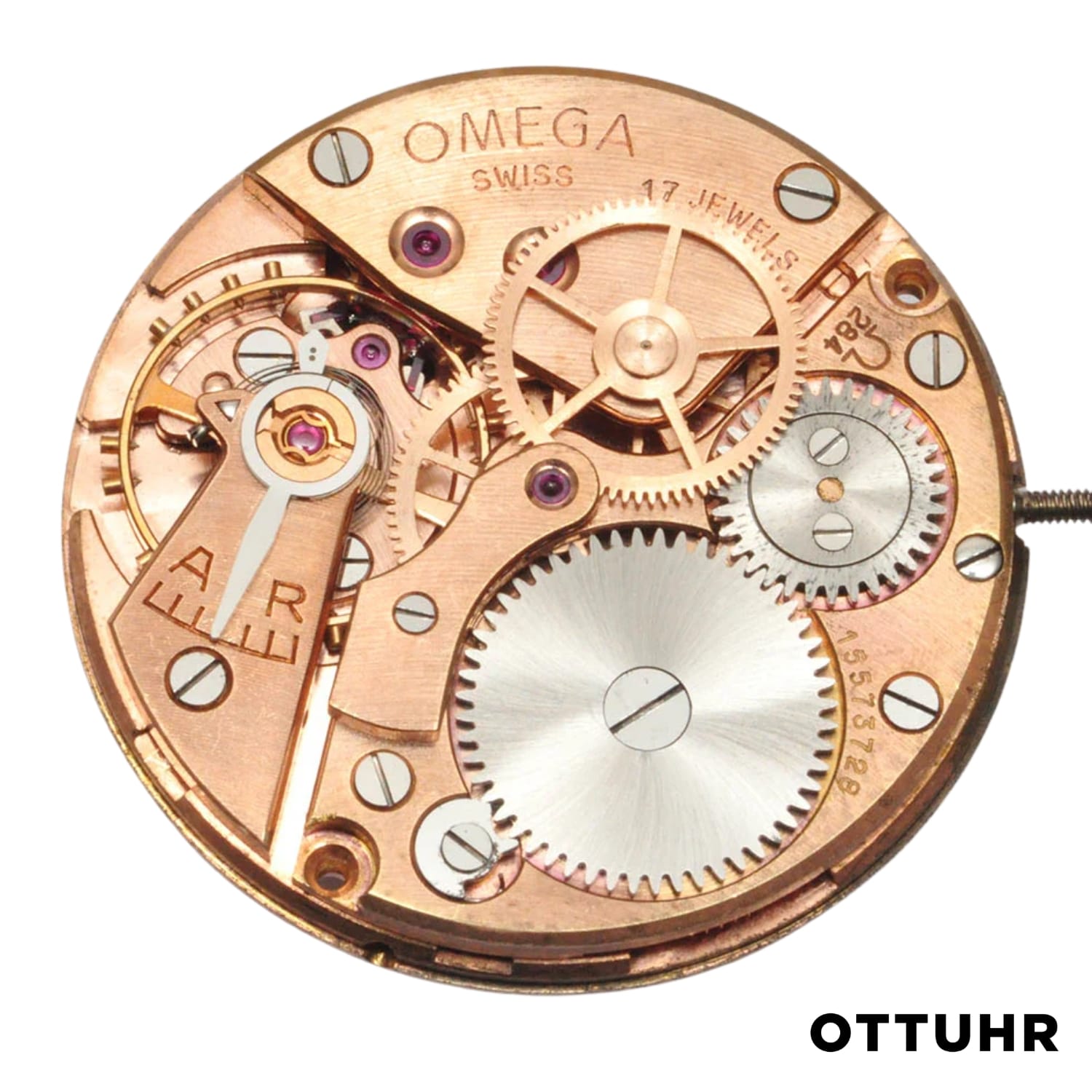
The Omega caliber 284 represents the renamed and refined successor to the legendary 30T2 movement family, one of the most successful manual-wind calibers in horological history. When Omega rationalized its movement nomenclature in 1949, the 30T2 sub-seconds configuration became the 260 series, while center-seconds versions became the 280 series. The 284 designation specifically identifies 30T2 derivatives produced from 1957 onward, most famously used in the first Omega Railmaster CK2914-1 and early Seamaster references. This caliber powered Omega’s precision chronometer movements that dominated observatory trials throughout the 1940s and 1950s, including the famous Kew Observatory victory in 1946 where an Omega 30T2-based movement achieved the highest precision rating and beat submissions from Patek Philippe and even Omega’s own tourbillon.
The 284 served as Omega’s premium manual-wind dress watch and tool watch caliber during the critical 1957-1963 period, bridging the gap between the original 30T2 designation and Omega’s eventual transition toward automatic movements. The movement’s 30.5mm diameter allowed for an optimally sized balance wheel and mainspring barrel, maximizing timekeeping stability and power reserve within a case size suitable for 34-36mm dress watches. Watchmakers praise the 284 for its logical layout, serviceability, and robust construction that continues to deliver reliable performance more than 60 years after production. The caliber’s reputation among collectors stems from its association with iconic references like the Railmaster, its proven accuracy, and its role in establishing Omega’s chronometer credentials during the golden age of mechanical watchmaking.
Production estimates for the entire 30T2 family (which includes the 284 and its siblings 265, 266, 267, 268, 269, 283, 285, and 286) total approximately 3 million units manufactured between 1939 and 1963. The specific 284 caliber, produced only from 1957 to approximately 1958 before being replaced by caliber 285, represents a small fraction of this total, likely 150,000 to 250,000 movements based on serial number ranges and known case reference production. This relatively short two-year production window makes the 284 uncommon compared to its longer-lived siblings. Factors contributing to the caliber’s collectibility include its use in the first-generation Railmaster antimagnetic watches, early Seamaster references, and premium dress watches in gold cases. The movement’s association with Omega’s observatory trial successes and its status as one of the final iterations of the 30T2 lineage before the 286 ended production in 1963 adds historical significance.
Collector demand for caliber 284 movements remains stable to rising, particularly in association with desirable case references like the Railmaster CK2914-1, early Seamaster references, and premium 18K gold dress watches. Standard 284 movements in common dress watch references trade at moderate premiums, typically ranging from £800 to £2,500 depending on case material and condition. Railmaster examples with caliber 284 command significant premiums, often reaching £5,000 to £15,000 for first-execution broad-arrow dial variants in excellent condition. Premium gold dress watch examples with original unrestored dials can achieve £3,000 to £4,500. The market shows strong preference for complete examples with functioning movements, original dials, and correct case-movement combinations, as the 284’s relatively short production window means fewer surviving examples compared to longer-lived calibers like the 285 and 286.
Historical Context, Provenance, and Manufacturing Details
The caliber 284 emerged as part of Omega’s 1949 movement nomenclature rationalization, which assigned three-digit caliber numbers to replace the alphanumeric 30T2 system that had served since 1939. The original 30T2 was developed by Henri Gerber’s assistant technical director, Henry Kneuss, and introduced in December 1938 as Omega’s response to market demands for a robust, accurate, and serviceable 30mm movement suitable for military contracts and civilian dress watches. The 30T2 achieved immediate success, securing a massive 110,000-unit contract from the British Ministry of Defence during World War II, representing approximately 10% of Omega’s total wartime production. This military pedigree established the 30T2’s reputation for reliability and accuracy under demanding conditions.
The development rationale for the 30T2 family, and by extension the 284, centered on creating a movement large enough to accommodate an optimally sized balance wheel and mainspring while remaining compact enough for 33-35mm wristwatches. The 30mm diameter represented the sweet spot where gear train efficiency, balance wheel inertia, and case proportions balanced optimally. Omega’s engineers prioritized simplicity in the design philosophy, using separate bridges for the barrel, train, and balance rather than complex three-quarter plates, which improved serviceability and manufacturing consistency. This logical architecture made the movement a favorite among watchmakers, as any component could be accessed and serviced without complete disassembly.
The 284 directly succeeded the original 30T2 sub-seconds configuration (renamed caliber 260, 265, 266, 267, 268, 269, and 283 depending on variations) and served alongside its siblings 285 and 286 until the entire 30mm family ceased production in 1963. The 284 was produced from 1957 to approximately 1958, when Omega transitioned to caliber 285 with minor improvements. The 285 continued from 1958 to 1961, followed by caliber 286 from 1961 to 1963. All three calibers (284, 285, 286) are functionally interchangeable with only minor parts differences, and watchmakers regularly substitute components between these movements during service. The successor to the entire 30T2 family came in the form of full-rotor automatic calibers like the 470, 471, 501, 550, and 560 series, which gradually replaced manual-wind movements in Omega’s lineup throughout the 1960s.
The 284 is an entirely in-house Omega manufacture movement, designed and produced at Omega’s Biel/Bienne facilities in Switzerland. No ebauche supplier was involved, and all components from plates to jewels were manufactured to Omega specifications. Production took place under the continued technical direction of Henri Gerber, who served as Omega’s Technical Director from 1928 into the 1960s and oversaw the entire 30T2 lineage development. The movement earned its place in horological history through observatory trial dominance: in 1946, an Omega 30T2 chronometer won first prize at the Kew Observatory trials, followed by back-to-back victories at Geneva and Neuchâtel observatory competitions from 1947 to 1951, where it beat Patek Philippe submissions and even Omega’s own tourbillon movements. In 1936, an Omega chronometer achieved a world precision record of 97.8 points out of 100 at Kew-Teddington, a record that stood for decades. These competitive successes established Omega as the largest manufacturer of COSC-certified chronometers for more than a decade, primarily using refined 30T2-based calibers.
Construction and Architecture

Technical diagram showing caliber number and identification mark locations on the Omega 284 movement
Plate and Bridge Layout
The caliber 284 employs a traditional separate bridge construction with individual bridges for the barrel, train, and balance. The 30.5mm diameter main plate is manufactured from brass with surface finishing that varies by grade, from basic frosting on standard movements to refined perlage on higher-grade examples. The movement features a barrel bridge that spans the mainspring barrel, a train bridge covering the third and fourth wheels, and a separate balance cock for the balance assembly. The pallet fork has its own dedicated bridge. This separate bridge philosophy, rather than three-quarter plate construction, reflects Omega’s commitment to serviceability and manufacturing efficiency. Watchmakers can access any wheel, pivot, or jewel by removing a single bridge without disturbing other components, making the 284 exceptionally logical to service.

Exploded parts diagram showing Omega 284 component relationships and assembly sequence
Balance Wheel
The 284 utilizes a screw-balance wheel with a diameter of approximately 10-11mm, featuring multiple timing screws around its rim for fine rate adjustment. The balance is constructed from beryllium bronze alloy, providing optimal thermal compensation characteristics and resistance to corrosion. The number of timing screws varies by production period and grade, typically ranging from 8 to 12 screws depending on the specific variant. Rate adjustment is accomplished by moving pairs of opposing screws radially inward (to increase rate) or outward (to decrease rate), changing the balance’s moment of inertia. The balance pivots are protected by Incabloc shock protection at both the upper and lower jewels.
Balance Spring (Hairspring)
The movement employs a Nivarox alloy hairspring, providing antimagnetic properties and improved temperature stability compared to earlier blued steel springs used in early 30T2 production. Standard 284 movements feature flat hairsprings with simple terminal curves, while higher-grade chronometer variants may incorporate Breguet overcoils for superior isochronism. The hairspring typically measures 11-12 coils in length. The outer terminal attaches to a stud mounted in the balance cock, with an index regulator (regulator curb pins) that can be moved along the hairspring’s length to adjust the effective active length and thereby modify the rate.

Detailed technical diagram of Omega 284 balance wheel, hairspring, escapement, and Incabloc shock protection
Escapement Type
The 284 features a Swiss lever escapement with a club-tooth escape wheel containing 15 teeth. The escape wheel is manufactured from polished steel and rotates at one revolution per minute, providing the characteristic tick-tick sound at 18,000 vibrations per hour (5 ticks per second). The pallet fork employs two synthetic ruby pallet stones (entrance and exit pallets) that engage with the escape wheel teeth through a sliding contact characteristic of Swiss lever designs. The impulse jewel, mounted on the balance roller table, engages with the pallet fork notch to receive impulses during each balance oscillation. This is a detached escapement, meaning the balance wheel operates freely through most of its rotation, only receiving impulses at specific points in its cycle. The lift angle of 49 degrees is within the standard range for Swiss lever escapements of this era and critical for proper timing machine analysis.
Shock Protection System
The caliber incorporates Incabloc shock protection at the balance wheel pivots, protecting both the upper and lower balance jewels. The Incabloc system uses a lyre-shaped spring that supports a conical jewel setting containing the hole jewel and cap jewel. During impact, the balance staff pivots can lift vertically within the jewel setting, compressing the spring and preventing pivot damage, then automatically re-centering when the shock force dissipates. This shock protection was standard on 284 production, representing an upgrade from very early 30T2 movements that lacked shock protection. The Incabloc brand was Omega’s preferred shock protection system throughout the 1950s and 1960s.
Regulator Type
Standard 284 movements employ an index regulator (regulator index) for rate adjustment. The regulator features a movable arm with curb pins that alter the effective length of the hairspring, marked with “+” (fast) and “-” (slow) indicators. This system provides adequate adjustment range for watches regulated in two or three positions, typical for non-chronometer grade movements. Chronometer-grade variants within the 30T2 family (designated 30T2RG, later renamed caliber 262 and 281) featured more sophisticated fine regulation devices including excenter regulators or swan-neck regulators for the precision adjustments required for five-position chronometer certification. The standard 284 index regulator, while less refined than chronometer systems, offers straightforward adjustment accessible to competent watchmakers.
Mainspring Material and Type
The mainspring is manufactured from white alloy steel, typical of 1950s-1960s production, offering improved longevity and consistent torque delivery compared to earlier carbon steel springs. Replacement mainsprings are specified as 1.70mm width, 0.120mm thickness, and 290mm length when fully extended, with a hook type 10.0 for manual-wind barrels. The mainspring employs a fixed attachment to the barrel arbor rather than a slipping bridle. The 45-hour power reserve, achieved with this mainspring specification within the 30.5mm diameter barrel, represents excellent performance for a manual-wind movement of this era.

Cross-section diagram of Omega 284 gear train showing winding mechanism and power transmission
Gear Train Details
The gear train consists of four wheels: center wheel (driven by the mainspring barrel), third wheel, fourth wheel, and escape wheel. The center wheel rotates once per hour and drives the minute hand through the cannon pinion. The sub-seconds hand is positioned at 6:00, driven indirectly through the fourth wheel arbor which rotates once per minute. This indirect seconds drive at 6:00 is the defining characteristic distinguishing the 284 from center-seconds variants in the 280 series. The gear train ratios produce the 18,000 vph (2.5 Hz) frequency through standard Swiss lever geometry, with the escape wheel receiving power from the fourth wheel via the pallet fork. All wheels are manufactured from brass with polished steel pinions.
Finishing Quality and Techniques
Finishing quality on caliber 284 movements varies from basic functional finishing on standard production to refined execution on higher-grade examples. Standard movements receive basic frosted or matte finish on the main plate with functional circular graining (perlage) that may show wider spacing and less precision. Bridges typically display nickel or rhodium plating with simple beveling (anglage) on edges, though without the mirror-bright polishing found on chronometer grades. Screw heads receive basic bluing or polishing. Ratchet wheels and crown wheels show snailed or circular graining finishes.
Higher-grade 284 movements, particularly those destined for premium gold cases or special editions, demonstrate significantly enhanced finishing. These examples feature refined circular perlage with tighter, more uniform circular patterns creating a pearl-like texture across the main plate. Bridge edges show hand-polished mirror-bright anglage with crisp corners that catch light beautifully. Some examples may display light Cotes de Geneve (Geneva stripes) on bridges, though this was less common on 284 than on later automatic calibers. Screw heads receive black polishing with perfectly centered slots. Movement plates may show gold plating or copper coloring, particularly on movements with beryllium bronze components.
The finishing level typically corresponds to the intended market and case material, with gold-cased examples receiving more attention than steel-cased versions. Chronometer-grade movements within the broader 30T2 family (though not typically designated 284) received the most refined finishing, with extensive decoration befitting their precision credentials.

Movement finishing comparison showing standard versus higher grade Omega 284 decoration
Cross-Reference Data
Alternative Caliber Names (Rebranded Versions)
Base Caliber vs. Elaborated Versions
| Variant Name | Differences | Jewel Count | Functions | Grade |
|---|---|---|---|---|
| Cal. 284 | Standard production, 1957-1958, Incabloc shock protection | 17 | Time, sub-seconds at 6:00 | Standard |
| Cal. 285 | Successor to 284, 1958-1961, minor improvements | 17 | Time, sub-seconds at 6:00 | Standard |
| Cal. 286 | Final iteration, 1961-1963, last of 30T2 family | 17 | Time, sub-seconds at 6:00 | Standard |
| Cal. 262 (30T2RG) | Chronometer grade with fine regulation, Breguet overcoil | 17 | Time, sub-seconds | Chronometer |
| Cal. 281 (30T2SCRG) | Chronometer grade, center seconds version | 17 | Time, center seconds | Chronometer |
Compatible Case References by Brand
Dial Compatibility Note
The caliber 284 features dial feet positioning at standard Omega 1950s locations, typically at approximately 12:30 and 5:30 positions. No date window is present on the base caliber, as it is a time-only movement. Sub-seconds hand position is fixed at 6:00 o’clock, driven by the fourth wheel arbor. Dial feet spacing and positioning are compatible across the 284, 285, and 286 family, allowing dial interchangeability within reason. However, collectors should note that case reference and dial style combinations are often specific to production years, and mixing dials between references can impact authenticity and value. The Railmaster specifically required dials with 1mm thickness (versus typical 0.4mm) to achieve antimagnetic protection, making standard dress watch dials incompatible with Railmaster cases.
Crown and Stem Specifications
Identification Marks
Technical diagram showing caliber number and identification mark locations on the Omega 284 movement
Caliber Number Location
The caliber designation “284” is engraved on the barrel bridge or main plate, typically visible when viewing the movement from the dial side with the balance cock in place. On some examples, the number appears on the barrel bridge itself, while others show the marking on the main plate adjacent to or beneath the bridge. The engraving style is characteristic of 1950s Omega production, with serif fonts and clear, deep engraving approximately 0.3-0.4mm in depth.
Logo and Brand Marks
The Omega logo and “OMEGA” text appear stamped or engraved on the movement bridges, most commonly on the barrel bridge or train bridge. The word “Swiss” or “Swiss Made” is engraved on the main plate, often visible beneath or near the balance cock. The jewel count marking “17 Jewels” (sometimes written as “17 Rubis” or “17p”) appears on the main plate or bridges. On movements destined for specific markets, additional markings may appear, such as the gilt star applied to Brazilian market watches signifying chronometer-grade calibers.
Date Codes
Omega did not use a standardized date code system on the 284 movements. Dating is accomplished through movement serial numbers stamped on the main plate or barrel bridge. Serial number ranges correspond to production years as follows:
These ranges overlap with the 284’s two-year production window (1957-1958), making serial number verification critical for authentication.
Finishing Marks
Expected finishing patterns vary by grade. Standard production movements show frosted or matte main plates with functional circular graining (perlage), basic beveled bridge edges without mirror polishing, and simple screw finishing. Higher-grade movements display refined perlage with tighter, more uniform circles, hand-polished mirror-bright anglage on all bridge edges, and more extensive decoration overall. Snailed finishing appears on ratchet wheels and crown wheels across all grades. Beryllium bronze balance wheels may show a characteristic copper or bronze coloring.
Movement finishing comparison showing standard versus higher grade Omega 284 decoration
Jewel Markings
The 17 jewels in the 284 consist of pressed jewel settings in the main plate and potentially chatons (raised jewel settings) on the balance and pallet pivots depending on grade. Standard grades typically use pressed jewels without gold chatons. Higher-grade examples may feature chatons on the balance wheel pivots, though this was less common on 284 than on chronometer variants like the 262 and 281. The escapement employs two ruby pallet stones and one impulse jewel. Incabloc shock protection jewels (hole jewel and cap jewel) are set in spring-mounted assemblies at the balance pivots.
Adjustment Markings
Standard 284 movements typically lack specific adjustment markings, as they were not submitted for chronometer certification. Movements intended for chronometer testing within the broader 30T2 family (designated 30T2RG, later 262 and 281) bear markings indicating adjustment positions and temperatures, typically “5 Positions” or “2 Temperatures,” along with chronometer certification stamps. The absence of such markings on a 284 is normal and expected, as this caliber was primarily used in standard production watches rather than certified chronometers.
Correct Serial Number Formats and Locations
Movement serial numbers appear stamped on the main plate, usually beneath the balance cock area or on the barrel bridge. Serial numbers are seven digits in length for 1950s production. The format is purely numeric with no prefix letters. Numbers are stamped with consistent depth and spacing, typically 1.5-2mm character height with clean, sharp edges. Examples of period-correct serial numbers for caliber 284 production include 15,567,191 (1957), 15,563,685 (1956-1957), and 15,376,123 (1957).
Expected Engravings and Stampings
Authentic 284 movements display the following engravings in characteristic 1950s Omega style:
- Caliber number (284) on barrel bridge or main plate
- OMEGA logo stamped on bridge
- Movement serial number on main plate or barrel bridge
- “Swiss” or “Swiss Made” on main plate
- “17 Jewels” or “17 Rubis” jewel count marking
- Incabloc logo on shock protection settings (typically “INCABLOC SWISS” in circular format)
All engravings should show consistent depth (approximately 0.3-0.4mm), period-appropriate serif or simplified serif fonts, and sharp edges without evidence of modern re-engraving or electric pencil marking. The Omega logo stamping should be clear and well-defined, not shallow or fuzzy as seen on counterfeit examples.
Font and Marking Style by Production Era
The 284’s two-year production window (1957-1958) shows relatively consistent font and marking styles, as this brief period did not encompass major stylistic transitions. Engravings feature serif fonts with clean, precise execution characteristic of late-1950s Omega production. The “OMEGA” logo stamping uses the company’s standard 1950s mark, with consistent depth and clarity. The transition from 284 to 285 in 1958 did not involve significant changes to engraving style, as both calibers were part of the same production lineage. Later movements in the family (285, 286) continued with similar marking styles through 1963, when the entire 30T2 family ceased production.
Part Information
Part Numbers and Interchangeability
Exploded parts diagram showing Omega 284 component relationships and assembly sequence
Sourcing Notes
Parts availability for the 284 remains relatively good compared to many vintage calibers, due to the massive 3-million-unit production of the 30T2 family and extensive cross-compatibility between variants. Generic Swiss mainsprings provide reliable replacements and are readily available from Generale Ressorts and other suppliers. Balance complete assemblies (part 721/167) can still be sourced from vintage parts dealers and cross-reference with other 30T2 family members. Balance staffs are available as both genuine Omega parts (723/103, 723/284) and generic Swiss replacements (100/137).
Commonly failing components include the mainspring (which loses temper and power reserve capacity over decades), worn pivots on the center wheel and third wheel (from years of continuous rotation), and dried lubrication throughout the movement causing increased friction and amplitude loss. The Incabloc shock protection springs and jewels occasionally require replacement after severe impacts or improper handling during service. The balance staff pivots, while protected by Incabloc, can still suffer damage if the watch experiences extreme shock or if the shock protection system itself fails.
Acceptable generic replacements exist for several components. Mainsprings from Generale Ressorts and other Swiss suppliers provide reliable substitutes with correct dimensions (1.70 x 0.120 x 290 x 10.0mm). Balance staffs can be replaced with generic Swiss staffs of correct dimensions, though DCN-numbered original parts (723/284) are preferred for authenticity. Incabloc shock protection components use standard Incabloc parts that cross-reference broadly. Barrel components cross-reference with ETA 640, indicating some standardization of parts. However, escapement components (escape wheel, pallet fork with jewels) should ideally be original or NOS Omega parts, as generic replacements may affect timekeeping performance and lift angle characteristics.
The extensive parts cross-compatibility within the 30T2 family (calibers 260 through 286) means that watchmakers can often source components from donor movements of adjacent calibers. The 284, 285, and 286 are particularly interchangeable, with one source noting that a watchmaker successfully used 285 components to repair a 284 movement. This interchangeability provides a safety net for servicing these movements, though purists prefer caliber-specific parts when available.
Performance Data
Manufacturer Specifications
Omega’s factory specifications for the caliber 284 reflect the movement’s design as a high-grade manual-wind caliber suitable for both dress watches and antimagnetic tool watches like the Railmaster:
Accuracy (new, standard grade): Standard production 284 movements were not chronometer certified, though they benefited from the same basic architecture as Omega’s chronometer-grade 30T2 variants. Well-adjusted examples from the factory likely achieved approximately +/- 15-30 seconds per day in normal wearing positions.
Accuracy (chronometer grade within 30T2 family): Chronometer-certified variants of the 30T2 (designated 30T2RG, renamed calibers 262 and 281) met COSC standards of the 1940s-1950s, typically -4/+6 seconds per day or better after adjustment in five positions and two temperatures. The 284 itself was not typically submitted for chronometer certification, though the underlying architecture was identical to certified movements.
Positions tested (standard): Standard 284 movements received basic regulation in 2-3 positions (horizontal dial up/down, vertical crown up or crown left).
Positions tested (chronometer variants): Chronometer-grade 30T2 variants were adjusted in 5 positions per COSC requirements.
Temperature compensation: The bimetallic beryllium bronze balance wheel provides passive temperature compensation across the typical wearing temperature range of 8-38°C. This alloy expands and contracts with temperature changes, automatically adjusting the balance’s moment of inertia to maintain consistent rate.
Isochronism: The flat hairspring on standard 284 movements shows typical isochronism characteristics for 1950s production, with some rate variation between full-wind and depleted power reserve states. Higher-grade examples or chronometer variants with Breguet overcoils demonstrate improved isochronism with less rate variation across the power reserve range.
Power reserve: 45 hours when fully wound, confirmed by both specifications and field observations.
Frequency: 18,000 vph (2.5 Hz, or 5 beats per second).
Lift angle: 49 degrees, critical for accurate timing machine analysis.
Observed Performance (Field Data)

Performance data visualization showing accuracy, amplitude, and service characteristics of Omega 284
Real-world performance data from collector reports, watchmaker observations, and dealer timing results provide insight into typical 284 behavior more than 60 years after production:
Accuracy range for well-maintained examples: Properly serviced 284 movements with minimal wear typically achieve +/- 10-20 seconds per day in normal wearing positions, with some exceptional examples maintaining +/- 4-8 seconds per day. One documented example achieved +4 seconds per day after professional service, verified on electronic timing equipment. This exceeds many collectors’ expectations for a 65+ year-old movement and demonstrates the 284’s inherent quality.
Common performance issues and causes:
- Loss of power reserve: The most common issue stems from weakened mainsprings that have lost temper over decades of service. Original mainsprings from the 1950s frequently provide less than 30 hours of reserve by the time movements reach the vintage market, compared to the specified 45 hours. Replacement with a modern Swiss mainspring restores full 45-hour reserve.
- Erratic timekeeping and amplitude loss: Dried lubrication, worn pivots, and contaminated components cause amplitude to drop below functional levels (typically below 200 degrees). The movement’s separate bridge construction makes cleaning and lubrication straightforward for competent watchmakers, allowing restoration of proper amplitude (240-280 degrees when fully wound).
- Magnetization: Despite the Railmaster’s antimagnetic capabilities (achieved through case construction, not movement design), standard 284 movements without additional shielding are susceptible to magnetization of steel components (escape wheel, pallet fork, hairspring if not Nivarox). Modern environments contain far more magnetic hazards than the 1950s, making demagnetization a common service requirement.
- Positional variation: Movements showing excellent accuracy in dial-up position may gain or lose significantly when worn on the wrist. This typically indicates issues with balance poise, hairspring geometry, or worn escape wheel and pallet surfaces. The screw-balance design allows watchmakers to adjust poise during service.
- Worn pivots and jewels: After 60+ years of operation, center wheel and third wheel pivots show measurable wear, as these components rotate continuously whenever the movement is running. The fourth wheel (seconds wheel) rotating once per minute also experiences significant wear over decades. Replacement of worn jewels and pivots may be necessary on heavily used examples.
Expected amplitude: A properly serviced 284 with minimal wear should achieve 260-280 degrees of amplitude when fully wound in the dial-up position. Amplitude drops to approximately 220-240 degrees as the mainspring unwinds to 50% reserve (22-23 hours), and further decreases to 200-220 degrees near the end of the 45-hour power reserve. Amplitude below 200 degrees indicates service requirements, worn components, or magnetization. Watchmakers consider 240+ degrees fully wound as excellent for a vintage movement of this age.
Performance degradation with age: The 284’s robust construction and logical architecture have proven remarkably age-resistant when properly maintained. Well-serviced examples continue to provide reliable daily wear performance more than 65 years after manufacture. However, unserviced movements often exhibit significant performance degradation after 10-15 years without maintenance. The combination of mainspring fatigue, pivot wear, dried lubricants, and accumulated contamination typically manifests as reduced amplitude, shortened power reserve, and eventually stopping.
Service interval and longevity: Watchmakers recommend complete service every 5-7 years for regularly worn examples, consistent with vintage manual-wind movements of this era. The 284’s separate bridge construction and availability of replacement parts make it one of the more serviceable vintage Omega calibers. Service costs typically range from £150-250 ($185-300) for complete overhaul including cleaning, new mainspring, lubrication, and regulation.
Collectors should expect that any 284 will require immediate service unless documentation proves recent professional maintenance. Movements that have sat idle for extended periods may require additional work beyond standard servicing if oils have solidified or components have corroded. The movement’s reputation for serviceability and parts availability make it an attractive choice for collectors seeking a wearable vintage Omega with proven durability and historical significance