

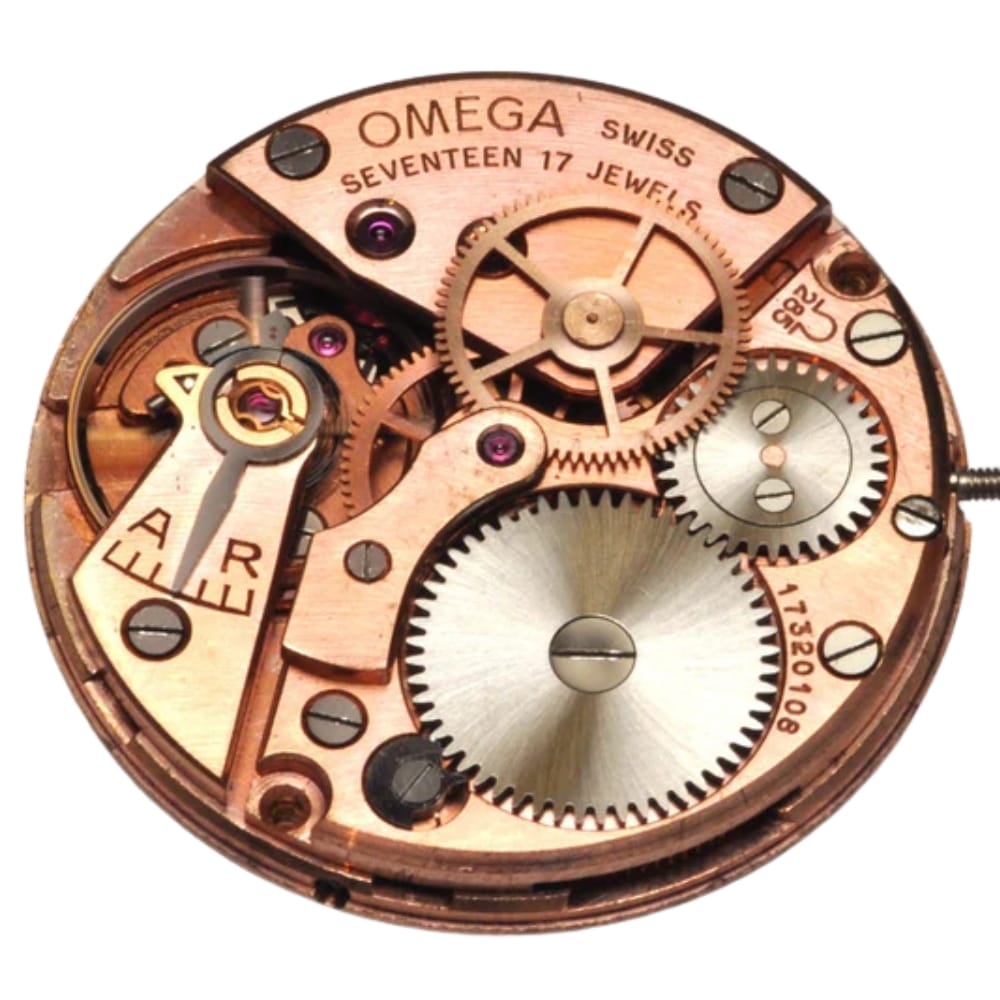
The Omega 285 represents the final chapter in one of watchmaking’s most successful movement families, the legendary 30mm series that powered Omega’s reputation from 1939 through the early 1960s. As a direct descendant of the famous 30T2, the caliber 285 carries DNA from a movement that equipped British RAF pilots during WWII, survived decades of field use, and established Omega as a manufacturer of precision timekeeping instruments. The caliber 285 was the workhorse behind Omega’s popular mid-century dress watches and early Seamaster references, delivering reliable daily timekeeping in an era when a wristwatch was still essential equipment, not a luxury accessory.
The caliber 285 is a manual-wind, center-seconds movement designed for everyday reliability rather than chronometric glory. Introduced around 1958 as part of Omega’s nomenclature shift from the 30T2 designation to the 26x and 28x series, the 285 shares its core architecture with calibers 265, 268, 284, and 286, differing primarily in jewel count, balance configuration, and finishing grade. The movement was built for serviceability, a quality watchmakers still appreciate today. Its large 30mm diameter allowed for robust gear trains and ample spacing between components, making assembly straightforward and parts replacement simple. Collectors value the 285 for its connection to Omega’s golden era and its presence in classic case designs, particularly the Seamaster 14390 series and various gold-cased dress references from 1958 to 1963.
Production estimates for the entire 30mm family, which includes the 30T2 and all subsequent 26x/28x calibers, total approximately 3 million movements manufactured between 1939 and 1963. The caliber 285 specifically represents a small subset of this total, manufactured during the final five years of the family’s production run. Based on serial number analysis from surviving examples, the 285 appears most frequently in watches with movement serial numbers ranging from 16,000,000 to 20,000,000, corresponding to production years 1958 through 1963. Within this range, the 285 would account for a fraction of total output, as Omega simultaneously produced multiple caliber variants (262, 265, 268, 269, 284, 285, 286) to serve different market segments and complications. A reasonable estimate places total caliber 285 production between 150,000 and 300,000 units over its five-year lifespan, making it relatively common among vintage Omega collectors but increasingly scarce in original, unrestored condition. The caliber should be classified as uncommon rather than rare.
The caliber 285 occupies a stable position in the vintage Omega market. It lacks the chronometer pedigree of higher-grade movements and the collector cachet of the Speedmaster’s caliber 321, but it benefits from strong association with popular case references and straightforward serviceability. Demand for 285-powered watches remains steady among collectors seeking affordable entry points into vintage Omega ownership, particularly for Seamaster references in stainless steel. Gold-cased examples with original dials command premiums, but overall market values track condition and originality rather than movement grade. The movement’s reputation for durability and parts availability supports collector confidence. Specific variants with desirable dial configurations or retailer signatures can command higher prices, but the caliber itself does not drive value the way a chronometer-grade movement would.
Historical Context, Provenance, and Manufacturing Details
The Omega caliber 285 emerged from one of the most successful movement development programs in mid-20th-century watchmaking. To understand the 285, one must first understand the 30mm family from which it descended. In 1939, Omega introduced the caliber 30, a 30mm diameter manual-wind movement that quickly established itself as a precision workhorse. The movement’s name derived from its 30-millimeter diameter, unusually large for the era and deliberately chosen to allow for robust construction and efficient gear train geometry. The 30mm architecture proved so successful that Omega developed it through multiple iterations: the 30T1 (15 jewels with Incabloc shock protection), the 30T2 (improved 15 or 17 jewel version with refined regulation), and eventually chronometer-grade variants designated 30T2RG and 30T2SCRG, which featured bimetallic balance wheels with regulation screws and excenter microregulators.
In 1949, Omega restructured its caliber nomenclature, retiring the T-series designations in favor of a numeric system that better reflected technical specifications. The 30T2 family was reorganized into the 26x and 28x series, with each variant number indicating specific features. The caliber 285 descends directly from this reorganization, representing a center-seconds variant with 17 jewels, Incabloc shock protection, and simplified regulation. It replaced earlier 30T2SC iterations while incorporating manufacturing improvements that reduced costs and enhanced parts interchangeability. The market need was clear: Omega required a reliable, serviceable movement for its growing line of dress watches and early sports models, particularly the Seamaster collection expanding in the late 1950s.
The caliber 285 succeeded the 30T2SC in Omega’s production lineup and served alongside related variants including the 262 (chronometer grade with screw balance), 265 (15-jewel small seconds), 268 (17-jewel small seconds), and 284 (17-jewel small seconds, earlier variant). The 285 was eventually succeeded by the caliber 286, introduced around 1963 as an improved version featuring Omega’s Novochoc shock protection system, an adjustable stud holder, and a flat hairspring replacing the Breguet overcoil. The 286 addressed serviceability concerns by standardizing parts and eliminating banking pins in the escapement, changes that Omega documented in Technical Guide No. 27 from 1963.
The caliber 285 represents pure Omega manufacture. Unlike later periods when Omega relied heavily on ebauche suppliers like ETA, the 30mm family was designed, manufactured, and finished in Omega’s Bienne facilities. The movement architecture reflects Omega’s design philosophy from the late 1930s and 1940s: large, robust bridges with functional finishing, simple plate layouts that prioritized reliability over decorative excess, and gear trains with generous tolerances for long-term durability. Watchmakers from the era consistently praised the 30mm family for ease of assembly and logical component arrangement, qualities that made field servicing straightforward even under less-than-ideal conditions.
Production remained concentrated in Bienne, Switzerland, throughout the caliber 285’s lifespan. Omega maintained tight control over manufacturing standards, and movements were tested before casing. While the 285 did not receive chronometer certification, it was regulated to commercial standards appropriate for daily-wear timepieces. The movement played a significant role in Omega’s market positioning during the late 1950s and early 1960s, bridging the gap between affordable dress watches and higher-grade chronometer pieces, and establishing the brand’s reputation for durable, serviceable movements that middle-class professionals could afford.
Construction and Architecture

Plate and Bridge Layout
The caliber 285 employs a traditional two-bridge construction with a robust mainplate and separate bridges for the barrel, train, and balance assembly. The mainplate is brass with a sunburst finish (starburst pattern) radiating from the center, a refinement introduced in the 26x/28x series that replaced the earlier perlage decoration seen on 30T2 variants. Two primary bridges secure the movement: a barrel bridge that stabilizes the mainspring barrel, and a train bridge that supports the gear train including the escape wheel. The balance cock is a separate component, allowing for independent balance regulation without disturbing the escapement. This architecture represents classic Swiss design philosophy: modular, serviceable, and proven over decades of production. The bridges feature blued steel screws with polished heads, and edges show light anglage (beveling) on higher-grade examples, though finishing remains functional rather than decorative.
Balance Wheel
The caliber 285 uses a smooth, monometallic balance wheel without timing screws. This represents a significant departure from earlier chronometer-grade 30mm movements, which featured bimetallic balance wheels with adjustable screws for precision regulation. The smooth balance, designated as a “ring balance” in Omega’s technical documentation, consists of a single-alloy Glucydur construction with four spokes connecting the rim to the central hub. The balance measures approximately 10-11mm in diameter and operates at 18,000 vibrations per hour (2.5 Hz), producing the characteristic slower tick rate associated with vintage movements. Adjustment is achieved through the index regulator rather than individual balance screws, simplifying manufacturing and service procedures but limiting fine-tuning potential compared to free-sprung or screw-adjusted designs.
Balance Spring (Hairspring)
The caliber 285 employs a Breguet overcoil hairspring, a critical feature for positional accuracy. The Breguet overcoil, developed by Abraham-Louis Breguet in the early 19th century, features a raised outer coil that curves up and over the main body of the spring, allowing the hairspring to expand and contract concentrically rather than eccentrically. This concentric breathing reduces positional errors caused by gravity’s effect on the balance wheel when the watch is held in different orientations. The hairspring is constructed from Nivarox or a similar paramagnetic alloy, chosen for thermal stability and resistance to magnetic fields. The spring attaches to the balance wheel via a collet at the inner end and to a stud holder at the outer end, with the stud providing the anchor point for oscillation. The use of a Breguet overcoil in the 285 reflects its lineage from the higher-grade 30T2 variants, though some sources suggest later 26x/28x calibers may have transitioned to flat hairsprings in certain production runs.
Escapement Type
The caliber 285 uses a Swiss lever escapement, the gold standard for mechanical timekeeping since the mid-19th century. The escapement consists of an escape wheel with 15 teeth (club-tooth profile), a pallet fork with entry and exit pallet stones, and an impulse jewel mounted on the balance wheel’s roller table. The pallet stones are synthetic ruby, selected for hardness and low friction. The escapement operates by converting the rotational energy of the escape wheel into discrete impulses that maintain the balance wheel’s oscillation, with each tick representing one tooth of the escape wheel passing through the pallet fork. The caliber 285’s escapement features standard Swiss geometry with a lift angle of 49 degrees, the angle through which the impulse jewel sweeps between initial contact with the pallet notch and final separation. The lift angle is critical for accurate timegrapher measurements and represents a design optimized for reliability rather than maximum efficiency.
Shock Protection System
The caliber 285 incorporates Incabloc shock protection, the Swiss industry’s dominant anti-shock system since its introduction in 1934. The Incabloc system protects the delicate balance staff pivots, the movement’s most vulnerable components, from damage during impacts or drops. The system consists of spring-loaded jewel settings (a hole jewel and cap jewel at both the upper and lower balance pivots) mounted in lyre-shaped springs. During a shock, the jewels can shift slightly within their settings, absorbing impact energy and preventing the thin balance staff pivots from breaking. After the impact, the springs return the jewels to their centered position, allowing the watch to resume normal operation. The Incabloc system in the 285 represents the standard configuration used across Omega’s mid-range movements of the period, providing adequate protection for daily wear without the cost premium of higher-grade systems like KIF. The shock blocks are identifiable by the lyre-shaped spring and the Incabloc branding stamped on the components.
Regulator Type
The caliber 285 uses an index regulator (also called a swan-neck regulator in some configurations, though not all 285 examples feature the swan-neck design). The index regulator consists of a regulator arm that can be moved along a graduated scale marked with plus and minus symbols, adjusting the effective length of the hairspring and thereby changing the watch’s rate. Moving the index toward the plus symbol shortens the active length of the hairspring, causing the balance to oscillate faster and the watch to gain time. Moving it toward the minus symbol lengthens the active length, slowing the watch. The regulator arm features curb pins that bracket the outer coil of the hairspring, constraining its motion. While not as precise as free-sprung systems or micrometric regulators found on chronometer-grade movements, the index regulator provides sufficient adjustment range for commercial timekeeping standards and allows watchmakers to regulate the movement quickly during service. Fine adjustment requires patience and iterative testing, but competent watchmakers report achieving daily rates of +/-5 seconds per day on well-maintained examples.
Mainspring Material and Type
The caliber 285 uses a white alloy mainspring constructed from a stainless steel alloy designed for unbreakability and long-term elasticity. According to Omega’s technical documentation from the early 1960s, the mainspring was engineered to maintain “its original elasticity almost indefinitely” and provide constant power for a period exceeding 42 hours. In practice, well-maintained examples with fresh mainsprings deliver 43 to 45 hours of power reserve when fully wound. The mainspring measures approximately 1.00mm in width, 0.120mm in thickness, and 240mm in unwound length, though specifications may vary slightly depending on supplier and production period. The mainspring attaches to the barrel arbor via a hook at the inner end and to the barrel wall via a slipping bridle at the outer end, a design that prevents barrel damage if the watch is overwound. Replacement mainsprings are readily available from Swiss suppliers, including Generale Ressorts (GR), which manufactured aftermarket springs for Omega calibers throughout the 20th century.
Gear Train Details
The caliber 285 employs a conventional four-wheel gear train: barrel (containing the mainspring), center wheel, third wheel, fourth wheel, and escape wheel. The center wheel, mounted on the cannon pinion, drives the minute hand and rotates once per hour. The third wheel serves as an intermediate gear, transmitting power to the fourth wheel while reducing rotational speed. The fourth wheel, which rotates once per minute, carries the center seconds hand, a defining feature of the caliber 285 and the reason for the “SC” (sweep center) designation in earlier nomenclature. The fourth wheel’s pinion meshes with the escape wheel, completing the power transmission path. The gear train uses standard Swiss ratios optimized for an 18,000 vph frequency, balancing efficiency against durability. Wheels are constructed from brass with polished teeth, and pinions feature hardened steel for wear resistance. The gear train shows functional finishing appropriate for a mid-grade commercial movement: clean machining, minimal decorative work, and emphasis on serviceability over aesthetics.
Finishing Quality and Techniques
The caliber 285 receives commercial-grade finishing appropriate for its market position. The mainplate features a sunburst (starburst) finish radiating from the center, a decorative pattern applied via machining that creates a subtle play of light across the brass surface. Bridges are smoothed and lightly polished, with edges showing chamfering (anglage) on higher-quality examples. Screw heads are blued via heat treatment and polished, adding a touch of refinement. The barrel, train wheels, and other functional components receive functional finishes: wheels are smoothed and teeth are polished to reduce friction, but elaborate hand-finishing techniques like black polishing or Côtes de Genève are absent. The movement prioritizes durability and serviceability over decorative excess, reflecting Omega’s design philosophy for commercial production movements. Chronometer-grade movements from the same family (such as the 262 and 281) received significantly enhanced finishing, including refined regulation mechanisms and higher-grade surface treatments, but the 285 was never intended for that market segment.
Cross-Reference Data
Alternative Caliber Names
The caliber 285 appears to have been exclusively an Omega-branded movement. Research indicates no evidence of the 285 being rebranded or sold to other manufacturers such as Tissot, Mido, or other brands within the greater Swiss industry. Unlike some ebauche-based movements that appeared under multiple brand names, the caliber 285 and its 30mm family predecessors were proprietary Omega designs manufactured in-house at Bienne. All examples encountered in the market bear Omega signatures and serial numbers consistent with Omega’s production records.
Base Caliber vs. Elaborated Versions
| Caliber | Differences | Jewels | Functions | Notes |
|---|---|---|---|---|
| 265 | 15-jewel base, small seconds at 6:00, no shock protection (early) or Incabloc (later) | 15 | Small seconds | Base caliber of 26x family, descended from 30T2 |
| 262 | Chronometer grade (30T2RG), screw-adjusted bimetallic balance, excenter regulator, higher finishing | 17 | Small seconds | High-grade chronometer variant, “RG” designation |
| 268 | 17-jewel small seconds, smooth ring balance, Incabloc, Breguet hairspring | 17 | Small seconds | Direct predecessor to 285, same architecture but small seconds |
| 269 | Evolution of 268, Novochoc shock protection, flat hairspring, adjustable stud holder, no banking pins | 17 | Small seconds | Successor to 268, improved serviceability (1963+) |
| 284 | 17-jewel small seconds, earlier variant, similar to 268 | 17 | Small seconds | Parallel variant to 268/285 |
| 285 | 17-jewel center seconds (sweep seconds), smooth ring balance, Incabloc, Breguet hairspring | 17 | Center seconds | Subject caliber, center seconds version of 268 |
| 286 | Evolution of 285, Novochoc shock protection, flat hairspring, adjustable stud holder, no banking pins | 17 | Center seconds | Successor to 285, improved serviceability (1963+) |
Key differentiation: Calibers 262 and 281 represent chronometer-grade movements with screw-adjusted balances and refined regulation, while calibers 268/269 and 285/286 are commercial-grade variants with smooth ring balances. The primary distinction between 268 and 285 is seconds hand configuration: small seconds at 6:00 versus center seconds. The 286 improved upon the 285 with Novochoc shock protection, a flat hairspring replacing the Breguet overcoil, and the elimination of banking pins for better escapement tolerances.
Compatible Case References by Brand
The caliber 285 appeared in numerous Omega case references produced between 1958 and 1963. The following table lists confirmed compatible references based on documented examples:
| Brand | Reference Numbers | Production Years | Notes |
|---|---|---|---|
| Omega Seamaster | 14390-1, 14390-3-SC, 14390-6-SC, 14390-7-SC, 14390-8-SC, 14390-9-SC, 14390-61-SC, 14390-62-SC | 1958-1962 | Pre-Seamaster 30, stainless steel, 35.5mm diameter, screw-back case |
| Omega Dress/Classic | 14708-61 | 1961 | 18ct gold case, approximately 35mm diameter |
| Omega Century | 14714-5-SC, 14714-61-SC | 1957-1961 | Gold or gold-plated cases, approximately 35mm diameter |
| Omega Dress/Classic | 928 | 1960-1961 | 9ct gold case, 34-35mm diameter |
| Omega Generic | 2900-1 | 1962 | Various case configurations |
The most frequently encountered caliber 285 examples appear in the Seamaster 14390 series, particularly the 14390-61-SC and 14390-3-SC references. These cases measure 35.5mm in diameter (excluding crown), feature screw-down casebacks with the Omega Seamaster logo, and take 18mm straps. Gold-cased references such as the 14708-61 and 928 are less common and typically command higher prices due to precious metal content.
Dial Compatibility Note
The caliber 285 requires dials with feet positioned to match the movement’s dial-side configuration. Dial diameters typically measure 29.5-30mm, with center seconds requiring a central hole for the fourth wheel pinion. Date complications were not offered on the caliber 285, so no date window is present. Collectors should verify dial foot positions when sourcing replacement dials, as positioning can vary between case references. Original dials feature applied markers (batons, daggers, or numerals) or printed indices, with lume plots on sports models. Dial restoration is common in the vintage market, so originality verification requires careful examination of printing quality, lume aging consistency, and marker application techniques.
Crown and Stem Specifications
The caliber 285 uses a stem with approximate thread diameter of 1.20mm, consistent with other 26x/28x family calibers. The crown threads to the case tube using a 0.90mm thread (TAP 10 standard). Stem length varies by case reference, with split stems used in some configurations. The winding mechanism engages via a clutch lever that allows the stem to pull out for setting without disengaging from the winding position. Crown diameter on period-correct examples measures approximately 5.5mm with 3mm thickness. Collectors should verify that crowns are signed with the Omega logo, as unsigned generic crowns are common replacements. Stem replacement during service is routine, and aftermarket stems are available from Swiss suppliers.
Identification Marks
Caliber Number Location
The caliber number “285” is engraved on the main bridge (train bridge) near the balance cock. The engraving typically appears in a clear, sans-serif font approximately 1-2mm in height, positioned where it can be read without removing the balance assembly. Some examples also show the caliber number stamped on the mainplate beneath the balance cock, visible only when the movement is disassembled. The placement and engraving style remained consistent throughout the 285’s production run.
Logo and Brand Marks
Authentic Omega caliber 285 movements bear several key markings:
- Omega Logo: The Omega symbol (Ω) appears on the main bridge or balance cock, typically near the caliber designation.
- “Swiss” or “Swiss Made”: Engraved on the mainplate or bridges, confirming Swiss manufacture.
- “Seventeen 17 Jewels”: Stamped on the mainplate or bridge, indicating jewel count. The redundant numbering (both word and numeral) is characteristic of the era.
- Incabloc Mark: The Incabloc shock protection blocks may bear the Incabloc branding or symbol, typically on the spring housing.
These markings should be crisp and consistent with period engraving techniques. Modern electro-engraving produces a different appearance than period hand-engraving or machined stamps.
Date Codes
Omega did not use explicit date codes on the caliber 285 itself. Dating is accomplished via the movement serial number, a separate seven or eight-digit number that corresponds to production year. The serial number is engraved on the mainplate, typically visible when the balance cock is removed or, in some cases, engraved on the edge of the mainplate visible from the dial side.
Finishing Marks
Authentic caliber 285 movements display characteristic finishing patterns:
- Sunburst (Starburst) Finish: The mainplate features radial machining lines emanating from the center, creating a sunburst pattern when viewed under angled light.
- Polished Screw Heads: Blued screws with polished heads are standard. The bluing should be deep and even, produced by heat treatment.
- Chamfered Edges: Bridges show light beveling (anglage) along edges, though this is subtle compared to higher-grade movements.
- Perlage: Not present on the 285. Earlier 30T2 variants used perlage (circular graining), but the 26x/28x series transitioned to sunburst finishing.
The finish quality should appear consistent across the movement. Mismatched finishing patterns or crude machining marks suggest replacement parts or incorrect restoration.
Jewel Markings
The jewels in the caliber 285 are mounted in pressed settings rather than gold chatons (jewel cups). This is consistent with commercial-grade movements and helps differentiate the 285 from chronometer variants, which often feature chatons on the escape wheel jewels or pallet jewels. The 17 jewels are distributed as follows: balance jewels (upper and lower cap jewels and hole jewels = 4), pallet jewels (entry and exit stones = 2), escape wheel jewels (2), fourth wheel jewels (2), third wheel jewels (2), center wheel jewels (2), and additional jewels in the escapement or train (3). Jewels should appear clean and translucent (ruby color), without chips or cracks.
Adjustment Markings
The caliber 285 was not offered with chronometer certification or adjustment markings indicating positional regulation. Chronometer-grade movements from the 30mm family (such as the 262) bear adjustment markings like “Adjusted 5 Positions” or “Chronometer” on the balance cock or mainplate. The absence of such markings on the 285 is correct and expected. Any caliber 285 bearing chronometer markings should be examined carefully, as this would indicate either incorrect parts or fraudulent enhancement.
Correct Serial Number Formats and Locations
Omega movement serial numbers for the caliber 285 production period (1958-1963) fall within the following ranges:
- 1958: 16,000,000 – 16,999,999
- 1959: 17,000,000 – 17,999,999
- 1960: 17,000,000 – 17,999,999 (overlap with 1959)
- 1961: 18,000,000 – 18,999,999
- 1962: 19,000,000 – 19,999,999
- 1963: 20,000,000 – 20,999,999
These ranges are approximate, as Omega’s serial number progression was not perfectly linear. The serial number is a seven-digit number (occasionally eight digits in later production) engraved on the movement’s mainplate. The engraving should be clean and consistent in depth, with numerals approximately 1-2mm in height. Serial numbers are unique to each movement and serve as the primary dating method for vintage Omega watches. Cross-referencing the movement serial number with case reference and dial features provides the most accurate dating.
Expected Engravings and Stampings
Authentic caliber 285 movements will display the following engravings:
- Caliber number: “285” on the main bridge
- Jewel count: “Seventeen 17 Jewels” or “17 Jewels”
- Country marking: “Swiss” or “Swiss Made”
- Brand: “Omega” or the Omega symbol (Ω)
- Serial number: Seven or eight-digit number on the mainplate
The engravings should be sharp and legible, with consistent font style matching period examples. Depth of engraving varies by component: caliber numbers and serial numbers are typically deeper, while decorative text may be shallower. Examining multiple period examples provides a reference for authentic engraving appearance.
Font and Marking Style by Production Era
Omega’s engraving style remained relatively consistent during the caliber 285’s production period (1958-1963). The primary font used was a clean, sans-serif style typical of mid-century Swiss manufacture. Key characteristics include:
- Numerals: Clean, evenly spaced, with consistent stroke width
- Letters: Sans-serif capitals for “OMEGA,” “SWISS,” “JEWELS”
- Logo: The Omega symbol (Ω) appears in a standard form, though minor variations in size and proportion exist
No significant font transitions occurred during the 285’s production run, so style differences should be minimal. Major font changes occurred in later decades as Omega modernized branding. The presence of modern fonts or laser engraving (which produces a different surface appearance than mechanical engraving) indicates parts replacement or fraudulent work.
Part Information

Part Numbers
Key Movement Parts
Parts catalogs from suppliers such as Cousins UK, Ofrei, Watch Material, and Perrin Watch Parts list individual components for the caliber 285, though availability has declined as parts stocks have been depleted over time. Some parts are listed generically under the broader 26x/28x family rather than specifically for the 285, as many components are interchangeable across the series.
Sourcing Notes
Parts availability for the caliber 285 varies by component:
Readily Available:
- Mainsprings: Multiple Swiss suppliers (Generale Ressorts, aftermarket manufacturers) produce compatible mainsprings. These are among the most commonly replaced parts during service and remain in good supply.
- Balance Staffs: Genuine Omega and aftermarket balance staffs (part 1321) are available from specialized suppliers, though stock levels fluctuate.
- Stems: Generic and OEM stems compatible with the 26x/28x family are available.
- Generic Parts: Click springs, setting levers, and other small components can often be sourced from generic Swiss parts assortments or harvested from donor movements.
Limited Availability:
- Balance Complete: Complete balance assemblies with hairspring are becoming scarce. Watchmakers may need to source from donor movements or fabricate hairspring repairs.
- Escape Wheels and Pallet Forks: While technically available, these parts are increasingly difficult to find as new old stock. Donor movements are common sources.
- Dial-Side Parts: Cannon pinions, hour wheels, and other dial-side components specific to the 285’s center seconds configuration may require donor movement sourcing.
Commonly Failed Parts:
- Mainsprings: The most common failure point. Springs lose elasticity over time or break due to metal fatigue. Replacement during service is standard practice.
- Balance Pivots: The thin pivots on the balance staff are vulnerable to damage from shocks or improper handling. Balance staff replacement is a routine repair.
- Pallet Stones: While durable, pallet stones can chip or crack from impacts. Replacement requires specialized tools and skills.
- Hairsprings: Hairsprings can become magnetized, deformed, or damaged. Demagnetization is possible, but physical damage often requires replacement.
Generic Replacements:
Some generic parts from Swiss suppliers can substitute for OEM components:
- Mainsprings: Aftermarket mainsprings with correct dimensions (width, thickness, length) function identically to OEM springs.
- Balance Staffs: Generic balance staffs matching Ronda reference 4283 work in the 285, though watchmakers prefer genuine Omega parts for dimensional accuracy.
- Stems: Aftermarket stems with correct thread (TAP 10, 1.20mm) are acceptable replacements.
Collectors and watchmakers should prioritize genuine Omega parts when available, as dimensional tolerances and material quality can vary in generic replacements. For movements intended for long-term preservation or high-value watches, sourcing OEM parts from specialized dealers is advisable. For routine service and restoration of common examples, carefully selected generic parts are acceptable.
Performance Data
Manufacturer Specifications
Omega did not publish detailed performance specifications for the caliber 285 in the manner typical of chronometer-grade movements, as the 285 was a commercial-grade caliber not intended for chronometer certification. However, based on Omega’s general standards for manual-wind movements of the era and documentation from related calibers in the 30mm family, the following specifications apply:
- Accuracy (new): Commercial-grade Omega movements of the 1960s were expected to achieve +/- 10 to 15 seconds per day in normal use, with well-regulated examples achieving +/- 5 seconds per day.
- Positions tested: The caliber 285 was not tested in multiple positions as part of chronometer certification. Factory regulation likely occurred in one or two positions (dial up, dial down) to ensure basic accuracy.
- Temperature compensation: No specific temperature compensation features beyond the use of Glucydur alloy in the balance wheel, which provides some resistance to temperature-induced expansion/contraction.
- Isochronism: The Breguet overcoil hairspring improves isochronism compared to flat hairsprings, helping maintain consistent amplitude and rate as the mainspring winds down.
Observed Performance (Field Data)
Field reports from collectors, watchmakers, and auction houses provide insight into real-world performance of well-maintained caliber 285 examples:
Typical Accuracy Range:
- Freshly serviced examples: +/- 5 to 10 seconds per day is achievable with proper regulation and fresh lubrication.
- Exceptional examples: Some owners report accuracy of +2 to +4 seconds per day on caliber 285 movements that have been carefully regulated by skilled watchmakers.
- Unserviced examples: Movements that have not been serviced in decades commonly run 20 to 40 seconds per day fast or slow, with amplitude degradation evident on timegrapher testing.
Common Performance Issues and Causes:
- Slow running (40+ seconds per day loss): Typically indicates dried lubricants, magnetization, or weak mainspring.
- Erratic timekeeping: Can result from damaged hairspring, magnetization, or dirty escapement.
- Low amplitude: Amplitudes below 200 degrees on a timegrapher suggest the movement requires service. Freshly serviced movements should achieve 250-300 degrees amplitude in dial-up position.
- High beat error: Beat errors above 0.5ms indicate the balance wheel is not oscillating symmetrically, often due to improper hairspring pinning or collet position.
Expected Amplitude:
- Fully wound, dial-up position: 260-300 degrees is typical for a serviced caliber 285.
- End of power reserve: Amplitude drops as mainspring tension decreases. By the final hours of the power reserve, amplitude may fall to 180-220 degrees, at which point timekeeping becomes less reliable.
Performance Degradation with Age:
Caliber 285 movements degrade predictably as they age without service:
- Years 0-10 since service: Accuracy remains within specification if the movement was properly serviced. Amplitude remains strong.
- Years 10-20 since service: Lubricants begin to dry and migrate. Accuracy degrades to +/- 15-30 seconds per day. Amplitude decreases by 10-20%.
- Years 20+ since service: Dried lubricants turn to sludge, increasing friction. Accuracy may exceed +/- 60 seconds per day. Amplitude falls significantly, and the watch may stop running.
Regular service every 8-10 years prevents degradation and extends movement life. The caliber 285 benefits from straightforward architecture and robust construction, making it resilient to moderate neglect, but long-term accuracy requires proper maintenance.