

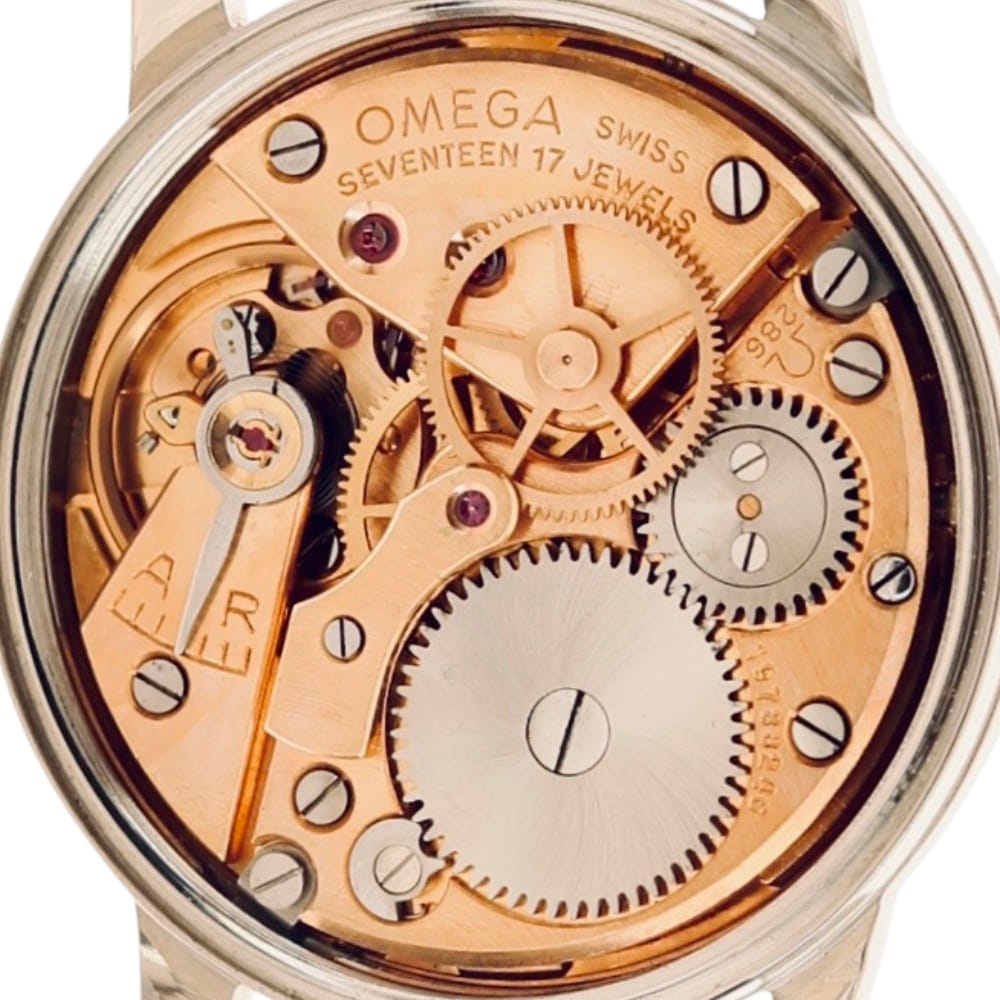
The Omega 286 represents the final evolutionary step in one of watchmaking’s most celebrated movement families. As the ultimate refinement of the legendary 30mm caliber line that built Omega’s reputation for precision from 1939 through 1966, the 286 delivered British Ministry of Defence reliability and observatory-grade engineering to the collector market at a moment when automatic movements were rapidly replacing manual wind calibers.
The caliber 286 is the center seconds variant of the caliber 269, distinguished primarily by its indirect center seconds drive via a dedicated bridge. Introduced in 1963 following extensive technical improvements, the 286 replaced the earlier caliber 285 by incorporating three critical upgrades: a new Novochoc shock protection system, an adjustable stud holder for improved timing stability, and the substitution of the traditional Breguet overcoil balance spring with a flat hairspring. These changes not only improved manufacturing efficiency but enhanced serviceability, making the 286 a favorite among watchmakers despite its brief production window.
Production of the caliber 286 spanned just four years from 1963 to 1966, corresponding to movement serial numbers 20,000,000 through 23,999,999. Omega manufactured approximately 3 million movements across the entire 30mm caliber family during its 27-year lifespan, though precise production figures for the 286 variant remain undocumented. Given the compressed production window and the market’s rapid shift toward automatic calibers during this period, the 286 represents a relatively scarce example within the 30mm lineage. The caliber is uncommon rather than rare, regularly surfacing in vintage dealer inventories but commanding attention due to its status as the ultimate expression of Omega’s manual wind heritage before the introduction of the caliber 600 family in 1967.
Collector demand for caliber 286-powered watches remains stable with modest upward momentum, particularly for original-condition examples with intact copper-gilt movement finish and untouched dials. Japanese market variants (reference 131.013) and Pakistan Air Force military-issued Seamaster 30 models command premiums due to historical significance and relative scarcity. The caliber itself enjoys strong regard among collectors who value the 30mm family’s proven reliability, though it lacks the chronometer certification and fine adjustment features that distinguish the earlier 30T2 RG variants.
Historical Context, Provenance, and Manufacturing Details
The caliber 286 emerged from Omega’s methodical refinement of the 30mm movement architecture that began with Henri Kneuss’s original 1938 design. By 1963, the market demanded improved shock protection and easier servicing, prompting Omega to evolve the caliber 285 (which featured a screwless Glucydur balance) into the 286 by integrating Novochoc shock protection, an adjustable stud holder, and discontinuing the use of banking pins in the escapement. Omega’s own technical documentation stated these modifications “not only prove advantageous during manufacture but improve interchangeability, thus facilitating the servicing of these movements”.
The caliber 286 directly succeeded the caliber 285 and was itself the final iteration of the center seconds 30mm line. The caliber 600 family, introduced in 1967 and based on the automatic caliber 550 architecture with the self-winding mechanism removed, replaced the entire 30mm manual wind lineage. This transition reflected the industry-wide shift toward automatic movements and thinner case profiles that the 30mm caliber’s 5.1mm height could not accommodate in modern waterproof case designs.
The caliber 286 is an entirely in-house Omega manufacture movement, not an ebauche-based design. All components, from the base plate to the escapement, were designed, manufactured, and finished at Omega’s Bienne facilities. Unlike many competitors who relied on movements from suppliers such as ETA, Peseux, or AS Schild, Omega maintained complete production control over the 30mm family throughout its existence.
Production occurred exclusively at Omega’s main manufacturing complex in Bienne, Switzerland. There were no documented changes in production location during the caliber’s brief 1963-1966 lifespan. The movement carried Omega’s standard quality markings and copper-gilt finish that became standard from the caliber 265 onwards, replacing the rhodium plating used on earlier 30T2 variants.
Within the broader context of horological history, the caliber 286 occupies a transitional position. It arrived too late to participate in the observatory chronometer competitions that defined the 30mm family’s reputation in the 1940s and 1950s, yet it inherited all the technical refinements that made those victories possible. The caliber served as a workhorse movement for mid-tier dress watches and tool watches (including military contracts), delivering proven reliability at a competitive price point during the final years before quartz technology upended mechanical watchmaking.
Construction and Architecture
Plate and Bridge Layout
The caliber 286 employs a traditional three-quarter plate construction with separate barrel bridge and balance cock. The architecture features four primary bridges: the barrel bridge, the train wheel bridge (covering the third and fourth wheels), the pallet cock, and the balance cock. All plates and bridges are manufactured from brass with copper-gilt finish (beryllium bronze plating) that provides both oxidation resistance and the characteristic rose-gold appearance associated with post-1949 30mm calibers. The architectural philosophy prioritizes accessibility for service, with all critical components reachable without complete disassembly.
Balance Wheel
The caliber 286 utilizes a screwless Glucydur balance wheel with four spokes. Glucydur, a beryllium bronze alloy, offers superior dimensional stability across temperature variations compared to bimetallic or standard nickel balance wheels. The screwless design, introduced in the caliber 285, eliminated traditional timing screws in favor of factory-set precision, reducing adjustment complexity while maintaining chronometric performance. The balance wheel diameter and mass are optimized for the 18,000 vph beat rate, providing stable oscillation even with the movement’s modest power reserve.
Balance Spring (Hairspring)
The caliber 286 employs a flat balance spring, a defining characteristic that distinguishes it from earlier 30mm calibers that used Breguet overcoils. The hairspring is manufactured from Nivarox, the Swiss industry-standard alloy known for temperature compensation and anti-magnetic properties. The flat configuration, combined with the newly introduced adjustable stud holder, simplified manufacturing while improving rate stability across positions. The stud holder allows precise adjustment of the hairspring’s effective length without bending the curve, a significant serviceability improvement over fixed-stud designs.
Escapement Type
The caliber 286 features a standard Swiss lever escapement with club-tooth escape wheel. The escapement employs synthetic ruby pallet stones (jewels) in the pallet fork and a synthetic ruby impulse jewel in the balance staff. A key technical modification introduced in the 269/286 variants eliminated traditional banking pins, instead using integral faces machined directly into the pallet cock to limit pallet fork travel. Omega’s technical documentation notes this change provided precision “less than one hundredth of a millimeter” in pallet positioning, allowing fitting without individual adjustment. The escapement jeweling includes pallet stones and impulse jewel, with additional jewels in the escape wheel pivot positions.
Shock Protection System
The caliber 286 incorporates Novochoc shock protection on the balance wheel pivots (both upper and lower jewels). Novochoc is a geometrical spring-based system distinct from Omega’s earlier use of Incabloc in previous 30mm variants. The system features a three-prong spring with bayonet-type attachment, free detachable spring design, and shock-absorbing blocks holding the balance jewels and cap jewels. Novochoc was used exclusively in Omega calibers 269 and 286, appearing nowhere else in Omega’s production. The system protects against shock damage to the delicate balance pivots while allowing easy disassembly for lubrication without disturbing the regulator settings.
Regulator Type
The caliber 286 uses a traditional index regulator with swan-neck fine adjustment capability in some variants, though most production examples feature a simpler two-part regulator design. The regulator acts on the adjustable stud holder, allowing precise timing adjustments by effectively lengthening or shortening the active portion of the balance spring. The index is marked with “A” (Avance/fast) and “R” (Retard/slow) indicators. Unlike chronometer-grade 30T2 RG variants that featured micrometric eccentric regulators, the standard 286 employs the more conventional index system suitable for daily-wear accuracy rather than observatory precision.
Mainspring Material and Type
The caliber 286 mainspring is manufactured from stainless alloy designed for consistent power delivery and described by Omega as “unbreakable” with elasticity maintained “almost indefinitely”. Technical specifications list the mainspring as 1.50mm wide by 0.13mm thick by 330mm long (approximately 11.5 lignes), though alternative sources cite 1.60mm by 0.110mm by 10.5mm. The mainspring features a slipping bridle attachment rather than a fixed end, allowing controlled power delivery as the spring approaches full wind and preventing overwinding damage. The spring is housed in a traditional going barrel that provides the advertised 45-hour power reserve (some sources cite 42+ hours, likely representing conservative manufacturer specifications versus observed performance).
Gear Train Details
The caliber 286 employs a four-wheel gear train (center wheel, third wheel, fourth wheel, and escape wheel) with indirect center seconds drive. The indirect seconds configuration, necessary due to the physical constraints of a 30mm diameter movement with large balance and barrel, routes the seconds hand drive through a dedicated bridge-mounted pinion rather than placing it directly on the fourth wheel staff. This design choice, while adding complexity, allows optimal placement of the balance wheel and escapement for maximum amplitude and accuracy. Specific gear ratios are not published in available technical documentation, though the train is designed to produce the 18,000 vph beat rate from the mainspring through standard Swiss watch ratios. The center wheel is indirectly driven, with the mainspring barrel rotating once per full power reserve cycle.
Finishing Quality and Techniques
The caliber 286 exhibits mid-tier finishing appropriate for a production movement. The copper-gilt finish (beryllium bronze plating) on plates and bridges provides both functional oxidation resistance and aesthetic warmth. The base plate features circular graining (perlage) executed in regular patterns, a functional finish that traps dust and excess oil away from pivot points. Bridges display beveled edges (anglage) with polished chamfers, though not to the hand-finished standard of chronometer-grade variants. Movement screws are blued through heat treatment and exhibit polished heads. The crown wheel and ratchet wheel feature radial brushing with moderate attention to finish. The gear train receives standard machining and light polishing appropriate for reliable long-term operation. Finishing quality remained consistent throughout the 1963-1966 production run, with no documented chronometer-certified or higher-grade elaborations of the caliber 286 produced. The movement does not feature Côtes de Genève (Geneva stripes), hand-finished anglage, or black polish reserved for Omega’s haute horlogerie pieces.
Cross-Reference Data
Alternative Caliber Names (Rebranded Versions)
The Omega caliber 286 was not rebranded or sold under alternative names to other manufacturers. The 30mm caliber family remained exclusively an Omega in-house manufacture movement throughout its production. Unlike many Swiss movement suppliers of the era (ETA, Peseux, AS Schild, Felsa), Omega did not sell ebauche movements to competing brands.
| Manufacturer | Caliber Designation | Notes |
|---|---|---|
| Omega | Cal. 286 | Original and only designation |
| Omega | 30 SC T6 PC AM 17 p | Full technical designation found on movements |
Base Caliber vs. Elaborated Versions
The caliber 286 exists as a single grade without chronometer-certified or adjusted elaborations. The 30mm family included higher-grade variants in earlier iterations (30T2 RG, caliber 281), but these were separate caliber designations rather than elaborations of the base 286.
Compatible Case References by Brand
Dial Compatibility Note
Dial foot positions for caliber 286 are standardized at the 30mm caliber specification with feet at approximately 2:00 and 8:00 positions. The movement does not include a date function, so no date window consideration applies. Dial diameter for 30mm calibers measures approximately 26-27mm to fit within typical 33-35mm cases with adequate clearance for chapter rings. Center seconds hand requires an appropriate height center pinion to clear hour and minute hands. Collectors restoring caliber 286 watches should note that dial variations exist across references (vertical brushed, starburst, crosshair, honeycomb, plain), but all share identical foot positions.
Crown and Stem Specifications
Identification Marks
Caliber Number Location
The caliber number “286” is engraved on the movement plate (base plate) visible when the case back is removed. The full technical designation “30 SC T6 PC AM 17 p” may also appear on some movements, indicating: 30mm size, SC (center seconds), T6 (sixth technical iteration), PC (shock protection), AM (anti-magnetic), and 17 jewels. The caliber number is typically located near the balance cock or between the winding mechanism and barrel bridge.
Logo and Brand Marks
Authentic caliber 286 movements display the Omega logo (Greek letter Ω) prominently on the rotor side of the movement, typically positioned near the 12:00 position above the balance wheel or on the barrel bridge. Additional markings include “Swiss” or “Swiss Made” indicating country of manufacture. Crowns should bear the Omega logo in relief or engraved format. Case backs on Seamaster models feature the hippocampus (seahorse) emblem, while Geneve models may display the Omega logo without model designation.
Date Codes
The caliber 286 does not employ a standardized date code system visible on the movement. Dating is accomplished through the movement serial number engraved on the movement plate, typically between the balance cock and barrel bridge or near the winding mechanism. Serial number ranges correspond to production years as follows:
| Serial Number Range | Year |
|---|---|
| 20,000,000 – 20,999,999 | 1963 |
| 21,000,000 – 21,999,999 | 1964 |
| 22,000,000 – 22,999,999 | 1965 |
| 23,000,000 – 23,999,999 | 1966 |
Case backs may include a two-digit date code indicating case manufacture year (e.g., “63” for 1963), though this reflects case production rather than movement assembly and the two may not align precisely.
Finishing Marks
Authentic caliber 286 movements exhibit copper-gilt finish (rose-gold appearance) on all brass components including plates, bridges, barrel, and winding wheels. The base plate features circular graining (perlage) in regular concentric patterns. Bridges display beveled edges with polished chamfers. Crown wheel and ratchet wheel show radial brushing. Movement screws are heat-blued with polished heads. The absence of copper-gilt finish (presence of rhodium plating instead) indicates an earlier 30mm caliber variant or incorrect replacement parts.
Jewel Markings
The caliber 286 employs 17 jewels total. Jewels are set in pressed settings rather than gold chatons, consistent with production-grade finishing. The Novochoc shock protection jewels (balance upper and lower) are easily identifiable by the three-prong spring system and are typically ruby-colored synthetic jewels. Pallet stones in the pallet fork are rectangular ruby jewels visible through the balance cock cutout. There are no special jewel markings or quality stamps beyond the standard jewel count designation.
Adjustment Markings
The caliber 286 was not produced in chronometer-certified or officially adjusted grades. Movements do not carry adjustment markings such as “Adjusted to 5 Positions,” “Chronometer,” or similar quality designations found on higher-grade 30mm variants like the 30T2 RG. The regulator is marked with “A” (Avance/fast) and “R” (Retard/slow) indicators for rate adjustment, but these are functional markings rather than quality certifications.
Correct Serial Number Formats and Locations
Movement serial numbers appear on the movement plate (baseplate) and consist of eight digits in the 20,000,000 to 23,999,999 range for authentic 1963-1966 production. The serial number is engraved (not stamped), with clean, evenly spaced numerals of consistent depth. Numbers should align with production year ranges listed above. Serial numbers outside this range indicate either a different caliber or fraudulent engraving. Example authentic serial number from documented source: 20,174,417 (approximately 1964).
Expected Engravings and Stampings
Authentic caliber 286 movements display the following engravings:
- Caliber number “286” or full designation “30 SC T6 PC AM 17 p”
- Movement serial number (8 digits)
- Jewel count “17 Jewels” or “17 Rubis”
- “Swiss” or “Swiss Made”
- Omega logo (Greek Ω)
Engravings should be crisp, evenly spaced, and of consistent depth. Font style should match period-appropriate Omega engraving conventions with slightly squared numerals and serif-style lettering for text. Shallow, irregular, or inconsistently spaced engravings indicate refinishing, replacement parts, or fraudulent movements.
Font and Marking Style by Production Era
The caliber 286’s brief 1963-1966 production window exhibits consistent engraving and marking styles without mid-production transitions. Fonts are period-typical 1960s Omega house style with squared numerals (particularly the “1,” “4,” and “7”) and slightly condensed letter spacing. The Omega logo maintained its standard Greek letter form throughout this period without stylistic changes. Case reference numbers on case backs follow the format “135.007-63” with hyphens separating the case model from the year code.
Part Information

Part Numbers

Winding and Setting Components
Balance and Regulating Components
Gear Train Components
Other Components
Sourcing Notes
Readily Available Parts:
- Mainsprings remain widely available through specialist suppliers as the 30mm family’s popularity ensures continued stock
- Winding stems (part 260-1106) are commonly stocked
- Crown wheels, ratchet wheels, and basic winding components are available from vintage parts specialists
- Generic screws and small components can often be substituted from 30mm family parts bins
Commonly Failed Parts Requiring Replacement:
- Mainsprings (age-related fatigue despite “unbreakable” designation)
- Balance staffs (pivot damage from shock or wear)
- Hairsprings (magnetization, corrosion, or physical damage)
- Novochoc springs (loss of tension or breakage)
Difficult to Source Parts:
- Complete balance wheels with hairspring assemblies in good condition
- Original Novochoc shock protection assemblies (springs and jewel settings)
- Escape wheels and pallet forks with unworn jewels
- Original copper-gilt finished bridges (if replacement needed)
Acceptable Generic Replacements:
- Mainsprings: Equivalent dimensions from Ronda, GR, or aftermarket suppliers work reliably
- Balance staffs: Generic Omega 30mm family staffs (part 1321) function identically across calibers 268/285/286
- Standard screws: Generic metric screws of appropriate dimensions can substitute for non-critical applications
- Crystals: Generic acrylic (plexiglass) crystals in appropriate diameters fit standard cases
Parts to Avoid:
- Incabloc shock protection (incorrect; caliber 286 uses Novochoc exclusively)
- Breguet overcoil balance springs (incorrect; caliber 286 uses flat springs)
- Rhodium-plated bridges (incorrect finishing; caliber 286 should be copper-gilt)
Performance Data
Manufacturer Specifications
Omega did not publish comprehensive performance specifications for the standard-grade caliber 286, as it was not produced in chronometer-certified variants. Based on technical documentation for the 30mm caliber family and related movements, the following represents manufacturer-intended performance:
The 30mm caliber family’s reputation for accuracy stems primarily from chronometer-certified variants (30T2 RG, caliber 281) that underwent precision adjustment and observatory testing. The caliber 286, as a production-grade movement, prioritized reliability and serviceability over observatory-level precision.
Observed Performance (Field Data)
Based on collector reports, watchmaker observations, and documented service records, the caliber 286 exhibits the following real-world performance characteristics:
Typical Accuracy Range (Well-Maintained Examples):
- Recently serviced movements in good condition: ±5 to ±15 seconds per day
- Movements requiring service but mechanically sound: ±20 to ±40 seconds per day
- Movements with significant wear or magnetization: ±60+ seconds per day
One documented example from collector forums reported ±30 seconds over 40 hours as questionable performance indicating service needed. Another owner tracked a serviced example at +1 second per day over extended monitoring. These anecdotal reports align with the movement’s design intent as a reliable daily-wear caliber rather than a precision timekeeping instrument.
Common Performance Issues and Causes:
- Rate instability across positions: Worn balance pivots, dried lubrication, or damaged Novochoc shock protection
- Progressive time loss: Weakened or damaged mainspring reducing power delivery
- Erratic rate with position changes: Hairspring magnetization (common given lack of modern anti-magnetic shielding)
- Amplitude drop after initial wind: Dried escapement lubrication or worn pallet jewels
- Complete stoppage: Broken balance staff pivots, seized barrel arbor, or corroded movement (moisture damage)
Expected Amplitude:
- Fully wound, dial up position: 260-290 degrees
- After 24 hours running: 240-270 degrees
- Power reserve depleted (40+ hours): 180-220 degrees
- Service-needed threshold: Below 200 degrees when fully wound
Amplitude measurements below 200 degrees indicate insufficient power delivery, typically from weakened mainspring, excessive friction (dried lubrication), or worn escapement components.
Performance Degradation with Age:
Unserviced caliber 286 movements exhibit predictable performance decline:
- 0-10 years since service: Gradual accuracy drift, typically +10 to +20 seconds per day additional loss
- 10-20 years since service: Significant accuracy degradation (±40-60 seconds per day), reduced power reserve (30-35 hours instead of 45), amplitude drop below 220 degrees
- 20+ years since service: High risk of complete failure from dried lubrication, corroded pivots, or crystallized mainspring lubricants
The caliber 286 benefits from the 30mm family’s robust architecture and generous tolerances, allowing many examples to continue running (albeit with poor accuracy) decades past recommended service intervals. Watchmakers note the movement’s forgiving nature during service, with most examples responding well to proper cleaning, lubrication, and adjustment.
Environmental Factors Affecting Performance:
- Moisture exposure: The non-water-resistant Seamaster 30 and Geneve cases provide minimal protection; moisture penetration causes rapid oxidation of copper-gilt finish and corrosion of steel components
- Magnetic fields: Lacking modern anti-magnetic shielding, the caliber 286 is susceptible to hairspring magnetization from speakers, magnetic clasps, and modern electronic devices
- Shock: Despite Novochoc protection, severe impacts can damage balance pivots or dislodge Novochoc springs
- Overwinding: The slipping mainspring bridle prevents overwinding damage, but aggressive winding can stress the crown wheel teeth
Collectors should expect a well-serviced caliber 286 in original condition to deliver ±10-20 seconds per day accuracy in normal wearing conditions, with annual rate checks and complete service every 5-7 years to maintain optimal performance