

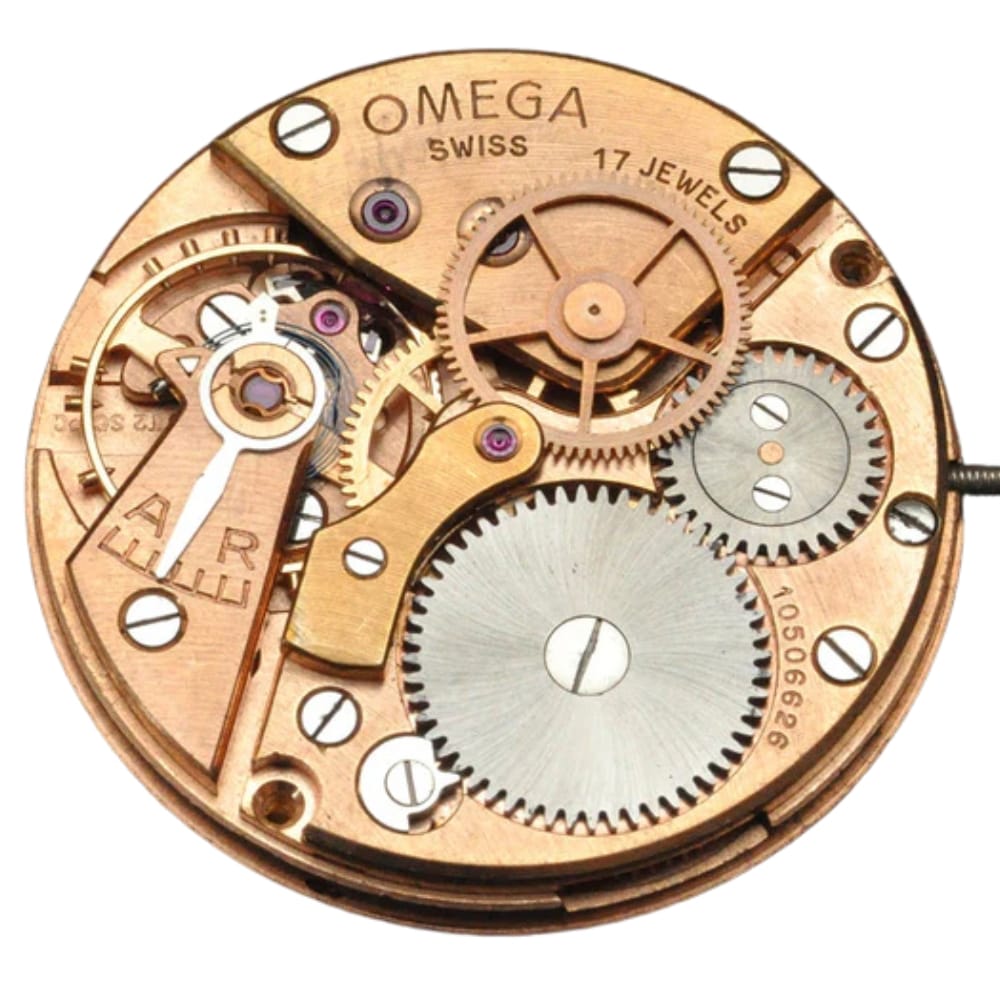
The Omega 30T2 SC powered some of the most significant military timepieces of World War II, including the RAF’s 6B/159 specification watches that British bomber crews wore on every sortie over occupied Europe. When the British Ministry of Defence ordered 110,000 Omega watches during the war, representing roughly 10% of the company’s entire wartime output, the 30T2 SC’s reputation for reliability under combat conditions was permanently secured. This was not a movement built for display cases or dress watches but for pilots calculating bombing runs on seven-hour missions to Berlin, where a few seconds of timing error could mean the difference between hitting a target and endangering an entire squadron.
The 30T2 SC represents the central seconds variant of Omega’s legendary 30mm caliber family, distinguished from its small-seconds sibling by an additional bridge that drives indirect central seconds via the upper third wheel. Designed by Henri Kneuss, Omega’s assistant technical director and a self-taught watchmaker with no formal training, the 30mm architecture prioritized robustness and serviceability over decorative finishing. The caliber’s large 30mm diameter allowed for an oversized barrel and balance wheel combined with the smallest escapement used in movements of this size, a combination that yielded exceptional precision and power reserve while remaining simple enough for field repairs. Watchmakers still praise the 30T2’s logical architecture and ease of assembly more than 80 years after its introduction.
Production of the 30T2 family reached approximately 3 million units across all variants between 1939 and 1963, making this one of Omega’s most successful movement platforms. The SC variant accounts for a substantial portion of this output, though exact figures for the central seconds version alone remain unconfirmed by factory records. Most examples surface regularly in the collector market, making the caliber common rather than scarce. However, specific variants command premiums: military-issued pieces with proper 6B/159 engravings, chronometer-grade 30T2RgSC examples with micro-regulators, and early nickel-plated wartime movements all trade at multiples of standard civilian versions. Jumbo-cased examples measuring 37-38mm also attract strong collector interest due to their contemporary wearability.
Collector demand for 30T2 SC watches has remained stable to rising over the past decade, driven by growing appreciation for military horology and vintage Omega pieces from the company’s golden era. The caliber’s 25-year production run means parts availability remains reasonable compared to shorter-lived movements, though finding quality hairsprings with proper Breguet overcoils and original balance assemblies has become progressively more difficult. The movement’s reputation as “one of the finest hand-wound movements ever conceived” ensures sustained collector interest, particularly for examples with intact original dials and proper military provenance.
Historical Context, Provenance, and Manufacturing Details
Development of the Calibre 30 began in 1938 under the direction of Henri Gerber, Omega’s technical director from 1928 through the 1960s, with Henri Kneuss leading the actual design work as Gerber’s second-in-command. Kneuss, entirely self-taught without formal watchmaking education, created a prototype that was presented in December 1938, with series production commencing in February 1939. The 30mm caliber was intended to replace the aging 26.5mm family that had served Omega through the 1930s, addressing market demand for larger wristwatches while incorporating lessons learned from Omega’s observatory competition program.
The 30T2 evolved from the base Calibre 30, with the “T2” designation indicating the second technical modification series. The SC suffix denotes “Sweep Central” seconds, achieved through an indirect drive system using an additional bridge to support the central seconds pinion. This indirect system was technically necessary because direct central seconds would have caused excessive impulse loss in a caliber of this size, a limitation already addressed in Omega’s earlier 23.4SC movement from 1936. The 30T2 SC first appeared in 1939 alongside the small-seconds 30T2, with both versions sharing the same base architecture and differing primarily in the seconds drive configuration.
The 30T2 family replaced the 26.5mm calibers and was itself eventually superseded by the three-digit nomenclature system Omega introduced in 1949. Under the new system, the 30T2 SC became Calibre 280, with subsequent variations numbered 281 (chronometer with micro-regulator), 283 and 284 (antimagnetic versions), 285 (smooth balance), and 286 (flat hairspring instead of Breguet overcoil). Production continued under these three-digit designations until 1963, when Omega phased out the entire 30mm family in favor of more modern automatic calibers. The 30mm platform’s 25-year production span and 3-million-unit output made it one of the longest-lived and most successful movement families in Omega’s history.
This is an in-house Omega manufacture caliber, designed and produced entirely at the Bienne factory without reliance on ébauche suppliers. Omega controlled every aspect of production, from bridge finishing to escapement manufacturing, which allowed for consistent quality control and the ability to produce both standard-grade and chronometer variants from the same tooling. Factory locations remained constant in Bienne throughout the production run, with no documented transfers to other facilities.
The 30T2 SC achieved historical significance by powering thousands of military timepieces for both British and American forces during World War II. The most famous application was the Omega CK2292, one of the twelve manufacturers meeting the British Air Ministry’s WWW (Wrist Watch Waterproof) specification, collectively known as the “Dirty Dozen”. These watches required special regulation to within 10 seconds per day in four positions, a specification the 30T2 SC met reliably enough to earn the trust of bomber crews on missions lasting up to seven hours. RAF Squadron Leader Frank Wright Walton wore his CK2292 on all 71 sorties and continued wearing it on every flight throughout his post-war career as Director of the Queen’s Flight, testament to the movement’s exceptional reliability.
The caliber also powered Omega’s chronometer program in the 1940s, with refined 30T2RgSC variants winning first prize for precision at the Kew Observatory trials in 1946. These competition-grade movements used specially selected components, including matched balance wheels, premium hairsprings, and hand-fitted escapements, with dedicated “régleurs de précision” tweaking individual movements until they achieved chronometer performance. While the standard 30T2 SC was not chronometer-certified, the platform proved capable of exceptional accuracy when properly regulated, cementing Omega’s reputation for precision during this formative period.
Construction and Architecture
The 30T2 SC employs a three-bridge architecture with separate cocks for the barrel, train wheels, and balance assembly. Bridge construction uses nickel-silver alloy for the base plate and bridges, with variations in surface treatment depending on production period and grade level. Early wartime examples feature nickel plating due to copper rationing, while post-war civilian production predominantly used copper or rose-gold plating that gives the movement its characteristic warm appearance. The movement plate features perlage finish on standard grades, with some later variants (265 onward) using a starburst pattern instead. The bridge layout prioritizes serviceability, with all major components accessible without complete disassembly, a design choice watchmakers still appreciate when servicing these movements.
The additional bridge distinguishing the SC variant supports the central seconds pinion, which is driven indirectly by the upper third wheel rather than the fourth wheel. This indirect drive system allows for proper impulse delivery while maintaining the large barrel and balance configuration that characterizes the entire 30mm family. The sweep seconds bridge mounts via two screws and requires precise adjustment during assembly to ensure proper mesh with the driving wheel and minimal friction at the center post.
Balance wheel specifications varied across the production run and between grade levels. Early 30T2 SC movements used a cut bimetallic compensation balance with timing screws, designed to self-compensate for temperature variations through the expansion characteristics of the two-metal laminate. This bimetallic design features a split balance rim that adjusts automatically as temperature changes, though this system became obsolete with the introduction of temperature-compensated alloy hairsprings. Later production examples, particularly those with Incabloc shock protection (PC variants), transitioned to monometallic Glucydur balance wheels. These smooth-rim balances rely on the hairspring alloy for temperature compensation rather than bimetallic construction, offering improved reliability and reduced sensitivity to magnetism. Both configurations feature multiple timing screws around the balance rim, typically 4-6 screws positioned to allow mean-time adjustment by adding or removing weight at specific positions. The balance diameter takes advantage of the large 30mm movement size, contributing to consistent amplitude and stable timekeeping.
All 30T2 SC variants use Breguet overcoil hairsprings, a critical feature for achieving stable rate across different positions. The Breguet overcoil raises the outer terminal curve of the hairspring above the plane of the flat spiral, allowing the spring to breathe concentrically during expansion and contraction rather than developing interference between coils. Early examples used blued steel hairsprings, while later production likely employed Nivarox or similar temperature-compensated alloys, though factory documentation does not consistently specify alloy composition. Hairspring length and active coil count optimize the 18,000 vph frequency with the large balance wheel, a pairing that yields good amplitude even as power reserve depletes. The stud carrier is fixed on early movements and becomes mobile on later variants, though both configurations attach to the balance cock rather than the main plate. Collector reports confirm that correct replacement hairsprings must have the Breguet overcoil, as flat springs from later calibers will not deliver proper timekeeping performance.
The escapement follows standard Swiss lever design with club-tooth escape wheel and straight-line lever. The escape wheel measures 7.36mm in diameter with an 8-tooth pinion, height between bearings is 4.61mm, and pinion diameter is 1.23mm. Pallet fork (part number 1316) features two synthetic ruby pallet stones and is jeweled at the pivot points on standard and higher grades. The impulse jewel (ellipse) fits into the balance roller table and must be properly shellacked to prevent loosening during operation. Escapement geometry provides the characteristic 49-degree lift angle, which remains consistent across all 30T2 variants and must be programmed correctly into timing machines for accurate amplitude readings.
Standard 30T2 SC movements lack shock protection, leaving balance pivots vulnerable to impact damage. The PC (Parachoc/Incabloc) variants introduced in 1941 add Incabloc shock jewel settings on both balance pivots, Omega’s first movement family to incorporate this feature. The Incabloc system uses spring-mounted jewel settings that can absorb impacts by allowing the jewel to move slightly before returning to center position, significantly improving reliability in military and sports applications. Later production runs also added shock protection to the pallet fork pivots on higher-grade versions. Movements lacking shock protection show characteristic wear patterns on balance staff pivots, particularly the dial-side pivot which carries more load.
Regulation on standard 30T2 SC movements uses an index regulator with a simple pointer that adjusts the effective length of the hairspring. This system allows for adjustment across a range of several minutes per day, adequate for achieving reasonable timekeeping in competent hands. The regulator arm features “+” and “-” markings indicating fast and slow adjustment directions. Chronometer-grade 30T2RgSC variants replace the index regulator with an eccentric micro-regulator system (swan-neck on some examples) that permits far more precise adjustment, capable of achieving rate changes measured in seconds rather than minutes. The micro-regulator was essential for observatory competition work, where movements required adjustment to tolerances of 1-2 seconds per day across multiple positions.
The mainspring barrel takes advantage of the 30mm movement diameter to house a large mainspring, contributing to the 44-hour power reserve despite the relatively simple architecture. Mainspring specifications vary slightly depending on supplier and production period, but most sources cite dimensions of 1.50mm height, 0.14-0.15mm thickness, and 330-340mm length, fitting a barrel with inner diameter of 11.5-13 lignes. The mainspring uses a slipping bridle attachment at the barrel wall, allowing the spring to slip harmlessly when fully wound rather than breaking or damaging the gear train. Modern replacement mainsprings are available from Generale Ressorts and other Swiss suppliers in appropriate specifications for the 30mm family.
The gear train features straightforward ratios with the center wheel driving the third wheel, third wheel driving the fourth wheel, and fourth wheel driving the escape wheel. In the SC configuration, the upper third wheel also drives the central seconds pinion through the additional bridge. Wheel teeth show good finish with properly shaped profiles on standard grades, while chronometer variants (30T2RgSC) feature polished and beveled teeth throughout the train. The large barrel and balance allow for conservative gear ratios that reduce wear and improve long-term reliability.
Finishing quality varies significantly by grade and production period. Base 30T2 SC movements show functional finishing with perlage on the base plate, straight-grained bridges with light beveling, and polished screw heads. The rhodium or nickel plating on wartime examples provides a lighter appearance than the copper-gilt finish used on most post-war production. Winding wheel teeth show adequate shaping but lack the deep beveling found on higher grades. Chronometer variants (30T2RgSC, later 281) feature significantly enhanced finishing including deeply beveled bridges with sharp anglage, polished crown and ratchet wheels, shaped and polished winding wheel teeth, and mirror-polished screw heads. The chronometer designation “RG” (Red Gilt) originally referred to the enhanced finishing level, though the actual plating color varies. Bridge design remains clean and functional across all grades, with beveled edges and good overall proportions that contribute to the movement’s reputation for elegance despite its utilitarian purpose.

Cross-Reference Data
Alternative Caliber Designations
| Designation | Period | Differences from Base 30T2 SC |
|---|---|---|
| 30T2 SC | 1939-1949 | Base central seconds version, 16 jewels, no shock protection |
| 30T2 SC PC | 1941-1949 | Added Incabloc shock protection, 17-18 jewels |
| 30T2 RgSC | 1940-1949 | Chronometer grade, micro-regulator, enhanced finishing, 17 jewels |
| Caliber 280 | 1949-1963 | Renamed 30T2 SC under new nomenclature, identical specifications |
| Caliber 281 | 1949-1963 | Chronometer grade (former 30T2 RgSC), micro-regulator, 17 jewels |
| Caliber 283 | 1950s-1963 | Antimagnetic version, 17 jewels |
| Caliber 284 | 1950s-1963 | Antimagnetic variant, 17 jewels |
| Caliber 285 | 1950s-1963 | Smooth (ring) balance instead of screw balance |
| Caliber 286 | 1950s-1963 | Flat hairspring instead of Breguet overcoil |
Small Seconds Variants (Related Family)
| Designation | Period | Configuration |
|---|---|---|
| 30T2 | 1939-1949 | Small seconds, 15 jewels, no shock protection |
| 30T2 PC | 1941-1949 | Small seconds, Incabloc, 15 jewels |
| 30T2 Rg | 1940-1949 | Chronometer small seconds, micro-regulator, 17 jewels |
| Caliber 260 | 1949-1963 | Renamed 30T2 |
| Caliber 262 | 1949-1963 | Chronometer small seconds (former 30T2 Rg) |
| Caliber 265, 266, 267, 268, 269 | 1950s-1963 | Various modifications (antimagnetic, balance types, hairspring variations) |
Compatible Case References by Brand
| Brand | Reference Numbers | Production Period | Notes |
|---|---|---|---|
| Omega | CK2292, UK2292 | 1940-1945 | RAF military issue, WWW spec, 6B/159 marking, 33mm, white dial |
| Omega | CK2324, 2324/4, 2324/9 | 1940s-1950s | Civilian central seconds, 35mm steel |
| Omega | CK2349, 2349/3 | 1940s | Calatrava-style dress watch, 35mm |
| Omega | CK2383 | 1940s-1950s | Screw-back, 35mm, wide bezel |
| Omega | CK2400 | 1940s-1950s | Similar to 2383, Swedish “Suveran” versions exist |
| Omega | CK2505-10 | 1940s | Jumbo/oversize case, 37-38mm |
| Omega | 13322 | 1939-1940 | Sterling silver cases |
| Omega | 2220 | 1940s | Steel case, 32mm |
Case reference systems: CK prefix indicates steel cases, OT/TO prefixes indicate gold cases. Dennison-cased examples add an extra digit (typically “5”) in the middle of the reference number. Post-1953 casebacks include the Omega triangle stamp, while earlier examples lack this marking.
Dial Compatibility and Specifications
The 30T2 SC requires dials drilled for central seconds configuration, with the seconds bit post at true center rather than the off-center position used for small seconds variants. Dial foot positions differ between the 30T2 (small seconds) and 30T2 SC families, making cross-compatibility impossible without re-drilling. Original military 6B/159 specification dials feature white or off-white backgrounds with Arabic numerals, railroad minute track, and luminous hour markers and hands. Civilian versions show tremendous variety including Roman numerals, Arabic numerals, sector dials, and various hand styles. The large 30mm movement allows for larger case sizes (35-38mm), which in turn permits more elaborate dial designs than smaller movements of the period.
Crown and Stem Specifications
| Component | Specification |
|---|---|
| Stem Thread | TAP 10 (0.90mm) |
| Stem Part Number | 260-1106 (fits all 30mm variants) |
| Crown Thread | 0.90mm, TAP 10 |
| Crown Tube Diameter | 2.0-2.2mm |
| Crown Tube Height | 1.4-1.8mm |
| Setting Mechanism | Yoke (clutch lever) system |
The winding stem (part 260-1106) fits all 30mm calibers including both 30T2 and 30T2 SC, as well as the later three-digit variants through 286. Period-correct crowns are typically unsigned, as Omega did not regularly sign winding crowns during this era. Any signed crown on a 1940s 30T2 watch indicates replacement.
Identification Marks
Caliber Number Location and Format
The caliber designation appears stamped on the main plate visible when viewing the movement from the dial side. Standard format reads “30T2 SC” or variants including “30T2 SC PC” (with shock protection) or “30T2 RgSC” (chronometer grade). After 1949, movements bear three-digit numbers (280, 281, 283, etc.) corresponding to the variant. The caliber number typically appears below the balance wheel area, though exact placement varies slightly across production batches.
Logo and Brand Marks
All authentic movements display “OMEGA” in capital letters, usually accompanied by the Omega symbol (Ω). Text “SWISS” or “SWISS MADE” appears separately, along with jewel count marked as “16 JEWELS,” “17 JEWELS,” or “SEVENTEEN JEWELS” depending on variant and production period. Military-issued movements may carry additional markings such as “AM” (Air Ministry) or “6B/159” on the case or movement. The Omega symbol and text should show consistent depth and professional engraving quality.
Date Codes and Serial Numbers
Omega did not use letter-based date codes during the 30T2 production period. Dating relies entirely on serial number cross-reference to production records. Serial numbers appear stamped on the movement, typically on the main plate near the balance cock. Serial number format consists of 7-8 digits, sequentially assigned from Omega’s system that began at 1,000,000 in 1894.
Approximate serial number ranges for 30T2 SC production:
| Serial Number Range | Approximate Year |
|---|---|
| 9,000,000-9,999,999 | 1939-1941 |
| 10,000,000-10,999,999 | 1941-1944 |
| 11,000,000-11,999,999 | 1944-1947 |
| 12,000,000-12,999,999 | 1947-1950 |
These ranges represent approximate periods and overlap considerably due to Omega’s batch production methods. Military contracts often received movements from specific serial ranges, with the 6B/159 watches documented in the 9.7-10.5 million range for 1943-1944 production.
Case serial numbers appear separately inside the caseback, typically below the case reference number. On clip-back or press-fit cases, the last 3-4 digits of the case serial often appear stamped on the case rim near a lug as a manufacturing reference.
Expected Finishing Patterns by Production Era
Early Production (1939-1941): Rhodium or nickel-silver plating gives a bright, silvery appearance. Perlage on main plate, straight graining on bridges. Bimetallic balance with bright finish. No shock protection jewel settings.
Wartime Production (1941-1945): Nickel plating due to copper rationing, resulting in lighter coloration than post-war examples. Introduction of PC variants with Incabloc shock protection identifiable by spring-mounted cap jewels on balance pivots. Military-specification examples show functional finishing without excessive decoration.
Post-War Civilian (1945-1949): Return to copper or rose-gold plating, giving warmer pinkish-gold appearance. Continued availability of both standard and PC (shock-protected) variants. Improved finishing consistency as production stabilized after war.
Late Production (1949-1963): Three-digit caliber numbers (280, 281, etc.). Some variants transition to starburst finish on main plate instead of perlage (265 family onward). Monometallic Glucydur balance becomes standard on shock-protected versions. Enhanced finishing on chronometer grades (281).
Adjustment Markings
Non-chronometer 30T2 SC movements lack adjustment markings, as these received only basic factory regulation rather than formal testing and certification. Chronometer-grade 30T2 RgSC (later 281) examples should display chronometer certification markings if originally sold with such documentation, though not all chronometer-grade movements received formal testing. Observatory competition examples carry special markings related to their trial results, though these are extremely rare and most were not sold commercially.
Font and Engraving Characteristics
Authentic engravings show professional depth and clarity with consistent character spacing. Font styles remained relatively consistent across the production period, using serif capitals for “OMEGA” and straightforward sans-serif numerals for jewel counts and caliber numbers. Hand-engraved or stamped markings should show appropriate wear consistent with the watch’s age, with edges softening slightly on examples from the 1940s. Sharp, crisp engraving on an 80-year-old movement may indicate replacement parts or fraudulent markings.
Parts Information

Critical Replacement Parts
| Part Name | Part Number | Interchangeability Notes |
|---|---|---|
| Mainspring | GR4228, various | 1.50 x 0.14-0.15 x 330-340 x 11.5-13, fits all 30mm calibers |
| Balance Complete | 262-1327 | Fits multiple variants, specify Breguet hairspring |
| Hairspring | 260-1327 | Must have Breguet overcoil, fits 260/280 family |
| Escape Wheel | 055 | 7.36mm diameter, 8-tooth pinion, fits Cal. 18-30 family |
| Pallet Fork | 1316 | Standard across 30T2 variants |
| Crown Wheel | Available | Shared across 30mm family |
| Ratchet Wheel | Available | Shared across 30mm family |
| Click Spring | Available | Standard component |
| Setting Lever Spring (Yoke Spring) | 260-1111 | Fits 30, 30T1, 30T2, 260-286 family |
| Winding Stem | 260-1106 | Universal for all 30mm calibers |
| Balance Staff | 332/170 | Specify caliber variant for correct dimensions |
| Roller Table | 730/11 | Fits 30mm family |
| Dial Screw | 260-2167 | 2 per movement, fits all 30mm variants |
| Various Screws | 2611, 2182 | Multiple small screws, often interchangeable |
Parts Sourcing and Availability
Original Omega parts for the 30T2 SC remain available from specialized vintage parts suppliers, though availability fluctuates and prices have increased significantly in recent years. Watch Material, Perrin Watch Parts, Cousins UK, and similar suppliers stock basic components including mainsprings, stems, screws, and some movement parts. Balance complete assemblies command premium prices (often $300-400) due to scarcity and the difficulty of properly matching hairspring to balance wheel. Generic or aftermarket mainsprings from Generale Ressorts provide acceptable performance and represent the most commonly replaced component.
The pallet fork (1316) fails less frequently than balance components but can suffer damage from inexperienced repair attempts or excessive wear in poorly maintained examples. Escape wheels rarely require replacement unless damaged during service work. The most problematic component is the hairspring, as finding correct examples with proper Breguet overcoils in the right alloy and dimensions becomes progressively more difficult. Some watchmakers resort to fitting hairsprings from related calibers (262, 265, 281) if dimensions match, though this requires expertise to ensure proper timekeeping.
Incabloc shock jewel settings use standard Incabloc components that remain readily available, though identifying the correct generation of Incabloc system for a specific production year requires some research. Balance staffs can be manufactured by competent watchmakers using a lathe if new-old-stock examples cannot be sourced, though this requires significant skill.
Case components including crystals, gaskets, and tubes show reasonable availability, as the 30T2 was used in many case references with some dimensional commonality. Period-correct plexiglass crystals in various profiles fit most cases, and generic gaskets can be adapted if original sizes are unavailable.
Performance Data
Manufacturer Specifications
Omega specified the 30T2 family for accuracy of +/- 60 seconds per day in standard grade, adequate for reliable timekeeping but not approaching chronometer standards. The movement was tested in basic positions during quality control but not subjected to formal multi-position rating in standard grades. Temperature compensation relied initially on bimetallic balance construction, later transitioning to temperature-compensated hairspring alloys with monometallic balances. Isochronism (rate consistency across different amplitude levels) benefits from the large balance and mainspring, allowing relatively stable timekeeping as the watch runs down from full wind to nearly depleted power reserve.
Military-specification 30T2 SC movements supplied under the 6B/159 contract received special regulation to meet stringent accuracy requirements: after 3 hours +/- 3 seconds, after 6 hours +/- 5 seconds, after 12 hours +/- 8 seconds, and after 24 hours +/- 15 seconds. This special adjustment to within 10 seconds per day in four positions approached chronometer-grade performance, though the movements were not formally certified. These military pieces demonstrate the caliber’s inherent capability when properly regulated by skilled watchmakers.
Chronometer-grade 30T2 RgSC variants (later 281) met full chronometer standards requiring +4/-6 seconds per day variation across five positions and two temperatures over 15 days of testing. Omega’s competition examples achieved even tighter tolerances, with some movements regulated to +/- 2 seconds per day for observatory trials. The platform’s flexibility allowed everything from basic grade to competition chronometer from the same fundamental architecture through component selection and regulator precision.
Power reserve of 44 hours when fully wound provides adequate running time between winds. The large mainspring barrel maintains relatively consistent torque delivery across most of this period, with amplitude remaining strong until the final 6-8 hours. Minimum acceptable amplitude at 24 hours after full wind is approximately 190 degrees in dial-up position, according to period service documentation.
Observed Performance (Field Data)
Well-maintained 30T2 SC examples regularly achieve +/- 10-15 seconds per day in normal use, significantly better than the manufacturer’s specification but typical for movements receiving proper service and regulation. Watchmakers report that the caliber’s simple architecture and large balance make achieving good timing results straightforward compared to smaller or more complex movements. Examples serviced by competent watchmakers routinely run at +/- 5 seconds per day, and exceptional examples approach +/- 2-3 seconds daily, performance rivaling modern mechanical watches.
Common performance issues trace to maintenance neglect rather than design flaws. Dried lubricants cause increased friction, reducing amplitude and causing the watch to lose time or stop entirely. Balance staff wear, particularly on non-shock-protected examples, creates end shake that manifests as positional variation and increased beat error. Magnetization affects timekeeping if the watch has been exposed to magnetic fields, though the large balance provides some resistance compared to smaller movements.
Amplitude when fully wound typically measures 260-280 degrees in dial-up position for well-serviced examples, dropping to 220-240 degrees at 24 hours and 190-210 degrees near the end of the 44-hour power reserve. Beat error should measure under 0.8ms for properly adjusted examples, with chronometer-grade pieces achieving 0.3-0.5ms or better. Rate consistency across positions (dial up, dial down, crown up, crown down, crown left, crown right) varies by grade and adjustment level, with basic grades showing 15-30 seconds variation and chronometer grades achieving under 10 seconds variation.
The movement’s performance typically degrades gracefully with age if properly maintained. Examples requiring service show progressively lower amplitude, increased positional variation, and eventual stopping, but rarely fail catastrophically if not subjected to impact damage. Collectors report that properly serviced 30T2 SC movements continue delivering reliable service 80+ years after manufacture, with many examples still functioning as daily wearers. The caliber’s reputation among watchmakers as “one of the finest hand-wound movements ever made” rests primarily on this combination of serviceability, reliability, and achievable accuracy rather than decorative finishing or technical complexity