

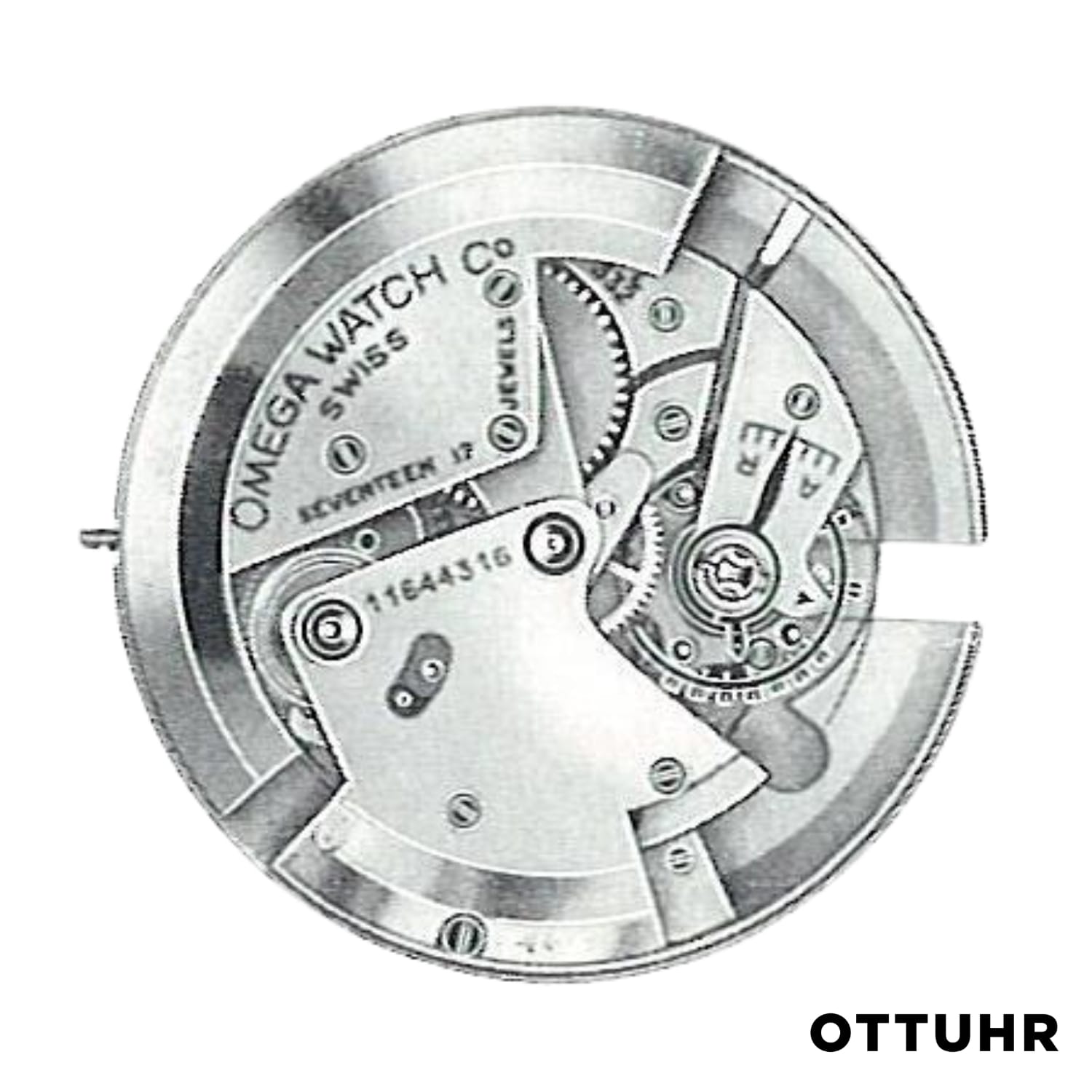
The Omega Caliber 332 designation emerged in 1949 as Omega renumbered their established 28.10 RA PC bumper automatic movement to a cleaner three-digit system, a change that simplified parts ordering and movement identification across the expanding Omega automatic line. The mechanical design behind the 332 had proven itself since 1943, powering hundreds of thousands of Omega watches including the first Seamaster references launched in 1948. This bumper automatic movement represented Omega’s refinement of self-winding technology, packaged with production-ready features that balanced reliability with manufacturability during the postwar period when Swiss manufacturers raced to perfect automatic winding systems.
The 332 served as a workhorse caliber designed for everyday reliability rather than chronometer precision. Its 17-jewel construction, sub-seconds layout, and bumper automatic winding mechanism delivered practical timekeeping in a movement thin enough for dress watch cases yet robust enough for active wear. The movement features a unidirectional bumper winding system where the oscillating weight swings approximately 120 to 130 degrees before striking buffer springs, producing the characteristic “thud” that gives bumper movements their name.
Production estimates for the broader 28.10/30.10/330 family exceed 1.3 million units manufactured between 1943 and 1955, with approximately 500,000 achieving chronometer certification. The specific 332 designation applied from 1949 to 1952, though the mechanical design continued production from 1943 as the 28.10 RA PC. Serial numbers ranging from 10.7 million to 12.1 million correspond to production years 1947 to 1950, covering both the late 28.10 RA PC period and the 332 renumbering era. This positions movements bearing the 332 caliber marking as uncommon rather than rare, with steady availability in the vintage market but decreasing numbers of unrestored examples.
Among collectors, Caliber 332 watches occupy a middle tier in the vintage Omega hierarchy. Steel cases command stronger prices than gold-filled examples, with solid 18-karat gold cases representing the most desirable configurations. Collector interest has remained stable over the past decade, with watches typically trading at $1,500 to $4,000 depending on case material, dial condition, and service history. The movement’s connection to Omega’s bumper automatic heritage provides collector appeal, though the 332 lacks the chronometer adjustments and finishing refinements that elevate later calibers like the 354.
Historical Context, Provenance, and Manufacturing Details
Omega introduced the Caliber 332 designation in 1949 as part of a comprehensive renumbering initiative that converted their existing automatic movement range from complex alphanumeric designations to simplified three-digit caliber numbers. The 332 represented the continuation of the 28.10 RA PC, Omega’s first production automatic movement launched in 1943 as a response to wartime and postwar demand for self-winding watches. This renumbering coincided with Omega’s expansion of their automatic movement family into the 330 series, which included variations for different case sizes, finishing levels, and complication sets.
The original 28.10 RA PC designation decoded as follows: 28.10 indicated the movement size in lignes (28.10mm equals approximately 12.45 lignes, though Omega rounded to 13.5”’), RA signified “remontage automatique” (automatic winding), and PC denoted “petites secondes centrales” or center small seconds mounting despite the sub-seconds display. The transition to “332” eliminated this descriptive complexity in favor of a sequential numbering system that Omega would maintain for decades.
The market need addressed by the 28.10 RA PC and its successor 332 centered on providing reliable automatic winding in a thinner movement suitable for both dress and sport applications. Omega designed the bumper automatic specifically to maintain a slim profile by keeping the oscillating weight and winding mechanism in the same plane as the base movement, avoiding the thickness penalties of full-rotor designs. This engineering priority reflected postwar demand for self-winding watches that could fit traditional case proportions, particularly important for the Seamaster line launched in 1948 to commemorate Omega’s wartime waterproof achievements.
The Caliber 332 designation replaced the 28.10 RA PC nomenclature while maintaining complete mechanical compatibility. Omega subsequently introduced the Caliber 342 in 1949, which modified the bumper mechanism with concealed buffer springs as the primary distinguishing feature. The 342 remained in production through 1955, achieving far greater production numbers under that specific designation than the 332. Later movements in the 330 series added features like sweep seconds (350, 351), chronometer adjustments (340, 343), and swan neck regulators (354).
The Caliber 332 qualifies as an in-house Omega manufacture movement, produced entirely within Omega’s facilities in Bienne, Switzerland. Unlike many period movements that used ébauches from suppliers like ETA or AS, Omega manufactured the complete 332 movement including plates, bridges, and the automatic winding mechanism. This vertical integration gave Omega control over quality and allowed the company to refine the bumper automatic design through multiple iterations without dependency on external suppliers.
Production remained centered in Bienne throughout the caliber’s designation period from 1949 to 1952, with no documented facility changes. The movement’s brass construction and copper-rose gold plating reflect manufacturing standards typical of high-grade Omega movements from this era. The 28.10 RA PC to 332 transition occurred seamlessly in Omega’s production lines, with the mechanical design remaining constant while only the movement plate engravings changed to reflect the new numbering system.
The 332 sits within horological history as part of Omega’s bumper automatic lineage that bridged the company’s early automatic experiments and their later full-rotor movements. The bumper automatic system, while less efficient than bidirectional full-rotor winding, proved sufficiently reliable to power hundreds of thousands of Omega watches through the 1940s and 1950s. Watchmakers today recognize these movements as serviceable workhorses that perform well when properly maintained, though parts scarcity for worn components increasingly challenges restoration work.
Construction and Architecture
The Caliber 332 employs a traditional three-quarter plate construction in brass with copper-rose gold plating, a manufacturing approach that provides structural rigidity while allowing access to the gear train through separate bridges. The movement features a main plate that houses the barrel, center wheel, and third wheel, with the fourth wheel and escape wheel mounted under a dedicated train bridge. The automatic winding mechanism occupies the dial side of the movement, with the oscillating weight, buffer springs, and winding gears visible when the dial and hands are removed.
The base plate material consists of brass, chosen for its machinability and stability, with a decorative copper-rose gold electroplated finish that provides corrosion resistance while creating the warm tone characteristic of vintage Omega movements. This plating typically measures 3 to 5 karats gold content in alloy with copper and zinc, with higher copper content producing the rose gold coloration that tarnishes distinctively over time. The plating is not beryllium bronze as sometimes stated, but rather a copper-gold alloy applied electrochemically over brass substrates.
Balance Wheel: The 332 uses a monometallic beryllium bronze balance wheel, a glucydur-type alloy selected for its thermal stability and resistance to magnetic fields. The balance diameter measures approximately 11 to 11.5 millimeters with a smooth rim lacking timing screws, indicating adjustment occurs through the regulator rather than balance weights. Beryllium bronze balances exhibit a coefficient of thermal expansion of 17 × 10^-6 per degree Celsius, requiring compensation from the hairspring’s thermoelastic properties to maintain rate stability across temperature changes. The balance features no screw adjustment provisions, classifying this as a fixed-balance design regulated entirely through hairspring length adjustment.
Balance Spring: Omega equipped the 332 with a Nivarox alloy hairspring, likely Nivarox 1 or equivalent given the movement’s manufacture period. Nivarox consists primarily of nickel (37 percent), chromium (8 percent), titanium (1 percent), beryllium (0.8 percent), with iron comprising the balance. This proprietary alloy provides temperature compensation through positive thermoelasticity, meaning the hairspring becomes stiffer as temperature rises to offset the increased rotational inertia from thermal expansion of the beryllium bronze balance. The hairspring uses a flat configuration without a Breguet overcoil, with an inner terminal curve that attaches to the collet. Hairspring length and characteristics remain undocumented in available technical literature, though watchmakers report that replacement hairsprings for the 330 series movements require matching to the balance diameter and frequency of 19,800 vph.
Escapement Type: The movement employs a Swiss lever escapement, the industry-standard design featuring a club-tooth escape wheel and pallet fork with two jeweled pallet stones. The escape wheel contains 15 teeth and operates with jeweled pallet stones set in the pallet fork arms at the standard Swiss lever angle. Omega used this escapement design across their entire 330 series production, providing reliable impulse transfer with minimal lubrication requirements when properly adjusted. The straight-line lever configuration indicates standard Swiss construction without modifications for chronometer-level performance.
Shock Protection System: Incabloc provides shock protection for both the balance staff pivots, with the upper shock assembly mounted in the balance cock and the lower assembly mounted in the main plate. The specific Incabloc model uses part number 1347 for the complete upper assembly, with separate catalog numbers for the block, cap jewel, and spring components. Incabloc systems from this period employ a cone-jewel design where the balance staff pivots run on a conical jewel held by a spring-loaded setting, allowing the jewel to absorb shock loads by moving upward within its mounting. The 332 does not feature Incabloc protection for the pallet fork or escape wheel pivots, limiting shock protection to the balance assembly only.
Regulator Type: The 332 uses a standard index regulator of the Bosley type, featuring a movable curb pin assembly controlled by a regulator lever marked with fast (F or +) and slow (S or -) indicators. This represents the most basic regulation system, contrasting with the swan neck micrometric regulators found on higher-grade calibers like the 354. The index regulator adjustment requires direct manipulation of the regulator lever, typically using a brass lever or pegwood to avoid scratching the movement. No fine-adjustment screws assist regulation, requiring watchmakers to make incremental movements until achieving desired rate. The regulator itself mounts on the balance cock with the curb pins positioned to grip the hairspring near its outer terminus, controlling effective hairspring length and thus oscillation frequency.
Mainspring Material and Type: The mainspring specifications for Caliber 332 measure 1.10 millimeters width, 0.095 millimeters thickness, 300 millimeters length, and 9.0 millimeters barrel arbor diameter. This sizing identifies the mainspring as an automatic-wind type designed for the specific power requirements and space constraints of the bumper mechanism. The mainspring material likely consists of a Nivaflex alloy, standard for Omega movements of this period, though the specific Nivaflex grade (NO versus NM) remains undocumented. The mainspring attaches to the barrel arbor with a bridle end that permits slipping when the spring reaches full wind, preventing overwinding damage common in manual-wind movements. Barrel dimensions and mainspring characteristics match other calibers in the 330 series, indicating parts interchangeability within this movement family.
Gear Train Details: The 332 employs a four-wheel gear train typical of three-hand watches with indirect center seconds. The center wheel drives the third wheel, which drives the fourth wheel that completes one rotation per minute. The fourth wheel drives the escape wheel through the gear train. The sub-seconds hand mounts on the fourth wheel through a separate arbor that extends through the dial, positioning the seconds subdial at the 6 o’clock position. Specific gear ratios remain undocumented in available technical sources, though the 19,800 vph frequency and standard Swiss construction suggest conventional ratios common to movements of this size and beat rate. The center wheel configuration uses indirect drive from the barrel through the great wheel, a construction approach that permits thinner movement architecture compared to direct-drive designs.
Finishing Quality and Techniques: The Caliber 332 receives basic industrial finishing appropriate to its positioning as a production-grade movement. Movement plates exhibit perlage (circular graining) applied by machine in regular patterns across visible plate surfaces. Bridge edges show simple beveling without hand polishing, and screw heads receive simple slots without blued steel decoration. The movement lacks Côtes de Genève (Geneva stripes), reserved for higher-grade Omega calibers with chronometer adjustments. The brass movement exhibits the characteristic copper-rose gold plating that provides the warm coloration collectors associate with vintage Omega movements, though this plating tarnishes distinctively when exposed to humidity and handling oils. Finishing quality remains consistent throughout the designation period from 1949 to 1952, with no documented grade variations or elaboration levels within the 332 nomenclature. The movement does not carry chronometer adjustment markings, confirming its positioning as a standard-grade caliber without the five-position adjustments found on calibers 340, 343, and 354.
Cross-Reference Data
Alternative Caliber Names
| Manufacturer | Caliber Designation | Notes |
|---|---|---|
| Omega | 28.10 RA PC | Original designation 1943-1949, mechanically identical to 332 |
| Omega | 330 | Base caliber for the series, sub-seconds |
The Caliber 332 was not sold under different brand names or rebranded for third-party manufacturers. Omega retained this movement exclusively for watches branded as Omega. The 28.10 RA PC represents the same mechanical design produced before Omega’s 1949 renumbering initiative.
Base Caliber vs. Elaborated Versions
The 332 represents a mid-series caliber within the 330 family, positioned between the original 330 base and the more refined 342 that introduced concealed buffer springs. All variants in the 330 through 354 range share substantial parts compatibility, particularly for the balance complete, mainspring, and gear train components.
Compatible Case References by Brand
All case references compatible with Caliber 332 use press-in case backs with case clamps to secure the movement. The movement mounting system employs case clamps (part numbers 1911, 1975) that screw into the movement to prevent tilting in larger cases. Case sizes typically measure 33 to 36 millimeters excluding crown, with 35 millimeters representing the most common diameter.
Dial Compatibility Note
The Caliber 332 positions the sub-seconds register at 6 o’clock through the fourth wheel arbor that extends through the dial. Dial foot positions follow Omega’s standard spacing for 30-millimeter movements, with two dial feet providing secure mounting. The movement does not include a date window or date mechanism, limiting dial compatibility to time-only configurations with sub-seconds at 6 o’clock. Collectors and restorers should verify dial foot positions match the specific case reference, as Omega occasionally modified dial foot placement between case iterations even when using the same caliber. Dials from 28.10 RA PC watches interchange with 332 movements as the mechanical layout remained identical.
Crown and Stem Specifications
| Specification | Value |
|---|---|
| Stem Thread | TAP 10 |
| Stem Part Number | 401 (generic designation) |
| Setting Mechanism | Yoke-type clutch system |
The Caliber 332 uses a TAP 10 threaded stem, standard for Omega movements of this size and period. Crown specifications vary by case reference, with signed Omega crowns appropriate for all original case configurations. The setting mechanism employs a yoke-type clutch where the winding pinion disengages from the crown wheel during time setting, a reliable design that minimizes wear on the winding gears. Stems from 28.10 RA PC movements interchange with 332 calibers.
Identification Marks
Authenticating a Caliber 332 requires examining multiple characteristics across the movement, case, and dial. Collectors must verify correct markings, finishing patterns, serial number formats, and parts compatibility to confirm originality. The distinction between 28.10 RA PC and 332 designations becomes critical when dating watches, as the same mechanical movement carries different engravings depending on production period.
Caliber Number Location: The caliber designation “332” appears engraved on the movement plate, typically visible near the balance cock or on the main plate area accessible after removing the balance cock. Omega marked the caliber number in small, precise machine engraving, though placement varies slightly between production batches. The caliber number should appear crisply engraved with consistent depth and sharp letter forms, not hand-stamped or irregularly formed. Movements produced before 1949 will carry “28.10 RA PC” instead of “332” even when mechanically identical.
Logo and Brand Marks: Authentic Caliber 332 movements carry “Omega Watch Co” markings on the main plate or bridges, typically accompanied by “Swiss” or “Swiss Made” to indicate country of manufacture. The Omega logo itself may appear on the oscillating weight (rotor), engraved or stamped depending on production period. Movements should display “17 Jewels” marking somewhere on the main plate or bridge, confirming the jewel count. Quality stamps or additional manufacturer marks rarely appear on standard-grade 332 movements, distinguishing them from chronometer calibers that carry adjustment markings.
Date Codes: Omega did not use date codes on the Caliber 332 itself. Dating the movement requires cross-referencing the serial number engraved on the movement plate with known Omega serial number production records. The serial number provides the primary dating mechanism, not letter codes or other date indicators. Collectors must recognize that watches with serial numbers in the 10.7 million to approximately 11.5 million range (1947-1949) may carry either 28.10 RA PC or early 332 designations depending on when during the 1949 transition the movement received its final engraving.
Finishing Marks: Expect machine perlage (circular graining) across visible plate surfaces, applied in regular overlapping patterns. Bridge edges should show simple beveling without extensive hand finishing or black polishing. Screw heads receive simple slotting without blued steel heat treatment. The movement plating exhibits a copper-rose gold color that tarnishes to darker brown or bronze tones over time, particularly on plates exposed to humidity and handling. Authentic movements lack Geneva stripes (Côtes de Genève), which Omega reserved for higher-grade calibers. Any movement claiming to be a standard 332 that displays Geneva stripes, extensive anglage, or polished screw heads requires additional verification, as these finishing characteristics indicate either incorrect identification or non-original modifications.
Jewel Markings: The 17 jewels in a Caliber 332 use standard pressed jewel settings without gold chatons. The balance jewels mount in the Incabloc shock protection system, identifiable by the spring-loaded cap jewel visible when examining the balance cock and main plate. Pallet jewels should appear as red rubies set in the pallet fork arms. Authentic movements do not use synthetic jewels marked with budget materials; Omega specified genuine jewel bearings throughout their production movements. The jewel count marking “17 Jewels” or “17 Rubis” appears engraved on the movement plate, confirming the official jewel count.
Adjustment Markings: The Caliber 332 does not carry chronometer adjustment markings, differentiating it from higher-grade calibers like the 340, 343, or 354. Authentic 332 movements should not display engravings indicating “Adjusted to 5 Positions” or “Chronometer” unless the movement has been incorrectly identified. The absence of adjustment markings confirms correct identification as a standard-grade caliber. The 28.10 RA PC designation could appear on chronometer-adjusted movements marked as 28.10 RA (without PC suffix), but the standard 28.10 RA PC and 332 lack these markings.
Correct Serial Number Formats and Locations: Serial numbers appear engraved on the movement plate, typically on the main plate between the barrel and center wheel, visible after removing the balance cock and associated bridges. Omega used sequential seven to eight-digit serial numbers during the 332 designation period from 1949 to 1952. Serial numbers for Caliber 332 movements typically fall within the 11,000,000 to 12,500,000 range based on documented examples, corresponding to production years 1949 to 1951. Earlier serial numbers in the 10,700,000 to 11,000,000 range correspond to late 28.10 RA PC production before the 1949 renumbering. The serial number format consists of seven to eight digits with no letters or prefixes during this period, engraved in a single line with consistent depth and spacing. Collectors should verify that the movement serial number falls within the appropriate range for the caliber designation, as serial numbers below 11 million combined with “332” engraving may indicate replacement parts or incorrect servicing.
Expected Engravings and Stampings: Legitimate Caliber 332 movements display the following engravings in crisp, machine-executed formats: caliber number “332” on the movement plate; “Omega” or “Omega Watch Co” on the main plate or bridges; “Swiss” or “Swiss Made” indicating country of origin; “17 Jewels” confirming jewel count; and the serial number in seven or eight digits. Engravings should exhibit consistent depth, uniform character height, and sharp edges without irregular stamping marks. Hand-stamped or roughly executed markings suggest non-authentic components or amateur repair work. The case back interior typically carries engravings including “Omega Watch Co,” “Fab Suisse” (Swiss Made), case reference numbers, and Swiss precious metal hallmarks when applicable. Case back engravings use a different style than movement engravings, typically larger and bolder to accommodate case back dimensions.
Font and Marking Style by Production Era: Omega maintained relatively consistent engraving styles throughout the 332 designation period from 1949 to 1952, with machine engraving producing uniform character heights and spacing. The caliber designation “332” appears in simple sans-serif numerals approximately 1.5 to 2 millimeters in height. The “Omega” brand marking uses a serif font consistent with period Omega typography, with letter heights of approximately 2 to 3 millimeters. Serial numbers employ simple Arabic numerals in consistent sizing, engraved in a single line without prefix letters. The transition from 28.10 RA PC to 332 marking occurred during 1949, with movements from this transitional period potentially showing variation in engraving placement or slight stylistic differences as Omega updated their movement engraving equipment. Later movements in the 330 series (350s) show similar engraving styles, indicating Omega maintained standardized marking equipment throughout the late 1940s and early 1950s.
Part Information

Part Numbers
Movement Components:
Sourcing Notes
Parts availability for the Caliber 332 has declined significantly as original Omega stock has been exhausted and movements have been cannibalized for repair parts over the past 70 years. Omega discontinued factory support for calibers of this vintage, requiring watchmakers to source parts through specialized vintage suppliers, donor movements, and aftermarket manufacturers.
Still Available Parts: Mainsprings remain available through suppliers like Ofrei, Cousins UK, and WatchMaterial using the 1.10 x 0.095 x 300 x 9.0mm specification. Incabloc shock protection components, particularly the upper complete assembly (part 1347), continue in limited stock from vintage parts dealers. Basic movement holders like case clamps (1911, 1975) and case screws appear periodically through specialist suppliers. Generic components such as stems, crowns, and crystals remain available as these parts fit multiple caliber families.
Commonly Failed Parts: The bumper spring (1415) represents the most critical wear component, as repeated impacts from the oscillating weight cause metal fatigue and eventual breakage. The oscillating weight bearing and associated pivots wear from continuous rotation, sometimes requiring replacement of the entire bearing plate assembly (1403). Escape wheel teeth can chip or wear from years of operation, though this occurs less frequently than bumper spring failure. The automatic winding mechanism components, particularly the pawls (1407) and driving gears, wear from the unidirectional winding action. Balance staffs break under shock loads when the Incabloc system becomes contaminated or damaged, requiring replacement of the complete balance or balance staff (723).
Acceptable Generic Replacements: Mainsprings from quality suppliers like Ranfft and specialists in Nivaflex springs provide acceptable replacements when sized correctly to the 1.10 x 0.095 x 300 x 9.0mm specification. Generic Incabloc components sometimes substitute for original Omega parts, though watchmakers must verify exact dimensional compatibility. Stems can use generic TAP 10 threaded stems if original Omega stems remain unavailable, provided the stem height and shoulder dimensions match. Crystals typically require generic replacements as original Omega hesalite crystals for 1940s and 1950s cases no longer exist in new-old-stock condition. No acceptable substitutes exist for the balance complete, escape wheel, pallet fork, or caliber-specific bridges, requiring watchmakers to source original Omega parts or donor movements for these components.
Performance Data
Manufacturer Specifications
Omega specified the Caliber 332 for standard grade performance without chronometer certification. The movement does not carry manufacturer-stated accuracy specifications in the same way that chronometer-grade calibers like the 340, 343, or 354 documented adjustment tolerances. Period Omega documentation from the 1940s and 1950s does not provide specific accuracy claims for non-chronometer bumper movements, focusing marketing efforts instead on the automatic winding feature and reliability rather than precision timekeeping.
The 332 received no positional adjustment during manufacture, distinguishing it from chronometer calibers adjusted in five positions (dial up, dial down, crown up, crown down, crown left, crown right). Temperature compensation occurs passively through the thermoelastic properties of the Nivarox hairspring working in conjunction with the beryllium bronze balance wheel, without active compensation mechanisms or testing. Isochronism, the consistency of rate regardless of mainspring tension from fully wound to nearly depleted, was not formally measured or adjusted in standard-grade movements, though the design of the mainspring and barrel aimed for reasonable isochronism across the 42-hour power reserve.
Observed Performance (Field Data)
Well-maintained Caliber 332 movements typically achieve accuracy of plus or minus 10 to 20 seconds per day in normal wearing conditions. This represents the expected range for a non-chronometer bumper automatic from the 1940s and 1950s, reflecting the movement’s positioning as a reliable daily wear caliber rather than a precision instrument. Some examples perform better, achieving plus or minus 5 to 10 seconds per day when freshly serviced and properly regulated, though this level of performance requires recent service by a skilled watchmaker and optimal operating conditions.
Common performance issues in surviving 332 movements include: worn bumper springs causing inefficient winding and reduced power reserve; contaminated or dried lubricants increasing friction and reducing amplitude; worn pivots or jewel bearings creating excessive positional variation; magnetization from modern electronics affecting rate consistency; and damaged or improperly adjusted escapements causing erratic timekeeping. The bumper automatic mechanism itself introduces positional sensitivity, as the oscillating weight’s position affects the balance when the watch rests in certain orientations.
Expected amplitude when fully wound typically measures 240 to 280 degrees on a timegrapher, indicating healthy mainspring power and proper escapement function. As the power reserve depletes over the 42-hour period, amplitude drops to 180 to 220 degrees before the movement stops. Watchmakers consider amplitudes below 200 degrees when fully wound as indication of service requirements, whether from dried lubricants, worn components, or weak mainsprings.
Performance degradation occurs predictably as movements age without service. After 10 to 15 years without proper cleaning and lubrication, amplitude drops noticeably and accuracy deteriorates as lubricants oxidize and migrate. The bumper mechanism shows wear faster than the base movement, with bumper springs typically requiring replacement after several decades of operation. Collectors should expect any 70-year-old Caliber 332 to require complete service including cleaning, lubrication, adjustment, and likely replacement of worn components to achieve reliable performance.
Positional variation in surviving examples typically shows the largest rate differences between dial-up and crown-down positions, sometimes exceeding 30 to 40 seconds per day difference between these orientations in movements needing service. Well-regulated examples can achieve positional variations of 10 to 15 seconds per day, though this requires careful regulation and optimal component condition. The lack of factory positional adjustment means watchmakers must regulate these movements based on the wearer’s typical usage pattern, usually optimizing for wrist-worn positions rather than attempting to achieve equal rates across all positions.