

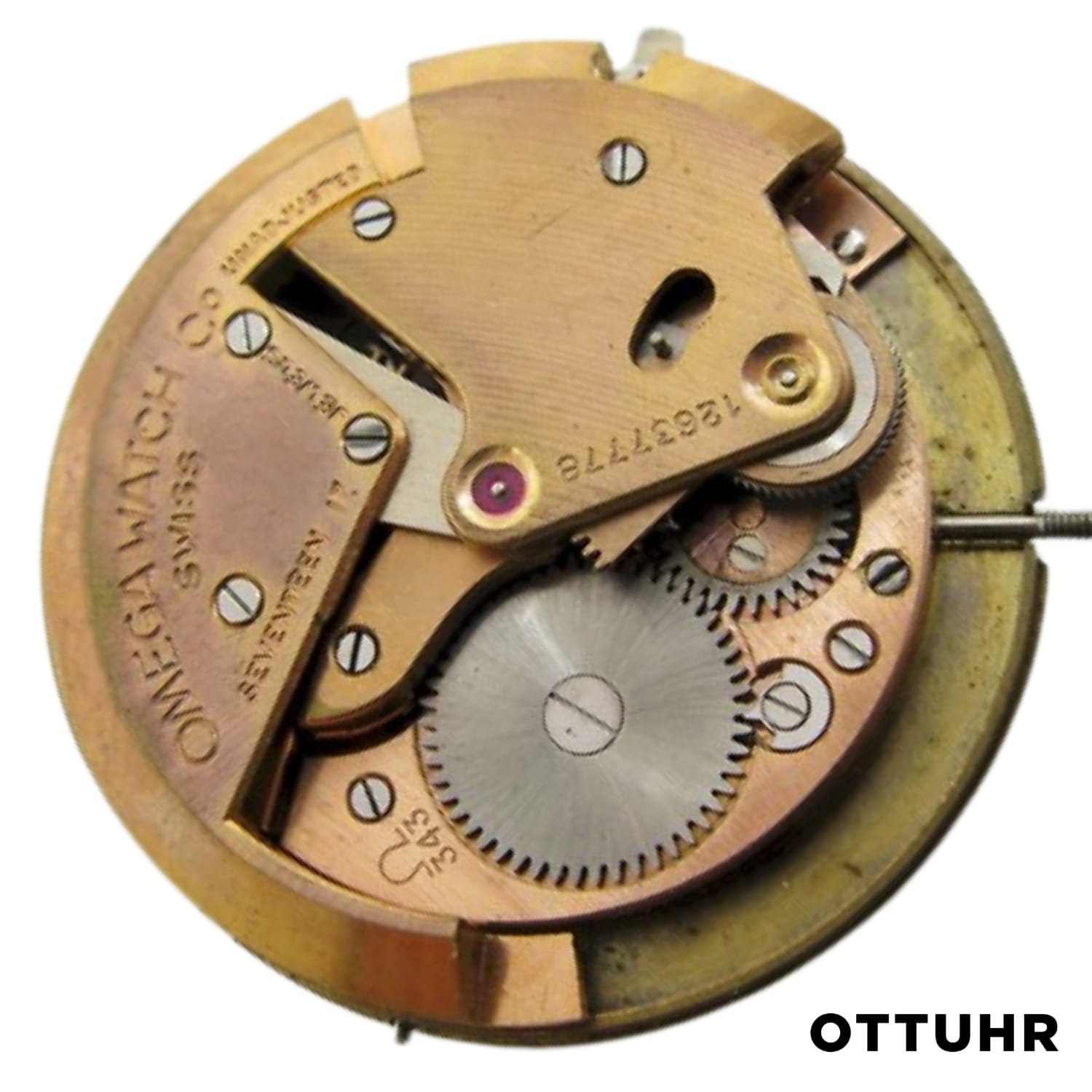
The Omega caliber 343 represents a pivotal moment in Omega’s history as one of the first chronometer-grade bumper automatic movements to power the groundbreaking Centenary collection celebrating Omega’s 100th anniversary in 1948. This movement preceded both the legendary Seamaster and Constellation lines, establishing Omega’s reputation for producing precision automatic wristwatches that could achieve chronometer certification while remaining thin enough for elegant dress watch cases at just over 5mm in height.
The caliber 343 belongs to Omega’s 30.10mm bumper automatic family, derived from the pioneering 28.10RA PC introduced in 1943. What distinguishes the 343 from its siblings is the eccentric regulator system (designated “RG” in Omega’s technical nomenclature), which allows for extremely fine rate adjustment critical to achieving chronometer specification. The movement powered some of Omega’s most prestigious references of the era, including the Centenary ref. 2499 and 2518, as well as early Seamaster chronometer models. Watchmakers and collectors regard the 343 as representing Omega’s bumper technology at its zenith, just before the company transitioned to full-rotor automatic movements with the caliber 470 series in 1955.
Production estimates for the caliber 343 suggest Omega manufactured approximately 15,000 to 20,000 units during its brief three-year production window from 1950 to 1953. This figure is derived from serial number analysis and production records referenced in collector forums, though Omega has never officially published total production numbers. The relatively short production period and the movement’s use primarily in precious metal chronometer-grade watches make the caliber 343 considerably scarcer than the more common caliber 342 (used in the first Seamaster models) or the later full-rotor caliber 500 series. Collectors rate the 343 as uncommon to scarce, with chronometer examples commanding premium prices due to their superior finishing and adjustment.
The caliber 343 occupies a unique position in today’s collector market as a transitional movement bridging Omega’s early automatic experiments and its later dominance in the automatic chronometer segment. Demand remains stable among Omega collectors who appreciate the historical significance of the Centenary models and early chronometer Seamasters. Watches housing the 343 chronometer grade with intact original dials and cases routinely command $3,000 to $8,000 at auction, with exceptional examples in precious metals exceeding $10,000. The non-chronometer 17-jewel variants are less sought after but still collectible. Parts availability presents challenges, as many winding components have been cannibalized over decades of service, making complete restoration increasingly difficult and expensive.
Historical Context, Provenance, and Manufacturing Details
Omega developed the caliber 343 in 1949 as part of a comprehensive upgrade to its bumper automatic line, introducing it to the market in 1950. The movement addressed a specific market demand: collectors and professionals sought automatic wristwatches that could achieve observatory chronometer certification while maintaining the slim profile necessary for formal dress watches. Prior automatic movements, including Omega’s own 28.10RA PC, rarely achieved chronometer specification consistently due to positional errors inherent in early automatic winding systems. The 343’s eccentric regulator (RG system) solved this problem by allowing watchmakers to perform extremely fine adjustments to the rate, compensating for these positional variations.
The caliber 343 directly evolved from the 28.10RA PC (later renamed caliber 330 when Omega adopted numeric designations in 1949). While the core architecture remained identical, including the characteristic bumper winding mechanism with concealed buffer springs, Omega added the eccentric regulator specifically for the 343. This modification allowed the movement to be regulated to chronometer standards more reliably than the simpler index regulator used in the base 330 and 342 calibers. The 343 succeeded the earlier chronometer-grade caliber 340 (28.1mm size) and ran concurrently with other bumper variants including the 342 (first Seamaster caliber), 350 (sweep seconds), and 351 (sweep seconds chronometer).
Omega eventually replaced the entire bumper automatic family, including the 343, with the caliber 470 and 490 series beginning in 1955. These new movements featured full 360-degree rotor winding that proved more efficient and reliable than the bumper system’s limited 270-degree oscillation. The successor to the 343’s chronometer mission was the caliber 501, a 19-jewel full-rotor automatic chronometer introduced in 1956. However, the 501 quickly gave way to the famous 24-jewel caliber 504 and 505 movements that powered the early Constellation line and cemented Omega’s reputation for automatic chronometer excellence.
The caliber 343 is an in-house manufacture movement designed and produced entirely by Omega at their Bienne, Switzerland facilities. Unlike many contemporary Swiss movements that relied on ébauche suppliers such as ETA, A. Schild, or Peseux for base movements, Omega developed the entire 28.10mm bumper family from the ground up. This vertical integration gave Omega complete control over quality, finishing, and the ability to produce chronometer-grade movements at scale. The factory maintained dedicated production lines for bumper automatic movements separate from manual-wind calibers, with specialized tooling for the complex automatic winding components.
Production remained concentrated at Omega’s main Bienne manufacture throughout the caliber 343’s entire lifespan from 1950 to 1953. No evidence exists of production transfers or outsourcing to satellite facilities. The movement represents a transitional technology in horological history, coming at the end of the bumper automatic era that dominated automatic watchmaking from the 1930s through early 1950s. While not groundbreaking in the way Rolex’s full-rotor system or later Omega innovations would be, the 343 was a highly refined execution of bumper technology, achieving chronometer certification rates that few other bumper movements could match.
Construction and Architecture
The Omega caliber 343 employs a traditional three-quarter plate construction typical of Omega’s 28.10mm movement family. The architecture features a large main plate made of brass with nickel-silver alloy plating, a single barrel bridge, a train wheel bridge covering the center wheel through fourth wheel, and a separate balance cock. The automatic winding mechanism mounts to the movement side visible through case backs, with a lower bumper bridge securing the winding weight’s pivoting base and an upper bridge containing the concealed buffer springs characteristic of the 342/343/344 series. This layout provided excellent stability for the gear train while allowing the large winding weight to oscillate freely through its approximately 270-degree arc.
The caliber 343 utilizes a bimetallic compensating balance wheel with gold-colored timing screws. The balance measures approximately 9.5mm in diameter, which is relatively large for a movement of this size and contributes to excellent timekeeping stability. The balance features screws positioned around its rim for poising and timing adjustment, a design that predates the modern smooth balance with weights. Omega used a Glucydur-type alloy for the balance rim, providing temperature compensation through the different expansion coefficients of the two metals in the bimetallic construction. The number of timing screws varies slightly by production period but typically features 12 screws, with two pairs designated for timing adjustment and the remainder for poising.
The hairspring is a flat Nivarox alloy spring with a Breguet overcoil terminal curve. Nivarox, developed in the 1930s, provided superior temperature and magnetic resistance compared to earlier blued steel springs. The Breguet overcoil (also called a Phillips terminal curve) allows the hairspring to breathe concentrically as it expands and contracts, improving isochronism and positional timekeeping. On chronometer-grade 343 movements, the hairspring includes an inner terminal curve attached to the collet for additional precision. The spring mounts to a triangular brass collet pressed onto the balance staff, with the outer terminal secured in the stud mounted on the balance cock.
The escapement follows the standard Swiss lever design with a forked steel pallet assembly engaging a brass escape wheel. The pallet fork pivots on a steel arbor jeweled top and bottom, while the ruby pallet stones themselves are directly jeweled in the fork. The escape wheel features 15 teeth and is fully jeweled with synthetic ruby bearings top and bottom. This escapement architecture is fundamentally unchanged since its development in the 18th century and remains the most common type in mechanical watchmaking due to its reliability and resistance to position errors. The caliber 343’s escapement components are finished to chronometer standards on certified examples, with polished lever faces and carefully shaped impulse faces on the escape wheel teeth.
Omega employed the Incabloc shock protection system on all caliber 343 movements. Introduced in 1934, Incabloc uses a lyre-shaped spring to hold jeweled settings for the balance staff pivots. During impact, the spring compresses, allowing the jewel settings to displace and absorb shock energy before returning to center when the impact ends. On the 343, Incabloc protection is applied to both upper and lower balance staff jewels, with the characteristic cone-shaped jewel settings clearly visible when examining the balance area. The system uses Incabloc reference blocks sized for the 28.10mm movement family, with jewel hole diameter of approximately 1.35mm and cap jewel diameter of 2.62mm.
The caliber 343’s regulator is the defining feature distinguishing it from other bumper automatic variants. The movement uses an eccentric regulator system (Omega’s “RG” designation), consisting of a swan-neck fine adjustment mechanism. This regulator allows the watchmaker to move the regulator pins with extreme precision by turning a screw, which rotates an eccentric cam that pushes against the regulator assembly. The swan-neck design provides both coarse and fine adjustment capabilities, with the swan-neck spring maintaining constant pressure against the adjusting screw to prevent drift. This sophisticated system permitted Omega’s chronometer workshop to adjust 343 movements to the tight tolerances required for observatory certification, typically achieving rates of +/- 2 seconds per day or better in five positions.
The mainspring is a traditional carbon steel alloy spring with Molybdenum alloying for increased durability. The spring measures approximately 1.20mm in height, 0.100mm in thickness, and 290mm in length when uncoiled, fitting in a barrel 9.0mm in diameter. Later production 343 movements may have used early Nivaflex alloy mainsprings, which began appearing in Omega movements in the early 1950s. The mainspring attaches to the barrel arbor via a hole in the inner coil (fixed attachment) and to the barrel wall via a traditional hook on the outer coil. The bumper automatic winding mechanism winds the mainspring unidirectionally, with a ratchet and click preventing reversal.
The gear train consists of four wheels plus the escape wheel, following standard Swiss watchmaking practice. Starting from the barrel, power flows through the center wheel (driving the minute hand), third wheel, fourth wheel (driving the sub-seconds hand at 6 o’clock), and finally the escape wheel. The center wheel is indirect drive, meaning it is not mounted on the cannon pinion but meshes with it through a separate pinion. Gear ratios follow standard calculations for 19,800 vph frequency: the fourth wheel rotates once per minute to drive the sub-seconds hand, while the escape wheel makes 1.6 rotations per second (96 per minute). All gear wheel arbors are jeweled except for the center wheel on standard 17-jewel versions, though chronometer grades jewel the center wheel for reduced friction and improved long-term performance.
Finishing quality on the caliber 343 varies significantly between the standard 17-jewel version and the 24-jewel chronometer grade. Standard versions receive basic finishing including Geneva stripes (Côtes de Genève) on the main plate and bridges, circular graining (perlage) on the lower plate, and chamfered edges on bridge outlines. Screw heads are typically polished but not blued. Chronometer-grade movements receive significantly enhanced finishing, including finer Geneva stripes, additional jeweling (bringing the total to 24 jewels including center wheel and additional winding system jewels), gold chatons for the balance jewels, fully polished and beveled balance cock edges, blued screws throughout, and additional perlage work. The movement plates on chronometer examples are also marked “Officially Certified Chronometer” and carry adjustment markings indicating testing in five positions and two temperatures.
Cross-Reference Data
Alternative Caliber Names and Rebranded Versions
Base Caliber vs. Elaborated Versions
Compatible Case References by Brand
Dial Compatibility
The caliber 343 uses a standard Omega dial foot configuration for the 28.10mm movement family with dial feet at approximately 6:00 and 3:00 positions. The sub-seconds display is at 6 o’clock, requiring dials with a sub-seconds chapter ring or aperture at that position. No date complication exists on the 343, so all compatible dials are time-only with sub-seconds. Dial diameter typically ranges from 27.5mm to 28.5mm depending on case design. Hour and minute hands fit cannon pinion and hour wheel with standard dimensions (hour hand hole approximately 1.40mm, minute hand hole approximately 0.75mm). Sub-seconds hand fits the fourth wheel arbor extending through the dial. Original dials for the Centenary models feature applied gold indices and are particularly valuable to collectors.
Crown and Stem Specifications
Identification Marks
Identifying an authentic Omega caliber 343 requires examining multiple aspects of the movement’s construction, finishing, and markings. The caliber number is engraved on the main plate, typically visible when viewing the movement from the winding mechanism side (case back side). The engraving reads “343” in a serif font consistent with Omega’s 1950s style, positioned near the balance cock or on the barrel bridge. Earlier examples may carry the “28.10 RA PC T1 RG” designation before Omega adopted simplified numeric nomenclature in 1949.
The movement plate features the Omega logo and “Swiss Made” text engraved or printed near the balance area. On chronometer-grade examples, additional text reading “Officially Certified Chronometer” or “Chronomètre” appears on the movement plate, typically arcing around the balance cock or positioned prominently on the main plate. The Omega logo style from this period features the classic script lettering that remained largely consistent through the 1950s. Case serial numbers are stamped on the inside case back and should fall within the range of 10,000,000 to 13,500,000 for watches produced between 1948 and 1953.
Omega did not use a codified date code system in the 1950s, but production dates can be estimated through serial number analysis. The movement itself carries a separate caliber number (not a serial number in the modern sense), while the case back interior features both a model reference number (such as 2499 or 2518) and a unique serial number. The combination of case reference, case serial number, and caliber designation allows collectors to authenticate and date examples with reasonable accuracy.
Expected finishing patterns vary between standard and chronometer grades. Standard 17-jewel versions display Geneva stripes (Côtes de Genève) on bridges running in parallel lines perpendicular to the bridge length. The pattern should be regular and evenly spaced, though not as refined as on higher-grade movements. The lower plate receives circular graining (perlage) creating a textured surface that reduces reflections and looks decorative. Bridge edges should be gently chamfered (beveled) but not highly polished on standard grades. Chronometer versions exhibit finer Geneva striping with tighter spacing, fully polished chamfers on all bridges, additional perlage work, and blued steel screws with polished heads.
Jewel settings on the caliber 343 use a combination of pressed jewels and chatons. The balance jewels are mounted in Incabloc settings with cone-shaped jewels visible from both top and bottom. On standard grades, these Incabloc blocks are undecorated metal (brass or nickel-silver). Chronometer grades feature gold chatons for the balance jewels, which are easily identified by their gold color contrasting with the movement’s nickel-silver plating. Other jewels in the gear train are pressed directly into the bridges and plates without chatons, a cost-saving measure common in this era. The total jewel count should be 17 on standard versions or 24 on chronometer grades, with the difference primarily in center wheel jeweling and additional jeweling in the automatic winding mechanism.
Adjustment markings on chronometer-certified movements indicate the testing regimen the movement passed. Omega chronometer movements from this era typically bear markings such as “Adjusted to 5 Positions” or simply “5 Positions,” indicating testing in dial up, dial down, crown up, crown left, and crown right positions. Some examples also indicate temperature testing (“2 Temperatures” or “Temp”), meaning the movement was tested at both room temperature and elevated temperature to verify rate stability. These markings are engraved on the main plate or balance cock and should be crisp and clear, not re-engraved or artificially aged.
Movement serial numbers on the Omega 343 appear on the main plate and should match the style and depth of other authentic Omega engravings from the period. Serial number formats typically consist of 8 digits, with numbers in the range appropriate to early 1950s production. The case reference number (2499, 2518, etc.) is stamped on the inside case back and should align with known references for watches using the caliber 343. Case serial numbers follow a separate sequence and do not correlate directly with movement serial numbers but should fall within ranges documented for the production period.
Font and engraving style evolved slightly over the caliber 343’s production run but remained generally consistent. Engravings should be sharp with clear, even depth and spacing. The Omega logo maintained its classic script style throughout this period without significant variation. Chronometer certification text uses a formal serif font appropriate to official certifications. Any markings that appear poorly executed, use incorrect fonts, show signs of re-engraving, or include anachronistic terminology should raise authentication concerns. The movement plates should show age-appropriate patina, with the nickel-silver plating potentially showing some darkening or light corrosion typical of 70+ year-old movements, but finishing patterns should remain clearly visible without excessive wear that would suggest refinishing.
Part Information

Critical Component Part Numbers
Sourcing and Restoration Notes
Parts availability for the Omega caliber 343 presents significant challenges for restoration. The automatic winding components, particularly the oscillating weight (bumper), upper and lower bridges, and buffer springs, commonly fail due to the mechanical stress inherent in bumper automatic operation. These parts have been extensively cannibalized from donor movements over decades, making original parts increasingly scarce. Complete automatic assemblies sometimes appear on specialist parts marketplaces but command premium prices.
Mainsprings remain readily available as they share dimensions with other movements in the 28.10mm family. Generic Nivaflex mainsprings of the correct dimensions provide acceptable replacements, though purists prefer period-correct steel springs. Balance staffs are available from specialty suppliers, with the Omega 1321 staff fitting the entire 330-355 caliber range. However, the complete balance assembly with correctly regulated hairspring is difficult to source intact, often requiring transfer from a donor movement.
Escape wheels, pallet forks, and other gear train components have moderate availability through cross-reference with AS (A. Schild) movements that share similar dimensions. Crown wheels, ratchet wheels, and other keyless works components remain available from established parts suppliers. Jewels, particularly Incabloc components, are available as generic parts sized for the movement. Acceptable generic replacements exist for most non-automatic components, though collectors and professional restorers prefer original Omega parts where possible.
The biggest restoration challenge involves the automatic winding mechanism. Complete failure of the bumper assembly is common, and many watchmakers convert failed bumper automatics to manual-wind operation rather than sourcing increasingly rare and expensive automatic components. This practice, while preserving the timekeeping function, significantly reduces collector value. Serious restoration of a caliber 343 often requires purchasing a second movement as a parts donor, making authentic, fully functional automatic examples increasingly valuable.
Performance Data
Manufacturer Specifications
Omega specified the caliber 343 chronometer grade to achieve accuracy of +4/-2 seconds per day when new and properly regulated. Testing occurred in five positions (dial up, dial down, crown up, crown left, crown right) and at two temperatures (room temperature and elevated temperature, typically 36-38°C). This testing regimen followed Swiss chronometer standards prevalent in the 1950s, which were slightly less stringent than modern COSC standards but still represented the highest civilian timekeeping certification available.
Temperature compensation is inherent in the bimetallic balance construction but is passive rather than active. The Glucydur-type balance alloy provides temperature stability across the tested range without requiring adjustment. The movement was not designed for extreme temperature operation and performs best between 5°C and 40°C.
Isochronism, the consistency of rate regardless of mainspring tension, was carefully optimized through hairspring design and regulator adjustment on chronometer examples. The Breguet overcoil terminal curve improves isochronism significantly compared to flat hairsprings, allowing the movement to maintain relatively consistent rate from full wind through the last hours of power reserve. However, rate does degrade noticeably in the final 6-8 hours of the power reserve as mainspring torque drops below optimal levels.
Observed Performance (Field Data)
Well-maintained caliber 343 chronometer examples typically achieve +/- 5 to 10 seconds per day in normal wrist wear. This represents good performance for a 70+ year-old bumper automatic, though not matching the original chronometer specification. Non-chronometer 17-jewel versions typically run +/- 10 to 20 seconds per day when properly serviced. Position error (variation in rate between positions) increases with age as pivots wear and lubricants degrade.
Common performance issues include amplitude loss due to aged mainsprings, worn barrel arbor pivots, and degraded lubricants. The bumper automatic winding system itself becomes a source of problems as bearings wear and buffer springs lose tension. Worn or broken buffer springs cause excessive shock to the gear train as the bumper slams into its stops, potentially damaging wheel teeth and pivots. Many watchmakers report that the automatic winding mechanism requires complete overhaul during service, not just cleaning and lubrication.
Expected amplitude when fully wound ranges from 270 to 310 degrees on a timing machine. As power reserve depletes, amplitude drops to approximately 180 to 220 degrees before stopping. Amplitude below 220 degrees when fully wound indicates problems requiring attention, such as a weak mainspring, excessive friction from dried lubricants, or damaged escapement components. Chronometer-grade movements with jeweled center wheels maintain higher amplitudes longer than non-jeweled versions due to reduced friction.
Performance degradation over time follows predictable patterns in the caliber 343. The automatic winding mechanism shows wear first, with reduced winding efficiency or complete failure after 20-30 years without service. Main plate bearing wear, particularly at the center wheel (if not jeweled), causes amplitude loss and position error. Hairspring settling or damage affects rate stability, while aged mainsprings lose torque and power reserve. A typical 343 showing significant timekeeping degradation requires complete disassembly, cleaning, pivot polishing or bushing, replacement of worn components, fresh lubrication, and full regulation to restore performance. Even with expert service, achieving original chronometer specification becomes increasingly difficult as movements age and accumulate wear.