

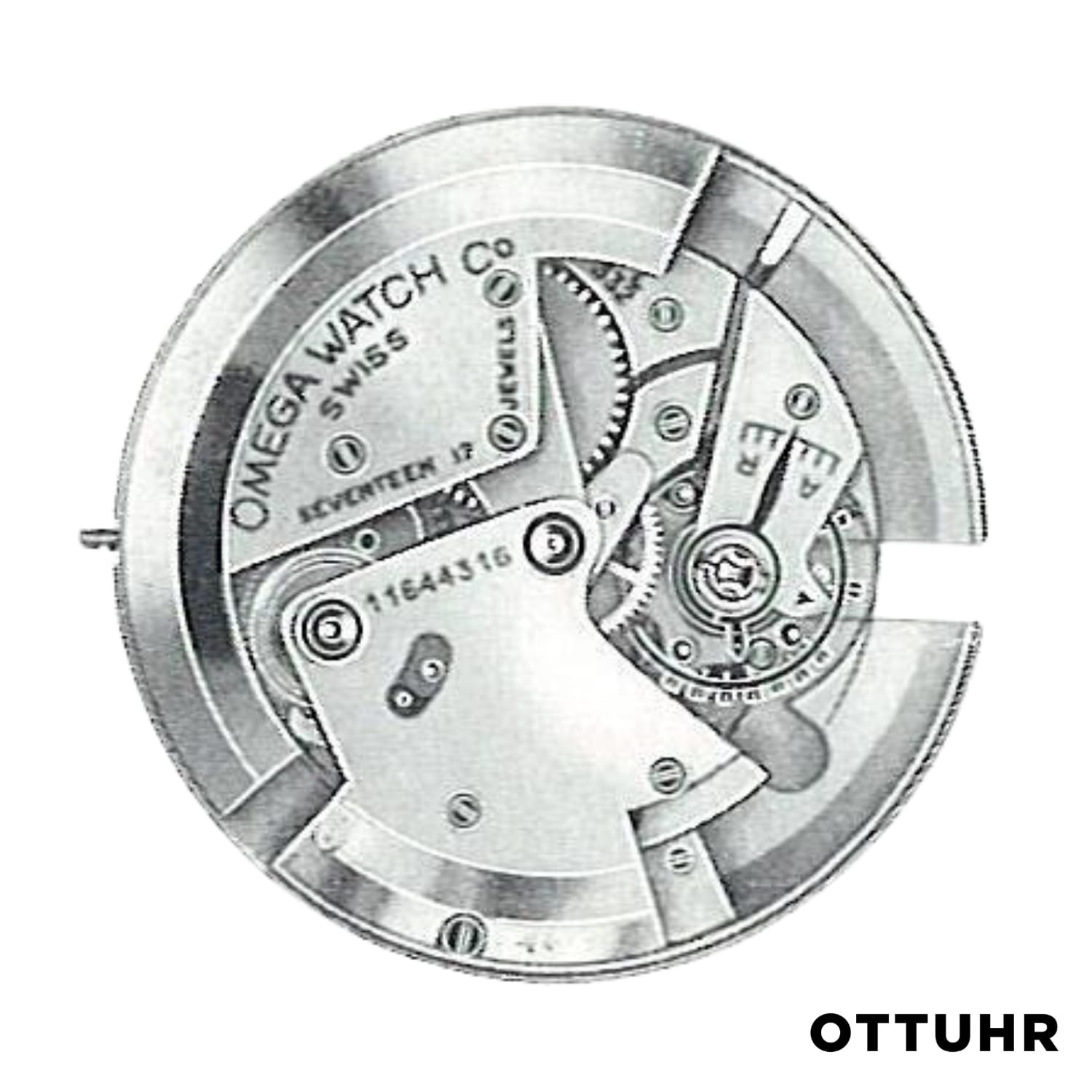
The Omega Caliber 352 RG represents the pinnacle of bumper automatic technology, standing as Omega’s most elaborately finished automatic chronometer movement of the immediate postwar era. This caliber powered the first generation Omega Constellation models introduced in 1952 and the most prestigious Seamaster Chronometer references, establishing the foundation for what would become two of Omega’s most enduring collections. The RG designation refers to the rare “Réglage de précision” (fine regulation) system, a sophisticated micrometric regulator that Omega reserved exclusively for their deluxe execution chronometer movements.
The 352 RG occupies a unique position in horological history as a transitional movement that bridged Omega’s early bumper technology with their later full-rotor automatics. While the bumper mechanism itself was already considered dated by 1949, Omega compensated through exceptional finishing standards and chronometer-grade regulation that yielded precision comparable to contemporary manual-wind movements. The caliber features sophisticated finishing rarely seen in automatic movements of the era, including decorated winding wheels, diamond-cut regulator components, and hand-polished surfaces throughout the train bridge and barrel bridge.
Production estimates for the 352 RG remain uncertain due to incomplete factory records, but collector consensus and serial number analysis suggest between 5,000 and 15,000 examples were manufactured during the caliber’s three-year primary production run. A documented subset of exactly 1,000 movements bearing serial numbers 11,418,001 through 11,419,000 were specially certified and sold as part of Omega’s “Famous 1000 Certified Chronometers” program, making these particular examples highly sought by collectors. The caliber is considered scarce in the current market, with the RG variant significantly rarer than its more common sibling, the Caliber 354, which featured standard swan-neck regulation rather than the deluxe RG system.
Collector demand for the 352 RG has increased steadily over the past decade as enthusiasts have come to appreciate the caliber’s role in Omega’s history and the tactile engagement of the bumper winding mechanism. Complete movements in original condition command premiums, particularly when accompanied by proper chronometer designation dials and untouched case finishes. The deluxe finishing of the RG regulation system makes these movements immediately identifiable and collectible compared to the more utilitarian 354 variants.
Historical Context, Provenance, and Manufacturing Details
Omega developed the 352 in 1949 as a direct evolution of the 28.10 JUB and 30.10 JUB bumper chronometer movements that powered the limited-production Centenary model celebrating Omega’s 100th anniversary in 1948. The 352 addressed market demand for chronometer-certified automatic wristwatches at a time when Omega had accumulated unprecedented success in observatory timing competitions, including world chronometer records set at Kew-Teddington Observatory in 1933 and repeated in 1936. By 1949, Omega needed a flagship automatic chronometer to capitalize on this timing prestige while meeting growing consumer preference for self-winding movements.
The 352 RG directly replaced the earlier 28.10 JUB chronometer bumper, incorporating the refined RG regulation system that had been developed and proven on the 30T2 RG manual-wind movements. This regulation system, known internally as the “Omega System,” became the defining feature of the caliber’s deluxe execution alongside fancy-finished winding and setting wheels with decorative turning. Omega simultaneously introduced the Caliber 354, a cost-reduced chronometer variant that substituted the RG system with a conventional swan-neck regulator and eliminated the deluxe wheel finishing, creating a clear hierarchy in the bumper chronometer lineup.
The 352 RG was eventually succeeded by the Caliber 501 and 505 full-rotor automatics introduced in 1955, which finally moved Omega beyond the bumper mechanism toward the modern 360-degree oscillating weight system. The transition was gradual, with some 352 production continuing through 1955 as Omega depleted component inventory and tooling. The shift to full-rotor movements marked the end of bumper automatic production at Omega after a 12-year run that had seen over 1.3 million bumper movements manufactured across the entire 28.10 and 30.10 families.
The 352 is an in-house Omega design and manufacture, not based on ebauche movements from external suppliers. Movement production occurred at Omega’s facilities in Bienne, Switzerland, with no documented changes in production location during the caliber’s lifespan. The movement represents the culmination of Omega’s bumper automatic development, incorporating lessons learned from earlier 28.10 variants while adding chronometer-grade regulation and finishing that positioned it as a premium offering within the bumper family.
From a broader horological perspective, the 352 RG exemplifies the late-stage refinement of bumper automatic technology just before full-rotor systems rendered the entire architecture obsolete. The caliber was neither groundbreaking in mechanism (bumpers dated to John Harwood’s 1920s patents) nor particularly efficient compared to contemporary Rolex Perpetual movements, but it demonstrated that a fundamentally limited winding system could still achieve chronometer precision through meticulous execution. Collectors today view the 352 RG as a transitional workhorse that captured a specific moment when manufacturers prioritized refinement over innovation, resulting in movements of exceptional quality built on architectures already destined for obsolescence.
Construction and Architecture
The Caliber 352 RG employs a three-bridge layout with separate bridges for the barrel, train, and balance cock, following Omega’s established architecture for the 28.10 family. The bridges are constructed from brass with copper electroplating, creating the characteristic rose-gold appearance visible on original examples. The plate and bridge finishing varies by grade, with RG-designated movements receiving Côtes de Genève decoration on the bridges, perlage on the mainplate, and hand-polished beveled edges throughout. This deluxe finishing distinguishes the 352 RG from the 354, which received only basic industrial finishing despite identical chronometer certification standards.
The balance wheel is a monometallic Glucydur (beryllium bronze) type with a smooth rim, specifically engineered to pair with the Nivarox balance spring’s thermal compensation characteristics. Glucydur’s coefficient of thermal expansion (approximately 17 x 10⁻⁶/°C) precisely matches the thermal behavior of the Nivarox spring, eliminating the need for bimetallic compensation. The balance measures approximately 10-11mm in diameter based on movement family specifications and operates without timing screws, relying instead on the RG regulator for all rate adjustments. The use of a smooth balance without screws was standard for regulated movements of this era, contrasting with later free-sprung designs that employed adjustable mass screws for regulation.
The balance spring is manufactured from Nivarox, a beryllium-nickel alloy (nominal composition: 37% Ni, 8% Cr, 1% Ti, 0.8% Be, with iron balance) specifically formulated for thermal stability and anti-magnetic properties. The spring features a flat configuration with approximately 13-14 coils, terminating in a collet at the inner end and a stud at the outer end captured by the RG regulator assembly. Nivarox’s positive thermoelastic coefficient means the spring becomes stiffer as temperature increases, compensating for the Glucydur balance’s thermal expansion to maintain isochronism across the operating temperature range. The spring length and dimensions are calibrated for the 19,800 vph frequency, with a typical specification requiring a 9.4mm inner diameter spring for the balance size used in the 352.
The escapement is a Swiss lever design with pallet stones jeweled in the pallet fork and an impulse jewel in the balance. The escape wheel drives the pallet fork through direct impulse on pallet entry and exit stones, with the pallet fork delivering impulse to the balance through the impulse jewel during each oscillation. The escapement jeweling contributes to the 17-jewel total count, with jewels distributed as follows: 2 for barrel arbor, 7 in the train (center wheel, third wheel, fourth wheel upper and lower, sweep second wheel), 2 for pallet fork pivots, 2 for pallet stones, 2 for balance pivots, 1 impulse jewel, and 1 for the automatic winding mechanism pivot. No exceptional innovations characterize the escapement, which follows standard Swiss lever practice of the era with proven geometry and materials.
Shock protection is provided by Incabloc systems installed at both balance jewels (upper and lower). The Incabloc design employs a spring-loaded cone jewel setting that allows the balance staff pivots to deflect during impact before returning to center, protecting against the most common failure mode in mechanical watches. The generation of Incabloc used in the 352 was the standard type available in the late 1940s and early 1950s, lacking the refinements introduced in later decades. Pallet fork jewels are not shock protected on this caliber, following the convention that only the balance assembly requires shock protection due to its light mass and high rotational speed.
The RG regulator represents the caliber’s most distinctive technical feature and deserves detailed examination. Unlike conventional index regulators that use a simple lever to shorten or lengthen the effective balance spring length, the RG system employs a graduated micrometric screw mechanism that allows extremely fine adjustments without disturbing the balance during operation. The regulator consists of three primary components: a fixed index with a graduated scale, a rotating adjustment screw (the “raquette régleur”), and a mobile stud holder that captures the balance spring’s outer terminal. Turning the adjustment screw causes the mobile stud holder to rotate incrementally around the balance cock, effectively changing the active length of the balance spring and thus the rate of oscillation. The RG system’s advantage lies in its sensitivity and repeatability, as each graduation on the adjustment screw corresponds to a predictable rate change, typically 0.5-1 second per day per graduation. The system’s primary disadvantage, noted by watchmakers, is that even slight pressure on the adjustment screw during regulation can temporarily distort the balance cock and throw the rate off, requiring patience to allow the movement to settle after each adjustment.
The mainspring is manufactured from white alloy steel designed for automatic winding applications, with dimensions of 1.10mm height x 0.095mm thickness x 300mm length, fitted to a 9mm barrel diameter. The spring uses an automatic-type bridle that allows slipping at full wind to prevent mainspring breakage when the bumper mechanism continues to deliver winding impulses. This slipping bridle is essential in bumper automatics, as the limited winding arc means the mechanism delivers frequent short winding bursts rather than continuous smooth winding. The mainspring barrel rotates freely on a fixed arbor, with the inner end of the spring hooked to the arbor and the outer end attached to the barrel wall. Barrel dimensions and mainspring specifications are shared across multiple 28.10 family variants, including calibers 330, 350, 351, 353, and 354.
The gear train consists of four wheels: center wheel (with integral cannon pinion, height 4.33mm), third wheel, fourth wheel (sweep second), and escape wheel. The center wheel is driven directly by the mainspring barrel, with a pinion engaging the crown wheel teeth cut into the barrel’s exterior circumference. The cannon pinion friction-fits to the center wheel arbor and carries the minute hand, with height specified at 2.20mm for the cannon pinion alone. The third wheel serves as an intermediate wheel between the center and fourth wheels, multiplying the speed to achieve the 60-second rotation period of the fourth wheel that carries the center seconds hand. A separate sweep second wheel assembly (part 351.1250) drives the center seconds through a friction spring (part 350.1255) that allows the seconds hand to slip during setting, preventing damage to the gear train. Specific gear ratios are not documented in available sources, but the ratio between barrel and fourth wheel must achieve the 60-second rotation period for the center seconds display.
Finishing quality on the RG-designated 352 movements includes several distinctive techniques that justify the deluxe classification. The train bridge receives Côtes de Genève decoration, consisting of parallel overlapping circular strokes applied by a rotating abrasive wheel to create the characteristic wave pattern. The mainplate receives circular perlage, applied through a rotating peg covered with abrasive paste that creates overlapping circular grain patterns. Bridge edges are beveled at approximately 45 degrees and hand-polished to a mirror finish, a labor-intensive process that demonstrates the movement’s premium positioning. Wheel spokes receive decorative turning with circular grain patterns, and screw heads are polished and beveled. The oscillating weight (bumper) is marked “OMEGA” in deep engraving and receives a polished finish on visible surfaces. This finishing represents the highest standard Omega applied to production bumper movements, placing the 352 RG above the 354 in the hierarchy despite identical functional performance.
Cross-Reference Data
Alternative Caliber Names
| Manufacturer | Caliber Designation | Notes |
|---|---|---|
| Omega | 352 | Standard designation on bridge |
| Omega | 28.10 RA SC PC T1 RG AM | Full technical designation |
| Omega | 28.10 RA SC RG | Alternative designation seen in documentation |
The 352 designation represents Omega’s simplified three-digit naming convention introduced in 1949, replacing the more descriptive alphanumeric codes used previously. The full designation 28.10 RA SC PC T1 RG AM translates to: 28.10mm diameter, RA (Remontage Automatique/automatic winding), SC (Seconde au Centre/center seconds), PC (Pare-Chocs/shock protected), T1 (antimagnetic grade 1), RG (Réglage de précision/fine regulation), AM (antimagnetic).
Base Caliber vs. Elaborated Versions
| Caliber | Differences | Jewel Count | Regulation System | Functions | Grade |
|---|---|---|---|---|---|
| 28.10 RA SC PC | Basic bumper, non-chronometer | 17 | Index regulator | Center seconds | Standard |
| 350 | Center seconds, basic finish | 17 | Index regulator | Center seconds | Standard |
| 351 | Center seconds, improved finish | 17 | Index regulator | Center seconds | Standard |
| 352 RG | Deluxe finish, RG regulator | 17 | RG micrometric | Center seconds | Chronometer |
| 353 | Date complication added | 17 | Index regulator | Center seconds, date | Standard |
| 354 | Swan-neck regulator | 17 | Swan-neck | Center seconds | Chronometer |
| 355 | Date with swan-neck | 17 | Swan-neck | Center seconds, date | Standard |
The 352 RG and 354 share nearly identical functional architecture with the primary distinctions being the regulation system (RG vs. swan-neck) and finishing standards (deluxe vs. standard). Both are chronometer-certified and achieve identical timing specifications, but the RG’s superior finishing and rare regulator design command higher collector premiums. The 354 was produced in significantly higher numbers than the 352 RG, making the latter substantially rarer in the market.
Compatible Case References by Brand
| Brand | Reference Numbers | Production Years | Notes |
|---|---|---|---|
| Omega Seamaster | 2577, 2577-11, 2577/2520, 2577-6 | 1950-1955 | 34mm cases, steel and gold-capped variants |
| Omega Seamaster | 2520 | 1950-1955 | 34mm solid gold cases |
| Omega Seamaster | 2521 | 1950-1955 | 36mm “Jumbo” cases |
| Omega Constellation | 2652 (CK 2652) | 1952-1954 | First generation Constellation, 35mm |
| Omega Constellation | 2782 | 1954-1955 | First generation, varied dial options |
| Omega Constellation | 2648 | 1954-1955 | Rare reference, no case gasket |
| Omega Constellation | 14324 | 1950-1955 | Deluxe “Ultima” model with gold bracelet |
| Omega Chronometer | 2635-2 | 1950-1955 | Steel chronometer cases |
| Omega Chronometer | 1431 | 1950-1955 | 18K gold chronometer cases, 35mm |
Case reference 2577 represents the most common housing for the 352 RG in Seamaster chronometer configurations, with two distinct case styles identified by collectors. The thin-lug variant features a fixed bezel, plain flat lugs, and a plain caseback, while the thick-lug variant has a removable bezel, beveled lugs, and accommodates different gasket specifications. Both variants are marked 2577 inside the caseback. The 2520 reference appears both as a standalone designation for solid gold cases and as a combined reference “2577/2520” indicating gold-capped cases with steel backs. Constellation references 2652 and 2782 represent the most collectible housings for the 352 RG, particularly examples with “pie-pan” dials and original gold finish.
Dial Compatibility
The 352 RG uses standard Omega dial foot positions for the 28.10 family with dial feet located at approximately 1:40 and 7:40 positions. Center seconds configuration requires a 2.20mm height cannon pinion with appropriate hand clearances. Dials must have a center pinion tube opening to accommodate sweep seconds. No date window exists on the 352, so dial compatibility is straightforward across all time-only dials sized for 28.10mm movements. Chronometer-designated examples should correctly pair with dials marked “Chronometer” or “Chronomètre Certifié” to maintain authenticity and value.
Crown and Stem Specifications
| Component | Specification |
|---|---|
| Stem Thread | Standard Omega tap size for era |
| Stem Part Number | 340.1106 (compatible across 28.10 family) |
| Crown Thread | To be determined by case-specific tube |
| Setting Mechanism | Yoke/lever clutch system |
Stem part 340.1106 is shared across multiple 28.10 variants including calibers 330, 350, 351, 352, 353, 354, and 355, ensuring relatively good availability for this critical wear component. The setting mechanism uses a yoke-style clutch activated by the setting lever, which engages the winding pinion during normal crown rotation and shifts to engage the motion works during time setting when the crown is pulled.
Identification Marks
Authentic Omega Caliber 352 RG movements display several distinctive markings that allow positive identification and help detect incorrect or replaced components. Understanding these identification features is essential for collectors and watchmakers evaluating the authenticity and originality of examples in the market.
The caliber number “352” is engraved on the bridge, specifically on the train wheel bridge or balance cock depending on movement generation. The engraving style is machine-executed with consistent depth and sharp edges, typically measuring 1.5-2mm in character height. The font is a simple sans-serif style consistent with Omega’s industrial marking standards of the 1950s. The full designation “28.10 RA SC PC T1 RG AM 17 pierres” may appear on the mainplate under the balance cock, though not all examples carry the complete technical designation.
Logo and brand marks include “OMEGA” stamped on the oscillating weight (bumper), engraved in a bold sans-serif font approximately 4-5mm wide. This engraving is deep and should show crisp edges even on well-used examples. The mainplate or bridges should carry “Omega Watch Co” or “Omega” markings along with “Swiss” or “Swiss Made” to indicate country of origin. The jewel count “17 Jewels” or “17 Pierres” appears stamped on the movement, typically on the mainplate near the winding mechanism or on a bridge. Chronometer-certified examples may carry additional markings such as “Chronometer” or “Certified Chronometer,” though placement varies.
The 352 RG does not use date codes in the modern sense. Dating of examples relies on serial number cross-referencing using established Omega serial number charts. Serial numbers for the 352 RG production period fall primarily in the 11,000,000 to 13,999,999 range, corresponding to approximately 1947-1954 production years. The famous 1,000 certified chronometers occupy serial numbers 11,418,001 through 11,419,000, making this range immediately identifiable to knowledgeable collectors. Serial numbers are engraved on the mainplate or movement ring, typically visible when the automatic winding mechanism is removed or visible through openings in the bridge structure.
Finishing marks on authentic RG-designated movements include Côtes de Genève (Geneva stripes) on the train bridge, running parallel to the bridge length. These stripes should appear as overlapping circular patterns creating a wave effect, applied with consistent depth and spacing. Perlage (circular graining) appears on the mainplate in overlapping circular patterns approximately 1-2mm in diameter. Bridge edges should show hand-polished bevels with mirror-finish surfaces free from machine marks. Wheel spokes display decorative circular graining applied before assembly. The presence of these finishing features distinguishes genuine RG movements from 354 variants or replacement movements lacking deluxe finishing.
Jewel settings in the 352 RG are predominantly pressed jewels with gold-colored settings, not gold chatons. Higher-grade chronometer movements sometimes employed screwed gold chatons, but standard production 352 RG movements used pressed settings for economy. The jewels themselves should be clear ruby or synthetic sapphire with consistent size and polish. Incabloc shock protection jewels at the balance positions feature the characteristic yellow Incabloc spring visible through the jewel opening.
Chronometer-certified 352 RG movements should display adjustment markings indicating the testing positions and temperature range. Standard markings include “5 Positions” or “Adjusted to 5 Positions” indicating regulation in dial up, dial down, crown down, crown left, and crown right orientations. Some examples may specify “5 Positions & Temperature” or similar notation indicating thermal testing in addition to positional adjustment. These markings typically appear engraved on the movement plate or balance cock, though placement varies. The absence of adjustment markings on a movement claiming chronometer status warrants investigation, as authentic chronometer-certified examples should carry this documentation.
Serial numbers on authentic 352 RG movements appear in consistent formats and locations. The movement serial number is engraved on the mainplate, typically between the barrel and winding mechanism or on the movement ring. Serial numbers consist of eight digits with no prefixes or letters in this production era. The format is strictly numeric (e.g., 11418523, 12456789, 13245678) with consistent character sizing and spacing. Engraving depth should be uniform across all digits, executed by machine rather than hand. Shallow, irregular, or hand-engraved serial numbers indicate potential forgery or remarking. Movement serial numbers can be cross-referenced against Omega’s production records to verify approximate date of manufacture and identify anomalies.
Known serial number ranges for 352 RG production include the 11,000,000 to 11,999,999 range (approximately 1947-1949), 12,000,000 to 12,999,999 range (1950-1952), and early 13,000,000 range (1952-1954). The bulk of 352 RG production falls in the 12 million range corresponding to 1950-1952 peak production years. Serial numbers below 11,000,000 or above 14,000,000 would be inconsistent with documented 352 RG production and should trigger closer examination of the movement’s authenticity.
Expected engravings and stampings on authentic movements include caliber number (352), jewel count (17 Jewels/Pierres), country of origin (Swiss/Swiss Made), manufacturer name (Omega Watch Co/Omega), and adjustment markings (5 Positions). Chronometer certification may be indicated by “Chronometer” or “Chronomètre” stamping. These engravings should show consistent depth, typically 0.1-0.2mm, with sharp clean edges free from burring or incomplete characters. Machine-executed engravings have uniform character sizing and baseline alignment, distinguishing them from hand-engraved markings that show variation in depth and alignment.
Font and marking styles remained relatively consistent during the 352 RG’s short production run (1949-1952) with no major transitions documented. Early examples from 1949-1950 may show slight variations in engraving tool types, but the overall marking style follows Omega’s established industrial standards of the late 1940s. No significant logo redesigns or branding changes occurred during this period that would affect movement markings. The transition to the three-digit caliber designation system (352 vs. 28.10 RA SC RG) was complete by 1949, so all production examples should carry the “352” designation on the bridge.
Original 1950s advert in American magazine advertising OMEGA

Part Information

The following tables document critical replacement parts for the Omega Caliber 352 RG based on official Omega parts documentation and cross-reference information from the 28.10 family.
Essential Replacement Parts
| Component | Part Number | Interchangeability Notes |
|---|---|---|
| Mainspring | GR2605X (1.10 x .095 x 300 x 9mm Auto) | Compatible with 330, 350, 351, 353, 354 |
| Balance Complete (RG) | 352.P01 or 333.1331 assembly | Specific to RG variants (333, 352 only) |
| Hairspring | Nivarox, 9.4mm inner diameter for 19,800 vph | Must match balance diameter and frequency |
| Escape Wheel | 350.1249 | Shared across 28.10 family |
| Pallet Fork | 350.1312 | Shared across 28.10 SC family |
| Crown Wheel | 331.1101 | Shared with 330, 331, 332, 350, 351, 353, 354 |
| Crown Wheel Core | 331.1102 | Shared with 330, 331, 332, 350, 351, 353, 354 |
| Ratchet Wheel | 331.1100 | Shared with 330, 331, 332, 350, 351, 353, 354 |
| Click (Bumper Mass) | 331.1104 | Shared with 330, 331, 332, 350, 351, 353, 354 |
| Setting Lever Spring | Standard 28.10 family | Shared across multiple calibers |
| Oscillating Weight (Bumper) | 352.1017 | Caliber-specific, marked “OMEGA” |
| Oscillating Weight Bearing | 332.1403 | Shared with 332, 350, 351, 353, 354 |
Movement Components Detail
| Component | Part Number | Notes |
|---|---|---|
| Plate | 351.1000 | Base plate assembly |
| Barrel Bridge | 352.1001 | Caliber-specific |
| Train Wheel Bridge | 352.1003 | Caliber-specific |
| Balance Cock | 333.1006 | Shared with Cal. 333 |
| Sweep Second Cock | 351.1007 | Shared with Cal. 351 |
| Lower Bridge for Oscillating Weight | 352.1009 | Intermediate bridge, caliber-specific |
| Banking Stop | 351.1012 | Bumper spring assembly |
| Upper Bridge for Oscillating Weight | 352.1013 | Center bridge, caliber-specific |
| Winding Stem | 340.1106 | Shared across 28.10 SC family |
| Cannon Pinion (height 2.20) | 350.1208 | Standard height for center seconds |
| Center Wheel with Cannon Pinion | 351.1224 (height 4.33) | Complete assembly |
| Hour Wheel | 351.1231 (height 1.41) | Standard motion works |
| Third Wheel | 350.1240 | Shared across 28.10 family |
| Fourth Wheel (Seconds) | 350.1243 | Center seconds configuration |
| Driving Wheel over Third Wheel | 351.1249 | Intermediate wheel |
| Sweep Second Pinion | 351.1250 | Center seconds drive |
| Friction Spring for Sweep Second | 350.1255 | Allows hand slipping during setting |
Regulator Components (RG System)
| Component | Part Number | Notes |
|---|---|---|
| Regulator (RG assembly) | 333.1331 | Complete RG regulator circle |
| Regulator Pointer | 333.1332 | RG pointer body |
| Two-piece Regulator | 333.1333 | Alternative configuration |
| Adjuster for Regulator | 333.1339 | Micrometric adjustment screw |
| Adjustment Plate | 333.1340 | Graduated scale plate |
The RG regulator components are specific to deluxe chronometer calibers 333 and 352, not interchangeable with standard index regulators used on calibers 330, 350, 351, 353, 354, or 355.
Jewels
| Component | Part Number | Notes |
|---|---|---|
| Jewel for Third Wheel (upper) | 4217 | Standard pressed jewel |
| Jewel for Fourth Wheel (lower) | 4213 | Standard pressed jewel |
| Incabloc (upper balance) | 333.1347 | Shock protection assembly |
Complete jewel sets are difficult to source as individual components. Most repairs requiring jewel replacement necessitate sourcing from donor movements or new-old-stock supplies.
Screws and Fasteners
| Component | Part Number | Notes |
|---|---|---|
| Barrel Bridge Screw | 2020 | Shared with train bridge and balance cock |
| Sweep Second Cock Screw | 2166 | Specific to center seconds configuration |
| Lower Bridge Screw (oscillating weight) | 2021 | Caliber-specific |
| Banking Stop Screw | 2142 | Bumper spring mounting |
| Upper Bridge Screw (oscillating weight) | 2021 | Caliber-specific |
| Ratchet Wheel Screw | 2185 | Winding mechanism |
| Crown Wheel Core Screw | 2187 | Winding mechanism |
| Click Screw | 2186 | Winding mechanism |
| Friction Spring Screw (sweep second) | 2608 | Center seconds assembly |
| Adjustment Plate Screw | 2191 | RG regulator mounting |
Sourcing Notes
Parts availability for the Omega 352 RG ranges from readily available to extremely scarce depending on component. The mainspring (GR2605X) remains available from specialty suppliers like Cousins UK, Watch Material, and others as new-old-stock Swiss-made Nivaflex automatic springs. This represents one of the most commonly needed service parts and collectors should experience no difficulty sourcing quality replacements.
Balance assemblies complete with RG regulator systems are scarce in the market, as these were produced in limited quantities and are specific to calibers 333 and 352 only. Complete balance assemblies occasionally appear through vintage parts dealers and specialist suppliers, but expect limited availability and premium pricing. Replacement hairsprings are available as raw Nivarox stock requiring fitting, pinning, and regulation by a qualified watchmaker. Pre-fitted hairsprings for the 352 are nearly impossible to source, making raw spring installation the standard approach.
Pallet forks for the 28.10 family have become increasingly difficult to source as the vintage Omega parts supply diminishes. The pallet fork (part 350.1312) is theoretically shared across the 28.10 SC family, but finding new or quality used examples requires patience and networking within watchmaker communities. Some watchmakers report success sourcing from Hong Kong-based vintage parts suppliers or through donor movements. Pallet stones and impulse jewels are available as generic replacements from Swiss parts manufacturers, though original Omega parts are preferable when available.
Common failure points in the 352 RG include mainspring fatigue (requiring replacement every 20-30 years depending on use), bumper spring breakage or weakening (banking stop springs part 332.1415), oscillating weight bearing wear (part 332.1403), and winding mechanism wear on the crown wheel and ratchet wheel. The bumper springs (banking stops) are particularly problematic as the constant impact loading causes metal fatigue and eventual breakage. Replacement bumper springs are available but may require fitting and adjustment to achieve correct tension. Setting lever springs frequently require replacement due to fatigue, and these are shared across the 28.10 family making them relatively accessible.
Acceptable generic replacements exist for some components including mainsprings (any high-quality automatic spring matching the 1.10 x .095 x 300 x 9mm specification will function correctly), Incabloc shock jewels (generic Incabloc parts for appropriate pivot diameters), and certain screws and fasteners. Jewels can be replaced with generic Swiss-made pressed jewels of appropriate diameter, though maintaining original jewel settings is preferred for collectibility. Crown and stem replacements often require generic parts as original Omega components are exhausted, but these should match the original tap sizes and stem diameters to ensure proper function.
Parts that should never be substituted with generic alternatives include the RG regulator assembly (caliber-specific and essential to the movement’s identity), the oscillating weight/bumper (marked “OMEGA” and caliber-specific), bridges and cocks (caliber-specific with finishing that affects value), and the balance wheel (Glucydur specification must match Nivarox spring thermal characteristics). Using incorrect balance or spring combinations will result in poor temperature compensation and degraded chronometer performance.
Watchmakers servicing the 352 RG should establish relationships with vintage parts specialists and maintain donor movements for critical unobtainable components. The bumper automatic architecture uses several wear-prone components that are increasingly difficult to source as vintage parts supplies diminish. Planning ahead for parts procurement can avoid extended service delays when critical components fail.
Performance Data
Manufacturer Specifications
Omega specified the Caliber 352 RG to chronometer standards as certified by the Contrôle Officiel Suisse des Chronomètres (COSC), meeting the international standard ISO 3159 for chronometer certification. The official chronometer certification criteria for mechanical movements during the 1950s required the following performance standards:
Accuracy (new, after certification): -4 to +6 seconds per day average daily rate. This specification represents the acceptable deviation range measured during the 15-day COSC testing protocol conducted at three temperatures (8°C, 23°C, and 38°C) and in five positions.
Positions tested: Five positions consisting of dial up, dial down, crown down, crown left, and crown right. Some movements may be marked “Adjusted to 5 Positions” indicating regulation across all five test orientations. The COSC protocol requires 24 hours of testing in each position with rate measurements taken daily.
Temperature compensation: Yes, across the range of 8°C to 38°C (46°F to 100°F). The Glucydur balance and Nivarox spring combination provides passive temperature compensation without requiring bimetallic balance construction. The thermoelastic coefficient of Nivarox (approximately +11.5 x 10⁻⁶/°C) combined with the thermal expansion of the Glucydur balance (approximately +17 x 10⁻⁶/°C) results in rate stability across the tested temperature range. Theoretical calculation suggests that a 30°C temperature increase produces compensating effects: the Glucydur balance expansion causes approximately -44 seconds/day loss, offset by Nivarox spring thermal expansion (+29 seconds/day) and increased spring stiffness from thermoelasticity (+15 seconds/day), yielding near-zero net rate change.
Isochronism: The relationship between amplitude and rate should remain consistent across the power reserve range, with minimal rate variation from full wind to approximately 50% power reserve depletion. Chronometer certification requires that the mean variation in rate over the 15-day test period not exceed 2 seconds per day, and the greatest variation between any two consecutive days not exceed 5 seconds. The difference between rates in horizontal positions (dial up, dial down) versus vertical positions (crown down, left, right) must fall within -6 to +8 seconds per day.
Lift angle: 50 degrees. This specification is used for timing machine setup when measuring rate and amplitude. The 50-degree lift angle is standard for Swiss lever escapements of this era and represents the angular rotation of the balance wheel during which the pallet fork delivers impulse to the balance through the impulse jewel.
Observed Performance (Field Data)
Real-world performance of properly maintained Omega Caliber 352 RG movements generally meets or exceeds original chronometer specifications, with several factors influencing long-term accuracy and reliability.
Typical accuracy range for well-maintained examples: +3 to +8 seconds per day in normal wearing conditions. This represents a slight gain bias compared to the COSC specification, which watchmakers attribute to mainspring strengthening over time and the effects of typical positional distribution during wear. Well-regulated examples averaging positions across a full day of wearing often achieve +4 to +6 seconds per day, within the upper half of the chronometer tolerance. Examples serviced to high standards with careful regulation can achieve 0 to +3 seconds per day accuracy, though this requires expert adjustment of the RG regulator system and may not remain stable across all wearing conditions.
Common performance issues and causes: The most frequent accuracy degradation stems from lubrication breakdown, typically occurring 8-12 years after service depending on usage intensity and storage conditions. Dried lubricants increase friction in the gear train and escapement, causing amplitude loss and rate instability. Symptoms include inconsistent daily rate, position-dependent rate variations exceeding 10-15 seconds per day, and gradual slowing over several hours of wear.
Bumper spring weakening or breakage represents another common failure mode unique to bumper automatics. Weakened bumper springs reduce winding efficiency, causing the watch to stop or run slowly during periods of light activity. Broken bumper springs produce an audible rattle when the watch is shaken and eliminate automatic winding entirely, requiring manual winding through crown rotation (which bumper movements support but with limited efficiency). The constant impact loading on bumper springs causes metal fatigue, with failure rates increasing on movements beyond 60-70 years of age without spring replacement.
Oscillating weight bearing wear causes increased friction in the automatic winding mechanism, reducing winding efficiency and potentially introducing positional rate variations as the weight shifts during wearing. Worn bearings may produce subtle grinding sensations or sounds during bumper oscillation. This wear pattern is inevitable given the bumper mechanism’s impact-based operation and typically requires bearing replacement during major service.
Magnetization affects rate stability despite the movement’s antimagnetic designation, as the “AM” specification of the 1950s provided only modest magnetic resistance compared to modern antimagnetic standards. Magnetized balance springs exhibit rate instability, position sensitivity, and tendency to stop unexpectedly. Demagnetization during service restores performance in most cases.
Expected amplitude when fully wound: 250-280 degrees in horizontal positions (dial up, dial down), 200-240 degrees in vertical positions (crown down, left, right). These amplitude values represent healthy performance on a properly serviced movement with correct beat rate and escapement geometry. Lower amplitudes indicate lubrication issues, worn pivots, magnetization, or mainspring weakness.
Power reserve depletion characteristics: Amplitude decreases progressively as the mainspring unwinds, with the rate remaining relatively stable through approximately 75% of the 42-hour power reserve. Beyond 30-32 hours of run time, amplitude typically drops below 200 degrees in horizontal positions, and rate may begin to slow by 2-5 seconds per day. The watch typically stops at 40-44 hours depending on mainspring condition and winding mechanism efficiency. The bumper automatic mechanism maintains some winding even during light activity, so watches worn regularly may never fully exhaust the power reserve.
Performance degradation with age: Assuming no service intervention, the 352 RG exhibits predictable performance decline over decades of operation. Mainspring set (permanent deformation from extended compression) reduces power reserve by approximately 10-15% over 20-30 years, shortening run time to 35-38 hours and reducing amplitude by 20-30 degrees. Lubricant oxidation and migration away from pivots increases friction, causing amplitude loss of 40-60 degrees and rate slowing of 10-20 seconds per day after 10-15 years without service. Pivot wear in high-load positions (center wheel, third wheel, escape wheel) can introduce increased positional rate variation, with differences between horizontal and vertical positions expanding from the original 6-8 seconds per day to 15-25 seconds per day.
The bumper mechanism’s impact loading accelerates wear on banking stop springs, oscillating weight bearings, and crown wheel teeth compared to full-rotor automatics. Collectors should expect that original 70+ year-old examples require comprehensive service including replacement of these wear components to restore chronometer-level performance. The positive aspect of the 352 RG’s construction is that, when properly serviced with quality replacement parts, the movement can deliver performance matching or exceeding original specifications, as the fundamental architecture and materials remain sound.
Watchmakers with expertise in vintage Omega calibers report that the 352 RG responds exceptionally well to careful service and regulation, often outperforming contemporary manual-wind movements once the automatic winding mechanism’s wear issues are addressed. The RG regulation system, while temperamental during adjustment, provides excellent long-term rate stability when correctly set, justifying Omega’s decision to reserve this regulator type for their premium chronometer movements