

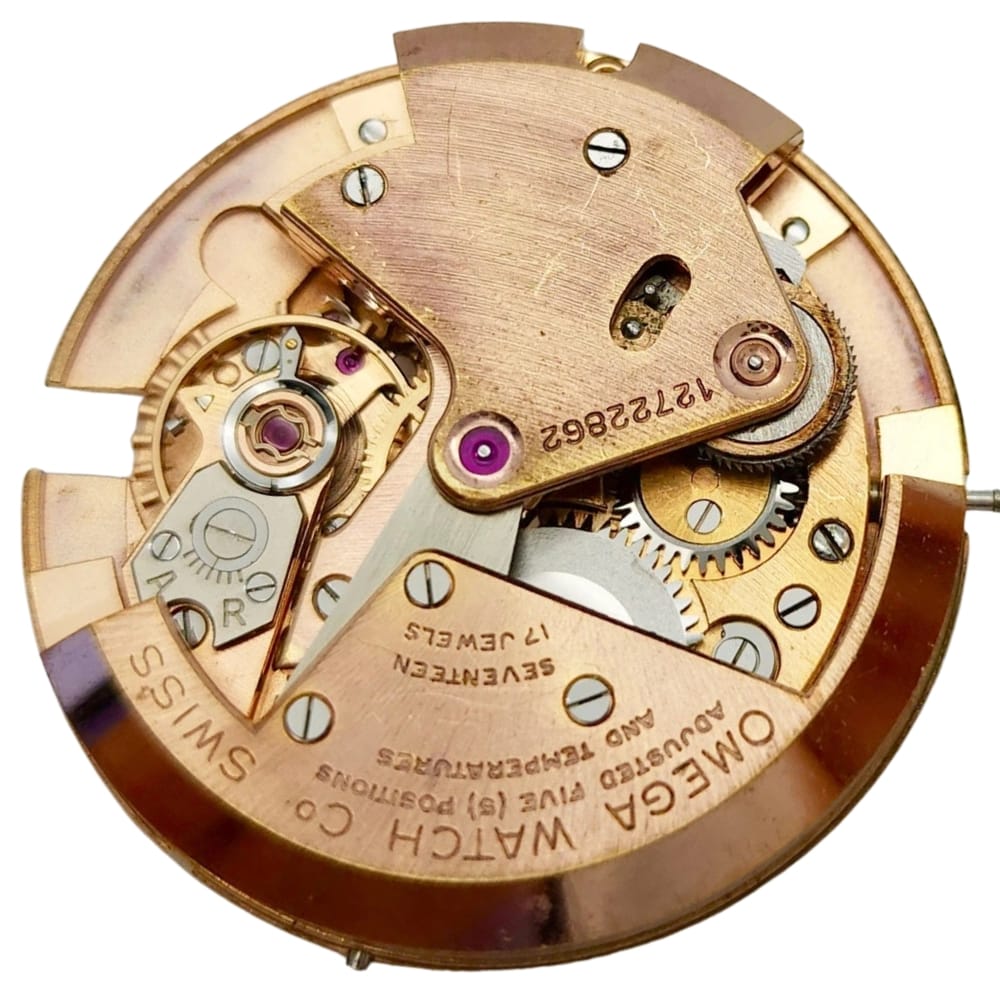
The Omega 352 represents one of the most significant deluxe-execution chronometer movements from the early bumper automatic era, distinguished by its rare RG (Omega System) fine regulation mechanism inherited from the legendary 30T2RG manual-wind calibers. While the more common caliber 354 with swan-neck regulator powered the bulk of early Constellation and Seamaster Chronometer production, the 352 stood above as Omega’s top-grade bumper automatic, featuring fancy-finished winding wheels, polished and anglaged components, and a micrometric regulator system that marked the technical pinnacle of Omega’s pre-rotor automatic movements.
The caliber 352 served as the bridge between Omega’s centenary chronometer achievements and the constellation era. Released in 1949 as part of Omega’s transition to three-digit caliber designations, the 352 evolved from the 28.10 RA SC PC T1 RG movement family and powered the very first Omega Constellation watches in 1952, alongside high-grade Seamaster Chronometers. Within the 28.10 family hierarchy, the 352 occupied the deluxe tier alongside the 333 (sub-seconds), while the 354 served as the production chronometer grade with simplified finishing. The 352’s RG regulator, though debated among collectors for practical superiority, commanded premium pricing and established these movements as the most collectible bumper automatics Omega produced.
Production of the caliber 352 was deliberately limited. While the entire 28.10/30.10 bumper family produced over 1.3 million movements between 1943 and 1955, the 352 represented a tiny fraction of this output. One documented series, the “Famous 1000,” comprised serialized chronometers numbered 11,418,001 through 11,419,000, all equipped with caliber 352 movements and delivered as a special certified batch. Beyond this known series, exact production figures remain undocumented by Omega, but collector consensus and market scarcity suggest fewer than 5,000 total caliber 352 movements were completed during the 1949-1952 primary production window, with limited assembly continuing through 1955 as inventory depleted. Serial number ranges observed on authentic examples cluster heavily in the 11.4-13.5 million range (1949-1952), corresponding to the movement’s documented production period.
The caliber 352 occupies rarefied air in the current collector market. Seamaster Chronometers with caliber 352 routinely command 40-60% premiums over equivalent 354-powered examples, with RG-equipped pieces trading between $1,800-$3,500 depending on case material and condition. First-generation Constellation references (2648, 2652, 2782) with caliber 352 are even more sought-after, particularly the deluxe OT 14327 “Ultima” configuration with 18k solid gold dial, which represents the absolute pinnacle of bumper Constellation collectibility. Demand remains strong and rising, driven by sophisticated collectors who recognize the 352 as Omega’s last hurrah in fancy-finished bumper movements before the transition to full-rotor automatics, and the RG regulator’s visual appeal and historical significance ensure these movements will continue appreciating as Omega’s vintage chronometer heritage gains broader recognition.
Historical Context, Provenance, and Manufacturing Details
The caliber 352 emerged from Omega’s ambitious post-war chronometer program, directly descended from the celebrated 30T2RG manual-wind movements that dominated observatory competitions in the 1940s. When Omega developed their first bumper automatic movements in 1943, the 28.10 RA PC and 30.10 RA PC represented purely functional designs focused on reliability rather than refinement. The introduction of chronometer-grade bumper movements came with the 1948 Centenary (Jubilee) editions, which featured the 28.10 JUB and 30.10 JUB movements with deluxe finishing and the distinctive RG micrometric regulator system transplanted directly from the 30T2RG manual calibers.

In 1949, Omega restructured their caliber nomenclature, transitioning from dimension-based designations to three-digit numbers. The 28.10 RA SC PC became the caliber 350 (sweep seconds, base grade), while chronometer variants split into two tiers. The caliber 354 inherited swan-neck regulation and became the workhorse chronometer grade, eventually powering over 500,000 certified chronometers. The caliber 352 retained the deluxe RG regulation and fancy finishing from the Centenary movements, positioning it as the premium offering for Omega’s most important chronometer models.
The 352 replaced no specific predecessor but rather represented the deluxe execution of the standard 350 base caliber. Its successor came in 1955 when Omega adopted the full-rotor caliber 500 series, which offered superior winding efficiency and eliminated the bumper’s directional winding limitations. By 1956, caliber 352 assembly had ceased entirely, with the last movements leaving Bienne’s workshops carrying serial numbers in the low-14 millions.
Manufacturing remained exclusively at Omega’s Bienne facility throughout the 352’s production run. Unlike many contemporaneous Swiss movements that relied on ébauche suppliers like ETA or AS Schild, the caliber 352 was manufactured in-house from baseplate through final adjustment. Omega controlled every aspect of production, from raw beryllium bronze movement plates through the proprietary RG regulator components that distinguished this caliber from all others. The deluxe finishing required additional labor, with movement finishers hand-polishing crown and ratchet wheels, applying Geneva striping (Côtes de Genève) to bridges, and executing precise anglage on component edges.
The caliber 352 occupies a unique position in horological history as Omega’s final statement in fancy-finished bumper automatics. While technically similar to the more common 354, the 352’s RG regulator and enhanced finishing represented Omega’s acknowledgment that chronometer-grade movements could serve as showcases for mechanical artistry, not merely functional timekeeping tools. This philosophy, bridging the gap between the hand-finished movements of the 1930s-1940s and the rationalized production of the 1960s, makes the 352 a transitional masterpiece that captures both eras’ distinct characteristics.
Construction and Architecture
The caliber 352 shares the fundamental architecture of the 28.10 family, featuring a copper-electroplated three-quarter baseplate with separate bridges for the barrel, wheel train, and balance, supplemented by the characteristic bumper automatic winding mechanism that defines this movement generation.
Plate and Bridge Layout: The movement employs five primary bridges mounted to the baseplate: the barrel bridge (part 352.1001), train wheel bridge (352.1003), balance cock (333.1006 specific to RG variants), sweep second cock (351.1007), and the two-piece oscillating weight bridge system comprising lower (352.1009) and upper (352.1013) components that sandwich the bumper rotor assembly. The baseplate, part number 351.1000 shared with caliber 351, features integrated banking stops and jewel mounting points precisely machined to accommodate the 28.1mm format. Construction material is beryllium bronze (copper-beryllium alloy) with copper electroplating, providing both the characteristic warm tone and excellent dimensional stability.
Balance Wheel: The 352 employs a Glucydur (beryllium bronze) balance wheel, typically featuring a smooth rim without adjustment screws in chronometer grades, relying instead on regulation via the RG system for rate adjustment. The Glucydur composition (approximately 98% copper, 2% beryllium) provides thermal stability superior to nickel alloys, with a coefficient of thermal expansion of 17×10⁻⁶/°C that precisely matches the compensating properties of the Nivarox hairspring. Balance diameter measures approximately 10-11mm, oscillating at 19,800 vph (2.75 Hz) with a lift angle of 50 degrees.
Balance Spring (Hairspring): The movement utilizes a Nivarox (nickel-iron-beryllium alloy) flat hairspring with approximately 11-13 coils. Nivarox’s thermoelastic properties specifically counteract the thermal expansion of the Glucydur balance, with the hairspring’s modulus increasing as temperature rises to compensate for the balance’s expansion. The spring measures roughly 12-15mm in developed length when free, matching the specific oscillation characteristics required for the 19,800 vph frequency and the balance’s inertial properties. The RG regulator system allows micrometric adjustment through a rotating eccentric disc that shifts the curb pins’ position relative to the hairspring’s active length.
Escapement Type: Swiss lever escapement with jeweled pallet fork and separate impulse jewel on the balance staff. The escape wheel features 15 teeth engaging with the pallet stones, which are ruby jewels pressed into the hardened steel pallet fork. Typical of Swiss lever designs, the escapement provides direct impulse through alternating pallet faces, with the guard pin preventing over-banking. Jeweling includes the escape wheel upper and lower pivots (jewels 4217 and 4213 per parts catalog), pallet fork pivots, and impulse jewel.
Shock Protection System: Incabloc shock-absorbing jewel settings protect both balance staff pivots. The system employs lyre-shaped springs (part 333.1347 for upper jewel setting) that allow the jewel assembly to move radially under shock impact, then return to center position once force dissipates. The Incabloc components visible on caliber 352 include the jewel holder, conical jewel, cap jewel, and spring clip. This system, standard across mid-century Swiss movements, effectively protects the balance staff’s fragile pivots from damage during wrist impacts.
Regulator Type: The defining feature of caliber 352 is the RG (Omega System) micrometric regulator, inherited directly from the 30T2RG manual-wind chronometer movements. Unlike conventional index regulators or swan-neck systems, the RG mechanism employs a circular, beveled disc (part 333.1339) with a threaded adjustment screw that rotates an eccentric cam. This cam shifts the position of the regulator pointer and curb pins relative to the hairspring, enabling extremely fine rate adjustments. The system mounts to a specific balance cock design (333.1006) unique to RG-equipped movements, with precise machined mounting points that differ from the standard balance cock used on swan-neck calibers.
The RG system’s practical advantages remain debated among watchmakers and collectors. Proponents cite the fine-pitch adjustment screw’s precision and the system’s elegant appearance. Critics note that any pressure applied during adjustment affects the balance cock and temporarily disrupts rate stability until components settle, whereas swan-neck regulators apply force laterally without balance cock stress. Regardless of technical merits, the RG’s visual appeal and historical connection to Omega’s chronometer heritage make it the most sought-after regulator variant among collectors.
Mainspring Material and Type: The movement uses an automatic-type mainspring with slipping bridle, dimensioned at 1.20mm height × 0.100mm thickness × 260mm length (or 290mm in some replacement specifications), fitting a barrel with approximately 8.5-9.0mm internal diameter. Material is white alloy steel (likely Nivaflex or similar stainless steel composition), replacing the older blued-steel mainsprings used in earlier 28.10 variants. The slipping bridle mechanism allows the mainspring to slip once fully wound, preventing mainspring breakage from over-winding via the automatic mechanism. A properly lubricated mainspring delivers consistent torque across the 42-hour power reserve.
Gear Train Details: The caliber 352 employs a four-wheel train from barrel to escape wheel, with sweep seconds driven through a dedicated sweep second pinion (351.1250) with friction spring (350.1255) mounted atop the fourth wheel. The center wheel with integrated cannon pinion (351.1224, height 4.33mm) carries the minute hand, while the separate hour wheel (351.1231, height 1.41mm) drives the hour hand. Third wheel (350.1240) and fourth wheel (350.1243) complete the train, with a driving wheel (350.1249) over the third wheel providing the connection to the sweep second pinion. Gear ratios follow standard Swiss lever configuration: center wheel (1 revolution per hour), third wheel, fourth wheel (1 revolution per minute), and escape wheel (15 teeth).
Finishing Quality and Techniques: The caliber 352 receives deluxe execution finishing that distinguishes it from the caliber 354 and standard 350/351 variants. Key finishing elements include:
- Crown wheel (331.1101) and ratchet wheel (331.1100) with mirror-polished surfaces and precise anglage on edges, contrasting sharply with the matte-finished wheels on standard grades
- Bridges decorated with Côtes de Genève (Geneva stripes) radiating from mounting screws, hand-executed using perlage tools
- Balance cock with black-polished beveled edge surrounding the RG regulator disc, showcasing the system as both functional and decorative element
- Movement plates with circular perlage (snailing) on exposed surfaces
- Jewel settings with polished chatons (raised jewel holders) rather than pressed jewels
- Screw heads with polished slots and beveled edges
Adjustment grades varied even within caliber 352 production. Chronometer-certified examples received five-position adjustment (dial up, dial down, crown up, crown down, crown left) plus two temperature points, documented on COSC certificates accompanying new watches. Non-certified examples typically received two-position adjustment. The deluxe finishing remained consistent across both chronometer and non-chronometer grades, distinguishing the 352 from the 354 which offered chronometer certification without the fancy wheel finishing.
Cross-Reference Data
Alternative Caliber Names (Rebranded Versions):
| Manufacturer | Caliber Designation | Notes |
|---|---|---|
| Omega | 28.10 RA SC PC T1 RG AM | Original technical designation (pre-1949 nomenclature) |
| Omega | Cal. 352 | Three-digit designation adopted 1949 |
The caliber 352 was never rebranded or sold to other manufacturers. Omega maintained exclusive use of this deluxe-execution movement for their own chronometer models.
Base Caliber vs. Elaborated Versions:
| Caliber | Relationship | Jewels | Key Differences |
|---|---|---|---|
| 330 (30.10 RA PC) | Base caliber family | 17 | 30.1mm diameter, sub-seconds, basic finishing |
| 340 (28.10 RA PC) | Base caliber family | 17 | 28.1mm diameter, sub-seconds, basic finishing |
| 350 (28.10 RA SC PC) | Direct base caliber | 17 | 28.1mm sweep seconds, basic finishing, standard regulator |
| 351 | Base with modifications | 17 | Shared baseplate with 352, standard finishing, banking stop variations |
| 352 (28.10 RA SC PC T1 RG AM) | Deluxe execution | 17 | RG regulator, fancy-finished wheels, chronometer grade |
| 353 | Date complication variant | 17 | Based on 352/354 with date mechanism |
| 354 (28.10 RA SC PC T1 AM) | Standard chronometer | 17 | Swan-neck regulator, standard wheel finish, chronometer grade |
| 355 | Date complication variant | 17 | Based on 354 with date mechanism |
| 333 | Deluxe sub-seconds | 17 | 30mm diameter, RG regulator, fancy finishing, sub-seconds |
| 343 | Deluxe sub-seconds chronometer | 17 | 28.1mm diameter, RG regulator, fancy finishing, sub-seconds |
| 344 | Standard chronometer | 17 | 28.1mm diameter, swan-neck regulator, chronometer grade, sub-seconds |
The caliber 352 and 343 represent the deluxe RG-equipped tier, while 354 and 344 served as the production chronometer grade. All share interchangeable components from the base 330 caliber family, with specific parts (regulator assembly, certain wheels) distinguishing each variant.
Compatible Case References by Brand:
Case references 2577 and 2520 are often listed together (2577/2520) as the same basic case with minor variations or manufacturing evolution. The 2577 served as the primary Seamaster Chronometer reference from 1949-1955, with caliber 352 typically found in examples with serial numbers below 13,500,000 (pre-1952), after which caliber 354 became dominant.
Dial Compatibility Note:
Caliber 352 and 354 share identical dial foot positions, with feet located at approximately 11 o’clock and 5 o’clock positions. This allows dial interchangeability between 352 and 354 movements within the same case reference. However, dials are not interchangeable with later full-rotor caliber 500/501 movements, which use different foot positions to accommodate the larger rotor assembly.
Date window position (for caliber 353/355 variants) appears at 3 o’clock, requiring case designs with appropriate dial aperture. Non-date calibers 352 and 354 use solid dials without cutouts.
Original dial configurations for caliber 352 chronometer models typically feature:
- “Chronomètre” or “Chronometer” inscription below 12 o’clock or above 6 o’clock
- Applied gold indices (dagger, arrow, mixed Arabic numerals and batons)
- Cross-hair or sector patterns on Constellation models
- Omega logo applied rather than printed on highest grades
- Dauphine hands (gold for gold cases, steel for steel cases) with luminous inserts
Crown and Stem Specifications:
| Component | Specification | Part Number |
|---|---|---|
| Winding Stem | Male thread, tap 10 | 340.1106 (shared with 340 family) |
| Stem Diameter | Approximately 1.0-1.2mm | N/A |
| Crown Thread | 0.90mm tap 10 | N/A |
| Setting Mechanism | Yoke-type clutch with set lever spring | Set lever: common 340 family part |
The stem features male threading at the crown end and engages the clutch wheel and setting mechanism at the movement end. Genuine Omega signed crowns from this era typically measure 5.5-6.0mm diameter for standard cases, with the four-leaf Seamaster design appearing on Seamaster Chronometer references.
Identification Marks
Authenticating a caliber 352 requires careful examination of multiple identifiers, as the movement’s rarity and value make it a target for misrepresentation. Genuine caliber 352 movements display consistent characteristics across production runs.
Caliber Number Location:
The caliber designation “352” appears engraved on the train wheel bridge (part 352.1003), visible when the automatic winding mechanism and upper bridges are in place. Unlike some Omega calibers where the number appears on the baseplate under the balance, the 352 follows the 28.10 family convention of bridge marking. The engraving style features clean, evenly-spaced numerals approximately 1.5-2.0mm in height, machine-engraved with consistent depth. Hand-engraved or irregularly stamped “352” markings indicate either incorrect identification or fraudulent modification.
On the baseplate (visible with bridges removed), you may find the earlier designation “28.10 RA SC PC T1 RG AM” or simply “28.10” on examples produced during the 1949 transition period. By 1950, most movements received only the “352” bridge marking, with technical designations relegated to factory records.
Logo and Brand Marks:
Genuine caliber 352 movements display the Omega logo and “OMEGA WATCH CO.” text on the baseplate, typically positioned near the balance cock or on the main plate area visible through the balance cock cutout. Additional markings include:
- “SWISS” or “SWISS MADE” engraved on the baseplate
- “17 JEWELS” or “17 RUBIS” indicating jewel count
- “ADJUSTED” or “ADJUSTED TO TEMPERATURE AND POSITIONS” on chronometer-certified examples (may appear on baseplate or balance cock)
The engraving style remains consistent with Omega’s mid-century practices: serif font, evenly spaced, machine-engraved with approximately 0.1-0.2mm depth. Examples showing poorly aligned text, inconsistent font sizing, or hand-scratched appearance warrant immediate suspicion.
Date Codes:
Omega did not employ date codes on caliber 352 movements. Dating relies on serial number correlation with Omega’s production records, with the movement serial number serving as the primary dating mechanism.
Finishing Marks:
Genuine caliber 352 movements exhibit specific finishing patterns that distinguish them from caliber 354 and lower grades:
- Côtes de Genève (Geneva Stripes): Parallel lines radiating from bridge screws, hand-executed with consistent width (approximately 0.3-0.5mm) and spacing. Present on barrel bridge, train wheel bridge, and visible portions of the automatic mechanism bridge.
- Perlage (Circular Graining): Overlapping circular patterns covering baseplate surfaces not occupied by functional components. Pattern consistency and complete coverage distinguish factory finishing from later refinishing attempts.
- Polishing: The crown wheel (331.1101) and ratchet wheel (331.1100) display mirror-polished surfaces on spokes and rim, contrasting with matte-finished hubs. This fancy finishing is thekey identifier separating caliber 352 from 354, which uses standard matte-finished wheels throughout.
- Anglage (Beveling): Component edges, particularly visible on bridges and the balance cock, show polished bevels at consistent 45-degree angles. Width typically measures 0.2-0.3mm.
Later refinishing attempts often show irregular perlage patterns, over-polished screw heads (losing slot definition), and missing or incorrect anglage on edges. Original factory finishing maintains crispness even after 70+ years, while amateur refinishing typically appears softer and less precise.
Jewel Markings:
The 17 jewels in caliber 352 include:
- Balance staff pivots: 2 jewels (Incabloc settings)
- Escape wheel pivots: 2 jewels (parts 4217 upper, 4213 lower)
- Pallet fork pivots: 2 jewels
- Impulse jewel: 1 jewel (on balance)
- Fourth wheel pivots: 2 jewels
- Third wheel pivots: 2 jewels
- Center wheel/cannon pinion lower pivot: 1 jewel
- Barrel arbor: 1 jewel
- Pallet stones: 2 jewels (ruby)
- Oscillating weight bearing: 2 jewels (parts 4009 upper, 4010 lower)
Chronometer-grade movements typically use ruby jewels with polished chatons (raised settings) rather than pressed jewels. The jewels should appear deep red (ruby) under magnification, with clean surfaces free of chips or cracks. Cloudy, orange-tinted, or synthetic pink jewels suggest replacement with incorrect parts or, in extreme cases, fraudulent assembly.
Adjustment Markings:
Chronometer-certified caliber 352 movements bear adjustment inscriptions indicating the testing regimen:
- “ADJUSTED TO TEMPERATURE AND 5 POSITIONS” (full chronometer adjustment)
- “ADJUSTED” (basic adjustment, typically 2-3 positions)
These markings appear engraved on the baseplate or, less commonly, on the balance cock. COSC-certified examples (post-1973 nomenclature, though 352 predates COSC formation) would have undergone equivalent testing through Swiss chronometer bureaus. The absence of adjustment markings does not definitively indicate non-chronometer status, as some high-grade movements received full testing without explicit marking, relying instead on dial designations and original documentation.
Correct Serial Number Formats and Locations:
The movement serial number appears engraved on the baseplate, typically visible between the balance cock and the barrel bridge or near the automatic mechanism bridge. Serial number format follows Omega’s standard seven-digit convention for this era, with caliber 352 examples predominantly falling within these ranges:
| Serial Number Range | Approximate Production Date |
|---|---|
| 11,418,001 – 11,419,000 | 1949-1950 |
| 11,500,000 – 11,999,999 | 1949-1950 |
| 12,000,000 – 12,999,999 | 1950-1951 |
| 13,000,000 – 13,999,999 | 1951-1952 |
| 14,000,000 – 14,500,000 | 1952-1955 |
Serial numbers outside these ranges should raise authentication concerns, particularly numbers above 15,000,000 (post-1956) or below 11,000,000 (pre-1949), as these fall outside the documented caliber 352 production window.
The serial number engraving should appear crisp and evenly spaced, executed by machine rather than hand. Depth remains consistent across all digits (approximately 0.1mm), and the font matches Omega’s standard serif style for this era. Re-engraved or altered serial numbers typically show irregular depth, inconsistent spacing, or different font characteristics compared to other engravings on the same movement.
Expected Engravings and Stampings:
A completely authentic, unmodified caliber 352 movement displays the following engravings:
On the baseplate:
- Movement serial number (7 digits)
- “OMEGA WATCH CO.”
- “SWISS” or “SWISS MADE”
- “17 JEWELS” or “17 RUBIS”
- Adjustment markings (if chronometer grade)
- Possible earlier technical designation “28.10 RA SC PC T1 RG AM”
On bridges:
- “352” on train wheel bridge
- Component-specific part numbers may appear on some bridges
- Manufacturer marks on automatic mechanism bridges
On the balance cock:
- Possible adjustment grade marking
- RG regulator component markings (part numbers 333.1331, 333.1339, etc.)
All engravings should show consistent depth, style, and technique. Laser engraving (common on post-1990s movements) did not exist during caliber 352 production and indicates either modern replacement parts or fraudulent assembly.
Font and Marking Style by Production Era:
Caliber 352 production spanned only 1949-1955, limiting font evolution compared to longer-production calibers. Early examples (1949-1950, serial numbers 11-12 million) occasionally display the transitional technical designation alongside or instead of the “352” marking. By 1951 (serial numbers 13+ million), standardization was complete, with “352” appearing consistently on the train wheel bridge in Omega’s standard serif font.
The Omega logo style remained consistent throughout 352 production, featuring the traditional serif Omega symbol without the modern “Ω” Greek letter styling that appeared in later decades. Changes in logo design serve as a secondary authentication tool: movements showing block sans-serif fonts or modern Omega logos are either re-finished, incorrectly identified, or fraudulent.
Part Information

The following tables provide comprehensive part numbers for caliber 352 components, drawn from Omega’s official parts catalog folio 352 dated 1954. Part numbers beginning with 352.xxxx are specific to caliber 352, while shared part numbers (330.xxxx, 331.xxxx, 333.xxxx, 340.xxxx, 350.xxxx, 351.xxxx) indicate interchangeability with related calibers in the 28.10 family.
Critical Replacement Parts:
Movement Bridges and Plates:
Automatic Winding Mechanism Parts:
Gear Train Components:
Regulator Components (RG System):
Winding and Setting Mechanism:
Screws (Selected Critical Parts):
Jewels (Selected):
Sourcing Notes:
Parts availability for caliber 352 has declined significantly since production ceased 70 years ago, though the movement’s relationship to the broader 28.10/30.10 family provides some cross-compatibility advantages.
Still Available (New Old Stock or Current Production):
- Mainsprings: Multiple suppliers stock Swiss-made Nivaflex automatic mainsprings fitting caliber 352 specifications (1.20 × 0.100 × 260-290mm)
- Generic screws: Standard Swiss watch screws in common thread sizes
- Incabloc components: Upper and lower jewel settings, springs, and cap jewels remain available as Incabloc standardized these components across many calibers
- Cannon pinions: Shared with other 350-series calibers, occasionally available
- Stems: Tap 10 stems compatible with 352 can be found, though correct length matching requires verification
Limited Availability (Watchmaker Networks, Estate Parts):
- Balance complete: Occasionally available through vintage parts dealers, though RG-specific balance cocks (333.1006) command premium pricing due to scarcity
- Fancy-finished wheels (crown wheel 331.1101, ratchet wheel 331.1100): The defining deluxe components rarely surface individually; watchmakers often source from donor movements
- Automatic winding mechanism components: Rotor, rotor bearings, and automatic bridges occasionally available but expensive
- Escape wheels and pallet forks: Shared with 350/351/354, moderately available through parts dealers
Rarely Available (Donor Movement Required):
- Complete movement bridges specific to 352 (barrel bridge 352.1001, train wheel bridge 352.1003, oscillating weight bridges 352.1009/352.1013)
- RG regulator components complete (adjuster 333.1339, regulator circle 333.1331, adjustment plate 333.1340): These rarely sell separately; collectors prefer complete movements
- Caliber-specific plates and cocks
Commonly Failed Components Requiring Replacement:
- Mainspring: Vintage mainsprings lose elasticity after decades, resulting in reduced power reserve and inconsistent amplitude. Replacement with modern Nivaflex mainspring restores full 42-hour reserve and improves rate stability.
- Rotor Bearings (Jewels 4009/4010): The oscillating weight’s constant motion stresses these jewels, leading to cracks, chips, or wear in the jewel mounting. Symptoms include clicking noises, rough rotor motion, or failure to wind. Original jewels measure 0.42mm ID × 1.5mm OD.
- Bumper Springs (332.1415): The springs absorbing rotor impacts degrade over time, either losing tension or breaking. Non-original replacement springs of incorrect strength affect winding efficiency and rotor behavior.
- Click Spring: Wear or metal fatigue causes the click to slip, resulting in barrel unwind and loss of running time.
- Balance Staff: While Incabloc protection helps, balance staff pivots can break or wear from severe impacts. Replacement requires Swiss-made balance staff matching original specifications (0.90mm balance wheel hub diameter per standard for this caliber family).
- Pallet Jewels: Worn or chipped pallet stones cause erratic timekeeping and poor amplitude. Original ruby pallet stones should be preserved when possible.
Acceptable Generic Replacements:
- Mainsprings: Ranfft/GR reference automatic mainsprings at 1.20 × 0.100 × 260mm (or 290mm) work perfectly, despite not being Omega-branded
- Incabloc components: Standard Incabloc parts (spring 170.03, cap jewel specifications matching original dimensions) function identically to Omega-branded Incabloc parts
- Generic Swiss screws: Provided thread pitch and head dimensions match, generic Swiss screws of appropriate quality serve effectively
- Stems: Generic tap 10 stems can be cut to length, though Omega-original stems with correct geometry are preferable
Parts Not Acceptable for Generic Replacement:
- Balance complete: Generic balances lack the precise inertia and hairspring pairing calibrated to 19,800 vph; replacement requires caliber-specific parts
- Fancy-finished crown and ratchet wheels: Substituting standard 354 wheels destroys the 352’s deluxe character and significantly impacts collector value
- RG regulator components: No generic alternatives exist; these components define the caliber 352
- Bridges and plates: Caliber-specific geometry prevents substitution with non-352 components
Restoration specialists working on caliber 352 typically keep donor movements (often incomplete or damaged examples) specifically for harvesting rare components like fancy wheels and RG regulators. The cost of sourcing these critical parts individually often exceeds the value of purchasing a complete donor movement.
Performance Data
Manufacturer Specifications:
Omega rated chronometer-certified caliber 352 movements according to the Swiss chronometer testing standards in effect during the 1949-1955 production period. Testing occurred at independent chronometer bureaus (predecessors to COSC, which formed in 1973) following standardized protocols.
Chronometer-certified examples received certificates documenting their specific performance across all test positions and temperatures. Non-certified caliber 352 movements, while built to identical specifications with deluxe finishing, did not undergo formal testing and lack adjustment markings and certificates.
Observed Performance (Field Data):
Based on collector reports, watchmaker observations documented in forums and restoration logs, and auction house timing results, caliber 352 movements in proper condition typically perform as follows:
Accuracy Range for Well-Maintained Examples:
- Fully serviced, properly adjusted: +2 to +8 seconds per day average across typical wearing positions
- Serviced, basic adjustment: +5 to +12 seconds per day
- Original chronometer certified, recently serviced: +2 to +6 seconds per day (approaching original certification standards)
- Unserviced but functional (15-25 years since service): +10 to +30 seconds per day, increasing with age
These figures assume proper lubrication, clean movement, intact mainspring with good elasticity, and no damaged components. Caliber 352 movements with worn pivots, degraded mainsprings, or contaminated lubricants routinely run 30-60+ seconds per day fast or slow.
Common Performance Issues and Causes:
- Slow running (losing time):
- Aged or contaminated lubricants increasing friction
- Weak mainspring unable to deliver sufficient torque
- Low amplitude (<180°) due to poor lubrication or worn pivots
- Magnetization affecting hairspring geometry and rate
- Fast running (gaining time):
- Hairspring deformed or touching adjacent coils
- Incorrect regulator setting (curb pins too close together)
- Magnetized hairspring causing effective shortening
- Over-lubrication causing hairspring coils to stick
- Erratic timekeeping (variable daily rate):
- Worn balance pivots causing inconsistent oscillation
- Damaged or chipped pallet stones
- Worn or broken bumper springs affecting automatic winding
- Click spring issues causing intermittent barrel unwind
- Positional variation (>20 seconds difference between positions):
- Out-of-poise balance wheel requiring rebalancing
- Worn pivots with excessive play
- Bent balance staff
- Incorrect beat (balance not centered)
Expected Amplitude When Fully Wound vs. Power Reserve Depleted:
Amplitude measurements provide critical diagnostic information about caliber 352 health:
- Fully wound (0-2 hours after winding): 270-290° amplitude in dial-up position, 250-270° in hanging positions (crown up/down/left)
- Half reserve (20-24 hours running): 240-260° dial up, 220-240° hanging positions
- Near depletion (40-42 hours running): 190-220° dial up, declining to 180° as movement stops
- Typical worn example (needs service): 180-220° fully wound, dropping rapidly below 180° within 12-24 hours
Amplitude below 180° in any position indicates the movement requires service. Modern watchmakers target 250-270° amplitude in dial-up position after service as optimal for caliber 352.
How Performance Typically Degrades with Age:
Caliber 352 movements exhibit predictable degradation patterns over decades without service:
Years 1-10 After Service:
- Performance remains close to post-service specifications
- Rate drift typically <5 seconds per day from original adjustment
- Amplitude decline minimal (<20°)
- Automatic winding efficiency unchanged
Years 10-25 After Service:
- Lubricants begin degrading, particularly at high-friction points (pallet stones, escapement, balance pivots)
- Rate drift increases to 10-20 seconds per day
- Amplitude declines 30-50° from post-service peak
- Automatic winding becomes less efficient as rotor bearing lubricant thickens
- Power reserve may drop to 36-40 hours
Years 25+ After Service (or Never Serviced):
- Lubricants fully degraded, often transformed into abrasive paste
- Rate highly variable, often 30-90 seconds per day off
- Amplitude <200° even fully wound, drops rapidly
- Automatic winding may fail entirely due to seized rotor bearings or broken bumper springs
- Power reserve drops to 24-36 hours or less
- Risk of catastrophic failure (broken balance staff, worn pivots, damaged escapement) increases significantly
Winding Efficiency and Wearing Patterns:
The bumper automatic mechanism’s uni-directional winding creates distinct wearing characteristics compared to modern bi-directional rotor systems:
- Winding direction: The caliber 352 rotor winds only when rotating in one direction (the other direction simply clicks past without engaging). Documented sources conflict on which direction winds (clockwise vs. counterclockwise), likely due to individual movement variations or component orientation.
- Required arm motion for full wind: Bumper automatics require approximately 2-3× the arm movement of modern bi-directional full-rotor systems to achieve full wind. A modern rotor captures energy from every wrist movement, while the 352 captures only movements in the winding direction.
- Time to full wind from dead stop (normal wearing): 6-10 hours of typical daily wearing activity brings a depleted caliber 352 to full reserve, compared to 3-4 hours for modern movements.
- Efficiency limitations: The bumper mechanism’s ~120-270° oscillation arc (sources vary) compared to full-rotor 360° rotation means each winding stroke delivers less energy to the mainspring. Additionally, the impact springs absorb energy that could otherwise contribute to winding.
Collectors report that caliber 352 watches perform best with active daily wear. Desk workers who spend long periods typing or with minimal arm movement often find their 352 movements fail to maintain full wind, resulting in declining amplitude and timekeeping degradation throughout the day. Winding manually via crown (while unusual for an automatic) helps maintain optimal performance for sedentary wearers.
The bumper’s inefficiency compared to modern automatics, while a technical limitation, creates the characteristic “alive” feeling collectors appreciate: the gentle thump of the rotor against bumper springs provides tactile feedback that modern silent rotors lack.