

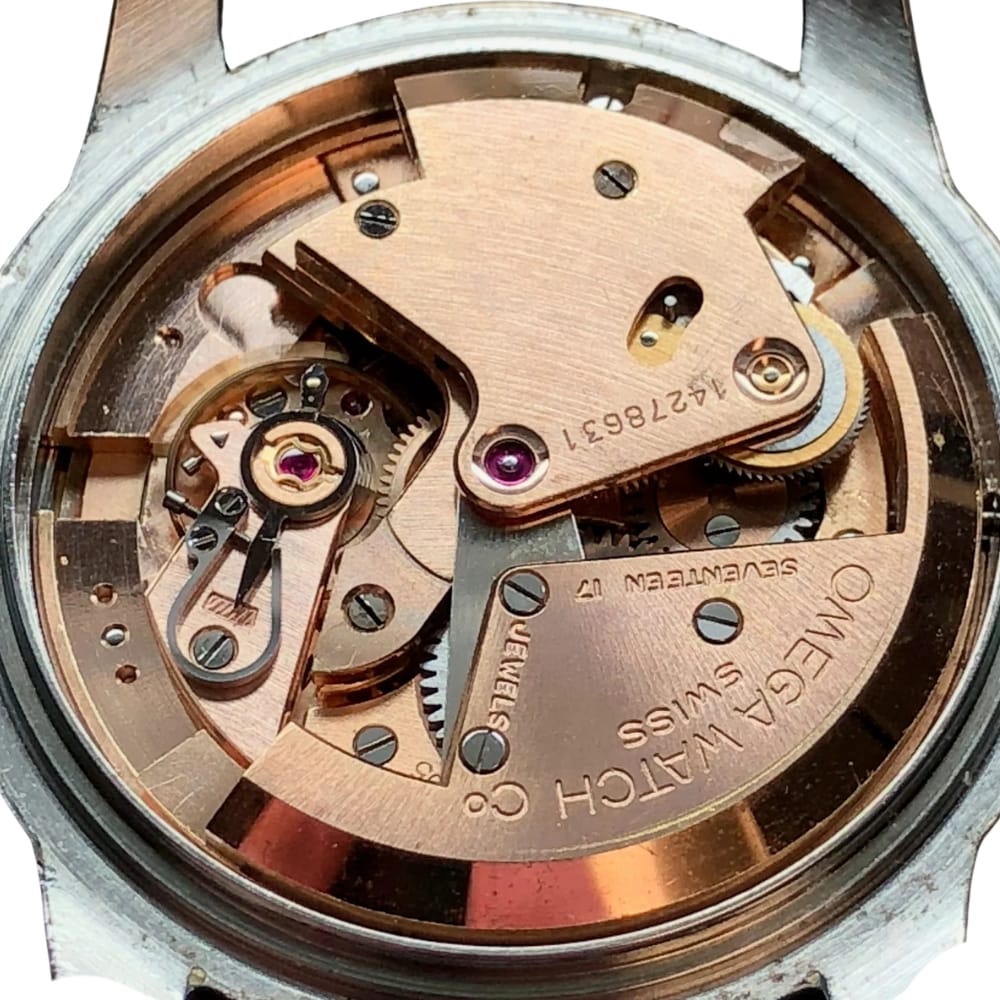
The Omega caliber 355 represents the final iteration of Omega’s bumper automatic movement series, a lineage that began with the revolutionary 28.10 RA PC in 1943 and concluded in 1962. This caliber holds the distinction of being the first Omega bumper movement to incorporate a date complication, making it a transitional design that bridged the gap between early automatic technology and the full-rotor caliber 500 series that would dominate the mid-1950s onward.
The caliber 355 is distinguished by its swan neck regulator, a feature that elevated it above the simpler index regulator found on the caliber 353. This refined adjustment mechanism allowed watchmakers to achieve superior timekeeping precision through micrometric screw adjustment. The movement’s copper-electroplated finish gave it a distinctive warm appearance that has, in many surviving examples, oxidized over the decades to reveal the brass substrate beneath. This patina does not affect technical performance but serves as a visual indicator of age.
Production numbers for the caliber 355 are not manufacturer-confirmed, but based on serial number analysis and the movement’s nine-year production run (1953-1962), estimates place total output in the range of 100,000 to 150,000 units. This figure accounts for the caliber’s presence in multiple Seamaster Calendar references as well as some non-Seamaster models. The caliber is classified as uncommon rather than rare. Calendar-equipped bumper movements from Omega command less collector interest than their full-rotor successors, partly due to the lack of quickset date functionality and partly due to the perception that bumper mechanisms require more specialized servicing.
Collector demand for caliber 355 watches remains steady but moderate. These pieces appeal primarily to collectors focused on Omega’s historical lineage rather than investment-grade acquisitions. Well-preserved examples with original dials and intact copper plating typically trade at a discount compared to chronometer-certified caliber 354 movements or later caliber 500 series pieces. The date complication adds modest value over non-date bumper calibers, though the absence of quickset adjustment limits appeal among users who prioritize daily wearability.
Historical Context, Provenance, and Manufacturing Details
The caliber 355 emerged in 1953 as Omega’s response to the growing market demand for calendar-equipped automatic watches. By the early 1950s, competitors had successfully integrated date complications into automatic movements, and Omega needed a solution that could be brought to market quickly. Rather than develop an entirely new architecture, Omega’s engineers adapted the proven caliber 350 bumper automatic (introduced in 1950) by adding a date mechanism at 6 o’clock. This approach reduced development time and allowed Omega to leverage existing tooling and supplier relationships.
The caliber 355 directly descended from the caliber 353, which was itself an evolution of the caliber 350 and 351 series. The primary enhancement over the 353 was the addition of the swan neck regulator, which replaced the simpler baton-shaped index regulator. This upgrade allowed for finer adjustment and contributed to improved rate stability. The caliber 354, a parallel development, received chronometer certification and featured similar construction but without the date complication. All three calibers (353, 354, 355) shared the same base architecture and differ primarily in regulation system and complications.
The caliber 355’s successor was the caliber 560 series, introduced in 1959 as part of Omega’s second-generation automatic family. The 560 series employed a full 360-degree rotor design that wound bidirectionally through reverser gears, eliminating the directional limitations and mechanical shock associated with bumper springs. By 1962, Omega had phased out all bumper production in favor of the more efficient and durable full-rotor designs. The caliber 355 thus represents the terminal point of a 19-year evolutionary line that began with Harwood’s 1920s bumper concept and culminated in Rolex’s full-rotor patent expiration in 1948.
Production of the caliber 355 took place at Omega’s main manufacturing facility in Biel/Bienne, Switzerland. This was an in-house manufacture movement, meaning Omega designed, produced, and assembled all major components internally. Unlike many mid-century Swiss movements that relied on ébauche suppliers such as ETA, AS (Adolf Schild), or Peseux, Omega maintained complete vertical integration for its core caliber families. The movement plates, bridges, and winding mechanism were all proprietary Omega designs, though certain commodity components (mainsprings, balance springs) were likely sourced from specialized suppliers like Nivarox.
The caliber 355 sits within the broader context of mid-century automatic watch development. While not groundbreaking in the manner of Rolex’s Perpetual or Jaeger-LeCoultre’s ultra-thin automatics, the 355 represents competent, reliable Swiss watchmaking during a period of rapid industrialization. Omega produced these movements in significant volume to meet consumer demand for affordable automatic watches with modern complications. The bumper mechanism, though ultimately superseded by full-rotor designs, was well-understood by watchmakers of the era and provided adequate winding efficiency for sedentary to moderately active wearers.
Construction and Architecture
The caliber 355 employs a three-quarter plate construction with separate bridges for the balance wheel, automatic winding mechanism, and upper oscillating weight assembly. The main plate and bridges are fabricated from brass with a copper electroplating finish, which was standard for Omega movements of this era. This plating served both aesthetic and functional purposes, reducing friction on certain pivots and providing corrosion resistance. Over time, the copper plating oxidizes and can develop a reddish-brown patina or, in some cases, turn dark brown to black where the plating has worn through to the brass substrate.
The balance wheel is a Glucydur-type bimetallic construction, approximately 11.5-12mm in diameter, with timing screws for adjustment. Glucydur is a beryllium-copper alloy known for its temperature compensation properties and corrosion resistance. The balance wheel features smooth-faced construction without visible poising screws on the rim, relying instead on adjustment screws inserted through the rim at strategic positions. This design was typical for mid-grade Swiss movements of the 1950s and provided adequate temperature compensation for daily wear without requiring the more complex compensation strategies seen in observatory chronometer movements.
The balance spring (hairspring) is a flat Nivarox spring without a Breguet overcoil. Nivarox is a cobalt-nickel-chromium alloy developed in the 1930s for its antimagnetic properties and resistance to temperature variation. The flat spiral configuration was common in this era and provided satisfactory isochronism for watches intended for general consumer use. The spring terminates at an outer stud that interfaces with the swan neck regulator, allowing micrometric adjustment via a fine-pitch screw. The inner terminal curve is fixed to the collet, which is friction-fit to the balance staff.

The escapement is a standard Swiss lever design with a club-tooth escape wheel. The pallet fork is fabricated from brass with synthetic ruby pallet stones, and the impulse jewel is similarly synthetic ruby. This configuration provides efficient energy transfer from the escape wheel to the balance wheel while minimizing friction and wear. The escapement operates at 19,800 vph (2.75 Hz), which was slightly below the industry standard of 18,000 vph (2.5 Hz) for earlier movements but not yet at the 21,600 vph (3 Hz) that would become common in the 1960s.
Shock protection is provided by Incabloc shock-absorbing jewel settings at both the balance staff pivots (upper and lower). The Incabloc system employs a lyre-shaped spring that holds a conical jewel setting in place. Upon impact, the spring flexes to absorb shock, preventing damage to the delicate balance staff pivots. This system was nearly universal in Swiss watchmaking by the 1950s and represented a significant improvement over fixed jewel settings, which were vulnerable to pivot fractures during routine handling.
The regulator is a swan neck design with a micrometric screw adjustment. The swan neck regulator consists of a curved spring steel member that holds the index pins in position and allows the watchmaker to move the index assembly along the arc of the hairspring by turning a fine-pitch screw. This design permits more precise rate adjustment than the simpler baton-shaped index regulators found on the caliber 353 and provides superior stability under vibration. The swan neck regulator was considered a mark of quality in mid-century Swiss movements and was typically reserved for chronometer-grade or higher-specification calibers.
The mainspring is a traditional white alloy type, dimensions 1.10 mm width by 0.105 mm thickness by 240 mm length, with an auto-wind barrel configuration featuring an internal bridle mechanism. The mainspring is housed in a barrel with a slipping bridle rather than a fixed attachment, allowing the spring to slip once fully wound and preventing overwinding damage. The mainspring can be manually wound via the crown in addition to the automatic winding provided by the oscillating weight. The power reserve of 42 hours is consistent with other Omega movements of this era and provides adequate runtime for daily wear with overnight rest periods.
The gear train consists of four wheels: barrel wheel, center wheel, third wheel, and fourth wheel (escape wheel). The center wheel is directly driven by the barrel and makes one rotation per hour, carrying the minute hand. The fourth wheel drives the escape wheel and makes one rotation per minute, driving the indirect center seconds via an intermediate wheel. The gear ratios are conventional for movements of this frequency and provide reliable power transmission from the mainspring to the escapement.
Finishing quality on the caliber 355 is functional rather than decorative, consistent with Omega’s positioning as a manufacturer of reliable tool watches rather than haute horlogerie. The movement plates feature perlage (circular graining) on visible surfaces, which provides a consistent texture and helps interrupt angular lines. Bridges are finished with a matte or lightly brushed surface, and screw heads are typically flat and polished rather than heat-blued or black-polished. The oscillating weight bears the Omega logo and caliber designation, applied via stamping or engraving. Edges are not chamfered (anglage), and there is no Côtes de Genève striping or other high-level decorative finishing. This level of finishing is entirely appropriate for a mid-market automatic movement and does not detract from the caliber’s functionality or durability.
Cross-Reference Data
The caliber 355 was not rebranded or sold to other manufacturers. Omega maintained exclusive use of this caliber designation throughout its production run.
Base Caliber vs. Elaborated Versions
| Variant | Differences | Jewel Count | Functions |
|---|---|---|---|
| Cal. 350 | Base bumper, no date, index regulator | 17 | Center seconds |
| Cal. 351 | Non-chronometer, index regulator, center seconds | 17 | Center seconds |
| Cal. 353 | Date at 6 o’clock, index regulator | 17 | Date, center seconds |
| Cal. 354 | Chronometer certified, swan neck regulator, no date | 17 | Center seconds |
| Cal. 355 | Date at 6 o’clock, swan neck regulator | 17 | Date, center seconds |
The caliber 353 and 355 are functionally identical except for the regulator type. The 353 employs a simpler baton-shaped index regulator, while the 355 features a swan neck regulator with micrometric adjustment. This distinction allowed Omega to offer two price points within the same case reference, with the 355 commanding a modest premium for its superior adjustment capability.
Compatible Case References by Brand
| Brand | Reference Numbers | Production Years | Notes |
|---|---|---|---|
| Omega Seamaster Calendar | 2627, 2627-7SC | 1951-1955 | Threaded case back, both Cal. 353 and 355 |
| Omega Seamaster Calendar | 2757, 2757-3SC, 2757-4SC | 1954-1962 | Press-in case back, beveled lugs, Cal. 355 |
| Omega Seamaster Calendar | 2849 | 1955-1962 | Late production reference, Cal. 355 |
| Omega (non-Seamaster) | Various 2xxx references | 1953-1962 | Gold-filled and solid gold cases |
The most common case reference for the caliber 355 is the Seamaster Calendar 2757 series, which featured thicker “beefy” lugs with beveled edges and a press-in case back. Earlier production 2627 models used both caliber 353 and 355, with the 355 typically appearing in later serial number ranges (14.3 million and above, corresponding to 1954 and later). Case diameters were typically 34-34.5mm excluding the crown, with lug-to-lug measurements of approximately 43-43.5mm.
Dial Compatibility
Dial foot positions for the caliber 355 are at approximately 11 o’clock and 5 o’clock when the crown is positioned at 3 o’clock. This configuration is specific to the 350 series bumper movements and is not interchangeable with full-rotor caliber 500 series movements, which use different foot positions to accommodate the larger rotor diameter and date wheel placement. The date window aperture is positioned at 6 o’clock and requires a date wheel with 31 numerals printed in a circular arrangement. Dial diameter for the caliber 355 is typically 26.5-27mm, and dials are secured via dial feet rather than dial screws.
Crown and Stem Specifications
| Component | Specification |
|---|---|
| Stem Thread | TAP 10 (0.90mm) |
| Crown Thread | TAP 10 (0.90mm) |
| Stem Height | 2.15mm |
| Setting Mechanism | Yoke-type clutch lever |
Crown threading for Omega movements of this era is consistently TAP 10, which corresponds to a 0.90mm thread diameter. This standardization allowed Omega to use common crown and stem components across multiple caliber families. Stems for the caliber 355 are two-piece designs with a female threaded post that accepts the crown. Replacement crowns and stems are available from aftermarket suppliers, though original Omega-signed crowns are preferred for authenticity.
Identification Marks
Authenticating a caliber 355 requires examination of multiple identification features and comparison against known genuine examples.
Caliber Number Location
The caliber number “355” is engraved on the movement plate beneath the balance wheel assembly. This engraving is typically small (approximately 1-1.5mm character height) and may require a loupe to read clearly. The number is often accompanied by the Omega logo and the jewel count marking “17 rubis” or “17 jewels”. Some movements also display “Swiss Made” or “Swiss” near the caliber marking.
Logo and Brand Marks
The oscillating weight (bumper rotor) bears the Omega logo engraved or stamped on its surface. This logo should be crisp and well-defined, with no signs of re-engraving or aftermarket alteration. The movement bridge may also bear quality stamps, though the caliber 355 was not chronometer-certified and therefore lacks the “Chronometer” or “Adjusted 5 Positions” markings found on the caliber 354.
Date Codes
Omega did not use alphanumeric date codes on movements during the 1950s. Production year is determined via the movement serial number, which is engraved on the movement plate. Serial numbers are seven-digit figures that follow a generally sequential pattern. For the caliber 355 production period (1953-1962), relevant serial number ranges are:
- 1953: 13,000,000-13,999,999
- 1954: 14,000,000-14,999,999
- 1956: 15,000,000-15,999,999
- 1958: 16,000,000-16,999,999
- 1959: 17,000,000-17,999,999
- 1961: 18,000,000-18,999,999
- 1962: 19,000,000-19,999,999
These ranges are approximate and can vary by several months in either direction. Serial numbers for Seamaster Calendar models equipped with the caliber 355 typically fall between 14,000,000 and 19,000,000, corresponding to 1954-1962 production.
Finishing Marks
The copper electroplating on the caliber 355 is the most distinctive visual characteristic. Genuine movements display a uniform copper-colored finish on the main plate and bridges, though this may have oxidized to a darker brown or reddish patina on older examples. The oscillating weight typically retains more of the original copper color due to less exposure to air and moisture. The balance cock should display perlage (circular graining) on visible surfaces, and screw heads should be polished but not black-polished.
Jewel Markings
Jewel settings on the caliber 355 are pressed into the plate rather than mounted in gold chatons. This was standard practice for mid-grade movements and does not indicate inferior quality. The Incabloc shock protection system employs spring-retained jewel settings at the balance staff pivots, which can be identified by the characteristic lyre-shaped springs visible at the balance cock.
Correct Serial Number Formats and Locations
Movement serial numbers are engraved on the movement plate and are visible when the rotor is removed. The serial number is a seven-digit integer with no letters or special characters. Authentic serial numbers are engraved using a pantograph or similar mechanical engraving tool, producing uniform character depth and spacing. Re-engraved or altered serial numbers often display irregular character alignment, inconsistent depth, or modern font styles inconsistent with 1950s production.
Expected Engravings and Stampings
Genuine caliber 355 movements display the following engravings:
- Caliber number (355)
- Jewel count (17 rubis or 17 jewels)
- Movement serial number (seven digits)
- Omega logo (on oscillating weight and sometimes on movement plate)
- “Swiss” or “Swiss Made”
The absence of any of these markings, or the presence of additional markings inconsistent with 1950s Omega production standards, warrants further investigation. Refinished or replaced movement components may lack original engravings, and movements with mixed components from different calibers should be evaluated carefully.
Font and Marking Style by Production Era
Engraving styles remained relatively consistent throughout the caliber 355 production run (1953-1962). The Omega logo on the oscillating weight was applied via stamping or shallow engraving and follows the standard Omega script logo style of the 1950s. Earlier examples (1953-1955) may display slightly different engraving depths or font weights compared to later production (1960-1962), but these differences are subtle and require comparison against multiple authenticated examples. Watchmakers familiar with Omega movements can generally identify re-engraved or fraudulent markings through comparison of engraving tool marks, character proportions, and depth consistency.
Part Information

Part Numbers
| Component | Part Number | Interchangeability Notes |
|---|---|---|
| Mainspring | 770/15 (MS-26N) | Compatible with Cal. 330, 340, 341, 342, 350, 351, 352, 353, 354 |
| Balance Complete | Varies by configuration | Not interchangeable; specific to Cal. 355 |
| Hairspring | Varies | Requires balance staff measurement; not interchangeable |
| Escape Wheel | Varies | Specific to 350 series calibers |
| Pallet Fork | Varies | Specific to 350 series calibers |
| Crown Wheel | Part #1104 | Compatible with 330, 340, 350 series |
| Ratchet Wheel | Varies | Specific to bumper automatic mechanism |
| Click Spring | Part #1411 | Compatible with 330, 340, 350 series |
| Setting Lever Spring | Varies | Specific to 350 series |
| Oscillating Weight | Part #1017 | Specific to Cal. 355; not interchangeable with 351/353/354 |
| Oscillating Weight Bearing | Part #1403 | Compatible with 330, 340, 350 series |
| Date Jumper | Part #1503 | Compatible with Cal. 353 |
| Date Star Driving Wheel | Part #1509 | Compatible with Cal. 353 |
| Cannon Pinion | Height 3.20mm | Specific to Cal. 355 |
| Sweep Second Pinion | Height 5.52mm | Compatible with Cal. 351 |
The mainspring part number 770/15 (also cataloged as MS-26N) is a Dennison Width 2, Dennison Strength 11 1/2 spring measuring 12 inches (approximately 305mm) in length, with metric dimensions of 1.10mm width and 0.095mm thickness. This mainspring is an automatic-type barrel spring with an internal bridle mechanism and is compatible across the entire 330/340/350 series bumper caliber family.
Oscillating weight (bumper rotor) components are specific to each caliber variant and are not fully interchangeable. The caliber 355 oscillating weight differs from the 353 and 354 versions in weight distribution and bearing configurations. Using an incorrect rotor can result in inadequate winding efficiency or mechanical interference with the date mechanism.
Sourcing Notes
Parts availability for the caliber 355 is limited but not impossible. Swiss-made mainsprings are available from specialized suppliers such as Ofrei, Perrin Watch Parts, Watch Material, and Esslinger. Generic parts sourced from these suppliers are of acceptable quality for service work, though genuine Omega NOS (New Old Stock) parts command premium pricing when available.
Commonly failed components include the oscillating weight bumper springs (Part #1415), which fatigue over time and may require replacement. These springs are shared with other 330/340/350 series calibers and are occasionally available from parts suppliers. The automatic winding mechanism, particularly the ratchet wheel and driving gear, experiences wear from the constant impact of the bumper rotor and may require replacement in high-mileage movements.
Balance staff pivots are vulnerable to fracture if the watch is dropped or subjected to shock despite the Incabloc protection. Balance staff replacement requires specialized tools and expertise, and staffs are caliber-specific. Watchmakers servicing the caliber 355 should inspect pivot condition carefully during disassembly and recommend replacement if wear or damage is evident.
Generic replacement parts such as gaskets, crystals, and generic mainsprings are acceptable for service work where original parts are unavailable. However, collectors and restoration specialists should prioritize genuine Omega parts or period-correct Swiss components to maintain authenticity and value.
Performance Data
Manufacturer Specifications
Omega did not publish detailed accuracy specifications for the caliber 355, as it was not chronometer-certified. However, based on industry standards for mid-grade Swiss automatic movements of the 1950s, expected accuracy for a new or freshly serviced caliber 355 would be:
- Accuracy (new/serviced): +12/-12 seconds per day typical, with well-adjusted examples achieving +8/-8 seconds per day
- Positions tested: Not specified; movements were adjusted in 2-3 positions (dial up, dial down, crown up) during production
- Temperature compensation: Passive compensation via Glucydur balance wheel; no active compensation
- Isochronism: Acceptable for daily wear; amplitude variation from full wind to power reserve depletion typically 20-30 degrees
The lack of chronometer certification indicates that Omega did not subject the caliber 355 to COSC testing or equivalent observatory trials. This positioning reflects the movement’s role as a reliable, affordable automatic caliber rather than a precision timekeeping instrument.
Observed Performance (Field Data)
Based on collector reports, watchmaker observations, and timing machine data from serviced examples, typical performance characteristics for well-maintained caliber 355 movements are:
- Typical accuracy range: +5 to +15 seconds per day for fully serviced examples in dial-up position
- Amplitude (fully wound): 250-280 degrees dial-up, 220-250 degrees in vertical positions
- Beat error: 0.5-2.0 milliseconds typical; well-adjusted examples can achieve under 0.5ms
- Winding efficiency: Moderate; requires regular wear or manual winding to maintain power reserve
Common performance issues include:
- Insufficient amplitude (below 220 degrees), typically caused by contaminated or dried lubricants, mainspring fatigue, or wear in the automatic winding mechanism
- Rate instability, often related to hairspring magnetization or improper regulator adjustment
- Date change misalignment, where the date changes several hours before or after midnight, usually caused by incorrect hand positioning during assembly
- Inadequate automatic winding, resulting from worn bumper springs or bearings in the oscillating weight mechanism
The caliber 355 performs best when serviced every 5-7 years and worn regularly. Sedentary wearers may find the bumper winding mechanism insufficient to maintain full power reserve and should supplement with manual winding. The movement is reasonably robust for its era but requires more frequent servicing than modern movements due to older lubricant formulations and higher-friction jewel settings.