

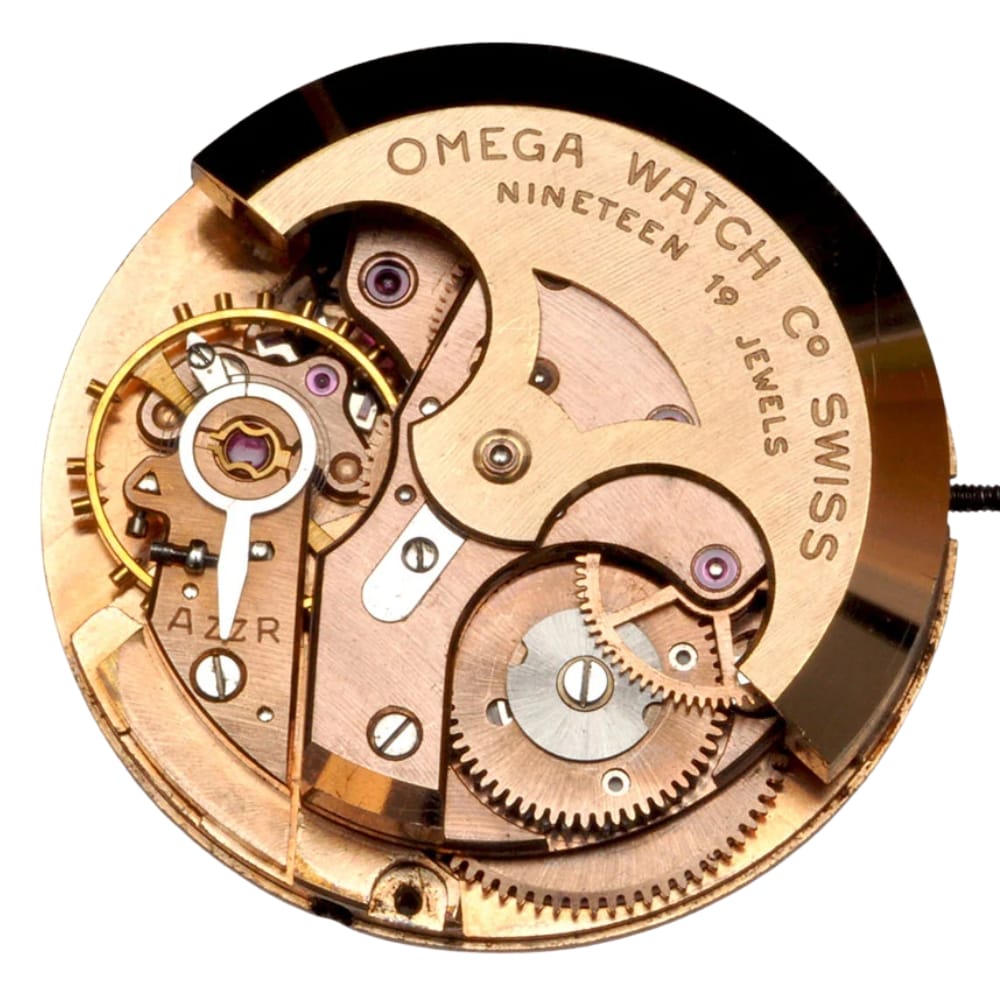
The Omega 471 represents a watershed moment in Omega’s horological evolution: it was the brand’s first full-rotor automatic movement with bi-directional winding, marking the definitive transition from the earlier bumper automatic designs to modern perpetual winding systems. Introduced between 1954 and 1955, the 471 appeared at a pivotal moment when Omega needed a reliable, mass-producible automatic caliber that could power its expanding Seamaster line without the mechanical limitations of 180-degree bumper rotors. This caliber proved so successful that it laid the architectural foundation for the entire 470/490/500 family of movements that would dominate Omega production through the late 1950s.
The cal. 471 was engineered as a practical workhorse movement rather than a chronometer-grade showpiece, though its 20-jewel variant approached higher-grade territory. It features a full 360-degree rotor on ball bearings, bi-directional winding, antimagnetic properties, and Incabloc shock protection, making it substantially more robust than the bumper automatics it replaced. The movement’s relatively compact 25mm diameter made it suitable for mid-sized cases in the 32-36mm range, which was considered standard sizing for men’s watches in the 1950s.
Production estimates for the entire 470/490/500 caliber family exceed one million movements manufactured between 1955 and 1960. While specific production figures for the cal. 471 alone are not manufacturer-confirmed, serial number ranges and observed market density suggest several hundred thousand examples were produced during its five-year production run. The caliber falls into the “common” scarcity category for Omega collectors, as numerous Seamaster references used this movement throughout the mid-to-late 1950s. However, availability varies significantly by jewel count: 20-jewel variants are more desirable and somewhat scarcer than 19-jewel versions, while 17-jewel cal. 470 variants (produced for the US market to avoid higher import tariffs) are less common still.
The cal. 471 occupies a stable position in the vintage Omega collector market, neither commanding strong premiums nor suffering from neglect. Complete Seamaster watches powered by this caliber typically trade in the $800-$2,500 range depending on case material, dial condition, and overall originality. Demand remains steady rather than rising, as collectors tend to favor later chronometer-grade movements like the cal. 501, 550, or 560 series for their superior finishing and swan-neck regulators. The cal. 471’s appeal lies in its historical significance as Omega’s first modern automatic, its reliability, and its accessibility to newer collectors seeking entry into vintage Omega ownership without chronometer pricing.
Historical Context, Provenance, and Manufacturing Details
The cal. 471 emerged from Omega’s urgent need to modernize its automatic winding systems in response to competitive pressure from Rolex, IWC, and other manufacturers who had already adopted full-rotor designs. By 1954, Omega’s bumper automatic calibers (such as the 28.10 RA series and cal. 342-354 family) were showing their age, with limited winding efficiency and increased maintenance requirements due to the constant shock loading on buffer springs. The cal. 470 series was developed to address these shortcomings while establishing a modular platform that could be scaled and elaborated for different market segments.
Development of the 470/471 series is attributed to Edouard Schwaar, a technical engineer at Omega who designed the entire early 500 series family. The caliber family was launched with the cal. 470 in 1954 as a 17-jewel variant, quickly followed by the cal. 471 in 1955 with an increased jewel count of 19 or 20 jewels depending on market and adjustment grade. The additional jewels in the 471 were concentrated in the automatic winding mechanism, with jeweling added to reverser wheels and reduction gears to reduce friction and improve long-term durability.
The cal. 471 directly replaced bumper automatic calibers in Seamaster production and eventually phased out the older 28.10 RA PC and 300-series movements across most of Omega’s automatic lineup. Its immediate successor was the cal. 501, which retained the same 25mm diameter and basic architecture but added a swan-neck micrometric regulator for finer adjustment, positioning it as a chronometer-grade movement. The 501 also increased total jewel count to 20 as standard and incorporated higher finishing standards. The cal. 471 itself was eventually superseded by the larger 28mm cal. 500 series around 1956-1957, though production overlapped significantly and both calibers remained in use through 1959.
The cal. 471 is an in-house Omega manufacture movement, designed, produced, and assembled at Omega’s Bienne factory in Switzerland. Unlike many movements of this era, it was not based on an ebauche from ETA, AS Schild, Peseux, or other third-party suppliers. However, components such as balance springs (likely Nivarox), shock protection systems (Incabloc), and certain standardized parts may have been sourced from specialized suppliers as was typical industry practice. The movement plates, bridges, gear trains, and rotor system were Omega’s own design and manufacture.
Manufacturing remained centralized at Omega’s Bienne facility throughout the caliber’s production run from 1954-1959. No evidence suggests production location changes during this period. The cal. 471 represents evolutionary rather than revolutionary design, incorporating proven Swiss lever escapement technology, traditional screw-balance regulation, and established automatic winding principles. Its significance lies in execution and production scale rather than technical breakthroughs, establishing Omega’s modern automatic platform that would carry the brand through the 1960s.
Construction and Architecture
Plate and Bridge Layout
The cal. 471 employs a traditional three-quarter plate construction with a separate train wheel bridge covering the third and fourth wheels. The movement consists of a base plate, a barrel bridge, a train wheel bridge, a pallet cock, a balance cock, and an upper and lower bridge for the automatic winding system. Construction material is brass with nickel plating or copper-tone rhodium plating, the latter being characteristic of Omega movements from this era and often mistaken for rose gold finish by collectors. The architectural philosophy emphasizes serviceability and parts interchangeability across the 470/490/500 family, allowing watchmakers to source components across multiple related calibers.

Balance Wheel
The cal. 471 uses a monometallic screw-adjusted balance wheel constructed from a proprietary Omega alloy that is neither brass nor standard glucydur. The balance features timing screws around its perimeter for rate adjustment, allowing watchmakers to fine-tune timekeeping by adding or removing mass at specific points. The balance diameter is proportionally sized for the 25mm movement, though exact specifications are not publicly documented. The balance is free-sprung in the sense that rate adjustment occurs via screws rather than index regulator positioning, though it retains an index-type regulator with pins rather than the swan-neck design found in higher-grade calibers like the cal. 501.
Balance Spring (Hairspring)
The movement employs a self-compensating flat balance spring, likely manufactured from Nivarox or similar beryllium alloy. This flat spiral design lacks the Breguet overcoil terminal curve found in higher-grade movements, which would improve isochronism across amplitude variations. The flat spring represents a cost-saving measure appropriate for a workhorse grade movement. The hairspring attaches via a collet to the balance staff and is secured at its outer terminal by a stud fixed to the balance cock. Length and characteristics are optimized for the 19,800 vph frequency.
Escapement Type
The cal. 471 utilizes a traditional Swiss lever escapement with straight-line geometry. The escapement features a jeweled pallet fork with entry and exit pallet stones (likely synthetic ruby), an impulse jewel mounted in the balance roller, and a club-tooth escape wheel. This represents conventional Swiss lever technology without innovation or variation from established practice. The escapement is jeweled with synthetic stones for the pallet fork pivots (upper and lower) and escape wheel pivots (upper and lower).
Shock Protection System
The cal. 471 incorporates Incabloc shock protection for the balance staff pivots, with spring-loaded conical jewel settings that can deflect under impact and return to position. The system includes upper and lower cap jewels (endstones) for the balance staff, held in place by Incabloc spring holders. The Incabloc system is mounted on both the balance cock (upper) and the movement plate (lower). Pallet fork and escape wheel pivots do not appear to have shock protection, which is typical for movements of this grade and era.
Regulator Type
The cal. 471 employs an index regulator system with two regulator pins that compress the outer coil of the hairspring to effectively shorten or lengthen its active length. A regulator pointer marked with plus and minus symbols indicates rate adjustment direction. This system lacks the swan-neck micrometric regulator found in the related cal. 501, which would allow finer adjustment increments. The index regulator is adequate for achieving acceptable timekeeping in two or three positions but is insufficient for chronometer certification, which requires five-position adjustment. Some 471 movements feature a two-piece regulator design that allows for easier servicing.
Mainspring Material and Type
The cal. 471 uses a white alloy mainspring designated part number WA31 by suppliers, with metric dimensions of 1.2mm width and 0.1mm thickness (Dennison size 3 width, 11 strength). The mainspring length is approximately 14 inches (355mm) when fully extended. Material composition is likely a proprietary steel alloy designed for automatic winding applications, where the mainspring must accommodate continuous small winding increments rather than full manual winding. The mainspring is housed in a going barrel that rotates freely, with power transmitted through the center arbor to the gear train. The mainspring is the same specification across the 470, 471, 490, 491, 500, 501, 502, 503, 504, and 505 calibers, demonstrating the platform approach of this movement family.
Gear Train Details
The cal. 471 features an indirect center seconds drive, meaning the seconds hand is driven by the fourth wheel through a friction-fit pinion rather than being mounted directly on the fourth wheel arbor. This arrangement requires a sweep second pinion (part 1250) with a friction spring (part 1255) to provide slipping torque and allow hand setting without damage. The gear train consists of the typical four-wheel arrangement: barrel, center wheel, third wheel, fourth wheel. The center wheel drives the cannon pinion that carries the minute hand, while the motion works (intermediate wheel and hour wheel) provide 12:1 reduction for the hour hand. Gear ratios are standard for a 2.75 Hz movement and are not specifically documented in available sources.
Finishing Quality and Techniques
The cal. 471 represents a mid-grade finishing level appropriate for a mass-production automatic movement. Finishing techniques include Cotes de Geneve (Geneva stripes) on the rotor bridge and possibly the barrel bridge, circular perlage (spotted pattern) on the plate visible through the balance cock cutout, and brushed finishing on bridge edges. Screw heads show polished slots. Edges are beveled but not hand-polished to a high polish. The movement plates exhibit a copper-tone or rose-colored rhodium plating that has become a signature aesthetic of Omega movements from this era. Finishing quality is adequate and attractive but does not approach chronometer-grade levels with black polishing, hand-applied anglage, or gold chatons. The movement is typically marked “Omega Watch Co Swiss,” “Nineteen Jewels” or “Twenty Jewels,” the caliber number “471,” and the serial number, all engraved on the movement plate or bridges.
Cross-Reference Data
Alternative Caliber Names and Elaborated Versions
The caliber family extends to 28mm variants:
Compatible Case References by Brand
Dial Compatibility Note
Dial feet positioning for the cal. 471 follows Omega’s standard layout for 25mm movements, with feet at approximately 90 and 270 degrees (3 and 9 o’clock positions). The movement lacks a date complication, so no date window cutout is required. Dial dimensions should be approximately 24.5-25mm to fit properly within the rehaut. Collectors restoring cal. 471 watches should verify dial foot positions match the movement, as some cal. 470 and 471 dials are interchangeable but service dials from later calibers may not fit correctly.
Crown and Stem Specifications
Identification Marks
Caliber Number Location
The caliber number “471” is engraved on the train wheel bridge or barrel bridge, typically visible when viewing the movement from the dial side after removing the dial. The number may also appear on the movement plate near the balance cock. Engraving depth and style are consistent with factory standards, with crisp, evenly-spaced numerals approximately 1-2mm in height.
Logo and Brand Marks
Authentic cal. 471 movements bear the engraving “Omega Watch Co Swiss” on the train wheel bridge or movement plate. Jewel count markings appear as “Nineteen Jewels” or “Twenty Jewels,” depending on the specific variant. These markings are engraved rather than stamped, with consistent depth and serif font styling typical of 1950s Omega production. The Omega symbol (Ω) may appear on bridges, though this is less common in earlier production examples.
Date Codes
The cal. 471 does not use a separate date code system. Production year is determined by the movement serial number, which correlates to specific year ranges. Serial numbers for cal. 471 movements fall primarily in the following ranges:
| Serial Number Range | Production Year |
|---|---|
| 14,000,000 – 14,999,999 | 1954 |
| 15,000,000 – 15,999,999 | 1956 |
| 16,000,000 – 16,999,999 | 1958 |
| 17,000,000 – 17,999,999 | 1959 |
Finishing Marks
Expected finishing patterns include Cotes de Geneve (parallel stripes) on visible bridge surfaces, particularly the rotor bridge and barrel bridge. Circular perlage (spotted circular pattern) should be present on the movement plate visible through openings in the bridges. These finishing marks should be consistent in pattern and depth. The movement plates typically exhibit copper-tone or rose-colored plating that distinguishes 1950s Omega movements.
Jewel Markings
Jewel settings in the cal. 471 are primarily pressed jewels rather than raised chatons, which is appropriate for this grade level. Balance jewels feature Incabloc shock protection settings with distinctive spring holders visible on the balance cock. Gold chatons are not used in the cal. 471, as these are reserved for higher chronometer-grade calibers. Jewel count (19 or 20) should match the engraved marking on the movement.
Adjustment Markings
The cal. 471 is typically not adjusted to chronometer standards and therefore lacks chronometer markings or adjustment indicators. Some higher-grade 20-jewel examples may carry markings indicating adjustment in two or three positions, but five-position chronometer adjustment is not present. The related cal. 501, in contrast, typically carries chronometer markings and adjustment notations.
Correct Serial Number Formats and Locations
Movement serial numbers on the cal. 471 appear on the movement plate, typically visible near the balance cock when viewing the movement from the dial side. Serial numbers are eight digits in length, falling within the ranges noted above (14,000,000 through 17,999,999 for production years 1954-1959). Engraving should be crisp and evenly spaced, with numerals approximately 1mm in height. Serial numbers do not include letters or prefixes in this era.
Expected Engravings and Stampings
Legitimate cal. 471 movements should display the following engravings:
- “Omega Watch Co Swiss” on train wheel bridge or plate
- “Nineteen Jewels” or “Twenty Jewels” on plate or bridge
- “471” caliber designation on bridge
- Eight-digit serial number on movement plate
- “Swiss Made” or “Swiss” marking
Engraving depth should be consistent across all markings, typically 0.1-0.2mm deep with clean edges. Font style is period-correct serif with consistent character spacing.
Font and Marking Style by Production Era
Engraving style remained largely consistent throughout the cal. 471’s production run from 1954-1959. Early examples (1954-1956) may show slightly heavier serif fonts, while later examples (1957-1959) exhibit more refined, lighter engraving. The transition to the cal. 501 and 500 series saw some changes in bridge design and marking placement, but the cal. 471 itself maintained consistent styling throughout its production life. Logo design remained stable during this period, with the Omega name spelled out rather than using only the Greek letter symbol.
Part Information

Part Numbers and Interchangeability
Parts Diagrams and Technical Drawings
Technical service manuals for the cal. 471 are documented and archived in watchmaker reference libraries. These manuals include exploded parts diagrams showing component relationships, part numbers, and assembly sequences. Original Omega technical documentation from the 1950s provides detailed specifications for jewel positions, gear ratios, and adjustment procedures. Parts suppliers such as Cousins UK, Ofrei, Perrin, and Jules Borel maintain cross-reference listings that include the cal. 471.
Sourcing Notes
Parts availability for the cal. 471 has become increasingly restricted as Omega/Swatch Group limits supply of vintage components to independent watchmakers. Key considerations:
Still Available:
- Mainsprings (generic Swiss-made WA31) remain widely available from multiple suppliers at $24-$40
- Balance springs (generic replacements)
- Common wear parts: sweep second friction springs, click springs, setting lever springs
- Incabloc components (standard parts)
- Some movement screws and basic components
Limited or No Longer Available:
- Rotor bearings for some variants (Omega has exhausted stock for cal. 501, likely similar for 471)
- Complete balances with original proprietary alloy
- Original bridges and plates (NLA from Omega)
- Some specialized wheels and pinions
Common Failures and Replacements:
- Sweep second friction spring (1255) commonly loses tension and requires replacement
- Barrel arbor bushings (upper and lower) wear over time and require bushing replacement or plate repair
- Rotor bearing wear is inevitable with age; some watchmakers report limited repair options
- Mainspring fatigue occurs after decades; replacement is standard service practice
- Balance staff pivots can break if watch is dropped; replacement staffs are available
Generic Replacements:
- Mainsprings: Generic Swiss WA31 springs perform equivalently to original Omega parts
- Balance springs: Generic Nivarox springs can be fitted and adjusted to length
- Incabloc parts: Standard Incabloc components are interchangeable
- Some screws and small components have generic equivalents
Watchmakers working on cal. 471 movements should establish relationships with specialized vintage parts suppliers and consider sourcing donor movements for critical components no longer available from Omega. The movement’s widespread production and parts compatibility across the 470/490/500 family provide some cushion against parts scarcity, but collectors should expect higher service costs as availability tightens.
Performance Data
Manufacturer Specifications
Omega’s technical specifications for the cal. 471 establish expected performance parameters:
The cal. 471 was not designed or adjusted to chronometer standards, which would require performance within -4 to +6 seconds per day across five positions and three temperatures. Instead, it targets the broader accuracy range appropriate for a mid-grade automatic movement. Isochronism (consistency of rate across different amplitudes) is adequate but not exceptional due to the flat balance spring design lacking a Breguet overcoil terminal curve.
Observed Performance (Field Data)
Collector reports, watchmaker observations, and vintage watch dealer timing results provide real-world performance data for well-maintained cal. 471 examples:
Typical Accuracy Range:
Well-serviced cal. 471 movements typically achieve +/- 8-15 seconds per day when worn regularly. This represents performance in the dial-up or dial-down position during daily wear. Accuracy degrades significantly in vertical positions (crown up, crown down, crown left, crown right), which is expected for a movement adjusted in only two or three positions. Some particularly well-regulated 20-jewel examples approach +/- 5-10 seconds per day in favorable positions.
Common Performance Issues:
- Amplitude loss: Aged mainsprings or dried lubricants cause amplitude to drop below 220 degrees, affecting rate stability and potentially causing the watch to stop in vertical positions
- Rate variation by position: The cal. 471 shows significant rate differences between horizontal and vertical positions, sometimes varying by 20-30 seconds per day
- Running fast: Watches that have not been serviced for extended periods often run fast as lubricants dry and increase friction in the gear train
- Temperature sensitivity: While not designed with temperature compensation, the cal. 471 shows moderate rate changes in extreme temperatures, typically running faster in heat and slower in cold
Expected Amplitude:
- Fully wound, horizontal: 260-280 degrees
- Fully wound, vertical: 240-260 degrees
- End of power reserve (40+ hours): 200-220 degrees
- Service required threshold: Below 200 degrees indicates mainspring weakness, dried lubricants, or mechanical issues
Performance Degradation with Age:
Unserviced cal. 471 movements exhibit predictable degradation patterns:
- Years 0-10: Performance remains close to specification with minimal degradation
- Years 10-20: Amplitude drops 10-15%, accuracy deteriorates to +/- 20-30 seconds per day
- Years 20-40: Significant amplitude loss (below 220 degrees), accuracy exceeds +/- 30 seconds per day, risk of stopping
- Years 40+: Service becomes critical; movement may stop intermittently, show severe amplitude loss, and require complete overhaul with parts replacement
Properly serviced cal. 471 movements can maintain acceptable performance indefinitely, with service intervals of 5-8 years recommended. The movement’s robust construction and parts availability support long-term serviceability, though collectors should anticipate increasing difficulty sourcing specific components as original Omega parts stocks are exhausted.