

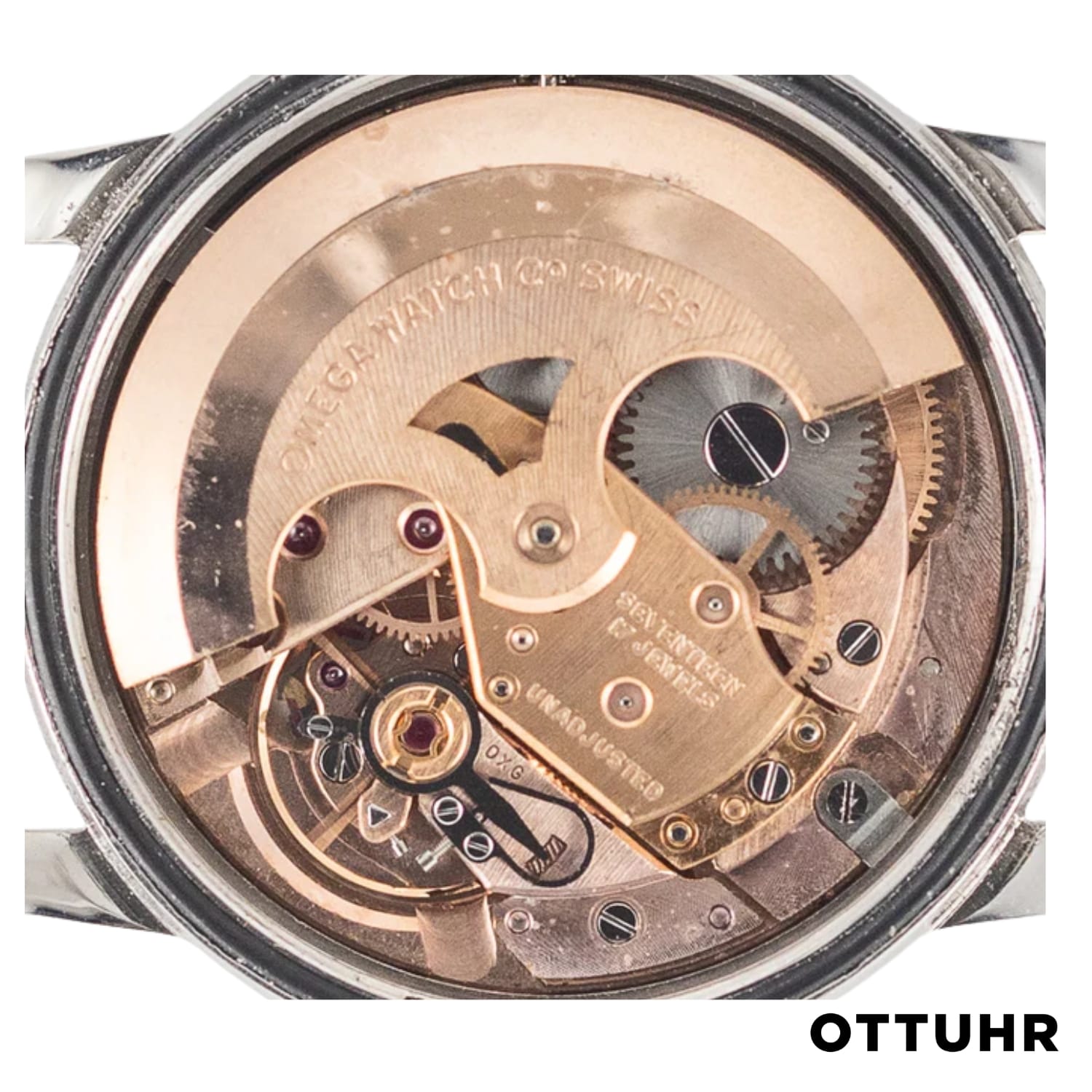
The Omega Caliber 560 represents one of the most compelling stories in mid-century watchmaking: a deliberate de-specification engineered specifically to circumvent U.S. import tariffs. With only 3,000 pieces produced between 1959 and 1967, this 17-jewel automatic became a strategic solution to democratize Swiss watchmaking for the American working class, sold through Norman Morris Corporation at an accessible $95 price point when comparable 24-jewel movements faced prohibitive import duties.
This caliber belongs to Omega’s celebrated 550-series family, itself considered among the finest mass-produced automatic movements ever manufactured. The 560 is mechanically identical to its 24-jewel sibling, the caliber 562, with one crucial difference: seven fewer jewels in the automatic winding assembly, where bushings replace jewel bearings. Far from a compromise, this substitution proves advantageous for long-term maintenance because bushings are softer than gear wheels, absorbing wear themselves rather than damaging expensive wheel components. The movement shares the same robust architecture, Incabloc shock protection, swan neck regulation, and bidirectional automatic winding that made the 550 family legendary among collectors and watchmakers.
Production of the 560 was strictly limited to 3,000 movements, distributed across nine confirmed case references marketed exclusively in the United States between 1963 and 1967, though movement production began in 1959. Serial numbers range from 16 million to 23 million, corresponding to production years 1959 through 1966. This extreme scarcity makes the 560 considerably rarer than most Omega complications or limited editions. When divided across nine model variants, certain dial and case combinations exist in quantities measured in hundreds rather than thousands, with some estimates suggesting specific configurations may number fewer than 300 examples.
Collector interest in caliber 560 watches has risen steadily as the story of this “tariff beater” movement has become better understood. While values remain modest compared to chronometer-grade Constellations or early Speedmasters, the 560’s combination of genuine rarity, historical significance, and inclusion in the revered 550 movement family has created strong demand among collectors who appreciate underdog narratives. Dial variants significantly impact desirability, with black glossy gilt dials commanding premiums over common white linen dials. The most frequently encountered references are KL6068 (approximately 16% of production) and 166.020 (approximately 14% of production), making other references considerably scarcer.

Omega Caliber 560 movement architecture showing layered construction with automatic winding mechanism
Historical Context, Provenance, and Manufacturing Details
The Omega Caliber 560 emerged directly from U.S. trade policy rather than horological innovation. In the late 1950s, American import tariffs on Swiss watches were structured around jewel count, with a significant duty increase applied to movements containing more than 17 jewels. This protectionist measure aimed to shield domestic watch manufacturers but created a pricing barrier that locked average American consumers out of quality Swiss automatic movements.
Norman Morris, the Austrian-born founder of Norman Morris Corporation who served as Omega’s exclusive U.S. distributor from 1930 to 1980, identified this market gap. Morris had already proven his influence within Omega, most notably by naming the De Ville line. He proposed a solution: produce a 17-jewel version of Omega’s excellent 562 caliber specifically for the American market, targeting “the simple man, the blue collar worker” with a sub-$100 Swiss automatic. Omega agreed to manufacture exactly 3,000 movements, a remarkably small production run even by vintage standards.
The 560 is fundamentally a de-jeweled variant of the caliber 562, itself part of the 550-series family that debuted in 1958-1959. The 550 family represented Omega’s response to competitive pressures from other manufacturers and succeeded in becoming one of the most respected automatic platforms of the era. Caliber 550 (17 jewels, no date) served as the base, with 551 (24 jewels, chronometer, no date), 552 (24 jewels, no date), 560 (17 jewels, date), 561 (24 jewels, chronometer, date), and 562 (24 jewels, date) filling out the range. All shared the same fundamental architecture, mainplate design, gear train geometry, and parts interchangeability.
The 560 differs from the 562 exclusively in the automatic winding assembly. Where the 562 uses jeweled bearings for the reversing wheels and winding pinion, the 560 employs brass bushings. This substitution reduced jewel count from 24 to 17 without compromising timekeeping performance or long-term reliability. Critically, all timing-critical components remained unchanged: the balance complete (part 1327), hairspring, escapement (pallet fork part 1316), gear train wheels, and mainspring are identical across 560, 561, and 562 calibers.
The 560 was manufactured entirely in Switzerland at Omega’s Bienne facilities, following the same production standards as chronometer-grade movements. However, final casing varied. Approximately 70% of caliber 560 watches were cased in the United States by specialized case manufacturers contracted by Norman Morris. The most common were Ross Watch Case Co. (marked “Ross” with hallmarks between lugs) and Jonell Watch Case Co. (marked with a “J” in an arrow, frequently seen on KL6312 and KL6303 references). The remaining 30%, including all stainless steel Seamaster variants (primarily 166.002, 166.020) and the Dynamic steel models (6196), were cased in Switzerland before export.
Production spanned 1959 to approximately 1967, though primary marketing occurred 1963-1967. By the late 1960s, Omega had introduced the 563-565 family with quickset date complications, rendering the semi-quickset 560 obsolete. The 563 (17 jewels, quickset) directly replaced the 560 in Omega’s lineup by 1966.
Construction and Architecture
The Omega Caliber 560 employs a classic Swiss three-quarter plate architecture with integrated automatic winding mechanism. This design philosophy prioritizes robustness, serviceability, and manufacturing efficiency while maintaining chronometric performance approaching chronometer-grade movements.
Plate and Bridge Layout
The movement uses a brass mainplate with copper-toned finish characteristic of Omega’s 1960s production. A large three-quarter plate covers the gear train from the mainspring barrel through the fourth wheel, secured by multiple screws. Separate cocks support the balance assembly (with integrated Incabloc shock protection) and the escape wheel. The automatic winding assembly occupies the movement’s upper surface, beneath a dedicated rotor bridge that also houses the reversing wheel mechanism. This modular bridge structure facilitates service: watchmakers can access the automatic winding train without disturbing the time-train, and the balance can be removed independently for regulation or hairspring work.
Balance Wheel
The 560 uses a Glucydur beryllium-bronze balance wheel, a significant technological advancement that appeared across Omega’s mid-range and premium calibers during this era. Glucydur alloys resist thermal expansion and maintain dimensional stability across temperature ranges, improving isochronism. The balance measures approximately 10mm diameter and features four gold-colored timing screws positioned at cardinal points around the rim, allowing traditional screw adjustment for poise and fine regulation. The balance pivots run in jeweled bearings with Incabloc spring-loaded shock protection at both upper and lower pivots.
Balance Spring (Hairspring)
The caliber 560 employs a Nivarox-type alloy hairspring, the Swiss industry standard by the 1960s. Nivarox (nickel-iron alloy with beryllium, chromium, and titanium additions) provides superior anti-magnetic properties and temperature compensation compared to traditional steel hairsprings. The 560 uses a flat Breguet overcoil terminal curve, though the exact configuration varies between examples. The inner terminal anchors to a collet on the balance staff, while the outer terminal attaches to a stud fixed in the balance cock.
Escapement Type
The movement uses a Swiss lever escapement, the industry-standard design that dominated precision watchmaking from the mid-19th century onward. The pallet fork (part 1316, interchangeable with 550, 551, 552, 561, 562, and the entire 600-series manual-wind family) carries two synthetic ruby pallet stones that alternately lock and release the escape wheel teeth. The escape wheel itself is manufactured from brass with precisely formed teeth. This escapement design achieves the 49-degree lift angle that defines the 550 family’s timing characteristics.
Shock Protection System
Incabloc provides shock protection at the balance pivots. The system uses a lyre-shaped spring clip that holds a conical jewel setting and cap jewel in place while allowing controlled vertical and radial displacement under impact. When shock occurs, the balance staff pivots can move within the jewel setting, then return to center without damage. The Incabloc design became Omega’s standard shock protection throughout the 1960s and remains highly regarded for reliability.
Regulator Type
The 560 employs a swan neck fine regulator (part 1333 for caliber 550, shared across the family). This elegant system uses a curved spring steel arm shaped like a swan’s neck to hold the regulator index against the hairspring stud. A micrometric screw at the end of the swan neck arm allows precise adjustment of the effective hairspring length, controlling rate. The swan neck design provides superior regulation stability compared to simple index regulators because it maintains constant pressure on the regulator index regardless of adjustment position. However, some 560 movements from later production periods may have pointer-style index regulators, reflecting Omega’s gradual transition toward simplified regulation systems in non-chronometer calibers during the mid-1960s.
Mainspring Material and Type
The caliber 560 uses a high-alloy “white metal” mainspring (commonly Nivaflex or equivalent) housed in a going barrel. These modern alloy mainsprings replaced traditional blued steel by the 1950s, offering superior energy density, reduced set (permanent deformation), and elimination of lubrication requirements at the mainspring itself. The mainspring measures approximately 1.01mm width, 0.110mm thickness, and 380mm length, specifications shared across the entire 550-565 family (part 1208 or equivalent aftermarket replacement). The mainspring barrel is approximately 7.5mm diameter and drives the center wheel through a fixed ratchet system. Power reserve extends approximately 50 hours from full wind.
Gear Train Details
The 560 uses indirect center seconds drive, meaning the fourth wheel (seconds wheel) is positioned off-center in the movement, with the center seconds pinion mounted atop the center wheel through a friction-spring coupling. This configuration allows the seconds hand to be stopped for setting without halting the entire movement, though the 560 lacks hacking (automatic stop seconds) functionality. The gear train runs: mainspring barrel → center wheel (1 revolution per hour) → third wheel → fourth wheel (60 seconds per revolution) → escape wheel (specific tooth count undocumented in available sources). The center wheel and associated cannon pinion are manufactured in multiple height variants (H1 part 1225 at 4.51mm, H2 part 1226 at 4.81mm) to accommodate different dial configurations.
Finishing Quality and Techniques
The caliber 560 receives mid-grade finishing appropriate to its positioning as an accessible workhorse automatic rather than a luxury chronometer. Bridges display Côtes de Genève (Geneva stripes) decoration, though execution quality varies between production batches. The mainplate shows circular perlage (circular graining) in recessed areas. Edges receive light chamfering rather than the precise anglage found on chronometer-grade 561 movements. Screw heads are polished but not mirror-finished. The rotor is decorated with concentric circular brushing and carries the Omega logo. Unadjusted movements lack position adjustment markings; adjusted variants are marked “ADJUSTED 2 POSITIONS” on the rotor bridge, indicating regulation in dial-up and crown-down positions. This finishing level reflects Omega’s practical approach to the 560: deliver reliable timekeeping at an accessible price point rather than compete in the luxury chronometer market.
Omega Caliber 560 identification marks and engraving locations
Cross-Reference Data
Alternative Caliber Names (Rebranded Versions)
The Omega Caliber 560 was never rebranded or sold under alternative names. Unlike ETA ebauches that appeared under multiple manufacturer designations, the 560 remained exclusive to Omega as a proprietary in-house manufacture caliber.
Base Caliber vs. Elaborated Versions
| Caliber | Jewel Count | Chronometer | Date Mechanism | Adjustment | Notes |
|---|---|---|---|---|---|
| 550 | 17 | No | No | Varies | Base non-date automatic |
| 551 | 24 | Yes (COSC) | No | 5 positions + temperature | Chronometer non-date |
| 552 | 24 | No | No | Varies | 24-jewel non-date |
| 560 | 17 | No | Yes (semi-quickset) | Unadjusted or 2 positions | U.S. market date version, bushing-based auto assembly |
| 561 | 24 | Yes (COSC) | Yes (semi-quickset) | 5 positions + temperature | Chronometer date, primarily Constellation |
| 562 | 24 | No | Yes (semi-quickset) | Varies | Standard 24-jewel date automatic |
Parts interchangeability within the 550-562 family is extensive. Balance complete (1327), pallet fork (1316), mainspring (1208), winding stem (1106), escape wheel, and most gear train components interchange freely. The primary difference between 560 and 562 lies in the automatic winding assembly jeweling; all timekeeping components remain identical.
Compatible Case References by Brand
The following case references definitively housed caliber 560 movements. Production figures represent approximate distribution percentages based on collector census data compiled by Hans Jorgen and other researchers:
| Reference | Brand Line | Case Material | Casing Location | Production % | Notes |
|---|---|---|---|---|---|
| KL6068 | Seamaster De Ville | 14K gold-filled, stainless | USA (Ross or Jonell) | ~16% | Most common variant, various dials |
| 166.020 | Seamaster De Ville | Stainless steel, two-tone | Switzerland | ~14% | Second most common, cased in Switzerland |
| KL6312 | Seamaster | 10K gold-filled | USA (Jonell) | ~12% | Often golden linen dial |
| KL6303 | Seamaster | 14K gold-filled | USA (Jonell) | ~8% | Various dial colors |
| KL6292 | Seamaster | Gold-filled | USA | ~7% | Standard case |
| KL6292VB | Seamaster | Gold-filled | USA | <1% | Exhibition “Kleerback” variant |
| 166.002 | Seamaster | Stainless steel | Switzerland | ~10% | Cased in Switzerland, OXG import mark debate |
| 6196 | Dynamic | Stainless, 14K top | Switzerland | <1% | Extremely rare, no confirmed examples |
| Various KL | Seamaster/Geneve | Mixed | USA | ~32% | Remaining references distributed across multiple KL codes |
Note: References KL6019, KL6020, KL6021 have been discussed in collector forums but are not confirmed in Omega USA documentation per the Omega Museum. Total production across all references equals 3,000 movements.
Dial Compatibility Note
The caliber 560 uses dial feet spacing and date window positioning identical to calibers 562, 563, 564, and 565. Date window is positioned at 3:00. Dial feet are positioned to accommodate both Seamaster and De Ville dial styles. However, center wheel height varies by dial thickness. Two standard heights exist: H1 (part 1225, 4.51mm center wheel, 2.70mm cannon pinion) and H2 (part 1226, 4.81mm center wheel). Collectors and restorers must match center wheel height to dial thickness to achieve proper hand clearance. Incorrect height causes hands to strike the dial or fail to clear hour markers.
Crown and Stem Specifications
| Component | Part Number | Specification |
|---|---|---|
| Winding Stem | 1106 | Shared with 550, 551, 552, 561, 562, 600, 601, 610, 611, 613 |
| Stem Threading | Standard Omega tap | TAP 10 (0.90mm) is common for era but specific tap unconfirmed |
| Crown Thread | Varies by case | U.S.-cased examples often use case manufacturer-specific threads |
| Setting Mechanism | Yoke clutch | Indirect seconds drive with yoke clutch and setting lever |
The stem (part 1106) must be cut to length for the specific case reference because U.S.-cased and Swiss-cased examples have different case back depths. Original Omega crowns for 560 models vary widely because Norman Morris had final say on dial and crown selection for U.S. market watches.
Identification Marks
Authenticating an Omega Caliber 560 requires careful examination of movement markings, serial number format, finishing characteristics, and case markings. The 560’s rarity and desirability have made it a target for misrepresentation, with 562 movements occasionally misidentified or fraudulently relabeled.
Caliber Number Location
The caliber number “560” is engraved on the train bridge (the large three-quarter plate covering the gear train) in serif font typical of Omega’s 1960s production. The number is positioned near the center of the bridge, clearly visible when the rotor is removed. Font style should show period-appropriate engraving depth and consistency. Modern re-engraving typically shows sharper, less aged edges. Some examples may show slight variations in font weight between production batches, but the fundamental serif style remains constant.
Logo and Brand Marks
The Omega logo (Greek omega symbol Ω) appears prominently on the automatic rotor, either engraved or applied depending on rotor variant. The rotor should display circular concentric brushing finishing radiating from the center pivot. The rotor bridge (automatic upper bridge) carries the text “OMEGA WATCH CO.” and “SWISS MADE” in characteristic 1960s Omega font. Chronometer-adjusted movements of sister calibers show “ADJUSTED TO FIVE POSITIONS AND TEMPERATURE” on the rotor bridge; the 560 never received this marking. Adjusted 560 movements show “ADJUSTED 2 POSITIONS” instead, with this marking appearing on the rotor bridge beginning around 1965.
Date Codes
Omega did not use separate date code systems during 560 production. Movement age is determined exclusively through serial number ranges (see below). Case backs may carry import or hallmark codes that provide secondary dating evidence. The OXG import code, assigned to Norman Morris Corporation, appears on many U.S.-cased examples. Swiss-cased models lack OXG marks.
Finishing Marks
Authentic 560 movements display Côtes de Genève decoration on bridges with period-appropriate execution quality. The pattern should appear slightly irregular under magnification, reflecting hand-finishing or early machine finishing rather than modern laser or perfectly consistent machine decoration. Perlage on the mainplate should show overlapping circular patterns with slight variation in depth and spacing. The rotor displays concentric circular brushing from center outward.
Jewel Markings
The 560 uses 17 jewels total: balance upper pivot, balance lower pivot, pallet fork pivots (2), escape wheel upper pivot, escape wheel lower pivot, fourth wheel upper pivot, fourth wheel lower pivot, third wheel upper pivot, third wheel lower pivot, center wheel lower pivot, pallet stones (2), and additional jewels in the winding/setting mechanism. Jewels are press-fit into brass settings rather than gold chatons (unlike chronometer-grade 561). Under magnification, authentic jewels show the characteristic deep red color of synthetic ruby with internal structure visible through the jewel. Replacement jewels may show color variations or excessive clarity suggesting modern synthetic manufacturing.
Adjustment Markings
Unadjusted 560 movements (majority of production, especially pre-1965) carry no adjustment markings. Adjusted examples (2 positions: dial up and crown down) show “ADJUSTED 2 POSITIONS” engraved on the rotor bridge. This represents timing regulation performed at the factory to reduce rate variation between these two positions. The 2-position adjustment is significantly less rigorous than the 5-position plus temperature adjustment applied to chronometer calibers (like the 561), but it provides improved timekeeping for collectors who consistently wear their watches.
Correct Serial Number Formats and Locations
Serial numbers for caliber 560 movements fall within the range 16,000,000 to 23,000,000, corresponding to Omega’s production from approximately 1959 to 1966. The serial number is engraved on one of the movement bridges (typically visible when removing the rotor and rotor bridge). Format is strictly numeric with seven or eight digits depending on position within the production range.
Serial number ranges by approximate year:
- 16,XXX,XXX: 1959
- 17,XXX,XXX – 19,XXX,XXX: 1960-1962
- 20,XXX,XXX – 21,XXX,XXX: 1963-1964
- 22,XXX,XXX – 23,XXX,XXX: 1965-1966
Because only 3,000 caliber 560 movements were produced, the serial numbers are not consecutive within a single range but rather scattered across Omega’s general production serial sequence for this era. A 560 movement with serial 21,864,188 (confirmed 1964 example) sits within a broader production run that included tens of thousands of other calibers. This makes serial number verification critical: the movement must fall within the documented 16-23 million window and the case should date to the 1963-1967 marketing period.
Expected Engravings and Stampings
Movement should display:
- “560” on train bridge
- “17 JEWELS” or “17 RUBIS” on bridge (French “rubis” less common but authentic)
- “OMEGA WATCH CO.” on rotor bridge
- “SWISS MADE” or “SWISS” on movement
- Seven- or eight-digit serial number
- “ADJUSTED 2 POSITIONS” on approximately 30% of production (post-1965 primarily)
Case back should display (varies by casing):
- Omega logo in triangular or shield stamp (Swiss-cased)
- Case reference number (e.g., 166.002, KL6312)
- Case serial number (should correlate within 1-2 years of movement serial)
- Case material marks (stainless: “ACIER INOXYDABLE” or “STAINLESS STEEL”; gold-filled: maker marks and gold content)
- Import marks: OXG for Norman Morris (U.S.-cased examples)
- Case manufacturer marks: “Ross” or “J” arrow for Jonell on U.S.-cased examples
Font and Marking Style by Production Era
Omega’s engraving style remained relatively consistent during 560 production (1959-1967). Serif fonts with moderate character spacing prevail. Earlier movements (pre-1963) may show slightly bolder engraving consistent with Omega’s 1950s aesthetic. Later movements (1965-1967) show slightly lighter, more refined engraving as Omega modernized production equipment. However, these variations are subtle. Dramatic differences in font style, engraving depth, or character spacing suggest non-original markings or incorrect caliber identification. The Omega logo style on the rotor remained constant throughout this period: the characteristic Greek omega symbol with consistent proportions.
Exploded view of Omega Caliber 560 key components with part numbers
Part Information
Part Numbers
Movement Components:
| Part Name | Part Number | Interchangeability Notes |
|---|---|---|
| Mainspring | 1208 | Fits 550, 551, 552, 560, 561, 562, 563, 564, 565, 750, 751, 752. Nivaflex alloy, 1.01 x 0.110 x 380 x 10.20mm |
| Balance Complete | 1327 | Fits 550, 551, 552, 560, 561, 562, 563, 564, 565, 600, 601, 610, 611, 613. Glucydur wheel with hairspring |
| Balance Staff | Varies by production | Specific part number not documented; varies between 550 family calibers |
| Hairspring | Varies | Nivarox type, must match balance for proper isochronism |
| Pallet Fork Complete | 1316 | Fits 550, 551, 552, 560, 561, 562, 563, 564, 565, 600, 601, 602, 610, 611, 613, 750, 751, 752 |
| Escape Wheel | Varies | Shared across 550 family but specific part number not documented |
| Center Wheel (H1) | 1225 | Height 4.51mm, cannon pinion height 2.70mm. For thinner dials |
| Center Wheel (H2) | 1226 | Height 4.81mm. For thicker dials including pie-pan styles |
| Hour Wheel (H2) | 1233 (or 1220) | Height 2.13mm, fits 560, 561, 562, 610 |
| Winding Stem | 1106 | Fits 550, 551, 552, 560, 561, 562, 600, 601, 610, 611, 613. Must be cut to length for case |
| Swan Neck Regulator | 1333 | Fits caliber 550 family. Later production may use pointer regulator (different part) |
| Rotor Complete | Specific to 560 | Must carry proper Omega logo and finishing; part number not documented |
| Rotor Bearing | Varies | Ball bearing race for rotor pivot |
| Date Indicator (High Curve) | 1582 series | Multiple variants for dial colors; 1582R for rose gold with black numbers |
| Crown Wheel | Varies | Shared across 550 family but specific number not documented |
| Ratchet Wheel | Varies | Sits atop mainspring barrel, shared across 550 family |
| Click Spring | Varies | Engages ratchet wheel teeth to prevent barrel reverse rotation |
| Setting Lever Spring | Varies | Holds yoke clutch in position during time setting |
Sourcing Notes
Parts Availability:
The caliber 560’s close relationship to the widely used 562 and its shared architecture with the entire 550-565 family creates excellent parts availability despite the 560’s rarity. Critical components remain obtainable from specialized Omega parts suppliers, generic Swiss parts manufacturers, and the secondhand market.
Commonly Available Parts:
- Mainspring (part 1208): Readily available as generic Swiss-made Nivaflex springs. Multiple suppliers stock this specification for the entire 550-565 range. Price approximately $25-50 USD.
- Balance complete (part 1327): Available from parts dealers, though prices have increased as vintage Omega parts demand has risen. Expect $250-400 USD for NOS (new old stock) examples.
- Pallet fork (part 1316): Still available from specialized suppliers. Price approximately $40-80 USD for good used examples, $100+ for NOS.
- Winding stem (part 1106): Readily available, approximately $20-60 USD. Must be cut to length for specific case.
- Center wheels (1225, 1226): Available but height-specific. Collectors must specify H1 or H2 variant.
Parts Requiring Careful Sourcing:
- Complete rotor assembly: Must carry correct Omega logo, proper finishing, and correct weight distribution. Generic rotors will not function properly. Source from donor 560/562 movements.
- Hairspring: While balance complete assemblies interchange freely, loose hairsprings require careful matching to balance wheel for proper isochronism. Best practice is to source balance complete assemblies rather than individual hairsprings.
- Date mechanism components: The semi-quickset date mechanism uses specific parts including date indicator driving wheel, date corrector, and date jumper. These interchange with 561, 562, 610, 611 but differ from the quickset mechanisms in 563-565. Parts remain available but require correct identification.
Commonly Failing Components:
- Mainspring: Vintage mainsprings lose elasticity over decades. Replacement with modern Nivaflex springs is standard practice during service and costs $25-50.
- Rotor bearing: The ball bearing race supporting the automatic rotor wears over time, especially if service intervals were neglected. This is the most common serious failure point in 550-series movements. Replacement requires specific Omega part or carefully matched generic bearing.
- Reversing wheels in automatic assembly: Because the 560 uses bushings rather than jewels in the winding train, these brass bushings wear over time. However, they are inexpensive and easier to replace than worn wheel teeth (the problem in jeweled 562 movements). This represents a maintenance advantage of the 560 design.
Acceptable Generic Replacements:
- Mainspring: Generic Swiss Nivaflex mainsprings to 1.01 x 0.110 x 380mm specification function identically to NOS Omega parts.
- Balance staff: Generic balance staffs machined to correct dimensions work if NOS Omega staffs are unavailable, though watchmaker must verify pivot diameters.
- Most screws: Case screws, dial screws, and some movement screws can be replaced with period-appropriate generic Swiss screws if properly sized.
Parts to Avoid Generic Substitution:
- Balance complete: Isochronism depends on precise balance-hairspring interaction. Use only Omega part 1327 assemblies.
- Pallet fork: Escapement geometry requires exact pallet stone positioning. Generic pallet forks rarely meet Swiss lever escapement tolerance requirements for the 560’s 49-degree lift angle.
- Escape wheel: Tooth geometry must precisely match pallet fork design. Use only correct Omega escape wheel.
Watchmakers servicing caliber 560 movements should note that parts documentation for this specific caliber is limited compared to more common variants like the 562 or 565. However, cross-reference with 562 parts listings provides complete parts information because the movements share all timekeeping components.
Performance Data
Manufacturer Specifications
Accuracy (New): Unadjusted movements were not rated to specific accuracy standards by Omega. Adjusted variants (marked “ADJUSTED 2 POSITIONS” on rotor bridge) were regulated to tighter tolerances, though Omega did not publish specific rate specifications for non-chronometer calibers. Based on contemporary Omega documentation and watchmaker reports, adjusted 560 movements likely achieved approximately +/- 20-30 seconds per day when new, with performance varying between dial-up and crown-down positions.
Positions Tested: Adjusted variants were regulated in two positions: dial up and crown down. These positions represent the watch’s most common orientations during wear (wrist horizontal) and overnight storage (crown down on nightstand). Unadjusted movements received no position testing beyond basic quality control.
Temperature Compensation: The combination of Glucydur balance wheel and Nivarox hairspring provides inherent temperature compensation across normal wearing temperatures (approximately 10°C to 35°C or 50°F to 95°F). However, the 560 was not specifically adjusted for temperature variation like chronometer-grade movements. Temperature effects on rate should be minimal within typical wearing conditions but may become noticeable in extreme cold or heat.
Isochronism: The 560 uses a free-sprung balance concept with timing screws allowing poise adjustment. Isochronism (rate consistency across varying amplitude as the mainspring unwinds) depends on proper hairspring formation, balance poise, and escapement geometry. Well-maintained examples should maintain relatively consistent rate from full wind through approximately 36 hours of the 50-hour power reserve, with increasing rate variation as the mainspring approaches full depletion.
Observed Performance (Field Data)
Collector reports, watchmaker observations, and auction house timing machine results provide substantial real-world performance data for caliber 560 movements. Because these movements are 55-65 years old as of 2026, observed performance reflects both original design capability and the cumulative effects of wear, service quality, and storage conditions.
Typical Accuracy Range for Well-Maintained Examples:
Recently serviced 560 movements with adjusted regulation typically achieve +/- 30-60 seconds per day depending on wearing pattern and position. Unadjusted movements may show greater variation, often +/- 45-90 seconds per day. These figures represent good but not exceptional performance, appropriate to the 560’s positioning as a mid-grade automatic rather than a chronometer.
Exceptional examples, particularly those that received careful regulation during recent service by experienced watchmakers, occasionally achieve +/- 10-20 seconds per day, approaching chronometer-grade performance despite lacking formal certification. This demonstrates the fundamental quality of the 550 family architecture when properly maintained.
Poorly maintained or unserviced examples commonly run +60 to +120 seconds per day (gaining time), reflecting dried lubrication increasing friction and causing the balance to oscillate at higher amplitude than designed. Less commonly, movements with weakened mainsprings or excessive wear run slow, losing -60 to -120 seconds per day.
Common Performance Issues and Their Causes:
- Inconsistent timekeeping with amplitude fluctuation: Usually indicates dirty movement or dried lubrication. The 560 requires service every 5-7 years under normal wearing conditions. Neglected movements accumulate oils that oxidize into varnish, increasing friction throughout the gear train.
- Rapid time gain (+90 seconds/day or more): Often caused by magnetization. While the Nivarox hairspring provides some anti-magnetic properties, strong magnetic fields (modern electronics, magnetic clasps) can magnetize the balance spring, causing coils to stick together and shortening effective hairspring length. Demagnetization typically restores proper rate.
- Position-dependent variation exceeding +/- 60 seconds between dial up and crown down:Suggests balance poise issues or worn balance pivots. Proper service includes balance poise adjustment using timing screws to minimize position error.
- Stopping after 20-30 hours despite full wind: Indicates weakened mainspring, excessive friction in gear train, or problems with automatic winding mechanism. Mainspring replacement typically resolves this issue.
- Gritty or difficult manual winding: Suggests worn reversing wheel bushings (specific to 560 due to bushing-based auto assembly), dried winding mechanism lubrication, or damaged crown wheel teeth. This is mentioned specifically in collector reports as a common 560 characteristic requiring service.
Expected Amplitude:
Properly serviced 560 movements should achieve:
- Full wind, dial up: 270-290 degrees amplitude
- Full wind, crown down: 240-270 degrees amplitude
- 36 hours after full wind, dial up: 220-250 degrees amplitude
Amplitude below 200 degrees in any position indicates service requirements. Amplitude above 310 degrees suggests excessive mainspring strength or timing issues requiring regulation. Modern timing machines measure amplitude directly, providing immediate diagnostic information during service.
Performance Degradation with Age:
Unserviced movements typically show gradual performance degradation over 5-10 years:
- Years 0-5: Minimal degradation if properly serviced initially. Rate may shift slightly as lubricants age.
- Years 5-10: Noticeable accuracy decline as gear train lubrication oxidizes. Position variation increases.
- Years 10+: Significant accuracy problems emerge. Movement may stop intermittently or run with severely reduced power reserve.
The 560’s bushing-based automatic winding assembly actually provides a longevity advantage over jeweled 562 movements. Because bushings are softer than gear wheels, they absorb wear themselves rather than damaging the more expensive reversing wheels. A skilled watchmaker can replace worn bushings for minimal cost during service, while worn reversing wheels in a 562 require expensive part replacement.
Service Interval Recommendations:
Modern watchmakers recommend servicing vintage automatic movements every 5-7 yearsregardless of apparent performance. This interval prevents accumulated wear from progressing to expensive part damage. The 560’s robust architecture tolerates reasonable wear well, but deferred maintenance eventually causes problems requiring costly repairs.
Collectors who wear 560 watches daily should consider 5-year intervals. Collectors who wear watches in rotation or store them for extended periods can extend to 7-year intervals. Watches showing any performance anomalies (stopping, dramatic rate changes, difficult winding) require immediate service regardless of time since last service.
Conclusion
The Omega Caliber 560 occupies a unique position in horological history: a deliberate de-specification that paradoxically enhanced certain performance characteristics while creating one of the scarcest automatic movements Omega ever produced for the U.S. market. Its 3,000-piece production run, distributed across nine case references, makes specific variants genuinely rare by any measure.
For collectors, the 560 represents an opportunity to own a technically excellent movement with compelling provenance at prices far below comparable Omega rarities. The movement’s shared architecture with the celebrated 550-565 family ensures robust performance and excellent parts availability despite extreme scarcity. The bushing-based automatic winding assembly, far from being a compromise, actually simplifies long-term maintenance compared to fully jeweled variants.
Authentication requires careful attention to serial number ranges (16-23 million), case reference verification, and examination of movement markings. The adjusted/unadjusted variants (identifiable by “ADJUSTED 2 POSITIONS” on the rotor bridge) and the four distinct casing configurations (Ross, Jonell, Swiss-cased steel, exhibition back) create collectible sub-variants within an already scarce production.
Well-maintained examples deliver reliable daily-wear performance approaching chronometer standards despite lacking formal certification. With proper 5-7 year service intervals, these movements routinely achieve 50+ years of service life and can be expected to function for decades more given the robust Swiss watchmaking principles underlying the 550 family design.
The caliber 560’s story of tariff-driven innovation, Norman Morris’s marketing vision, and Omega’s engineering flexibility in creating a movement that sacrificed prestige (jewel count) while maintaining performance makes it one of the more interesting narratives in mid-century watch collecting