

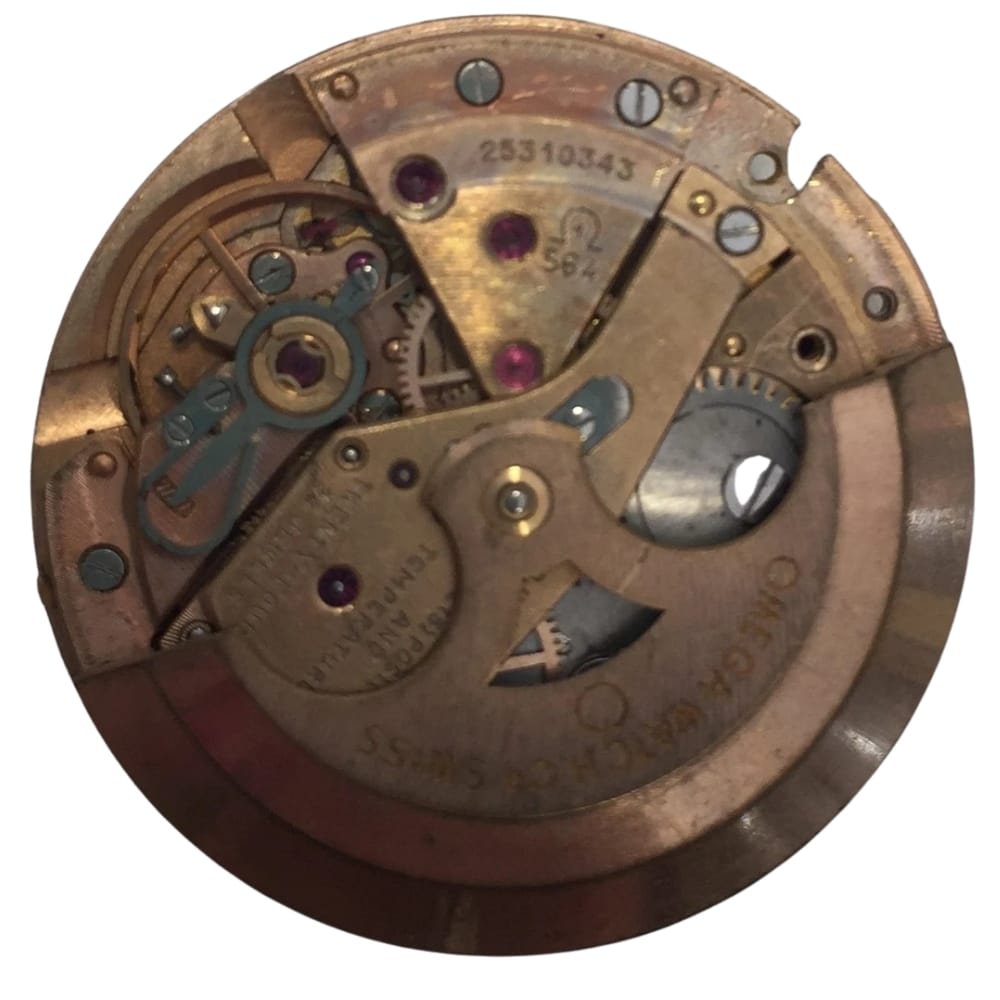
The Omega Caliber 564 represents a watershed moment in Omega’s automatic movement development, introducing the brand’s first quickset date function to the market in 1966. This 24-jewel chronometer-grade caliber powered the final generation of pie pan dial Constellations and the early C-shape models designed by Gérald Genta, bridging two iconic design eras in Omega’s flagship dress watch line.
Mechanically, the 564 belongs to Omega’s legendary 550 family, a movement architecture that dominated the brand’s automatic production from 1958 through the early 1970s. The caliber exhibits the characteristic copper-plated finish that distinguishes all mid-century Omega movements, features a swan neck micrometer regulator for precision adjustment, and delivers chronometer-grade accuracy when properly maintained. The quickset date mechanism, while innovative for its time, operates via a push-pull crown system that requires careful handling to avoid damage.
Production volume for the 564 specifically remains undocumented by Omega, but context provides reasonable estimates. By 1969, Omega was producing more than 194,500 Constellations annually, and the broader 550 family totaled approximately 5.8 million calibers between 1958 and 1969. Given the 564’s relatively short production window of approximately six years (1966-1972) and its exclusive use in higher-grade chronometer watches, total production likely ranged between 300,000 and 500,000 units. Serial number ranges place early examples in the 24-25 million range (1966-1967), mid-production examples around 26-27 million (1967-1968), and late examples approaching 30-31 million (1969-1971).
The 564 occupies an interesting position in today’s collector market. While not as scarce as earlier bumper-wind Constellation calibers, it commands respect for its chronometer certification, robust construction, and the convenience of its quickset date. Demand remains stable, with collectors appreciating both the technical advancement it represented and its association with Gerald Genta’s C-case design. Stainless steel Constellation examples typically trade between $1,200 and $3,500 depending on condition and dial configuration, while 18k gold variants command $2,200 to $5,800+. The caliber is neither undervalued nor inflated, reflecting fair market recognition of its quality without the premium attached to earlier pie pan calibers like the 551 or 561.
Historical Context, Provenance, and Manufacturing Details
The Caliber 564’s development traces directly to Marc Favre, the independent movement manufacturer whose designs became the foundation of Omega’s modern automatic production. In 1954, Omega turned to Favre’s full-rotor automatic calibers to replace its aging bumper-wind movements. Rather than simply licensing the designs, SSIH Group (Omega’s parent company) acquired Marc Favre outright in 1958, absorbing the firm into Omega’s manufacturing operations. This acquisition gave Omega complete control over what would become the 550 family architecture.
The base Caliber 550 launched in 1958 as a direct evolution of Favre’s earlier 470 series, measuring 1mm flatter and delivering 4 hours additional power reserve compared to its predecessor. Over the next eight years, Omega developed an extensive family of variants built on this platform: the 551 (chronometer, 24 jewels), 552 (non-chronometer, 24 jewels), 560 (date), 561 (chronometer with date), 562 (date, 24 jewels), and 563 (quickset date, 17 jewels). The 564 arrived in late 1966 as the chronometer-certified version of the recently introduced quickset date mechanism, combining the precision pedigree of the 551 with the modern convenience of rapid date advancement.

What distinguished the 564 from its immediate predecessor, the 561, was the quickset date feature. Where the 561 required advancing the hands through 24-hour cycles to change the date, the 564 employed a push-pull crown mechanism that advanced the date one day each time the crown was pulled from the time-setting position to a third position and returned. This seemingly minor convenience represented significant engineering, requiring additional components in the keyless works and careful coordination between the date driving wheel and the quickset corrector yoke to prevent damage during the date changeover period between 10pm and 2am.
The 564 served as Omega’s premium automatic caliber for Constellation models from late 1966 through approximately 1972, when it was gradually replaced by the 750 series (day-date) and eventually succeeded by the 1000-series movements in the mid-1970s. During its production run, it appeared primarily in Constellation references but also powered select Seamaster chronometer models and occasionally appeared in Dynamic and De Ville lines.
Manufacturing took place at Omega’s facilities in Bienne, Switzerland, with component production distributed across SSIH’s vertically integrated supply chain. The movement employed in-house developed components for the gear train, bridges, and regulator assembly, while sourcing standardized parts like the Incabloc shock protection, Nivarox balance springs, and certain screws from specialized Swiss suppliers. The copper-plated finish applied to all plates and bridges served both aesthetic and functional purposes, providing corrosion resistance while creating the distinctive rose-gold appearance that became synonymous with vintage Omega calibers.
The 564 represents the final expression of Omega’s mid-century automatic movement philosophy: robust construction, chronometer-grade precision, and incremental functional improvements built on a proven architecture. It was neither groundbreaking nor revolutionary, but rather the perfected evolution of a design lineage that had already proven itself through millions of movements and decades of chronometer competition success.
Construction and Architecture
Plate and Bridge Layout
The Caliber 564 employs a three-quarter plate construction with separate bridges for the barrel, train, pallet, and automatic winding mechanism. The architecture prioritizes serviceability and adjustment access while maintaining structural rigidity. The main plate and all bridges are constructed from brass with a distinctive copper-plated finish, giving the movement its characteristic rose-gold appearance. This plating served both aesthetic and functional purposes, providing superior corrosion resistance compared to bare brass or rhodium plating. The finishing quality on the bridges includes perlage (circular graining) on the main plate and Côtes de Genève striping on visible bridge surfaces, though the execution varies by production era, with earlier examples typically exhibiting sharper, more consistent finishing than later production runs.
The architectural philosophy follows Omega’s house style of the era: conservative, proven design with emphasis on reliability over novelty. The train bridge carries four wheels (third, fourth, escape, and center seconds), while the barrel bridge secures the mainspring barrel. The automatic winding mechanism mounts entirely on the dial side, a configuration that simplifies servicing by allowing complete disassembly without disturbing the time train.
Balance Wheel
The 564 employs a Glucydur monometallic balance wheel, a beryllium-bronze alloy that provides superior temperature compensation compared to traditional bimetallic balances. The balance measures approximately 10-11mm in diameter and features a smooth rim without timing screws, indicating that all regulation occurs via the swan neck micrometer regulator rather than through screws on the balance rim itself. This approach reduces complexity and eliminates the risk of screws loosening over time, though it requires a skilled watchmaker for precise adjustment.
The Glucydur alloy composition (approximately 98% copper, 1.9% beryllium, and traces of other elements) delivers excellent elasticity and minimal thermal expansion, allowing the balance to maintain consistent oscillation rates across temperature ranges. The balance wheel is press-fitted onto the balance staff with precise interference fits, a permanent assembly that cannot be disassembled without destruction.
Balance Spring (Hairspring)
The movement employs a flat Nivarox balance spring, the Swiss industry standard since the late 1930s. Nivarox is a cobalt-nickel alloy (approximately 42% nickel, 21% chromium, 15% cobalt, 13% iron, plus smaller percentages of titanium, beryllium, and manganese) developed by Dr. Reinhard Straumann in 1933 that exhibits minimal magnetic susceptibility and superior temperature compensation compared to earlier Elinvar alloys.
The hairspring in the 564 measures approximately 12-13 turns and terminates in a collet at the inner end and a stud at the outer end. The spring features a flat configuration without a Breguet overcoil terminal curve, a design choice that simplifies manufacturing while still delivering chronometer-grade performance when properly adjusted. The spring is factory-matched to the balance wheel inertia to achieve the target frequency of 19,800 vph, with fine adjustment handled by the swan neck regulator’s index pins.
Escapement Type
The 564 employs a Swiss lever escapement, the industry standard for precision timekeeping. The design features a straight-line lever with two synthetic ruby pallet stones set at approximately 10-degree angles to the escape wheel teeth. The escape wheel itself is manufactured from hardened steel with 15 precisely machined teeth, each engaging alternately with the entry and exit pallet stones.
The jeweling of the escapement includes synthetic ruby jewels for both pallet fork pivots (upper and lower), the two pallet stones, and the impulse jewel press-fitted into the balance roller. All jewels are set in brass chatons for the 24-jewel version, providing both structural support and ease of replacement during service. The escape wheel pivots run in jeweled bearings top and bottom, with the upper jewel including a cap jewel to contain lubricant and protect against axial shocks.
The geometry of the escapement is optimized for the 49-degree lift angle, a specification critical for accurate timegrapher readings and diagnostic work. This relatively low lift angle (compared to modern escapements at 52-53 degrees) reflects the design priorities of the 1960s, when lower angles reduced friction at the expense of some shock resistance.
Shock Protection System
The 564 employs Incabloc shock protection for the balance wheel pivots, a system introduced in 1934 that became the Swiss industry standard. The Incabloc design consists of a conical jewel setting held by a lyre-shaped spring within a circular mounting block. During shock events, the spring allows the jewel setting to move vertically and then return to its original position, preventing the delicate balance staff pivots from breaking.
Both the upper (cap jewel side) and lower (through jewel side) balance pivots receive Incabloc protection. The pallet fork pivots run in standard jewels without shock protection, a cost-saving measure justified by the pallet fork’s higher inertia and greater resistance to damage. The escape wheel similarly uses conventional jeweled bearings without shock protection.
The Incabloc system in the 550 family requires careful attention during service, as the spring-loaded block can easily become dislodged and lost during disassembly. The spring and jewel setting can be removed vertically once unlocked, or in some cases may need to be manipulated horizontally to lock into position during reassembly.
Regulator Type
The 564 features a swan neck micrometer regulator, considered the premium regulation system of its era. The mechanism consists of an S-shaped spring (the swan neck) that applies constant tension to a regulator arm, which in turn carries two index pins that straddle the balance spring. Turning the regulator screw moves the index pins along the balance spring, effectively changing its active length and thus adjusting the rate.
The swan neck design provides two significant advantages over simpler index regulators: first, the constant spring tension ensures the regulator arm maintains consistent position without slipping, and second, the fine-pitch screw allows for extremely small adjustments measured in seconds per day. The system proved so effective that Omega continued using variations of this design through multiple movement generations.
Adjustment markings on the regulator plate typically include “A/R” (Advance/Retard) or “+” and “-” symbols, with the full adjustment range allowing approximately ±60 seconds per day from the nominal rate. Watchmakers performing regulation typically work in the ±20 second range, with chronometer-grade examples held to within ±4 seconds per day across five positions.
Mainspring Material and Type
The 564 employs an automatic-specific mainspring (part number 550-1208) measuring 1.01mm width, 0.110mm thickness, 380mm length, and 10.20mm internal diameter. The spring is manufactured from a white alloy steel (likely Nivaflex or similar) that provides consistent torque delivery throughout the power reserve and minimal set (permanent deformation) over its service life.
The mainspring attaches to the barrel arbor via a sliding bridle, a design that allows the spring to slip when fully wound rather than breaking or damaging the automatic winding mechanism. This slipping action becomes audible as a subtle clicking when the automatic winding system continues to operate with a fully wound mainspring. The bridle is lubricated with Moebius 8217 or similar barrel grease at four contact points to ensure smooth slipping action.
The barrel itself measures approximately 10mm diameter and includes a cover plate held by friction fit. The barrel arbor runs in a jeweled bearing on the train bridge side and a bronze bushing on the dial side, a cost-effective configuration that places the jewel where loads are highest.
Gear Train Details
The 564 gear train follows standard Swiss practice with a four-wheel configuration: center wheel (cannon pinion), third wheel, fourth wheel (seconds), and escape wheel. The center wheel drives from the barrel via a 1:8 gear ratio (typical for this frequency), with subsequent reductions through the third and fourth wheels arriving at the 15-tooth escape wheel.
The center seconds configuration is indirect drive, meaning the seconds pinion is not permanently attached to the fourth wheel but instead rides on a friction spring that presses it against the fourth wheel’s post. This design allows the seconds hand to be removed during servicing without disassembling the entire train, and it isolates the timekeeping train from any friction created by a bent seconds hand rubbing against the crystal or dial.
The gear train uses brass wheels with polished steel pinions (except the center wheel, which is brass throughout). All pivot bearing surfaces are polished to reduce friction, with jewels placed at all critical pivot points in the 24-jewel configuration: center wheel (2 jewels), third wheel (2 jewels), fourth wheel (2 jewels), escape wheel (2 jewels), pallet fork (2 jewels), balance wheel (5 jewels including the impulse jewel), and additional jewels in the automatic winding mechanism and keyless works.
Finishing Quality and Techniques
The 564 exhibits chronometer-grade finishing appropriate for Omega’s flagship automatic caliber of the era. The baseplate features circular perlage (circular graining) applied via rotating abrasive pins, creating overlapping circular patterns that trap metal dust and provide visual interest. The pattern density and consistency vary by production era, with earlier examples showing tighter, more regular patterns.
The bridges display Côtes de Genève finishing (Geneva stripes), parallel decorative lines applied with a rotating abrasive wheel. On the 564, these stripes run parallel to the bridge edges and exhibit reasonably consistent spacing and depth, though they do not approach the mirror-polished perfection seen in haute horlogerie pieces. Some collectors report that finishing quality declined in later production runs as Omega increased output volumes to meet demand.
Anglage (beveling) appears on bridge edges, though executed via machine polishing rather than hand filing. Screw heads receive circular graining, with the quality described as excellent in period documentation. The rotor features radial sunburst finishing on its visible face, with some examples showing the Omega logo and “Officially Certified Chronometer” text engraved and filled.
Chronometer-certified examples bear adjustment markings on the automatic bridge indicating “Adjusted to 5 Positions and Temperature” or similar text. This designation indicates the movement passed COSC (Contrôle Officiel Suisse des Chronomètres) testing in five positions (dial up, dial down, crown up, crown left, crown right) across three temperatures (4°C, 20°C, 36°C) for 15 consecutive days.
Cross-Reference Data
Alternative Caliber Names (Rebranded Versions)
The Caliber 564 was produced exclusively for Omega and was not rebadged or sold to other manufacturers. However, it shares fundamental architecture and many interchangeable parts with other calibers in the 550 family:
Base Caliber vs. Elaborated Versions
| Variant Name | Differences | Jewel Count | Functions |
|---|---|---|---|
| Omega 550 (base) | Time-only, no date, no chronometer | 17 | Time-only |
| Omega 563 | Quickset date, non-chronometer | 17 | Time, quickset date |
| Omega 564 | Quickset date, chronometer certified | 24 | Time, quickset date |
| Omega 565 | Quickset date, non-chronometer | 24 | Time, quickset date |
| Omega 751 | Day-date, chronometer certified | 24 | Time, day, quickset date |
The jump from 17 to 24 jewels occurs by adding jewels to the automatic winding mechanism and certain components of the keyless works, not by jeweling additional parts of the timekeeping train.
Compatible Case References by Brand
Dial Compatibility
The 564 uses dial feet positioned at approximately 2:00 and 8:00 positions (roughly 60 degrees and 240 degrees) with the crown at 3:00. The date window appears at the 3:00 position on the dial, requiring dials specifically designed for date complications. Dial feet spacing is critical, as 550 family dials are not universally interchangeable across all variants. Constellation dials feature either applied hour markers with onyx or diamond inlays (luxury variants) or printed indices (standard variants), with the constellation star logo appearing below the 12:00 position.
Crown and Stem Specifications
The stem is a two-piece design with female threading to accept the crown post. The setting mechanism employs a yoke that engages different positions via a spring-loaded detent mechanism.
Identification Marks
Caliber Number Location
The caliber number “564” is engraved on the train bridge, positioned near the balance wheel assembly. The engraving is recessed and filled with paint (typically black or dark blue on earlier examples, sometimes left unfilled on later production). The number appears in a serif font approximately 1.5-2mm tall. Additional markings on the train bridge include “Adjusted to 5 Positions and Temperature” or similar chronometer certification text.
Logo and Brand Marks
The automatic bridge (visible through the caseback) features several identifying engravings:
- “Omega Watch Co.” or “Omega Watch Co. Swiss” on the rotor-side bridge
- “Swiss” or “Swiss Made” near the balance wheel
- “Twenty Four Jewels” or “24 Jewels” on chronometer-certified examples
- The Omega symbol (Ω) may appear on the rotor itself
The rotor displays finishing with radial sunburst pattern and may include “Officially Certified Chronometer” text along with the Omega logo. Earlier rotors (pre-1968) feature more elaborate pivot designs with raised bearing assemblies, while later rotors (post-1968) use simpler, flatter pivot designs.
Date Codes
Omega movements from this era do not employ date codes in the manner of some other Swiss manufacturers. Dating is accomplished via the movement serial number, which is engraved on the movement plate (visible when the automatic winding mechanism is removed) and sometimes repeated on the automatic bridge. The serial number is typically 8 digits long.
Serial number ranges for the 564:
- 24,000,000 – 25,999,999: 1966
- 26,000,000 – 27,999,999: 1967-1968
- 28,000,000 – 31,999,999: 1969-1971
Finishing Marks
Expected finishing patterns on authentic 564 movements:
- Baseplate: Circular perlage (circular graining) with overlapping patterns approximately 1-1.5mm diameter
- Bridges: Côtes de Genève (parallel stripes) running parallel to bridge edges, typically 0.8-1.2mm spacing
- Rotor: Radial sunburst finish originating from center pivot
- Screw heads: Circular graining or radial polishing
- Pivots: Mirror-polished bearing surfaces visible under magnification
The copper plating should appear uniform in color, ranging from rose-gold to slightly more orange depending on age and oxidation. Excessive darkening or green corrosion indicates improper storage or water exposure.
Jewel Markings
Jewel settings in chronometer-grade 564 movements are set in gold-colored brass chatons (bezels) that are press-fitted into the movement plates and bridges. Lower jewels are typically unset (pressed directly into the plate). The cap jewels on the balance pivots are held by the Incabloc shock protection springs. All jewels should be synthetic ruby (aluminum oxide), identifiable by their reddish-pink color under magnification and lack of natural inclusions.
Adjustment Markings
Chronometer-certified 564 movements display adjustment markings on the automatic bridge, typically reading:
- “Adjusted 5 Positions and Temperature” (English)
- “Ajusté à 5 Positions et Température” (French)
- Or simply “Adjusted 5 Positions”
These markings indicate the movement passed COSC chronometer testing. Non-chronometer 565 movements lack these markings despite being mechanically identical.
Correct Serial Number Formats and Locations
The movement serial number appears in two locations:
- Primary location: Engraved on the movement baseplate, visible only when the automatic winding mechanism is removed (dial side, typically near the barrel bridge mounting area)
- Secondary location: Often repeated on the automatic winding bridge (case back side)
Serial numbers are 8 digits, engraved in a serif font approximately 1.5-2mm tall. The format is continuous numeric with no prefixes or suffixes (example: 25277960). The serial number should match between locations if present in both places.
Expected Engravings and Stampings
Authentic 564 movements feature the following engravings:
On the movement bridges (visible through caseback):
- “Omega Watch Co. Swiss” or “Omega Watch Co.”
- “564” (caliber number)
- “Twenty Four Jewels” or “24 Jewels”
- “Adjusted to 5 Positions and Temperature” (chronometer examples)
- Movement serial number (8 digits)
On the rotor:
- “Omega” with or without the Ω symbol
- “Officially Certified Chronometer” (chronometer examples)
- Potential service markings (circle symbol indicates service replacement rotor)
All engravings should exhibit consistent depth (approximately 0.1-0.15mm), sharp edges without rounded corners, and professional execution. Hand-engraved or poorly executed text indicates aftermarket modification or counterfeit components.
Font and Marking Style by Production Era
1966-1968 (Early Production):
- Serif font for all text engravings
- Paint-filled engraving on caliber number
- More elaborate rotor pivot design with raised bearing assembly
- Consistent copper plating color
1968-1972 (Late Production):
- Transition to simpler rotor pivot design (flat bearing assembly)
- Some variation in engraving font weight
- Occasional unfilled engravings on caliber number
- Slight variation in copper plating tone (slightly more orange)
The most significant visual identifier for production era is the rotor design, with the elaborate raised pivot indicating pre-1968 production and the simpler flat pivot indicating post-1968 production.
Part Information

Part Numbers
Sourcing Notes
Parts Currently Available:
- Mainsprings: Readily available from multiple suppliers including Ofrei, Perrin, and Cousins UK; both genuine Omega and high-quality Swiss generic versions
- Balance complete: Available but expensive ($75-120 USD); interchangeable with entire 550 family
- Date corrector yoke: Generic Swiss-made replacements available ($30-40)
- Click springs and keyless works components: Generally available
- Stems: Available but require proper length selection based on case type
Parts Difficult to Source:
- Rotor bearings: Limited availability; Omega increasingly restricts parts to authorized service centers
- Reverse wheel: Expensive (£80+) and occasionally out of stock; complex 7-component assembly
- Hairsprings: Must be properly matched; generic Nivarox available but requires expert fitting
- Balance staff: Available but requires specialized pressing equipment for installation
Common Failure Points:
- Rotor bearing: Bronze alloy wears if watch not regularly serviced; causes roughness in automatic winding
- Reverse wheel: Reduction wheel in automatic winding mechanism subject to wear from spring-loaded click
- Date corrector mechanism: Quickset yoke and associated parts prone to breakage if operated during danger zone (10pm-2am)
- Barrel complete: Internal scoring and pitted arbors occur on neglected examples; entire assembly may require replacement
- Center wheel: Scoring around dial jewel from contaminated lubricant; replacement needed
Acceptable Generic Replacements:
- Mainsprings: Swiss-made generic mainsprings from Generale Ressorts or similar manufacturers perform identically to Omega-branded versions
- Incabloc components: Standard Incabloc parts are universal across movements using this system
- Click springs and similar simple components: Generic Swiss-made equivalents acceptable
- Date corrector yoke: Generic Swiss parts available and functionally equivalent
Components Requiring Genuine Omega Parts:
- Balance complete (for proper frequency matching)
- Rotor (for correct cosmetic appearance and engraving)
- Bridges (for proper cosmetic appearance)
- Train wheels (for proper meshing and endshake)
Service Parts Situation
Parts availability has deteriorated since Swatch Group implemented restrictions on parts distribution to independent watchmakers around 2015. Authorized Omega service centers maintain access to genuine parts through Omega’s internal supply chain, while independent watchmakers increasingly rely on generic Swiss-made components, NOS (new old stock) parts from specialist suppliers, and occasionally cannibalized movements.
For collectors, this creates a service landscape where authorized Omega service commands premium pricing ($550+ for basic overhaul) but guarantees genuine parts and factory-backed work, while independent watchmakers offer lower pricing ($400-600) but may need to source parts creatively or substitute generic equivalents. The 564 benefits from its membership in the prolific 550 family, meaning many parts cross-reference to other calibers with greater parts availability.
Performance Data
Manufacturer Specifications
Accuracy (New):
- Chronometer certified: -1 to +6 seconds per day average rate (COSC standard)
- Positions tested: 5 positions (dial up, dial down, crown up, crown left, crown right)
- Temperature compensation: Yes, tested at 4°C, 20°C, and 36°C over 15-day period
- Isochronism: Maximum daily rate variation across positions not exceeding 5 seconds per day
- Mean variation: Not exceeding 2 seconds per day between consecutive days
- Power reserve: 50 hours minimum when fully wound
COSC Testing Protocol:
The 564’s chronometer certification required passage of the Contrôle Officiel Suisse des Chronomètres (COSC) testing protocol, consisting of 15 consecutive days of observation:
- Days 1-10: Movement tested in five positions at 20°C
- Day 11: Dial up position at 4°C
- Day 12: Dial up position at 20°C (return to baseline)
- Day 13: Dial up position at 36°C
- Days 14-15: Crown left position at 20°C
Only movements meeting strict criteria for mean daily rate, variation, and positional deviation received chronometer certification. The “Adjusted 5 Positions and Temperature” marking confirms the movement passed this testing.
Observed Performance (Field Data)
Accuracy Range for Well-Maintained Examples:
Based on collector reports, watchmaker observations, and auction house timing data, properly serviced 564 movements typically deliver:
- Excellent condition: +2 to +10 seconds per day
- Good condition: +6 to +20 seconds per day
- Fair condition (needs service): +15 to +60 seconds per day
These ranges represent watches worn daily in normal conditions. Accuracy degrades predictably with wear, contaminated lubricant, and magnetization.
Common Performance Issues and Causes:
- Excessive rate deviation (+30 to +60 sec/day):
- Contaminated or dried lubricant in train jewels and escapement
- Magnetization of balance spring or other ferrous components
- Worn pivots causing excessive endshake or sideplay
- Damaged or deformed hairspring from shock or mishandling
- Low amplitude (below 220 degrees):
- Positional variation (large rate differences between positions):
- Bent or damaged balance pivots causing pivot hole contact
- Improper poise (balance not properly centered)
- Damaged or incorrectly positioned hairspring
- Worn pallet fork pivot jewels allowing lateral movement
- Erratic timekeeping (rate varies day to day):
- Magnetization causing intermittent hairspring sticking
- Worn click or ratchet wheel allowing mainspring to slip backward
- Temperature-induced changes in lubricant viscosity (indicates wrong lubricant used)
- Loose hairspring stud or collet allowing hairspring length to change
Expected Amplitude:
- Fully wound, dial up: 270-290 degrees
- Fully wound, dial down: 260-280 degrees
- Fully wound, vertical positions: 240-260 degrees
- Near end of power reserve: 200-220 degrees
Amplitudes measured at 49-degree lift angle on timegrapher. Amplitudes below 200 degrees indicate service required; amplitudes below 180 degrees suggest significant mechanical problems.
Degradation Patterns with Age:
0-10 years since service: Movement typically maintains chronometer-grade performance if properly maintained. Rate deviation minimal (+5 to +15 seconds/day).
10-20 years since service: Lubricants begin drying and thickening. Rate deviation increases to +15 to +30 seconds/day. Amplitude drops 20-30 degrees from new. Power reserve decreases to 40-45 hours. Automatic winding efficiency degrades as rotor bearing lubricant dries.
20+ years since service: Lubricants dried or converted to abrasive paste. Rate deviation often exceeds +60 seconds/day. Amplitude drops below 220 degrees. Accelerated pivot wear begins, particularly in center wheel and rotor bearing. Watch may stop running entirely in certain positions. Power reserve drops below 36 hours. Immediate service required to prevent permanent damage.
The 564’s reputation for reliability assumes regular service intervals of 5-7 years. Neglected examples exhibit accelerated wear, particularly in the bronze rotor bearing and the reduction wheel of the automatic winding mechanism. The copper plating on plates and bridges provides excellent corrosion resistance, meaning many neglected examples survive decades with minimal rust, though dried lubricant creates abrasive paste that grinds away pivot jewels and bearing surfaces.
Collectors acquiring vintage 564 movements should assume service is required unless comprehensive service documentation (including timegrapher results) exists from within the previous 5 years. The cost of parts replacement on neglected examples can approach or exceed the value of common stainless steel references, making pre-purchase inspection by a qualified watchmaker advisable for higher-value gold examples.