

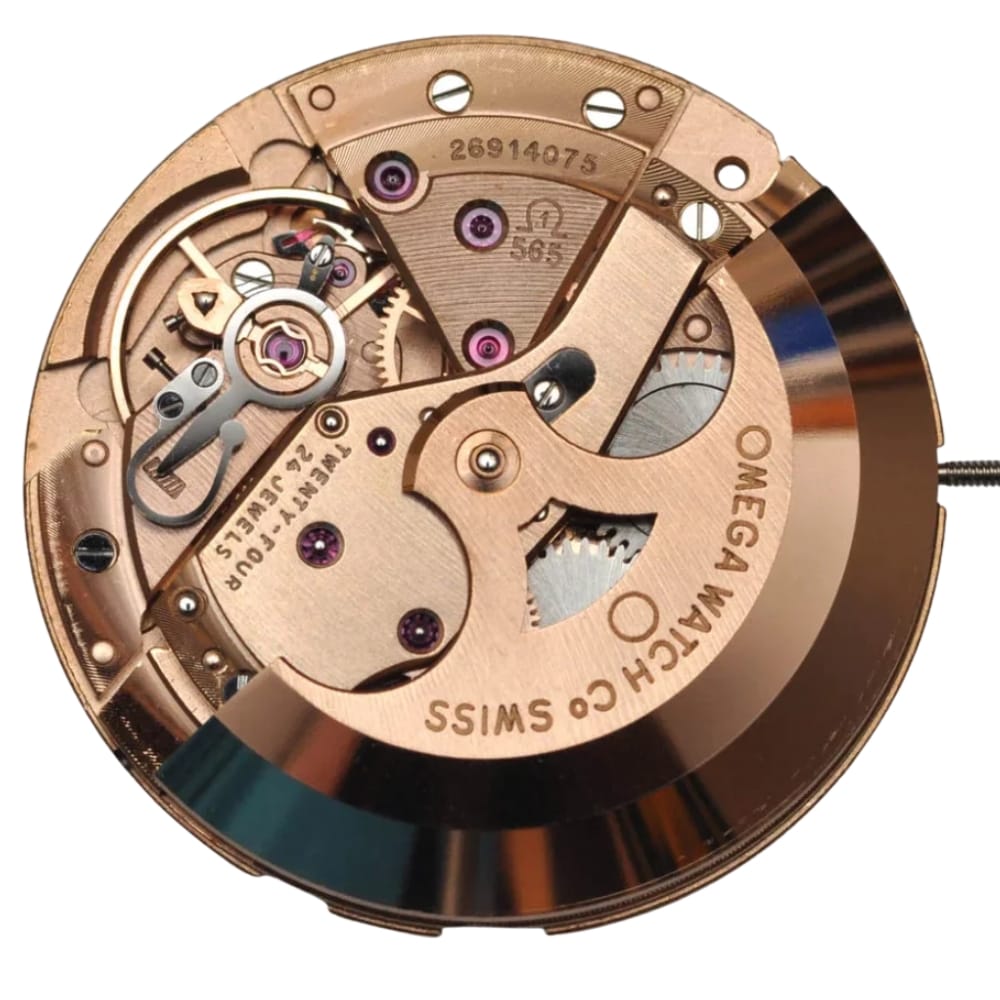
The Omega 565 represents the pinnacle of Omega’s non-chronometer automatic movements from the 1960s, distinguished by its introduction of the first quickset date function in Omega’s automatic lineup. While the caliber 561 earned chronometer certification for Constellation models and the caliber 564 brought quickset date functionality to the chronometer segment, the 565 delivered the same advanced quickset mechanism to Seamaster, De Ville, Dynamic, and Cosmic models at a price point accessible to a broader market.
The 565 belongs to Omega’s celebrated 5xx series family, specifically the final iteration of the second-generation automatic movements that many watchmakers and collectors regard as some of the finest mass-produced automatic calibers ever manufactured. This movement powered an extraordinary range of iconic 1960s Omega references, from the Seamaster 120 dive watch to elegant De Ville dress pieces, demonstrating remarkable versatility across tool watches and formal timepieces alike.
Production estimates for the caliber 565 remain difficult to pinpoint with precision, as Omega has not officially disclosed manufacturing figures for individual non-chronometer calibers. Based on serial number ranges observed across surviving examples and the movement’s four-year production window (1966-1969/early 1970), conservative estimates suggest total production in the range of 150,000 to 300,000 movements. This figure accounts for the caliber’s widespread deployment across multiple model lines and its status as Omega’s primary non-chronometer automatic date movement during this period. The 565 should be classified as uncommon rather than rare, readily available in the vintage market but significantly less common than entry-level movements from the same era. The 17-jewel caliber 563, produced concurrently for the U.S. import market to avoid higher tariff rates on watches with more than 17 jewels, appears less frequently and commands slightly lower collector interest.
Collector demand for the 565 remains stable and shows gradual appreciation, driven primarily by the quality of the host watch rather than the movement alone. Seamaster 120 models with caliber 565 movements have experienced steady value growth, with examples in excellent condition commanding $2,200 to $4,900 depending on dial configuration and originality. De Ville references with intact quickset date mechanisms and period-correct bracelets hold similar values, while Dynamic models in original condition attract younger collectors drawn to their unconventional case designs. Watches with documented service history and functioning quickset mechanisms command premiums of 15-20% over examples requiring quickset repair, reflecting the fragility of the date change system and the expense of genuine Omega replacement parts.
Historical Context, Provenance, and Manufacturing Details
Omega introduced the caliber 565 in 1966 as the quickset date evolution of the caliber 562, which itself was the 24-jewel non-chronometer variant in the 5xx family. The movement addressed a specific market need: delivering the convenience of rapid date adjustment to mid-range Omega models without the cost premium associated with chronometer-certified movements. Watchmakers had grown frustrated with the time-consuming process of advancing the date by rotating the hands through 24-hour cycles, and the 565’s push-pull quickset mechanism represented a significant practical improvement for daily wearers.
The caliber 565 directly replaced the caliber 562, which had been in production since approximately 1960 and featured only traditional date advancement through hand rotation. The 565 shared the same base architecture as the 562 but incorporated additional components on the dial side to enable the quickset function, including a date corrector yoke, date corrector lever, and specialized setting wheel configuration. This quickset mechanism operated through a unique push-pull crown action: pulling the crown to the outermost position engaged time-setting mode, while repeatedly pulling and pushing the crown at this position advanced the date one day per cycle.
By early 1970, Omega had begun transitioning production to the fourth-generation automatic movements, specifically the caliber 1010 and its variants (1011, 1012, 1020, 1022, 1030). These newer movements featured higher beat rates (28,800 vph), hacking seconds, and thinner profiles but suffered from reliability issues in their initial iterations. The 1010 series eventually superseded the entire 5xx family, though many watchmakers and collectors regard this transition as a step backward in terms of robustness and serviceability. The 565 and its siblings represented the culmination of two decades of refinement on the 5xx platform, incorporating improvements learned across the 550, 551, 552, 560, 561, 562, and 563 calibers that preceded it.
The caliber 565 is an entirely in-house Omega manufacture movement, designed, produced, and finished at Omega facilities in Switzerland. Unlike some contemporaneous Omega calibers that utilized ebauche bases from ETA or other suppliers, the 565 represents pure Omega engineering from the ground up. The movement shares its fundamental architecture with the caliber 563, which was essentially a 17-jewel version of the same base movement produced specifically for the U.S. market. The key difference between these variants lies solely in jewel count: the 563 uses 17 jewels to avoid U.S. import duties on higher-jewel-count movements, while the 565 employs the full 24-jewel complement, with the additional seven jewels located on the automatic winding bridge and providing superior long-term reliability.
All caliber 565 movements were manufactured at Omega’s primary production facilities in Biel/Bienne, Switzerland, with no documented evidence of production shifts to other locations during the movement’s four-year lifespan. This concentration of manufacturing ensured consistent quality control and explains the remarkable uniformity in finishing and performance characteristics across surviving examples.
The 565 occupies a significant position in horological history as the final expression of Omega’s second-generation automatic movement philosophy before the industry’s rush toward higher frequencies and thinner profiles. The movement represents a conservative, reliability-focused design that prioritized ease of service and long-term durability over specifications-sheet bragging rights. Where competitors pursued ever-higher beat rates and chronometer certification for all models, Omega maintained a disciplined product segmentation strategy: chronometer movements for Constellation models, robust non-chronometer movements like the 565 for everything else. This approach proved commercially successful and created a clear value hierarchy that collectors still recognize today.
Construction and Architecture
Plate and Bridge Layout
The caliber 565 employs a traditional three-quarter plate architecture with separate bridges for the automatic winding system, barrel, and balance. The main plate is machined from brass with a copper-colored rhodium plating that provides excellent corrosion resistance, a hallmark of Omega movements from this era. The movement uses a total of three primary bridges: the barrel bridge (also carrying the center wheel), the train bridge (visible when viewing the movement from the winding-stem side), and the balance bridge (positioned prominently on the movement’s top surface). The automatic winding system adds two additional bridge components: the lower automatic bridge (housing the reversing wheels) and the upper automatic bridge (securing the rotor bearing and oscillating weight).
The bridge layout follows Omega’s established second-generation automatic design philosophy, with the train bridge incorporating perlage circular finishing on its undersurface and the balance bridge featuring vertical Côtes de Genève stripes visible through the display caseback on models so equipped. The barrel and balance bridges receive similar decorative treatment, though the level of finishing varies between standard-grade and higher-grade examples. The movement employs brass throughout its bridge and plate construction, chosen for its excellent machinability, dimensional stability, and resistance to magnetic interference.
Balance Wheel
The 565 utilizes a monometallic Glucydur-type balance wheel measuring approximately 10.5mm in diameter. This beryllium-copper alloy balance wheel represents a significant advancement over bimetallic compensation balances, providing superior temperature stability without the complexity of adjustable timing screws. The balance features no timing screws on its rim, as the Glucydur alloy composition provides inherent temperature compensation through its metallurgical properties. The smooth-rim design reduces air resistance and simplifies servicing, as watchmakers need not worry about lost or misaligned timing screws during disassembly.
The balance wheel mounts on a hardened steel staff with Incabloc shock protection at both pivot points (upper and lower). The balance jewels are mounted in gold-colored chatons (jewel settings) that can be removed for cleaning, a design feature that facilitates thorough servicing but occasionally creates problems when watchmakers mix up the upper and lower chatons during reassembly. The balance wheel’s inertia and diameter were carefully calculated to work harmoniously with the 19,800 vph frequency, providing stable timekeeping without excessive power consumption.
Balance Spring (Hairspring)
The caliber 565 employs a Nivarox hairspring, the industry-standard nickel-iron alloy developed in the 1930s specifically for watch balance springs. Nivarox (from the German “Nicht variabel oxydfest,” meaning “non-variable, non-oxidizing”) exhibits a remarkably stable elastic modulus across temperature ranges, making it far superior to earlier steel hairsprings that required complex compensation mechanisms. The 565’s hairspring utilizes a flat configuration without a Breguet overcoil, terminating at the inner end with a standard collet attachment and at the outer end with a stud anchored to the balance bridge.
The hairspring measures approximately 12-13mm in developed length and features a thickness of roughly 0.03mm, optimized for the movement’s 19,800 vph frequency. Watchmakers report that the 565’s hairspring geometry is forgiving during service and relatively resistant to accidental deformation compared to higher-frequency movements, though any hairspring manipulation requires extreme care and proper tooling. The Nivarox alloy exhibits minimal magnetic susceptibility, though the movement as a whole remains vulnerable to magnetization through its steel components (particularly the pallet fork, escape wheel, and balance staff).
Escapement Type
The 565 utilizes a traditional Swiss lever escapement with synthetic ruby pallet stones and a hardened steel escape wheel. The pallet fork features two pallet stones: the entry pallet (toward which the escape wheel teeth initially contact) and the exit pallet (which releases the escape wheel tooth to advance). These synthetic ruby stones are precisely positioned and polished to minimize friction during the locking and unlocking phases of escapement action. The escape wheel contains 15 teeth and rotates once per minute, driving the movement’s seconds display.
The escapement operates on the classic Swiss lever principle, with the pallet fork pivoting approximately 10 degrees in each direction to alternately lock and release escape wheel teeth. The impulse is delivered through a combination of sliding and direct contact as the escape wheel tooth travels along the impulse face of the pallet stone, transferring energy from the gear train to the balance wheel. The pallet fork jewels are set in a brass pallet frame (fork), which pivots on jeweled bearings that also receive Incabloc shock protection.
The lever design incorporates a guard pin that prevents over-banking (excessive pallet fork rotation that could cause the fork to slip past the banking pins). The safety roller on the balance staff features a single impulse jewel (also called the impulse pin or ruby pin) that engages the pallet fork’s notch during each oscillation, creating the mechanical link between the balance wheel’s oscillations and the escapement’s start-stop action.
Shock Protection System
The caliber 565 employs Incabloc shock protection at four critical pivot points: the upper and lower balance staff pivots and the upper and lower pallet fork pivots. Incabloc, developed in the 1930s by Swiss engineer Fritz Marti, uses a spring-loaded jewel setting that allows the jewel to move vertically when subjected to shock, protecting the delicate pivots from fracture. The system consists of several components: a jewel (synthetic ruby), a cap jewel (also ruby), a conical jewel setting (the block), and a lyre-shaped spring that holds everything in place.
The Incabloc springs on the 565 are the traditional lyre type, recognizable by their tuning-fork-like shape with two prongs that grip the jewel block. These springs require careful handling during service, as they can easily detach if the block is removed improperly. The correct procedure involves rotating the block to the unlocked position and allowing it to drop out vertically, rather than prying or pulling. Watchmakers consistently note that Incabloc systems on 5xx-series movements are generally well-behaved during service, though replacement springs can be challenging to source if the original springs are damaged or lost.
The balance jewel settings (chatons) on the 565 are gold-colored and removable, secured by small screws on the dial side and friction-fit on the movement side. This removable design facilitates thorough cleaning during service but creates the risk of mixing up the upper and lower jewel assemblies, which are not always interchangeable despite appearing identical.
Regulator Type
The caliber 565 features a two-piece regulator system with a swan-neck fine adjustment mechanism. The regulator consists of a traditional index arm (the regulator proper) that moves the curb pins to adjust the effective length of the hairspring, combined with a swan-neck spring and micrometric adjustment screw that provides extremely fine rate adjustment. The swan-neck design is considered superior to simple pointer regulators because it offers both coarse adjustment (by moving the entire index arm) and fine adjustment (via the micrometric screw) without requiring direct manipulation of delicate components.
The regulator index features the traditional fast-slow scale, with graduations indicating the direction of adjustment. The swan-neck spring and micrometric screw are positioned on the balance bridge, allowing watchmakers to make precise timing adjustments with the movement fully assembled and running on a timing machine. This design facilitates achieving and maintaining chronometer-level accuracy even though the 565 itself was never submitted for chronometer certification.
The index arm incorporates two curb pins that embrace the hairspring on opposite sides, allowing the watchmaker to adjust the effective length of the spring by moving the pins closer to or farther from the hairspring’s collet. The regulator can be moved across its full range without disassembling the balance, though Omega literature recommends making small incremental adjustments rather than large movements to preserve the hairspring’s geometry.
Mainspring Material and Type
The caliber 565 utilizes a white alloy Nivaflex mainspring measuring 1.01-1.05mm in width, 0.110-0.120mm in thickness, and 360-380mm in developed length. Nivaflex, like Nivarox, is a proprietary alloy developed specifically for watch mainsprings, offering superior elastic properties and resistance to setting (permanent deformation) compared to carbon steel springs. The mainspring is housed in a standard brass barrel with a slipping bridle attachment at the outer end, allowing the spring to slip when fully wound rather than applying excessive torque to the gear train.
The genuine Omega mainspring carries the part number 72205501208, though generic Swiss-made replacements from suppliers like Générale Ressorts (GR part numbers 2628X, 2533X, or 2535X) are widely available and generally considered acceptable substitutes. Watchmakers note that the mainspring barrel should be lubricated with appropriate breaking grease (HP1300 or equivalent) on the barrel walls and Moebius 8217 or D5 on the barrel arbor to ensure smooth power delivery and prevent the characteristic “slipping” noise that indicates insufficient lubrication.
The mainspring provides 38-50 hours of power reserve when fully wound, with most well-maintained examples delivering 45-48 hours of runtime in practice. This power reserve is considered excellent for a movement of this era and compares favorably to contemporaneous automatic movements from other manufacturers.
Gear Train Details
The 565 employs a standard four-wheel gear train consisting of the barrel (first wheel), center wheel (second wheel, rotating once per hour), third wheel, and fourth wheel (also called the escape wheel pinion, rotating once per minute and driving the escape wheel). The center wheel carries the cannon pinion, to which the minute hand attaches, while an hour wheel (with 12:1 reduction from the center wheel) drives the hour hand. The seconds hand mounts directly on the extended fourth wheel pinion, creating a center-seconds configuration that became standard for sport and tool watches by the 1960s.
The gear train follows conventional Swiss watchmaking practice, with each wheel pivoting in jeweled bearings to minimize friction. The 565 uses 24 jewels total: seven in the automatic winding system (including jewels for the rotor bearing), seven in the gear train and escapement, four for shock protection (balance and pallet fork), and six additional jewels providing support for the third wheel, fourth wheel, and other high-load pivot points. This generous jeweling contributes to the movement’s excellent longevity and reliability, as jeweled bearings exhibit far less wear than brass plate bearings over decades of operation.
The gear train is designed for maximum efficiency, with tooth profiles and pressure angles optimized to minimize energy loss through friction. The relatively low 19,800 vph beat rate further reduces wear compared to higher-frequency movements, contributing to the 565’s reputation for exceptional durability even when servicing intervals are significantly extended.
Finishing Quality and Techniques
The caliber 565 receives industrial-grade finishing appropriate for a non-chronometer movement, with visible machine marks on some surfaces but respectable decoration on prominent components. The automatic bridge typically features Côtes de Genève stripes (also called Geneva waves or Geneva stripes), consisting of parallel lines created by a rotating abrasive wheel. These stripes serve both aesthetic and practical purposes: they create an attractive visual texture while also breaking up any remaining machining marks that could trap dust or debris.

The main plate and bridge undersides receive perlage (also called circular graining or engine turning), consisting of overlapping circular patterns created by a rotating abrasive tool. This finish is less visible than Côtes de Genève but serves an important technical function by creating a textured surface that prevents oil from spreading across the plate. The perlage pattern on 565 movements is relatively coarse by haute horlogerie standards but perfectly adequate for the movement’s intended purpose and price point.
Bridge edges show chamfering (beveling) with varying degrees of polish depending on the specific example. Most 565 movements exhibit machine-applied chamfers with satin finishing rather than the hand-polished black-polish bevels found on high-grade chronometer movements or complications. The screws receive minimal finishing, typically limited to slots with clean edges and heads with circular brush patterns.
The level of finishing on the 565 is entirely appropriate for its market position as a robust, mid-tier automatic movement. The decoration present serves primarily functional purposes (preventing oil migration, breaking up machining marks, reducing corrosion) with aesthetic considerations secondary. This practical approach to finishing kept manufacturing costs manageable while ensuring excellent long-term reliability.
Alternative Caliber Names (Rebranded Versions)
The caliber 565 was sold exclusively under the Omega brand and was not rebranded for other manufacturers. However, the closely related caliber 563 (17 jewels) was produced concurrently and is functionally nearly identical aside from jewel count.
Base Caliber vs. Elaborated Versions
Compatible Case References by Brand
The caliber 565 was deployed across an exceptionally wide range of Omega references during its production period. The following table documents confirmed original fitments:
Note: The caliber 565 appears in Constellation cases only as a replacement or service-swap movement. Original Constellation models from this era were specified with chronometer-certified caliber 564 movements.
Dial Compatibility
The caliber 565 utilizes dial feet positioned at 1:30 and 7:30 (measuring from center), a configuration shared across most 5xx-series movements with date complications. The date window is positioned at 3:00, and dials must be specifically designed for quickset date movements to accommodate the window’s position and size. Dials from non-date movements (calibers 550, 551, 552) or traditional date movements without quickset (calibers 560, 561, 562) are not directly compatible without modification.
Dial swaps between different 565-powered references are generally possible if the dial feet positions match and the case diameter is similar, though collectors strongly prefer original dial-to-reference pairings. The 565’s relatively tall height (5.0mm) compared to manual-wind calibers means that dial-to-crystal spacing will differ if a dial originally fitted to a manual movement is installed in a 565-powered watch.
Crown and Stem Specifications
The caliber 565 uses a standard Omega Tap 10 stem with 0.90mm thread pitch, making crown replacements relatively straightforward when using generic Swiss-made crowns. The movement features a clutch-type setting mechanism with a setting lever spring and yoke that engages the keyless works when the crown is pulled. The quickset date function operates through a specialized corrector lever that advances the date wheel with each pull-push-pull cycle of the crown.
Identification Marks
Caliber Number Location
The caliber number “565” is engraved on the train bridge (visible from the winding-stem side of the movement) and is typically positioned near the top of the bridge in clear, machine-engraved numerals measuring approximately 2-3mm in height. This marking should be crisp and deeply engraved, as it was applied during manufacture using precision engraving equipment. The caliber number is the primary identifier for authenticating a 565 movement and distinguishing it from related calibers like the 563 (17 jewels) or 564 (chronometer-certified).
Logo and Brand Marks
Authentic caliber 565 movements display several specific markings:
- Rotor: The oscillating weight carries “OMEGA” in raised letters on its visible surface, with the logo typically centered and highly polished. Some examples may feature additional text such as “OMEGA WATCH CO” or “SWISS” on the rotor. The rotor should also display “AUTOMATIC” on the underside (visible when the rotor is removed).
- Balance Bridge: The text “OMEGA WATCH CO SWISS” or “OMEGA SWISS” should appear on the balance bridge, typically positioned below the balance wheel. This marking is engraved rather than stamped and should show consistent depth and character spacing.
- Train Bridge: In addition to the caliber number “565,” the train bridge may display “TWENTY FOUR JEWELS” or “24 JEWELS” to indicate the movement’s jewel count. This text should be cleanly engraved and properly aligned.
- Main Plate: Some examples feature additional markings on the main plate visible from the dial side, though these are less consistent across production runs.
Date Codes
The caliber 565 does not use a date code system on the movement itself. Dating relies on the serial number engraved on the movement (see below).
Finishing Marks
Authentic 565 movements display the following finishing characteristics:
- Côtes de Genève: Parallel wave patterns should appear on the automatic bridge and rotor, running lengthwise along the bridge. These stripes should be evenly spaced (approximately 1-1.5mm between centers) and show consistent depth and texture.
- Perlage: Overlapping circular patterns should appear on the main plate (dial side) and the undersides of bridges. The circles should be relatively uniform in diameter (1-2mm) and show clear overlap creating a fish-scale effect.
- Bridge Chamfering: The edges of bridges should show 45-degree chamfers with satin finishing. These chamfers should be consistent in width (approximately 0.3-0.5mm) and free from machine chatter marks.
Jewel Markings
The caliber 565’s jewels are mounted in two configurations:
- Chatons: The balance wheel pivots use jewels mounted in removable gold-colored chatons (jewel settings) secured by small screws on the dial side. These chatons should be properly seated and show no signs of damage or amateur repair.
- Pressed Jewels: Most other jewels in the movement are press-fit directly into the plates and bridges without removable settings. These jewels should sit flush with the surrounding surface and show no signs of cracking or improper installation.
Higher-grade 565 movements may feature more chatons than basic examples, though this variation is less pronounced than in chronometer-certified movements.
Adjustment Markings
The caliber 565 is not chronometer-certified and should not display adjustment markings. Authentic 565 movements will not show “Adjusted to Five Positions and Temperature” or similar text on the automatic bridge. If such markings are present, the movement is either:
- A caliber 564 (chronometer-certified variant) that has been incorrectly identified
- A service replacement where a 564 bridge was installed on a 565 movement
- A fraudulent marking added to misrepresent the movement’s grade
The absence of adjustment markings is correct and expected for the 565, which was never submitted for chronometer testing despite its technical capability to achieve such certification with proper regulation.
Correct Serial Number Formats and Locations
The movement serial number is engraved on the movement between the lugs on the main plate, typically visible when the movement is removed from the case. The serial number is also usually repeated on the inside of the caseback, though case and movement serial numbers do not always match due to service replacements and factory assembly practices.
Serial number format: Seven to eight digits, typically in the range of 23,000,000 to 32,000,000 for 565-powered watches.
Serial Number Ranges by Production Year
| Year | Serial Number Range (Approximate) |
|---|---|
| 1966 | 23,000,000 – 24,999,999 |
| 1967 | 25,000,000 – 25,999,999 |
| 1968 | 26,000,000 – 27,999,999 |
| 1969 | 28,000,000 – 31,999,999 |
| Early 1970 | 32,000,000 – 32,999,999 |
These ranges are approximate and should be used as general guidelines rather than definitive dating tools. Omega’s serial number system occasionally shows overlap between years, and service replacements can result in movements with serial numbers that do not match the original production date.
Expected Engravings and Stampings
All engravings on an authentic 565 should display the following characteristics:
- Depth: Approximately 0.1-0.2mm deep, creating visible shadows when viewed at an angle
- Character Style: Machine-engraved with consistent serif fonts typical of 1960s Omega production
- Spacing: Even character spacing with proper alignment to the component’s centerline
- Sharpness: Clean edges without burrs, smudging, or evidence of hand-engraving
Font and Marking Style by Production Era
The caliber 565’s production span (1966-1969/early 1970) was sufficiently brief that font and marking styles remained highly consistent throughout. Minor variations in rotor logo style may appear, with earlier examples sometimes featuring slightly different letter proportions compared to later production, but these differences are subtle and do not represent dramatic design shifts.
The most significant identifier for authentic 565 movements is the quality of the engravings themselves: precise, consistent machine-engraving that would be extremely difficult to replicate without proper tooling. Soft, shallow, or inconsistent engravings should raise immediate authenticity concerns.
Part Information

Part Numbers
Essential Replacement Components
Note: Many 565 parts are interchangeable with other 5xx-series calibers, particularly the 563 and 564. Watchmakers should consult the Omega technical documentation or parts catalogs to verify specific compatibility before ordering replacement components.
Sourcing Notes
Currently Available Parts: Generic Swiss-made mainsprings remain widely available from suppliers like Générale Ressorts (GR), Cousins UK, Watch Material, and specialty vendors. These aftermarket mainsprings perform identically to genuine Omega springs and are considered acceptable replacements by professional watchmakers. Balance assemblies (part 1327) occasionally appear on the secondhand market but have become increasingly scarce as donors are cannibalized for parts.
Commonly Failed Parts: The rotor bearing is the most frequent failure point in the 565, manifesting as excessive play or grinding when the rotor spins. The bearing consists of a small brass bushing pressed into the rotor with a pinion for the automatic winding system. Omega still manufactures replacement rotor bearings, but they are available only through authorized Omega service centers and independent watchmakers with Omega parts accounts. The cost of a genuine Omega rotor bearing typically ranges from $40-80 depending on the watchmaker’s parts pricing structure.
The quickset date mechanism represents the second most common failure point, with the date corrector yoke (part 1568) and associated components prone to breakage if the date is changed during the restricted hours of 9:00 PM to 1:00 AM. These parts are increasingly difficult to source, as Omega’s parts inventory for vintage non-chronometer movements has become limited. When quickset components fail, some watchmakers opt to disable the quickset function and rely on traditional date advancement through hand rotation rather than sourcing increasingly expensive original parts.
Generic Replacement Options: Mainsprings are the primary component where generic Swiss-made replacements are widely accepted and perform comparably to original parts. Other generic options (crowns, stems, crystals) are available from aftermarket suppliers, though collectors and purists prefer original Omega components when possible. Balance jewels, pallet stones, and other precision components should be genuine Omega parts or NOS (new old stock) Swiss-made equivalents to ensure proper function and maintain the movement’s integrity.
Parts Availability Trend: Overall parts availability for the 565 is declining as Omega reduces its vintage non-chronometer parts inventory. Watchmakers report increasing difficulty sourcing specific components (particularly quickset date parts, rotor bearings, and some specialized springs) through official channels. The movement remains serviceable for the foreseeable future due to parts interchangeability within the 5xx family and the availability of donor movements, but long-term serviceability concerns are legitimate for examples requiring rare components.
Performance Data
Manufacturer Specifications
The caliber 565 was never submitted for chronometer certification and therefore carries no official accuracy specifications from Omega or COSC. The movement was designed to meet commercial timekeeping standards appropriate for its market position, typically targeting accuracy of -10 to +20 seconds per day when new and properly regulated.
Observed Performance (Field Data)
Based on collector reports, watchmaker observations, auction house timing results, and online community discussions, the following performance characteristics are typical for well-maintained caliber 565 movements:
Accuracy Range for Well-Maintained Examples
Freshly serviced 565 movements with proper regulation typically achieve -5 to +15 seconds per day across most wearing positions. Exceptional examples with carefully tunedregulators and minimal wear can achieve 0 to +8 seconds per day, performance that approaches chronometer standards despite the movement’s non-certified status. These accuracy figures assume recent service (within 3-5 years), proper lubrication, minimal component wear, and regulation performed by a competent watchmaker.
Examples requiring service but still functional often show accuracy of -20 to +30 seconds per day, which remains acceptable for daily wear but indicates the need for overhaul. Movements showing accuracy degradation beyond ±30 seconds per day likely have specific issues requiring attention: magnetization, worn pivots, dried lubricant, balance spring defects, or escapement problems.
Common Performance Issues and Their Causes
- Low Amplitude (180-220 degrees instead of 240-280 degrees):
- Dried or contaminated lubricants in the gear train or escapement
- Worn balance pivots or balance jewels
- Insufficient mainspring tension (old or set spring)
- Excessive end shake in the barrel arbor
- Problems with the Incabloc spring or jewel settings
- Rotor Grinding or Excessive Noise:
- Worn rotor bearing/bushing (most common cause)
- Insufficient end shake in the rotor post
- Contamination or dried lubricant on rotor bearing surfaces
- Rotor jewel wear (less common)
- Quickset Date Failure:
- Broken date corrector yoke (part 1568)
- Worn or damaged setting lever spring
- Incorrect adjustment of date change mechanism
- User error (changing date during restricted hours)
- Inconsistent Rate in Different Positions:
- Balance pivot wear (creates different friction in different positions)
- Bent or distorted hairspring
- Magnetization of steel components
- Pallet fork pivot wear
Expected Amplitude When Fully Wound vs. Power Reserve Depleted
A healthy 565 movement should show the following amplitude characteristics when measured on a timing machine:
- Fully wound (0-12 hours): 260-280 degrees dial up, 240-260 degrees crown up/down
- Mid-reserve (12-24 hours): 250-270 degrees dial up, 230-250 degrees crown up/down
- Low reserve (24-38 hours): 220-240 degrees dial up, 200-230 degrees crown up/down
Amplitude below 200 degrees in any position indicates a problem requiring investigation. Amplitude differences exceeding 50-60 degrees between dial-up and crown-up positions suggest balance pivot wear, hairspring issues, or escapement problems.
How Performance Typically Degrades as the Movement Ages
The caliber 565 exhibits predictable aging characteristics:
Years 0-10 (assuming regular wear, no service): The movement maintains factory-specification performance with gradually increasing rate variation as lubricants begin to degrade. Accuracy typically remains within ±15 seconds per day during this period.
Years 10-20 (no service): Dried lubricants cause increased friction, manifesting as rising amplitude in dial-up position (as the balance wheel encounters less resistance from depleted gear train lubricants) and declining amplitude in vertical positions. Accuracy degrades to ±20-30 seconds per day. The rotor bearing begins showing increased play and potential grinding.
Years 20+ (no service): Metal-on-metal wear accelerates as protective lubricants are exhausted. Balance pivots develop visible wear under magnification, creating position-dependent rate variations. The escapement may show reduced amplitude and erratic behavior. The movement may still run but requires comprehensive service to prevent permanent damage.
With regular service every 5-7 years, the 565 can maintain near-original performance for decades. The movement’s robust construction and generous jeweling allow it to tolerate extended service intervals better than many contemporaneous movements, though watchmakers universally recommend not exceeding 10 years between services to prevent accelerated wear.