

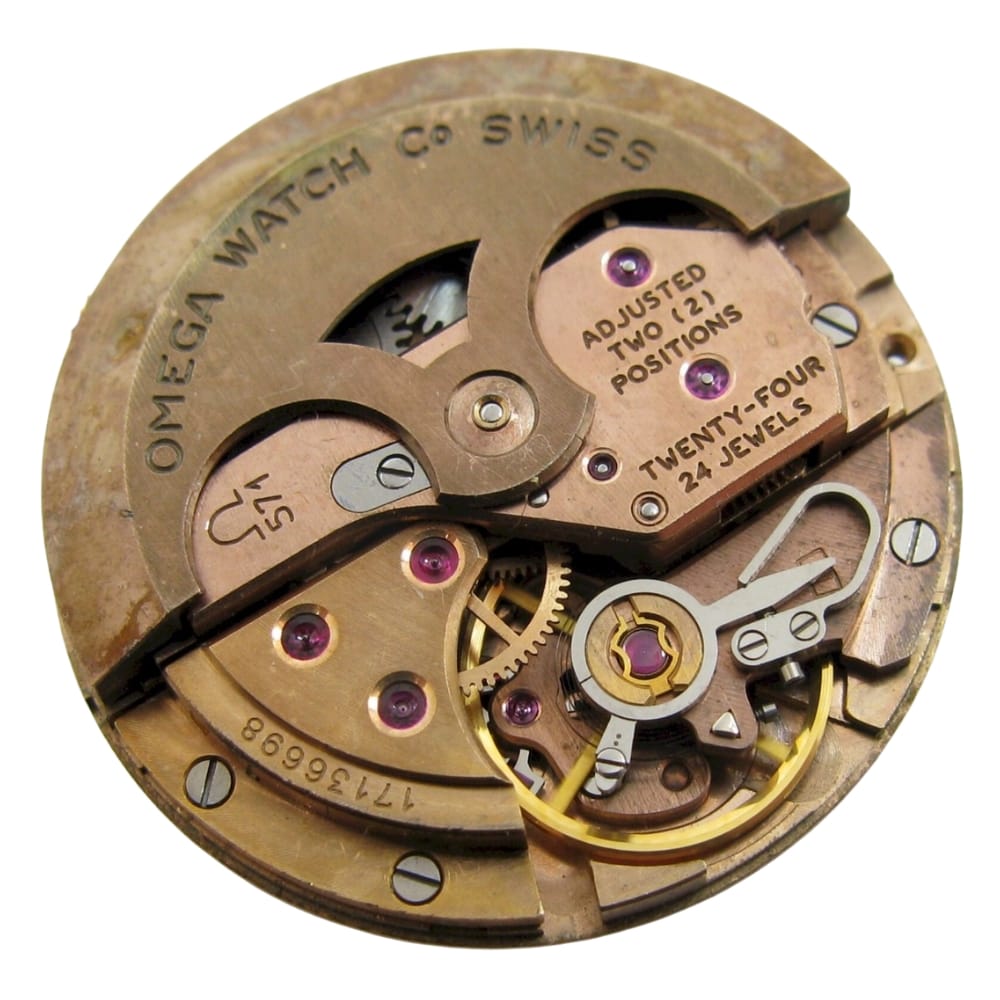
The Omega Caliber 571 represents a technical fork in Omega’s third-generation automatic movement development, distinguished solely by its elevated jewel count. While its 17-jewel sibling, the Caliber 570, was engineered specifically for the American market to circumvent customs duties levied on movements exceeding 17 jewels, the 571 served European and other international markets where no such tax penalty existed. This market-driven differentiation resulted in two functionally identical movements, separated only by seven additional jewel bearings in the automatic winding mechanism.
Introduced in 1959 alongside the broader 550 and 570 series, the Caliber 571 powered a specific niche of Omega’s catalog: the distinctive tank-style dress watches that defined late 1950s and early 1960s refinement. References 3999, 14253, and 2991 represent the most common hosts for this caliber, with case dimensions typically measuring 28-29mm in width, often executed in stainless steel or 18k gold. The 571’s compact 24.9mm diameter and slim 4.50mm profile made it ideal for the era’s slender, elongated case designs.
Production volume for the Caliber 571 remains undocumented in Omega’s published archives, though the movement’s restricted application in tank-style dress watches suggests significantly lower output than the concurrent 550 series that powered mainstream Constellation and Seamaster models. Collectors encounter the 571 infrequently compared to its contemporaries, placing it in the “uncommon” category rather than scarce or rare. The 570, its 17-jewel variant, appears even less frequently due to its specific American market targeting.
Collector interest in Caliber 571 watches remains moderate and steady. The tank-style cases that house this movement attract dedicated enthusiasts who prize mid-century rectangular case designs, but the caliber itself lacks the technical innovations or historical significance that drive premium valuations. Well-preserved examples in original condition command appropriate vintage prices, though specific 571-powered references show no evidence of accelerating demand or notable premiums over similar-era Omega dress watches.
Historical Context, Provenance, and Manufacturing Details
Omega introduced the Caliber 571 in 1959 as part of a comprehensive movement modernization program that began in the mid-1950s. The caliber addressed no specific technical challenge; rather, it served as a market-specific variant of the 570, created solely to satisfy international markets where higher jewel counts faced no import restrictions. The seven additional jewels in the 571 appear in the automatic winding mechanism bridges, providing enhanced bearing support for the reversing wheels and automatic winding train.
The 571 evolved directly from Omega’s second-generation automatic movements, specifically the 500 series (calibers 500, 501, 502, 503, 504, 505) that debuted between 1956 and 1957. These predecessors established the architectural foundation that the 570/571 would refine: bidirectional automatic winding via full rotor, swan neck micrometer regulator, and a low-beat 19,800 vph frequency. The transition from 500 to 570/571 series involved dimensional reduction (the 500 series measured slightly larger) and manufacturing refinements rather than fundamental redesign.
The 660 and 661 calibers succeeded the 570/571 in the early to mid-1960s, though exact transition dates remain unclear in Omega’s records. The 660 series introduced updated finishing and shared parts compatibility with other contemporary calibers, marking Omega’s continued evolution toward standardized component architecture. The 550 series, introduced concurrently with the 570/571 in 1958-1959, represents a parallel development branch rather than a predecessor or successor. The 550 family powered mainstream production models, while the 570/571 served specialized dress watch applications.
Omega manufactured the Caliber 571 at its Biel/Bienne facility in Switzerland. The movement qualifies as an in-house manufacture caliber, meaning Omega designed, produced, and finished all components internally rather than sourcing an ebauche base from external suppliers like ETA, AS, or Peseux. This manufacturing approach positioned the 571 as a premium offering within Omega’s catalog, distinguished from later decades when the brand increasingly relied on externally-sourced base movements.
Within horological history, the Caliber 571 occupies the role of workhorse rather than innovator. It introduced no groundbreaking technical advances, achieved no timing competition victories, and powered no historically significant timepieces. The caliber instead represents Omega’s focus on reliable, well-finished movements for mid-market dress watches during an era of rapid industry expansion and technological experimentation.
Construction and Architecture
Plate and Bridge Layout: The Caliber 571 employs a traditional three-quarter plate construction with separate bridges for the balance assembly, automatic mechanism, and barrel. The main plate and bridges are fabricated from brass, rhodium-plated to enhance corrosion resistance and provide the characteristic silver-white finish common to mid-century Omega movements. The architectural philosophy prioritizes accessibility for service, with the automatic winding mechanism mounted beneath a dedicated bridge that can be removed without disturbing the gear train or escapement.
Balance Wheel: The 571 features a monometallic Glucydur balance wheel, a beryllium-copper alloy that provides thermal stability superior to traditional bimetallic compensating balances. The smooth, screwless design eliminates the need for regulating screws, relying instead on the swan neck regulator for rate adjustment. The balance diameter measures approximately 9-10mm (specifications vary slightly across production runs). The Glucydur composition resists deformation under temperature fluctuations and shock, contributing to improved long-term rate stability.
Balance Spring (Hairspring): Omega equipped the 571 with a Nivarox hairspring, an iron-nickel-beryllium alloy developed specifically to provide self-compensating temperature characteristics. The spring features a flat configuration rather than a Breguet overcoil, with the outer terminal attached to a stud on the balance bridge and the inner terminal fixed to the balance staff collet. The Nivarox composition exhibits minimal elasticity variation across temperature ranges, reducing the thermal error that plagued earlier steel hairsprings and eliminating the need for complex compensating balance wheels.
Escapement Type: The movement employs a straight-line Swiss lever escapement, positioning the escape wheel, pallet fork, and balance wheel in linear alignment. This represents the standard configuration for Swiss watchmaking of the era. The escape wheel is manufactured from hardened steel alloy, featuring 15 teeth that engage with jeweled pallet stones. The pallet fork carries two synthetic ruby pallet stones (entry and exit pallets) that are precisely aligned and polished to minimize friction and maximize impulse efficiency. The impulse jewel, mounted on the balance staff, completes the escapement components.
Shock Protection System: The 571 incorporates Incabloc shock protection at the balance jewels (both upper and lower pivots). The Incabloc system employs lyre-shaped springs that allow the jewel settings to shift under impact, preventing the delicate balance pivots from fracturing when the watch experiences sudden shock. When impact force subsides, the spring returns the jewel setting to its original position. This system, invented in 1934, became the Swiss industry standard by the 1950s and appears in the vast majority of quality mechanical movements produced during the 571’s production era.
Regulator Type: Omega fitted the Caliber 571 with a swan neck micrometer regulator, a refined adjustment mechanism that provides precise rate regulation through a threaded screw system. The regulator consists of a swan-neck-shaped spring that applies pressure to a threaded post attached to the index arm. Rotating the regulating screw causes the index arm to move in minute increments, effectively lengthening or shortening the active portion of the hairspring. This system translates relatively large screw rotations (easily controlled by a watchmaker) into extremely fine adjustments of the regulating index, enabling precision timing adjustments. The swan neck design became a signature Omega feature during this era, appearing on chronometer-grade and higher-quality calibers.
Mainspring Material and Type: The 571 uses an alloy mainspring (likely Nivaflex or similar proprietary composition, though Omega did not publish specific alloy designations for this era). The mainspring measures approximately 1.2mm width × 0.1mm thickness, though these specifications may vary slightly. Part number 770/65 (Omega designation) fits both calibers 570 and 571, indicating identical mainspring specifications across both movements. The mainspring employs a fixed attachment at the barrel arbor (the inner end hooks to the arbor), with the outer end secured to the barrel wall via a slipping bridle that prevents overwinding damage.
Gear Train Details: The movement features a standard four-wheel gear train configuration: barrel, center wheel, third wheel, fourth wheel, and escape wheel. The caliber uses an indirect center seconds arrangement, meaning the seconds hand is driven by a separate pinion and friction spring assembly rather than being carried directly on the fourth wheel arbor. This architectural choice, characteristic of Omega’s movements during this era, facilitates both center seconds and subsidiary seconds configurations with minimal modification to the base movement. The indirect system also positions the balance wheel near the plate’s perimeter, improving visibility and serviceability.
Finishing Quality and Techniques: The Caliber 571 receives standard-grade finishing appropriate for mid-tier automatic movements of its era. The bridges and main plate feature perlage (circular graining) applied in overlapping patterns, visible on the plate surface beneath the bridges. The automatic bridge displays linear brushing rather than decorative Côtes de Genève striping, reflecting the movement’s positioning below Omega’s chronometer-grade offerings. The movement receives no anglage (beveling) on bridge edges, which remain squared and brushed rather than hand-chamfered and polished. Screw heads show basic polishing but not mirror-black finishing. The rotor features radial brushing with a subtle decorative pattern. This finishing level represents honest, functional execution, prioritizing durability and ease of manufacture over aesthetic elaboration. The movement was adjusted to two positions (dial up and crown down, typically), marked accordingly on the rotor or bridge.
Cross-Reference Data
Alternative Caliber Names (Rebranded Versions)
| Manufacturer | Caliber Designation | Notes |
|---|---|---|
| Omega | 570 | 17-jewel version for US market; functionally identical except for jewel count |
| N/A | N/A | The 571 was not rebadged or sold to other manufacturers |
The Caliber 571 was produced exclusively for Omega-branded watches and received no third-party branding or ebauche distribution.
Base Caliber vs. Elaborated Versions
| Variant Name | Differences | Jewel Count | Functions |
|---|---|---|---|
| Caliber 570 | 17 jewels (US market version) | 17 | Time-only, automatic |
| Caliber 571 | 24 jewels (international market) | 24 | Time-only, automatic |
No chronometer-certified or adjusted variants of the 571 are documented. All 571 movements received standard two-position adjustment.
Compatible Case References by Brand
| Brand | Reference Numbers | Production Years | Notes |
|---|---|---|---|
| Omega | 3999, 3999-4 SC, 3999 SC-61 | 1959-1962 | Tank case, steel or gold, 28mm width |
| Omega | 14253, 14253 SC-61 | 1959-1962 | Tank case, larger “jumbo” variant, approximately 28-30mm |
| Omega | 2991, 2991-61 SC, 2991-2 SC | 1959-1962 | Tank case, steel, 28-30mm width |
| Omega | 2864-6 | 1959-1960 | Tank case, gold-plated |
These represent the most commonly observed case references housing the Caliber 571. Omega’s reference numbering system of this era followed no strict standardization, and variations exist.
Dial Compatibility Note
The Caliber 571’s dial foot positions align with other 570-series movements, utilizing a two-point dial attachment system. The movement does not feature a date complication, so no date window consideration applies. Dial feet positioning should match specifications for the 570 family, though exact measurements were not published in available service documentation. When restoring or re-dialing a 571-powered watch, collectors should ensure dial feet match the movement’s pillar positions; generic dials intended for ETA or other ebauche movements will not fit without modification.
Crown and Stem Specifications
| Component | Specification |
|---|---|
| Stem Part Number | 1106 (Omega) |
| Stem Thread | Tap 10 |
| Stem Diameter | 0.90mm thread |
| Crown Thread | 0.90mm (Tap 10) |
| Setting Mechanism | Clutch-lever system (yoke-type) |
The stem (part 1106) is shared across multiple Omega calibers including 450, 455, 550, 551, 552, 560, 561, 562, 570, 571, 590, 591, 592, 593, 660, and 661.
Identification Marks
Caliber Number Location: The caliber designation “571” is engraved on the automatic winding bridge (the upper bridge that covers the reversing wheels and winding mechanism). The number typically appears near the balance wheel, stamped in a clean, machine-engraved font characteristic of Omega’s mid-century production. Some movements may also display the caliber number on the main plate beneath the rotor, though bridge placement is most common.
Logo and Brand Marks: Authentic Caliber 571 movements display the Omega symbol (Ω) on the automatic bridge or rotor. The rotor may also carry the word “AUTOMATIC” and occasionally “ADJUSTED TWO POSITIONS” or “ADJUSTED 2 POSITIONS” if the movement received formal adjustment testing. The Omega logo should be crisply engraved or printed, not crudely stamped or painted. Some movements carry additional marks such as “SWISS MADE” or “SWISS” on the main plate or bridges.
Date Codes: The Caliber 571 does not use Omega’s later date code system (which began in the 1960s-1970s with single-letter or letter-number combinations). Production year must be determined through serial number cross-referencing rather than date code interpretation.
Finishing Marks: Expect to see perlage (circular graining) on the main plate and visible surfaces. The automatic bridge typically displays linear brushing. The absence of Côtes de Genève striping on bridges is correct for this caliber and should not raise authenticity concerns. Screw heads should show basic polishing with slots cleanly cut and centered. The rotor should display radial or circular brushing with an even, factory-applied finish.
Jewel Markings: The 571’s 24 jewels consist of pressed jewels (jewels set directly into the plate and bridges without gold chatons or bezels). This represents standard construction for mid-grade automatic movements. Chronometer-grade or higher-specification movements would feature gold chatons around the jewels, but the 571 does not. The jewels should be synthetic ruby (appearing pink-red under magnification), cleanly set without cracks or chips.
Adjustment Markings: The Caliber 571 received adjustment in two positions: dial up and crown down. Authentic examples may carry the marking “ADJUSTED TWO POSITIONS” or “ADJUSTED 2 POSITIONS” on the automatic bridge or rotor. The absence of this marking does not indicate inauthenticity, as Omega applied adjustment markings inconsistently during this production period. Movements marked “ADJUSTED” without specifying position count were typically adjusted to two positions as well.
Correct Serial Number Formats and Locations: Serial numbers appear on the movement between the lugs at 12 o’clock (visible when the movement is removed from the case). The serial number is a seven or eight-digit number stamped into the case back interior or engraved on the movement itself. For 1959-1962 production (the 571’s primary production window), serial numbers fall within the 17,000,000 to 20,000,000 range. Specifically: 17,000,000-17,999,999 corresponds to 1959-1960; 18,000,000-18,999,999 to 1961; 19,000,000-19,999,999 to 1962.
Expected Engravings and Stampings: All engravings should be crisp, evenly depth-consistent, and executed in period-correct font styles. The caliber number “571” appears in a sans-serif typeface. The Omega symbol should match the logo style used in the late 1950s to early 1960s (the “Ω” character in a clean, modernist style). Jewel count markings may appear as “24 JEWELS” or “TWENTY-FOUR JEWELS” in English, or occasionally in French depending on market destination.
Font and Marking Style by Production Era: The 571’s short production window (approximately 1959-1963) means limited font variation across production runs. Early 1959 production may show slightly different engraving depth or font weight compared to 1961-1962 examples, but these differences are subtle and not useful for authentication without extensive reference collection comparison. The “OXG” mark (Omega eXport Geneva house code) sometimes appears on movements destined for the American market, stamped on the movement plate near the balance cock or below the rotor bridge. This mark indicates the movement was cased by a US-based Omega importer (typically Norman Morris) rather than in Switzerland.
Part Information

Part Numbers
| Component | Part Number | Interchangeability Notes |
|---|---|---|
| Mainspring | 770/65 (Omega) | Shared with caliber 570; generic Swiss mainspring specifications: 1.2mm width × 0.1mm thickness × 360mm length |
| Balance Complete | 1327 (Omega) | Shared with calibers 260, 261, 262, 265, 266, 267, 280, 281, 381, 570, 662, 663, 730; includes balance wheel, staff, and hairspring |
| Hairspring | Part of 1327 balance complete | Not sold separately; Nivarox alloy, flat configuration |
| Escape Wheel | Not documented in available sources | Likely shares with 570 and related calibers |
| Pallet Fork | Not documented in available sources | Swiss lever type, jeweled pallet stones |
| Crown Wheel | Not documented in available sources | Standard Omega configuration for this era |
| Ratchet Wheel | Not documented in available sources | Two-part design typical of Omega automatics |
| Click Spring | Not documented in available sources | Standard configuration |
| Setting Lever Spring | Not documented in available sources | Clutch-lever mechanism |
| Rotor | Not documented in available sources | Bidirectional winding rotor |
| Rotor Bearing | Part 1402 (likely) | Bronze bushing, known wear point; may fit 1045 and related calibers |
| Winding Stem | 1106 (Omega) | Shared with 450, 455, 550, 551, 552, 560, 561, 562, 570, 590, 591, 592, 593, 660, 661 |
Part numbers marked “(Omega)” are official Omega designations. Generic equivalent parts may be available from aftermarket suppliers under different numbering systems.
Sourcing Notes
Currently Available Parts: Genuine Omega mainsprings (part 770/65) and winding stems (part 1106) remain available through authorized Omega service centers and specialized vintage watch parts suppliers, though stock fluctuates. The balance complete (part 1327) occasionally appears in new-old-stock condition from parts specialists but should be considered scarce. Generic Swiss-made mainsprings matching the 1.2mm × 0.1mm × 360mm specifications can substitute for the original part with minimal performance impact.
Commonly Failing Components: The bronze rotor bearing represents the most frequent failure point in the Caliber 571. The rotor spins on a bronze bushing pressed into the automatic bridge. Over decades of operation, this bushing wears oval, creating excessive rotor play and reducing winding efficiency. This wear pattern is endemic to Omega’s automatic movements of this era, as the non-jeweled bronze bearing cannot withstand the rotational stresses imposed by the relatively heavy rotor. Watchmakers can machine replacement bronze bushings when original parts are unavailable, though this requires lathe work and precise fitting. The mainspring commonly weakens with age and service intervals, losing elastic strength and reducing power reserve. Hairspring damage from shocks or improper handling also occurs, though less frequently than rotor bearing wear.
Acceptable Generic Replacements: Generic Swiss-made mainsprings from suppliers like Bestfit or other Swiss parts manufacturers can replace the original Omega part 770/65 mainspring without performance degradation, provided the dimensions match (1.2mm width, 0.1mm thickness, 360mm length). Generic crowns in Tap 10 (0.90mm thread) from aftermarket suppliers fit the 571’s stem, though they may not precisely match the original crown’s aesthetic design. Other components, particularly the escapement parts, balance complete, and automatic mechanism components, should be replaced with genuine Omega parts when possible. Generic escape wheels, pallet forks, and other precision components rarely provide satisfactory long-term performance.
Performance Data
Manufacturer Specifications: Omega did not publish comprehensive performance specifications for the Caliber 571 in consumer-facing documentation or technical manuals available in the current research. The movement was adjusted to two positions (dial up and crown down), which suggests a target rate tolerance of approximately ±10 to ±15 seconds per day when new, though Omega did not formally certify this specification. The movement was not submitted for COSC chronometer certification, nor did it receive Geneva Seal certification. Temperature compensation is passive (relying on the Nivarox hairspring and Glucydur balance’s self-compensating properties) rather than actively tested across temperature ranges. Isochronism (rate consistency as mainspring winds down) was not formally specified.
Observed Performance (Field Data): Well-maintained Caliber 571 movements serviced within the past 5-10 years typically achieve rate performance of ±5 to ±15 seconds per day in normal wearing positions. Examples that have gone 15-20+ years without service commonly drift to ±20 to ±40 seconds per day as mainspring elasticity degrades, lubrication dries or oxidizes, and pivot bearings accumulate wear. The most common performance degradation mechanism is rotor bearing wear, which reduces automatic winding efficiency without directly affecting rate stability. A watch exhibiting poor automatic winding (stops when not worn for 12-18 hours despite active wear) but acceptable rate in the dial-up position likely suffers from rotor bearing wear rather than mainspring or escapement issues.
Amplitude when fully wound typically measures 240-280 degrees on a timegrapher (dial-up position), dropping to 200-240 degrees as the mainspring approaches the end of its power reserve. Amplitude below 200 degrees generally indicates service requirements: weak mainspring, dried lubrication, excessive pivot friction, or escapement problems. Beat error (the difference in duration between clockwise and counterclockwise balance swings) should measure less than 1.0ms in a properly adjusted movement. The indirect center seconds mechanism occasionally produces a slight “stutter” or hesitation in the seconds hand sweep, visible as a momentary pause every 4-8 seconds. This characteristic is inherent to the indirect drive system and does not indicate malfunction unless the stutter becomes pronounced or irregular.
Aging impacts the 571 predictably: after 40-50 years without service, expect power reserve to decline from the original 42-48 hours to 24-36 hours due to mainspring fatigue. Rate stability degrades as pivot bearings accumulate wear and lubrication breaks down. The rotor bearing, being bronze rather than jeweled, wears significantly faster than other bearings and typically requires replacement or rebushing during the second or third service cycle. Hairsprings in 571 movements occasionally suffer from magnetization if exposed to modern electronic devices, though the Nivarox alloy resists magnetic influence better than traditional steel springs. A magnetized movement exhibits rate instability that changes dramatically with watch position and cannot be corrected through regulation alone; demagnetization restores normal performance.