

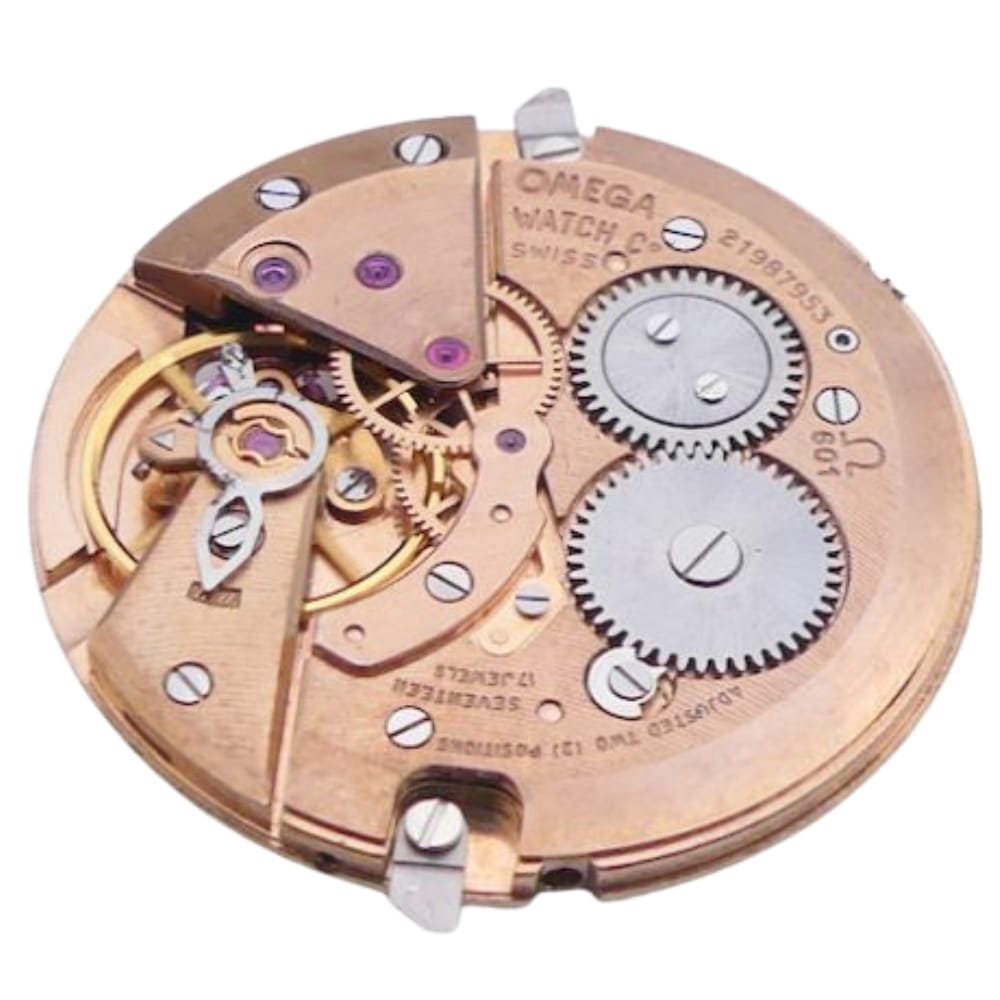
The Omega Caliber 601 represents one of the most successful manual-wind movements Omega produced during the 1960s, serving as the workhorse caliber for entry-level Seamaster 600 models and Geneve dress watches for nearly a decade. Derived from the automatic Caliber 550 series by removing the self-winding mechanism, the 601 delivered reliable timekeeping in a thinner package suited to dress watch proportions while maintaining Omega’s reputation for quality at accessible price points.
This movement powered an enormous quantity of watches during its production run, making it common in today’s vintage market but highly valued by collectors and watchmakers for its serviceability, parts availability, and proven durability. The 601’s architecture balances practical construction with sufficient finishing to satisfy serious collectors, featuring proper jeweling, Incabloc shock protection, and Nivarox hairspring technology borrowed from Omega’s higher-grade automatic movements.
Total production numbers for the Caliber 601 are not manufacturer-confirmed, but serial number analysis and market prevalence suggest production in the hundreds of thousands across all models from 1962 to 1970. The movement appears in case serial numbers ranging from approximately 19,000,000 (1962) through 32,999,999 (1970). This high production volume makes the caliber common rather than scarce, with collector demand driven primarily by condition, originality, and the specific watch model rather than movement rarity. Well-preserved examples trade regularly in the vintage market, while movements requiring service or restoration remain readily available to collectors at entry-level price points.
The Caliber 601 occupies a stable position in the collector market as an affordable gateway to vintage Omega ownership. Demand remains consistent for clean examples in popular models like the Seamaster 600 with black dials (often called “mini Speedmasters”) and Geneve dress watches with original dials. Market values for complete watches with serviced 601 movements typically range from £400 to £2,500 depending on case material, dial condition, and provenance. The movement’s reputation for accuracy and reliability supports steady rather than speculative demand, with prices appreciating gradually alongside general vintage Omega interest rather than experiencing dramatic spikes.
Historical Context, Provenance, and Manufacturing Details
Omega introduced the Caliber 600 series in the early 1960s as a strategic response to market demand for thinner, more affordable watches without sacrificing movement quality. The development timeline shows Caliber 600 first appearing in 1960 with a swan-neck regulator, followed by Caliber 601 in 1962 (some sources cite 1964) with the cost-reduced pointer-style excenter regulator replacing the more expensive swan-neck system. This substitution reduced manufacturing costs without meaningfully compromising regulation precision when properly adjusted.
The Caliber 601 evolved from and replaced Caliber 600 as the standard non-date manual wind movement in Omega’s mid-tier lineup. It was eventually succeeded by date-equipped variants (Caliber 611 introduced circa 1964-1965, and Caliber 613 with quick-set date circa 1966-1967) and ultimately by the Caliber 1000 series in the early 1970s as Omega transitioned to newer movement architectures. The 601’s eight-year production run demonstrates its commercial success and technical competence during a period when Swiss watchmaking faced increasing pressure from lower-cost competition.
The Caliber 601 is an ebauche-based movement in the sense that it derives its fundamental architecture from the Caliber 550 automatic series, with Omega manufacturing both the base movement and its manual-wind derivatives in-house at its Bienne facility. The relationship between the 550 automatic family and the 600 manual family means many components interchange directly, a deliberate design choice that simplified production, inventory management, and service operations. Parts cross-compatibility extends to bridges, wheels, jewels, and even certain setting mechanism components between the 550/560/600/610 families.
All Caliber 601 movements were manufactured at Omega’s primary production facility in Bienne, Switzerland, with no documented production location changes during the caliber’s lifespan. The movement remained fundamentally unchanged from introduction to discontinuation, maintaining consistent specifications, dimensions, and construction throughout its production run. This manufacturing stability contributes to the caliber’s serviceability today, as watchmakers can reliably source parts and apply consistent service procedures across all production years.
In the broader context of horological history, the Caliber 601 represents a transitional design philosophy. It embodies the practical Swiss approach of the 1960s: leverage proven automatic movement architecture, remove complexity where market segments don’t demand it, maintain quality standards sufficient to uphold brand reputation, and price products to compete effectively. The 601 is neither groundbreaking nor inferior but rather a competent workhorse that served its intended purpose exceptionally well, powering hundreds of thousands of watches that introduced buyers to Swiss watchmaking quality at accessible prices.
Construction and Architecture
Plate and Bridge Layout
The Caliber 601 employs a traditional three-bridge architecture with a main plate, barrel bridge (part 1001), train wheel bridge (part 1003), and separate cocks for the pallet fork (part 1005), sweep second (part 1007), and balance (part 1030). This layout prioritizes serviceability and manufacturing efficiency over decorative elaboration, with bridges constructed from brass with nickel plating providing corrosion resistance and dimensional stability. The architectural philosophy emphasizes practical durability: bridges are substantial enough to maintain jewel positioning under shock, and the construction allows complete disassembly and reassembly without specialized tooling.
The main plate features proper jeweling for all pivots requiring low-friction support, with the gear train mounted between the plate and train wheel bridge in a sandwich configuration that maintains precise gear mesh. The sweep second cock (center seconds cock) mounts separately, a design choice necessitated by the indirect center seconds drive system inherited from the automatic 550 base caliber. This separate cock arrangement slightly increases movement height compared to direct-drive center seconds but improves reliability and simplifies service.
Balance Wheel
The Caliber 601 employs a large four-arm annular balance wheel constructed from beryllium-bronze alloy, measuring approximately 10-11mm in diameter. This is a smooth balance without timing screws, representing a cost-reduction measure compared to screw-adjusted balances found in higher-grade movements. The smooth configuration means timing adjustments occur exclusively via the regulator rather than through balance weight distribution, limiting adjustment flexibility but simplifying manufacturing.
The balance wheel material (beryllium-bronze) provides temperature stability and anti-magnetic properties superior to traditional bimetallic balance designs. The four-arm configuration with annular construction (weight distributed at the rim) maximizes inertia relative to mass, supporting stable oscillation and improved isochronism. The balance beats at 19,800 vph (2.75 Hz), a moderate frequency that balances accuracy potential against power consumption, contributing to the movement’s 48-hour power reserve.
Balance Spring (Hairspring)
The Caliber 601 employs a Nivarox hairspring, the industry-standard alloy developed in the 1930s for its temperature compensation, anti-magnetic properties, and resistance to oxidation. The spring configuration appears to be a flat spiral with standard inner terminal curve rather than a Breguet overcoil, consistent with the movement’s positioning as a practical rather than haute horlogerie caliber. Some collector discussions mention confusion about Breguet curves on 601 movements, but standard production examples feature flat spirals without overcoils.
The Nivarox material composition (iron-nickel alloy with chromium, beryllium, and other elements) provides self-compensating properties across normal temperature ranges, meaning rate variation due to temperature changes is minimized without requiring a bimetallic balance. The hairspring attaches to the balance via a collet (integral with the spring) and to the balance cock via a stud secured by a screw. The stud is movable for beat error adjustment, with watchmakers adjusting beat by rotating the collet relative to the balance, a procedure requiring careful manipulation to avoid hairspring damage.
Escapement Type
The movement employs a Swiss lever escapement with jeweled pallet stones, the standard design for quality Swiss watches throughout the 20th century. The escape wheel (part 1305) and pallet fork (part 1316) are properly jeweled, with the pallet fork pivoting in jeweled bearings at both upper and lower pivots. The pallet stones themselves are synthetic ruby (listed in parts documentation as polyrubies for standard grade), providing the hardness and polish quality necessary for reliable impulse transmission.
The escapement design is entirely conventional with no notable innovations, which benefits serviceability as replacement parts and watchmaker familiarity are both readily available. The lift angle of 56.0 degrees is moderate, indicating a standard lever escapement geometry without unusually deep or shallow pallet engagement. This lift angle value is critical for accurate timegrapher readings, as incorrect lift angle settings will yield false amplitude measurements.
Shock Protection System
The Caliber 601 features Incabloc shock protection on the balance staff, with an important distinction between upper and lower bearing configurations. The upper balance jewel (under the balance cock) employs a standard Incabloc system with the characteristic spring-loaded cap jewel assembly secured by a bolt. This system allows the jewel and its setting to float within the block under shock, preventing pivot damage from impacts.
The lower balance bearing uses a different shock protection system consisting of a cover plate with spring rather than a full Incabloc assembly. This asymmetric shock protection approach represents a cost-saving measure, with the upper bearing (which experiences greater shock forces when the watch is worn dial-up or crown-up) receiving the more sophisticated protection. Watchmakers note that servicing the lower shock system differs from standard Incabloc procedures, requiring careful removal of the spring-loaded cover rather than pushing out an Incabloc block.
The escapement pivots do not receive jeweled shock protection, a standard configuration for movements in this grade and era. The fourth wheel (seconds wheel) and escape wheel pivot in conventional jewel settings without spring-loaded shock systems.
Regulator Type
The Caliber 601 employs an excenter regulator (also called pointer regulator or index regulator), a simpler and less expensive system than the swan-neck regulator found on its predecessor Caliber 600. The regulator consists of a curved arm with pins that embrace the hairspring, with the entire arm rotating around an eccentric pivot to adjust the effective length of the spring. This design allows reasonably precise adjustment when performed carefully but lacks the micrometric screw-adjustment capability of swan-neck systems.
A secondary fine adjustment screw (an eccentric screw) appears on the pallet cock, providing an additional adjustment point for extremely fine rate corrections. Watchmakers can perform coarse adjustments by moving the regulator arm and fine adjustments via the eccentric screw, together offering sufficient precision for achieving chronometer-grade performance when the movement is in excellent condition.
The transition from swan-neck (Caliber 600) to excenter (Caliber 601) exemplifies Omega’s strategic cost management during the 1960s. Both systems can achieve similar accuracy results in skilled hands, but the excenter regulator is simpler to manufacture and assemble. Collectors and watchmakers report no meaningful performance difference between properly adjusted 600 and 601 movements despite the regulator design change.
Mainspring Material and Type
The Caliber 601 uses a white alloy mainspring measuring 1.05mm to 1.50mm in height, 0.105mm to 0.120mm in thickness, and 300mm to 380mm in length depending on supplier. The most commonly cited specification is 1.05 x 0.120 x 380 x 10.00mm (height x thickness x length x strength). This is a manual-wind mainspring with higher torque output than automatic mainsprings, designed to provide the 48-hour power reserve from a single barrel without supplementary power from rotor winding.
The mainspring features a slipping bridle attachment at the barrel wall rather than a fixed hook, allowing controlled mainspring slip to prevent overwinding damage. This safety feature is particularly important for manual-wind movements where users might inadvertently attempt to wind past full tension. The barrel arbor (part 1204) and barrel with arbor assembly (part 1200) house the mainspring, with the barrel driving the great wheel (part 1216) to power the gear train.
Replacement mainsprings are readily available from Swiss suppliers including Ranfft and aftermarket sources, with some variation in specifications between manufacturers. Watchmakers note that the 0.12mm thickness mainspring produces approximately 30% greater force than 0.11mm variants, with the stronger spring recommended for optimal amplitude and power reserve.
Gear Train Details
The Caliber 601 employs a four-wheel gear train with indirect center seconds drive, inherited from the automatic Caliber 550 architecture. The gear train consists of: barrel wheel (great wheel, part 1216), center wheel with cannon pinion (parts 1219), third wheel (part 1240, which also serves as the intermediate wheel for center seconds), fourth wheel (seconds wheel, part 1243), and escape wheel (part 1305).
The indirect center seconds system uses a separate sweep second pinion (part 1250B) driven by an extension of the third wheel, with a friction spring (part 1255) providing the tension necessary for the pinion to rotate freely on the center wheel arbor while being driven by the third wheel. This configuration allows the seconds hand to be stopped independently (back-hacking) by pulling the crown to setting position and reversing slightly, a technique users sometimes employ despite the movement lacking a true hacking seconds feature.
All wheels are properly jeweled at their bearing points, with jewels documented in the parts list for upper and lower pivots of the center wheel, third wheel, fourth wheel, and escape wheel. The gear ratios follow standard Swiss lever escapement conventions optimized for 19,800 vph frequency, though specific ratio numbers are not documented in available technical literature.
Finishing Quality and Techniques
The Caliber 601 exhibits utilitarian finishing appropriate to its positioning as an entry-level Swiss movement, with practical rather than decorative treatments dominating. The main plate and bridges receive circular graining (perlage) on visible surfaces, a machine-applied texture that serves both aesthetic and functional purposes by trapping dust particles. The perlage pattern is regular but not hand-refined, with overlapping circles visible under magnification.
Bridges do not receive Côtes de Genève (Geneva stripes) in most examples, instead featuring either perlage or brushed finishes depending on production era. The absence of Geneva striping distinguishes the 601 from higher-grade Omega movements and reduces manufacturing time without affecting functionality. Bridge edges receive minimal chamfering (anglage) if any, typically showing simple radiused edges rather than hand-polished bevels.
The movement is not adjusted to chronometer standard in normal production (with the exception of the rare Caliber 602 chronometer variant). Standard 601 movements received adjustment in two positions at the factory, while better examples may have received three or five-position adjustment during periods when Omega offered grade variations. Adjustment markings, when present, appear on the balance cock or main plate, though many 601 movements lack adjustment markings entirely.
The characteristic copper-tone finish (rose gold tone) mentioned by collectors and dealers refers to the color of the brass plates and bridges before nickel plating. Some 601 movements exhibit this warmer coloring while others show brighter nickel plating, likely representing variations in plating processes over the production run or differences in aging and patina development. The movement features Omega’s applied logo on the train wheel bridge and caliber number engraving on the main plate below the balance.
Cross-Reference Data
Alternative Caliber Names and Related Variants
The Caliber 600 series comprises six related movements, all based on the automatic Caliber 550 architecture with the self-winding mechanism removed:
Parts interchangeability exists extensively within the 600 series and between the 600 and 550 series base calibers. Key components including the balance complete (part 1327), barrel bridge (part 1001), gear train wheels, and many smaller parts cross-reference directly between calibers.
Compatible Case References by Brand
The Caliber 601 appears in numerous Omega watch references across multiple model lines:
Case diameters for 601-equipped watches typically range from 33mm to 35mm excluding crown, with tonneau-shaped and round cases both common. Lug widths are most commonly 18mm, with some 20mm variants in larger Seamaster cases.
Dial Compatibility Notes
Dial compatibility within Caliber 601 watches is excellent due to consistent dial foot positioning and standardized cannon pinion heights throughout the production run. Dial foot positions appear at 12 and 6 o’clock (two-foot configuration) or at 12, 3, and 9 o’clock (three-foot configuration) depending on case reference. The movement does not feature a date window in standard 601 configuration, though dial cutouts vary when the movement is replaced with date-equipped variants (611, 613) in compatible cases.
The cannon pinion (part 1219) sits at 2.20mm height, determining dial spacing and compatible hand lengths. Hour wheel (part 1232) height is 1.33mm. These dimensions remain consistent across all 601 production, meaning period-correct dials from different watch references can often be swapped if dial feet match, though collectors strongly prefer maintaining original dial configurations.
Restorers and watchmakers note that dial refinishing was common during the 601’s service life, with many examples showing professionally restored dials from the 1970s through 2000s. Original dials command significant premiums over refinished examples, with tropical (UV-damaged) dials sometimes valued above pristine examples when the aging is even and attractive.
Crown and Stem Specifications
The Caliber 601 uses Omega’s standard TAP 10 stem threading with 0.90mm thread diameter. Stem part numbers vary by case configuration:
- Part 1106 (72206001106): Standard winding stem for wristwatch applications, movement portion with beak
- Part 1141 (72206001141): Winding stem, movement part with beak, alternate configuration
- Part 1149 (72206001149): Winding stem, movement part with beak, pocket watch variant
- Part 1125 (72206001125): Winding stem for pocket watch, length 23.50mm
Crown thread specifications vary by case manufacturer and reference but commonly use 0.80mm to 0.90mm thread diameters with TAP 9 or TAP 10 configurations. Crown part numbers are case-specific rather than caliber-specific, requiring identification of the exact case reference for proper crown sourcing. The setting mechanism employs a yoke-type clutch (part 1111, bascule) with setting lever (part 1109, tirette) featuring a push-release button rather than a screw to remove the stem.
Identification Marks
Caliber Number Location
The caliber number “601” is engraved on the main plate below the balance wheel, visible when the movement is removed from the case. The engraving appears in a standardized Omega font with clear, machine-engraved characters approximately 2-3mm in height. The number is always located in the same position across all 601 production, making identification straightforward when the case-back is removed.
Some examples also show the caliber designation on bridges or visible through exhibition case-backs, though this is less common for entry-level models that typically featured solid case-backs. The engraving depth and clarity should be consistent with machine engraving, as hand-engraved or re-engraved numbers may indicate fake or altered movements.
Logo and Brand Marks
Authentic Caliber 601 movements bear the Omega name and logo engraved or stamped on the movement. The primary logo location is on the train wheel bridge, with “OMEGA” appearing in period-correct font. Earlier production examples (1962-1966) sometimes show applied metal logos, while later examples more commonly feature engraved text.
The main plate bears the inscription “OMEGA WATCH CO” or “OMEGA WATCH CO SWISS” below the balance or on visible areas of the plate. Swiss manufacture marking is standard, with “SWISS” or “SWISS MADE” appearing on the movement. Quality markings indicating jewel count (“17 RUBIS” or “17 JEWELS”) appear on the train wheel bridge or main plate in authentic examples.
Date Codes and Serial Numbers
Omega used movement serial numbers for dating rather than date codes during the 601’s production era. The serial number is engraved on the movement (typically on the main plate) and falls within these ranges by production year:
| Serial Number Range | Production Year(s) |
|---|---|
| 19,000,000 – 19,999,999 | 1962 |
| 20,000,000 – 20,999,999 | 1963 |
| 21,000,000 – 21,999,999 | 1964 |
| 22,000,000 – 22,999,999 | 1965 |
| 23,000,000 – 24,999,999 | 1966 |
| 25,000,000 – 25,999,999 | 1967 |
| 26,000,000 – 27,999,999 | 1968 |
| 28,000,000 – 31,999,999 | 1969 |
| 32,000,000 – 32,999,999 | 1970 |
These serial numbers apply to non-Speedmaster Omega watches and align with documented 601 production periods. The serial number consists of eight digits engraved in machine-applied characters, with authentic examples showing consistent depth and spacing. Serial numbers should never be re-engraved or hand-altered, as this indicates movement tampering or replacement.
Finishing Marks and Expected Patterns
Authentic Caliber 601 movements exhibit machine-applied perlage (circular graining) on the main plate and bridge surfaces visible through case-backs or upon disassembly. The perlage pattern consists of overlapping circles approximately 0.8-1.2mm in diameter, applied with consistent depth and spacing. Hand-applied or irregularly spaced perlage may indicate later refinishing or fake movements attempting to mimic proper finishing.
Bridges typically show either perlage or brushed finishes depending on production year, with no Geneva striping (Côtes de Genève) on standard production 601 movements. The absence of Geneva stripes is correct for this caliber and should not be considered a deficiency. Bridge edges show simple rounding or minimal chamfering rather than polished bevels, appropriate to the movement’s grade level.
The brass base metal of plates and bridges ranges from copper-rose tone to bright nickel-plated finish depending on production era and surface treatment. Both presentations are correct for authentic movements, with the warmer copper tone more common in earlier production and well-preserved examples, while brighter nickel plating appears on later production or movements that have been professionally cleaned.
Jewel Markings and Settings
The Caliber 601 uses pressed jewel settings (jewels pressed directly into the plate or bridge) rather than gold chatons (raised jewel settings) for most pivot points. This is correct for the movement’s grade and represents standard construction for entry-level to mid-grade Swiss movements of the era. The balance staff pivots receive cap jewels held in Incabloc settings as described in the shock protection section.
Jewel count is always 17 jewels in authentic 601 movements. The distribution includes jeweled bearings for the balance staff (2), escape wheel (2), fourth wheel (2), third wheel (2), center wheel (2), pallet fork (2), and pallet stones (2), plus cap jewels in the Incabloc settings (2), and the impulse jewel on the balance roller (1). Any deviation from 17 jewels indicates either a different caliber or a movement with replaced components.
Adjustment Markings
Standard production Caliber 601 movements received two-position adjustment at the factory, though adjustment markings are often absent on these entry-level movements. When present, adjustment marks appear as stamped or engraved symbols on the balance cock indicating: “2 POS” or “ADJUSTED 2 POSITIONS” or similar marking.
Higher-grade examples or movements that received additional adjustment during service may show three-position or five-position markings, though this is uncommon for standard 601 production. The absence of adjustment markings on a 601 is not a red flag, as many authentic examples left the factory without these markings despite receiving basic adjustment.
The Caliber 602 chronometer variant shows “CHRONOMETER” or “OFFICIALLY CERTIFIED CHRONOMETER” markings on the movement, distinguishing it from standard 601 production. These markings should appear on both the movement and the corresponding dial in authentic chronometer examples, and any 602-marked movement should trace to the Reference 137.001 solid gold Geneve, as this was the only model to receive the chronometer caliber.
Font and Marking Style by Production Era
Omega’s engraving and marking style remained relatively consistent throughout the 601’s production run, with machine-engraved characters in standardized fonts used for caliber numbers, serial numbers, and quality markings. Early production (1962-1966) sometimes featured slightly different character spacing or font weights compared to later production (1967-1970), but these differences are subtle and require side-by-side comparison to distinguish.
Authentic engravings show consistent depth (approximately 0.1-0.2mm), sharp edges without burring or roughness, and machine-precision spacing between characters. Hand-engraved or stamped numbers that appear irregular, overly deep, or inconsistent indicate movements that have been tampered with, renumbered, or assembled from parts. Collectors should be particularly wary of movements with mismatched serial numbers between the movement and case, as this often indicates replacement or marriage of components from different watches.
Part Information

Key Components with Part Numbers
The following table lists critical service parts and consumables for the Caliber 601:
Sourcing Notes
Parts availability for the Caliber 601 is generally excellent due to the movement’s high production volume and extensive cross-compatibility with the 550 automatic series. Watchmakers can source components through multiple channels:
Genuine Omega Parts: Available through Omega service centers and authorized parts distributors, though Swatch Group (Omega’s parent company) ceased supplying parts to independent watchmakers in 2015. Collectors and watchmakers with existing parts inventory or relationships with authorized service centers can still obtain genuine components, albeit at premium prices and with potential supply delays.
Generic/Compatible Parts: Many components have generic equivalents available from Swiss parts suppliers like Ranfft, Cousins UK, and specialized vintage watch parts dealers. These include commonly replaced items like mainsprings, balance staffs, jewels, and setting mechanism components. Generic parts typically offer acceptable quality for service work, though purists prefer genuine Omega parts for valuable or collectible examples.
Donor Movements: Given the 601’s production volume and market prevalence, sourcing parts from donor movements is often practical and economical. Non-working or parts-grade 601 movements regularly appear in the vintage watch market, providing balance wheels, bridges, jewels, and other components for restoration projects.
Interchangeable Parts from Related Calibers: The extensive cross-compatibility between 550/600/601/611 calibers means watchmakers can source certain components from more readily available automatic movements. Balance wheels, wheels, jewels, bridges, and many small parts interchange directly, expanding the parts pool significantly beyond 601-specific inventory.
Common Failures and Replacement Priorities
Based on watchmaker reports and service documentation, the following components commonly require replacement or attention during 601 service:
Mainspring: Frequently requires replacement in vintage examples due to loss of elastic properties, rust, or breakage. Original mainsprings may show reduced power output resulting in low amplitude and shortened power reserve. Modern replacement mainsprings are readily available and typically improve performance over aged original springs.
Balance Staff: Broken pivots are common, particularly on the lower pivot which lacks full Incabloc protection. Replacement requires pressing out the old staff and pressing in a new one while preserving the balance wheel and hairspring, a delicate procedure requiring specialized tools.
Hairspring: Can become magnetized, damaged during rough service, or develop shape irregularities that cause poor timekeeping. Hairspring replacement or manipulation is among the most challenging service procedures, often requiring replacement of the complete balance assembly rather than hairspring alone.
Setting Lever Spring: Documented as broken on some examples, requiring replacement. Part 1110 (setting lever spring) is readily available and straightforward to replace during service.
Crown and Stem: Frequently worn or damaged, particularly on watches that saw heavy daily wear. Stem replacement requires matching the correct TAP 10 threading and ensuring proper length for the specific case configuration.
Friction Spring for Sweep Second Pinion: Can lose tension over time, resulting in seconds hand slip or jumping. Replacement restores proper seconds hand operation, though some watchmakers prefer direct-drive center seconds systems due to this spring’s tendency to cause issues when worn.
Jewels and Pivot Bushings: Rarely require replacement unless damaged during prior service or subject to severe shock. When necessary, jewel replacement requires specialized tools and skill to press new jewels to correct depth.
Performance Data
Manufacturer Specifications
Omega specified the following performance parameters for the Caliber 601 as delivered from the factory:
The movement does not feature temperature compensation beyond the inherent properties of the Nivarox hairspring, nor does it receive the extensive positional adjustment of chronometer-grade movements. The two-position adjustment means performance may vary more significantly in crown-up, crown-down, or inverted positions compared to dial-up and dial-down positions.
Observed Performance (Field Data)
Collector reports, watchmaker observations, and timegrapher results from serviced examples reveal the following typical performance characteristics:
Accuracy Range for Well-Maintained Examples: Properly serviced 601 movements with fresh mainsprings, clean pivots, and correct lubrication typically achieve +/- 5 to +/- 15 seconds per day in the dial-up position. Examples running within +/- 10 seconds per day are common after professional service, with some exceptional examples achieving +/- 5 seconds per day or better. These results significantly exceed factory specifications and demonstrate the movement’s capability when in optimal condition.
Common Performance Issues and Causes:
- Excessive rate loss (-60 to -120 seconds per day): Typically indicates contaminated pivots, dried lubricant, worn balance staff pivots, or magnetization. These conditions increase friction and reduce amplitude, causing severe timekeeping degradation.
- Low amplitude (below 220 degrees horizontal): Suggests weak mainspring, excessive friction in the gear train, improper lubrication, or escapement problems. Amplitude below 200 degrees after 24 hours indicates urgent service needs.
- High beat error (above 1.0 milliseconds): Results from impulse jewel misalignment relative to pallet fork, correctable by rotating the hairspring collet. Most watchmakers target beat error below 0.5ms for optimal performance.
- Positional variation (more than 20-30 seconds difference between dial-up and crown-up positions): Normal for two-position adjusted movements but can be improved with additional positional adjustment during service.
Expected Amplitude Performance:
- Fully wound, dial-up position: 250-280 degrees typical, 280-300 degrees excellent
- After 24 hours running: 220-250 degrees acceptable, above 240 degrees good
- Crown-up/crown-down positions: 10-20 degrees lower than horizontal positions is normal
- Amplitude below 160 degrees after 24 hours indicates service required
Power Reserve Field Performance:
Well-maintained 601 movements routinely deliver 48 hours of running time from full wind to stop, with some examples running 50-52 hours under optimal conditions. This exceeds the performance of many contemporary movements and demonstrates efficient gear train design and effective mainspring specifications. Users report consistent power delivery throughout the reserve with gradual rather than sudden rate degradation as the mainspring unwinds.
Rate Stability Observations:
The 601 exhibits good isochronism (rate consistency across different mainspring tension states) when properly serviced. Rate should remain relatively stable from full wind through approximately 36 hours of running, with slight acceleration typical as the mainspring approaches full depletion. Erratic rate changes or inconsistent timekeeping across the power reserve indicate service needs or worn components.
Service Impact on Performance:
Collector and watchmaker reports consistently indicate that service quality dramatically affects 601 performance. Movements that have received proper disassembly, cleaning, examination, lubrication, and adjustment typically perform near or better than factory specifications, while neglected examples may show severely degraded performance despite lacking mechanical damage. The 601’s design is fundamentally sound, and poor performance in most cases reflects maintenance needs rather than inherent movement limitations