

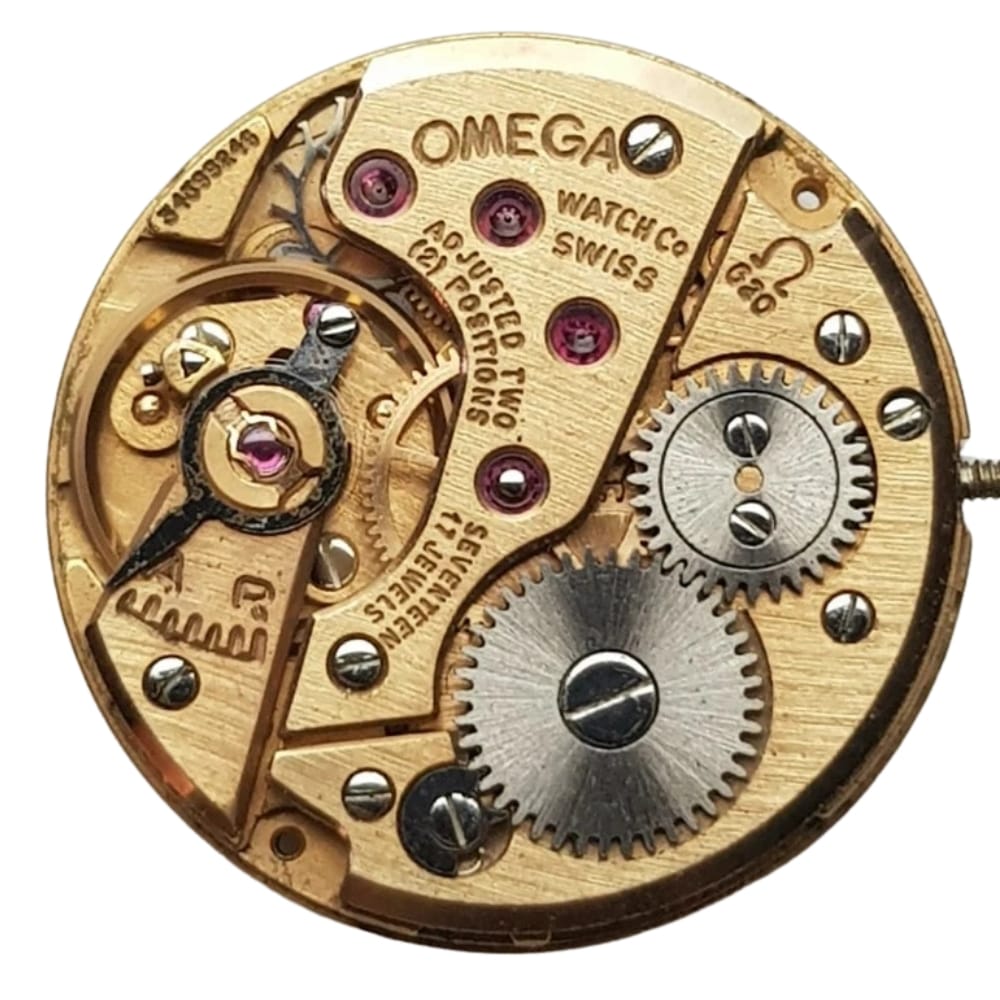
The Omega caliber 620 represents a pivotal moment in 1960s dress watch design when Jacques Ziegler engineered one of the thinnest manual-winding movements of its era. At just 2.5mm tall, this “Superflat” caliber powered countless De Ville dress watches through the transformative decade when Omega claimed more than half of all chronometer certificates issued in Switzerland, yet the 620 itself remained deliberately unadjusted, a workhorse movement designed for elegance over precision bragging rights.
The caliber 620 served as the foundation of Omega’s ultra-thin dress watch strategy during the 1960s and early 1970s. This 17-jewel, two-hand movement beat at 19,800 vph and delivered 42 hours of power reserve in a package that allowed case heights under 8mm. Designed for pure simplicity, the 620 displayed only hours and minutes, appealing to collectors who valued classical proportions and refined aesthetics over complications. Among watchmakers, the 620 earned a reputation for reliability and ease of service, though it lacked the chronometer adjustments that elevated its siblings in the 500 and 600 series. The movement’s copper-plated beryllium-bronze finish gave it visual warmth, while its Glucydur balance and Nivarox hairspring provided temperature stability without the cost premium of chronometer certification.
Omega produced approximately 1.4 million caliber 620 movements during its thirteen-year production run from 1960 to 1973. This substantial output places the 620 firmly in the “common” category, far more available than chronometer-grade calibers but still representing a finite vintage resource. The movement appeared predominantly in ladies’ watches ranging from 19mm to 28mm, though a smaller subset powered men’s De Ville models in the 33-34mm range. Most examples resided in solid gold or gold-filled cases, reflecting the caliber’s positioning as an affordable luxury movement. While not scarce in absolute terms, finding well-preserved examples with original dials and properly functioning movements has become more challenging as surviving watches age past 50 years. The movement’s ubiquity in ladies’ models means many were worn daily and then retired to drawers, resulting in dried lubricants and degraded performance by the time they reach today’s market.
In the current collector landscape, the caliber 620 occupies a modest but stable position. The movement lacks the prestige of Omega’s chronometer-certified calibers, and the predominantly small case sizes limit appeal among collectors focused on sport models or larger dress watches. However, the 620 benefits from growing appreciation for 1960s design purity and ultra-thin movements. Men’s De Ville references with the 620, particularly the 111.077 with sunburst dials, command premiums when condition is exceptional. Ladies’ examples in 18-karat gold cases maintain value but rarely appreciate significantly unless paired with unusual dials or rare case designs. Demand remains steady rather than surging, making the 620 an accessible entry point for collectors interested in Omega’s golden age without the investment required for Constellation or Seamaster pieces. The movement’s straightforward construction and parts availability also appeal to collector-hobbyists capable of performing their own maintenance.
Historical Context, Provenance, and Manufacturing Details
Jacques Ziegler, working under the supervision of Omega’s legendary Technical Director Henri Gerber, designed the caliber 620 in 1960 as part of Omega’s response to the fashion industry’s demand for ultra-thin dress watches. The late 1950s and early 1960s represented a pivotal period in Swiss watchmaking when formal dress codes drove demand for elegant, low-profile timepieces that could slip beneath shirt cuffs without bulk. Omega had already achieved success with the 500-series automatic movements, but the manual-winding segment required a dedicated solution that prioritized thinness above all else. Ziegler’s 620 answered this need, achieving a height of just 2.5mm while maintaining Omega’s standards for reliability and serviceability.
The caliber 620 evolved from Omega’s established tradition of compact manual-winding movements but represented a distinct design optimized for the “Superflat” marketing initiative. While sharing some conceptual DNA with earlier small calibers, the 620 was purpose-built for the 1960s aesthetic rather than being a refinement of older designs. Omega positioned the movement below the chronometer-grade 600-series calibers in their hierarchy, accepting unadjusted performance in exchange for manufacturing efficiency and competitive pricing. By 1965, Ziegler developed the caliber 625, which accelerated the beat rate from 19,800 to 21,600 vph while maintaining identical dimensions. This created a family structure: the 620 at 19,800 vph for hours and minutes, the 625 at 21,600 vph for hours and minutes, the 630 at 19,800 vph with sweep seconds, and the 635 at 21,600 vph with sweep seconds. The 620 itself eventually gave way to the 625 as production standards evolved, but remained in production through 1973 to serve existing case designs and price points.
The caliber 620 was entirely an in-house Omega manufacture movement, designed, produced, and finished at Omega’s facilities in Bienne, Switzerland. Unlike some manufacturers who relied on ébauche suppliers like ETA, FHF, or Peseux for base movements, Omega maintained vertical integration for signature calibers during this period. The 620 exemplified this approach: every component from the mainplate to the smallest screw bore Omega’s engineering philosophy. The movement’s architecture reflected Henri Gerber’s decades-long emphasis on reliability, serviceability, and production efficiency. Manufacturing occurred at Omega’s Bienne facility, where dedicated production lines handled the 620 alongside other dress calibers throughout the 1960s and into the early 1970s. No significant changes in production location occurred during the caliber’s lifespan, though manufacturing techniques evolved as CNC machining and precision measurement tools advanced. The OXG stamp found on many examples indicates U.S. import through Norman Morris Imports, a marking required from 1937 until 1970 when the requirement ceased.
The caliber 620 emerged during what many consider the golden age of Swiss mechanical watchmaking, positioned between the post-war boom and the quartz crisis that would devastate the industry in the 1970s. The movement represented neither groundbreaking innovation nor transitional compromise, but rather a mature execution of established principles. By 1960, the fundamentals of Swiss lever escapement design had been refined over decades, allowing Omega to focus on optimization rather than experimentation. The 620’s significance lies in its role as an accessible luxury movement during an era when Omega dominated chronometer certifications and technical achievements. While flagship models captured headlines, workhorses like the 620 filled display cases and generated the volume that sustained the company. The movement’s thirteen-year production run, spanning 1960 to 1973, positioned it as a witness to dramatic industry changes, from the height of mechanical dominance through the early tremors of quartz disruption. By the time production ceased in 1973, Omega had already begun pivoting toward integrated circuits and tuning-fork technology, relegating traditional manual-winding calibers to heritage status.
Construction and Architecture
The Omega caliber 620 employs a traditional two-layer base plate construction with separate bridges for the barrel, train wheels, pallet, and balance. The mainplate and bridges are fabricated from brass, then copper-plated to provide corrosion resistance and the characteristic warm golden tone seen in many vintage Omega movements. This copper plating served both functional and aesthetic purposes: functionally, it protected the brass substrate from oxidation and moisture damage; aesthetically, it created the rose-gold appearance that became synonymous with high-grade Omega calibers of this era. The plates received machine perlage (circular graining) on non-functional surfaces to trap dust and reduce friction from airborne particles, a traditional finishing technique that combines utility with beauty. The movement’s compact 17.5mm diameter and 2.5mm height required careful spatial planning. The barrel bridge, train wheel bridge, and pallet bridge are secured with blued screws, while the balance bridge receives particular attention with a single substantial screw and carefully shaped arms to minimize weight while maintaining rigidity.
The caliber 620 features a beryllium-copper alloy balance wheel, commercially known as Glucydur, measuring approximately 8mm in diameter. This smooth-rim balance lacks adjustment screws, relying instead on factory poising to achieve concentricity. Glucydur, an alloy of approximately 98% copper and 2% beryllium, was chosen for its mechanical properties: high strength when precipitation-hardened, excellent elasticity, and non-magnetic characteristics. Contrary to common misconception, Glucydur has a relatively high coefficient of thermal expansion, approximately 17×10⁻⁶ per degree Celsius, similar to brass and 63% greater than steel. However, when paired with a properly engineered Nivarox hairspring, the system achieves thermal compensation through the complementary expansion rates of balance and spring. The balance wheel received precision dynamic poising during manufacture, with any imbalance corrected through material removal rather than addable weights. This smooth-rim design simplified production and reduced maintenance requirements compared to screw-adjusted balances, though it limited the watchmaker’s ability to fine-tune poising during service. The balance operates at 19,800 vibrations per hour (2.75 Hz), completing 5.5 beats per second.
The hairspring in the caliber 620 is a Nivarox flat spiral without a Breguet overcoil. Nivarox, a ferro-nickel-chromium-cobalt alloy with beryllium and titanium additions, became the Swiss industry standard for hairsprings by the 1950s due to its exceptional elasticity, resistance to temperature variations, and immunity to magnetic fields. The decision to use a flat hairspring rather than a Breguet overcoil reflected cost considerations and manufacturing efficiency for an unadjusted movement. While Breguet overcoils improve positional isochronism by allowing the hairspring to breathe concentrically, the 620’s unadjusted classification meant Omega did not test or regulate the movement across multiple positions. The flat spiral terminates at a standard collet friction-fitted to the balance staff, with the outer terminal passing through an index regulator for rate adjustment. The hairspring’s inner coil requires careful truing to ensure concentric breathing; watchmakers servicing the 620 must verify that inner coils do not touch when the balance reaches full amplitude. The spring’s characteristics, combined with the Glucydur balance, create an oscillating system largely immune to temperature variations between 5°C and 35°C, the typical range for wrist-worn watches.
The caliber 620 employs a traditional Swiss lever escapement with 15-tooth escape wheel and synthetic ruby pallet stones. The escape wheel, fabricated from brass with hardened steel teeth, is jeweled at its upper pivot to reduce friction during the high-frequency interactions with the pallet fork. The pallet fork features two synthetic ruby stones: the entry stone (receiving impulse from the escape wheel teeth) and the exit stone (releasing the escape wheel). These pallet stones are set at precise angles to provide appropriate draw, lock, and impulse. The escapement operates at a lift angle of 48 degrees, meaning the balance wheel rotates 48 degrees of arc during each impulse. This relatively conservative lift angle, typical of vintage Swiss movements, balances efficiency against the need for adequate impulse energy. The escape wheel pivots run in jeweled holes: the lower pivot in a standard hole jewel set into the mainplate, and the upper pivot in a jeweled bearing. The pallet fork pivots similarly, with the lower pivot jeweled in the mainplate and the upper secured beneath the pallet bridge. Unlike some complications, the lever escapement in the 620 is entirely conventional, prioritizing proven reliability over innovation.
The caliber 620 protects both the balance and escape wheel pivots with Incabloc shock protection systems. Incabloc, developed in the 1930s and ubiquitous by the 1960s, suspends the delicate pivots within spring-mounted jewel assemblies that can absorb impact forces. When subjected to shock, the spring-loaded cap jewel and hole jewel compress slightly, allowing the pivot to move within safe limits before rebounding to center. The balance receives Incabloc protection at both upper and lower pivots, critical given the balance’s role as the most shock-vulnerable component. The escape wheel, subject to lesser but still significant shock loads, receives similar treatment. The Incabloc assemblies in the 620 consist of a hole jewel seated in a gold-colored spring holder, a cap jewel above, and a cap jewel retaining spring. During service, watchmakers must carefully remove these assemblies for cleaning, taking care not to lose the delicate springs or cap jewels. The Incabloc part number for the lower balance jewel assembly is 1346, compatible across the 620, 630, 660, 670, 671, 672, and 680 caliber family.
Rate adjustment in the caliber 620 is accomplished through a traditional index regulator mounted on the balance bridge. This regulator consists of a movable arm with an index (numbered scale), two regulator pins that embrace the hairspring’s outer coil, and a fine adjustment screw. To increase the rate (make the watch run faster), the watchmaker rotates the regulator toward the “+” or “A” (Avance) marking, effectively shortening the active length of the hairspring. To decrease the rate (slow the watch), the regulator moves toward the “-” or “R” (Retard) marking, lengthening the active spring. The 620’s regulator provides a range of approximately ±60 seconds per day, adequate for typical service adjustments but limited compared to micrometric regulators found on higher-grade movements. Fine adjustment requires patience: the regulator arm features a friction fit, and watchmakers must move it incrementally while checking rate on a timing machine or through daily observation. The movement provides no mechanism for beat adjustment, relying instead on the hairspring stud’s position to be correctly set during initial assembly or service. Unlike chronometer-grade movements with swan-neck regulators or free-sprung balance configurations, the 620’s basic index regulator reflects its positioning as an unadjusted, cost-efficient movement.
The mainspring in the caliber 620 is a white alloy (likely Nivaflex) measuring approximately 1.20mm height by 0.10mm thickness by 300-320mm length, with a barrel inner diameter of 6.5-9.5mm depending on the source. Multiple part numbers exist (GR2920, GR2921, GR2936, GR2276), reflecting slight dimensional variations and supplier differences over the caliber’s production run. The mainspring is housed in a going barrel, meaning it drives the center wheel directly rather than through an intermediate gear. This going barrel construction, standard in manual-winding movements, provides smooth torque delivery and eliminates the need for complex barrel arbor gearing. The spring features a fixed outer end attached to the barrel wall and a hooked inner end that engages the barrel arbor. When fully wound, the spring stores sufficient energy to power the movement for approximately 42 hours. The barrel itself, fabricated from brass, includes a toothed periphery that meshes with the center wheel pinion. The barrel arbor runs in jeweled bearings top and bottom, reducing friction during the winding cycle. During service, watchmakers typically replace the mainspring if it shows signs of set (permanent deformation) or if the movement has sat dormant for extended periods. Original Nivaflex springs maintain excellent characteristics, resisting set and corrosion even after decades of use.
The gear train in the caliber 620 follows a conventional four-wheel layout: barrel, center wheel (with attached cannon pinion), third wheel, and fourth wheel (seconds wheel, though it does not drive a seconds hand in this two-hand caliber). The center wheel, driven directly by the barrel, rotates once per hour and carries the minute hand via the friction-fit cannon pinion. The center wheel’s pinion meshes with the third wheel, which in turn drives the fourth wheel. The fourth wheel pinion drives the escape wheel at the required ratio to achieve 19,800 vibrations per hour. In a three-hand movement, the fourth wheel would drive a sweep seconds hand, but the 620 terminates the visible train at the center wheel. The gear train ratios are carefully calculated to ensure the escape wheel rotates at precisely 6,930 revolutions per hour (19,800 vph ÷ 2 impulses per escape wheel tooth ÷ 15 teeth = 6,930 rpm ÷ 60 minutes = 115.5 revolutions per minute). Each wheel runs in jeweled bearings: hole jewels for lower pivots and either jeweled holes or cap jewels for upper pivots, totaling 17 jewels for the complete movement. The wheels themselves are brass with either polished steel pinions or brass pinions depending on position. The third wheel typically receives decorative beveling on its upper surface, visible through any display caseback.
The caliber 620 received finishing appropriate to its grade: functional, clean, and traditional, but not haute horlogerie. The bridges and mainplate exhibit machine perlage (also called pearling or circular graining) applied in overlapping circular patterns across flat surfaces. This perlage serves the dual purpose of trapping airborne dust particles and providing an attractive matte texture that contrasts with polished bevels and screw heads. The edges of bridges received beveling and polishing, creating a reflective chamfer that catches light and emphasizes the component shapes. Screw heads were blued through controlled heating, a traditional technique that produces the characteristic violet-blue oxide layer while indicating proper hardening. The balance cock and pallet bridge feature engraved text: “Omega Watch Co Swiss,” the caliber number “620,” and “17 Jewels.” This engraving was executed by machine, producing consistent, legible text across all examples. Notably, the 620 does not feature Côtes de Genève (Geneva stripes) on its bridges, a finishing technique typically reserved for higher-grade movements. The absence of Geneva stripes, combined with the machine-applied perlage and basic beveling, positions the 620 firmly in the “utility grade” category: honest, competent finishing that prioritizes function and cost efficiency over decorative extravagance. For collectors, this straightforward finish has aged well, as it avoided the fragile decorative techniques that often deteriorate or suffer damage during amateur service attempts.
Cross-Reference Data
Alternative Caliber Names and Elaborated Versions
The caliber 620 formed the foundation of a four-member family distinguished by beat rate and hand configuration. All four calibers share identical 17.5mm diameter and 2.5mm height dimensions, making them mechanically interchangeable within cases designed for the platform. The progression from 620 to 625 involved Jacques Ziegler’s redesign of the escapement geometry to increase the frequency from 2.75 Hz to 3 Hz while maintaining reliability. The 630 and 635 variants added a traditional seconds mechanism with fourth wheel and sweep seconds hand, increasing jewel count and complexity but retaining the family’s ultra-thin profile.
Compatible Case References by Brand
The caliber 620 appeared predominantly in De Ville dress watches, Omega’s dedicated formal watch line launched as a separate collection in 1967 (though De Ville-branded Seamasters existed from 1960). Case sizes varied dramatically: men’s models typically measured 32-34mm diameter, while ladies’ examples ranged from 19mm to 28mm. The movement’s 17.5mm diameter accommodated this range because the dial diameter exceeds movement diameter by 5-10mm, allowing the same caliber to serve multiple case sizes. Gold cases (14k, 18k) and gold-filled cases were more common than stainless steel for the 620, reflecting the movement’s positioning in Omega’s dress watch segment rather than sport collections.
Dial Compatibility and Mounting Specifications
Dial foot positions on caliber 620 movements follow a two-foot layout positioned at approximately 1:30 and 7:30, with foot spacing of approximately 8-9mm. Dial feet are secured by two screws on the dial side of the mainplate. The dial opening (movement side) measures approximately 19-20mm, accommodating dial sizes from 19mm to 28mm depending on case design. No date window exists on the base caliber 620 (date complications appeared in the 680-series elaborations). When ordering replacement dials or hands, watchmakers must specify the hand height indicator found inside the Omega logo on the movement: “1” for flat crystals, “2” for slightly domed crystals, and “3” for highly domed crystals (H1, H2, H3 respectively). This system ensures correct clearance between hands, dial, and crystal. The hour wheel height varies with the hand height specification: H1 movements use a 1.18mm or 1.31mm hour wheel, H2 uses a 2.30mm hour wheel, and H3 specifications vary further.
Crown and Stem Specifications
The caliber 620 uses Omega’s standard TAP 10 winding stem with 0.90mm thread diameter, shared across the 620/625/630/635/670/680 family for parts commonality. The stem is a two-piece design: a movement-side section that engages the keyless works, and a crown-side section that threads into the crown. This two-piece construction allows crown replacement without disturbing the movement, a practical consideration for service. The stem features a square cross-section at the winding pinion interface and a clutch engagement at the setting mechanism position. Original Omega crowns for the period feature the Omega logo, either applied or recessed, with some variants including a colored decorative stone or enamel dot.
Identification Marks
Authenticating an Omega caliber 620 requires examination of multiple identifying characteristics, as the movement’s ubiquity and value have made it a target for misrepresentation, dial refinishing, and parts mixing.
Caliber Number and Location
The caliber number “620” is engraved on the top plate (bridge side) of the movement, typically positioned between the balance wheel and the barrel, visible when the case back is removed. The engraving should appear crisp and machine-executed, with consistent depth and character height approximately 1-1.5mm. The font style is sans-serif, typical of Omega’s 1960s-1970s caliber markings. On some examples, particularly those with hand-height indicators, a small number (1, 2, or 3) appears inside the Omega logo above the caliber number, indicating the hand height specification for crystal clearance.
Logo and Brand Marks
The movement bridge should carry engraved text reading “Omega Watch Co Swiss” or “Omega Watch Co Suisse” depending on production period and market. This text appears on the balance cock (balance bridge) and typically includes the Omega symbol (Ω) either separately or integrated into the text. The engraving quality should match the caliber number: machine-executed, consistent depth, and clear edges. Below this primary marking, the jewel count “17 Jewels” or “17 Rubis” appears. All text should be oriented consistently and aligned with the movement’s architectural elements. Fake or refinished movements sometimes exhibit poorly executed engravings with inconsistent depths, hand-cut appearance, or incorrect font styles.
Date Codes and Serial Numbers
The caliber 620 carries a movement serial number engraved on the mainplate, visible from the dial side when the dial is removed. This eight-digit serial number dates the movement according to Omega’s sequential numbering system:
- 17,000,000-17,999,999: 1960
- 18,000,000-18,999,999: 1961
- 19,000,000-19,999,999: 1962
- 20,000,000-20,999,999: 1963
- 21,000,000-21,999,999: 1964
- 22,000,000-22,999,999: 1965
- 23,000,000-24,999,999: 1966
- 25,000,000-25,999,999: 1967
- 26,000,000-27,999,999: 1968
- 28,000,000-31,999,999: 1969
- 32,000,000-32,999,999: 1970
- 33,000,000-33,999,999: 1971
- 34,000,000-35,999,999: 1972
- 36,000,000-37,999,999: 1973
The serial number should be engraved with consistent depth and clarity, typically in a sans-serif font. The number must match the style and execution quality of other movement engravings. Cases also carry separate case serial numbers and reference numbers, typically found on the inside of the case back or case mid-section.
Finishing Marks and Expected Patterns
Authentic caliber 620 movements exhibit specific finishing characteristics:
Perlage (circular graining): The mainplate visible from the dial side and portions of the bridge plate should display overlapping circular patterns applied by rotating abrasive tools, creating a matte, textured surface that traps dust. The perlage should be evenly spaced with consistent overlap, indicating machine application. Irregular or hand-applied perlage may indicate amateur refinishing.
Beveling and polishing: Bridge edges should show polished bevels (chamfers) catching light at consistent angles. These bevels should exhibit smooth, mirror-like surfaces free from scratches or buffing marks. Over-polishing during misguided restoration attempts can round sharp edges and destroy original geometry.
Copper plating: The movement plates and bridges should display a warm, copper-rose color resulting from the copper plating over brass substrate. This plating may show tarnishing (darkening or discoloration) with age, particularly if exposed to moisture. The plating should appear uniform without bare brass patches, though some wear at high-contact points is acceptable. The first-generation copper plating used by Omega (85-90% copper, 10% silver, 3% gold, 3% zinc) is less stable than later formulations and may oxidize to black in extreme cases.
Screw bluing: Movement screws should display the characteristic blue-violet color of thermally blued steel. This bluing results from controlled heating during manufacture and serves both decorative and functional purposes (indicating proper tempering). The blue color should be uniform across screws of the same type, without rainbow patterns or brown discoloration that would indicate improper heat treatment or post-production tampering.
Jewel Markings and Settings
The 620’s 17 jewels should be synthetic rubies (aluminum oxide) exhibiting the characteristic red color when viewed under magnification. The jewels are primarily hole jewels set directly into brass seats in the plates and bridges, without gold chatons (bezels). This pressed-jewel construction was typical of utility-grade movements and contrasts with the gold-chatonned jewel settings found in chronometer-grade calibers. The upper balance cap jewel and some other high-stress locations use spring-mounted Incabloc settings, identifiable by the gold-colored spring clips holding the cap jewels. The jewel settings should appear factory-installed with uniform seating depth and secure mounting. Loose jewels or missing jewels indicate previous damage or incomplete service work.
Adjustment Markings
The caliber 620 is an unadjusted movement, meaning it was not tested in multiple positions or temperature conditions for chronometer certification. Consequently, authentic 620 movements should not carry adjustment markings such as “Adjusted,” “Adjusted to 5 Positions,” “Adjusted to Temperature,” or chronometer certificates. The absence of these marks is correct and expected. Movements claiming to be caliber 620 but carrying chronometer or adjustment markings are either misidentified, assembled from parts, or fraudulently marked. Omega did produce chronometer-certified movements in this size range (various 600-series calibers), but the 620 specifically was never adjusted or submitted for certification as part of its standard production specification.
OXG Import Stamp
Many caliber 620 movements destined for the United States market carry an “OXG” stamp on the balance bridge. This marking represents the import code registered to Norman Morris Imports, a requirement for watches imported into the U.S. from approximately 1937 until 1970 when the marking requirement was eliminated. The OXG stamp should appear as a crisp, stamped impression (not engraved) typically near the balance cock. The presence or absence of this stamp provides information about the movement’s original market: OXG stamps indicate U.S. import, while absence suggests European or other markets. After 1970, new movements would not carry this stamp, though the 620’s production ended in 1973, so some final-year examples may lack it.
Expected Engraving Style and Font Evolution
The caliber 620 maintained consistent engraving styles throughout its production from 1960 to 1973, reflecting Omega’s standardized manufacturing practices. The font is a sans-serif, industrial style with uniform stroke width and consistent character spacing. Text should align parallel to the natural geometry of the bridge or plate carrying it, not skewed or irregularly positioned. The depth of engraving is shallow but distinct, typically 0.05-0.1mm, sufficient to catch light and remain legible without compromising the structural integrity of thin bridge sections. Unlike hand-engraved movements where each example shows slight variations, the 620’s machine-engraved text should appear virtually identical across different examples from the same production period. Collectors should be suspicious of engravings that show hand-cut characteristics, irregular depths, or fonts inconsistent with documented examples.
Part Information
The caliber 620’s straightforward construction and long production run resulted in good parts availability compared to more exotic Omega calibers. Many components are still available through specialized suppliers, though prices have risen as the movement transitions from “vintage” to “antique” status.

Core Components – Mainspring
Mainsprings for the 620 are Nivaflex alloy (white alloy steel) with manual wind characteristics. Multiple part numbers exist due to slight dimensional variations between suppliers and production batches. The most commonly cited specification is GR2936 (1.20mm height), though some sources reference the smaller GR2276 (0.96mm height). This discrepancy may reflect different barrel designs or measurement methodologies. When ordering replacement mainsprings, watchmakers should verify the existing spring’s dimensions or barrel inner diameter to ensure correct fit. Generic Swiss-made mainsprings from Grobet and other suppliers offer reliable performance at lower cost than NOS Omega parts.
Core Components – Balance and Related Parts
The balance complete (part 1327) is available in sealed factory packages containing the balanced wheel, installed and regulated hairspring, and collet. This pre-assembled unit simplifies service but costs significantly more than individual components. Balance staffs (part 100/165) are critical-tolerance parts requiring precise measurement; staffs from other calibers may fit mechanically but cause timing issues if pivot diameters differ. The Incabloc lower assembly (part 1346) is shared across multiple caliber families, improving availability.
Escapement Components
Escapement parts are generally available but require careful inspection. Pallet stones must be securely set in the fork; loose stones indicate damage or improper service. The escape wheel should show no wear or chipped teeth; even minor damage causes erratic timekeeping. Original Omega parts are preferable, but generic Swiss escapement components from ETA-compatible lines can substitute in emergencies, though purists reject such compromises.
Keyless Works and Winding Components
The keyless works (winding and setting mechanism) are robust but critical to functionality. The crown wheel and ratchet wheel teeth wear over time; if rounded or damaged, the watch will slip during winding. The clutch wheel’s sliding pinion mechanism must move smoothly; binding indicates dried lubricant or damage. Winding stems are shared across the entire 620-family and extended 670-685 series, improving availability but requiring careful verification of stem length for specific case designs.
Train Wheels and Pinions
Train wheels rarely require replacement unless damaged by impact, foreign objects, or failed components. The center wheel and cannon pinion must mate with proper friction: too loose and the minute hand slips, too tight and the hand-setting mechanism binds. The third wheel, with visible beveling on its upper surface, often shows decorative wear from cleaning attempts; original beveling should remain crisp.
Barrel Components
Barrel components are durable and rarely need replacement. The barrel arbor’s square hole engages the mainspring’s inner hook; this square must remain true (not rounded). The barrel’s periphery teeth mesh with the center wheel pinion; these teeth must remain sharp and undamaged. When installing a new mainspring, watchmakers must ensure correct winding direction and proper seating of both inner and outer hooks.
Dial-Side Components
The hour wheel’s height specification is critical and must match the hand height indicator (1, 2, or 3) found inside the Omega logo on the movement. Using incorrect hour wheel height causes hands to rub against dial or crystal. Minute wheels transmit motion from cannon pinion to hour wheel; the pinion must mesh smoothly without binding.
Jewels and Cap Jewels
Jewels and cap jewels are individually numbered but often interchangeable within tolerance ranges. When replacing Incabloc jewel assemblies, obtain complete units (part 1346) rather than attempting to source individual components.
Screws and Small Parts
The caliber 620 uses numerous screws in various sizes and functions. Part numbers include:
- Balance bridge screw: 3412, 3414, 3416
- Click screw: 5425/131
- Crown wheel screw: 5420/185
- Pallet bridge screw: 5125/68
- Plate screws: 5110/178
- Ratchet wheel screw: 5415/163
Original Omega screws are preferable but often unavailable. Generic Swiss watch screws in correct thread sizes substitute adequately. Screw slots should not be damaged; “buggered” screw heads indicate amateur service and should be replaced.
Sourcing Notes and Current Availability
As of 2026, caliber 620 parts availability divides into three categories:
Readily Available: Mainsprings, balance staffs, complete balance assemblies, Incabloc assemblies, winding stems, generic screws, and basic keyless works components remain in production from Swiss parts suppliers or are available as NOS (new old stock). These parts can be sourced through major distributors like Cousins UK, Ofrei, Boley, and specialist Omega parts dealers.
Moderately Available: Train wheels, pallet forks, escape wheels, and specialized dial-side components require more searching. NOS stocks exist but are diminishing. Some components may require purchasing donor movements for cannibalization. eBay and specialized watch parts marketplaces offer individual components salvaged from incomplete movements, though authenticity and condition verification is essential.
Difficult to Source: Original Omega-signed dials in good condition are increasingly scarce and expensive. Hairsprings for the 620 are available but require proper installation and adjustment by experienced watchmakers. Case components (crystals, crowns, gaskets) for specific references may require custom fabrication or adaptation from similar models.
Common Failure Points: The most frequent service requirements for aged caliber 620 movements include mainspring replacement (springs take a “set” and lose elasticity), balance staff replacement (worn pivots from poor lubrication or shock damage), dried lubricants throughout the movement (requiring complete cleaning and re-lubrication), worn crown wheel and ratchet teeth (from years of daily winding), and corroded or frozen screws (from moisture ingress in non-waterproof cases).
Generic Replacement Considerations: Purist collectors insist on original Omega parts, but practical watchmakers accept generic Swiss components when originals are unavailable or prohibitively expensive. Mainsprings, balance staffs, jewels, and screws from reputable generic suppliers (Grobet, Bergeon, etc.) perform adequately. However, train wheels, escape wheels, and pallet forks should remain original when possible, as dimensional variations affect timing performance.

Omega Seamaster De Ville Watches. Original Advert 1964 (ref
Performance Data
Manufacturer Specifications
Omega specified the caliber 620 for the following performance characteristics:
Accuracy (new): Not officially published for unadjusted movements. Contemporary Omega literature did not provide accuracy specifications for non-chronometer calibers, focusing marketing efforts on adjusted and certified movements. However, internal factory standards likely aimed for ±15-30 seconds per day in horizontal positions when new.
Positions tested: None. The caliber 620 is an unadjusted movement, meaning Omega did not test or regulate individual movements across multiple positions before shipping. This distinguished the 620 from chronometer-grade movements like the 551 or 564, which underwent 5-position testing (dial up, dial down, crown up, crown down, crown left) and received individual adjustment. The absence of positional adjustment was a deliberate cost-saving measure appropriate to the 620’s market positioning.
Temperature compensation: The Glucydur balance and Nivarox hairspring combination provided passive temperature compensation across typical wearing temperatures (5°C to 35°C). However, Omega did not subject the 620 to temperature testing at 4°C, 20°C, and 36°C as required for chronometer certification. The materials themselves compensate for thermal expansion effects, but individual movements received no temperature adjustment.
Isochronism: The flat hairspring and index regulator in the 620 limited isochronism (consistency of rate at different amplitudes) compared to Breguet overcoil configurations or free-sprung balances. Factory specifications did not include isochronism testing or adjustment for utility-grade movements. Watchmakers could optimize isochronism during service by ensuring proper hairspring geometry and minimizing friction, but the 620’s design prioritized simplicity over ultimate precision.
Observed Performance (Field Data)
Decades of service experience and collector reports provide realistic performance expectations for caliber 620 movements:
Typical accuracy range for well-maintained examples: +5 to +15 seconds per day in normal wearing positions, with total variation across all positions potentially reaching 20-30 seconds per day. This assumes recent service (within 5 years), proper lubrication, and absence of significant wear. Position-dependent variation is typical: dial-up positions often run slower than vertical positions due to increased balance cock friction, while crown-down position may be faster or slower depending on individual movement characteristics.
Best-case accuracy: Exceptional examples, particularly those receiving careful regulation by skilled watchmakers, can achieve ±5 seconds per day averaged over 24 hours across typical wearing positions. However, this performance requires optimal conditions: fresh service, minimal wear, careful regulation, and favorable dominant wearing position. Such accuracy is uncommon for unadjusted movements and should not be expected as standard.
Common performance issues and causes:
- Erratic timekeeping or stopping: Usually indicates dried lubricants, damaged pivots, or foreign matter in the movement. The 620’s compact design makes it susceptible to dust ingress in non-waterproof cases. Solution requires complete disassembly, cleaning, and re-lubrication.
- Running fast (gaining 30+ seconds/day): Often caused by magnetization of the hairspring, causing coils to stick together and effectively shorten the spring’s active length. Modern magnetic sources (mobile phones, magnetic closures, speakers) easily magnetize watch movements. Demagnetization solves this issue without disassembly.
- Running slow (losing 30+ seconds/day): Indicates insufficient mainspring tension (weak or broken spring), excessive friction from dried oil, or a hairspring stud position error. Mainspring replacement or re-lubrication typically corrects this.
- Positional variation exceeding 30 seconds/day: Normal for unadjusted movements but exacerbated by worn pivots, improper hairspring geometry, or balance wheel out of poise. While some positional variation is inherent, excessive variation suggests service is needed.
- Power reserve less than 36 hours: Indicates mainspring problems (broken, weak, or improperly installed), excessive friction in the gear train, or escapement issues. A fully functional 620 should deliver 40-42 hours of power reserve.
Expected amplitude: A healthy, fully-wound caliber 620 should display amplitude of 270-295 degrees when tested in the dial-up position on a timing machine. As the mainspring runs down, amplitude decreases; at 36 hours (approaching end of power reserve), amplitude may drop to 220-250 degrees. Amplitude below 200 degrees indicates problems: insufficient mainspring tension, excessive friction, or escapement issues. During service, watchmakers aim for 280+ degrees dial-up amplitude when fully wound, which indicates adequate lubrication and minimal friction.
Performance degradation with age: Unserviced caliber 620 movements exhibit predictable degradation patterns. After 5-10 years without service, lubricants oxidize and become viscous, increasing friction and reducing amplitude. After 10-15 years, lubricants dry completely in some locations, particularly the escapement and balance jewels, causing erratic timekeeping or stopping. After 20+ years, pivot wear becomes significant, particularly at the balance staff and escape wheel pivots which experience the highest rotational speeds. The copper plating on plates and bridges may tarnish with moisture exposure, though this is primarily cosmetic. Mainsprings gradually lose elasticity through metal fatigue, reducing power reserve and amplitude. Regular servicing every 5-7 years prevents cumulative damage and maintains reasonable performance throughout the movement’s lifespan.
Real-world accuracy anecdotes: Collector reports and watchmaker observations suggest that well-serviced caliber 620 movements in men’s 33-34mm cases often perform better than those in smaller ladies’ cases, possibly due to greater mass and momentum in the larger movements and less sensitivity to position changes during typical wearing. Some watchmakers report that the 620 ages gracefully compared to more complex movements, with its simple two-hand configuration and absence of complications reducing failure points. However, the movement’s lack of adjustment means performance varies significantly between individual examples, and “luck of the draw” plays a role in finding particularly accurate specimens.
Service interval recommendations: Based on field experience, caliber 620 movements benefit from complete service (disassembly, cleaning, lubrication, adjustment) every 5-7 years under normal wearing conditions. Watches stored unused for extended periods should receive service before resuming wear, as lubricants deteriorate even without operation. After service, accuracy should stabilize within 2-3 days as lubricants distribute and the escapement reaches equilibrium.
The Omega caliber 620 remains a testament to 1960s Swiss watchmaking priorities: elegance, reliability, and pragmatic engineering. While lacking the prestige of chronometer-certified movements or the collector cachet of sport calibers, the 620 powered a generation of dress watches through an era when mechanical movements ruled supreme. For collectors seeking authentic 1960s Omega pieces without flagship pricing, a well-preserved De Ville with caliber 620 offers tangible connection to the brand’s golden age. For watchmakers, the 620 provides straightforward service requirements and good parts availability. And for historians, this caliber documents the market realities that sustained Swiss watchmaking: not every movement needed chronometer certification or innovative complications, sometimes simple competence sufficed.