

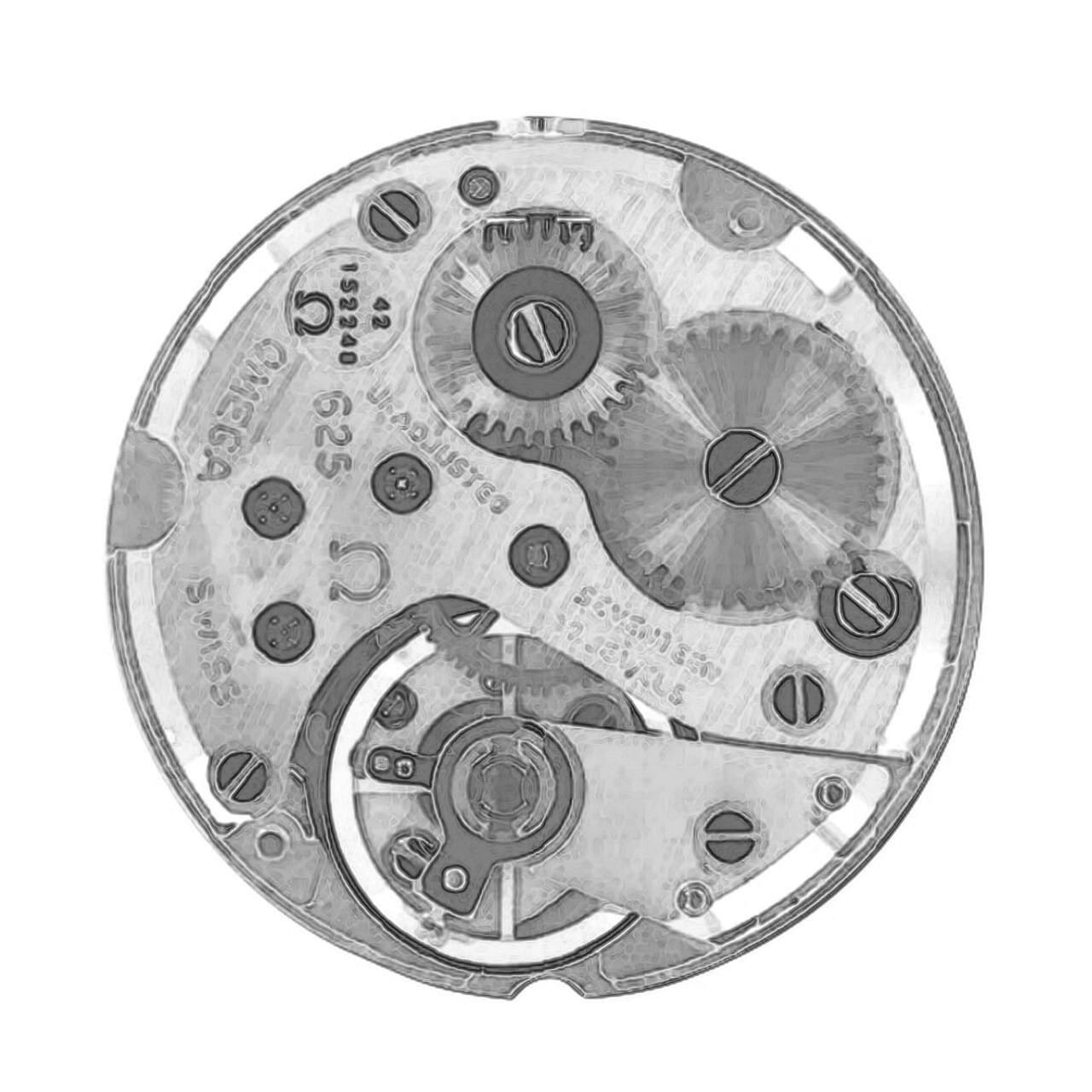
The Omega 625 represents a significant technical upgrade within Omega’s small dress watch movement family, replacing the earlier caliber 620 in 1973 with increased frequency and improved manufacturing precision. While the 620 operated at 19,800 vph, Omega pushed the 625 to 21,600 vph, delivering better accuracy and isochronism in a movement that retained the same compact 17.5mm footprint. This frequency increase marked a clear statement of intent: Omega was modernizing production methods while maintaining the traditional virtues of thin, elegant manual-wind calibers designed for dress watches.
The caliber 625 powered a diverse range of Omega DeVille and Geneve models throughout the 1970s, appearing in cases ranging from diminutive 19.5mm ladies’ watches to 37mm men’s dress pieces. Despite its modest specifications, the movement developed a reputation among watchmakers for robust construction, serviceability, and consistent timekeeping. The single bridge design covering both barrel and wheel train simplified assembly while maintaining adequate support for the gear train, a practical solution that reduced manufacturing costs without sacrificing reliability.
Production volume for the caliber 625 is not manufacturer-confirmed, but serial number analysis and case reference cross-checks suggest Omega produced several hundred thousand units during the seven-year production run from 1973 to 1979. Serial numbers in the 37,000,000 to 41,000,000 range correspond to this period, indicating steady production across the decade. The caliber qualifies as common within vintage Omega collecting circles. Examples surface regularly at auction and through dealers, typically in DeVille or Geneve cases. Condition varies widely: many show signs of previous service with replaced parts, while others retain original components in excellent condition. Scarcity increases significantly for examples in solid gold cases with original bracelets, and dramatically so for the rare elaborated variants discussed below.
Collector interest in the caliber 625 remains moderate and stable. The movement lacks the cachet of Omega’s high-beat chronometer calibers or the cultural weight of the Speedmaster’s Lemania-based movements, positioning it firmly in the entry-level vintage Omega category. Market prices for watches housing the 625 range from $300 to $2,500, with most transactions falling between $400 and $800. Gold-cased examples command premiums, but demand remains strongest for stainless steel or gold-plated pieces in clean, original condition. The movement’s serviceability and parts availability work in its favor: collectors appreciate that the 625 can be maintained affordably, unlike rarer calibers where parts scarcity drives service costs into four figures. Demand has held steady over the past decade, neither rising sharply nor declining, making 625-powered watches predictable acquisitions rather than speculative investments.
Historical Context, Provenance, and Manufacturing Details
Omega introduced the caliber 625 in 1973 as a direct replacement for the caliber 620, explicitly stating in period technical documentation that parts between the two movements are not interchangeable despite sharing identical exterior dimensions. The development represented what Omega described as “modernisation of production methods,” leveraging improved machining stability to manufacture components previously impossible to realize with older equipment. The frequency increase from 19,800 vph to 21,600 vph required re-engineering the escapement geometry and recalculating gear ratios, while the adoption of glued hairspring stud attachment replaced traditional pinning methods to improve adjustment quality.
The caliber 625 succeeded the 620, which itself descended from earlier small-caliber manual-wind movements in Omega’s 7.75-ligne family. While the 620 served adequately through the late 1960s and early 1970s, Omega recognized that competitors were pushing frequency standards higher across the industry. The 625’s 21,600 vph positioned it competitively against ETA and other ebauche suppliers who had standardized on this beat rate. The movement’s replacement came gradually rather than abruptly: production of both 620 and 625 overlapped briefly in 1973 before the 620 was fully discontinued. The 625 itself was eventually superseded by quartz movements in the early 1980s as the quartz crisis forced Omega to rationalize its mechanical movement catalog.
The caliber 625 is an in-house Omega manufacture movement, produced at Omega’s facilities in Switzerland. Unlike many competitors who relied on ébauche suppliers such as ETA, Peseux, or AS, Omega maintained vertical integration for most of its movement production during this period, including small-caliber dress movements. Some sources incorrectly cite Peseux origins for the 625, likely confusing it with other Omega calibers that did utilize Peseux ébauches. The 625 architecture, parts specifications, and finishing style align with Omega’s proprietary design language of the early 1970s rather than generic ébauche patterns.
Manufacturing remained centered in Switzerland throughout the caliber’s production run, with no evidence of facility changes or outsourcing during the 1973-1979 period. Quality control maintained typical Omega standards for non-chronometer grade movements: adequate finishing with functional perlage, signed bridges, and rhodium plating on plates and bridges. The movement lacks the lavish hand finishing of Omega’s chronometer-grade calibers but exceeds generic ébauche finishing standards.
In horological context, the caliber 625 represents a competent but unremarkable entry in the dress watch movement category. It arrived during a transitional period when mechanical watchmaking faced existential pressure from quartz technology. The movement delivered reliable service and adequate accuracy but offered no groundbreaking technical innovations. It functioned as a workhorse caliber: dependable, serviceable, and affordable to produce. This practical role explains both its longevity in the Omega catalog and its lack of collector mystique today.
Construction and Architecture
Plate and Bridge Layout: The caliber 625 employs a single large bridge that covers both the barrel and the wheel train, a simplified construction that reduces component count while maintaining adequate support. This three-quarter plate configuration positions the center of gravity of the wheels lower than traditional separate-bridge designs, allowing pinions to self-center perpendicular to the plate during bridge installation. The main plate and bridge are constructed from brass with rhodium plating, providing corrosion resistance and an attractive appearance. The overall architectural philosophy prioritizes manufacturing efficiency and serviceability over elaborate finishing or complex bridge arrangements. Two screws secure the main bridge to the plate.
Balance Wheel: The 625 utilizes a Glucydur balance wheel, a copper-beryllium alloy known for its temperature stability and corrosion resistance. The balance features screw adjustment with regulation screws positioned around its perimeter, allowing watchmakers to adjust rate through screw repositioning if necessary, though standard regulation occurs via the index regulator. The balance wheel measures approximately 8-9mm in diameter, appropriate for the movement’s compact dimensions. Material selection follows Omega’s standard practice for non-chronometer movements of this era, balancing cost with performance requirements.
Balance Spring (Hairspring): The movement employs a flat Nivarox hairspring with a glued stud attachment, a modern method Omega highlighted in its technical documentation as superior to traditional pinning. According to Omega’s 1973 technical guide, pinned hairsprings suffer deformation at the attachment point where the spring must conform to the hole’s curvature, compromising the blade’s physical properties. The gluing process fixes the hairspring without mechanical stress, maintaining the spring’s natural position and improving both flatness and centering without correction. This represents a measurable quality improvement over earlier attachment methods. The hairspring length and characteristics conform to the 21,600 vph frequency requirement.
Escapement Type: The caliber 625 uses a Swiss lever escapement, the industry-standard design offering optimal balance between efficiency, reliability, and manufacturing cost. The escapement features jeweled pallet stones and an impulse jewel in the balance roller. The lift angle specification of 52 degrees sits within normal parameters for movements of this era and frequency. Escapement jewels are press-fitted rather than mounted in gold chatons, consistent with Omega’s approach to non-chronometer movements where cost containment took priority over maximum elaboration.
Shock Protection System: The movement incorporates Incabloc shock protection on the balance pivots, protecting the delicate balance staff from damage during impacts. The system uses both upper and lower Incabloc jewel settings on the balance assembly, with the upper Incabloc setting located under the balance cock. Watchmakers note that the upper and lower Incabloc components differ in size on the 625, requiring careful attention during service to avoid part mix-ups. The Incabloc system represents industry-standard shock protection for this period, proven through decades of use across countless movements.
Regulator Type: The 625 employs a traditional index regulator system with an improved fixing principle designed to resist accidental displacement during shocks. Omega’s technical documentation emphasizes that the regulator assembly increases contact surfaces and produces both lateral and vertical grip through increased friction, considerably reducing displacement risks compared to earlier designs. The regulator features a small adjustment screw for fine rate regulation, though adjustment precision remains limited compared to swan-neck micrometric regulators found on higher-grade movements. The system allows watchmakers to adjust rate by moving the index pins closer to or farther from the balance wheel pivot, effectively lengthening or shortening the active length of the hairspring.
Mainspring Material and Type: The movement uses a modern alloy mainspring with dimensions of 1.05 x 0.09 x 220 x 6.5mm (height x thickness x length x barrel diameter), part number 1208. This represents a white alloy mainspring rather than traditional blued steel, offering improved power delivery characteristics and reduced setting over time. The mainspring attaches via a fixed bridle to the barrel wall rather than a slipping bridle, standard practice for manually-wound movements where controlled torque delivery matters less than in automatic calibers. Mainsprings for the 625 remain readily available from parts suppliers, with both genuine Omega and compatible aftermarket options accessible.
Gear Train Details: The four-wheel gear train consists of the barrel wheel, center wheel with cannon pinion (part 1200), third wheel (part 1240), fourth wheel (part 1243), and escape wheel (part 1305). The center wheel drives indirectly through an intermediate wheel arrangement common to small-caliber movements. The seconds hand drive position remains absent in the base 625 caliber, as this version displays only hours and minutes through central hands. Specific gear ratios are not published in available documentation, but the train must deliver the 21,600 vph frequency to the escapement while providing the stated 41-hour power reserve. Parts suppliers stock most wheel train components as genuine Omega replacements, though the center wheel with integrated cannon pinion can prove scarce.
Finishing Quality and Techniques: The caliber 625 receives functional finishing appropriate to its mid-tier positioning. Plates and bridges show rhodium plating providing a bright, silvery appearance. Perlage (circular graining) appears on visible plate surfaces, executed by machine to adequate standards without the precision depth and spacing consistency seen on chronometer-grade movements. Bridges display some beveling and polishing on edges, though anglage (anglage) remains limited. Screw heads show bluing and slots are cut cleanly. The balance cock features Omega’s signature logo engraving. Overall finishing prioritizes reliability and serviceability over aesthetic elaboration. No Côtes de Genève striping appears on this movement, as that decoration remained reserved for Omega’s higher-grade calibers. Finishing remained consistent throughout the production run, with no evidence of quality degradation or enhancement during the 1973-1979 period.
Cross-Reference Data
Alternative Caliber Names and Elaborated Versions
The caliber 635 represents the most common variant, adding a sweep second hand while maintaining the same 21,600 vph frequency and core architecture. The rare 626 and 627 variants command significant premiums when encountered, though documentation on these special editions remains limited.
Compatible Case References by Brand
Reference numbers beginning with “511” typically indicate ladies’ models with non-water-resistant cases and gold-plated or solid gold construction. The “111” prefix designates men’s or unisex sizing, generally 30-37mm case dimensions. Many DeVille and Geneve models using the 625 featured integrated mesh bracelets, particularly in ladies’ sizes. Case materials ranged from stainless steel to gold-plated brass to solid 9ct, 14ct, and 18ct gold.
Dial Compatibility Note: The caliber 625 accommodates multiple dial configurations through a height-indicating system on the hour wheel. Omega machined circular grooves on the top of the hour wheel, with the groove count designating the respective hand-fitting height (H0, H1, H2). This allows watchmakers to match hands to dial thickness variations without modifying the movement. Dial feet insert into plastic holders driven onto the feet, creating a grip when inserted into plate holes. Date functionality does not appear on the base 625, eliminating date window positioning concerns. Restorers should note that many 625-powered watches have suffered non-original dial replacements over the decades, as the movement’s prevalence and generic mounting system facilitated swaps.
Crown and Stem Specifications: The caliber 625 uses a stem with 0.90mm thread diameter and 1.2mm stem height. The crown typically measures TAP 10 threading, though specific crown specifications vary by case manufacturer. The setting mechanism employs a yoke-type clutch system operated by the setting lever. Replacement stems are available as part number 1106 (standard) and 1125 (long version for specific case configurations). Generic stems matching these specifications may be substituted if necessary, though original Omega parts ensure proper fitment and function.
Identification Marks
Caliber Number Location: The caliber number “625” is engraved on the main plate, typically visible near the balance cock or adjacent to the barrel bridge. On most examples, the number appears clearly stamped in a consistent font and size characteristic of Omega’s 1970s manufacturing standards. The number should appear crisp and deeply engraved, not superficially scratched or stamped with irregular depth.
Logo and Brand Marks: Authentic caliber 625 movements bear the Omega logo engraved on the balance cock, typically centered or positioned prominently. The main plate should be signed “OMEGA” and “SWISS” in period-correct engraving style. The characteristic Omega symbol should appear as a raised or applied mark, not painted. The bridge may also carry Omega branding depending on production batch. Quality control stamps or inspector marks may appear but are not universal across all production.
Date Codes: The caliber 625 does not employ a separate date code system beyond the watch’s serial number, which was engraved on the case rather than the movement during this era. Serial numbers in the 37,000,000 to 41,000,000 range correspond to production between 1973 and 1979. Omega serial numbers provide approximate dating but cannot pinpoint exact production dates due to batch variations and non-sequential assignment across different product lines.
Finishing Marks: Expect to see functional perlage on the main plate, visible through the movement back. The perlage pattern should appear consistent in depth and spacing, though precision will not match chronometer-grade movements. Bridges should show rhodium plating with a bright, silvery finish free from significant discoloration unless the movement has been improperly serviced or exposed to moisture. Screw heads should display bluing, though this may fade with age or disappear entirely on heavily serviced examples.
Jewel Markings: The 17 jewels are press-fitted rather than mounted in gold chatons. Jewel settings should appear uniform without visible cracks, chips, or replacement stones of inconsistent color or style. The movement does not carry jewel count engravings prominently displayed, though “17 JEWELS” may appear on some dials. Incabloc shock protection jewels should show the characteristic Incabloc spring arrangement, and both upper and lower settings should be present on the balance assembly.
Adjustment Markings: The caliber 625 was not produced in chronometer grade and therefore lacks chronometer adjustment markings. No timing certificates or adjustment position engravings should appear on authentic examples. If a movement bears markings suggesting chronometer certification or multi-position adjustment, this indicates either misrepresentation or a different caliber entirely.
Correct Serial Number Formats and Locations: Serial numbers for Omega watches of this era appear on the case, not the movement. Vintage 625-powered watches typically have serial numbers engraved on the inside of the snap-back case back. The serial number format consists of an eight-digit number (e.g., 37335206, 39612821, 41970286) corresponding to production dates through Omega’s serial number database. Serial numbers should appear deeply engraved with consistent depth and character spacing. Shallow, irregular, or hand-scratched serial numbers raise immediate authenticity concerns.
Expected Engravings and Stampings: The movement should be engraved with “OMEGA,” “SWISS,” “625,” and “17 JEWELS” at minimum. The balance cock carries the Omega logo. No additional elaborate engravings or decorative elements appear on standard production examples. The movement bridge should be secured with two screws, and all visible screw heads should show uniform finishing. Any engravings or stampings that appear inconsistent with period manufacturing standards, such as laser engraving (not available in the 1970s) or modern font styles, indicate either later service modifications or counterfeit components.
Font and Marking Style by Production Era: Throughout the 1973-1979 production run, Omega maintained consistent engraving styles using period-typical serif fonts for text and the traditional Omega logo design. The logo should match the style used across Omega’s product line during the 1970s, with the characteristic “Ω” symbol proportioned correctly. Any deviation from this house style suggests non-original parts or counterfeit movements. Changes in branding or logo design did not occur within the 625’s production window, simplifying authentication compared to longer-running calibers that spanned multiple corporate identity changes.
Part Information

Core Component Part Numbers
Sourcing Notes: The caliber 625 enjoys reasonable parts availability despite being out of production for over four decades. Mainsprings remain widely available from multiple suppliers in both genuine Omega and compatible aftermarket versions. Balance complete assemblies (part 1327) can be sourced from parts dealers specializing in vintage Omega, though prices have increased as NOS (new old stock) supplies diminish. The pallet fork (part 1316) remains available through specialist suppliers but commands premium pricing.
Common Failure Points: Watchmakers report that the mainspring, balance staff, and pallet fork represent the most frequently replaced components during service. The mainspring, being a consumable part subject to metal fatigue, requires replacement every 10-15 years under normal service intervals. Balance staffs can break from impacts despite Incabloc protection, particularly on watches subjected to rough handling. The setting lever spring (part number not widely documented) has earned notoriety for detaching or pinging away during movement disassembly, and replacement examples can prove difficult to source. The click spring occasionally requires replacement due to fatigue or deformation.
Acceptable Generic Replacements: Mainsprings represent the most commonly substituted component, with generic Swiss-made mainsprings of matching dimensions (1.05 x 0.09 x 220 x 6.5mm) providing acceptable performance if genuine Omega parts cannot be sourced. Incabloc jewels and springs can be replaced with generic Incabloc components of matching size, as the shock protection system uses industry-standard dimensions. Crown and stem specifications match generic sizing, allowing watchmakers to substitute compatible components when original Omega parts are unavailable or cost-prohibitive. Balance complete assemblies, escape wheels, and pallet forks should preferably use genuine Omega parts to maintain correct escapement geometry and timing, though skilled watchmakers may substitute components from compatible movements when absolutely necessary.

Performance Data
Manufacturer Specifications: Omega specified the caliber 625 for an accuracy of +/-12 to +/-15 seconds per day when new, typical for non-chronometer grade mechanical movements of the 1970s. The movement was not adjusted to multiple positions during manufacturing, unlike chronometer-grade calibers that underwent extensive testing and adjustment. Temperature compensation was not specified, and the simple balance wheel and flat hairspring configuration lacks the sophisticated compensation mechanisms found in higher-grade movements. Isochronism characteristics were not published in available technical documentation, though the modern alloy mainspring and increased 21,600 vph frequency would have improved amplitude maintenance compared to the predecessor caliber 620.
Observed Performance (Field Data): Well-maintained caliber 625 movements typically achieve accuracy between +/-5 to +/-10 seconds per day in daily wear, with exceptional examples running within +/-3 seconds per day. Freshly serviced movements often demonstrate surprisingly good performance, with watchmakers reporting amplitude readings of 270-307 degrees at full wind and beat errors below 1.0ms. These figures exceed expectations for movements of this grade and era, suggesting that competent servicing can extract excellent performance from the caliber despite its modest specifications.
Common performance issues stem from aging lubricants, worn pivots, and mainspring fatigue rather than fundamental design flaws. Movements deprived of service for decades typically arrive in workshops running slow or not at all, with dried lubricants causing excessive friction throughout the gear train. Amplitude typically drops to 180-220 degrees on neglected movements, with rate errors expanding to +/-30 seconds per day or worse.
Expected amplitude when fully wound should reach 270-300 degrees on a properly serviced movement, measured on a timegrapher in the dial-up position. As power reserve depletes, amplitude gradually decreases, typically dropping to 240-260 degrees after 24 hours and declining further as the mainspring approaches exhaustion. Movements showing amplitude below 220 degrees at full wind indicate service needs, whether from contaminated lubricants, worn pivots, or balance spring issues.
Performance degradation with age follows predictable patterns. Mainsprings lose elasticity over 10-15 years, reducing power delivery and amplitude even when lubricants remain functional. Balance pivots wear where they contact jewel holes, increasing friction and reducing amplitude. Pallet stones can wear or lose lubrication, causing inconsistent escapement action and timing variation between positions. The Incabloc spring may weaken with repeated compressions, reducing shock protection effectiveness. Most performance issues prove correctable through proper service, making the caliber 625’s maintenance requirements manageable for competent watchmakers.
Position variation between dial-up, dial-down, and crown positions can reach 10-20 seconds per day on non-adjusted movements, normal for calibers not regulated in multiple positions during manufacture. Collectors should expect positional variation and judge overall performance on average rate across positions rather than any single position measurement. Movements running consistently within +/-10 seconds per day average rate perform well for their grade, regardless of positional spread.