

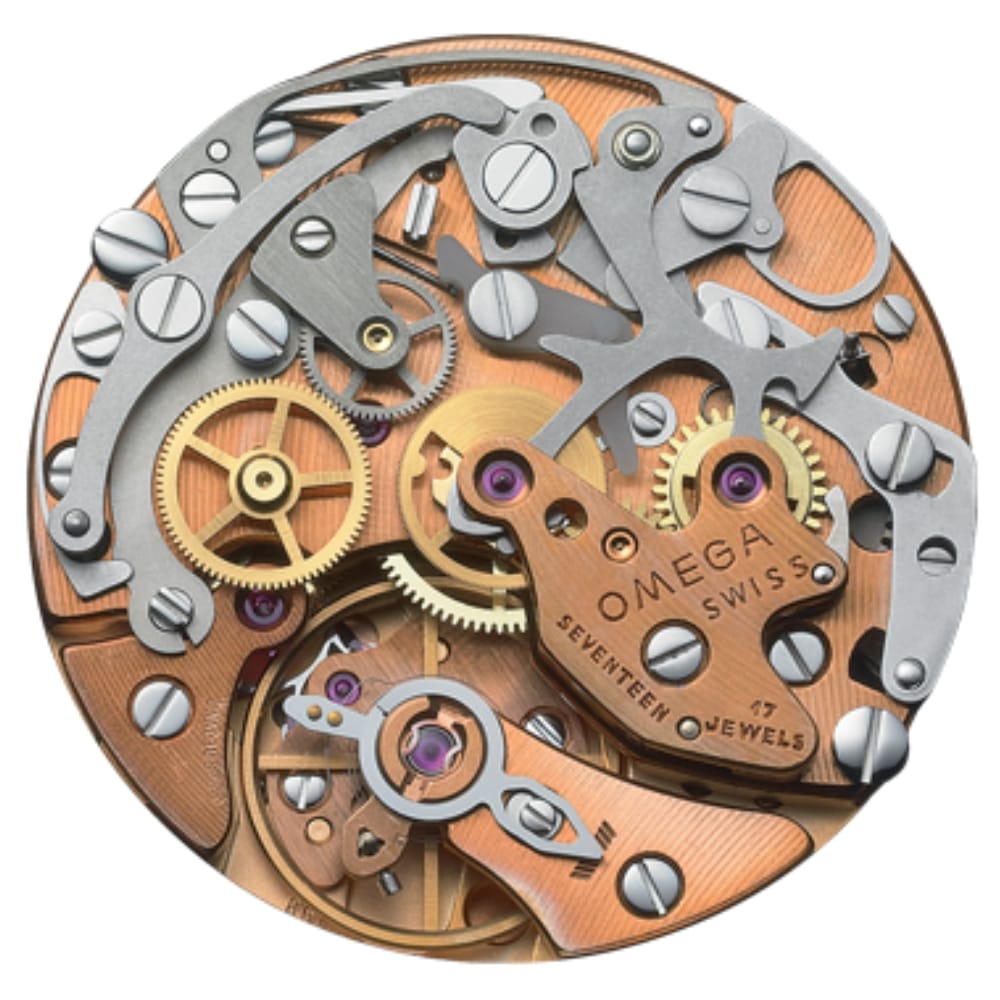
The Omega 861 powered the Speedmaster that logged more time in space than any other mechanical movement in history. While the column-wheel caliber 321 went to the moon first, the 861 became the workhorse that followed astronauts on every Apollo mission after 1969, through Skylab, the Apollo-Soyuz Test Project, and into the Space Shuttle era. NASA re-certified the 861 for EVA use in 1972 and again in 1978, cementing its status as the most flight-tested chronograph movement ever built.
The 861 represents a deliberate simplification of Omega’s legendary 321. Based on the Lemania 1873 ebauche, the caliber swapped the 321’s elegant but labor-intensive column wheel for a robust cam-and-shuttle chronograph actuation system. The frequency increased from 18,000 to 21,600 vph, the Breguet overcoil gave way to a flat hairspring, and the adjustable-mass balance became a smooth-rimmed design with micrometer regulation. These changes cut production costs substantially while maintaining reliability. Omega designed the 861 to be field-serviceable, with interchangeable parts and fewer adjustments required during assembly.
Production volume estimates remain elusive because Omega never published official figures and the 861 shared serial number ranges with other contemporary calibers. Based on Speedmaster serial progressions from approximately 28,000,000 in 1968 to 48,000,000 by 1996, and accounting for gaps in production and parallel references, conservative estimates suggest between 300,000 and 500,000 caliber 861 movements entered circulation across all references during the 28-year production run. This figure includes Speedmaster Professional models, Mark II variants, Flightmaster derivatives (calibers 910 and 911), and a small number of rebranded movements supplied to other manufacturers. The caliber 861 qualifies as common in collector terms, particularly in Speedmaster 145.022 references from the 1970s and early 1980s. Scarcity increases for transitional 145.022-68 and 145.022-69 models bridging the 321-to-861 changeover, and for gold Flightmaster references limited to 200 pieces or fewer.
Collector demand for 861-powered Speedmasters has strengthened considerably since 2020, driven by the discontinuation of the caliber 1861 and introduction of the co-axial 3861. Buyers recognize the 861 as the last unrhodiumed version of the Lemania-based Speedmaster movement, distinguished by its copper-plated bridges and plates. Specific variants command premiums: transitional pre-moon references with applied metal logos and step dials, Mark II Racing Dial models, and any 861 retaining the early metal chronograph brake rather than the later Delrin plastic component. Prices for serviced 145.022 examples have climbed from $2,500-3,500 in 2018 to $4,000-6,000 in 2025, with exceptional examples exceeding $8,000.
Historical Context, Provenance, and Manufacturing Details
Omega introduced the caliber 861 in late 1968 to address production bottlenecks and cost pressures associated with the hand-finished caliber 321. The 321’s column wheel required extensive hand-fitting to eliminate burrs on the wheel’s sharp teeth, and the entire chronograph mechanism demanded skilled assembly with multiple adjustments. By 1968, Speedmaster demand had outstripped Omega’s capacity to produce 321 movements economically. The solution was to refine the Lemania 1873 ebauche into a caliber optimized for volume production without sacrificing the essential performance characteristics that had earned NASA certification.
The 861 directly replaced the caliber 321 in Speedmaster production. The last 321-equipped Speedmaster Professional reference 145.012 carried serial numbers through approximately 27,719,000 in 1968. The first 861-equipped reference 145.022 appeared with serial numbers starting around 28,420,000 in late 1968, creating a brief overlap period where both calibers coexisted. Transitional 145.022-68 and 145.022-69 models retained design elements from the 321 era, including applied metal Omega logos, step dials, and pre-moon seahorse casebacks, making them highly sought by collectors. The 861 remained in production until 1996, when Omega introduced the caliber 1861 with rhodium-plated components and an 18th jewel.
The caliber 861 is fundamentally a Lemania 1873 ebauche finished and decorated to Omega specifications. Lemania, a movement manufacturer based in L’Orient, Switzerland, designed the 1873 as part of a 12-ligne chronograph family running at 21,600 vph and lacking modern features like hacking seconds. Lemania had entered a joint venture called SSIH (Société Suisse pour l’Industrie Horlogére) with Omega and Tissot in 1932, and became the primary supplier of chronograph movements to both brands. The relationship allowed Omega to specify finishing levels, part materials, and component modifications while Lemania handled base movement production. Omega applied its own caliber designation (861) and added specific components like the friction spring for the chronograph runner and unique regulator designs.
Production occurred at Lemania facilities in L’Orient, with final assembly, regulation, and casing performed at Omega workshops in Bienne, Switzerland. Unlike the caliber 321, which saw variations in finish quality between production batches, the 861 maintained consistent specifications throughout its run. Early examples from 1968-1975 featured metal chronograph brakes and copper-plated bridges. Around serial number 32,800,000 (approximately 1970-1971), Omega transitioned to a Delrin plastic brake for improved longevity and reduced wear on the fine teeth of the chronograph runner. Movement finishing remained utilitarian: perlage on the main plate, circular graining on bridges, and basic beveling on component edges. Display caseback models received the caliber 863 or later 1863 designation, which retained the metal brake and featured upgraded finishing with Côtes de Genève striping.
The 861 bridged an important era in horological history. It arrived as mechanical watchmaking faced existential threats from quartz technology, yet it proved robust enough to remain NASA-certified through the quartz crisis and beyond. Omega never intended the 861 to compete aesthetically with the 321; the goal was reliability, serviceability, and cost-effective production. In that mission, it succeeded spectacularly.
Construction and Architecture
Plate and Bridge Layout: The 861 employs a three-quarter plate architecture with separate bridges for the barrel and wheel train, chronograph mechanism, and balance assembly. The main plate and bridges are constructed from brass with copper plating (early production) or no plating (later production), distinguishing the 861 from the rhodium-plated 1861 introduced in 1996. Five screws secure the barrel and wheel train bridge, three screws fix the chronograph bridge, and two screws hold the balance bridge. The architecture prioritizes accessibility for service: removing the balance bridge exposes the escapement, and removing the chronograph bridge provides access to the chronograph runner, minute recorder, and intermediate wheels without disturbing the gear train.

Balance Wheel: The 861 uses a smooth-rimmed glucydur balance wheel with a diameter of approximately 10.5mm. Unlike the 321’s adjustable-mass balance with timing screws, the 861 balance has no provision for fine adjustment via screws. All rate adjustments occur via the regulator index. The balance pivots run in Incabloc shock settings on both the upper and lower jewels. The balance rotates at 21,600 vph (3 Hz), completing 6 beats per second. This higher frequency compared to the 321’s 18,000 vph improves timekeeping stability and positional accuracy.
Balance Spring (Hairspring): The 861 employs a flat Nivarox balance spring without a Breguet overcoil. The flat configuration simplifies production and assembly compared to the hand-formed overcoils required for the 321. The hairspring attaches to the balance via a traditional stud, and the outer terminal curve passes between two regulator pins extending downward from the regulator assembly. Proper centering of the hairspring between these pins is critical: if the spring leans against either pin in certain positions, the watch will gain time. The flat spring breathes concentrically during oscillation, and watchmakers can adjust isochronism by manipulating the inner and outer curves.
Escapement Type: The movement uses a Swiss lever escapement with a 15-tooth escape wheel. The pallet fork features two ruby pallet stones that alternately lock and release the escape wheel teeth, transmitting impulses to the balance. The escape wheel pivots run in jeweled bearings on both upper and lower pivots. Pallet staff pivots are not oiled per Omega specifications. The lift angle measures 50 degrees, requiring watchmakers to set timing machines to this value when measuring rate and amplitude.
Shock Protection System: The 861 uses Incabloc shock absorbers on the balance jewels (upper and lower). Earlier caliber 321 movements used KIF shock systems, but Omega transitioned to Incabloc for the 861. The Incabloc settings consist of a spring-loaded cap jewel that can deflect and absorb impact energy when the watch experiences shock. Omega specifications call for oiling both the upper and lower balance pivots and cap jewels with Omega oil 1.02.
Regulator Type: The 861 employs an index regulator with micrometer screw adjustment. The regulator consists of a regulator cock with two pins extending downward. The hairspring passes between these pins, and the position of the pins determines the effective length of the hairspring. An eccentric screw allows fine adjustment: turning the screw moves the regulator assembly, which changes the effective length of the hairspring. Moving the pins closer together lengthens the active hairspring and slows the watch; moving them apart shortens the spring and speeds the watch. The system is extremely sensitive: a fractional turn can shift the rate by 10-15 seconds per day.
Mainspring Material and Type: The 861 uses a Nivaflex alloy mainspring with dimensions of 1.30mm height, 0.115mm thickness, 420mm length, and 10.5mm inner diameter (also referenced as RM1S13115 or GR3280). The mainspring fits inside a barrel that rotates on the barrel arbor, with the inner end of the spring hooked to the arbor and the outer end attached to the barrel wall via a slipping bridle. The bridle allows the spring to slip when fully wound, preventing overwinding damage. Omega specifies greasing the barrel arbor pivots with grease 2.01 and the mainspring contact surfaces with grease 2.03.
Gear Train Details: The gear train consists of the barrel, center wheel, third wheel, fourth wheel, and escape wheel. All wheels except the barrel run on jeweled bearings. The center wheel drives the cannon pinion via friction, allowing independent adjustment of the hands. The fourth wheel drives the escape wheel and carries the seconds hand on watches with center seconds (though the 861 places the running seconds on a subdial at 9:00). The chronograph driving wheel (part 1710) presses onto the fourth wheel arbor and drives the chronograph runner via the coupling clutch when the chronograph is engaged. Two eccentrics control gear mesh depth: eccentric 1701 adjusts the penetration between the coupling wheel and chronograph runner, while eccentric 1702 adjusts penetration between the coupling wheel and driving wheel.
Finishing Quality and Techniques: The caliber 861 receives basic industrial-grade finishing appropriate for a tool watch movement. The main plate features circular perlage (circular grain pattern) applied by automated machines. Bridges receive circular graining with varying textures depending on the surface. Component edges show minimal beveling or anglage, with most edges simply deburred rather than hand-polished. Screw heads have simple slots rather than the polished beveled slots found on higher-grade movements. The copper plating (or lack of plating) on plates and bridges serves functional rather than decorative purposes. No Côtes de Genève striping appears on standard 861 movements; this decoration was reserved for display-caseback calibers 863 and 1863. Omega produced no chronometer-certified or observatory-adjusted versions of the caliber 861. All 861 movements fall into a single finishing grade: functional, robust, and serviceable, with no provision for multi-position adjustment or superior decoration.
Cross-Reference Data
Alternative Caliber Names (Rebranded Versions)
Base Caliber vs. Elaborated Versions
Compatible Case References by Brand
Other Brands Using Lemania 1873
Dial Compatibility Note
The caliber 861 uses a dial with feet positioned at approximately 2:00 and 8:00. No date window exists on the standard 861 (date functionality requires caliber 930). Dial height must accommodate the chronograph mechanism below, with subdials at 3:00 (30-minute counter), 6:00 (12-hour counter), and 9:00 (small seconds). Aftermarket dials often fail to match the original foot positions or have incorrect subdial spacing, causing installation problems. Collectors should verify dial authenticity by checking for correct font style, logo placement (applied metal on transitional models, printed on later production), and lume plots that match the period of production.
Crown and Stem Specifications
Identification Marks
Caliber Number Location: The caliber number “861” is engraved on the chronograph bridge, visible when the movement is removed from the case. On some examples, the designation may also appear on the main plate near the balance cock. The engraving depth should be crisp and clean, not superficial or poorly formed.
Logo and Brand Marks: Authentic 861 movements are signed “OMEGA WATCH CO.” on the main plate along with “SEVENTEEN 17 JEWELS” (or “EIGHTEEN 18 JEWELS” for post-1993 examples). The Omega logo may appear on the rotor or main plate depending on the variant. Display caseback calibers (863) show upgraded finishing and may have additional quality markings. Early 861 movements from 1968-1970 sometimes retain design elements from the caliber 321 era, including specific bridge shapes and screw styles.
Date Codes: Omega did not use date codes on the caliber 861. Dating relies on serial number ranges cross-referenced with production records.
Finishing Marks: Expect circular perlage on the main plate visible through the cutouts in the bridges. Bridges should show circular graining patterns, with the texture varying by surface area. Copper-colored plating or unplated brass indicates an authentic 861; rhodium plating indicates a later 1861. No Côtes de Genève striping should appear on standard 861 movements; this decoration is exclusive to calibers 863 and 1863.
Jewel Markings: Early 861 movements (pre-1993) have 17 jewels total. The 18th jewel, added in 1993, appears on the chronograph intermediate wheel where earlier versions used a metal bushing. Jewels are press-fit into the plates and bridges, not mounted in gold chatons. Incabloc shock settings on the balance use spring-loaded cap jewels visible on both the dial and movement sides.
Adjustment Markings: The caliber 861 was never produced in chronometer-certified or observatory-adjusted grades. No adjustment markings should appear on authentic 861 movements. Any examples marked “CHRONOMETER” or “ADJUSTED TO X POSITIONS” are either franken-watches or misidentified calibers.
Correct Serial Number Formats and Locations: Serial numbers appear on the movement itself, engraved on the main plate between the lower lugs when viewed from the movement side. Serial numbers are seven or eight digits, matching the following ranges:
- 1968: 28,420,XXX to 31,629,XXX
- 1969: 26,000,XXX to 27,719,XXX (transitional 145.022-69); 31,000,XXX to 32,857,XXX (standard production)
- 1970: 28,000,XXX to 30,000,XXX
- 1971: 30,000,XXX to 32,000,XXX
- 1976-1978/79: 37,870,XXX to 39,946,XXX
- 1996: 48,000,XXX range (final 861 production before transition to 1861)
Serial numbers should be cleanly engraved with consistent depth and character spacing. Note that Omega serial number ranges overlap between references and calibers, so serial number alone cannot definitively date a movement.
Expected Engravings and Stampings: All authentic 861 movements should display:
- “OMEGA WATCH CO.” on the main plate
- “SEVENTEEN 17 JEWELS” or “EIGHTEEN 18 JEWELS” (post-1993) on the main plate
- “861” on the chronograph bridge
- Serial number on the main plate between lower lugs
- “SWISS” or “SWISS MADE” on the main plate
Engravings should be sharp and precise, with consistent character height and spacing. Poorly formed or shallow engravings indicate refinished plates or counterfeit components.
Font and Marking Style by Production Era: Early 861 movements (1968-1970) may show font styles and engraving techniques carried over from caliber 321 production. The transition to updated fonts and marking equipment occurred gradually through the early 1970s. By 1975, standardized industrial engraving produced consistent character styles across all 861 production. Display caseback calibers (863/1863) may show refined engraving with slightly different character sizing to accommodate the visual presentation through the sapphire crystal.
Part Information

Critical Components Part Numbers
Sourcing Notes
Readily Available Parts:
- Mainsprings remain widely available from multiple suppliers including Omega, Cousins UK, and aftermarket manufacturers
- Balance cap jewels, escape wheels, pallet forks, and basic gear train components stock at major parts suppliers
- Crown wheels, ratchet wheels, clicks, and keyless works components available from Omega and third-party sources
- Screws, springs, and minor components generally available
Parts Requiring Caution:
- Balance complete assemblies are expensive (€400+) and availability can be limited. Watchmakers often attempt to salvage existing balances rather than replace
- Hairsprings must be fitted by experienced watchmakers; incorrect installation causes rate and positional errors
- Chronograph runner (part 1705) should never be disassembled; the friction spring support requires specialized knowledge to service correctly
- Barrel arbor hole wear in the main plate is a common failure requiring specialized bushing repair rather than simple part replacement
Generic Replacements:
- Mainsprings: Generic Nivaflex mainsprings of correct dimensions function identically to Omega-branded versions
- Basic jewels and cap jewels accept generic replacements from Incabloc and other manufacturers
- Some screws and springs can be replaced with generic equivalents if dimensions match precisely
Parts With Limited Availability:
- Original metal chronograph brakes (blocking lever 1726) for early 861 movements are increasingly scarce; Delrin replacements are standard
- Specific bridge screws with correct head styles and thread pitches can be difficult to source; mismatched screws damage threads
- Cases, crystals, and external components for Flightmaster references 145.013, 145.026, and 145.036 are rare
Service Recommendations:
- Full service including cleaning, lubrication, and adjustment should occur every 5-7 years
- Barrel arbor hole wear in the main plate should be inspected during every service; bushing repair by a competent watchmaker costs €100-200 and prevents catastrophic bearing failure
- Chronograph mechanism requires careful adjustment of eccentric screws 1701 and 1702 to ensure correct gear mesh depth; improper adjustment causes rapid wear
- Mainspring replacement is recommended at each service interval given the low cost and significant improvement in power reserve and amplitude
Performance Data
Manufacturer Specifications
Observed Performance (Field Data)
Typical Accuracy Range for Well-Maintained Examples:
Properly serviced caliber 861 movements typically achieve -1 to +8 seconds per day in normal wearing conditions. Exceptional examples can maintain 0 to +3 seconds per day, though this requires expert regulation and favorable wearing patterns. Watches gaining more than +12 seconds per day or losing more than -5 seconds per day benefit from regulation adjustment or require service. Accuracy degrades if the chronograph function remains engaged continuously; Omega recommends stopping the chronograph when not actively timing events to reduce wear on the chronograph mechanism.
Common Performance Issues and Causes:
- Slow running (-15 to -30 seconds per day): Typically indicates dirty movement, dried lubricants, or magnetization. Service resolves most cases. Hairspring touching regulator pins in certain positions can also cause erratic rate.
- Fast running (+15 to +30 seconds per day): Often caused by hairspring misalignment between regulator pins, allowing the spring to lean against a pin and effectively shorten. Magnetization can also cause fast running.
- Erratic rate varying by position: Indicates balance pivot wear, improper lubrication, or hairspring centering issues. Watchmakers should check balance endshake and sideplay.
- Low amplitude (<220 degrees after full wind): Suggests mainspring fatigue, excessive friction in the gear train, or dirty escapement. Mainspring replacement and complete service typically restore proper amplitude.
- Power reserve <45 hours: Indicates weak or broken mainspring, or excessive friction preventing full barrel rotation. Original Omega mainsprings should deliver 48+ hours of reserve.
Expected Amplitude Fully Wound vs. Power Reserve Depleted:
A properly serviced 861 should show 260-280 degrees amplitude in the dial-up position immediately after full winding. After 24 hours of running, amplitude should remain above 220 degrees in dial-up position and above 190 degrees in crown-down position. As the mainspring unwinds past 40 hours, amplitude drops more rapidly, falling to 150-170 degrees near the end of the power reserve. Watches failing to maintain 220+ degrees at 24 hours require service attention.
Performance Degradation with Age:
861 movements age gracefully when properly maintained. The primary failure mode is barrel arbor hole wear in the main plate, where the brass bushing supporting the arbor wears oval over time, creating excessive radial and axial play. This wear develops after 30-40 years of service and requires bushing replacement, a specialized repair costing €100-200. Hairspring set typically remains stable unless the movement has been dropped or experienced severe shock. Balance pivots can wear after extended service intervals, reducing amplitude and causing positional errors, though balance staff replacement is less common than in many other calibers. The Delrin chronograph brake introduced in the early 1970s has proven durable, with few reported failures in normal use. Collectors preferring the metal brake for originality or philosophical reasons can source replacement metal brakes from early 861 or 863 calibers.
Chronograph Function Performance:
The cam-operated chronograph mechanism in the 861 provides reliable start/stop/reset functionality with less refinement than column-wheel designs. Users may notice a slight “stutter” when starting the chronograph as the coupling clutch engages. The minute counter advances in instantaneous jumps every 60 seconds; on some examples, the minute hand begins moving 1-3 seconds before the center chronograph hand completes its 60-second sweep, which is considered normal for cam-operated mechanisms. The chronograph should return precisely to zero when the reset pusher is pressed; any deviation indicates worn parts or misadjustment requiring service.