

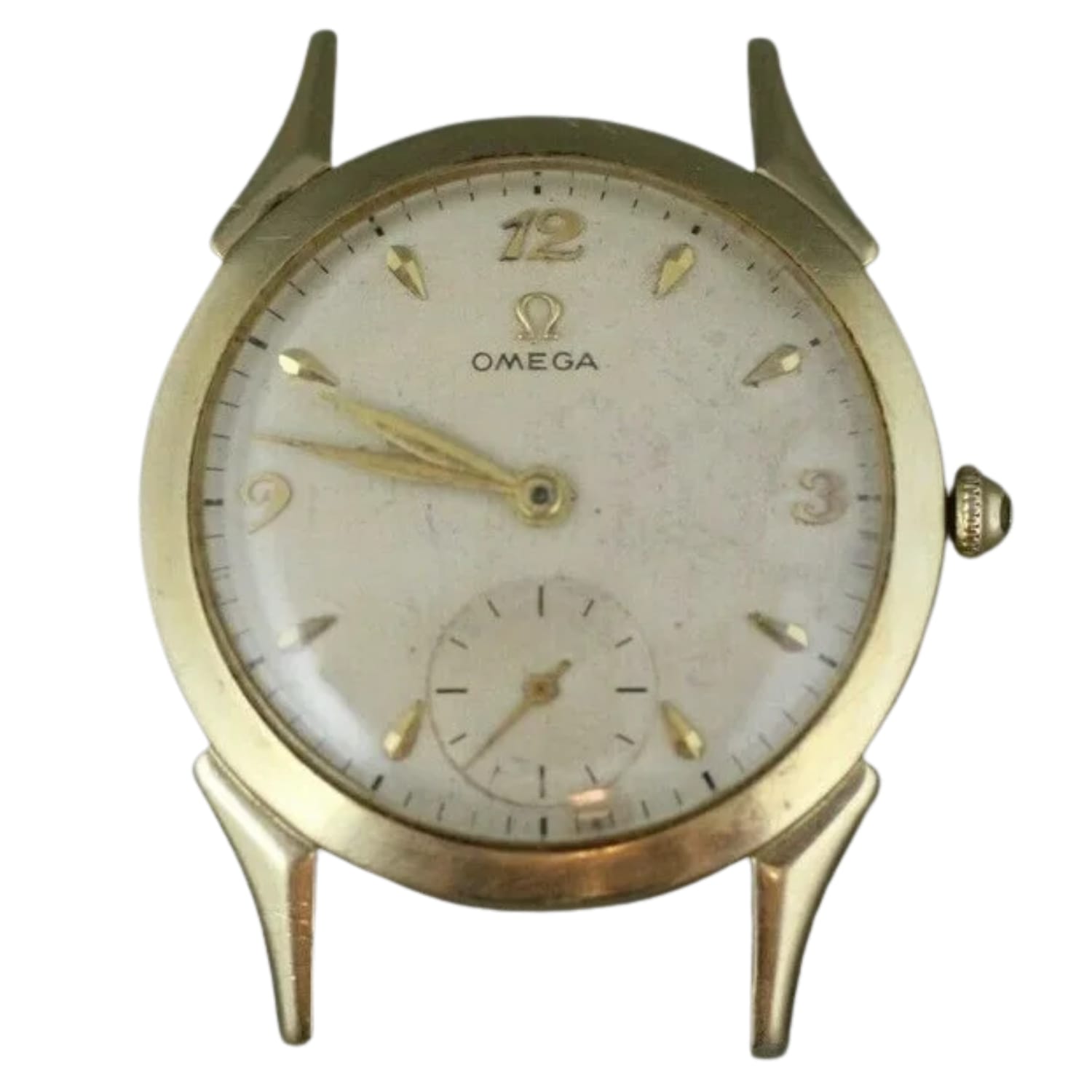
The Omega B-6237 represents a captivating chapter in mid-century American watch retail, embodying the sophisticated elegance that defined dress watches of the early 1950s. As part of Norman Morris’s exclusive U.S. market collection, this reference stands apart from international Omega catalogs with its distinctive design language: elongated, architecturally striking lugs that collectors now recognize as “dog leg” or “fancy” lugs, paired with the refined guilloché dial work that was a hallmark of premium dress watches during this era.
This reference exemplifies the unique partnership between Omega and Norman Morris, who served as the brand’s American distributor from the 1930s through 1980. Unlike standard international references, these U.S. market models featured case designs conceived and manufactured domestically, while housing Swiss-made Omega movements. The B-6237, dating primarily to 1950 based on movement serial numbers, captures a moment when American taste favored bold lug designs and intricate dial textures over the simpler aesthetics emerging in European markets.
For collectors, the B-6237 offers an entry point into vintage Omega at a more accessible price point than iconic sport models, while delivering exceptional craftsmanship and a fascinating provenance story. Its relative rarity, distinctive styling, and connection to the Norman Morris legacy make it a compelling addition to any vintage dress watch collection.

Omega 18K YG Oversize Fancy Lug Dress Model circa 1946
History & Production Period
The Omega B-6237 emerged during the early 1950s as part of the Norman Morris U.S. Collection, a distinctive series of watches created exclusively for the American market. Norman Morris, an Austrian-born entrepreneur who founded the Norman Morris Corporation in 1924, served as Omega’s official United States distributor from the 1930s until his retirement in 1980, when Omega purchased his company.
The genesis of these U.S.-specific models stemmed from American import tariff structures. High duties on complete Swiss watches incentivized a different approach: movements were imported separately and then cased domestically, allowing for more favorable tax treatment while creating opportunities for case designs tailored to American tastes. These watches typically featured 14-karat gold-filled cases (rather than the 9-karat or 18-karat gold common in European markets) and often carried 17-jewel movements instead of higher jewel-count versions, both strategies to navigate import duty thresholds.
Production of the B-6237 centered around 1950, as evidenced by movement serial numbers in the 12 million range corresponding to that year. The model appears in the 1955 Norman Morris catalog, confirming its continued availability into the mid-1950s. Like many Norman Morris references, the B-6237 was never listed in Omega’s standard vintage database, as these U.S. market pieces maintained separate documentation that was tragically lost when Omega acquired Norman Morris’s operations in the early 1980s.
The case model prefix “B” followed Norman Morris’s alphanumeric naming convention, where one or two letters preceded a four-digit number. This system differed entirely from Omega’s international reference structure, making these watches immediately identifiable to informed collectors. The specific number 6237 was also occasionally used as a case component reference (appearing in parts catalogs for crowns), though the full “B-6237” designation refers to the complete watch model.
During this period, Norman Morris offered multiple dial variations for most models, allowing buyers to select from different finishes and textures while maintaining the same case design. This approach to customization was common across the U.S. collection and contributes to the variety seen in surviving examples today.
Technical Specifications
The Omega B-6237 exemplifies the refined proportions of early 1950s dress watches, balancing presence on the wrist with the formal elegance expected of business attire during the era.
Case Dimensions:
- Case diameter: 33.3 mm (excluding crown)
- Lug-to-lug length: 44 mm
- Case thickness: 8.8 mm (including acrylic low-dome crystal)
- Lug width: 18 mm
Case Construction:
- Material: 14-karat gold-filled (14K GF)
- Construction: Three-piece case with removable bezel and snap-on caseback
- Crystal: Acrylic low-dome crystal (no tension ring required)
- Caseback: Snap-on design with no gasket
Water Resistance:
Not water-resistant. Like most dress watches of the period, the B-6237 features a simple snap-back case without sealing gaskets, making it unsuitable for moisture exposure beyond hand washing with care.
Crown:
Mushroom-type unsigned crown, which was period-correct for this reference. The crown’s distinctive shape aids in identification of original examples.
Weight & Wearability:
The elongated lugs create visual presence that makes the 33.3mm case wear larger than its nominal diameter suggests. The extended 44mm lug-to-lug measurement approaches the limits of comfortable wearability for those with wrist sizes below 6.5 inches, though the thin 8.8mm profile keeps it sleek under shirt cuffs.
1950s Vintage Omega Wrist Watch 18K Yellow Automatic Date Dial
Movements/Calibers
The Omega B-6237 houses the manually-wound Caliber 361, a robust and reliable movement that served as a workhorse for Omega’s dress watch line throughout the 1950s and early 1960s.
Omega Caliber 361 Specifications:
- Type: Manual wind
- Jewel count: 17 jewels
- Diameter: 28.0 mm (approximately 13 lignes)
- Height: 3.25 mm
- Frequency: 18,000 vibrations per hour (2.5 Hz)
- Power reserve: Approximately 40 hours
- Features: Sub-seconds display, Breguet hairspring
- Shock protection: Varies by production year; some examples feature Incabloc, others utilize standard jewel settings
Movement Context:
The Caliber 361 represents what collectors often describe as “the manual wind version of a bumper automatic,” sharing design DNA with Omega’s earlier automatic calibers but stripped to essentials for a thinner, more elegant profile. Its 17-jewel configuration was strategically chosen for the U.S. market to avoid higher import duties that applied to movements with 18 or more jewels.
Introduced around 1949-1950 and remaining in production through approximately 1965, the Caliber 361 powered numerous Norman Morris dress watch references beyond the B-6237. The movement features traditional manual winding architecture with a Breguet overcoil hairspring, contributing to reliable timekeeping performance.
Movement Identification & Markings:
Critical for authenticating Norman Morris/U.S. market Omega watches is the presence of the OXG import stamp on the movement’s balance bridge. This three-letter code was assigned to Norman Morris imports under the 1936 U.S.-Switzerland Trade Agreement, which required all imported watch movements to carry a distinguishing mark identifying their U.S. importer. The OXG marking was used from approximately 1937 through 1970, when such stamps were no longer required by U.S. customs.
Inside the caseback, collectors should find the case model stamped as “B6237” or “B-6237,” along with the gold content marking “14K GOLD FILLED” and sometimes a case serial number.
Servicing Considerations:
The Caliber 361 remains serviceable by competent watchmakers, with parts still available through specialty suppliers. The movement’s straightforward architecture and Omega’s excellent documentation make it less challenging to service than more complicated calibers. Expect service intervals of 4-5 years for watches in regular rotation.

Dial Variations
The Omega B-6237’s most distinctive feature is its dial, which typically showcases intricate guilloché decoration that elevates this reference above simpler dress watches of the period.
Primary Dial Style:
The most commonly observed and celebrated dial variant features guilloché (also spelled “brigué” in some period references) decoration. This engine-turned texture, created on a rose engine lathe, produces a mesmerizing pattern that catches light differently depending on viewing angle. The guilloché work on B-6237 examples typically presents as a radiating or concentric pattern emanating from the dial center, sometimes described as resembling a honeycomb or basketweave when viewed closely.
62 Years Old Vintage Omega Guilloche Dial / Ref. 14794 62 SC / Cal. 610 / Vintage 1963 Exclusive Vintage Swiss Watches
Dial Characteristics:
- Applied numerals: Hour markers often consist of applied Arabic numerals or mixed Arabic/index markers in gold tone, matching the case material
- Hands: Period-correct gold-toned hands, typically dauphine or alpha style
- Sub-seconds dial: Small seconds register, usually at 6 o’clock position
- Text: “OMEGA” typically appears at 12 o’clock, with “SWISS MADE” at the bottom (though see authentication notes below)
- Surface finish: The guilloché texture creates a silvered or champagne appearance that resists glare while adding visual depth
Dial Color Variations:
While specific documentation of all original dial variations remains incomplete due to lost Norman Morris records, the U.S. collection typically offered models in multiple dial colors and finishes. For the B-6237, documented examples include:
- Silver/white guilloché (most common)
- Champagne/cream guilloché
- Possibly other tones, as Norman Morris routinely offered 2-4 dial options per case model
Luminous Material:
Given the B-6237’s 1950-1953 production window, original luminous material would have been radium-based if present. However, many dress watches of this era featured no luminous material whatsoever, relying instead on metallic hands and markers for legibility. Collectors should be cautious of examples showing bright white or green luminous paint, which indicates either replacement during service or complete dial refinishing.
Case & Bezel Variations
The Omega B-6237’s case represents a defining example of early 1950s American watch design, characterized by dramatic lug architecture that distinguishes it immediately from contemporary European models.
Case Design:
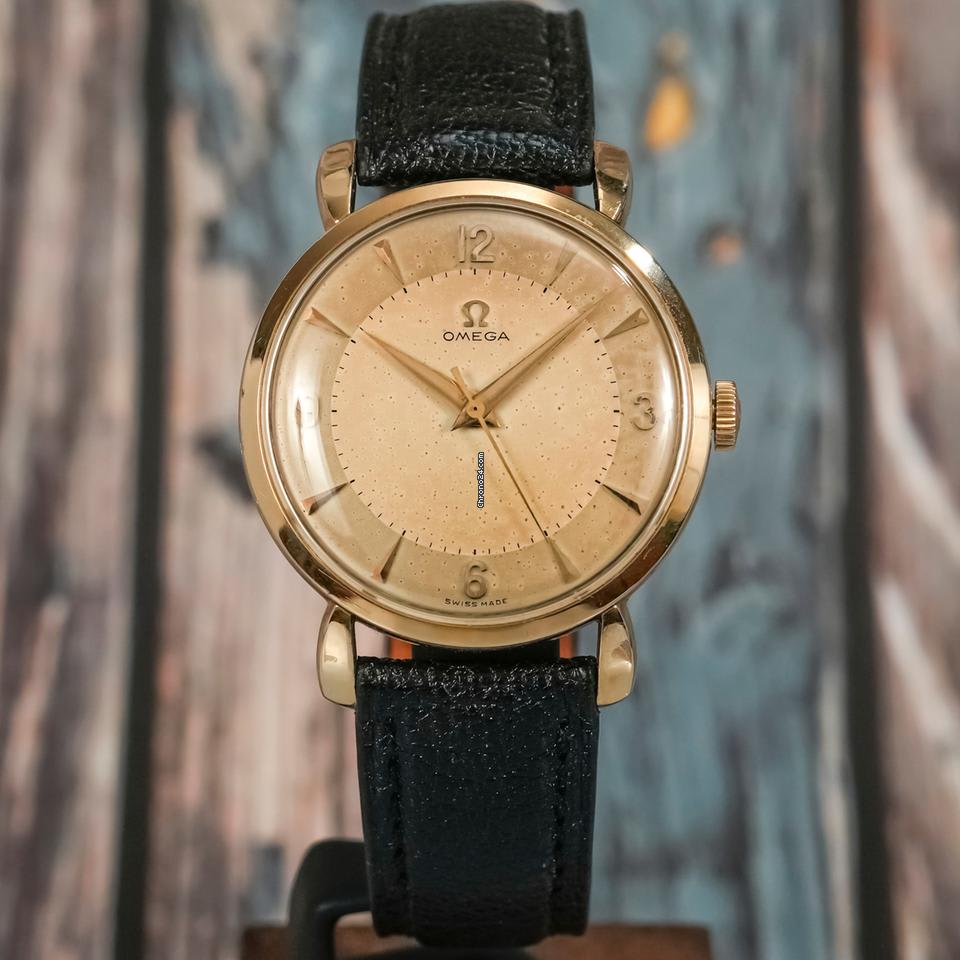
The B-6237 employs what collectors variously term “dog leg,” “fancy lugs,” or “elongated lugs.” These gracefully curving extensions flow from the case body with significant length (contributing to the 44mm lug-to-lug measurement) and distinctive curvature. This American-market styling preference created watches with greater visual presence despite modest case diameters.
Omega 18K YG Oversize Fancy Lug Dress Model circa 1946
Case Material & Construction:
- Material: 14-karat gold-filled (marked “14K GOLD FILLED” or “14K GF”)
- Manufacturing: Domestically manufactured in the United States
- Construction: Three-piece case consisting of a case body with fixed bezel, separate crystal-holding bezel ring, and snap-on caseback
- Case makers: Likely produced by one of the American case manufacturers that supplied Norman Morris, potentially including Ross Watch Case Co. or Jonell Watch Case Co., though specific attribution for the B-6237 remains unconfirmed
Gold-Filled Explained:
Gold-filled cases feature a substantial layer of gold alloy (in this case, 14-karat) mechanically bonded to a base metal core, typically brass. Unlike gold plating, which measures in microns, gold-filled construction provides a much thicker gold layer (typically 1/10 to 1/20 of total weight), offering durability that allowed these watches to maintain their appearance through decades of wear when properly cared for.
Bezel:
The bezel is smooth, polished, and fixed (non-rotating). It integrates seamlessly with the case profile, maintaining the sleek lines appropriate for a dress watch. The crystal-retaining portion utilizes a removable compression-fit bezel ring that holds the acrylic crystal in place without requiring a tension ring.
Caseback:
The snap-on caseback features:
- Smooth, polished exterior finish
- Interior markings including case model “B6237” or “B-6237”
- “14K GOLD FILLED” or similar gold content marking
- Possible case serial number
- No gasket groove (watch is not designed for moisture protection)
Variations:
Unlike some Norman Morris models that appeared in multiple case materials (solid gold, gold-filled, or gold-capped), the B-6237 appears to have been offered exclusively in 14K gold-filled. No solid gold or stainless steel variants have been documented, though incomplete historical records mean surprises occasionally surface.
Condition Considerations:
Gold-filled cases present specific challenges. The primary concern is wear-through at high points, particularly on lug edges, case corners, and the caseback rim where the gold layer may wear down to reveal the brass base metal beneath. Additionally, aggressive polishing reduces the gold layer’s thickness, accelerating wear-through. Original, lightly worn cases with sharp edges and intact gold coverage command significant premiums over heavily polished examples.
Omega Vintage 30T2 Fancy Lugs -1952- Nice Original Condition
Bracelet & Strap Options
The Omega B-6237 was designed as a strap watch, intended for use with leather straps rather than metal bracelets. This design choice aligned with dress watch conventions of the early 1950s and suited the watch’s formal aesthetic.
Period-Correct Strap Specifications:
- Lug width: 18 mm
- Material: Leather, typically in black or brown
- Style: Plain leather dress strap with minimal stitching
- Buckle: Simple gold-toned pin buckle, often signed “OMEGA” but not always
- Buckle finish: Gold tone to match case material
Original Equipment:
Some new-old-stock and well-preserved examples retain documentation showing that watches were sold with:
- Original Omega-branded leather strap
- Period-correct buckle (note: not all original buckles carried the Omega logo; some were plain gold-tone buckles)
- Original presentation boxes (various styles existed)
Modern Strap Considerations:
For contemporary wear, collectors have several options:
Appropriate Choices:
- Vintage-style plain leather straps in black or brown
- Shell cordovan leather for durability and period-appropriate patina
- Suede straps for casual elegance
- Box-calf leather for formal occasions
- Width: 18mm, tapering to 16mm at the buckle for balanced proportions
Less Appropriate:
- Modern Omega-branded straps (anachronistic)
- Heavy-textured or exotic leather (conflicts with the watch’s subtle elegance)
- NATO-style straps (too casual for the watch’s dress-focused design)
- Metal expansion bracelets (not period-correct and too informal)
Buckle Selection:
Finding period-correct 1950s gold-toned buckles proves challenging but worthwhile for authenticity. Alternatively, high-quality reproduction vintage-style buckles in gold tone provide a sympathetic pairing. Avoid modern Omega-logo buckles, as these are visually and historically incongruous with early 1950s aesthetics.
Identifying Original vs. Replaced Parts
Authenticating a vintage Omega B-6237 requires careful examination of multiple components, as decades of wear, service, and well-intentioned “improvements” have left many examples with non-original parts. Understanding what’s correct helps collectors make informed purchasing decisions and properly value examples.
Dial Authentication:
The dial presents the most common area of concern. Many vintage Omega watches have undergone dial refinishing or complete replacement, often compromising value significantly.
Signs of Original Dial:
- Guilloché texture shows consistent depth and precision across entire dial surface
- Applied numerals sit flush with no gaps or excess adhesive visible at edges
- Dial color shows subtle, even aging (slight yellowing or patina) consistent with case/movement condition
- Printing remains crisp at 10x magnification with no fuzzy edges or irregular lettering
- “SWISS MADE” text appears at bottom (though see note below about exceptions)
- Guilloché pattern extends properly under applied elements, visible only from specific angles
Red Flags for Refinished Dial:
- High-gloss finish appearing too pristine for a 70+ year-old watch
- Paint or lacquer visible on edges of applied hour markers (indicates dial was refinished after markers were applied)
- Inconsistent font styles, spacing, or sizes in printed text
- Missing “SWISS MADE” designation (often omitted by refinishers due to difficulty of application)
- Dial condition dramatically better than case/crystal condition (if case shows honest wear but dial looks new, suspect refinishing)
- Luminous material appearing bright white or neon (original radium ages to cream/tan)
Important Exception: Some genuine 1940s-early 1950s Omega dials, particularly on U.S. market models, occasionally featured less precise printing or slightly irregular lettering that appears “hand-done.” This was sometimes factory original due to manufacturing processes of the era. Comparison with documented authentic examples helps distinguish period quirkiness from modern refinishing.
Hands Authentication:
- Original characteristics: Gold-toned hands matching case material, with luminous material (if present) showing age-consistent cream/tan patina matching dial markers
- Red flags: Bright white lume on hands but aged lume on dial (or vice versa), indicating replacement hands or relume service
Movement Verification:
- Must have: OXG stamp on balance bridge (essential for confirming U.S. market provenance)
- Correct caliber: Omega Caliber 361 with 17 jewels
- Serial number: Should correspond to 1950-1953 production (approximately 12-14 million range)
- Red flags: Movement serial number significantly mismatched to case/dial era; missing OXG stamp; non-Omega movement
Crown Authentication:
- Correct style: Unsigned mushroom-type crown
- Red flags: Modern Omega-logo crown (anachronistic for 1950); incorrect crown size or thread pitch
Case Considerations:
- Polishing impact: Over-polishing reduces case thickness, rounds sharp edges, and thins the gold-filled layer
- Assessment: Original cases should show some honest wear but maintain crisp lug definition and sharp transitions between polished and brushed surfaces
- Wear-through: Check lug edges and caseback rim for brass showing through gold layer (indicates either heavy wear or aggressive polishing)
Crystal:
- Original: Low-dome acrylic crystal
- Acceptable replacement: Modern acrylic crystal in correct profile and size (approximately 33mm diameter)
- Less ideal: High-dome crystal (incorrect profile) or sapphire crystal (anachronistic)
The “Swiss Made” Question:
Most Swiss watches from the 1950s onward should display “SWISS” or “SWISS MADE” on the dial. However, early Norman Morris models occasionally appeared without this marking on original dials, and refinished dials frequently omit it due to application difficulty. Its absence warrants careful scrutiny of all other dial characteristics, but shouldn’t automatically disqualify a watch, particularly if all other signs point to authenticity.

72 Years Old Vintage Omega Rare Guilloche-Honeucomb Dial Ref
Collector Notes & Market Context
The Omega B-6237 occupies an intriguing position in the vintage watch market: under-appreciated compared to Omega’s iconic sport models yet offering exceptional design merit and wearability for collectors who value elegance over recognition.
Market Positioning & Value:
Vintage dress watches from the 1950s, particularly lesser-known U.S. market references, trade at significant discounts compared to Speedmasters, Seamaster 300s, or even Constellation “Pie Pan” models. This creates opportunity for collectors seeking quality and distinctiveness without investing in five-figure sport watches.
Approximate Value Range:
- Excellent original condition (original dial, sharp case, running movement): $1,500–$2,500
- Good condition with honest wear (original dial with aging, some case wear, serviced movement): $1,000–$1,800
- Refinished dial or compromised condition: $500–$1,200
- Parts watches or heavily damaged examples: $200–$600
These estimates reflect the broader vintage dress watch market as of late 2024-early 2025. Factors driving value within this range include dial originality (paramount), case condition, movement functionality, and completeness of documentation.
What Drives Premiums:
Dial condition dominates valuation. An all-original B-6237 with crisp guilloché, intact applied markers, and proper aging can command 50-100% more than an identical example with refinished dial. Other premium factors include:
- Unpolished case with sharp lug definition
- Complete set with original box, papers, or period documentation (rare for U.S. market models)
- Documented service history from reputable watchmaker
- Unusual dial variations (if authenticated as original)
Common Pitfalls:
- Dial refinishing: The most common issue affecting value and authenticity
- Over-polishing: Many examples show rounded lugs and thinned cases from aggressive polishing
- Mismatched parts: Replacement crowns, wrong-era movements, or non-original hands
- Gold layer wear-through: On gold-filled cases, this dramatically impacts both appearance and value
- Moisture damage: Despite being dress watches, many examples suffered water damage from inadequate protection
Relative Scarcity:
U.S. market Norman Morris Omega watches appear regularly in the secondary market but far less frequently than international references. The B-6237 specifically surfaces only occasionally, making it neither extremely rare nor readily available. This moderate scarcity sustains interest without creating the sort of competitive bidding seen for truly rare references.
Wearability & Modern Context:
The B-6237’s 33.3mm diameter and 8.8mm thickness align perfectly with contemporary preferences for vintage-sized dress watches. The elongated lugs provide surprising wrist presence, making the watch wear closer to 35-36mm. For formal occasions, business attire, or collectors seeking alternatives to obvious luxury pieces, the B-6237 delivers understated sophistication that remains entirely relevant seven decades after its introduction.
Comparison to Other Omega Dress Watches:
Against Omega’s broader 1950s dress watch lineup:
- Less expensive than: Solid gold models, chronometer-grade pieces, or Constellation references
- Similar pricing to: Other Norman Morris dress references, Omega Geneve models, basic Seamaster De Ville watches
- More expensive than: Later 1960s-70s Omega dress watches, quartz-era models, or heavily compromised vintage examples
Investment Perspective:
Vintage dress watches have appreciated more slowly than sport watches over the past decade, but the gap between pristine examples and average-condition pieces has widened. Collectors increasingly prioritize originality, suggesting that exceptional B-6237 examples with untouched dials and crisp cases may appreciate faster than the broader dress watch category. However, this remains a “buy what you love” category rather than a pure investment play.
Advice for Prospective Buyers:
- Prioritize dial authenticity above all else; a refinished dial permanently compromises value and desirability
- Accept honest wear over aggressive restoration; patina and light wear tell a watch’s story
- Verify the OXG stamp on movement to confirm U.S. market provenance
- Budget for service: Assume $300-$600 for complete movement service if buying from private sellers
- Purchase from knowledgeable dealers or experienced collectors who understand Norman Morris references
- Study comparable sales before committing to ensure fair pricing

Omega Constellation Omega Lyre Lugs 1961 Omega Constellation
Conclusion
The Omega B-6237 encapsulates a distinctive moment in mid-century American watch culture, when domestic case designs and Swiss movement expertise merged to create timepieces tailored specifically for U.S. buyers. Its graceful elongated lugs, intricate guilloché dial work, and 14-karat gold-filled construction exemplify the aesthetic sophistication that defined quality dress watches in an era before quartz revolutions and tool watch dominance.
For collectors, this reference offers multiple appeals: the historical intrigue of the Norman Morris partnership, the elegant wearability of a well-proportioned vintage dress watch, and the relative accessibility compared to Omega’s more celebrated references. While the B-6237 lacks the name recognition of a Speedmaster or the investment trajectory of a Seamaster 300, it delivers authentic vintage charm and genuine Swiss watchmaking at a fraction of the cost.
The watch’s modest 33.3mm case diameter and slim 8.8mm profile make it eminently wearable for modern collectors who appreciate mid-century design sensibilities. The manual-wind Caliber 361 movement provides the engaging ritual of daily winding while offering reliable performance when properly maintained. And the distinctive guilloché dial, when found in original condition, ranks among the most visually compelling dial treatments of the 1950s dress watch genre.
As with all vintage watches, condition and authenticity determine desirability. A B-6237 with original dial, crisp case, and proper OXG-stamped movement deserves serious consideration from collectors building vintage Omega collections or anyone seeking an elegant alternative to contemporary dress watches. The lost Norman Morris records add an element of mystery that only enhances the appeal: these watches survive as tangible connections to a partnership that shaped American watch retail for half a century.
Whether acquired for daily wear, special occasions, or as a compelling addition to a broader collection, the Omega B-6237 rewards those who appreciate subtle elegance over obvious statement pieces. Seven decades after its introduction, this dress watch continues to fulfill its original purpose: delivering Swiss quality, American styling, and timeless sophistication to those who recognize craftsmanship beyond brand cachet.