


Last updated ~ February 2, 2026
Brand
Production Period
1944–1956
Model Line
Case Shape
Round
Diameter
33mm
Lug to Lug
42mm
Lug Width
17mm
Case Thickness
10mm
Case Back
Screw-Down
Caliber
Crystal
Bezel
Smooth
The Omega CK 2450 represents one of the most enduring and historically significant manual-wind dress watches of the post-war era, encompassing a production run extending from 1944 to 1956, substantially longer than contemporary references like the military-influenced CK 2622. This compact 32.5–36mm stainless steel watch, powered by the robust Caliber 26.5 family movement, occupied a crucial market position during the transition from conservative pre-war designs to the innovative automatic Seamaster collection. With subsidiary seconds at 6 o’clock, striking two-tone dial variations, and a straightforward push-in crown design, the CK 2450 appeals to contemporary collectors who value mechanical reliability, historical authenticity, and the tactile engagement of manual-wind operation. The extended production window generated numerous sub-references with distinct dial and case variations, creating substantial collecting opportunities within this single reference family. This comprehensive guide addresses specifications, production chronology, dial variations, movement specifications, authentication protocols, and the historical positioning of the CK 2450 within Omega’s formative post-war era.
Reference Overview and Historical Context
Official Designation: CK 2450 (stainless steel)
Production Timeline: Approximately 1944–1956 (extended production run)
Movement Family: Caliber 26.5 (robust, proven design from 1920s–1950s)
Historical Classification: Pre-Seamaster manual wind dress watch
The Omega CK 2450 emerged during a fascinating transitional period in wristwatch evolution. Introduced in 1944, the 2450 represented conservative horological philosophy: a straightforward, reliable, manually-wound dress watch eschewing cutting-edge innovation in favor of proven mechanics. Throughout the late 1940s, as Omega developed and launched its revolutionary Seamaster collection with bumper automatic movements (the 2576 and 2577), the CK 2450 continued production, serving customers who preferred the simplicity, familiarity, and maintainability of manual-wind operation.
The reference achieved notable longevity—extending through 1956 with documented sub-references (2450-1 through 2450-10+) suggesting iterative refinement and market responsiveness. This extended production reflects Omega’s commitment to serving multiple customer segments simultaneously: those embracing automation and those valuing tradition. The 2450’s 12-year production run dwarfs contemporary competitors like the CK 2622 (1949–1950 only), indicating substantial market demand for accessible, reliable manual-wind dress watches.

Omega ref CK 2450 cal 26.5 circa 1950 Vintage watch — Long
Physical Specifications

Omega CK 2450 Key Specifications
Dimensional Context and Case Variations
The Omega CK 2450 presents remarkable dimensional flexibility across its sub-references. Standard examples measure approximately 32.5–34mm in diameter (a notably compact size for dress watches), with later variants (particularly 2450-10) reaching toward 36mm. This size evolution reflects broader design trends toward slightly larger wrist presence throughout the 1950s. The slim 9–11mm case profile demonstrates sophisticated movement engineering, accommodating the 26.5 caliber in an exceptionally svelte package.
Lug-to-lug measurements of approximately 42–43mm ensure comfortable wear despite the varying case diameters, while lug width ranges from 16–18mm depending on specific variant. This dimensional flexibility—combined with the straightforward push-in crown design—made the 2450 accessible to users across varied wrist sizes and preferred wearing styles.
| Dimension | Measurement | Context |
|---|---|---|
| Case Diameter | 32.5–36mm (standard ~33–34mm; some variants ~36mm / excluding crown) | Compact dressy proportions; evolution toward larger sizes later in production |
| Lug-to-Lug | ~42–43mm | Comfortable proportions despite varying case diameters |
| Case Thickness | ~9–11mm | Remarkably thin for manual-wind mechanical movement |
| Lug Width | 16–18mm (varies by sub-reference) | Standard variation for period; slight differences between variants |
| Water Resistance | 30m (3 ATM) | Screw-back design with metal gasket; theoretical on 80+ year specimens |
Movement Specifications
Caliber 26.5 Family (Bimetallic Screw Balance, Breguet Mainspring)
The Caliber 26.5 family represents one of Omega’s most prolific and reliable movement designs, produced continuously from the mid-1920s through the 1950s and beyond. The 26.5 family variants (26.5 T, 26.5 T3 PC, and related designations) employed in the CK 2450 feature:
- 15 jewels (rubies and other jewel types strategically placed)
- 18,000 vibrations per hour (2.5 Hz beat rate)
- ~37-hour power reserve when fully wound
- Bimetallic screw balance (resists temperature variations)
- Breguet mainspring (superior consistency)
- Manual wind only (no automatic mechanism)
- Lever escapement (proven, efficient design)
The 26.5 caliber’s extended longevity in production testifies to its robust engineering and consumer reliability. These movements remain straightforward to service by experienced watchmakers familiar with vintage mechanics. The lack of complication (no chronograph, date function, or automatic mechanism) translates to mechanical simplicity and inherent durability.

Vintage Omega Manual wound Sub-seconds watch with two-tone
Case Materials and Construction
The CK 2450 was produced primarily in stainless steel—the “CK” designation in Omega’s nomenclature system indicating this material. Omega employed robust Staybrite stainless steel or equivalent high-grade alloys, finished with a brushed exterior characteristic of the era. Some examples in gold or gold-capped materials are documented in collector circles, though considerably rarer than steel versions.
Screw-In Caseback with Metal Flat Gasket
The screw-in caseback with metal flat gasket seal represents the standard construction for CK 2450 examples. This design provides reliable water sealing and, critically, simple access for movement service. The metal gasket seats against a machined ledge inside the case, creating a mechanical seal—robust and proven effective across decades of survival.
Interior caseback markings typically display:
- “CK 2450” designation (or specific sub-reference)
- Stainless steel material code
- Caseback serial number
- Sometimes movement serial number
A completely blank caseback interior is suspicious and may indicate replacement or service non-originality.
Case Design and Evolution
Compact, Refined Aesthetic
The CK 2450 features a distinctly dressy case architecture: compact diameter, slim thickness, and refined proportions. The rounded case middle (neither angular nor overly domed) reflects 1940s–1950s design sensibilities that prioritized elegance over aggressiveness. The fixed bezel is simple and unadorned, machined integral to the case without removable elements.
Crown Design and Water Sealing
The 2450 employs a signed Omega push-in crown—not a screw-down design. The crown seals via gasket pressure against the crown tube, providing the rated 30m water resistance. This push-in design is characteristic of dress watches of the era and differs markedly from later screw-down or helium escape valve crowns that would appear on more sophisticated references.
Authentication Considerations
Original unpolished CK 2450 examples should display sharp caseback edges and crisp internal caseback markings. The presence of a metal flat gasket inside is critical for authentication. Any example showing a snap-on caseback or clover/Naiad crown has been modified post-factory.

Vintage Omega Manual wound Sub-seconds watch with two-tone
Dial Variations: An Extensive Family
The CK 2450’s extended 12-year production run generated substantial dial variation—creating a rich field for collectors interested in this reference family.
- Early Examples: Simply marked “OMEGA” without additional text; some lack “SWISS MADE” designation
- Standard Examples: “OMEGA” with “SWISS MADE” marking (most common)
- Sub-Seconds Dial: Present at 6 o’clock on all documented examples
- No “Seamaster” Branding: Critical distinction from automatic Seamaster variants
The absence of “Seamaster” branding definitively identifies the 2450 as a pre-Seamaster reference, produced before or concurrent with the Seamaster collection’s launch (1948), but marketed separately.
The 2450 displays remarkable diversity in hour marker styles:
- Applied Batons with Radium Lume: Metal indices with lume-filled center grooves (most typical)
- Large Applied Arabic Numerals: Oversized numerals at cardinal positions (particularly documented on some variants)
- Combination Layouts: Numerals at key positions (3, 6, 9, 12) with markers at others
- Outer Minute Track: Some examples feature railway-style minute markings around the dial perimeter (particularly on military-influenced examples)
- Applied Indices Only: Minimal markings, relying on applied batons without numerals
- Silver/White: Most common base color; often aged to cream or champagne tones
- Black: Documented on rarer examples; particularly striking with contrasting markers
- Two-Tone: Contrasting matte and polished finishes (characteristic of 2450-3 variant), creating visual depth and sophistication
- Tropical/Patinated: Natural aging effects developing warm gold, brown, or tan undertones
The two-tone dial variants are particularly distinctive and sought by collectors, as the contrasting finishes create visual interest and depth absent from single-finish dials.
The small dial at 6 o’clock presents in several configurations:
- Simple Ring Dial: Plain circular field with center dot or small lume plot
- Marked Subdial: Some examples feature numerals or minute markings in the seconds dial
- Crosshair or Marking: Central design element (less common than on automatic Seamasters)
The subdial represents classical dress watch design—allowing seconds reading without the center seconds hand’s presence interfering with dial proportions.
Hands and Luminous Material
The CK 2450 is typically equipped with syringe-style hands—elongated, narrow designs characteristic of 1940s–1950s military and dress watch aesthetics. The hands taper elegantly from a slightly wider base to fine points. Some later examples present Dauphine-style hands(faceted, lance-shaped), reflecting design evolution during the production run.
Hands are steel-colored (rhodium-plated) on all documented examples, as the watch is exclusively produced in stainless steel for standard variants. The hour and minute hands feature center grooves filled with radium lume; the small seconds hand may be polished (no lume) or lume-filled depending on variant.
Radium Lume and Aging Patterns
All original CK 2450 examples contain radium-based luminous material applied to:
- Index markers (batons, numerals, or dots)
- Hour and minute hand grooves
- Subdial seconds hand (where applicable)
Authentic Aging:
- Radium naturally darkens over 80 years to cream, tan, brown, grey, or yellowish tones depending on storage conditions and UV exposure
- Hand lume (applied by different manufacturing process than dial lume) often ages to different color saturation—entirely normal and highly desirable as evidence of authenticity
- Some examples display striking patina variation where one hand appears tan while another reads more brown—strong authentication indicator
- Creamy, mottled appearance indicates original aging; uniform bright lume suggests modern tritium or superluminova relume
Red Flag – Uniform Bright Lume: If all lume across hands and indices displays identical, glossy brightness, modern relume is indicated rather than authentic radium aging.
Sub-References and Dial Variations
While Omega’s pre-1962 suffix encoding system remains incompletely documented, the following sub-references are confirmed among collectors:
| Sub-Reference | Approximate Production | Documented Characteristics | Notes |
|---|---|---|---|
| 2450-1 | 1944–1946 | Early variant; possibly varied marker configuration | First production variant |
| 2450-2 | 1946–1948 | Variant designation; specific dial configuration | Transition period |
| 2450-3 | 1948–1950 | Two-tone dial (matte silvered center, polished outer); characteristic sub-reference | Very distinctive; highly recognizable variant |
| 2450-10 | 1950–1954 | Dial with alternating Arabic numerals and marker dots; potentially larger case (~36mm) | Later production; documented size increase |
| 2450+ (others) | 1950–1956 | Various dial configurations; later sub-references as production continued | Extended production into mid-1950s |
The two-tone 2450-3 is particularly well-documented and sought after, as the contrasting finishes create striking visual presence distinct from single-tone dials.
Visual Aspects and Wrist Presence
The Omega CK 2450 presents a distinctly refined yet unpretentious wrist presence:
- Compact Case Presence: At 32.5–36mm, the watch reads as a true dress watch, not commanding wrist real estate but maintaining authoritative presence
- Slim Elegance: The ~9–11mm thickness permits comfortable fit under dress shirt cuffs without bulk
- Two-Tone Dial Beauty: The 2450-3 variant, with contrasting matte silvered center and polished outer ring, creates visual sophistication and depth
- Radium Patina Character: Aged lume develops unique mottled patterns and warm tones that modern relume cannot replicate
- Syringe Hand Aesthetic: The narrow, pointed hand style evokes military heritage while maintaining dressy refinement
- Simple Dial Clarity: Unadorned by “Seamaster” branding or unnecessary text, the dial emphasizes clean proportions and legibility
- Historical Presence: The watch carries the weight of 80-year history—bridge between pre-war and post-war Omega, conservative alternative to automation
The overall wrist presence is sophisticated, historically grounded, and distinctly different from the more modern aesthetic of concurrent automatic Seamasters. The 2450 reads as a gentleman’s understated dress watch—refined, reliable, and unpretentious.
Historical Context and Relation to Seamaster Collection
The CK 2450 occupies a fascinating historical position during Omega’s transition from conservative pre-war designs to innovative post-war modernization:
- Pre-Seamaster Introduction: While produced concurrently with the Seamaster collection launch (1948), the 2450 lacks “Seamaster” branding—it represents a parallel product line
- Manual Wind Philosophy: The 2450 reflects conservative engineering philosophy: proven mechanics, ease of service, reliability without cutting-edge innovation
- Extended Production: The 12-year production run (1944–1956) dramatically exceeds the CK 2622 (1949–1950), indicating substantial market demand for manual-wind alternatives to automatics
- Caliber 26.5 Heritage: The movement family derives from mid-1920s designs, representing proven, refined engineering rather than novelty
- Accessibility: The CK 2450 served price-conscious buyers who valued straightforward mechanics over automatic innovation
The 2450 demonstrates that Omega recognized market diversity—not all customers wanted or could afford the newer automatic Seamaster movements. The extended production window reveals this was a successful market strategy.
Authentication and Identification Guide

Omega CK 2450 Authentication Guide: Original Markers and Red Flags
Critical Authenticity Checkpoints
- Sub-Seconds Dial at 6 O’Clock: The most fundamental verification. Original CK 2450s must feature a small dial at 6 with seconds hand. Center-seconds hand indicates a different reference (2577 or similar).
- Manual Wind Movement Only: Open the caseback and verify the movement is manually wound. The absence of automatic rotor action is critical. Bumper automatic or full-rotor automatic movements indicate case swap or wrong reference.
- Caliber 26.5 Family Designation: The movement should clearly indicate Cal. 26.5 or variants (26.5 T, 26.5 T3 PC, etc.). Full rotor automatics or other movement numbers indicate incompatibility.
- Screw-In Caseback: The caseback must be threaded (screw-in), not friction-fit snap-on. A snap-on caseback indicates a different, likely earlier reference.
- Metal Flat Gasket Inside: When caseback is opened, the original metal flat gasket seal should be visible. Its presence indicates original, unserviced (or carefully serviced) construction.
- Signed Omega Crown: The crown must bear Omega signature and feature push-in (not screw-down) design. A clover/Naiad crown or helium escape valve crown indicates non-original replacement.
- No “Seamaster” Branding: The dial should read “OMEGA” and “SWISS MADE” without “Seamaster” designation. The absence of Seamaster branding confirms pre-Seamaster reference.
- Radium Lume Patina Variation: Original watches exhibit different lume colors between hands and dial indices due to separate manufacturing batches. Uniform, bright lume indicates modern relume.
- Proper Caseback Interior Markings: Inside caseback should clearly display “CK 2450” (or specific sub-reference) along with material codes. Entirely blank interiors are suspicious.
- Serial Number Alignment: Movement and case serial numbers in 11M–12M range (or higher through early 1950s) align with known production windows.
- Center-seconds hand (wrong reference)
- Snap-on caseback (wrong design for 2450)
- “Seamaster” text on dial (wrong reference)
- Bumper or full-rotor automatic movement (wrong movement type)
- Clover/Naiad crown (non-original replacement)
- Entirely uniform bright lume (modern relume)
- Blank or illegible caseback interior (suggests replacement)
- Completely polished case (destroys authenticity markers)
- Helium escape valve crown (far too modern for 1950 watch)
Pricing and Market Context
The Omega CK 2450 occupies an interesting price position reflecting its accessibility, scarcity relative to automatics, and mechanical interest:
| Condition / Specification | Estimated Price Range | Market Notes |
|---|---|---|
| Steel, working condition | $400–$900 | Accessible entry point; good mechanical interest |
| Steel, exceptional condition (unpolished) | $600–$1,200 | Premium for preservation; original patina valued |
| Steel, two-tone dial (2450-3) | $600–$1,300 | Two-tone variants command moderate premium |
| Steel, rare dial variant | $700–$1,500+ | Specific sub-references or unusual dials can reach higher |
| Gold or gold-cap examples | $800–$2,000+ | Rare; material value and rarity justify premiums |
Value Drivers:
- Unpolished original case with sharp edges and crisp interior markings
- Factory-original dial with authentic radium patina and color variation
- Two-tone dial variants (particularly 2450-3)
- Signed caseback interior with clear “CK 2450” designation
- Matching movement and case serials
- Manual wind movement (appeals to mechanical purists)
- Recent professional service history (adds confidence)
- Complete original boxes and papers (extremely rare; can double value)
Servicing and Preservation
The Caliber 26.5 is a straightforward manual-wind movement that continues to function reliably in properly serviced examples. Professional watchmakers trained in pre-1960 mechanics can competently service the 26.5. Full professional service typically costs $300–$600 in 2024. The movement’s simplicity and absence of complications make it less temperamental than complex automatics, and parts availability remains reasonable through specialty suppliers.
Radium Handling and Safety
Original radium lume poses negligible health risk when sealed in a case. Alpha radiation is blocked by the acrylic crystal; gamma radiation decays substantially over distance; radon buildup is minimal in a single watch in normal ventilation. However, if caseback removal is necessary for service, handling should be minimized. Many specialist watchmakers prefer to leave sealed cases undisturbed during movement service when possible.
Case Restoration
Original unpolished cases with sharp edges and crisp interior markings are increasingly valued by collectors for their patina and authenticity. Aggressive polishing removes material, obscures caseback markings, and destroys surface character. Conservative restoration preserving sharp edges and original surface appearance is preferable to complete refinishing.
Crystal Replacement
Replacement with period-correct acrylic plexiglass (rather than modern sapphire) maintains historical authenticity. Original crowns are increasingly valued; replacement crowns are functional but indicate post-factory modification.
Related References and Broader Context
Understanding the CK 2450 requires familiarity with related references from the 1944–1956 period:
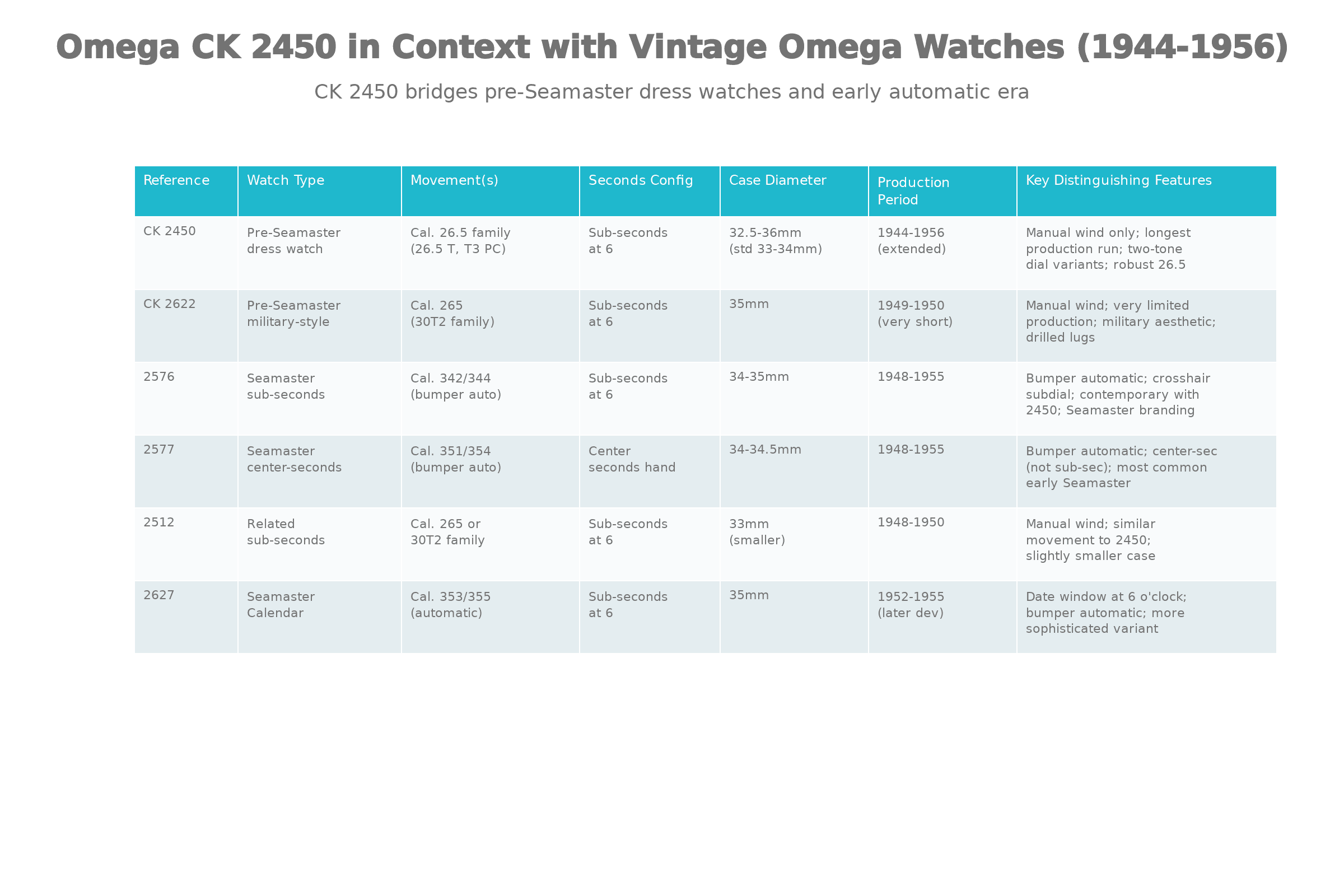
Omega CK 2450 in Context: Manual Wind and Early Automatic References (1944-1956)
Reference CK 2622 (Contemporary Military-Style)
Produced 1949–1950, the CK 2622 is contemporaneous with the 2450 but represents a distinctly different design philosophy. The 2622 features drilled lugs, military aesthetic, and extremely limited production (roughly one year). While both employ manual-wind mechanics, the 2622’s military heritage and brief production window create different collector appeal and rarity profile.
References 2576 and 2577 (Seamaster Automatics)
The 2576 (sub-seconds) and 2577 (center-seconds) represent Omega’s transition to automatic bumper movements. While produced concurrently with the later CK 2450 variants, the Seamasters feature fundamentally different movements (Cal. 342/344 and 351/354) and carry “Seamaster” branding. The Seamasters achieved larger production volumes and remain more commonly encountered than the 2450.
Reference 2512 (Related Sub-Seconds Manual Wind)
The 2512 employs similar movement technology (Cal. 26.5 family or 30T2 variants) to the 2450, with comparable sub-seconds configuration. The 2512 features a slightly smaller case (33mm vs. the 2450’s 32.5–36mm range) and overlapping production period.
Acquisition and Market Sources
Finding an authentic Omega CK 2450 requires patience and diligent research:
- Specialized Vintage Dealers: Retailers focused on early Omega watches or pre-Seamaster references occasionally maintain stock
- Online Marketplaces: https://www.chrono24.com/ (established as major marketplace reference) hosts occasional 2450 listings; authenticity verification is essential
- Auction Houses: Vintage watch auctions periodically feature examples, sometimes with provenance documentation
- Collector Forums: Omega Watch Forums (https://omegaforums.net/) provides reference materials, marketplace sections, and expert discussion
- Direct Private Sales: Established vintage watch collectors sometimes offer pieces directly, often with detailed historical knowledge
Conclusion
The Omega CK 2450 occupies a historically crucial yet often-overlooked position in Omega’s post-war evolution. Produced from 1944 through 1956, the 2450 represents conservative horological philosophy during a period of industry innovation—a straightforward, reliable, manually-wound dress watch that served those valuing proven mechanics and ease of service over cutting-edge automatic technology.
The reference’s extended 12-year production run, compared to contemporary limited-production variants like the CK 2622, demonstrates substantial market demand. The numerous sub-references (2450-1 through 2450-10+) with distinct dial and case variations create rich collecting opportunities within this single reference family. The distinctive two-tone 2450-3 variant, with its contrasting matte silvered center and polished outer ring, represents one of the most visually striking dress watches of the era.
The robust Caliber 26.5 family movement—featuring bimetallic screw balance, Breguet mainspring, and straightforward 15-jewel design—continues to function reliably in surviving examples. The manual-wind mechanism appeals to contemporary collectors who value mechanical engagement and understand the intimate connection between owner and watch that automatic mechanisms cannot replicate.
Authentication requires careful attention to sub-seconds dial at 6 o’clock, screw-in caseback with metal gasket, manual-wind-only movement, and absolute absence of “Seamaster” branding. Collectors should seek unpolished original examples with sharp caseback edges and aged radium lume showing natural color variation between hands and dial indices.
An authentic, well-preserved Omega CK 2450—particularly striking two-tone variants—represents both a mechanically sound investment and a tangible connection to Omega’s formative post-war era. The reference deserves consideration alongside more celebrated automatic Seamasters, offering historical significance, mechanical integrity, and distinctive aesthetic charm that continues to resonate with discerning vintage watch enthusiasts more than 75 years after its introduction.