

The Omega Seamaster Calendar, introduced in 1952 as Reference 2627, represents Omega’s first wristwatch with a date complication. This milestone combined the brand’s proven water-resistant Seamaster architecture with the practical utility of a calendar display. For today’s vintage watch collectors, these pieces offer exceptional value: genuine 1950s Swiss horology with date complications starting around $600 for steel examples, roughly one-third the price of comparable vintage Rolex Datejusts.
The line’s significance extends beyond being a mere “first.” Over its decade-long primary production run (1952-1962), the Seamaster Calendar evolved through three major generations, spawned numerous dial variants that remain highly sought after, and established the template for Omega’s approach to everyday luxury watches with practical complications. While Rolex had introduced the Datejust seven years earlier in 1945, Omega’s offering combined the date function with their superior water-resistance technology developed during wartime collaboration with the British Royal Navy.
Historical Significance
The Omega Seamaster Calendar emerged from a specific historical moment when Omega was transforming military technology into civilian luxury. The original Seamaster line launched in 1948 to celebrate Omega’s centenary, drawing directly from watches supplied to Britain’s Royal Air Force during World War II. Omega delivered over 110,000 timepieces to the British Ministry of Defence between 1940 and 1945.
René Bannwart, considered the “father of the Omega Seamaster” and later founder of Corum, developed these water-resistant cases using O-ring gasket technology that achieved 50 meters of water resistance, exceptional for the era. The Seamaster Calendar (Ref. 2627) added date functionality four years later, positioning Omega in the emerging market for everyday luxury watches with practical complications.
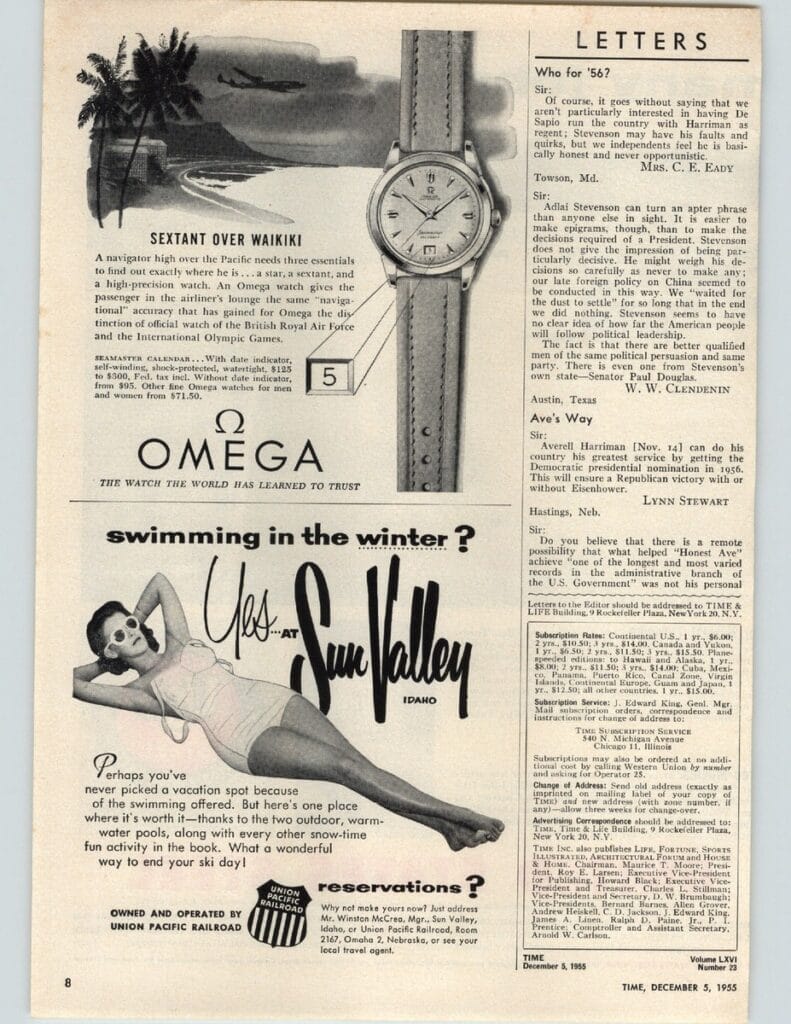
The timing placed Omega in direct competition with established players. Rolex’s Datejust (1945) had pioneered the date window concept, while Universal Genève had introduced complete calendar complications as early as 1943. Omega’s own Cosmic line (1947) offered sophisticated triple-calendar moonphase complications, but these complex pieces served a different market. The Seamaster Calendar filled the gap for buyers wanting a robust, water-resistant automatic with simple date display, what marketing executives then called “half dress, half casual.”
Manufacturing occurred entirely at Omega’s Biel/Bienne facility during what collectors consider the brand’s golden era of in-house production. The early calibers (353, 355, 503) were assembled to exacting standards using components manufactured on-site, a distinction from later Omega production that relied increasingly on third-party suppliers like ETA from the 1980s onward.
Production Period & Historical Context
The first-generation Seamaster Calendar Reference 2627 (1952-1957) utilized Omega’s “bumper” automatic movements, Calibers 353 and 355, where an oscillating rotor wound the mainspring by swinging approximately 120-130 degrees before “bumping” into cushioning springs. These 17-jewel movements ran at 19,800 beats per hour with roughly 42-hour power reserves.
Case specifications set the tone for the entire line: 35.3mm diameter, 42.6mm lug-to-lug, approximately 12mm thickness, and 30-meter water resistance via screw-down caseback. Materials included stainless steel, 14K gold-capped steel (designated with “KO” prefix), and solid 18K yellow gold. The distinctive date window at 6 o’clock became a hallmark, unusual since most competitors, including Rolex, placed their apertures at 3 o’clock.
Early 1952 examples featured square date windows, transitioning to the more common trapezoid shape from 1953 onward, a minor detail that commands slight premiums among specialized collectors. Dial signatures read “Omega” and “Automatic” below an applied logo at 12 o’clock, with “Seamaster” and “Calendar” positioned above the date aperture.
Reference 2757 (1954-1958) offered a variant with snap-back rather than screw-back construction, sharing the Caliber 355 bumper movement. Production of bumper calibers reached massive scale: over 1.3 million bumper automatic movements were manufactured between 1943 and 1955 across the caliber family.
Evolution Overview
The pivotal technological transition came in 1956 with the introduction of Caliber 503, Omega’s first full-rotor automatic movement with date complication. Designed by Edouard Schwaar, approximately 163,000 Cal. 503 movements were produced between 1956 and 1960.
This 19/20-jewel caliber featured a full 360-degree rotor providing bidirectional winding, 46-hour power reserve, and Omega’s first semi-quickset date mechanism. Users advanced the date by cycling the hands back and forth near midnight rather than the tedious 24-hour rotation required by bumper calibers. The Cal. 503 also moved the date window from 6 o’clock to 3 o’clock, aligning with industry convention.
Reference 2849 became the dominant model during this era (1956-1962), available in numerous suffixed variants (2849-1SC through 2849-12SC) denoting different dial and case configurations. Case diameter settled at 34-34.5mm, slightly smaller than the original 2627. Materials expanded to include stainless steel, gold-capped, two-tone combinations, and solid gold in both 14K and 18K.
The 550-series calibers arrived from 1959 onward, bringing further refinements. Calibers 560, 561, 562, 563, 564, and 565 offered combinations of standard date versus chronometer certification (Cal. 561, 564), various jewel counts (17-24), and quick-set date mechanisms via push-pull crown (Cal. 563, 564, 565).
The 166.xxx reference series (1962 onward) employed these advanced movements, with 166.010 and 166.020representing the final evolution before the explicit “Seamaster Calendar” branding faded from dials.
Reference Families
| Generation | Caliber(s) | Years | Features |
|---|---|---|---|
| Bumper | 353, 355 | 1952-57 | Date at 6 o’clock, no quick-set, 17 jewels |
| Full-rotor 500 | 502, 503, 504 | 1956-60 | Semi-quickset, date at 3 o’clock, 17-24 jewels |
| Full-rotor 550 | 560-565 | 1959-70s | Quick-set available, chronometer options, 17-24 jewels |
Dial Variants and Collector Hierarchy
Dial configuration drives a significant portion of Seamaster Calendar values, with certain variants commanding premiums of 30-50% or more over standard examples.
Honeycomb and waffle textures feature a grid pattern pressed into the dial surface. These appear in both white/silver and the considerably rarer black versions. A black honeycomb dial on a steel case can command $1,500-$2,500, nearly triple the price of a standard silver dial.
Crosshair dials display perpendicular lines quartering the dial surface, typically passing under the center. These were most common on 1950s through early 1960s production. Collectors should note that “broken crosshairs” (lines interrupted by text) typically indicate redials on early-mid 1960s Seamasters, though broken configurations were original on late 1960s Seamaster Cosmics, a nuance that separates experienced buyers from novices.
Pie-pan dials feature 12 faceted sides on the outer plane with a distinct angle change to the inner plane. More commonly associated with the Constellation line, these appeared on certain gold Seamaster Calendar examples and add meaningful premiums. Sector dials divided into segments represent another desirable variant.
The Tiffany, Türler, and other retailer-signed dials (“double-signed” with both Omega and retailer names) command 30-50% premiums above standard examples, a consistent pattern across vintage Omega collecting.
Common Specifications
Case diameters ranged from 33.5mm (manual-wind 136.xxx) through 35.3mm (original Ref. 2627), with 34-34.5mm representing the most common range across the 2849 and 166.xxx series. Lug width remained consistently 18mmthroughout production. All crystals were acrylic/hesalite; mineral or sapphire glass was not used.
Water resistance was rated at 30 meters (3 bar) across the line, excellent for the 1950s but decidedly historical today. Vintage gaskets deteriorate; no collector should submerge these pieces regardless of original ratings.
Manual-wind variants also existed: Calibers 610 and 611 powered reference 136.xxx models from 1962-1965, though these hand-wound calendar pieces are considerably less common.
The Seamaster Calendar in Omega’s Broader Catalog
The Omega Cosmic (1947-1956) was entirely separate: a sophisticated triple-calendar moonphase watch powered by the hand-wound Caliber 381. The Cosmic offered day, date, month, and moon phase complications, vastly more complex than the simple date-only Seamaster Calendar. Interestingly, the Cosmic’s Cal. 381 shares design DNA with the legendary Caliber 321 used in early Speedmasters, both developed by Albert Piguet at Lémania.
The Seamaster Cosmic (1966-early 1970s) created nomenclature confusion by reviving the Cosmic name. This later model featured distinctive barrel-shaped “Unicoc” unibody cases and modern Cal. 565 movements, aesthetically and technically unrelated to either the original Cosmic or Seamaster Calendar.
The Constellation Calendar (from 1952) positioned higher, featuring chronometer-certified movements (Cal. 504, 561, 564) and the iconic observatory medallion caseback. Constellation pricing typically ran 50-100% above equivalent Seamaster Calendar pieces.
The De Ville evolution absorbed much of the Seamaster Calendar’s market role. Beginning as a thinner, dressier Seamaster sub-collection in 1960, “Seamaster De Ville” appeared on dials from 1963-1966 at the request of U.S. distributor Norman Morris. By 1967, De Ville became an independent collection, dropping “Seamaster” from dials entirely.
The explicit “Seamaster Calendar” designation gradually disappeared during the mid-1960s as date functions became standard features rather than noteworthy complications. Production didn’t “end” so much as merge into standard Seamaster, De Ville, and Seamaster Cosmic models.
Provenance & Collector Standing
For collectors seeking genuine 1950s Swiss horology with date complications, the Seamaster Calendar represents arguably the best value proposition in vintage watches today.
Entry-level steel examples (Ref. 2849 with average condition, possibly redialed) start around $300-$600. Mid-range pieces with original dials showing acceptable patina trade for $700-$1,200. Top-tier steel examples with original dial, minimal wear, and recent service reach $1,200-$2,000. Museum-quality or near-NOS full sets with boxes and papers can achieve $2,000-$3,500.
Gold-capped models range from $500 at entry level to $2,500 for excellent examples. Solid 18K gold pieces start around $1,500 for average condition, reaching $5,000-$8,000 for pristine rose gold examples with original documentation.
Condition factors rank in importance as: dial originality (40-50% of value), case condition (25-30%), correct signed crown (10-15%), and original hands (5-10%). Original dials command 50-100% premiums over redials. A redialed Seamaster Calendar essentially becomes a “parts watch” for serious collectors. Over-polished cases with rounded lugs similarly diminish value significantly.
Compared to a vintage Rolex Datejust of equivalent era, the Seamaster Calendar offers comparable movement quality at one-third to one-quarter the price. A 1950s steel Datejust typically commands $3,000-$8,000, while equivalent Seamaster Calendars trade for $600-$2,000. The trade-off: Rolex offers superior brand recognition and investment appreciation, while Omega provides better value for collectors prioritizing wearability and horological substance over resale potential.
Buying Guidance and Authentication
New collectors should prioritize Reference 2849 as an entry point: full-rotor movements are more reliable than bumpers, parts remain readily available, and examples are abundant. Those seeking historical significance should pursue Reference 2627 bumper models, accepting that many have redialed dials or incorrect parts.
Authentication requires attention to details. Movement photos should confirm correct caliber for the reference number. Dial examination under magnification reveals repaint signs; dials that appear “too clean” warrant skepticism. Signed crowns in correct period styles (bowler for earliest, clover for most) are essential. Caseback reference numbers should match the case.
Prices under $300 typically indicate problems: incorrect parts, undisclosed redials, or deferred service needs. Budget $300-$500 for service on any unseen purchase, covering full movement service, gaskets, and potential crystal replacement.
Conclusion
The Omega Seamaster Calendar occupies a distinctive position in vintage horology: historically significant as Omega’s first date watch, technically accomplished with fully in-house movements, aesthetically varied enough to sustain collecting interest, yet priced accessibly enough for entry-level collectors to acquire genuinely excellent examples.
The line’s evolution from bumper automatics with 6 o’clock date windows (1952) through full-rotor quickset movements with conventional 3 o’clock apertures (late 1960s) tracks the broader development of practical luxury watchmaking. Black honeycomb dials and crosshair configurations represent the “grails” of the collection, while solid gold cases offer remarkable value relative to modern precious metal premiums.
For collectors who prioritize wearing and enjoying vintage watches over investment returns, the Seamaster Calendar delivers mid-century Swiss craftsmanship at contemporary smart-watch prices, a proposition that explains its enduring appeal seven decades after Reference 2627 first left the Biel/Bienne factory.