


The Omega Seamaster 105.001 houses the legendary Caliber 321, the same column-wheel chronograph movement that powered the Speedmaster to the moon. While the Speedmaster grabbed headlines and NASA contracts, the 105.001 quietly offered collectors an elegant dress chronograph alternative with the same mechanical pedigree, a combination that today positions it as one of the most interesting and undervalued vintage Omega chronographs on the market.
The 105.001 represents Omega’s approach to the early 1960s chronograph: elegant proportions, refined details, and serious mechanical capability. This reference bridges the gap between mid-century elegance and modern sporting functionality, featuring a compact 35 to 35.5mm case with long, beveled lugs, round pump pushers, and a fixed tachymeter bezel. The watch was designed as a stylish alternative to the tool-oriented Speedmaster, prioritizing aesthetics while maintaining the technical competence of the Caliber 321.
Production figures for the 105.001 remain unconfirmed by Omega, but serial number analysis and market availability suggest relatively limited production compared to the concurrent Speedmaster references. Serial numbers predominantly fall within the 19 million range (1962) through the low 20 million range (1963-1964), indicating a concentrated production window of approximately two to three years before transitional models and successor references took over. Conservative estimates based on serial number clustering suggest production in the low thousands rather than tens of thousands, though this remains speculative without factory records. The 105.001 is scarce in today’s collector market, with black dial variants being particularly rare.
The 105.001 occupies an interesting position in the current collector market. Values have risen steadily over the past five years as collectors recognize the appeal of Caliber 321-powered chronographs beyond the Speedmaster. Auction results show clean examples with original dials and unpolished cases commanding EUR 5,000 to USD 7,000, with particularly well-preserved or rare variants (black dials, solid gold cases) reaching higher. Demand is rising but the reference remains accessible compared to equivalent-era Speedmasters, making it an entry point for collectors seeking 321 provenance without Moonwatch premiums. Specific variants commanding premiums include black dial examples, solid 14k or 18k gold cases, and pieces with fully matching serial numbers between case and movement accompanied by original documentation.
No widely recognized nickname has been assigned to the 105.001, unlike many Speedmaster and Seamaster 300 references. Collectors simply refer to it by reference number or as a “Seamaster 321 chronograph.”
Historical Context & Manufacturing Details
The Omega Seamaster 105.001 emerged during a transformative period in Swiss watchmaking, when chronographs transitioned from specialized tools to accessible luxury items for an expanding global middle class. Introduced in 1962, the 105.001 represented Omega’s effort to capitalize on the technical credibility of the Caliber 321 beyond the Speedmaster, offering a refined chronograph that appealed to customers seeking elegance over overt sportiness. This reference arrived as Omega was consolidating its catalog around the new six-digit reference number system, replacing the earlier CK/MI alphanumeric codes, and coincided with a broader industry shift toward more contemporary aesthetics in dial design and case finishing.
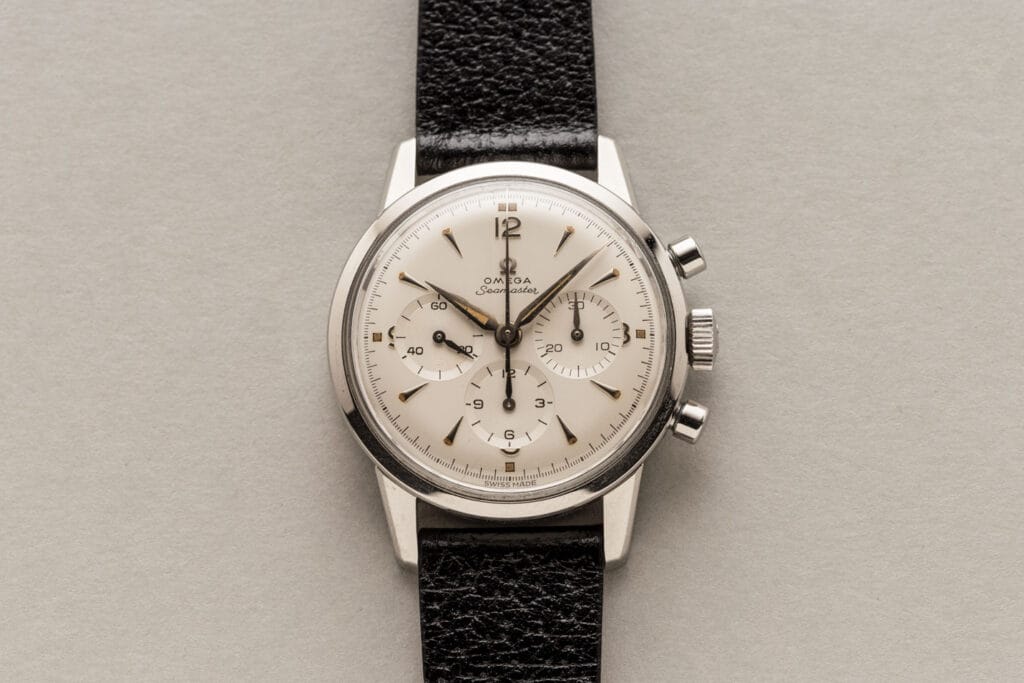
The early 1960s saw Omega riding high on the success of its professional trilogy: the Seamaster 300, Railmaster, and Speedmaster, all introduced in 1957. By 1962, the Speedmaster had proven its technical capabilities, and Omega sought to extend the Caliber 321’s reach into dressier, more versatile chronographs within the Seamaster family. The 105.001 filled this niche, appealing to customers who wanted Caliber 321 performance in a package suitable for both professional and social settings. The watch arrived at a moment when the Seamaster line was expanding rapidly, with dive watches, chronographs, and dress variants all sharing the Seamaster name, creating a broad family rather than a single design language.
Development History
The Seamaster 105.001 was introduced in 1962 as part of Omega’s effort to diversify its chronograph offerings beyond the sport-focused Speedmaster. While the Speedmaster had been on the market since 1957 and was gaining traction with professional users, Omega recognized demand for a more refined chronograph that could serve as both a timing tool and a dress watch. The 105.001 addressed this market need, offering the Caliber 321’s mechanical excellence in a case designed for elegance rather than ruggedness.
Production of the 105.001 appears to have concluded by the mid to late 1960s, likely around 1967-1968, coinciding with Omega’s introduction of the Caliber 861 and the brand’s decision to streamline its chronograph lineup. By this period, the Caliber 321 was becoming increasingly expensive to produce due to its hand-finished components and complex column-wheel construction, prompting Omega to transition toward the more cost-effective and easier-to-manufacture Caliber 861. The 105.001 was not directly replaced by a single successor reference; instead, Omega reorganized its chronograph catalog, with references like the 105.005 and later 145.005 continuing in production with updated styling, and the Caliber 861-powered references taking over the mainstream chronograph segment.
Manufacturing Context
The 105.001 was a significant but not groundbreaking release for Omega. It did not introduce technical firsts or revolutionary complications; rather, it represented a thoughtful application of an existing, proven movement in a new case and dial configuration tailored to a different market segment. The reference fit within Omega’s broader Seamaster catalog as an upmarket chronograph option, positioned above simpler time-only Seamasters but without the overt sporting character of the Speedmaster.
Production volume for the 105.001 was modest compared to high-volume references like the Seamaster 300 or Speedmaster Professional. While exact figures remain unavailable, serial number distribution and current market scarcity suggest the 105.001 was produced in limited quantities, likely in the low thousands over its production lifespan. This limited volume was likely intentional, reflecting the reference’s positioning as a specialized offering within the Seamaster family rather than a mass-market product.
Factory & Production Location
The Seamaster 105.001 and its Caliber 321 movement were manufactured at Omega’s facilities in Biel/Bienne, Switzerland. Omega had acquired Lemania in 1932 as part of the SSIH group (Société Suisse pour l’Industrie Horlogére), which also included Tissot, giving Omega access to Lemania’s movement production capabilities. The Caliber 321 itself was based on the Lemania 2310 (also known as the 27 CHRO C12), an ebauche that Omega finished, decorated, and branded as the Caliber 321.
Cases for the 105.001 were likely sourced from external case manufacturers, a standard practice in the Swiss watch industry. While specific case maker markings (such as Huguenin Freres or Centrale Boites stamps) have not been consistently documented for the 105.001 as they have for other Omega references, the quality and finishing of the cases suggest production by reputable Swiss case specialists. Dials were likely produced by specialized dial manufacturers to Omega’s specifications, with applied indices and printed scales executed by skilled artisans. No significant changes in production location occurred during the 105.001’s lifespan, as Omega maintained consistent manufacturing operations in Biel throughout the 1960s.
Horological Significance
The Seamaster 105.001 is best characterized as a workhorse rather than a groundbreaking or transitional piece. It did not introduce revolutionary technology, nor did it mark a significant departure in design philosophy; instead, it exemplified Omega’s ability to apply proven technology in thoughtful, market-appropriate configurations. The watch’s horological significance lies in its role as a refined application of the Caliber 321, demonstrating that this legendary movement could serve elegant, dress-oriented purposes as effectively as it powered professional timing tools.
The 105.001 occupies a modest but meaningful place in watch history. It is not a milestone reference that redefined chronograph design, but it represents Omega’s depth of catalog during the 1960s, a period when the brand could offer multiple interpretations of the same core movement to different customer segments. For collectors, the 105.001 offers an accessible entry point into Caliber 321 ownership, providing the technical appeal of the Moonwatch movement without the premium pricing that accompanies Speedmaster provenance. This positions the reference as quietly significant: a competent, handsome chronograph that has aged gracefully and now offers collectors substance and value.
Construction & Architecture
The Omega Seamaster 105.001 embodies mid-century chronograph design principles: clean lines, balanced proportions, and restrained detailing that prioritizes legibility and wearability over visual complexity. The watch presents a compact, elegant profile with a 35 to 35.5mm round case, long beveled lugs that extend the visual presence beyond its modest diameter, and a fixed tachymeter bezel integrated into the dial surround. The overall aesthetic is dressy rather than overtly sporty, with polished and brushed case finishing that catches light attractively without appearing ostentatious. The design reflects the early 1960s moment when chronographs were transitioning from specialized instruments to versatile daily companions, blending functionality with refinement.
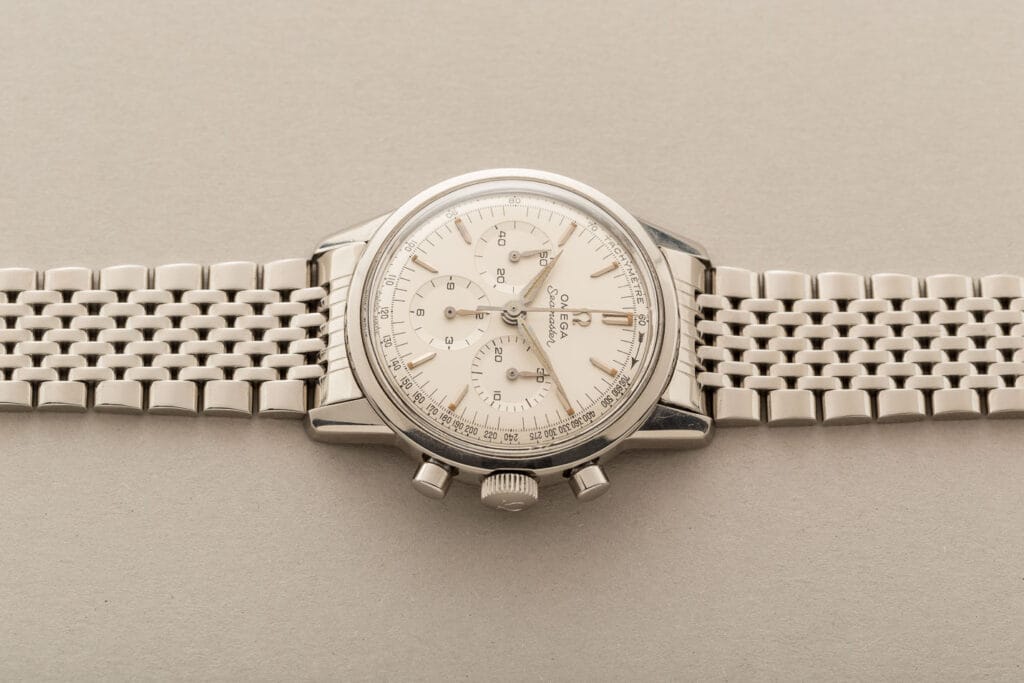
The dial layout follows classic chronograph conventions: three subsidiary registers (running seconds at 9 o’clock, 30-minute counter at 3 o’clock, 12-hour counter at 6 o’clock), applied or printed hour indices, an outer tachymeter scale, and simple, legible hands. The absence of extraneous text or branding keeps the dial uncluttered, allowing the proportions and spacing to speak for themselves. This design philosophy has aged exceptionally well, as the 105.001 reads as timeless rather than dated, a testament to Omega’s design discipline during this period.
Case Design
The 105.001 features a round case measuring between 35mm and 35.5mm in diameter, placing it firmly in the smaller end of vintage chronograph sizing but within the typical range for dress-oriented pieces of the early 1960s. Lug-to-lug measurement ranges from approximately 42.5mm to 43.6mm, providing a balanced wrist presence that avoids the compact, stubby appearance of some smaller vintage watches. Case thickness is approximately 12mm to 12.7mm, a reasonable dimension for a manual-wind chronograph of this era.
The case style is best described as a refined dress chronograph. It lacks the heavy-duty construction and aggressive styling of tool watches like the Speedmaster, instead presenting polished and brushed surfaces, beveled lugs, and a relatively thin profile suitable for wearing under a dress shirt cuff. The case shape is round with long, beveled or teardrop-shaped lugs that taper gracefully from the case body, creating an elegant transition to the strap or bracelet. These lugs are a defining feature of the 105.001, distinguishing it from the straighter, thinner lugs found on the related 105.005 reference.
Case materials offered include stainless steel (most common), gold-plated or gold-filled variants, and solid 14k or 18k yellow gold examples. Stainless steel examples represent the majority of production and are the most accessible in today’s market, while solid gold cases command significant premiums due to their rarity and intrinsic material value. Gold-plated variants occupy a middle ground, offering the aesthetic of gold at a lower price point but with the understanding that plating can wear through with use and age.
Case finishing combines polished and brushed surfaces, with polished top surfaces on the lugs and case flanks contrasting with brushed or matte side surfaces, a typical approach for mid-century Swiss chronographs. Over time and through polishing by previous owners or watchmakers, these original finishing patterns can become softened or lost, reducing the crispness of transitions and rounding lug edges. Collectors prioritize examples that retain sharp, well-defined lugs and visible bevels, as these details confirm limited polishing and better preservation of original proportions.
Cases for the 105.001 were likely sourced from external Swiss case manufacturers, a standard practice in the industry. While specific case maker markings (such as Huguenin Freres or Centrale Boites stamps) have not been consistently documented for the 105.001, the quality and finishing suggest production by reputable specialists. No significant case variations tied to specific sub-references have been widely documented, though minor differences in finishing or lug shaping may exist across production batches.
Dial Variations
The 105.001 was offered with two primary dial colors: silver (or silvered, the most common) and black (significantly rarer). Silver dials feature a matte or slightly textured finish, with applied or printed hour indices, an outer tachymeter scale, and three recessed subsidiary dials with circular graining or concentric patterns. Black dials, while less common, follow a similar layout but were produced in far smaller quantities, making them highly desirable among collectors today.
Dial material is consistent with 1960s Swiss chronograph standards: a metal base (brass or similar) with lacquered or painted surfaces for color and protection. Applied indices are typically steel or gold-toned, matching the case material, and are affixed to the dial via small feet that pass through the dial base. Some dials feature printed rather than applied indices, though applied markers are more commonly associated with higher-grade examples and are generally preferred by collectors for their dimensionality and visual interest.
Lume application on the 105.001 transitioned during its production lifespan. Early examples (primarily 1962 production with serial numbers in the 19 million range) may feature radium-based luminous material, which has aged to a characteristic brownish or cream patina and may lack “T” markings on the dial. By 1963-1964, Omega had transitioned to tritium-based lume, which is typically indicated by “T Swiss T” or “T Swiss Made T” markings at the bottom of the dial. However, some transitional examples from 1962-1963 may have tritium lume without the “T” markings, as the labeling convention was not immediately adopted industry-wide. Lume plots are typically small circles or dots applied to the tips of indices or within the indices themselves, with matching luminous material on the hands.
Signature dial features include the Omega logo applied at 12 o’clock, “Seamaster” text (either printed or applied) typically positioned above 6 o’clock or across the lower dial, and Swiss Made or T Swiss Made T text at the bottom edge. The tachymeter scale runs around the outer edge of the dial, with numerals and hash marks indicating speed measurement capability for the chronograph function.
Service dial differences are a significant consideration for collectors. Omega service centers replaced dials that showed damage, aging, or lume degradation, often installing later-production dials with updated printing, lume types, or text configurations that may not match the original specifications for the watch’s serial number. Common service dial indicators include modern LumiNova lume on a 1960s-era watch (LumiNova was not introduced until the late 1990s), overly uniform or fresh-looking dial surfaces on an otherwise aged watch, incorrect font weights or styles, and missing or incorrect dial codes on the reverse side of the dial. Collectors place significant value on original, untouched dials with age-appropriate patina, even if that patina includes minor spotting, tropical toning, or lume degradation, as these characteristics confirm originality.
Hands
The 105.001 was equipped with multiple hand styles over its production run, reflecting both design evolution and potential service replacements. Original hand styles include alpha hands (tapered, leaf-shaped with pointed tips, commonly found on earlier examples and transitional models), baton hands (simple, rectangular batons with blunt tips), and dauphine hands (faceted, diamond-shaped with sharp, tapered profiles). Some examples feature a combination of baton main hands with alpha or baton subsidiary hands on the chronograph registers, though the correctness of mixed hand sets varies by production period and serial number.
Hand materials and finishing are typically steel for stainless steel cases and gold-tone for gold-plated or solid gold cases, maintaining consistency with the case material. Hands are either polished to a mirror finish or brushed, with polished variants being more common and visually legible against the dial.
Lume application on hands mirrors the dial: early examples feature radium-based lume that has aged to cream or brown, while later examples use tritium lume with a characteristic greenish or yellowish patina. The lume on hands should ideally match the aging and color of the lume plots on the dial, as significant mismatches suggest service replacement hands. Original hands that have aged alongside the dial present a harmonious, cohesive appearance, while replacement hands often show different lume color, application technique, or aging characteristics.
Hand variations across production years or sub-references are not exhaustively documented, but collectors have observed that earlier serial numbers (19 million range) more commonly feature alpha or mixed hand sets, while later examples (low 20 million range) trend toward fully baton hand sets. Verification requires careful comparison with documented examples and consultation with Omega archives or expert references when available.
Crown
The 105.001 features a push-pull crown rather than a screw-down crown, consistent with dress chronograph standards of the early 1960s. The crown is round, relatively small in diameter, and typically finished to match the case material: polished or brushed steel for stainless cases, gold-tone for gold-plated or gold-filled cases, and solid gold for 18k or 14k gold variants.
The crown is signed with the Omega logo, either embossed or engraved on the crown’s outer surface. Crown dimensions are modest, proportionate to the 35 to 35.5mm case, and do not protrude aggressively, maintaining the watch’s low-profile, dress-oriented aesthetic. No significant crown variations tied to specific sub-references or production periods have been widely documented, though service replacement crowns from later periods may differ in logo style, depth, or finish compared to original crowns.
Crystal
The 105.001 is equipped with an acrylic (plexiglass) crystal, the standard material for Swiss watches of the early 1960s. The crystal is typically domed, providing a classic, vintage aesthetic and reducing the visual impact of the bezel by allowing the dial to sit closer to the viewer’s eye. Acrylic crystals are not signed with the Omega logo in the center, a feature that would become more common on later references and modern reissues.
Crystal shape is dome or slightly domed, following the natural curve of the case and bezel. Flat crystals are not correct for the 105.001 and suggest replacement with an incorrect part. Crystal manufacturers and specific part numbers for original 105.001 crystals are not widely documented in available sources, though Omega service documentation and parts catalogs would contain this information.
No crystal changes over the production lifespan of the 105.001 have been definitively documented. Acrylic remained the standard material throughout the reference’s run, with sapphire crystal adoption at Omega not occurring until decades later.
Bracelet & Strap Options
Original bracelet options for the 105.001 include the Omega reference 1502 “beads of rice” bracelet, a five-row stainless steel design with articulated, rounded links that resemble grains of rice. This bracelet is highly desirable among collectors for its period-correct styling, comfort, and visual elegance. Endlinks for the 1502 bracelet are typically marked with “11” or “12” on their reverse side, indicating the specific variant designed to fit the 105.001’s lug width and case profile.
Bracelet materials match the case: stainless steel for steel cases, gold-plated or gold-filled for gold-plated cases, and solid gold for 14k or 18k gold variants. The 1502 bracelet features a folding clasp, often signed with the Omega logo, and may include micro-adjustment holes or a basic friction-fit design depending on the production period.
Original strap options include leather straps, typically in black or brown, with Omega-signed buckles in steel or gold-tone to match the case. Lug width for the 105.001 is 18mm, the standard size for straps and bracelets, ensuring compatibility with a wide range of aftermarket and vintage strap options.
Bracelet and strap variations tied to specific sub-references or case materials are logical: stainless steel cases were offered with steel 1502 bracelets or leather straps, gold-plated cases with gold-plated bracelets or leather straps with gold-tone buckles, and solid gold cases with solid gold mesh or integrated bracelets (less common) or premium leather straps with solid gold buckles.
Sub-Reference Summary Table
| Sub-Reference | Case Material | Dial Variant | Bezel Type | Bracelet/Strap | Notes |
|---|---|---|---|---|---|
| 105.001-62 | Stainless steel | Silver | Fixed tachymeter | 1502 bracelet or leather | Most common variant |
| 105.001-62 | Stainless steel | Black | Fixed tachymeter | 1502 bracelet or leather | Rare, highly collectible |
| 105.001-62 | Gold plated | Silver | Fixed tachymeter | Gold-plated bracelet or leather | Mid-tier variant |
| 105.001 | 14k yellow gold | Silver | Fixed tachymeter | Gold mesh or leather | Rare, solid gold |
| 105.001 | 18k yellow gold | Silver | Fixed tachymeter | Gold mesh or leather | Very rare, solid gold |
The “-62” suffix likely indicates a specific case design or production year variant (1962), consistent with Omega’s practice of appending two-digit codes to reference numbers to denote iterations or case styles. Not all 105.001 examples carry the “-62” suffix in caseback stampings, suggesting possible variation in how Omega applied or documented sub-reference codes during this transitional period in their numbering system.
Reference Key, Variations & Sub-References
Understanding the Omega Seamaster 105.001’s reference structure, production variations, and correct component pairings is essential for authentication, valuation, and informed collecting. The 105.001 was produced during a period when Omega was transitioning from alphanumeric reference codes (CK, MI, OT) to a six-digit numerical system, making reference taxonomy slightly less standardized than later periods. Collectors must recognize how reference numbers encode case design, production iterations, and material choices, and how seemingly identical reference numbers can encompass multiple distinct configurations due to dial changes, hand updates, and movement variations over the production run.
Decoding reference numbers, recognizing production variations, and identifying correct component pairings are critical skills for avoiding overpaying for compromised examples or missing opportunities to acquire undervalued pieces with correct, original specifications. The 105.001’s relatively short production window and limited documentation compared to Speedmaster references mean that collectors must rely on serial number analysis, dial details, and comparison with verified examples to establish originality.
Taxonomy & Nomenclature Decoding
The Omega Seamaster 105.001 reference number follows Omega’s early 1960s six-digit system, which encoded basic information about the watch but lacked the extensive detail of later PIC and PIC14 systems.
Reference Number Breakdown: 105.001
- 1: Indicates a gent’s (men’s) watch, the first digit in Omega’s system for identifying watch size and target market.
- 0: Suggests a round case with screw-back construction, the second digit typically encoding case shape.
- 5: Denotes water-resistant or “Seamaster” family case construction, the third digit identifying the general case type or collection.
- .001: The final three digits specify the particular model variant within the broader 105.XXX series, with .001 indicating the base model chronograph with Caliber 321.
Suffix: -62
The “-62” suffix frequently seen on 105.001 casebacks (written as 105.001-62) likely indicates a specific case iteration or production year (1962), a common practice at Omega during this period. The suffix does not necessarily denote functional differences but may reflect minor case design updates, supplier changes, or production batch identifiers.
Evolution of Numbering
The 105.001 was introduced during the early years of Omega’s six-digit MAPICS system (Management Program for Integrated Control Systems), which Omega adopted in 1962 to replace the earlier alphanumeric CK/MI/OT system. This transition was industry-wide, as Swiss manufacturers sought more systematic cataloging for expanding product lines. The 105.001’s reference number is straightforward by design, reflecting the relatively simple product matrix of early 1960s chronographs before complications, materials, and dial options proliferated in later decades.
The Mark (MK) System
The “Mark” system, commonly used by collectors to differentiate production iterations of Rolex and other brands, is not formally applied to the Omega Seamaster 105.001 in available documentation or collector literature. Unlike the Speedmaster, which has extensively documented Mark variants (MK1, MK2, MK3 dials), the 105.001’s shorter production run and more limited collector focus mean that dial iterations have not been systematically cataloged and labeled.
However, dial variations do exist within the 105.001 production, reflecting changes in printing techniques, lume application, and text configurations. Collectors should examine:
Dial Iterations:
- Early dials (1962, serial numbers in 19 million range): May feature radium lume without “T” markings, slightly different font weights or styles, and specific dial codes on the reverse side.
- Later dials (1963-1964, serial numbers in 20 million range): Typically feature tritium lume with “T Swiss T” or “T Swiss Made T” markings, updated printing, and potential minor changes in logo size or text positioning.
Hands and Indices:
- Variations in hand styles (alpha vs. baton) may correlate with production periods, though this is not definitively established.
- Lume plot sizes and application techniques may vary slightly across production batches, though “maxi dial” variants (larger lume plots) are not documented for the 105.001 as they are for Speedmaster references.
Without a formal Mark system, collectors must rely on detailed photography, serial number correlation, and comparison with verified examples to identify specific dial iterations. A comprehensive Mark system for the 105.001 would require access to Omega archives, extensive serial number and dial code analysis, and collaboration among collectors to establish production timelines and corresponding dial details.
Sub-References & Transitional Models
The 105.001 does not have extensively documented sub-references in the manner of Speedmaster or Seamaster 300 variants, but related references and transitional models provide context for understanding its place in Omega’s chronograph lineup.
Related References:
- 105.002: A rare transitional Speedmaster reference produced for approximately six months in 1962, featuring a step dial, DON (Dot Over Ninety) bezel, and alpha or baton hands. The 105.002 is a Speedmaster, not a Seamaster, but shares the 105.XXX reference structure and production timing, making it a useful comparison point. The 105.002’s rarity (estimated production in the hundreds) and transitional status have made it highly collectible.
- 105.003: The “Ed White” Speedmaster, introduced in 1962-1963, featuring baton hands, a step dial, and asymmetrical case with crown guards. Again, a Speedmaster rather than a Seamaster, but relevant for understanding Omega’s chronograph evolution in the early 1960s.
- 105.005: A Seamaster chronograph with straight, thin lugs rather than the 105.001’s beveled, teardrop lugs, introduced around 1962-1966. The 105.005 shares the Caliber 321 and general chronograph layout but presents a distinctly different aesthetic. Later examples feature “De Ville” rather than “Seamaster” dial text, reflecting Omega’s 1967 decision to split the De Ville into its own collection.
- 145.005: Replaced the 105.005 in the mid to late 1960s, continuing with Caliber 321 and similar styling. The 145.XXX prefix indicates a later production period and updated case construction.
Transitional References:
The 105.001 itself may include transitional examples from 1962 that bridge earlier CK-prefix Seamaster chronographs and the fully standardized six-digit system, though specific examples are not well-documented in available sources.
“Franken” vs. Factory Anomalies:
The vintage Omega market includes “Frankenwatch” examples assembled from mismatched parts, either by unscrupulous sellers or well-meaning but uninformed owners who replaced damaged components with incorrect parts. Distinguishing factory-correct anomalies from aftermarket modifications requires careful examination:
- Factory anomalies: Watches with unusual but period-correct pairings, such as a 1962 case with 1963 movement due to factory assembly timing, or a silver dial case that received a black dial at the point of sale due to customer request. These are legitimate and can be verified through Omega archives if documentation is available.
- Franken examples: Watches with components from different references, production periods, or incorrect specifications, such as a 105.001 case with a later Caliber 861 movement, a 1960s case with a modern service dial featuring LumiNova, or mismatched hands and dial lume. These configurations reduce value significantly and should be avoided unless priced accordingly as “projects” or parts watches.
Service Parts:
Omega service centers replaced worn or damaged components with whatever parts were available at the time of service, which may not match the original specifications for the watch’s serial number. Common service replacements include dials (often with updated lume, printing, or text), hands (potentially in incorrect styles or with modern lume), crowns, pushers, and crystals. Identifying service parts requires comparing the watch against documented original examples and noting any anachronisms (modern lume on a 1960s case, incorrect font weights, etc.).
Transitional pieces can affect collectibility positively or negatively. A well-documented factory transitional watch with unusual but correct specifications may carry a premium due to rarity and historical interest. Conversely, an undocumented or unverifiable transitional configuration may raise suspicion and reduce value unless supported by Omega archival evidence.
Case & Component Codes
Understanding internal case markings, bracelet codes, and component pairings is essential for verifying originality and identifying correct configurations for the 105.001.
Caseback Stamps:
The inside of the caseback on a 105.001 typically features:
- Reference number: 105.001 or 105.001-62, stamped or engraved.
- Serial number: The case serial number, typically seven or eight digits, which may differ from the movement serial number if the case and movement were paired later in production or during service.
- Material codes: Indicators of case material or water resistance, such as “WATERPROOF” or “WATER-RESISTANT” text.
- Case maker stamps: Small logos or codes indicating the case manufacturer (e.g., Huguenin Freres, Centrale Boites), though these are not consistently present on all 105.001 examples.
Bracelet and End-Link Pairings:
The Omega 1502 “beads of rice” bracelet is the correct period bracelet for the 105.001. Correct end-link codes for the 1502 bracelet include:
- No. 11: Common end-link variant for 18mm lug width cases.
- No. 12: Alternative end-link variant, also fitting 18mm lug widths.
End-link codes are typically stamped on the reverse side of the end-link piece and should match the bracelet reference. Mismatched or unmarked end-links suggest replacement with incorrect or generic parts.
| Bracelet Reference | End-Link Code | Lug Width | Case Material Compatibility |
|---|---|---|---|
| 1502 | No. 11 | 18mm | Stainless steel |
| 1502 | No. 12 | 18mm | Stainless steel |
| 1502 (gold-plated) | No. 11 or No. 12 | 18mm | Gold-plated |
Clasp Codes:
The clasp on an Omega 1502 bracelet may feature:
- Omega logo: Stamped or embossed on the outer clasp surface.
- Date codes: Some clasps include letter codes indicating production year, though this system is not universally applied to all 1960s bracelets.
Dating the bracelet separately from the watch head is challenging for 1960s Omega bracelets, as the letter-code system documented for later periods was not consistently used in the early 1960s.
Material & Production Batches
Material-specific details and batch variations are less exhaustively documented for the 105.001 than for more heavily collected references, but collectors should be aware of key considerations.
Metal Variations:
- Stainless steel: The most common case material, typically 316L stainless steel, the industry standard for Swiss watches of the period.
- Gold-plated or gold-filled: Cases with a layer of gold bonded over a base metal (steel or brass), providing the aesthetic of gold at lower cost. Gold plating thickness varies, with gold-filled cases offering thicker, more durable gold layers than simple electroplating. Wear-through of gold plating is common on high-contact areas (lugs, case edges), reducing aesthetic appeal but not affecting functionality.
- 14k or 18k solid gold: Rare and valuable, with intrinsic material value driving premiums. Solid gold cases should be hallmarked with fineness stamps (585 for 14k, 750 for 18k) and may include additional maker marks or import codes depending on the market for which the watch was produced.
Batch-Specific Patina:
Certain serial ranges or production batches may exhibit characteristic aging patterns due to variations in dial lacquer formulation, lume composition, or environmental exposure. Documented examples include:
- Tropical dials: Dials that have aged from their original silver or black color to brown, chocolate, or bronze tones due to UV exposure or chemical reactions in the lacquer. Tropical dials are highly desirable among collectors for their unique appearance and rarity, often commanding significant premiums over standard examples.
- Spider dials: Dials with fine cracking or crazing patterns in the lacquer, resembling a spider web, resulting from lacquer degradation over time. Spider dials are divisive: some collectors prize them for their distinctive character, while others view them as damaged and undesirable.
Specific serial ranges associated with tropical or spider dials for the 105.001 are not well-documented in available sources, likely due to the reference’s limited production and collector base compared to Speedmaster variants. Collectors encountering unusual dial aging should verify authenticity through comparison with documented examples and consider whether the patina enhances or detracts from the watch’s appeal and value.
Movements & Calibers
The Omega Caliber 321 is the defining feature of the Seamaster 105.001, representing one of the most respected and historically significant chronograph movements in watchmaking history. Introduced in 1946 (initially as the 27 CHRO C12) and continuing in production until 1968, the Caliber 321 powered not only the Seamaster 105.001 but also the early Speedmaster references that accompanied astronauts to the moon, cementing its reputation as a reliable, high-performance chronograph movement. For collectors, the Caliber 321 is a major draw: it offers column-wheel chronograph construction, hand-finished details, and a proven track record of durability and accuracy, all in a movement that predates the cost-cutting and automation of later decades.
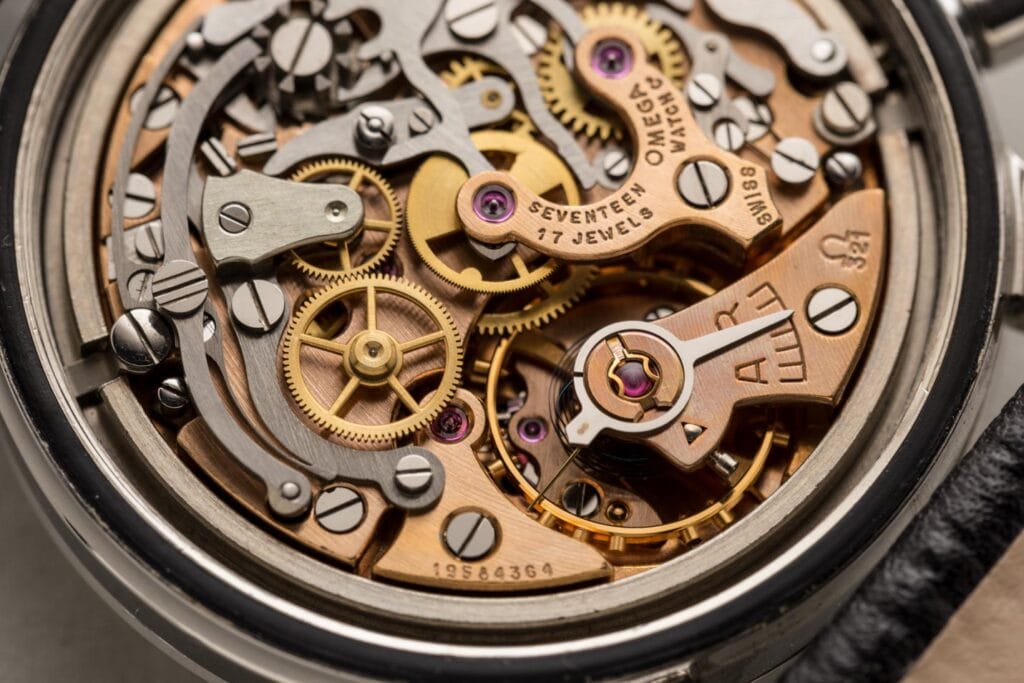
The 105.001 used the Caliber 321 exclusively throughout its production run, with no documented transitions to other movements. This consistency simplifies authentication and ensures that every 105.001 with an original movement offers the same mechanical pedigree. The Caliber 321’s desirability has increased significantly in recent years, driven by Omega’s 2019 announcement that it would recommence production of the movement for modern reissue Speedmasters, bringing renewed attention to vintage examples.
Caliber Overview & Production Periods
The Omega Caliber 321 was used in the Seamaster 105.001 from the reference’s introduction in 1962 through its discontinuation in the mid to late 1960s. No caliber changes occurred during this period; all 105.001 examples equipped with original movements feature the Caliber 321.
The Caliber 321 is based on the Lemania 2310 (also known as the 27 CHRO C12), an ebauche (movement blank) developed by Lemania in the 1940s. Lemania became part of the SSIH group (Société Suisse pour l’Industrie Horlogére) in 1932, which also included Omega and Tissot, giving Omega access to Lemania’s movement production capabilities. Omega finished, decorated, and branded the Lemania 2310 as the Caliber 321, adding its own refinements and quality control standards.
The Caliber 321 was also used by other prestigious manufacturers, including Patek Philippe (as the basis for the CH 27-70), Vacheron Constantin (Caliber 1140), Breguet (Caliber 533.3), and Roger Dubuis, attesting to the movement’s quality and desirability. This cross-brand adoption is highly unusual and speaks to the Lemania 2310’s excellence as a chronograph platform.
| Caliber | Production Years in 105.001 | Movement Origin | Reason for Use |
|---|---|---|---|
| Omega 321 | 1962 – mid to late 1960s | Lemania 2310 ebauche, finished by Omega | High-grade manual chronograph with column-wheel construction, proven reliability |
The Caliber 321 was replaced in Omega’s chronograph lineup by the Caliber 861 (based on the Lemania 1873) in 1968, a decision driven by the 861’s simpler construction, lower production costs, and easier serviceability. The 861 uses a cam-and-lever chronograph system rather than the 321’s column wheel, reducing complexity but also eliminating some of the tactile refinement and visual elegance that collectors prize in column-wheel movements.
Key Features & Complications
The Caliber 321 offers the following functional features:
Hacking: The Caliber 321 does not feature a hacking (stop-seconds) function. When the crown is pulled to the time-setting position, the balance continues to run, making precise time synchronization more challenging. Hacking was not a standard feature on chronograph movements of this era and is not expected by collectors.
Quickset Date or Day-Date Mechanisms: The Caliber 321 is a time-only movement with chronograph functions; it does not include date, day-date, or other calendar complications. All 105.001 examples are time-only with chronograph.
Chronometer Certification: The Caliber 321 in the 105.001 was not typically submitted for COSC chronometer certification, unlike some Speedmaster examples. Chronometer certification is not expected for the 105.001, and the absence of “Chronometer” text on the dial is correct.
Complication Functions: The Caliber 321 provides:
- Central chronograph seconds hand: Sweeps the dial in one-fifth second increments, allowing timing to 1/5th of a second.
- 30-minute counter: Registers elapsed minutes up to 30 minutes at the 3 o’clock position.
- 12-hour counter: Registers elapsed hours up to 12 hours at the 6 o’clock position.
- Running seconds: Small seconds subdial at 9 o’clock displays continuous seconds independent of chronograph operation.
Features Collectors Prioritize: Collectors value the Caliber 321 for its column-wheel chronograph construction, which provides a smoother, more refined feel when operating the chronograph pushers compared to cam-and-lever systems. The column wheel is visible through the movement and adds visual appeal for collectors who appreciate mechanical sophistication. The Breguet overcoil hairspring is another highly regarded feature, offering superior timekeeping performance and isochronism (consistent rate in different positions) compared to flat hairsprings. Finally, the copper or rose-gold galvanic coating applied to the movement bridges and plates (original to the 321, not a later addition) gives the movement a distinctive, warm appearance that collectors find aesthetically appealing.
Caliber Evolution & Variants
The Caliber 321 used in the 105.001 did not undergo significant evolution or variant development during the reference’s short production run. The movement remained mechanically consistent from 1962 through the mid to late 1960s, with only minor differences in finishing or component suppliers that do not affect functionality or collector desirability.
Incremental Improvements: No documented incremental improvements (updated escapement, improved shock protection, enhanced power reserve) specific to the 321 in the 105.001 are available. The movement’s design was mature by 1962, having been in production since 1946, and Omega did not introduce significant updates before discontinuing it in favor of the Caliber 861.
Visual Differences Between Caliber Generations: The Caliber 321 in the 105.001 should feature the characteristic copper or rose-gold galvanic coating on the bridges and plates, a hallmark of original 321 movements. Modern recreations of the Caliber 321 use Sedna gold PVD coating instead of the original copper galvanic process, resulting in a slightly deeper red coloration. For vintage 105.001 examples, the presence of the copper-toned finish confirms originality; movements with bright, uncoated brass or nickel-plated bridges suggest replacement with incorrect parts or service interventions.
Sub-Variants of the Same Base Caliber: The Caliber 321 was not produced in decorated vs. standard variants for the 105.001. All 105.001 movements feature the same finishing and decoration level, consistent with Omega’s quality standards for the period. Date vs. no-date variants do not apply, as the Caliber 321 is a time-only chronograph movement.
Caliber variants do not significantly affect collectibility for the 105.001, as the movement remained consistent throughout production. Collectors should prioritize originality: a correctly finished, copper-toned Caliber 321 with matching serial numbers is more valuable than a movement with replaced parts, incorrect finishing, or evidence of heavy wear or poor servicing.
Movement Markings & Identification
Identifying and authenticating the Caliber 321 in a 105.001 requires examining movement markings, serial numbers, and finishing details.
Caliber Number Location and Format: The Caliber 321 designation is typically engraved on the movement bridge, though the specific location can vary. Collectors should look for “CAL. 321” or “CALIBRE 321” stamped on one of the visible bridges when the caseback is removed.
Serial Number Placement: The movement serial number is engraved on one of the movement bridges, typically an eight-digit number. This serial number is independent of the case serial number and can be used to date the movement separately from the case, which is useful for verifying that the case and movement are from the same production period. Movement serial numbers in the 19 million range correspond to 1962, while numbers in the 20 million range indicate 1963-1964 production.
Manufacturer Stamps or Logos: The Caliber 321 features the Omega logo stamped or engraved on the movement, typically on the rotor bridge or balance cock. The movement may also include “SWISS MADE” text or “SEVENTEEN JEWELS” / “17 JEWELS” engraving, confirming the jewel count.
Adjustment Markings: High-grade Caliber 321 movements may feature adjustment markings indicating regulation in multiple positions (e.g., “ADJUSTED TO 5 POSITIONS,” “ADJUSTED TO TEMPERATURE”), though these are not universally present on all 105.001 examples. Adjustment markings increase desirability by confirming higher-grade regulation and quality control.
Chronometer Certification Engravings: The Caliber 321 in the 105.001 typically does not carry chronometer certification engravings, as COSC certification was not standard for this reference. If a movement features chronometer markings, collectors should verify authenticity, as this may indicate a movement swap or incorrect replacement.
Service Markings: Service centers often mark movements with scratches, punch marks, or engraved codes indicating service dates, watchmaker initials, or parts replacements. While service markings confirm that a watch has been maintained, they can also indicate that non-original parts have been installed, reducing originality. Collectors should examine service markings carefully and, if possible, obtain service records or documentation confirming correct parts usage.
Authentication Guide
Authenticating a vintage Omega Seamaster 105.001 requires evaluating multiple components together: dial, hands, case, movement, and overall consistency between serial numbers, production periods, and correct specifications. The vintage watch market includes refinished parts, incorrect replacements, service modifications, and outright fakes, making authentication skills essential for protecting against overpaying for compromised examples. A single incorrect detail: a modern service dial, replacement hands with mismatched lume, or a movement from the wrong era can indicate a problematic watch that should either be avoided or negotiated down significantly in price.
Authentication is not about demanding perfection. Vintage watches age, wear, and require service, and some degree of patina, wear, and service history is expected and acceptable. The goal is to identify watches that retain their original components in honest, well-preserved condition, avoiding examples that have been heavily modified, refinished, or assembled from mismatched parts.
Dial Authentication
Identifying correct and original dials for the Omega Seamaster 105.001 requires careful examination of dial finish, printing quality, lume characteristics, and aging patterns.
Correct Dial Variations for Specific Production Years:
- 1962 (serial numbers in 19 million range): Silver or black dials with radium lume (no “T” markings, or possibly “SWISS MADE” without “T”s), applied or printed indices, tachymeter scale on outer edge.
- 1963-1964 (serial numbers in 20 million range): Silver or black dials with tritium lume (“T SWISS T” or “T SWISS MADE T” markings), applied or printed indices, tachymeter scale.
Printing Quality and Characteristics: Original 105.001 dials feature sharp, precise printing with consistent ink density and alignment. Fonts should be crisp and well-defined, with no bleeding, smudging, or unevenness. The Omega logo, “Seamaster” text, and Swiss Made markings should be cleanly applied, with no signs of modern reprinting or overly perfect, “too good to be true” sharpness that suggests refinishing.
Applied Indices: Applied indices should be correctly shaped (typically baton or dart shapes), properly attached via small feet that pass through the dial base, and finished to match the case material (steel or gold-tone). Loose, misaligned, or replacement indices are red flags suggesting dial damage or incorrect restoration.
Lume Plots: Lume plots should be correctly sized, shaped, and positioned for the dial variant, with aging and patina consistent across all plots and matching the lume on the hands. Radium lume ages to cream, brownish, or yellowish tones, while tritium ages to greenish, yellowish, or pale cream, depending on environmental exposure and time. Modern LumiNova lume (bright white or green when uncharged, glowing bright green or blue under UV light) is incorrect for a 1960s watch and indicates a service dial or aftermarket replacement.
Overall Aging and Patina: Original dials age gracefully, developing subtle toning, minor spotting, or tropical coloration (browning or bronzing) due to UV exposure or chemical reactions in the lacquer. Refinished dials, by contrast, often appear overly uniform, with perfectly even color, no patina, and suspiciously pristine printing that lacks the subtle imperfections and variations of original dials.
Signs of Refinished or Service Replacement Dials:
- Overly uniform color or finish: Original dials develop subtle variations in tone and texture with age; refinished dials look “too perfect”.
- Incorrect font weights or styles: Service dials may use updated fonts or printing techniques that differ from original specifications.
- Modern lume on vintage-era watches: LumiNova lume on a 1960s watch is a definitive sign of a service dial.
- Missing or incorrect dial codes and stampings on the dial back: Original dials feature codes stamped on the reverse side indicating dial manufacturer, style, and production details; service dials may lack these codes or feature incorrect codes.
- Text or logos that appear too crisp or perfect for the stated age: Sixty-year-old printing should show some degree of aging, fading, or micro-cracking; overly sharp printing suggests refinishing.
Collectors should compare any 105.001 dial against documented original examples, consult with experienced collectors or dealers, and, when in doubt, request dial removal and inspection of dial codes or consult Omega archives for verification.
Font & Logo Authentication
Typography and branding elements on the 105.001 dial are critical authentication details, as fonts, logo styles, and text positioning changed over time and vary between original and service dials.
Brand Logo Evolution: The Omega logo on the 105.001 is typically applied (a three-dimensional metal logo affixed to the dial) and positioned at 12 o’clock. The logo should feature the characteristic Omega symbol (Ω), correctly proportioned and finished to match the dial and case material. Logo size should be consistent with original examples from the same production period; oversized or undersized logos suggest refinishing or incorrect replacement.
Font Styles for Model Names and Text: “Seamaster” text is typically printed or applied in a serif or sans-serif font, depending on the production year. Early examples may feature a “coat-hanger S” style, a distinctive serif character seen on some 1960s Seamaster dials. Later examples trend toward simpler, sans-serif fonts. The font weight, spacing, and alignment should match documented original examples; variations suggest service dials or refinishing.
Depth Markers Text Format: The tachymeter scale on the outer edge of the dial features numerals and hash marks for speed measurement. Numerals should be correctly sized, spaced, and printed in a font consistent with the period. No “meters first” vs. “feet first” variations apply to the 105.001, as the reference does not feature depth ratings or water resistance markings on the dial.
Signature Text Details: “Swiss Made” or “T Swiss Made T” text appears at the bottom edge of the dial, below 6 o’clock. Correct configurations:
- SWISS MADE (no “T”s): Indicates radium lume, typically on 1962 examples.
- T SWISS T or T SWISS MADE T: Indicates tritium lume, typically on 1963-1964 and later examples.
The text should be cleanly printed, correctly positioned (centered or slightly off-center, depending on production period), and proportionate to the dial size. Incorrect text configurations (e.g., “T Swiss T” on a watch with radium lume, or “Swiss Made” on a watch with modern LumiNova) indicate service replacement dials or incorrect restoration.
Collectors should examine fonts and logos under magnification (loupe or macro photography) to identify printing quality, font accuracy, and alignment. Comparison with documented original examples is essential for establishing correctness.
Hands Authentication
Original, period-correct hands are a critical component of an authentic 105.001, as replacement hands significantly reduce value and indicate previous service interventions.
Correct Hand Styles for Each Production Period: The 105.001 was equipped with alpha, baton, or dauphine hands, depending on production year and case configuration. Correct hand styles:
- Alpha hands: Tapered, leaf-shaped with pointed tips, commonly found on earlier examples (1962).
- Baton hands: Simple, rectangular batons with blunt tips, used on mid-production examples.
- Dauphine hands: Faceted, diamond-shaped with sharp, tapered profiles, elegant and dressy.
Hand style should be consistent with the watch’s serial number, dial configuration, and production period. Mixed hand sets (e.g., baton main hands with alpha register hands) may be correct for certain production periods but should be verified against documented examples.
Hand Finishing and Material: Hands should be finished to match the case material: polished or brushed steel for stainless steel cases, gold-tone for gold-plated or solid gold cases. Hand surfaces should be smooth, evenly finished, and free of scratches, corrosion, or discoloration. Replacement hands often show different finishing techniques, incorrect materials, or modern manufacturing characteristics that differ from original 1960s craftsmanship.
Lume Type and Appearance by Era: Hands should feature lume that matches the dial: radium (cream, brownish, or yellowish aging) for early 1962 examples, tritium (greenish, yellowish, or pale cream aging) for 1963-1964 examples. Modern LumiNova lume (bright white or green when uncharged, glowing bright green or blue under UV light) is incorrect and indicates replacement hands.
Correct Aging Characteristics for Original Lume: Lume on original hands ages alongside the dial, developing consistent patina, color, and texture. Lume should show some degree of cracking, shrinkage, or discoloration consistent with 60 years of aging. Fresh, perfectly smooth lume suggests replacement or re-luming.
How to Identify Replacement Hands:
- Incorrect proportions: Replacement hands may be slightly too long, too short, or incorrectly shaped compared to original hands.
- Mismatched lume color compared to dial: Hands with different lume aging or color than the dial indicate replacement.
- Modern lume on vintage-era pieces: LumiNova or Super-LumiNova on a 1960s watch confirms replacement hands.
- Incorrect finishing or material: Hands with brushed finish on a polished dial watch, or vice versa, suggest replacement.
Collectors should carefully compare hands against dial lume under natural and UV light, examine hand proportions and styles against documented examples, and note any inconsistencies in aging or finish.
Crown Authentication
Original crowns are less commonly discussed in 105.001 authentication guides than dials or hands, but incorrect crowns can indicate service replacements or modifications.
Correct Crown Style for the Reference: The 105.001 features a push-pull crown (not screw-down), round, and relatively small in diameter, proportionate to the 35 to 35.5mm case. The crown should be signed with the Omega logo, either embossed or engraved on the outer surface.
Crown Dimensions and Proportions for Each Production Period: No significant crown size changes across the 105.001’s production period are documented. Crowns should be modest, not oversized, and should sit flush or slightly proud of the case flank when pushed in.
Logo or Signature Details on Signed Crowns: The Omega logo on the crown should be correctly proportioned, sharply defined, and centered on the crown surface. Worn, faded, or poorly executed logos suggest replacement crowns from later periods or aftermarket sources.
Crown Tube Compatibility and Correct Threading: The crown should screw smoothly onto the crown tube (if threaded for attachment purposes, though the 105.001 is not a screw-down crown for water resistance). Loose, binding, or incorrectly fitting crowns suggest replacement with incorrect parts.
Common Replacement Crowns Found on the Market: Service replacement crowns from later Omega references or generic aftermarket crowns are common on 105.001 examples that have been serviced. These crowns may differ in size, logo style, or finishing compared to original crowns. Collectors should compare crowns against documented original examples and note any discrepancies.
Case Authentication
Verifying correct case style and originality requires examining case dimensions, lug style, finishing, caseback markings, and serial numbers.
Correct Case Shape and Dimensions for the Reference: The 105.001 features a round case measuring 35mm to 35.5mm in diameter, with long, beveled or teardrop-shaped lugs and a case thickness of approximately 12mm to 12.7mm. Case proportions should match documented examples, with no signs of stretching, reshaping, or resizing that would alter original dimensions.
Lug Style and Proportions: Lugs should be long, gracefully beveled from the case body to the strap attachment points, and feature sharp, well-defined edges. Lug holes for strap attachment are drilled through the lugs from top to bottom, a standard construction for 1960s Omega cases. Lug thickness and shape should be consistent with original specifications; thin, rounded, or soft-edged lugs suggest heavy polishing or reshaping.
Case Finishing by Production Period: The 105.001 features polished top surfaces on lugs and case flanks, with brushed or matte side surfaces providing contrast. Original finishing should show crisp transitions between polished and brushed areas, with no blending or softening of edges. Over-polished cases lose these transitions, appearing uniformly polished and lacking the visual definition of original finishing.
Caseback Style and Engravings: The caseback is screw-down, featuring three notches on the outer edge for a case-opening tool. The outside of the caseback may feature:
- “SEAMASTER” text.
- “WATERPROOF” or “WATER-RESISTANT” text.
- Omega logo or seahorse emblem (less common on 105.001 casebacks but seen on other Seamaster references).
Inside the caseback, collectors should find the reference number (105.001 or 105.001-62), case serial number, and possibly material or water resistance codes.
Case Serial Number Placement and Format: The case serial number is stamped or engraved inside the caseback, typically a seven or eight-digit number. The serial number should be cleanly executed, evenly spaced, and consistent with Omega’s stamping style for the period. Poorly executed, re-struck, or altered serial numbers indicate caseback replacement, re-stamping (a fraudulent practice), or case swapping.
Between-the-Lugs Stampings and Reference Codes: Some Omega references feature additional stampings between the lugs (visible when the bracelet or strap is removed), though this practice is not consistently documented for the 105.001. Collectors should examine between-the-lugs areas for any codes, markings, or stamps that may provide additional verification of originality.
Signs of Case Polishing or Reshaping: Heavy polishing softens lug edges, reduces case dimensions, and eliminates the crisp bevels and transitions between polished and brushed surfaces. Warning signs include:
- Soft, rounded lug edges: Original lugs should have sharp, well-defined edges.
- Reduced lug thickness: Over-polishing removes material, making lugs thinner and more fragile.
- Altered proportions: Cases that appear “off” in proportions compared to documented examples may have been reshaped or over-polished.
- Loss of definition between polished and brushed areas: Original cases show clear transitions; over-polished cases appear uniformly polished.
Collectors should examine cases under magnification and strong lighting, comparing lug sharpness, finishing transitions, and overall proportions against documented original examples.
Bezel Authentication
The 105.001 features a fixed tachymeter bezel, integrated into the dial surround rather than a separate, rotating component.
Bezel Type for the Reference: Fixed (non-rotating), with a tachymeter scale printed or applied on the outer edge of the dial or inner bezel ring. The bezel does not rotate and is not removable without disassembling the watch.
Bezel Insert Material by Production Period: Not applicable, as the 105.001 does not use a removable bezel insert. The tachymeter scale is printed directly on the dial or inner bezel surface.
Bezel Insert Markings: The tachymeter scale features numerals (typically 60, 80, 100, 120, 140, 160, 200, 400, 500) and hash marks indicating speed measurement. Font style, size, and spacing should match documented original examples. Incorrect or poorly executed tachymeter scales suggest dial refinishing or replacement.
Bezel Click Mechanism and Action: Not applicable, as the bezel is fixed and does not rotate.
Bezel Retaining System: Not applicable.
Common Reproduction Bezels and Inserts: Not applicable for the 105.001, as the fixed bezel design makes reproduction or replacement less common. Collectors should focus on dial authenticity rather than bezel verification.
Authentication Red Flags Summary
A consolidated checklist of warning signs that indicate a watch may be problematic:
- Mismatched serial numbers between case and movement: Case and movement serial numbers from significantly different production years suggest case-movement swapping or replacement.
- Incorrect component pairings for the production period: Modern service dials on vintage cases, incorrect hand styles, replacement crowns or pushers that do not match original specifications.
- Signs of refinishing on dial, hands, or case: Overly perfect dials, modern lume, soft lug edges, uniform case finishing without polished/brushed transitions.
- Aftermarket or incorrect replacement parts: Generic crowns, non-Omega pushers, modern crystals, incorrect bracelets or end-links.
- Inconsistent aging across components: Pristine dial with heavily patinated hands, fresh lume on a dial with tropical aging, mismatched lume color between dial and hands.
- Missing or incorrect caseback engravings: Caseback without reference number, incorrect serial number format, missing Seamaster text or water resistance markings.
- Any detail that does not match known correct specifications for the reference: Incorrect case dimensions, wrong caliber, non-period-correct features.
Multiple red flags compound the likelihood of a compromised watch. A single minor issue (a service crystal, a replacement strap) may be acceptable if priced accordingly, but multiple issues (service dial, replacement hands, over-polished case) suggest a watch that has been heavily modified and should be avoided or heavily discounted.
Wearability & Collector Standing
The Omega Seamaster 105.001 occupies an interesting position in today’s collector market: mechanically significant due to its Caliber 321 movement, aesthetically elegant with its mid-century proportions, and accessibly priced compared to equivalent-era Speedmasters. For collectors seeking a refined, versatile chronograph that can be worn daily or reserved for special occasions, the 105.001 offers strong wearability despite its compact, vintage dimensions. The watch’s 35 to 35.5mm case, long beveled lugs, and relatively thin profile create a balanced wrist presence that suits a range of wrist sizes, though collectors accustomed to modern 40mm+ watches may find it surprisingly small.
Water resistance and dust resistance ratings for the 105.001 are modest by modern standards. The watch was marketed as “water-resistant” rather than a dive watch, with no specific depth rating prominently advertised. Original gaskets from the 1960s have long since degraded, meaning most 105.001 examples today should not be considered water-resistant without modern servicing and gasket replacement. Collectors should treat the 105.001 as a dress chronograph suitable for daily wear in dry conditions, avoiding water exposure, swimming, or humid environments unless the watch has been recently serviced and pressure-tested.
The 105.001’s proportions appeal to collectors who appreciate vintage aesthetics and classic mid-century design, but the watch’s compact size may not suit everyone’s preferences or wrist dimensions. Collectors with larger wrists (7.5 inches and above) may find the 105.001 appears small or delicate, while those with smaller wrists (6 to 7 inches) will likely find it perfectly proportioned. The long, beveled lugs extend the visual presence beyond the 35mm case diameter, helping the watch wear larger than its modest dimensions suggest.
Case Size & Modern Wearability
The 105.001’s 35 to 35.5mm case diameter places it squarely in vintage sizing territory, significantly smaller than the 40 to 42mm norm for modern men’s watches. For collectors new to vintage watches, this dimension may require an adjustment in expectations, as the 105.001 will appear smaller, more delicate, and less visually dominant on the wrist than contemporary timepieces. However, the watch’s proportions are well-balanced, with long lugs and a relatively thin profile that create an elegant, understated presence rather than a “too small” appearance.
Case Diameter Relative to Current Trends: By modern standards, 35 to 35.5mm is considered small for men’s watches, though it remains within the “dress watch” category where smaller dimensions are still accepted and even preferred by some collectors. The 105.001’s size is comparable to vintage Patek Philippe Calatravas, mid-century Rolex Oyster Perpetuals, and other classic dress watches from the 1950s through 1970s, a period when 34 to 36mm was the standard for men’s timepieces.
Lug-to-Lug Length and How It Sits on Various Wrist Sizes: The 105.001’s lug-to-lug measurement of 42.5mm to 43.6mm is moderate, allowing the watch to fit comfortably on wrists ranging from 6 to 7.5 inches without lugs overhanging or appearing disproportionately long. For smaller wrists (6 to 6.5 inches), the 105.001 sits beautifully, with the lugs extending just to the edges of the wrist, creating a balanced, elegant appearance. For medium wrists (7 to 7.5 inches), the watch remains proportionate, though it may appear smaller than modern 40mm+ watches. For larger wrists (7.5 inches and above), the 105.001 may appear delicate or undersized, though some collectors appreciate the contrast between a compact watch and a larger wrist, viewing it as a mark of vintage sophistication.
Case Thickness and How It Wears Under a Shirt Cuff: The 105.001’s case thickness of approximately 12mm to 12.7mm is slim by modern chronograph standards, allowing the watch to slip easily under a dress shirt cuff. This thinness enhances the 105.001’s suitability as a dress chronograph, maintaining elegance and formality while still offering chronograph functionality. Collectors seeking a versatile watch that can be dressed up or down will appreciate the 105.001’s slim profile, as it avoids the bulkiness of modern chronographs while still offering mechanical interest.
Overall Wrist Presence: The 105.001 wears larger than its 35 to 35.5mm case diameter suggests, thanks to its long, beveled lugs, polished case surfaces, and visually engaging dial layout. The watch does not disappear on the wrist, but neither does it dominate; instead, it presents a refined, balanced appearance that suits both professional and casual settings. Collectors describe the 105.001’s wrist presence as “elegant,” “understated,” and “versatile,” qualities that align with mid-century design principles emphasizing proportion and restraint over visual aggression.
Appeal by Collector Type: The 105.001 appeals primarily to:
- Vintage purists: Collectors who appreciate classic proportions, period-correct sizing, and mid-century design language.
- Collectors who prefer smaller case sizes: Those with smaller wrists or a preference for dress-watch proportions over modern, oversized cases.
- Caliber 321 enthusiasts: Collectors seeking Caliber 321 provenance at accessible pricing compared to Speedmaster premiums.
The 105.001 is less likely to appeal to collectors seeking substantial, modern wrist presence or those accustomed to 40mm+ watches who find vintage proportions uncomfortably small.
Durability & Practical Considerations
The 105.001 was designed as a dress chronograph, prioritizing elegance and mechanical refinement over ruggedness and extreme durability. Collectors should approach the watch with realistic expectations about its practical limitations, treating it as a vintage timepiece requiring care and appropriate handling rather than a tool watch capable of withstanding harsh conditions.
Case Construction and Robustness: The 105.001 features a solid screw-down caseback, providing reasonable protection for the movement against dust and minor impacts. The case construction is solid and well-executed, with no obvious weak points or fragile components, but the watch lacks the thick case walls, protective crown guards, and heavy-duty construction of tool watches like the Speedmaster or Seamaster 300. The 105.001’s thin profile and polished surfaces prioritize aesthetics over impact resistance, making it more suitable for office, formal, and casual wear than for active or demanding use.
Water Resistance Rating and Real-World Reliability: The 105.001 was marketed as “water-resistant,” but no specific depth rating is prominently documented. Early 1960s “water-resistant” watches typically offered basic protection against splashes and brief immersion but were not designed for swimming or diving. Modern testing of 60-year-old gaskets is unreliable, as rubber gaskets degrade over time, losing elasticity and sealing capability. Collectors should assume that a 105.001 in original condition is not water-resistant and should avoid water exposure, including hand washing, rain, and humidity. Watches that have been recently serviced with new gaskets may offer basic splash resistance, but this requires professional servicing and pressure testing to verify.
Dust Resistance and Crown Sealing Effectiveness: The 105.001’s push-pull crown (not screw-down) provides limited dust resistance compared to modern screw-down crowns. Dust and moisture can enter the case more easily through a push-pull crown, especially if gaskets are degraded or the crown is not fully seated. Collectors should ensure the crown is pushed in fully after winding or setting the time and should avoid wearing the watch in dusty or humid environments.
Crystal Durability: The 105.001’s acrylic crystal is scratch-prone, accumulating hairline scratches and surface marks with regular wear. However, acrylic crystals are easily polished with crystal polishing compounds (Polywatch, etc.), allowing collectors to restore clarity and remove scratches without replacing the crystal. Sapphire crystals, by contrast, resist scratches but can shatter under impact, a trade-off that collectors should consider when deciding whether to replace an original acrylic crystal with a modern sapphire alternative.
Bracelet or Strap Durability and Long-Term Wear Characteristics: The Omega 1502 “beads of rice” bracelet is comfortable and visually appealing but can develop stretch with age and regular wear. Bracelet stretch is a common issue on vintage metal bracelets, as the small, articulated links wear at their connection points, increasing play and reducing overall bracelet length. Collectors should inspect bracelets for stretch, loose links, and missing or damaged pins before purchasing. Leather straps, by contrast, are consumable items that wear out and require replacement every few years depending on use.
Known Weak Points or Common Issues with Regular Wear: No specific weak points or failure-prone components are widely documented for the 105.001, though general vintage watch considerations apply. Chronograph pushers can wear or bind if not regularly serviced, requiring cleaning and lubrication to maintain smooth operation. Gaskets degrade and require replacement every 5 to 10 years to maintain water and dust resistance. Acrylic crystals scratch easily and may require periodic polishing or replacement. The Caliber 321 movement is robust and reliable but requires servicing every 5 to 10 years to maintain accuracy and prevent excessive wear, with parts availability a concern due to the movement’s age and limited production.
Comfort & Ergonomics
The 105.001’s comfort and ergonomics are generally excellent, with a slim profile, smooth case edges, and balanced weight distribution that make it suitable for all-day wear.
Case Shape and How It Conforms to the Wrist: The 105.001’s round case and long, gently curved lugs conform well to the wrist, sitting flat and secure without rocking or lifting. The lugs taper from the case body to the strap attachment points, creating a smooth transition that avoids the sharp, angular edges found on some vintage watches with straight lugs.
Weight Distribution: The 105.001 is well-balanced, with no tendency toward head-heaviness or strap-heaviness. The watch’s slim profile and relatively light weight (estimated at 50 to 70 grams on a leather strap, 80 to 100 grams on a bracelet) make it unobtrusive during extended wear, avoiding the wrist fatigue associated with heavier modern chronographs.
Bracelet or Strap Comfort: The Omega 1502 “beads of rice” bracelet is widely praised for its comfort, flexibility, and elegant appearance. The bracelet’s five-row construction and small, articulated links allow it to conform closely to the wrist, reducing pressure points and improving overall comfort. However, worn or stretched bracelets may feel loose or insecure, reducing comfort and requiring replacement or tightening. Leather straps offer traditional, dressy comfort and are easily replaced if worn or damaged.
Ergonomic Issues Collectors Commonly Report: Few significant ergonomic issues are reported for the 105.001. The watch’s small crown and pump pushers are proportionate to the case but may feel cramped for collectors with larger hands. The pushers require moderate force to actuate and do not offer the crisp, tactile feedback of modern chronographs, a characteristic typical of vintage chronographs with worn or unserviced movements. Some collectors report that the 105.001’s compact size takes time to adjust to, especially if coming from modern 40mm+ watches, but most find the proportions comfortable and well-suited to all-day wear once acclimated.
Whether Certain Bracelet or Strap Configurations Improve the Wearing Experience: The Omega 1502 “beads of rice” bracelet is generally considered the ideal pairing for the 105.001, offering period-correct styling, excellent comfort, and visual elegance. Leather straps in black or brown provide a dressier alternative, well-suited to formal or business-casual settings. NATO or perlon straps, while not period-correct, can provide a casual, modern aesthetic and improved comfort for collectors who prefer textile straps. Collectors should experiment with different strap options to find the configuration that best suits their wearing preferences and use cases.
Collector Sentiment & Reputation
The Omega Seamaster 105.001 occupies a niche position in the collector market: respected for its Caliber 321 movement and elegant design but not as widely known or sought-after as the Speedmaster or Seamaster 300.
General Reputation Within the Collector Community: The 105.001 is regarded as an undervalued, quietly excellent chronograph that offers Caliber 321 provenance at accessible pricing. Collectors who prioritize mechanical significance, vintage aesthetics, and value appreciate the 105.001 as an alternative to the Speedmaster, offering similar technical appeal without the premiums associated with “Moonwatch” branding. The reference is not hyped or heavily marketed, making it a collector’s choice rather than a mainstream grail piece.
Common Praise: Collectors praise the 105.001 for its:
- Caliber 321 movement: The legendary chronograph movement, offering column-wheel construction, hand-finished details, and proven reliability.
- Elegant proportions: Compact, well-balanced case with long, beveled lugs and a slim profile suitable for dress or casual wear.
- Accessible pricing: Values remain reasonable compared to Speedmaster references, making the 105.001 an entry point for Caliber 321 ownership.
- Versatility: A chronograph that can be dressed up or down, worn daily or reserved for special occasions.
Common Criticisms: Collectors note the 105.001’s:
- Compact size: 35 to 35.5mm case diameter may appear small to collectors accustomed to modern 40mm+ watches.
- Limited documentation and market presence: The 105.001 lacks the extensive collector resources, reference guides, and market liquidity of the Speedmaster, making authentication and valuation more challenging.
- Service challenges: Caliber 321 parts are scarce and expensive, making servicing costly and time-consuming.
Notable Reviews or Opinions from Respected Collectors, Dealers, or Publications: No widely published reviews or feature articles dedicated to the 105.001 are available in mainstream watch publications (Hodinkee, Fratello, Monochrome), reflecting the reference’s niche status. However, dealers specializing in vintage Omega (A Collected Man, Analog:Shift, Wind Vintage, Shuck the Oyster) have featured 105.001 examples with positive commentary, praising the watch’s elegance, mechanical interest, and value proposition.
Overall Sentiment and Whether Opinions Have Shifted Over Time: Collector sentiment toward the 105.001 has improved in recent years, driven by rising interest in Caliber 321 chronographs and a broader collector trend toward undervalued, lesser-known vintage references. As Speedmaster prices have escalated, collectors seeking Caliber 321 provenance at accessible pricing have turned to alternative references like the 105.001, increasing demand and values. This trend is likely to continue, with the 105.001 positioned as a smart collector’s choice that offers substance and value without the hype and premiums of more mainstream references.
Rarity & Availability
The Omega Seamaster 105.001 is scarce in today’s collector market, though not unobtainably rare.
Overall Production Numbers: Exact production figures for the 105.001 are not publicly available, as Omega does not typically release detailed production data for vintage references. Serial number analysis and market availability suggest production in the low thousands over the reference’s approximately five to six-year production run (1962 to mid to late 1960s). This places the 105.001 in the “scarce” category: not as rare as ultra-limited references like the 105.002 (estimated production in the hundreds) but significantly less common than high-volume references like the Speedmaster Professional or Seamaster 300.
Current Market Availability: The 105.001 appears occasionally on the vintage market, typically through specialized dealers, auction houses, and private sales. Availability is inconsistent: collectors may encounter multiple examples within a short period, then see none for months. The reference does not benefit from the steady market supply and liquidity of mainstream Speedmaster references, requiring patience and diligent searching to find examples in acceptable condition at fair pricing.
Geographic Distribution: No specific geographic concentration of 105.001 examples is documented, though Swiss, European, and North American markets see the majority of examples come to market. The reference was likely sold globally during its production run, with distribution reflecting Omega’s international sales network in the 1960s.
Specific Sub-References or Variations That Are Particularly Rare or Sought After: Black dial variants are significantly rarer than silver dial examples and command premiums due to their scarcity and visual appeal. Solid 14k or 18k gold cases are also rare and desirable, with material value and limited production driving higher prices. Examples with fully matching serial numbers (case and movement from the same production period), original papers, or Omega archival documentation carry additional premiums due to enhanced provenance and verification.
Whether Rarity Is Driven by Low Production Numbers, High Attrition Rates, or Strong Collector Retention: The 105.001’s rarity is primarily driven by limited production numbers rather than high attrition or strong collector retention. While some 105.001 examples have likely been lost to wear, damage, or scrapping over the past 60 years, the reference was not produced in large quantities to begin with, ensuring that examples remain scarce even without high attrition. Collector retention is moderate: the 105.001 is not as tightly held as ultra-rare grail pieces, but collectors who acquire well-preserved examples tend to retain them, recognizing the difficulty of finding comparable replacements.
Popularity & Collector Following
The Omega Seamaster 105.001 has a niche but growing collector following, driven by enthusiasts who prioritize mechanical significance, vintage aesthetics, and value over mainstream appeal and hype.
Whether the Reference Is Widely Popular, Niche, or Has a Dedicated Cult Following: The 105.001 is niche, lacking the widespread recognition and mass appeal of the Speedmaster or Seamaster 300 but enjoying a dedicated following among vintage Omega collectors and Caliber 321 enthusiasts. The reference does not benefit from celebrity endorsements, film appearances, or marketing campaigns that drive mainstream popularity, positioning it as a collector’s piece rather than a status symbol or fashion statement.
The Collector Demographic: The 105.001 appeals to:
- Seasoned enthusiasts: Collectors with experience in vintage watches who appreciate the reference’s mechanical significance, elegant design, and value proposition.
- Brand loyalists: Omega collectors seeking to diversify their holdings beyond the Speedmaster, exploring lesser-known references within the brand’s catalog.
- Caliber 321 specialists: Collectors focused on acquiring examples of the legendary Caliber 321 in various references and configurations.
- Value-conscious collectors: Those seeking mechanical and aesthetic quality at accessible pricing, avoiding overpaying for hype or branding.
The 105.001 is less likely to appeal to entry-level collectors unfamiliar with vintage watches or those seeking mainstream recognition and resale liquidity.
Trends in Collector Interest Over Time: Interest in the 105.001 has risen steadily over the past five years, driven by broader trends in the vintage watch market: increasing appreciation for lesser-known references, rising Speedmaster prices pushing collectors toward alternatives, and renewed focus on Caliber 321 chronographs following Omega’s 2019 announcement of the movement’s return to production. Auction results and dealer prices reflect this trend, with clean, original examples commanding higher prices than in the early 2010s.
Notable Collectors, Celebrities, or Historical Figures Associated with the Reference: No widely documented celebrity or historical figure associations exist for the 105.001, unlike the Speedmaster’s connection to astronauts or the Seamaster’s James Bond appearances. The reference’s appeal is rooted in its mechanical and aesthetic qualities rather than external associations or branding.
Whether the Reference Is a Gateway Piece or a Destination Piece: The 105.001 occupies both roles, depending on the collector’s experience and focus. For newcomers to vintage Omega, the 105.001 can serve as a gateway piece, introducing the appeal of Caliber 321 chronographs and mid-century design at accessible pricing, potentially leading to deeper exploration of the Speedmaster, Seamaster 300, or other vintage Omega references. For seasoned collectors, the 105.001 can be a destination piece: a carefully chosen, undervalued reference that offers substance and character without the premiums and hype of more mainstream alternatives. The reference’s niche status and mechanical interest ensure it remains relevant and desirable for collectors at all experience levels, whether as an entry point or a deliberate, informed choice.