

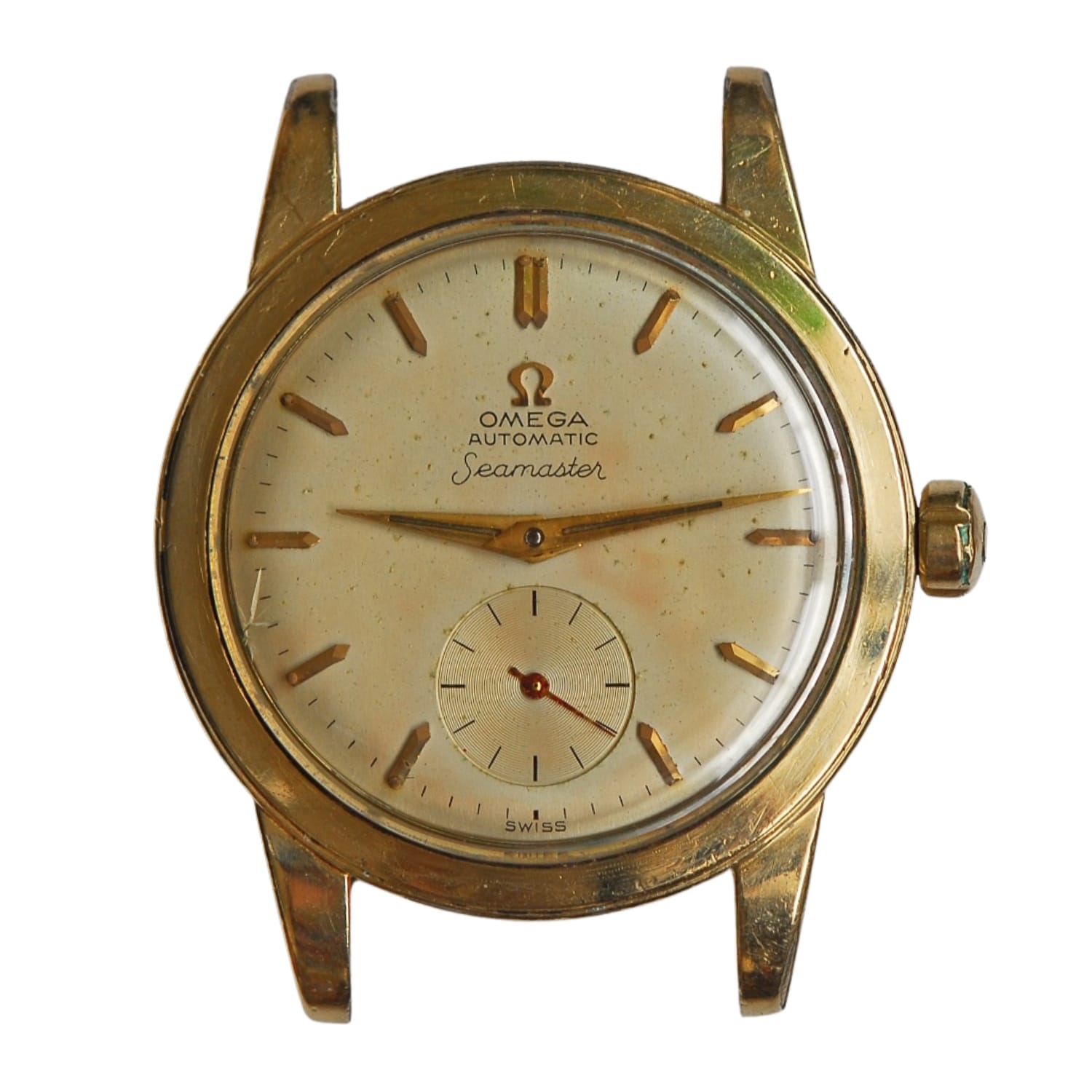
The Omega F6249 and its close sibling FX6249 represent quintessential examples of mid-1950s Seamaster design, embodying the sophisticated elegance and technical innovation that defined Omega’s post-war golden era. Produced primarily between 1952 and the late 1950s, these case references housed some of the most significant movements in Omega’s automatic evolution: the bumper-winding Caliber 344 and its successor, the full-rotor Caliber 490.
These references hold particular significance as part of Omega’s US market collection, manufactured with 14K gold-filled cases specifically for American retailers and consumers. The gold-filled construction, combining a thick layer of 14K gold bonded to a base metal core, provided luxurious appearance and durability at prices below solid gold while dramatically outperforming gold-plated alternatives in longevity.
The F6249/FX6249’s most distinctive design element lies in its dramatically curved, downturned lugs that sweep elegantly from the case to embrace the wrist’s natural contour. This sculptural lug design, sometimes described as “beefy lugs” by collectors, creates substantial visual presence despite the modest 34-35mm case diameter. The combination of graceful proportions, automatic movements, and American market provenance positions these references as highly collectible examples of 1950s Seamaster design.
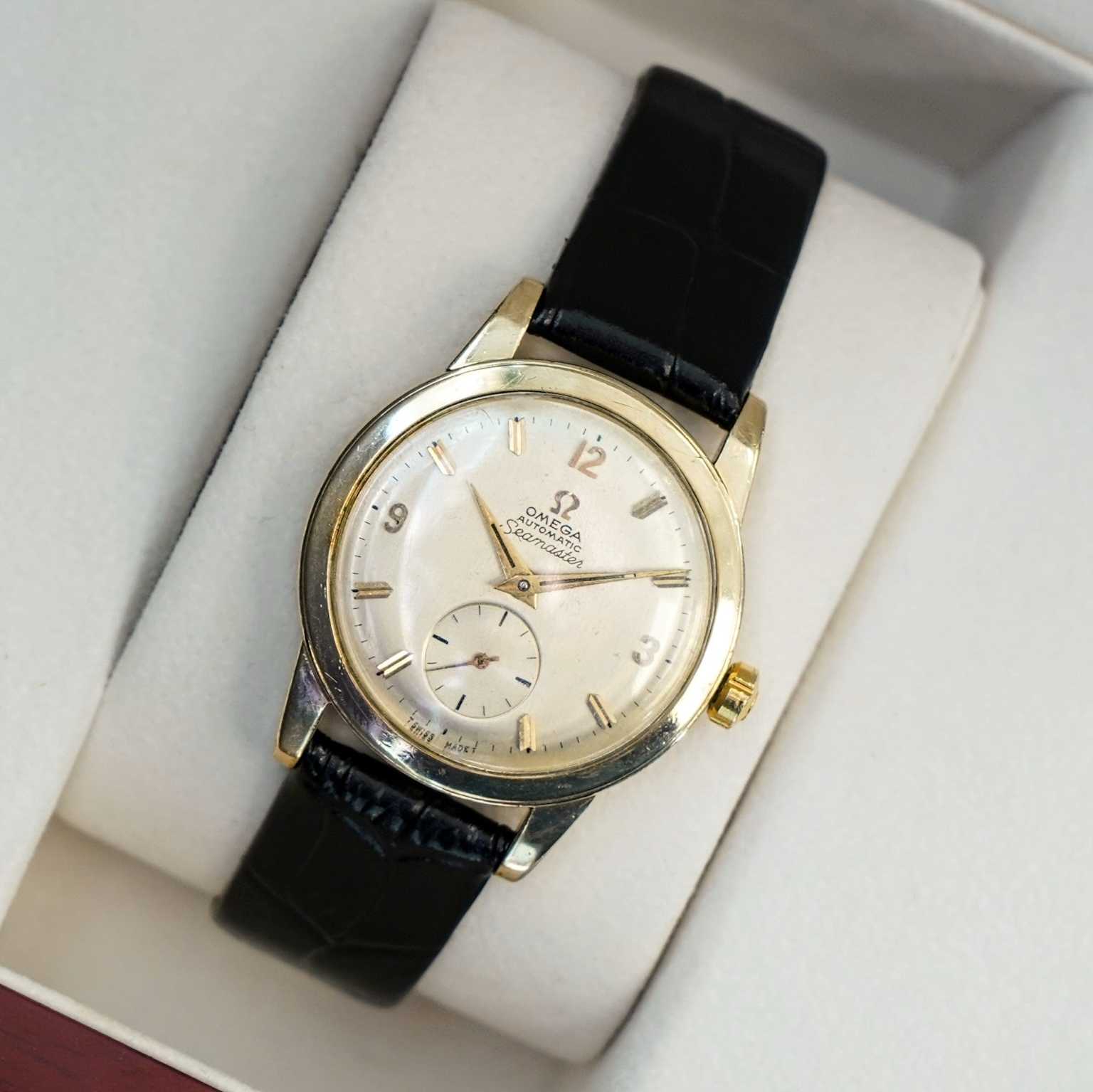
1957 OMEGA Seamaster Automatic Watch Ref. FX6249 Cal. 490 Wristwatch 14K G.F. – IN BOX
History & Production Period
Origins and the American Market Strategy
The F6249 and FX6249 case references emerged during Omega’s aggressive expansion into the American market during the 1950s. Following World War II, the United States represented the world’s largest luxury goods market, and Swiss watch manufacturers competed intensely for American consumers.
Omega developed specific case models for US distribution, partnering with American case manufacturers to produce gold-filled cases that met American preferences and price points. These US-market watches carry distinctive case reference numbers beginning with “F” or “FX” that don’t follow Omega’s standard European nomenclature system.
The letter prefix system worked as follows:
- F prefix: Standard US market case models
- FX prefix: Modified or later production variants of F series cases
Production commenced around 1952 with the F6249 housing the Caliber 344 bumper automatic movement. By approximately 1955-1956, the FX6249 variant appeared, typically housing the newer Caliber 490 full-rotor automatic. Both case references remained in production through the late 1950s, with examples documented through approximately 1958-1959.
Dating by Serial Numbers
Serial numbers provide approximate dating guidance for F6249/FX6249 examples:
- 13,000,000-14,000,000: 1952-1954 (typically Cal. 344)
- 14,000,000-15,000,000: 1954-1957 (Cal. 344 and early Cal. 490)
- 15,000,000-16,000,000: 1956-1958 (typically Cal. 490)
- 16,000,000-17,000,000: 1958-1959 (late production, Cal. 490)
These ranges apply to movement serial numbers, which Omega stamped on the movement plates. Case serial numbers, when present, follow different sequences established by case manufacturers.
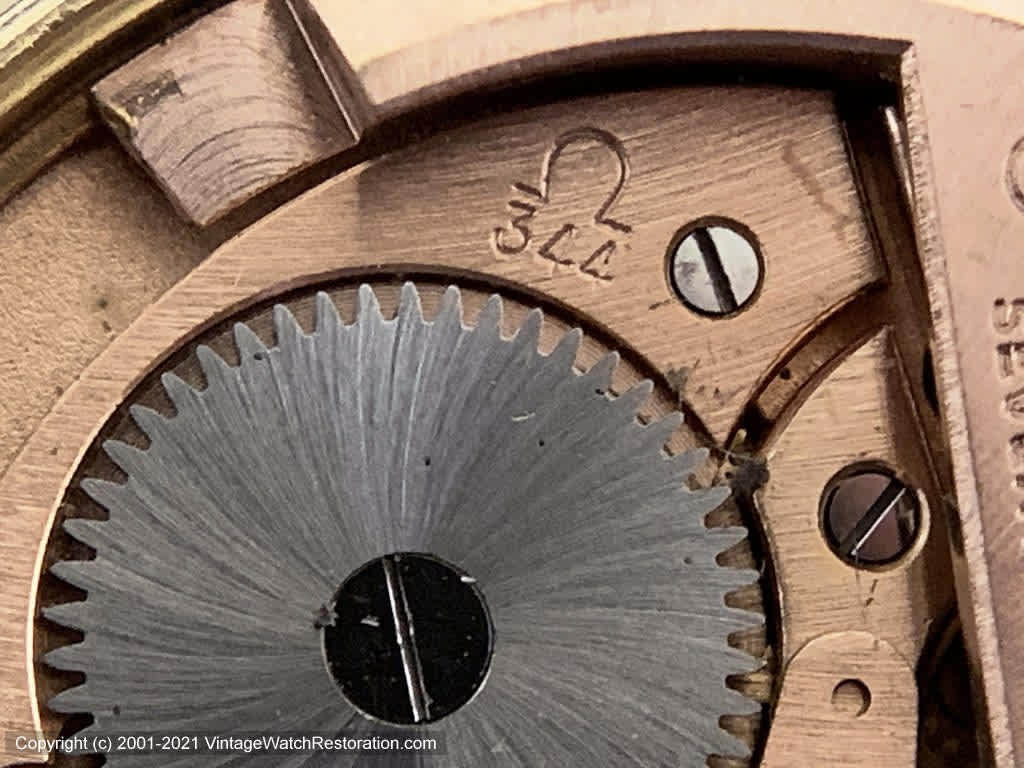
Omega Silver Dial Cal 344 Bumper, Automatic, 33mm
Technical Specifications
The F6249/FX6249 references adhere to classical mid-century proportions while providing modern wearability through intelligent design:
Case Diameter: 34-35mm (excluding crown, varies slightly by example)
Case Thickness: 9-10mm
Lug Width: 18mm
Lug-to-Lug: 42-43mm
Water Resistance: Minimal (flat-ring rubber gasket, not designed for water exposure)
Crystal Type: Acrylic (domed)
Case Construction: 14K gold-filled bezel with stainless steel snap-back caseback
Crown: Omega signed with clover logo
The 34-35mm case diameter, while modest by contemporary standards, achieves substantial wrist presence through the dramatically curved lugs that extend visual diameter beyond measured specifications. The downturned lug design conforms to wrist curvature, creating comfortable wear and elegant profile.
The 42-43mm lug-to-lug measurement suits most wrist sizes, preventing overhang on smaller wrists while maintaining presence on larger anatomies. Modern collectors find these proportions particularly appealing, as they deliver vintage character without appearing diminutive.
The 14K gold-filled case construction deserves specific attention. Gold-filled differs significantly from gold-plated, utilizing a thick layer of solid 14K gold (typically 1/20th the total weight) mechanically bonded to a base metal core through heat and pressure. This construction provides durability approaching solid gold, with wear resistance dramatically superior to thin gold plating.
The stainless steel snap-back caseback, while practical, creates a distinctive two-material construction visible when the caseback is removed. This mixed-metal approach kept costs reasonable while preserving the luxurious gold appearance on all visible surfaces.
Movements/Calibers
The F6249 and FX6249 cases housed two historically significant Omega automatic calibers, representing the evolution from early “bumper” automatic technology to modern full-rotor automatic winding.
Caliber 344: Bumper Automatic Pioneer
The Omega Caliber 344, introduced in 1953, represents a refined iteration of Omega’s early automatic movement architecture. As a “bumper” automatic (also called “hammer automatic”), the 344 utilizes a limited-rotation rotor that oscillates back and forth rather than rotating continuously.
Caliber 344 Specifications:
- Introduction Year: 1953
- Configuration: Bumper automatic (limited rotor rotation)
- Jewels: 17
- Frequency: 19,800 vibrations per hour (2.75 Hz)
- Power Reserve: Approximately 42 hours
- Diameter: 25.1mm
- Features: Sub-seconds at 6 o’clock (most configurations)
- Successor to: Caliber 342 (first Seamaster movement)
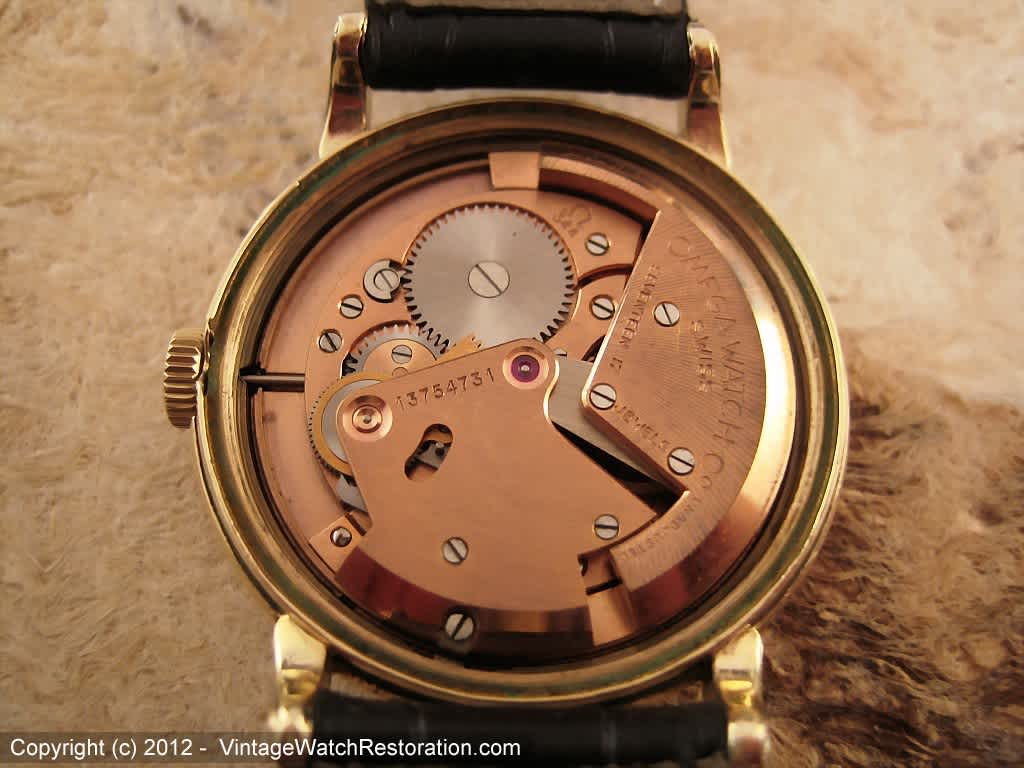
Black Dial Omega Automatic Cal 344 Bumper, Automatic, Large 35mm
Bumper Technology Explained
Bumper automatic movements, representing early automatic winding technology, employ a weighted rotor that swings approximately 120-140 degrees in each direction before “bumping” against spring-loaded stops. This oscillating motion winds the mainspring bi-directionally, providing automatic winding functionality despite the limited rotation arc.
The bumper mechanism creates a distinctive tactile sensation when wearing the watch, as the rotor’s impact against the buffer springs produces a subtle “bump” or “thunk” that wearers can feel and sometimes hear. This mechanical character, while charming, reveals the technology’s primary limitation: the constant impact creates wear on buffer springs and rotor pivots, eventually requiring maintenance.
The Caliber 344 improved upon earlier Omega bumper movements by utilizing concealed buffer springs that reduced visual bulk and improved reliability. The 344 also incorporated Omega’s swan neck regulator on some variants (designated 354), allowing precise rate adjustment.
Caliber 490: Full-Rotor Evolution
By 1955, Omega introduced the Caliber 490, representing a fundamental technological advancement in automatic winding. The 490 abandoned the bumper mechanism in favor of a continuously rotating central rotor that could complete full 360-degree rotations, winding the mainspring bi-directionally without impact limitations.
Caliber 490 Specifications:
- Introduction Year: 1955
- Configuration: Full-rotor automatic (360-degree rotation)
- Jewels: 17
- Frequency: 19,800 vibrations per hour (2.75 Hz)
- Power Reserve: Approximately 46 hours
- Diameter: 25.1mm
- Features: Sub-seconds at 6 o’clock, sweep seconds on some variants
- Rotor Type: Central rotor, bi-directional winding
The Caliber 490’s full-rotor design eliminated the wear issues inherent to bumper movements while providing more efficient winding, particularly during periods of moderate arm movement. The continuous rotation allowed the rotor to wind from both directions without the jarring impact of bumper stops.
The 490 became one of Omega’s most successful and reliable automatic calibers, remaining in production through the early 1960s and powering countless Seamaster and other models. Its robust construction and straightforward architecture make it relatively easy to service, contributing to the strong survival rate of 490-powered watches.
Movement Quality and Finishing
Both the Caliber 344 and 490 feature solid Swiss industrial finishing appropriate to their mid-grade positioning. Movement plates receive perlage (circular graining), bridges display Geneva striping, and steel components show polishing and beveling.
Neither caliber achieved chronometer certification or Geneva Seal standards, positioning them as reliable, accurate daily-wear movements rather than haute horlogerie pieces. However, both calibers deliver excellent timekeeping when properly regulated, often performing within COSC chronometer tolerances despite lacking formal certification.
Dial Variations
The F6249/FX6249 references appeared with multiple dial configurations, reflecting Omega’s 1950s practice of offering variety within case models.
Silvered Dials
The most common configuration features silvered dials with applied gold-tone hour markers. These dials typically display:
- Applied dart or dagger hour markers in gold tone
- Printed minute track with five-minute markers
- “Omega” signature at 12 o’clock with brand logo
- “Seamaster” designation below logo (on Seamaster-branded examples)
- “Automatic” inscription above 6 o’clock
- Sub-seconds register at 6 o’clock (Cal. 344 and some Cal. 490 examples)
- Sweep seconds (Cal. 490 center-seconds variants)
Silvered dials range from bright mirror finishes to brushed or sunburst textures, creating varying light interactions. Original dials often develop attractive patina over decades, with silvered surfaces acquiring warm tones or subtle spotting that collectors prize as evidence of authenticity.
Champagne and Two-Tone Dials
Warm-toned champagne dials complement the gold-filled cases beautifully, creating cohesive visual presentations. These dials typically feature:
- Champagne or golden surface finishes
- Applied gold-tone markers matching case color
- Matching dauphine or leaf hands
- Subtle sunburst or brushed textures
Two-tone dials, featuring contrasting center sections and outer chapter rings, appear occasionally and represent particularly desirable variants. These sophisticated dial designs create visual depth and architectural interest.
Hands and Luminous Material
Hand styles vary across production:
- Dauphine hands (most common): Faceted, tapered profiles
- Leaf hands: Pointed teardrop profiles
- Pencil hands: Slim, linear profiles
Omega Seamaster Dial Help please. : r/watchrepair
Early examples featured radium luminous material on hands, though most F6249/FX6249 watches utilized non-luminous hands appropriate to dress watch character. The modest luminous application reflects these watches’ intended use as elegant daily wears rather than tool watches.
Dial Condition and Authenticity
Original dials command significant premiums over refinished examples. Warning signs of refinishing include:
- Overly bright, perfect surfaces lacking age-appropriate character
- Incorrect fonts for Omega signature or model designation
- Mismatched printing quality or inconsistent text spacing
- Poorly reapplied markers with visible glue or uneven spacing
- Modern lume material where none existed originally
Omega Seamaster Dial Help please. : r/watchrepair
Acceptable aging characteristics include:
- Even patina or warm toning across dial surface
- Minor spotting in peripheral areas (tropical aging)
- Slight fading of printing (if consistent and honest)
- Original surface texture preserved under patina
Collectors should strongly prefer honest original dials showing appropriate aging over refinished examples that appear artificially perfect.
Case & Bezel Variations
Case Construction Details
The F6249/FX6249 cases employ sophisticated hybrid construction that balanced luxury appearance with practical durability and reasonable cost.
Case Components:
- Bezel and Lugs: 14K gold-filled (1/20th 14K gold by weight)
- Case Body: Base metal core with gold-filled external surface
- Caseback: Stainless steel snap-back
- Crown: Gold-plated brass with Omega clover logo
The gold-filled bezel and lugs create the watch’s primary visual presentation, providing rich gold color and texture that ages beautifully over decades. Unlike thin gold plating that wears through to base metal at high-contact points (particularly lug edges and case sides), gold-filled construction maintains appearance through normal wear.
The Signature Curved Lugs
The F6249/FX6249’s defining design element lies in the dramatically curved, downturned lugs that sweep gracefully from the case. These sculptural lugs:
- Curve downward to follow wrist contour
- Feature substantial thickness creating “beefy” appearance
- Taper gradually from case to strap attachment points
- Display polished finishing on top surfaces with brushed sides (on well-preserved examples)
This lug design creates several advantages:
- Enhanced Comfort: Downturned profile conforms to wrist anatomy
- Visual Presence: Extended lug length creates larger perceived diameter
- Elegant Proportions: Graceful curves soften the watch’s appearance
- Secure Strap Attachment: Substantial lug thickness prevents deformation
Case Condition and Wear Patterns
Gold-filled cases show characteristic wear patterns that help authenticate examples and assess condition:
Normal Wear (Acceptable):
- Light surface scratching on polished bezel
- Minor wear to high points on lug edges
- Subtle thinning of gold layer at case sides (where case contacts surfaces)
- Preserved hallmarks and case numbers
Excessive Wear (Concerning):
- Base metal exposure at lug edges or case sides (indicates wear-through)
- Rounded lug edges from heavy polishing
- Missing or illegible hallmarks
- Significant case distortion or damage
The gold-filled construction provides excellent longevity, with well-cared-for examples showing minimal wear even after 60-70 years. This durability distinguishes gold-filled from gold-plated construction, which typically shows base metal exposure within years rather than decades.
Caseback Details
The stainless steel snap-back caseback should display:
- Case model number (F6249 or FX6249)
- Case serial number (varies by manufacturer)
- “Stainless Steel” or “Stainless Steel Back” marking
- Omega Hippocampus (seahorse) logo on Seamaster-branded examples
- Various American case manufacturer markings
Original casebacks remain clean and crisp, with minimal scratching or damage from improper opening attempts. The flat-ring rubber gasket provides minimal water resistance, indicating these watches were designed for daily wear rather than aquatic activities.
Bracelet & Strap Options
Period-Correct Presentation
The F6249/FX6249 references were sold predominantly on leather straps, reflecting their dress watch character despite the Seamaster designation. Original Omega straps in alligator, crocodile, or calf leather complemented the gold-filled cases appropriately.
Period-Correct Strap Specifications:
- Lug Width: 18mm
- Materials: Alligator, crocodile, or high-quality calf leather
- Colors: Brown, black, burgundy to complement dial and case tones
- Buckles: Gold-plated Omega signed buckles
Original Omega buckles, when present, add authenticity and modest value. These buckles should display the Omega logo and appropriate period-correct design.
Contemporary Strap Options
Modern collectors typically fit F6249/FX6249 watches with vintage-style leather straps from quality manufacturers. Appropriate choices include:
- Hand-stitched alligator in brown or black
- Vintage-style calf leather with period-appropriate stitching patterns
- Crocodile for luxury presentation
- Lizard skin for 1950s authenticity
The 18mm lug width represents a standard vintage size, ensuring excellent strap availability. The substantial, curved lugs accommodate straps gracefully, with the downturned profile creating elegant visual flow from case to strap.
Identifying Original vs. Replaced Parts
Movement Authentication
The correct movement for F6249/FX6249 cases depends on production period:
Caliber 344 (earlier production, approximately 1952-1956):
- “Omega Watch Co.” signing on movement
- “Swiss Made” marking
- “17 Jewels” inscription
- Caliber designation “344” engraved on movement
- Movement serial number in 13,000,000-15,000,000 range
Caliber 490 (later production, approximately 1955-1959):
- “Omega Watch Co. Swiss” signing
- “17 Jewels” marking
- Caliber number “490” engraved
- Movement serial number in 15,000,000-17,000,000 range
Replacement movements or incorrect calibers significantly reduce value and collectibility. The F6249/FX6249 cases should house only period-appropriate Omega movements.
Dial Verification
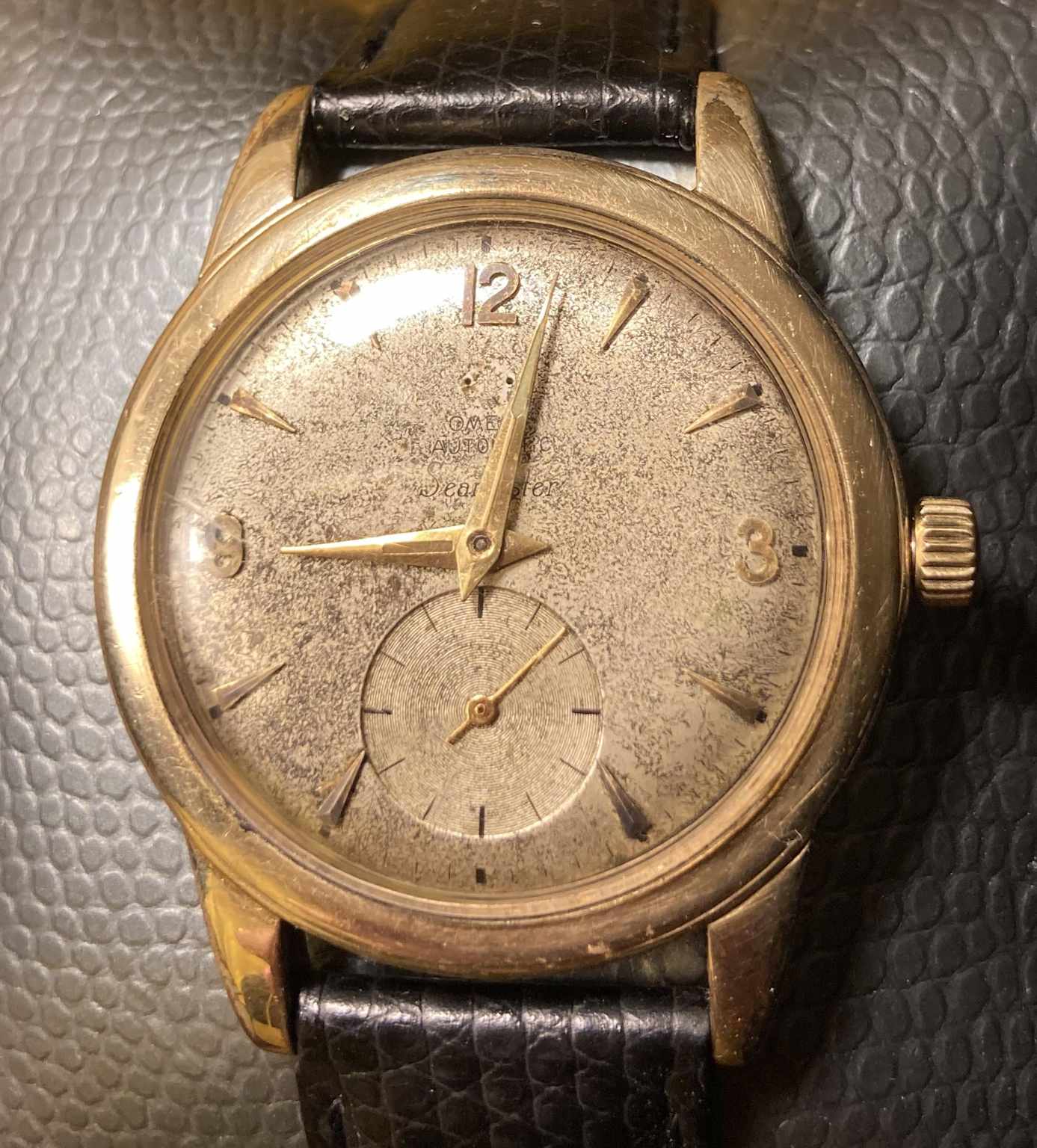
Dial authenticity presents challenges due to refinishing prevalence in the vintage watch market. Collectors should:
Omega Seamaster Dial Help please. : r/watchrepair
- Examine printing quality under magnification (original dials show crisp, consistent printing)
- Verify font accuracy for Omega signature and model designation
- Check marker application for secure attachment and period-correct profiles
- Confirm appropriate aging between dial surface and hands
- Look for consistent patina patterns (refinished dials often show unnatural perfection)
Expert examination or comparison to documented original examples helps verify dial authenticity.
Case Condition Assessment
Gold-filled case condition significantly affects value and desirability:
Positive Indicators:
- Sharp, defined lug edges with substantial thickness
- Visible case numbers and hallmarks
- Minimal base metal exposure at high-wear points
- Original polished/brushed surface finishing distinction
- Unpolished condition showing honest wear
Warning Signs:
- Rounded lug edges from excessive polishing
- Significant base metal showing through gold layer
- Missing or illegible case markings
- Heavily refinished surfaces obscuring original finishing
- Case distortion or amateur repairs
Collectors should strongly prefer examples showing light wear but retaining original case architecture over heavily polished pieces.
Collector Notes & Market Context
Market Positioning (2024-2025)
The F6249/FX6249 references occupy an accessible entry point in vintage Omega collecting, offering authentic 1950s design, automatic movements, and gold-filled cases at prices well below solid gold or stainless steel Constellation models.
Approximate Value Ranges (Based on Market Observation):
- Caliber 344 (Bumper), Good Condition: $600-$1,200
- Caliber 490 (Full Rotor), Good Condition: $700-$1,400
- Exceptional Original Condition, Box/Papers: $1,200-$2,000
- Refinished Dial or Heavy Wear: $400-$800
These ranges assume functioning movements, honest cases showing normal wear, and reasonable dial condition. Complete sets with original boxes and papers are exceptionally rare for these US-market models and command premiums.
Value Drivers and Detractors
Premium Factors:
- Original dial with honest patina (no refinishing)
- Unpolished case retaining sharp lug definition
- Functioning automatic movement recently serviced
- Original Omega crown and caseback
- Caliber 490 full-rotor movement (slightly more desirable than bumper 344)
- Complete set with box/papers (extremely rare)
- Attractive dial color or two-tone variant
Value Detractors:
- Refinished or service replacement dial
- Heavily worn case with base metal showing through gold-filled layer
- Non-functioning automatic movement requiring service
- Replaced crown or caseback
- Amateur repairs or modifications
- Excessive polishing destroying lug architecture
Collecting Strategy
The F6249/FX6249 represents excellent value for collectors seeking authentic mid-century Omega design without premium pricing. As US-market pieces, these references offer interesting historical context about Omega’s American expansion strategy while delivering the technical quality and design sophistication expected from the manufacture.
Market Dynamics:
The vintage Omega market has seen significant appreciation for quality 1950s pieces, though US-market gold-filled models remain considerably more affordable than solid gold or even stainless steel examples. This creates opportunity for collectors to acquire genuine vintage Omega watches with interesting movements and attractive design at entry-level prices.
The bumper automatic Caliber 344 appeals to collectors interested in early automatic technology and mechanical character, while the full-rotor Caliber 490 offers more practical daily wearability and easier service. Both movements deliver reliable performance when properly maintained.
Common Pitfalls:
- Accepting refinished dials without significant price reduction
- Overlooking gold-filled wear patterns (base metal exposure indicates excessive wear)
- Undervaluing movement functionality (service costs can exceed watch value)
- Paying solid gold prices for gold-filled examples
- Neglecting to verify period-correct movement for case reference
Savvy Collecting Approach:
- Prioritize original dials even with honest aging
- Accept light gold-filled wear but avoid base metal exposure
- Verify movement functionality before purchase
- Consider Caliber 490 examples for easier service and daily wear
- Look for unpolished cases retaining architectural definition
- Research movement serial numbers to confirm period-correct caliber
- Budget for service (expect $300-$500 for proper overhaul)
Wearability and Modern Context
Despite 1950s origins, the F6249/FX6249 delivers excellent modern wearability. The 34-35mm diameter suits contemporary tastes for vintage-proportioned watches, while the dramatically curved lugs prevent the watch from appearing diminutive. The 42-43mm lug-to-lug measurement accommodates most wrist sizes comfortably.
The automatic movements provide convenience for daily wear, though collectors should understand power reserve limitations (approximately 42-46 hours) mean the watch will stop if unworn for two days. This typical automatic behavior requires no winding when worn regularly but necessitates resetting after storage periods.
The gold-filled case construction provides practical durability for daily wear while maintaining attractive gold appearance. Unlike solid gold watches that require careful handling to avoid scratching soft 14K gold, the gold-filled construction’s base metal core provides structural rigidity that resists deformation.
Service and Maintenance
Both Caliber 344 and 490 movements require service approximately every 4-5 years for optimal performance. Competent watchmakers can service these straightforward movements without difficulty, as parts remain available through Omega service centers and aftermarket suppliers.
The bumper Caliber 344 requires specific attention to buffer springs, which wear from the rotor’s constant impact. Experienced watchmakers familiar with bumper technology should perform service to ensure proper buffer spring tension and rotor clearances.
The full-rotor Caliber 490 presents fewer service complications, with straightforward automatic winding train that most watchmakers can service confidently. The 490’s robust construction and parts availability make it an excellent choice for collectors seeking daily-wear vintage Omega watches.
Service costs for both calibers typically range $300-$500 for complete overhaul including cleaning, lubrication, regulation, and replacement of worn parts. Collectors should budget for service when purchasing examples with unknown service history.
Conclusion
The Omega F6249 and FX6249 references represent mid-century American market Seamaster production at its most accessible and charming. Spanning production from 1952 through the late 1950s, these case references housed historically significant Omega automatic calibers while delivering elegant design, practical gold-filled construction, and the distinctive curved-lug architecture that defines their visual character.
The transition from bumper-automatic Caliber 344 to full-rotor Caliber 490 within these case references documents Omega’s evolution in automatic movement technology. Both movements deliver reliable performance and mechanical interest, with the 344 offering early automatic charm and the 490 providing modern automatic convenience.
For collectors, the F6249/FX6249 represents exceptional opportunity to own authentic 1950s Omega design with automatic complications at prices well below solid gold or even stainless steel contemporaries. The 14K gold-filled construction, when properly preserved, delivers luxury appearance with practical durability that has allowed these watches to survive decades of use while maintaining attractive condition.
The dramatically curved lugs, elegant proportions, and varied dial options create visual interest that transcends the modest case diameter. These watches wear substantially larger than specifications suggest, providing modern wearability while preserving authentic vintage character.
As the vintage watch market continues maturing, collectors increasingly recognize the value of honest, original examples from significant manufactures regardless of gold content or designation. The F6249/FX6249, with its US market provenance, interesting movements, and elegant execution, represents exactly this collecting opportunity: genuine vintage Omega quality at accessible prices that reward informed collectors who value authenticity, design, and horological interest over precious metal content alone