

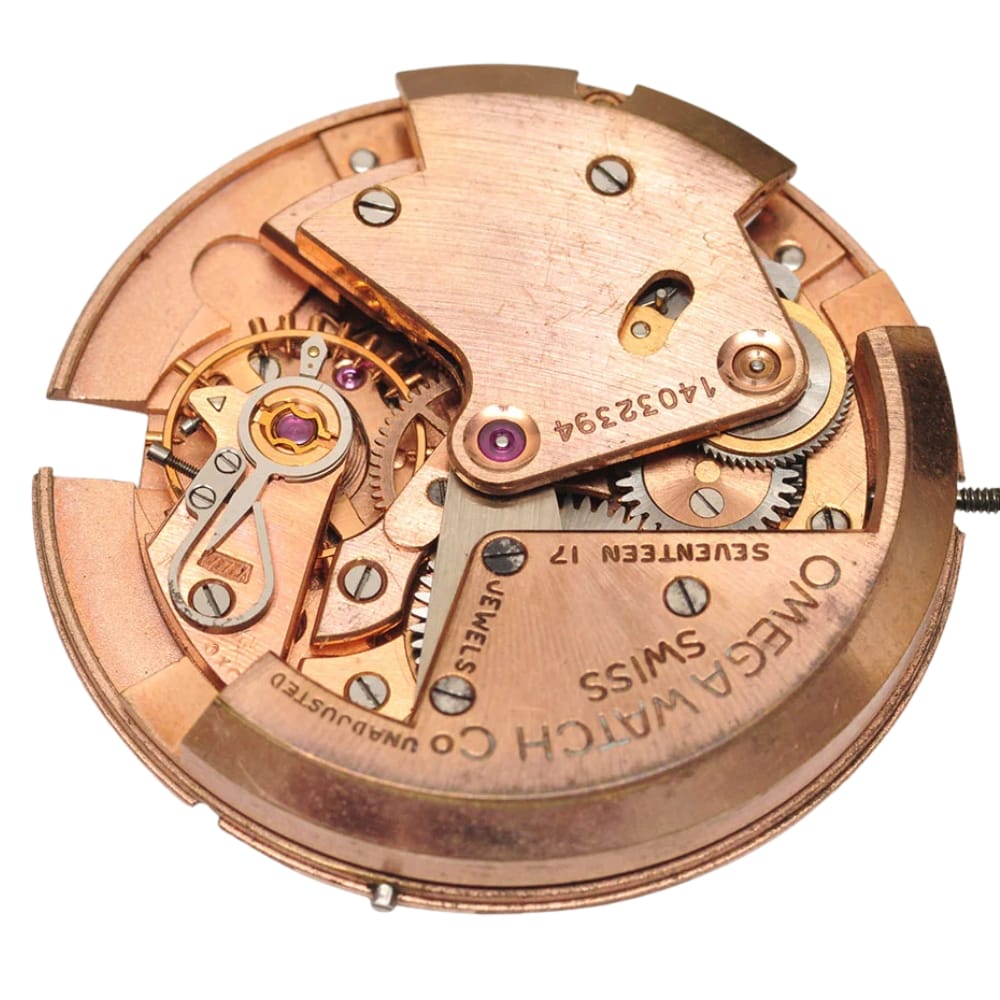
The Omega 344 represents a fascinating transitional moment in automatic watchmaking history: the final iteration of Omega’s bumper automatic movements before the company abandoned the design entirely in favor of the more efficient full-rotor system. Introduced in 1953 as an evolution of the caliber 342 that powered the first Omega Seamaster, the 344 was part of a family that produced over 1.3 million movements between 1943 and 1955, making it one of the most successful automatic movement platforms of the immediate post-war era. By the time production ceased in 1955, Omega had already committed to full-rotor designs, rendering the 344 and its siblings obsolete within just two years of introduction. Today, collectors view these bumper movements with mixed appreciation: historically significant as evolutionary stepping stones, yet mechanically inferior to the full-rotor designs that replaced them.
The caliber 344 is a 17-jewel bumper automatic movement with sub-seconds and bidirectional winding. The movement measures 28.1mm in diameter (12.5 lignes) and stands 4.8mm tall, offering a relatively slim profile for an automatic movement of its era. The bumper mechanism employs a semi-circular oscillating weight that swings through approximately 120-130 degrees of arc before impacting buffer springs, hence the “bumper” nickname. Unlike the unidirectional 28.10 RA that preceded it, the 344 features bidirectional winding, improving efficiency over its ancestors. The movement is distinguished by its copper-rose electroplated finish, a hallmark of Omega’s mid-century production that has aged gracefully into warm amber tones. Among watchmakers, the 344 has a reputation as serviceable and reasonably robust when properly maintained, though parts availability for the automatic winding mechanism can be challenging. The movement lacks the swan-neck regulator found on its higher-grade siblings (calibers 354 and 355), instead employing a standard index regulator, which places it firmly in the non-chronometer category despite competent timekeeping performance.
Precise production figures for the caliber 344 specifically are not manufacturer-confirmed, but the movement’s three-year production window (1953-1955) and its position as a late-stage bumper design suggest significantly lower output than its longer-running siblings. The entire 28.10 RA family produced over 1.3 million units between 1943 and 1955, with the caliber 342 alone accounting for approximately 1.3 million examples (about 500,000 of which were chronometer-grade). Given that the 344 entered production in 1953, just two years before Omega phased out bumpers entirely, and that Omega was already developing and promoting full-rotor movements like the caliber 470/471 (introduced 1955), production numbers for the 344 likely represent only a small fraction of the family total. Serial number evidence from surviving examples clusters primarily in the 13-14 million range, corresponding to the 1952-1954 production years. The caliber is best characterized as uncommon rather than rare: examples appear regularly in the vintage market, particularly in stainless steel Seamaster cases, but with far less frequency than the longer-running calibers 342, 354, or later full-rotor movements. Gold-cased examples command premiums, and oversized cases (36mm or larger) are notably scarce. The relative abundance of the 344 compared to truly rare calibers, combined with collector preference for full-rotor movements or higher-grade swan-neck regulated variants, places the 344 in a middle tier of collectibility: accessible to collectors, historically interesting, but not aggressively pursued.
The caliber 344 occupies a neutral position in the current collector market, neither actively sought nor avoided. Demand is stable but modest, driven primarily by enthusiasts of early Seamaster models and those interested in the technical history of automatic winding mechanisms rather than pure investment-oriented collectors. Pricing for 344-equipped watches generally falls below comparable examples with full-rotor movements or higher-grade bumper variants (354/355). The movement’s appeal lies in its historical context rather than mechanical superiority: it represents the final chapter of Omega’s bumper automatic program, a technology the brand would completely abandon within two years. Specific variants do command attention: examples in 18k gold cases, oversized (36mm+) configurations, and watches with pristine original dials showing the characteristic quilted or waffle patterns of the period. The bumper mechanism itself generates interest among collectors who appreciate the tactile feedback of the oscillating weight striking the buffer springs, a sensory experience absent from modern full-rotor automatics. Market trends suggest that while demand for 344-equipped watches is not declining, it is not appreciating at the rate of more celebrated Omega calibers from the period. Collectors entering the vintage Omega market often view the 344 as an affordable entry point to mid-1950s Seamaster ownership, a reputation that supports steady demand at accessible price points.
Historical Context, Provenance, and Manufacturing Details
Development History
The caliber 344 emerged from Omega’s comprehensive reorganization of its movement nomenclature system in 1949. Prior to this date, Omega identified its bumper automatic movements using decimal designations: the 28.10 RA PC (sub-seconds) and 30.10 RA PC (larger diameter). In 1949, the company transitioned to a three-digit naming system that consolidated related calibers into numbered families. The 28.10 RA PC was renamed caliber 340, while the center-seconds variant 28.10 RA SC PC became caliber 350. The caliber 342, introduced in 1950 as the first movement specifically designated for the Seamaster line, differed from the 340 primarily in the concealment of its buffer springs within the movement architecture. The 344, introduced in 1953, represented an incremental update to the 342, though surviving documentation does not specify the exact technical modifications that distinguished it from its immediate predecessor. The timing of the 344’s introduction coincided with Omega’s development of full-rotor automatic movements, suggesting the company was already planning to phase out bumper technology even as the 344 entered production. The movement addressed no specific market challenge or technical problem: by 1953, Rolex’s patents on full-rotor winding systems had expired, and most Swiss manufacturers were transitioning away from bumper designs. The 344 appears to have been a refinement of existing technology rather than an innovative response to competitive pressure.

The caliber 344 evolved directly from the caliber 342, which itself descended from the 28.10 RA PC introduced in 1943. The lineage traces back to Omega’s first mass-produced bumper automatic, making the 344 the culmination of twelve years of iterative development on the same basic architecture. The 344 retained the 342’s fundamental construction: bidirectional bumper winding, 17 jewels, Incabloc shock protection, and sub-seconds display. The movement was eventually replaced not by another bumper caliber but by an entirely different technology: the caliber 470/471 full-rotor automatic movements introduced in 1955. This represented a complete architectural departure rather than an evolution, as full-rotor systems eliminated the limited-arc oscillating weight and buffer springs in favor of a continuously rotating rotor. The transition was not gradual: Omega ceased bumper production entirely in 1955, rendering the 344 obsolete after just two years in the catalog. No direct successor exists within the bumper family because Omega abandoned the technology entirely.
Manufacturing Context
The caliber 344 is an in-house manufacture movement, produced entirely by Omega in Bienne, Switzerland, during the period when the company still maintained complete vertical integration of its movement production. This distinguishes it from later Omega calibers that would be based on ETA ebauches. The movement shares substantial components and architecture with other members of the 28.10 RA family (calibers 330, 331, 332, 333, 340, 341, 342, 343, 350, 351, 352, 353, 354, 355), and parts interchangeability across this family is extensive, though not universal. The movement was manufactured exclusively in Omega’s Bienne facility, and no changes in production location occurred during its brief two-year lifespan. The company’s decision to maintain in-house production of the 344 even as it developed full-rotor alternatives reflects the conservative manufacturing approach typical of Swiss watchmaking in the early 1950s: existing production lines continued operating while new technologies were developed in parallel, rather than immediately replacing proven designs.
Historical Context
Within the broader timeline of horological history, the caliber 344 occupies a transitional position between two eras of automatic watchmaking. The bumper automatic mechanism, pioneered by John Harwood in the 1920s and refined by multiple manufacturers during the 1930s and 1940s, represented the dominant approach to self-winding watches during the period when Rolex held tight patents on full-rotor systems. By 1953, those patents had largely expired, and the technical superiority of full-rotor winding was becoming undeniable. The 344 was neither groundbreaking nor particularly innovative: it was a competent workhorse movement produced at the tail end of a declining technology. Its significance lies not in technical advancement but in its role as a historical bookend, one of the final bumper automatics Omega would ever produce. The movement’s two-year production window captured a moment when Swiss manufacturers simultaneously produced old and new automatic winding technologies, a transitional period that would end decisively in 1955 with the industry’s wholesale adoption of full-rotor systems. From this perspective, the 344 is best understood as a conservative final iteration rather than a progressive design.
Construction and Architecture
Plate and Bridge Layout
The caliber 344 employs a traditional three-quarter plate construction with separate bridges for the barrel, train wheels, balance, and automatic winding mechanism. The mainplate (reference 342.1000) is fabricated from brass with a copper-rose electroplated finish, a characteristic Omega treatment from this era that has aged into warm amber tones on surviving examples. The barrel bridge (344.1001) and train wheel bridge (332.1003) are substantial components that provide rigid support for the gear train, while the balance cock (344.1006) is a separate component attached to the train wheel bridge. The automatic winding mechanism occupies a separate plane, with a lower bridge for the oscillating weight (332.1010) and an upper bridge (342.1013) that sandwiches the bumper mechanism. The banking stop (351.1012), which limits the oscillating weight’s travel, is a distinct component visible on the movement’s perimeter. The overall architecture prioritizes serviceability: bridges can be removed individually, and the automatic mechanism can be accessed without disturbing the time train. This modular approach reflects 1940s-1950s Swiss manufacturing philosophy, which emphasized repairability over miniaturization.
Balance Wheel
The caliber 344 employs a bimetallic balance wheel with adjustment screws positioned around its rim. The balance measures approximately 9-10mm in diameter, a typical size for movements of this era and caliber. The bimetallic construction, composed of a brass inner ring and steel outer rim, provides temperature compensation: the differential expansion rates of the two metals cause the balance to deform slightly with temperature changes, counteracting the hairspring’s temperature sensitivity. Timing screws threaded into the balance rim allow watchmakers to adjust the movement’s rate by changing the balance wheel’s moment of inertia: removing mass from the rim increases frequency, while adding mass decreases it. The balance wheel’s design reflects pre-Glucydur technology: later movements would adopt monometallic Glucydur alloys with superior temperature stability, but in 1953, bimetallic compensating balances remained the industry standard for non-chronometer movements. The balance arbor is supported by jeweled bearings with Incabloc shock protection at both upper and lower pivots.

Balance Spring (Hairspring)
The caliber 344 utilizes a flat hairspring, most likely manufactured from Nivarox alloy, which had become the Swiss industry standard for hairsprings by the early 1950s. The spring features a terminal curve at its inner end, which attaches to the collet mounted on the balance staff. The outer end terminates at a stud pinned to the balance cock. The spring does not employ a Breguet overcoil, a feature typically reserved for higher-grade chronometer movements like the 354 and 355. The flat configuration was standard for non-chronometer calibers of this period and provides adequate isochronism (consistent rate across the power reserve range) for general timekeeping purposes. The spring’s characteristics, length, and elasticity determine the movement’s frequency of 19,800 vph (2.75 Hz), a moderate beat rate that balances energy efficiency with precision. The hairspring represents one of the few components not interchangeable across the entire 28.10 RA family: while balance complete assemblies share the same basic design, hairsprings must be specifically fitted and adjusted for each movement.
Escapement Type
The caliber 344 employs a Swiss lever escapement with a club-tooth escape wheel. The escape wheel is fabricated from steel with 15 teeth, typical for this style of escapement. The pallet fork is manufactured from brass and features two synthetic ruby pallet stones: the entry pallet (which receives impulse first) and the exit pallet. The impulse jewel, located on the balance staff, is also synthetic ruby. The escapement operates with a lift angle of 50 degrees, meaning the balance’s impulse jewel sweeps through a 50-degree arc during its interaction with the pallet fork. This is slightly lower than the 52-degree standard common to many Swiss lever escapements, reflecting the specific geometry of Omega’s design. The escapement provides bidirectional impulse: the balance receives energy during both its clockwise and counterclockwise swings. The club-tooth profile of the escape wheel teeth optimizes the impulse delivery angle and minimizes sliding friction between the pallet stones and wheel teeth. The pallet fork pivots are jeweled at both ends, and the escapement components receive specific lubrication during service to minimize friction while maintaining adequate banking. The Swiss lever configuration represents the dominant escapement design in mid-20th century Swiss watchmaking, valued for its balance of efficiency, reliability, and manufacturability.
Shock Protection System
The caliber 344 incorporates Incabloc shock-absorbing jewel settings at both the upper and lower pivots of the balance staff. The Incabloc system, which had become nearly universal in Swiss watchmaking by the 1950s, employs a lyre-shaped spring that holds a conical jewel setting in place. When the watch experiences impact, the spring flexes to absorb shock energy, preventing damage to the delicate balance staff pivots. The system is identified by its distinctive heart-shaped spring visible beneath the balance wheel. The movement’s specification sheet (part 332.1347) confirms Incabloc protection on the balance, while other pivots in the train use traditional fixed jewel settings. The Incabloc system can be disassembled for cleaning during service: the spring unlatches, allowing removal of the jewel setting and cap jewel for ultrasonic cleaning. Watchmakers must exercise care during reassembly to ensure the spring seats correctly and maintains proper spring tension. The Incabloc system represented a significant advancement over earlier fixed jewel settings, which were highly vulnerable to pivot fractures during routine handling or drops.
Regulator Type
The caliber 344 employs a standard index regulator, also known as a Bosley-type regulator, for rate adjustment. The regulator consists of a circular portion centered on the balance wheel with a long pointer that overlies the balance cock, where F (fast) and S (slow) markings provide visual reference. Curb pins at the short end of the regulator grip the hairspring, allowing the watchmaker to adjust the effective length of the spring: moving the regulator toward F shortens the effective length and increases rate, while moving toward S lengthens it and decreases rate. The regulator includes an adjusting spring (part 344.1356) that provides fine adjustment capability via a small screw. This two-piece regulator assembly (part 344.1333) allows for precise rate adjustments without requiring free-sprung balance technology. The absence of a swan-neck regulator distinguishes the 344 from its higher-grade siblings, calibers 354 and 355, which feature swan-neck mechanisms that provide micrometric adjustment and maintain position more securely against shock or vibration. The index regulator represents the standard approach for non-chronometer movements of this era: effective, serviceable, but lacking the refinement of more sophisticated systems.
Mainspring Material and Type
The caliber 344 utilizes an automatic mainspring with a slipping bridle, identified by part number GR2605X (1.10 x .095 x 300 x 9 Automatic). The mainspring barrel measures 9mm in diameter, and the spring itself measures 1.10mm wide, 0.095mm thick, and 300mm in length. The slipping bridle mechanism allows the mainspring to slip within the barrel when fully wound, preventing overwinding damage. This is essential for automatic movements, which wind continuously during wear and could otherwise exert excessive torque on the barrel arbor and automatic mechanism. The mainspring material is most likely a “white alloy” spring, a cobalt-nickel-chromium alloy developed in the 1950s that replaced traditional blued steel springs. White alloy springs provide superior elasticity, resist setting (permanent deformation), and deliver more consistent torque across the power reserve range. The spring features a fixed attachment at the barrel arbor rather than a traditional barrel hook, which improves reliability by eliminating a common failure point. The mainspring is shared across the entire 28.10 RA family (calibers 330, 341, 342, 344, 350, 351, 353, 354, 355), reflecting the substantial parts interchangeability within this movement platform. During service, watchmakers typically replace the mainspring as a precautionary measure, as aged springs lose elasticity and deliver reduced power reserve even if not visibly damaged.
Gear Train Details
The caliber 344 employs a four-wheel gear train: barrel, center wheel, third wheel, and fourth wheel, plus the escape wheel. The center wheel (part 332.1224) carries the cannon pinion (part 332.1218, height 2.30mm) and rotates once per hour, driving both the motion work for the hands and the third wheel of the time train. The third wheel meshes with the fourth wheel, which drives the escape wheel. The gear train is configured for sub-seconds display: the fourth wheel arbor extends through the dial, carrying the seconds hand at the 6:00 position. This sub-seconds configuration is one of the primary distinctions between the 344 and its center-seconds siblings in the 350 family. Gear ratios are not documented in surviving technical literature, but the 19,800 vph frequency and standard four-wheel configuration allow calculation: the escape wheel rotates 2.75 times per second (16,500 times per hour), and gear reduction through the train steps this down to the center wheel’s 1 rotation per hour (1:16,500 ratio). The gear train components are fabricated from brass with polished steel arbors, and all wheel pivots run in jeweled bearings. The train wheel bridge (332.1003) provides rigid support for these components, minimizing positional error and maintaining consistent gear mesh throughout the movement’s operation.
Finishing Quality and Techniques
The caliber 344 receives utilitarian finishing appropriate for a non-chronometer automatic movement. The mainplate and bridges display copper-rose electroplated finish rather than rhodium plating or bare brass, giving the movement its characteristic warm appearance. Visible surfaces show perlage (circular graining), a decorative technique that creates overlapping circular patterns through repeated application of a rotating abrasive peg. The perlage serves both aesthetic and functional purposes: the texture traps dust particles in the grooves, potentially keeping them away from the gear train, though this functional benefit is minimal in modern contexts. Bridge edges show basic anglage (beveling), but the quality is industrial rather than hand-finished: angles are consistent but not mirror-polished. Screw heads are polished but not blued. The movement does not feature Côtes de Genève (Geneva stripes) on the bridges, a decoration typically reserved for higher-grade calibers. The balance cock shows basic engraving with the caliber number “344” marked clearly. Overall, the finishing reflects the movement’s positioning as a reliable workhorse rather than a prestige caliber: clean, professional, but without the decorative flourishes found on chronometer-grade or haute horlogerie movements. The finishing quality remained consistent throughout the 344’s production, as Omega maintained standardized manufacturing processes during this period.
Cross-Reference Data
Alternative Caliber Names (Rebranded Versions)
The caliber 344 was produced and sold exclusively under Omega branding. Unlike some Swiss ebauche movements that were distributed to multiple manufacturers under different designations, the 344 was an in-house manufacture caliber not available to other brands. No rebranded versions exist.
Base Caliber vs. Elaborated Versions
| Caliber | Differences | Jewel Count | Functions | Notes |
|---|---|---|---|---|
| 344 | Standard index regulator, bidirectional winding | 17 | Sub-seconds, automatic | Standard grade |
| 354 | Swan-neck regulator, chronometer grade | 17 | Center seconds, automatic | Higher finishing, chronometer certification |
| 355 | Swan-neck regulator, chronometer grade | 17 | Sub-seconds, automatic | Higher finishing, chronometer certification |
The 344 shares the base architecture with calibers 354 and 355 but lacks the swan-neck regulator and chronometer-grade finishing that distinguish the higher variants. Parts interchangeability between 344 and 354/355 is extensive but not universal: regulators, balance assemblies, and finishing techniques differ.
Compatible Case References by Brand
| Brand | Reference Numbers | Production Years | Notes |
|---|---|---|---|
| Omega | 2576, 2576-4, 2576-5, 2576-6 | 1952-1956 | Most common Seamaster case, also used with cal 342, 354 |
| Omega | 2766-1 | 1952-1955 | Seamaster variant |
| Omega | 2494 | 1953-1956 | Seamaster gold-plated variant |
| Omega | 2714 | 1953-1955 | 18k gold case, oversized |
| Omega | F 6231-1 | 1952-1954 | 14k gold-filled |
| Omega | F 6262 | 1953-1955 | 10k gold-filled, various dial configurations |
| Omega | C 2576-6 | 1953-1955 | Stainless steel Seamaster |
The 344 was primarily cased in Seamaster references, with case diameters ranging from 32mm to 37.5mm. Gold cases (18k, 14k gold-filled, 10k gold-filled) are less common than stainless steel examples. Oversized cases (36mm+) are notably scarce.
Dial Compatibility Note
The caliber 344 uses a sub-seconds configuration with dial feet positioned for Omega’s standard Seamaster dial layout. Dial feet are located at approximately 2:00 and 8:00 positions (specific measurements not documented in surviving technical literature). The sub-seconds register is positioned at 6:00, and dials must accommodate this placement. Date windows are not applicable: the 344 does not support date complication. Collectors and restorers sourcing replacement dials must ensure sub-seconds positioning matches the 344’s configuration, as center-seconds dials from caliber 350/354 movements are not directly compatible without modification. Original dials feature a variety of finishing styles: silver, black, champagne, two-tone quilted or “waffle” patterns, and applied or printed markers. Dial feet must engage the movement’s dial rest positions correctly to ensure proper hand clearance and alignment.
Crown and Stem Specifications
| Component | Specification |
|---|---|
| Stem Thread | TAP 10 (0.90mm diameter, 0.225mm pitch) |
| Stem Part Number | 340.1106 (shared across 28.10 RA family) |
| Crown Thread | TAP 10 (0.90mm) |
| Crown Tube Opening | 2.0-2.5mm |
| Setting Mechanism | Yoke clutch type |
The TAP 10 threading system is standard for Omega crowns from this period. Aftermarket crowns are readily available in TAP 10 configuration, though correct profile and Omega logo engraving vary by case reference. The stem (part 340.1106) is shared across calibers 330, 331, 332, 333, 340, 341, 342, 343, 344, 350, 351, 352, 353, 354, 355, ensuring parts availability.
Identification Marks
Caliber Number Location
The caliber number “344” is engraved on the automatic winding mechanism bridge, visible when viewing the movement from the dial side after removing the dial and hands. The marking appears adjacent to the oscillating weight bearing assembly, stamped or engraved in a clear sans-serif font. The number is typically preceded by “CAL” or appears alone, depending on production period. The engraving is machine-executed with consistent depth and clarity, measuring approximately 1.5-2mm in height.
Logo and Brand Marks
The oscillating weight (part 342.1017) is signed “Omega Watch Co Swiss” along with “Seventeen Jewels” engraved in two lines. The mainplate bears “Omega Watch Co” stamping, typically located near the balance cock. Bridges may show additional Swiss Made markings or quality control stamps. The balance cock is engraved with the caliber number “344” in a decorative script, positioned adjacent to the regulator. No additional quality stamps (chronometer markings, adjustment positions) appear on the 344, as it was not offered in chronometer-certified configuration.
Date Codes
The caliber 344 does not use internal date codes. Dating is accomplished through the movement serial number, which is engraved on the mainplate beneath the oscillating weight or on the balance cock. The serial number is a seven or eight-digit number that corresponds to Omega’s production date ranges:
- 13,000,000 – 13,999,999: 1952
- 14,000,000 – 14,999,999: 1954
- 15,000,000 – 15,999,999: 1956
Given the 344’s documented production period of 1953-1955, serial numbers should fall primarily in the 13.5-15 million range. Serial numbers outside this range indicate either misdating or movement replacement.
Finishing Marks
Expected finishing characteristics include perlage (circular graining) on the mainplate and bridge surfaces, visible as overlapping circular patterns approximately 1-2mm in diameter. Bridge edges show basic anglage (beveling) at approximately 45-degree angles, but without mirror polishing. Screw heads are polished but not heat-blued. The copper-rose electroplated finish should show uniform coverage without flaking or excessive oxidation. Absence of Geneva stripes (Côtes de Genève) is normal and correct for this caliber: this decoration appears only on higher-grade Omega movements.
Jewel Markings
The 17 jewels are distributed as follows: balance staff upper and lower (2), pallet fork upper and lower (2), escape wheel upper and lower (2), fourth wheel upper and lower (2), third wheel upper and lower (2), center wheel upper and lower (2), barrel arbor (1), pallet stones (2), impulse jewel (1). Jewels are set in pressed settings (not gold chatons) for all positions except the balance staff pivots, which use Incabloc shock-protected settings. The jewel count “17” or “Seventeen Jewels” appears on the oscillating weight. Higher jewel counts indicate modified or incorrect movements.
Adjustment Markings
The caliber 344 was not offered with adjustment markings. The absence of any adjustment stamps (such as “Adjusted,” “Adjusted 2 Positions,” “Adjusted to Temperature,” or “Chronometer”) is correct and expected. Presence of such markings indicates either fraudulent modification or case/movement mismatch, as only calibers 354 and 355 received chronometer-grade adjustments.
Correct Serial Number Formats and Locations
Serial numbers appear engraved on the mainplate, typically visible beneath the oscillating weight or on the balance cock. The number is a continuous seven or eight-digit integer without letters or prefixes. Format: XXXXXXX or XXXXXXXX (e.g., 13998646, 14523891). The engraving is machine-executed with consistent depth, approximately 1.5-2mm in character height. Hand-scratched or irregularly stamped serial numbers indicate potential forgery or re-stamping.
Expected Engravings and Stampings
Legitimate caliber 344 movements display the following engravings:
- Caliber number “344” on balance cock
- “Omega Watch Co Swiss” on oscillating weight
- “Seventeen Jewels” on oscillating weight
- Movement serial number (7-8 digits) on mainplate
- “Fab Suisse” or “Swiss Made” on mainplate or bridges
Engraving style is consistent across components: machine-executed with uniform depth and character height. Font is sans-serif for technical markings, occasionally decorative script for caliber number on balance cock.
Font and Marking Style by Production Era
The caliber 344’s brief production window (1953-1955) shows minimal variation in engraving style. Early production (1953, serial numbers 13.5-13.9 million) and late production (1955, serial numbers 14.5-15 million) use identical fonts and marking techniques: machine engraving with consistent depth and clarity. No significant transitions in branding or logo design occurred during this period. Omega’s reorganization of movement nomenclature occurred in 1949, prior to the 344’s introduction, so all examples follow the post-1949 three-digit caliber numbering system. Any 344 marked with the earlier 28.10 RA designation is incorrectly marked or represents a frankenwatch.
Part Information

Part Numbers Table: Core Components
| Part Name | Part Number | Interchangeability Notes |
|---|---|---|
| Mainspring | GR2605X (1.10 x .095 x 300 x 9) | Shared: 330, 341, 342, 344, 350, 351, 353, 354, 355 |
| Balance Complete | 039-102 (721/2171) | Family-specific, requires proper hairspring adjustment |
| Hairspring | Movement-specific | Must be fitted and timed to individual movement |
| Escape Wheel | 032-106 (705/1405) | Shared across 28.10 RA family |
| Pallet Fork & Arbor | 035-56 (710/1375) | Shared across 28.10 RA family |
| Crown Wheel | 058-36 (420/1330) | Shared across 28.10 RA family |
| Ratchet Wheel | 059-56 (415/1345) | Shared across 28.10 RA family |
| Click | 060-39 (425/1017) | Shared across 28.10 RA family |
| Click Spring | Part 430/1069 | Shared across 28.10 RA family |
| Setting Lever Spring | Part 435/1028 (Clutch Lever Combo 071-51) | Shared across 28.10 RA family |
| Oscillating Weight | 342.1017 | Specific to 342/344 |
| Oscillating Weight Bearing | 332.1403 | Shared across 34x/35x series |
Part Numbers Table: Movement Architecture Components
| Part Name | Part Number | Notes |
|---|---|---|
| Mainplate | 342.1000 | Specific to 342/344 |
| Barrel Bridge | 344.1001 | Specific to 344 |
| Train Wheel Bridge | 332.1003 | Shared across 33x/34x/35x |
| Balance Cock | 344.1006 | Specific to 344 |
| Lower Bridge (Oscillating Weight) | 332.1010 | Shared across family |
| Banking Stop | 351.1012 | From 351, compatible with 344 |
| Upper Bridge (Oscillating Weight) | 342.1013 | From 342, used in 344 |
| Banking Stop Springs | 332.1415 | Shared across family |
| Winding Stem | 340.1106 | Shared across entire 28.10 RA family |
| Cannon Pinion | 332.1218 (height 2.30mm) | Family-shared |
| Centre Wheel with Cannon Pinion | 332.1224 (height 4.42mm) | Family-shared |
| Hour Wheel | 332.1231 (height 1.51mm) | Family-shared |
Part Numbers Table: Regulator Components
| Part Name | Part Number | Notes |
|---|---|---|
| Regulator Ring | 332.1331 | Shared across non-swan neck calibers |
| Regulator Pointer | 344.1332 | Specific to 344 |
| Two-Piece Regulator | 344.1333 | Specific to 344, NOT compatible with 354/355 swan-neck |
| Adjusting Spring for Regulator | 344.1356 | Specific to 344 |
| Incabloc Upper | 332.1347 | Shared across family |
Sourcing Notes
Parts availability for the caliber 344 is mixed. Generic components shared across the 28.10 RA family (mainsprings, gear train wheels, click, ratchet wheel, crown wheel, pallet fork, escape wheel, winding stem) remain available from aftermarket suppliers and vintage parts dealers. Mainsprings are readily available from Generale Ressorts (Swiss manufacturer) in the correct specification (GR2605X). Incabloc components are generic and widely available. The most challenging components to source are movement-specific parts: the 344-specific barrel bridge (344.1001), balance cock (344.1006), regulator components (344.1332, 344.1333, 344.1356), and the oscillating weight (342.1017 when unavailable from 342 donors). Bumper springs (332.1415) are critical wear items that commonly require replacement: these springs fatigue from repeated impacts and can fracture, rendering the automatic winding mechanism inoperative. Original bumper springs are scarce, but aftermarket equivalents are available from suppliers like UsedWatchParts and specialty Omega parts dealers. Balance complete assemblies are available but require proper hairspring adjustment and timing after installation. The balance cock and regulator components from caliber 354/355 are NOT directly compatible due to the swan-neck mechanism differences. Acceptable generic replacements exist for: mainspring (various aftermarket automatic springs), Incabloc components (universal Incabloc parts), click spring, and case clamps. Movement plates, bridges, and caliber-specific components require original Omega parts or donor movements.
Performance Data
Manufacturer Specifications
| Specification | Value |
|---|---|
| Accuracy (new) | Not specified by manufacturer |
| Positions Tested | Not specified (non-chronometer grade) |
| Temperature Compensation | Yes, via bimetallic balance |
| Isochronism | Adequate for non-chronometer grade |
| Power Reserve | 42 hours |
| Frequency | 19,800 vph (2.75 Hz) |
| Amplitude (fully wound, dial up) | 270-310 degrees (estimated) |
| Beat Error | <1.5ms acceptable |
Omega did not publish official accuracy specifications for the 344, as it was not offered in chronometer-certified configuration. The movement was not submitted to COSC or any observatory for testing. Temperature compensation is provided by the bimetallic balance construction, effective across typical wearing temperature ranges (approximately 5-35°C). Isochronism (rate consistency across the power reserve range) is adequate but not exceptional: the flat hairspring and standard escapement geometry provide reasonable performance for a non-chronometer movement.
Observed Performance (Field Data)
Based on collector reports, watchmaker observations, and timegrapher data from serviced examples, the caliber 344 exhibits the following performance characteristics:
Typical Accuracy Range (well-maintained): Properly serviced examples typically achieve +/- 30 to 60 seconds per day across all positions. Exceptional examples may achieve +/- 10 to 20 seconds per day after careful regulation. Performance degrades in vertical positions (crown up, crown down, crown left) compared to dial up position, with vertical position variation commonly ranging 20-40 seconds per day. This positional variation is normal for non-chronometer movements of this era.
Common Performance Issues:
- Low Amplitude (<200 degrees): Indicates dried lubricants, mainspring weakness, or excessive friction in the gear train. Serviced examples should show 250-300+ degrees amplitude dial up when fully wound.
- High Beat Error (>2.0ms): Suggests impact damage to balance staff, incorrect hairspring positioning, or bent pallet fork. Should be corrected during service to <0.5ms ideally, <1.5ms acceptably.
- Bumper Mechanism Failure: Worn or broken bumper springs prevent automatic winding. Audible clicking during wrist movement indicates functional bumper operation; absence suggests spring failure.
- Rapid Power Reserve Depletion (<30 hours): Indicates weak mainspring or excessive friction. Should be addressed with mainspring replacement.
- Stopping in Vertical Positions: Suggests inadequate amplitude or lubrication issues in the escapement.
Expected Amplitude:
- Dial Up (fully wound): 270-310 degrees
- Dial Down (fully wound): 260-290 degrees
- Crown Up: 240-270 degrees
- Crown Down: 240-270 degrees
- Crown Left: 250-280 degrees
Amplitude degrades as the mainspring unwinds: a drop to 200-220 degrees near the end of the power reserve is normal. Amplitude below 180 degrees indicates insufficient energy delivery and requires service.
Performance Degradation with Age:
Unserviced movements typically exhibit declining performance after 5-10 years: lubricants oxidize and migrate, increasing friction and reducing amplitude. Mainsprings lose elasticity over decades, reducing power reserve and amplitude. Pivot wear in the gear train increases friction and positional variation. The bumper springs are particularly vulnerable: repeated impacts cause work-hardening and eventual fracture, with most original springs failing after 60-70 years. Modern watchmakers routinely replace bumper springs during service to prevent future failures. Properly serviced and maintained, the caliber 344 can achieve service intervals of 5-7 years with acceptable performance throughout.