

Patek Philippe 10-200
- Launch Year: 1946
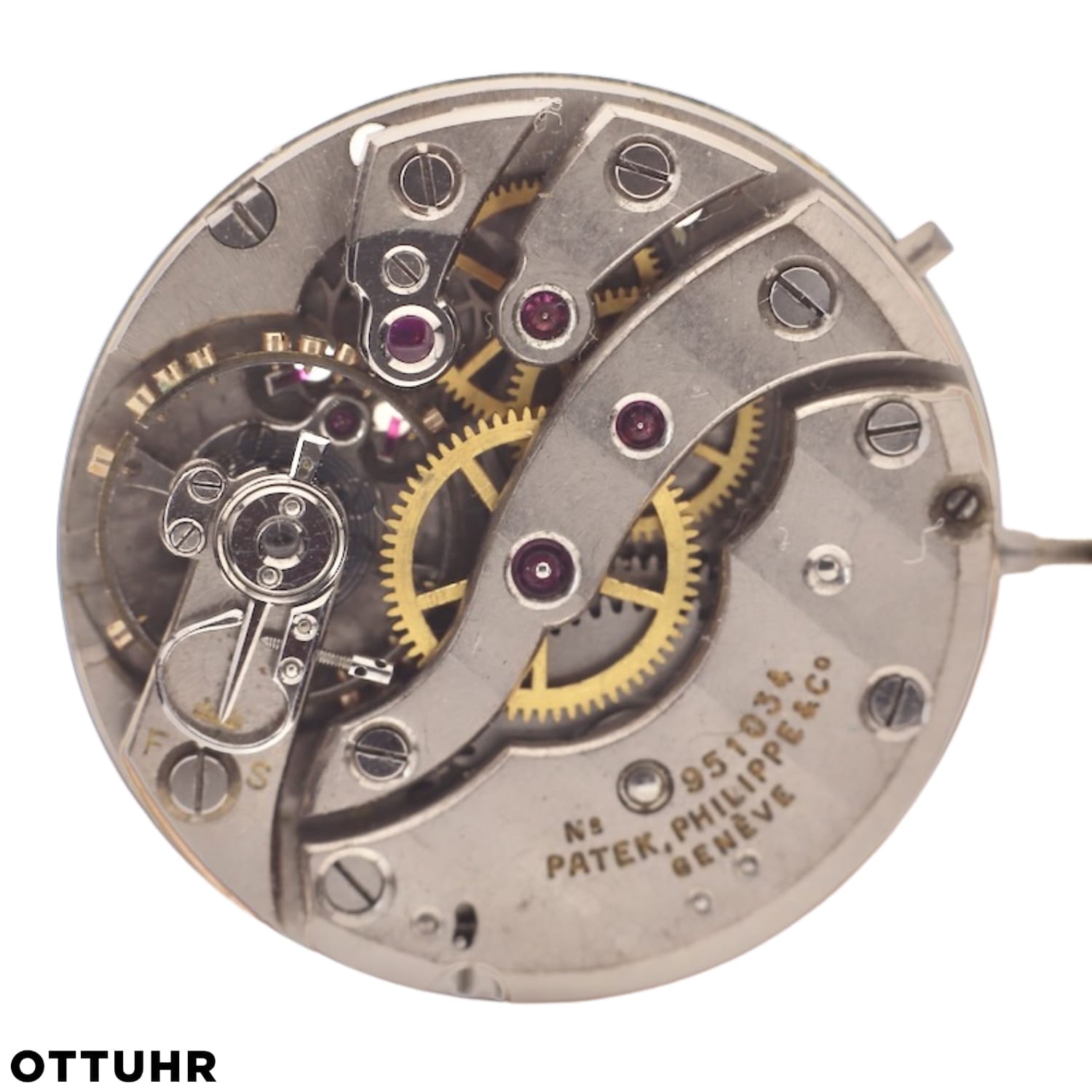
|
Brand |
Patek Philippe |
|
Caliber Number |
10-200 |
|
Production Start |
1946 |
|
Production End |
1965 |
|
Lignes |
10''' |
|
Diameter |
22.50mm |
|
Height |
3.65mm |
|
Power Reserve |
36 hours |
|
Frequency |
19,800 vph (2.75 Hz) |
|
Jewel Count |
18 |
|
Escapement |
Swiss lever, straight-line |
|
Anti-Shock Device |
Incabloc |
|
Lift Angle |
48 degrees |
|
Hand Count |
3 |
|
Manufacture Region |
Switzerland |
|
Functions |
Time-only |
Patek Philippe 10-200 Description
The Patek Philippe 10-200 represents the apex of mid-century manual winding craftsmanship in a compact 10-ligne package. As the third and final evolution in Patek’s 10-ligne series, this movement powered some of the most elegant Calatrava and shaped case references of the 1950s and early 1960s, establishing itself as the benchmark for thin dress watch movements before being succeeded by the caliber 215 in 1974.
Introduced in 1946 and produced through 1965, the 10-200 served as Patek Philippe’s premier small-diameter manual caliber during the golden age of mid-century dress watchmaking. At just 22.5mm diameter and 3.65mm height, it delivered Geneva Seal-grade finishing and chronometer-level regulation in a package suitable for elegant cases ranging from 28mm to 36mm. The movement appeared in both round Calatrava models and shaped references, including some of the manufacture’s most distinctive rectangular, cushion, and asymmetric case designs.
Approximately 20,197 examples of the 10-200 were manufactured between 1946 and 1965, making it uncommon but not rare in absolute terms. The caliber equipped at least 23 distinct reference numbers, including the 2488, 2496, 2501, 2525, 2527, 2546, and many others. Because production was distributed across numerous references over two decades, finding specific reference-caliber combinations can range from relatively available (ref. 2501) to extremely scarce (platinum ref. 2488). Movement serial numbers for the 10-200 fall primarily within two ranges: 740,000-759,999 and 950,000-959,999.
Standing in today’s vintage market, the 10-200 occupies a sweet spot for collectors seeking authentic mid-century Patek Philippe quality without the premium commanded by complicated or automatic calibers. Well-preserved examples with original dials and proper Geneva Seal double-stamping attract consistent demand, particularly in desirable references like the stepped-case 2525/1 or rectangular 2488. Collector preference leans toward examples retaining original finishing, unpolished cases, and complete archives documentation confirming production and sale dates.
Historical Context, Provenance, and Manufacturing Details
Patek Philippe developed the 10-200 as the successor to two earlier 10-ligne calibers: the 10-105 (produced 1939-1946) and the 10-110 (produced 1940-1950). All three movements shared similar architectural DNA, but the 10-200 incorporated refinements in regulation, finishing standards, and adjustment protocols that reflected the manufacture’s post-war commitment to chronometer-grade performance in even its simplest time-only movements.
The 10-200 arrived at a pivotal moment in wristwatch history. Post-war prosperity drove demand for elegant dress watches, and Patek Philippe responded by expanding its Calatrava collection with diverse case shapes and finishing treatments. The 10-200 powered this expansion, appearing in round, rectangular, cushion, tonneau, and asymmetric cases crafted by specialist casemakers including Wenger, whose work is identifiable by internal case markings. The caliber’s compact diameter required movement holders or spacers when fitted to larger cases, a common practice that allowed the same movement to serve watches ranging from 28mm ladies’ models to 36mm men’s pieces.
The 10-200 is a fully in-house Patek Philippe manufacture caliber, produced at the company’s Geneva facilities. Every movement bears the Poinçon de Genève (Geneva Seal), with most examples double-stamped on both the movement plate and balance cock, signifying compliance with the strict standards of the Bureau de Contrôle Officiel de la Qualité in Geneva. Production continued until approximately 1965, when evolving technical standards and the growing popularity of automatic movements began shifting the manufacture’s focus toward larger-diameter calibers.
Following the 10-200’s discontinuation, Patek Philippe developed the caliber 23-300, a larger 23mm (10-ligne designation notwithstanding) manual movement that incorporated a free-sprung Gyromax balance with overcoil hairspring. The 23-300 bridged the gap until 1974, when the caliber 215 was introduced as the modern successor to Patek’s thin manual-wind lineage, a role it continues to serve in the current collection.
Construction and Architecture
Plate and Bridge Layout: The 10-200 follows traditional Genevan architecture with a three-quarter plate construction featuring separate bridges for the going train and escapement. The movement employs five principal bridges/cocks: the barrel bridge, center wheel bridge, third/fourth wheel bridge, escape wheel bridge, and balance cock. The base plate and bridges are fabricated from brass with nickel plating, then finished with rhodium plating to resist tarnishing. The architectural philosophy prioritizes stability, accessibility for servicing, and visual harmony, with each bridge designed to facilitate complete disassembly and reassembly by skilled watchmakers.
Balance Wheel: The 10-200 employs a Gyromax balance wheel, Patek Philippe’s proprietary variable-inertia system introduced in 1949 and progressively integrated across the manufacture’s calibers throughout the 1950s. The Gyromax uses eight pivoting eccentric weights positioned around the balance rim, allowing precise adjustment of the balance’s moment of inertia without traditional timing screws. This system reduces air resistance compared to screw-adjusted balances while permitting fine regulation. The balance is monometallic, constructed from Glucydur or similar temperature-compensating alloy, eliminating the need for bimetallic compensation prevalent in earlier movements.
Balance Spring (Hairspring): The movement utilizes a flat Breguet overcoil hairspring manufactured from Nivarox or similar corrosion-resistant, temperature-compensating alloy. The Breguet overcoil terminal curve lifts the outer coil above the body of the hairspring and curves it inward within the circumference, ensuring the spring breathes concentrically during oscillation. This configuration minimizes positional errors and contributes to the movement’s chronometer-grade performance across multiple positions. Some sources reference blued steel hairsprings in early production examples, though Nivarox became standard during the 1950s.
Escapement Type: The 10-200 features a Swiss lever escapement with straight-line configuration. The escapement consists of a 15-tooth escape wheel engaging with a lever carrying two synthetic ruby pallet stones. The entry and exit pallet faces are precisely angled to provide optimal impulse delivery to the balance while maintaining secure drop and lock. The escapement jeweling includes capped jewels for the escape wheel pivots, contributing to the movement’s 18-jewel count.
Shock Protection System: Incabloc shock protection is fitted to both the upper and lower balance staff pivots. The Incabloc system, introduced in 1934, uses spring-mounted jewel settings that can deflect during impact, protecting the delicate balance staff pivots from damage. Following impact, the spring returns the jewel to its centered position. This system became the industry standard and was widely adopted by Swiss manufacturers during the 1940s and 1950s.
Regulator Type: The 10-200 employs a swan-neck micrometric regulator despite featuring a free-sprung Gyromax balance. This combination is somewhat unusual, as free-sprung balances typically eliminate the need for index regulators. The swan-neck regulator provides fine adjustment of the effective hairspring length via a threaded adjustment screw acting against a spring-loaded regulator arm. The regulator includes index markers for measuring adjustment increments.
Mainspring Material and Type: The barrel contains a traditional alloy mainspring with fixed outer attachment to the barrel wall. Mainspring dimensions are approximately 1.45mm width x 0.065mm thickness x 6.0mm developed length (units require verification). The barrel inner diameter measures 8.7mm, and the arbor diameter is approximately 2.8mm. The mainspring provides approximately 36 hours of power reserve when fully wound, though some sources cite 44-48 hours, likely reflecting variations in mainspring specifications or winding state definitions.
Gear Train Details: The movement uses a conventional four-wheel going train (barrel, center wheel, third wheel, fourth wheel) driving the escape wheel. The center wheel carries the minute hand via friction fitting, while the cannon pinion drives the hour wheel through intermediate gearing. Small seconds are displayed via a subsidiary seconds wheel mounted on the extended fourth wheel arbor, positioned at 6:00 on the dial. The gear train operates with minimal backlash, contributing to smooth energy transmission and stable amplitude throughout the power reserve.
Finishing Quality and Techniques: As a Geneva Seal-certified movement, the 10-200 meets stringent finishing standards across all visible and hidden surfaces. The base plate features circular perlage (circular graining) applied in overlapping patterns. Bridges display Côtes de Genève (fausses côtes) in parallel stripes, executed by hand or machine with subsequent hand polishing to remove tool marks. All bridge edges exhibit anglage (beveling/chamfering) with polished internal and external angles. Screw heads are polished flat with chamfered slots, though Patek Philippe does not use blued screws in this caliber. Jewel settings are polished, with chatons used for key pivots. The level of finishing is appropriate for a mid-tier Patek caliber, superior to ébauche-based movements but not approaching the haute horlogerie standards reserved for complicated calibers.
Cross-Reference Data
Patek Philippe References Using Caliber 10-200
| Brand | Reference Numbers | Production Years | Notes |
|---|---|---|---|
| Patek Philippe | 431, 482 | 1946-1965 | Round Calatrava models |
| Patek Philippe | 1419, 1458 | 1946-1965 | Also used cal. 10-105 in earlier production |
| Patek Philippe | 1519 | 1946-1965 | Round case |
| Patek Philippe | 2407, 2408 | 1950-1961 | Calatrava references |
| Patek Philippe | 2425, 2431 | 1948-1955 | With 12-200 in some examples |
| Patek Philippe | 2440 | 1946-1953 | Rectangular “Clubs” model, extremely rare |
| Patek Philippe | 2451 | 1949-1959 | “Aquatic” case, 36 known examples |
| Patek Philippe | 2484 | 1950-1961 | “Few hundred” produced |
| Patek Philippe | 2488 | 1950-1959 | Rectangular/square, ~500 produced |
| Patek Philippe | 2496 | 1950-1965 | Square/rectangular, hobnail decoration available |
| Patek Philippe | 2501 | 1946-1965 | Round Calatrava, available with/without seconds |
| Patek Philippe | 2525, 2525/1 | 1952-1962 | Stepped case, fluted lugs, rare in white gold |
| Patek Philippe | 2527, 2528 | 1950-1961 | Calatrava models |
| Patek Philippe | 2530 | 1950-1961 | First series with stepped case |
| Patek Philippe | 2546 | 1954-1955 | Twisted lugs, approximately 10 known |
| Patek Philippe | 2547, 2548 | 1950-1965 | Calatrava references |
| Patek Philippe | 2549/1, 2549/2 | 1950-1965 | Calatrava variants |
| Patek Philippe | 2573 | Circa 1960 | Rectangular case |
| Patek Philippe | 2577 | 1956-1960 | Enamel dials known |
| Patek Philippe | 2596 | Circa 1959 | Round case |
| Patek Philippe | 2598 | 1950s | Calatrava, rose gold |
| Patek Philippe | 3496 | 1946-1965 | Later production reference |
The 10-200 was not offered in multiple elaboration grades. All examples were manufactured to the same high standard with Geneva Seal certification, 18 jewels, and adjustment to heat, cold, isochronism, and five positions.
Dial Compatibility and Case Specifications
The 10-200’s 22.5mm diameter necessitated movement holders or spacer rings when fitted to cases larger than approximately 30mm. Dial feet positions follow Patek Philippe’s standard configuration for 10-ligne movements. Small seconds sub-dial aperture is centered at 6:00 when present. Date windows are not applicable, as the 10-200 is a time-only caliber.
Crown and Stem Specifications
Identification Marks
Caliber Number Location: The caliber designation “10-200” is engraved on the movement plate, typically visible near the balance cock or barrel bridge when the movement is removed from the case.
Logo and Brand Marks: Authentic movements display “PATEK, PHILIPPE & Co.” and “GENEVE SWISS” engraved on the movement plate. The Geneva Seal (Poinçon de Genève) appears as a double stamping on the movement plate and balance cock in most examples. The seal depicts the Geneva coat of arms with an eagle and key. Movements destined for the U.S. market may also bear “HOX” customs/tariff code markings.
Adjustment Markings: The movement plate is engraved with adjustment specifications: “ADJUSTED TO HEAT, COLD, ISOCHRONISM & FIVE (5) POSITIONS” or similar text indicating chronometer-level regulation. This marking confirms the movement underwent positional adjustment during manufacture.
Jewel Markings: The text “EIGHTEEN (18) JEWELS” is engraved on the movement plate. Jewel settings are polished, with some pivots featuring gold chatons depending on production era and elaboration level.
Serial Number Formats and Locations: Movement serial numbers are engraved on the movement plate, typically a six-digit number. Known serial ranges for the 10-200 include 740,000-759,999 and 950,000-959,999, though production serial numbers span additional ranges given the approximately 20,000 movements manufactured. Case serial numbers are engraved on the inside case back or case lugs, typically a seven-digit number correlating to Patek Philippe’s production records.
Expected Engravings and Stampings: All engravings should be sharply executed with consistent depth and font style. The caliber number, manufacturer name, jewel count, Geneva Seal, and adjustment markings must be present and correctly spelled. Any deviation in font style, engraving depth, or marking placement raises authenticity concerns.
Font and Marking Style by Production Era: Early 10-200 examples (1946-1950s) feature serif fonts with delicate engraving. Later production (late 1950s-1965) may show slight variations in font weight or engraving technique as tooling evolved, but core characteristics remain consistent. The Geneva Seal design remained unchanged throughout the production period.
Part Information
Key Component Part Numbers
Sourcing Notes
Parts availability for the 10-200 is severely limited. Patek Philippe’s official service policy directs watchmakers to submit movements requiring parts directly to Patek Philippe Service Centers, as third-party parts distribution is not supported for this caliber. Specialized vintage parts suppliers such as Ofrei, Jules Borel, and European dealers occasionally stock generic components (mainsprings, balance staffs, stems), but movement-specific parts (bridges, wheels, jewel plates) are rarely available outside Patek’s internal parts inventory.
Common failure points include worn balance staff pivots (requiring replacement or re-pivoting), deteriorated mainsprings (loss of elasticity reduces power reserve), and damaged pallet stones (requiring pallet fork replacement or re-stoning). Generic Swiss-made mainsprings compatible with the 10-200’s barrel dimensions are available from aftermarket suppliers, though original Patek specifications are preferred.
Servicing a 10-200 requires submission to authorized Patek Philippe Service Centers or highly experienced independent watchmakers specializing in vintage Patek calibers. Full service costs from Patek Philippe service centers vary by region, with manual-winding movements typically priced at CHF 900-1,000 (approximately $1,000-1,100 USD) plus additional costs for case/bracelet refreshing, parts replacement, or archive documentation.
Performance Data
Manufacturer Specifications: The 10-200 was regulated to chronometer-level standards, with movements adjusted to heat, cold, isochronism, and five positions during manufacture. Official accuracy specification when new: within approximately ±5 seconds per day across tested positions, though individual movements could achieve tighter tolerances depending on regulation quality. The movement was tested in five positions (dial up, dial down, crown up, crown down, crown left) to verify consistent rate performance regardless of wrist orientation. Temperature compensation is inherent in the monometallic Glucydur balance and Nivarox hairspring, which maintain stable rate across the operating temperature range of approximately 5-35°C.
Observed Performance (Field Data): Well-maintained 10-200 movements in service today typically achieve accuracy within ±3 to ±10 seconds per day, depending on regulation state, service history, and wear. Freshly serviced examples can deliver COSC chronometer-level performance (approximately -4/+6 seconds per day) when properly regulated. Common performance issues include:
- Positional variation: Movements with worn balance pivots or damaged hairsprings exhibit increased rate variance between positions, sometimes exceeding ±20 seconds per day between dial-up and pendant positions.
- Amplitude decay: Expected amplitude when fully wound ranges from 270-310 degrees in horizontal positions. As power reserve depletes, amplitude decreases to approximately 200-240 degrees near the 36-hour mark. Amplitudes below 200 degrees indicate mainspring weakness, excessive friction, or insufficient lubrication.
- Beat error: Properly serviced movements should exhibit beat error below 0.5ms. Beat error above 1.0ms indicates hairspring misalignment or balance pivot issues requiring adjustment during service.
Age-related degradation patterns include thickened lubricants (increasing friction and reducing amplitude), worn pivots (causing increased positional error), and hairspring deformation (affecting rate stability and isochronism). The 10-200’s robust architecture and high-quality materials enable excellent longevity when properly maintained, with many examples from the 1950s continuing to deliver reliable daily wear performance after professional service.