

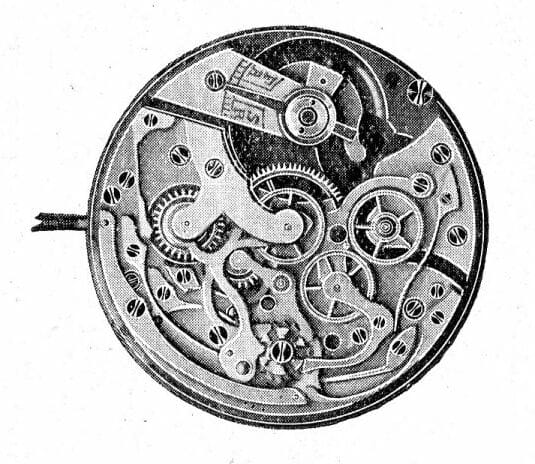
The Valjoux 22 powered some of the most historically significant chronographs of the 20th century, from Rolex’s first modern wrist chronograph to Breguet’s legendary Type 20 military pilot watches. For six decades, this column-wheel caliber served as the foundation for precision chronographs across price points, from modest brands to haute horlogerie manufacturers who extensively modified and finished it to their exacting standards. Its longevity and widespread adoption make it one of the most important chronograph movements in horological history.
Originally designed for pocket watches in 1914, the Valjoux 22 is a 14 ligne (31.3mm) manual-wind chronograph featuring a 9-column wheel control system and two sub-registers: small seconds at 9 o’clock and a 30-minute or 45-minute chronograph counter at 3 o’clock. The movement was intentionally oversized for pocket watch applications, which resulted in larger wrist chronographs when brands adapted it for wristwatches in the 1920s through 1950s. This substantial size, combined with its robust architecture and reliable timekeeping, established the caliber’s reputation as a workhorse movement that could withstand demanding applications from military aviation to motorsports timing.
Production volume estimates suggest that hundreds of thousands of Valjoux 22 movements were manufactured during the 60-year production run, though exact figures were never published by Valjoux SA or its successor ETA. Based on serial number ranges observed by collectors and the fact that the smaller Valjoux 72 family produced approximately 750,000 movements, conservative estimates place Valjoux 22 production between 200,000 and 400,000 units. The caliber is uncommon to scarce in today’s market, with examples in good working condition commanding premium prices when found in desirable branded cases. The movement is less common than its smaller sibling, the Valjoux 23, because the 14 ligne size made it less versatile for the trend toward smaller wrist chronographs in the post-war era.
Collector demand for Valjoux 22 chronographs has strengthened considerably over the past decade, driven by appreciation for vintage tool watches and military chronographs. The caliber’s presence in sought-after references such as the Rolex 2508, Breguet Type 20 with flyback (Cal. 222), and Vacheron Constantin 4072 (modified as Cal. 434) has elevated its status among serious collectors. Prices vary dramatically based on the brand, dial configuration, and condition, with unbranded or lesser-known examples trading for $1,500 to $3,000, while branded examples from prestigious manufacturers reach $15,000 to $50,000 or more. The most collectible variants include early monopusher versions (1914-1936), military-issued pieces with provenance, and manufacturer-modified versions with exceptional finishing.
Historical Context, Provenance, and Manufacturing Details
Brothers John and Charles Reymond founded their workshop in Les Bioux, in Switzerland’s Vallée de Joux, in 1901 under the name J. & C. Reymond Frères. Specializing in chronograph movements from the outset, the company introduced the Caliber 15”’ in 1914, a 14 ligne monopusher chronograph intended for pocket watches. This movement would evolve into the Valjoux 22 when the company changed its name to Valjoux SA (short for Vallée de Joux) in 1929. The caliber designation “22” likely referred to an internal classification system, with “15”'” denoting the original ligne measurement.
The Valjoux 22 was developed during the transition from pocket watches to wristwatches, when chronograph complexity was migrating from large pocket formats to smaller wrist-worn cases. The 14 ligne size represented a compromise: small enough for larger wristwatches but large enough to accommodate reliable chronograph mechanisms using existing manufacturing techniques. The movement initially featured a single pusher in the crown (monopusher configuration), which controlled start, stop, and reset functions sequentially. By 1936, Valjoux had updated the design to accommodate two-pusher operation, separating start/stop from reset functions, though some manufacturers continued ordering monopusher versions into the 1940s.
The Valjoux 22 did not replace a specific predecessor but rather evolved from Valjoux’s experience with earlier pocket watch chronographs. Its successor was the Valjoux 71, introduced in the 1940s, which added a third sub-register for 12-hour chronograph timing. However, the 22 remained in production alongside the 71 because many manufacturers preferred the cleaner two-register dial layout. The caliber was eventually phased out in 1974 as Valjoux transitioned to more modern designs and consolidated production under parent company ETA, which had absorbed Valjoux through Ebauches SA in 1944.
Valjoux SA functioned as an ebauche manufacturer, producing unfinished or partially finished movements that were sold to watch brands for final finishing and casing. The company’s location in Les Bioux placed it at the heart of Switzerland’s watchmaking Vallée de Joux, in close proximity to prestigious manufacturers like Jaeger-LeCoultre and Audemars Piguet. Production took place in a municipal factory building constructed specifically for the Reymond brothers’ operation. When Ebauches SA assumed control in 1944, production continued uninterrupted in Les Bioux. Later, in 1968, Ebauches SA constructed a modern factory in Moutier to consolidate Valjoux and Venus production, though the Valjoux name officially dissolved into the ETA organization in 1979.
In the broader context of horological history, the Valjoux 22 represents the classic era of column-wheel chronographs before the quartz crisis. It was neither groundbreaking nor transitional, but rather a refined execution of established chronograph principles: column-wheel control, lateral clutch, and robust construction. The movement’s true significance lies in its adoption by elite manufacturers who recognized that a well-made ebauche could be transformed into an exceptional movement through proper finishing and adjustment. Patek Philippe and Vacheron Constantin’s extensive modifications to Valjoux movements demonstrated that manufacture status was less important than final execution, a lesson that continues to influence modern watchmaking.
Construction and Architecture

Plate and Bridge Layout: The Valjoux 22 employs a three-quarter plate architecture with separate bridges and cocks for the balance wheel, chronograph mechanism, and train wheels. The main plate is constructed from nickel-plated brass, providing dimensional stability and corrosion resistance. The large chronograph bridge dominates the movement’s back, incorporating a distinctive curved design that accommodates the column wheel, chronograph clutch, and related levers. This architecture allows for efficient servicing, as the chronograph mechanism can be removed without disturbing the going train. The design philosophy emphasizes accessibility and repairability over aesthetic refinement in base-grade examples, though higher-grade versions and manufacturer modifications added Geneva stripes, perlage, and anglage.
Balance Wheel: The standard Valjoux 22 features a Glucydur (beryllium bronze) monometallic balance wheel with two arms and adjustable timing screws. Glucydur offers superior resistance to temperature variations and magnetic fields compared to traditional bimetallic balances. The balance measures approximately 10-11mm in diameter and incorporates typically four timing screws positioned at 90-degree intervals for fine adjustment of moment of inertia. Base-grade movements used smooth balances without adjustment screws, relying entirely on regulator adjustment. Higher-grade examples destined for chronometer certification featured screw-adjusted balances allowing watchmakers to fine-tune rate in multiple positions. The balance wheel’s construction reflects the movement’s intended use as a robust tool rather than a showcase for haute horlogerie finishing.
Balance Spring (Hairspring): Valjoux equipped the caliber 22 with Nivarox hairsprings, the industry-standard alloy introduced in the 1930s. Nivarox (nickel-chromium-cobalt-beryllium-titanium alloy) provides self-compensation for temperature variations, eliminating the need for bimetallic balances. Most examples feature a flat Breguet overcoil terminal curve, which improves concentricity of expansion and contraction, resulting in better positional timekeeping. The hairspring attaches to a stud fixed to the balance cock, with effective length adjusted via a regulator with curb pins. Premium examples modified by manufacturers like Patek Philippe featured raised Breguet overcoils with improved geometry for chronometer-grade performance.
Escapement Type: The movement employs a Swiss lever escapement with ruby pallet stones and a synthetic ruby impulse jewel on the balance roller. This design, standardized across Swiss chronograph production, provides efficient power transfer and excellent reliability. The escape wheel features 15 teeth and operates at 18,000 vibrations per hour, delivering a 2.5 Hz beat rate. The pallet fork and escape wheel are typically jeweled with five jewels: two pallet stones, the impulse jewel, and jeweled pivot points for both the pallet fork and escape wheel arbor. The Swiss lever escapement’s geometry in the Valjoux 22 produces a 48-degree lift angle, the value watchmakers must use when timing the movement on electronic timing machines.
Shock Protection System: Most Valjoux 22 movements from the 1950s onward incorporated Incabloc shock protection for the balance wheel pivots. Incabloc, manufactured by Portescap SA, consists of a lyre-shaped spring holding a conical jewel setting that can move axially to absorb shock. Earlier examples (1914-1940s) often lacked shock protection entirely, making them more vulnerable to balance staff breakage from impacts. Some manufacturers specified KIF shock protection as an alternative, though Incabloc was far more common. The shock protection system is visible on both sides of the balance cock, with the jewel settings appearing as small brass-colored chatons that can be removed for servicing. Premium manufacturer-modified versions sometimes eliminated shock protection in favor of a more classical aesthetic, accepting reduced shock resistance as a trade-off.
Regulator Type: The standard Valjoux 22 uses an index regulator (also called a Bosley regulator), consisting of two curb pins that grip the hairspring to adjust its effective length. A lever extending from the regulator bearing provides the adjustment point, with markings typically showing “+” (fast) and “-” (slow) or “A” (advance) and “R” (retard). This system allows relatively crude adjustment compared to swan-neck regulators or free-sprung balances. The regulator in base-grade movements is simply a flat arm secured by a single screw. Some adjusted-grade examples feature a more refined regulator with a pointer for precise positioning. Manufacturer-modified versions, particularly those by Patek Philippe, replaced the standard index regulator with swan-neck fine adjusters that provided micrometric regulation and prevented accidental movement of the regulator setting.
Mainspring Material and Type: The Valjoux 22 originally used traditional steel mainsprings requiring periodic replacement due to setting and loss of elasticity. Post-war examples transitioned to white alloy (unbreakable) mainsprings offering longer service life and more consistent torque delivery. Standard mainspring dimensions for the caliber are 1.50mm width, 0.100-0.105mm thickness, and 280-290mm length, with strength rated at 9.0. The mainspring attaches to the barrel arbor via a hole and hook arrangement (fixed attachment) rather than a slipping bridle. When fully wound, the mainspring provides approximately 40 hours of power reserve, declining gradually with a relatively consistent torque curve suitable for chronograph applications. Mainspring suppliers including Ranfft and Grizzly offer compatible replacements under various part numbers, though exact dimensions should be verified for specific movement variants.
Gear Train Details: The going train consists of four wheels: barrel, center (with cannon pinion), third, and fourth (escape wheel). The center wheel drives directly from the barrel and carries the minute hand via friction-fit cannon pinion. Gear ratios produce the 18,000 vph frequency through the standard Swiss calculation: center wheel (8 turns per hour) to third wheel to fourth wheel to escape wheel (15 teeth, 2 impulses per oscillation). The small seconds hand drives indirectly from a subsidiary wheel train rather than from the fourth wheel, allowing the small seconds at 9 o’clock to continue running when the chronograph is activated. This separate seconds drive distinguishes chronographs from simple time-only movements and accounts for the movement’s increased thickness. The chronograph seconds hand operates via a lateral clutch that engages the fourth wheel when the chronograph starts.
Finishing Quality and Techniques: Base-grade Valjoux 22 movements featured utilitarian finishing: circular graining (perlage) on the main plate visible through the dial side, brushed or grained bridges without striping, and polished screw heads. Adjusted-grade examples added Geneva stripes (Côtes de Genève) to visible bridges, beveled (anglaged) edges on steel parts, and heat-blued screws for decorative effect. Chronometer-grade movements destined for timing certification received the highest finishing, with hand-applied Geneva stripes, mirror-polished steel parts, and meticulous anglage. Brand-modified versions varied dramatically: Vacheron Constantin applied moderate finishing upgrades while maintaining the ebauche character; Patek Philippe completely reworked the movement with new bridges, swan-neck regulators, and Geneva Seal-worthy finishing that transformed the base ebauche into a manufacture-quality caliber. Finishing quality declined in later production years (1960s-1970s) as cost pressures increased and the movement approached obsolescence.

Cross-Reference Data
Alternative Caliber Names (Rebranded Versions)
| Manufacturer | Caliber Designation | Notes |
|---|---|---|
| Alpina | 942, 943 | Standard Valjoux 22 with Alpina signing |
| Eterna | 703 | Ebauche-grade finishing, Eterna-signed bridge |
| Heuer | 347 | Used in References 333, 347, 2508; signed “Heuer” on movement |
| Invicta | 60 | Standard base movement with Invicta signature |
| Marvin | 730 | Used in oversized chronographs, 36-40mm cases |
| Vacheron Constantin | 434 | Extensively modified: reshaped bridges, improved finishing, swan-neck regulator added on some examples; produced 1940-1950 |
| Zeiss Ikon | MBK 1000 | Military variant for Luftwaffe machine gun training chronographs |
Base Caliber vs. Elaborated Versions
| Variant | Production Period | Differences | Jewel Count | Functions |
|---|---|---|---|---|
| Cal. 15”’ | 1914-1928 | Original designation, monopusher only | 17 | Time, small seconds, 30-minute chronograph |
| Cal. 22 | 1928-1966 | Renamed version, available in mono- or two-pusher | 17 | Time, small seconds, 30-minute chronograph |
| Cal. 22 GH | 1928-1966 | Standard two-pusher, 30- or 45-minute counter options | 17 | Time, small seconds, 30/45-minute chronograph |
| Cal. 22 GHT | 1928-1974 | Height increased to 14.25 lignes for specific applications | 17 | Time, small seconds, 30/45-minute chronograph |
| Cal. 71 | 1946-1974 | Added 12-hour chronograph counter at 6:00 (three registers) | 17 | Time, small seconds, 30-minute and 12-hour chronograph |
| Cal. 84 | 1940s-1974 | Mono-rattrapante (split-seconds) complication | 17+ | Time, small seconds, 30/45-minute chronograph, rattrapante |
| Cal. 222 | 1952-1970 | Flyback module added for Type 20 military watches; height 6.8mm | 17 | Time, small seconds, 30-minute chronograph with flyback |
Compatible Case References by Brand
| Brand | Reference Numbers | Production Years | Notes |
|---|---|---|---|
| Rolex | 2508 | Late 1930s-mid 1940s | Two case variants: olive pushers (earlier) and square pushers (later); 35-36mm |
| Rolex | 3525, 4062 | 1940s | Anti-magnetic variants; steel and gold cases |
| Heuer | 333, 347 | 1940s-1950s | Snap-back cases, 36-38mm; various dial configurations |
| Vacheron Constantin | 4072, 4178 | 1940-1964 | Cal. 434 (modified 22); 36mm; steel and precious metals |
| Breguet | Type 20 (5101/54) | 1954-1960 | Cal. 222 with flyback; 38.5mm steel case; military issue |
| Dodane | Type 20 | Late 1950s-1960s | Cal. 222 with flyback; 37mm steel; French military |
| Mathey-Tissot | Type XX | 1950s | Cal. 222 with flyback; assembled for Breguet military contracts |
Dial Compatibility Note: Valjoux 22 dials feature two feet positioned at approximately 1:30 and 7:30 (or variations depending on manufacturer). No date window exists on standard configurations. Dial feet positions differ from the smaller Valjoux 23 (13 ligne), making dials non-interchangeable despite visual similarity. Sub-dial positioning is fixed: small seconds at 9:00, chronograph minutes at 3:00. Replacement dials must match the original foot positions precisely, and period-correct dials command significant premiums. Refinished or reprinted dials dramatically reduce collector value, often by 50-70% compared to original patinated examples.
Crown and Stem Specifications
| Component | Specification | Notes |
|---|---|---|
| Winding Stem Thread | TAP 7 (1.20mm) | Standard for Valjoux 22, 71, 84, 222 |
| Stem Thread (alternate) | TAP 10 (0.90mm) | Less common, verify with original stem |
| Stem Part Number | Valjoux 22-401 | Interchangeable with Cal. 71, 84, 222 |
| Crown Thread | 0.90mm or 1.20mm | Matches stem tap size |
| Setting Mechanism | Yoke clutch | Sliding pinion design activated by pull-out stem |
Identification Marks
Caliber Number Location: The caliber number marking appears engraved on the main plate visible from the dial side, typically positioned near the 4-5 o’clock area adjacent to the winding stem. On some examples, “Valjoux” or “Val. Joux” appears on the chronograph bridge on the back side of the movement, often accompanied by “Swiss” or “Swiss Made.” Earlier monopusher examples (1914-1920s) may show only the original “15”'” designation. The engraving should be crisp, machine-cut, and consistent in depth. Hand-scratched or poorly executed markings suggest replacement parts or non-original components.
Logo and Brand Marks: Authentic Valjoux 22 movements display the Valjoux signature or logo on the chronograph bridge, balance cock, or main plate. The standard marking is “VALJOUX” in capital letters, typically serif font, with “SWISS MADE” appearing separately. Rebranded versions (Heuer, Alpina, etc.) replace the Valjoux signature with the retailer’s or manufacturer’s name. Higher-grade movements may display adjustment markings such as “ADJUSTED” or “ADJUSTED 3 POSITIONS” on the balance cock or main plate. Manufacturer-modified movements (Vacheron Constantin, Patek Philippe) completely remove Valjoux markings and apply only the brand signature, making the ebauche origin nearly invisible except through technical analysis.
Date Codes: Valjoux SA did not employ systematic date codes on the Valjoux 22. Dating must rely on serial number analysis, case hallmarks, and dial printing characteristics. Serial numbers provide approximate production periods when cross-referenced with documented examples. The transition from monopusher to two-pusher operation (circa 1936) serves as a useful dating reference, as do the introduction of Incabloc shock protection (1940s-1950s) and the shift to Glucydur balances with Nivarox hairsprings in post-war production.
Finishing Marks: Expected finishing patterns vary by grade. Base-grade movements show circular perlage on the main plate, visible from the dial side, applied with a rotating abrasive tool creating overlapping circular patterns. The chronograph bridge on base grades typically shows simple brushing or coarse graining. Adjusted-grade movements add Geneva stripes (Côtes de Genève) to bridges, consisting of parallel lines applied with a rotating abrasive wheel guided by hand. Premium grades feature hand-applied beveling (anglage) on bridge edges, creating polished 45-degree chamfers. Manufacturer-modified versions display the highest finishing quality, with mirror-polished chronograph levers, hand-beveled edges, and “black polish” on steel parts visible from the caseback.
Jewel Markings: The standard Valjoux 22 contains 17 jewels set in the following positions: balance staff (2), pallet fork (2), escape wheel (2), fourth wheel (2), third wheel (2), center wheel (2), barrel arbor (1), and chronograph components (4). Base-grade movements use pressed-in jewels without decorative chatons. Higher-grade examples and manufacturer modifications employ gold or brass chatons (decorative bezels) surrounding visible jewels, particularly for the balance and escape wheel. Shock-protected versions add spring-mounted jewel settings for the balance pivots, easily identified by the lyre-shaped Incabloc springs. Some premium versions may increase jewel count to 19-21 by adding jeweling to chronograph components.
Adjustment Markings: Movements intended for chronometer certification or sold as adjusted-grade display engraved markings indicating positional adjustment. Common markings include “ADJUSTED 3 POSITIONS” or “3 ADJ.” engraved on the balance cock or main plate. These indicate the movement was regulated in three positions (typically dial up, dial down, and crown down). True chronometer-grade examples may show “ADJUSTED 5 POSITIONS” or certification numbers from testing bureaus. These markings should appear as crisp, factory-applied engravings, not hand-scratched additions. Movements lacking adjustment markings were sold at base grade and typically achieve ±30-60 seconds per day accuracy.
Correct Serial Number Formats and Locations: Serial numbers appear stamped on the main plate, typically between the balance cock and the chronograph mechanism. Numbers follow sequential numeric format without letters or prefixes in standard Valjoux examples. Observed serial number ranges span from early five-digit numbers (1920s) to six-digit numbers in later production. Some rebranded versions add a second serial number specific to the watch brand. Serial number format should match period-correct examples: lightly stamped but clearly legible, aligned in a straight row, and positioned consistently with other known examples. Misaligned, re-stamped, or oddly positioned serial numbers suggest movement swaps or forgeries.
Expected Engravings and Stampings: Legitimate Valjoux 22 movements display specific engravings applied during manufacture. The main plate should show: caliber number (22, 22 GH, or 22 GHT), serial number, jewel count (17 RUBIS or 17 JEWELS), and “SWISS” or “SWISS MADE.” The chronograph bridge may show the Valjoux signature or rebrander’s name. Adjustment markings appear on the balance cock or adjacent to it. All engravings exhibit consistent depth, professional execution, and period-appropriate font styles. Modern laser engraving, poorly formed characters, or inconsistent depth indicate non-original parts or recent alterations. Manufacturer-modified versions show only the brand name with no Valjoux reference, maintaining consistent branding across all stamped surfaces.
Font and Marking Style by Production Era: Early production (1914-1930s) features serif fonts with slightly irregular hand-guided engraving, characteristic of pre-automated marking systems. Mid-production (1940s-1950s) shows more consistent machine engraving with uniform character heights and spacing. Late production (1960s-1974) exhibits modernized sans-serif fonts and standardized ETA-era marking styles as production consolidated. Rebranded versions from prestigious manufacturers employed custom fonts matching their corporate identity. Collectors can often date movements within a decade based on font characteristics, engraving depth, and marking placement, though this requires familiarity with documented reference examples.
Part Information

Part Numbers
| Component | Part Number | Interchangeability Notes |
|---|---|---|
| Mainspring | Valjoux 22 (1.50 x 0.100-0.105 x 280-290mm) | Compatible with Cal. 22, 22 GH, 22 GHT, 71, 84; strength 9.0 |
| Balance Complete | VA22-723 | Shared with Cal. 71, 84; includes balance wheel, staff, roller, and hairspring |
| Balance Staff | VA22-723 | Interchangeable with Cal. 71, 84; critical tolerance part requiring precision fit |
| Hairspring | Standard Nivarox for 14”’ movements | Must be sized and adjusted for specific movement; non-interchangeable without fitting |
| Escape Wheel | Part 705 | Shared across Valjoux 22 family; 15 teeth |
| Pallet Fork | Part 710 | Compatible with Cal. 22, 71, 84; includes synthetic ruby pallet stones |
| Crown Wheel | Part 401 (complete with core) | Interchangeable within 22 family |
| Ratchet Wheel | Part 415 | Standard across Valjoux 22, 71, 84 |
| Click Spring | Part 442 | Compatible with 22 family movements |
| Setting Lever Spring | Part 450 | Shared with Cal. 71 |
| Winding Stem | Valjoux 22-401, TAP 7 (1.20mm) | Compatible with Cal. 22, 71, 84, 222, 225 |
Sourcing Notes: Mainsprings remain widely available from suppliers including Ranfft, Otto Frei, and specialized vintage parts dealers, typically $15-25. Balance complete assemblies are scarce and expensive ($150-400) when available, often requiring custom fabrication by watchmakers. Balance staffs can be sourced from NOS (new old stock) suppliers or manufactured by skilled watchmakers using lathe equipment. Generic escape wheels and pallet forks for Swiss lever escapements may fit but require verification of pivot diameters and tooth profiles. Crown wheels, ratchet wheels, and winding stems remain available through ETA parts distribution and vintage specialists. Chronograph-specific components (column wheel, chronograph lever, minute-recording jumper) are increasingly difficult to source, often requiring donor movements or custom fabrication.
Common Failures: The most frequent failure points include: (1) broken balance staff pivots, particularly in examples lacking shock protection; (2) worn mainspring requiring replacement every 10-15 years of active use; (3) worn chronograph clutch friction spring causing poor engagement or slipping chronograph seconds hand; (4) hardened lubricants in jewel pivots causing increased friction and poor timekeeping; (5) worn chronograph pushers allowing moisture ingress and subsequent corrosion. The chronograph reset mechanism, specifically the heart cam and hammer, experiences wear from repeated use and may require replacement or refurbishing in heavily-used examples. Column wheel teeth rarely fail but can develop surface wear affecting crisp engagement.
Generic Replacements: Standard Swiss lever escapement parts (escape wheel, pallet fork) from other 14 ligne movements may physically fit but require careful verification of pivot diameters, depthing, and drop angles. Generic mainsprings can substitute if properly sized, though period-correct replacements are preferred for originality. Balance staffs cannot be substituted generically and must be precisely fitted to the existing balance wheel. Modern synthetic ruby jewels can replace worn jewels if original chatons are preserved. Crown and stem assemblies require exact specification matching, as tap sizes varied. Collectors and serious restoration projects should prioritize NOS original parts, while watchmakers performing functional repairs may accept certain generic substitutions for non-visible components.
Performance Data
Manufacturer Specifications: Valjoux SA did not publish detailed performance specifications for base-grade Valjoux 22 movements, as these were sold as ebauche movements requiring final adjustment by the purchasing manufacturer or watchmaker. Adjusted-grade examples typically specified ±20 to ±40 seconds per day accuracy when new, tested in 3 positions (dial up, dial down, crown down). Premium manufacturer-modified versions, particularly those certified as chronometers by Patek Philippe or Vacheron Constantin, achieved COSC standards of -4 to +6 seconds per day across 5 positions and 3 temperatures. Temperature compensation relies on the Nivarox hairspring’s self-compensating properties rather than a bimetallic balance, providing consistent rate across the 8°C to 38°C range typical of wrist wear.
Isochronism: Properly regulated examples maintain consistent amplitude across the full power reserve range, typically showing 270-290 degrees when fully wound, declining to 220-240 degrees at end of reserve. The rate should not vary more than 5-10 seconds per day between fully wound and nearly exhausted states in well-maintained examples. Poor isochronism (excessive rate variation with amplitude change) suggests worn pivots, damaged hairspring, or improper adjustment of the hairspring stud position.
Observed Performance (Field Data): Well-maintained Valjoux 22 movements in regular service typically achieve ±15 to ±30 seconds per day in dial-up position, which represents normal wrist-wearing orientation. Three-position adjusted examples can achieve ±10 to ±20 seconds per day averaged across positions. Positional variation (difference between dial up and crown down) commonly ranges from 15 to 40 seconds per day in base-grade examples, tightening to 5-15 seconds per day in adjusted grades. These performance figures assume recent servicing (within 5 years), proper lubrication, and undamaged components.
Common Performance Issues and Causes: Poor timekeeping typically results from: (1) hardened or absent lubrication, requiring complete service every 5-7 years; (2) magnetized hairspring, balance wheel, or pallet fork, correctable with demagnetization; (3) damaged hairspring developing a kink or bent coil, requiring replacement; (4) worn balance pivots causing excessive endshake and positional variation; (5) dirty or damaged pallet stones reducing escapement efficiency. Chronograph-specific issues include: poor chronograph hand return due to weak heart cam spring; chronograph seconds hand that jumps or stutters indicating clutch wear; failure to start indicating column wheel or operating lever problems.
Expected Amplitude: When fully wound and freshly serviced, the Valjoux 22 should achieve 270-290 degrees amplitude in dial-up position, 250-270 degrees in dial-down position, and 240-260 degrees in crown-down position. As power reserve depletes toward the 40-hour limit, amplitude typically drops to 220-240 degrees dial-up, still sufficient for reliable operation. Amplitude below 200 degrees suggests service is required. Measurements should be taken with a timing machine at the correct 48-degree lift angle setting.
Performance Degradation with Age: Valjoux 22 movements experience predictable degradation over time. Without service, accuracy deteriorates significantly after 10-15 years due to lubricant breakdown. Mainsprings lose elasticity over decades, reducing power reserve from the original 40 hours to 28-32 hours. Balance pivots develop wear patterns, particularly in examples lacking shock protection. Chronograph friction points (column wheel, operating levers, clutch) show accelerated wear in frequently-used examples. Examples that sat dormant for decades often require complete overhaul, as lubricants harden into varnish-like deposits that prevent movement operation. Regular service every 5-7 years, or every 3-5 years for actively used chronographs, extends service life and maintains performance within original specifications