

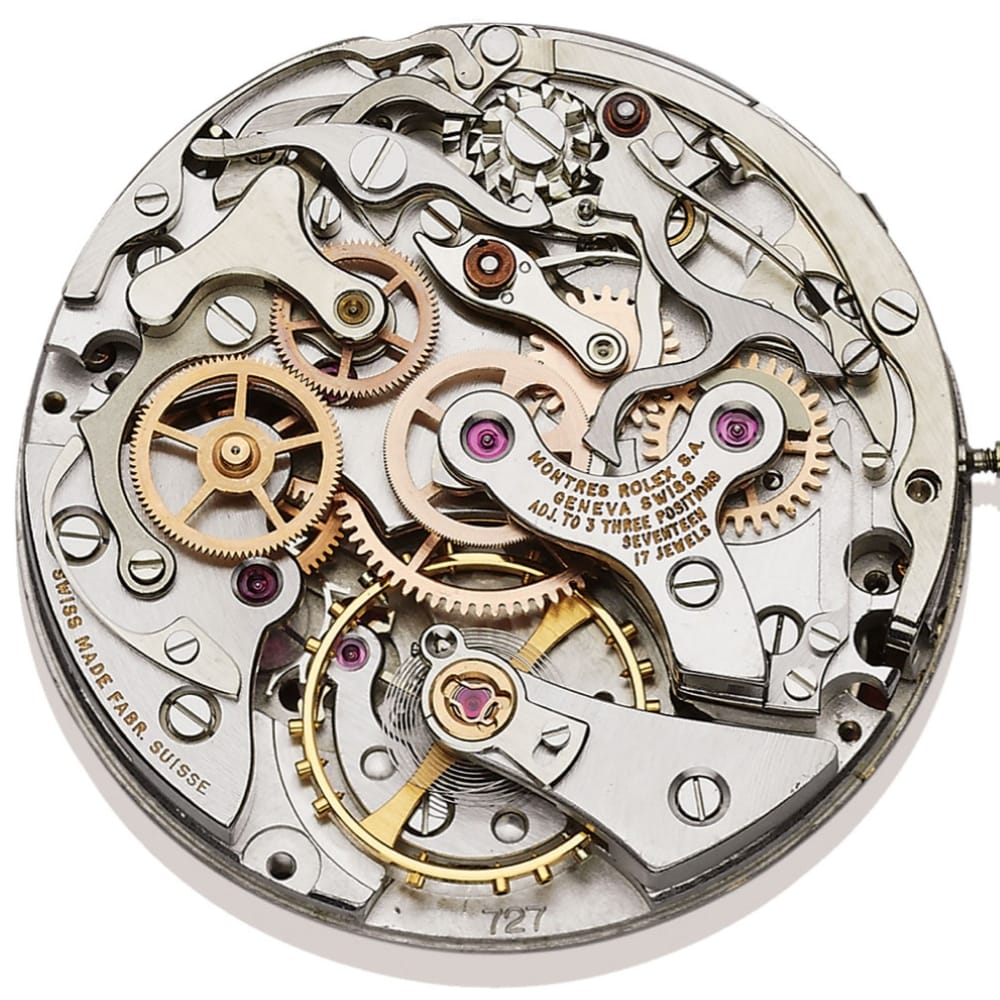
The Valjoux 72 powered some of the most valuable wristwatches ever made, including the Rolex Daytona 6239, the Patek Philippe 2499, and the Heuer Carrera 2448. This 13 ligne column wheel chronograph, introduced in 1938, represents the pinnacle form of the manual wind chronograph: three subdials, two pushers, and a 12-hour totalizer that earlier calibers lacked. When a Paul Newman Daytona sells for $17.8 million or a Patek 2499 brings $4 million at auction, collectors are not just buying the case and dial. They are buying access to this movement, a mechanism so well executed that manufacturers used it largely unmodified for over three decades.
The Valjoux 72 sits in an unusual position for an ebauche movement. Watch manufacturers typically finished and adjusted these raw movements to their own specifications, but the 72’s fundamental architecture proved so sound that even Rolex and Patek Philippe accepted its basic design with minimal changes beyond balance wheels and hairsprings. This caliber found its way into chronographs from at least 17 major Swiss brands, from Rolex to Wittnauer, powering everything from professional tool watches to elegant dress chronographs. The movement ran continuously from 1938 through 1974, outlasting many supposedly superior manufacture calibers.
Production figures for the Valjoux 72 family remain estimates, but the most credible research suggests approximately 750,000 movements across all variants over the 36-year production run. This translates to roughly 15,000 to 20,000 pieces annually, shared across dozens of brands. For context, Rolex alone consumed an estimated 59,847 Valjoux 72 movements for Daytona production, representing nearly 8 percent of total 72 family output. Patek Philippe used approximately 605 Valjoux-based movements for their perpetual calendar chronographs. These are not high numbers by modern standards. The Valjoux 7750, introduced in 1974, reportedly produced 100,000 units in its first year alone. The 72’s relatively modest production volume makes examples scarce today, particularly in original, unserviced condition.
Collector interest in Valjoux 72-powered watches has intensified dramatically since 2010. Early Rolex Daytonas that traded for $50,000 in the 1990s now command six figures, and seven figures for exceptional examples. Heuer Carreras and Autavias with 72 movements have risen from $3,000-5,000 to $15,000-30,000 for clean examples. Even lesser-known brands like Enicar, Zodiac, and Gallet fetch $3,000-8,000 when equipped with a 72, where comparable models with cam-operated movements struggle to break $2,000. The market has learned to value the movement, not just the name on the dial. Specific variants command premiums: triple calendar 72C examples, flyback 720 models, and GMT-equipped 724 calibers trade at significant multiples over base 72 prices when they surface.
Historical Context, Provenance, and Manufacturing Details

Development History
Valjoux SA, operating as Reymond Frères SA until 1929, introduced the Valjoux 22 in 1914 as a 14 ligne chronograph movement for pocket watches and early wristwatches. This column wheel caliber featured a 30-minute counter and beat at 18,000 vph, establishing the technical foundation for what would become the 72. Two years later in 1916, Valjoux launched the smaller 13 ligne Caliber 23, reducing the diameter from 14 to 13 lignes while maintaining the column wheel architecture. The 23 became a workhorse movement, ultimately producing approximately 125,000 ebauches between 1916 and 1974.
The critical limitation of both the 22 and 23 was their two subdial layout: small seconds and 30-minute counter, but no 12-hour totalizer. For timing events longer than 30 minutes, users had to manually track hours. By the late 1930s, chronograph specialists like Gallet and manufacturers including Rolex pushed for a three-register configuration. Valjoux responded in 1938 with the Caliber 72, adding a 12-hour counter at the 6 o’clock position. This layout, what collectors now call the “tri-compax” configuration, became the canonical chronograph format: running seconds at 9, 30-minute counter at 3, and 12-hour counter at 6.
The 72 addressed market demand at a moment when wrist chronographs were transitioning from single-pusher to dual-pusher operation. While the 72 could be configured with either system, most examples from the 1940s onward used the two-pusher layout patented by Willy Breitling in the early 1930s. This allowed for start/stop on the top pusher at 2 o’clock and reset on the bottom pusher at 4 o’clock, the standard configuration still used today.
Manufacturing Context
The Valjoux 72 is an ebauche movement, meaning it was sold as a raw or semi-finished blank to watch manufacturers who would then modify, finish, and regulate it according to their standards. Valjoux SA operated as an ebauche specialist within the Swiss watchmaking ecosystem, never producing complete watches under its own name. In 1944, Valjoux joined Ebauches SA, the massive holding company that controlled most Swiss movement blank production. In 1965, Ebauches SA absorbed Valjoux more fully into the ETA division, though movements continued to carry Valjoux nomenclature through the end of production in 1974.
This ebauche structure explains why Valjoux 72 movements vary significantly in finishing quality and adjustment. Buyers ranged from high-end manufactures like Patek Philippe, who extensively reworked and refined every component, to budget brands that installed the movement with minimal intervention. Patek Philippe’s caliber 13-130, used in the references 1518 and 2499, began life as a Valjoux 23 ebauche but underwent such extensive modification that it barely resembles the base movement. Rolex took a middle path, adding their Microstella balance wheel and Breguet overcoil but leaving much of the chronograph mechanism untouched.
Predecessor and Successor
The Valjoux 72 evolved directly from the Valjoux 23, sharing the same 13 ligne diameter and most internal components. The primary difference: the 72 adds the 12-hour counter mechanism on the dial side, increasing movement thickness from approximately 6.75mm to 6.95mm. Component interchangeability between the 23 and 72 is high, particularly for the base movement and chronograph runners.
The 72 did not have a direct successor so much as an evolution. Around 1969, Valjoux increased the beat rate from 18,000 vph to 21,600 vph, creating the Valjoux 726 (23 equivalent) and 727 (72 equivalent). These higher-beat versions offered improved accuracy but reduced power reserve and required more frequent servicing. Rolex adopted the 727 in 1969 for later Daytona references like the 6262 and 6265. Production of both the 18,000 vph and 21,600 vph versions ended in 1974 when Valjoux shifted focus to the cam-operated Valjoux 7750, a fundamentally different architecture designed for higher-volume production.
Factory and Location
All Valjoux 72 movements were manufactured in Les Bioux, located in the Vallée de Joux in the canton of Vaud, Switzerland. This valley, running along the French-Swiss border in the Jura mountains, became a center for complicated movement production due to its isolation and long winters that historically forced farmers into watchmaking as supplemental income. Valjoux remained in Les Bioux throughout production, with no evidence of satellite facilities or production shifts during the 36-year run. After Valjoux’s absorption into ETA in 1965, the Les Bioux facility continued producing column wheel movements until 1974, when ETA consolidated chronograph production around the cam-operated 7750.
Construction and Architecture

Plate and Bridge Layout
The Valjoux 72 uses a three-quarter plate architecture with a large barrel bridge covering approximately 75 percent of the dial-side plate. This massive bridge, secured by three screws, houses the mainspring barrel, crown wheel, ratchet wheel, click, and click spring. The design provides excellent stability for the winding mechanism but complicates disassembly, as removing the barrel bridge is necessary to access the fourth wheel with its extended pivot for the center chronograph seconds hand.
On the balance cock side, the movement features separate bridges for the train wheels and a dedicated balance cock at the 12 o’clock position. The plates are brass, typically with a gilt or rhodium finish depending on the brand and grade. Entry-level examples show minimal finishing beyond basic brushing, while higher grades received perlage (circular graining) on plates and Geneva stripes (Côtes de Genève) on bridges.

Balance Wheel
The standard Valjoux 72 ebauche came equipped with a screw-adjusted balance wheel, typically featuring four timing screws arranged in opposing pairs on the balance rim. These screws allow watchmakers to adjust the balance’s moment of inertia, fine-tuning rate without touching the regulator. The balance diameter measures approximately 10-11mm, larger than many contemporary movements, contributing to the 72’s stable amplitude.
Material and construction varied by grade. Basic ebauches used a bimetallic balance (brass rim with steel spokes), while higher grades specified a monometallic Glucydur balance. Glucydur, a beryllium-copper alloy, eliminates temperature-induced rate variations that afflict bimetallic balances. Some manufacturers replaced the standard balance entirely. Rolex installed their proprietary Microstella balance, which uses adjustable nuts instead of screws, allowing rate adjustment without removing the balance from the movement. The Microstella system also functions as a free-sprung regulator, eliminating the index pins that can compromise amplitude in conventional regulators.
Balance Spring (Hairspring)
Early Valjoux 72 movements came with flat Nivarox hairsprings and conventional index regulators. Starting in the late 1940s, Valjoux offered Breguet overcoil hairsprings as an upgrade, typically paired with a Breguet-style regulator that accommodates the raised terminal curve. The Breguet overcoil lifts the outer coil of the hairspring into a plane parallel to the other coils, with the terminal curve bending inward toward the balance staff. This geometry forces the hairspring to breathe concentrically, minimizing lateral forces on the balance pivots that can degrade amplitude and rate stability.
Nivarox, a cobalt-nickel alloy developed in the 1930s, replaced traditional blued steel as the standard hairspring material. Nivarox offers superior resistance to magnetism and temperature variations compared to steel, and unlike steel, Nivarox does not require periodic cleaning to remove oxidation. The specific Nivarox alloy used in standard 72 movements was Nivarox 2, with higher grades specifying Anachron or similar premium alloys.
Escapement Type
The Valjoux 72 employs a Swiss lever escapement with a straight-line lever, the standard configuration for mid-to-high grade Swiss movements. The escape wheel features 15 teeth and is typically manufactured from steel, though higher grades used Nivarox escape wheels for improved wear resistance. The pallet fork carries two synthetic ruby pallet stones (entrance and exit) and one synthetic ruby impulse jewel mounted on the roller table.
The escapement is jeweled with a total of 17 jewels: two for each pivot of the escape wheel, pallet fork, and fourth wheel; two for the balance; three for the pallet/impulse assembly; and additional jewels for the third wheel and center wheel. The jewel count does not include the chronograph jewels, which are considered part of the complication rather than the base movement.
Shock Protection System
Standard Valjoux 72 ebauches used Incabloc shock protection on the balance pivots (both upper and lower). The Incabloc system employs a conical hole jewel and domed cap jewel held in place by a spring-loaded setting, allowing the jewels to lift and shift when the movement experiences impact, then return to their proper position. This system protects the delicate balance pivots, which are the thinnest and most vulnerable components in any mechanical movement.
The Incabloc cap jewels for the Valjoux 72 are part number 330 (upper balance jewel) and part number 370 (lower balance jewel). These are not interchangeable, as the upper and lower settings have different spring tensions. Watchmakers report that Incabloc springs weaken over time, particularly in movements that have seen heavy use, and should be inspected during service.
Some manufacturers substituted alternative shock systems. Rolex, for example, used KIF shock protection on later Valjoux-based movements, though early Daytona references retained Incabloc. KIF offers a different spring geometry that some watchmakers prefer for its retention and ease of adjustment, though Incabloc remains the more common system.
Regulator Type
The base Valjoux 72 with flat hairspring uses a conventional index regulator with regulator pins that pinch the hairspring, effectively shortening or lengthening the active portion to adjust rate. A graduated scale on the balance cock, typically marked “A” (Avance, fast) and “R” (Retard, slow), allows the watchmaker to read the regulator position.
Movements equipped with Breguet overcoils require a different regulator design, typically called a Breguet regulator or swan-neck regulator, which accommodates the raised terminal curve while still allowing index adjustment. The regulator pins must clear the overcoil, positioning the pinching point on the first or second coil down from the terminal curve.
Free-sprung regulation, used by Rolex in their Microstella-equipped movements, eliminates the index pins entirely. Rate adjustment occurs solely through the balance wheel screws or nuts, a system that preserves hairspring geometry and can improve isochronism (rate consistency across amplitude variations). However, free-sprung balances require more time and skill to adjust, making them less practical for ebauche movements intended for mass distribution.
Mainspring Material and Type
The Valjoux 72 uses a traditional alloy mainspring, later upgraded to Nivaflex NO in standard grades and Nivaflex NM in higher grades. Nivaflex, like Nivarox, is a cobalt-nickel alloy that resists setting (permanent deformation) and delivers more consistent torque over its power reserve compared to carbon steel springs. The mainspring is referenced as part number 771 in Valjoux parts catalogs.
Mainspring dimensions for the Valjoux 72: length varies between 320-340mm depending on the barrel arbor hook style, width approximately 1.40-1.50mm, and thickness approximately 0.11-0.12mm. The spring attaches to the barrel arbor via a hole or hook, and the outer end attaches to the barrel wall via a slipping bridle, a safety feature that allows the spring to slip rather than break when the movement is overwound.
Watchmakers emphasize mainspring replacement during service. Mainsprings weaken over time, losing set (the memory of their coiled shape when relaxed), which reduces amplitude and causes erratic timekeeping. Original Valjoux mainsprings are no longer available, but Swiss supplier Générale Ressorts produces compatible replacements that maintain correct specifications.
Gear Train Details
The Valjoux 72 uses a conventional four-wheel train: barrel, center wheel (cannon pinion), third wheel, fourth wheel, and escape wheel. The fourth wheel features an extended pivot that passes through the dial to drive the central chronograph seconds hand, a common configuration in chronographs. This extended pivot, longer than typical fourth wheel pivots, is vulnerable to bending if the chronograph hand is removed carelessly or if the movement suffers impact.
Gear ratios follow standard Swiss practice: the center wheel makes one revolution per hour (driven by the cannon pinion), the third wheel increases speed, the fourth wheel makes one revolution per minute, and the escape wheel delivers impulses to the balance. The specific gear counts and ratios for the Valjoux 72 are not widely published, as these details were considered proprietary during production.
The chronograph mechanism uses a separate gear train driven by the fourth wheel via a coupling clutch. When the chronograph engages, the coupling clutch meshes with the fourth wheel’s upper driving wheel, transmitting power to the chronograph runner (center seconds wheel), which drives the 30-minute counter at 3 o’clock and the 12-hour counter at 6 o’clock via intermediate wheels on the dial side.
Finishing Quality and Techniques
Finishing on Valjoux 72 movements varies dramatically depending on the grade and the manufacturer’s specifications. As an ebauche movement, the 72 left the Valjoux factory in different states of completion:
Standard Grade: Minimal finishing. Plates and bridges are brushed or sandblasted with no decorative patterns. Screw heads are flat and unpolished. Steel parts (escape wheel, pallet fork, screws) are left in their raw machined state. This grade accounts for the majority of 72 production, particularly for mid-market brands.
Elaboré Grade: Light finishing. Plates receive perlage (circular graining) applied with a rotating abrasive tool that creates overlapping circular patterns. Bridges may show basic Geneva stripes. Screw heads are polished flat. Steel parts may be polished but not heat blued.
Top Grade: Higher finishing standard. Geneva stripes on bridges are evenly spaced and aligned across different components, indicating hand application or careful machine setup. Plates receive uniform perlage. Screw heads are polished and chamfered. Steel parts are polished, and some manufacturers will blue-finish visible steel components. Balance cock and other visible areas receive additional hand finishing.
Chronometer Grade: Highest finishing, though true chronometer certification was rare for the Valjoux 72 since most manufacturers handled their own regulation. Movements destined for chronometer certification received premium components (Glucydur balance, Anachron hairspring, Nivarox pallet lever and escape wheel) and extensive adjustment in five positions.
Specific brands applied their own finishing standards that often exceeded the ebauche grade. Rolex, for example, polished all screw heads to a mirror finish and applied perlage to the barrel bridge, even on movements that arrived from Valjoux with only standard finishing. Patek Philippe completely refinished Valjoux ebauches to their exacting standards, including hand-applied Geneva stripes, black-polished steel, and mirror-polished anglage (beveled edges).
Cross-Reference Data
Alternative Caliber Names (Rebranded Versions)
Base Caliber vs. Elaborated Versions
Compatible Case References by Brand
Dial Compatibility Note
Valjoux 72 dials use a two-foot mounting system positioned at approximately 5:00 and 9:00 (some sources indicate slight variations). Date window, when present on 72C variants, appears at 12:30 with day and month apertures flanking it at 11:30 and 12:30. Dial feet spacing is not standardized across manufacturers, as each brand specified custom dial configurations. Collectors attempting dial swaps should verify foot positions match, as forcing misaligned feet can crack the dial or damage the movement plate.
Crown and Stem Specifications
Identification Marks
Caliber Number Location
The caliber designation “Valjoux 72” or “VZH” (Valjoux Zähler Heure, meaning “Valjoux counter hour”) appears engraved on the main plate, typically visible when the movement is removed from the case. Specific location varies: some examples show the marking near the balance cock, others position it near the barrel bridge. The marking is typically hand-engraved in a serif font, with character size 1-2mm.
Logo and Brand Marks
Expected Markings on Base Valjoux Ebauches:
- “Swiss Made” or “Swiss” stamped on the plate, often near the balance cock
- “Fabr. Suisse” appears on some examples
- Jewel count “17 Rubis” or “17 Jewels”
- Some movements show “Valjoux” engraved in script
Manufacturer-Modified Movements:
- Rolex: “Rolex Genève” engraved on the plate, position varied by era
- Rolex: “Swiss Made” typically appears twice, once on plate and once on balance cock
- Other manufacturers either left Valjoux markings visible or overstamped with their own name
Date Codes
The Valjoux 72 does not use a systematic date code visible to collectors. Serial numbers, when present, were applied by the watch manufacturer, not by Valjoux at the ebauche stage. Rolex, for example, placed case serial numbers on the case lugs (between the lugs at 12 o’clock on later examples), but these numbers reference production date for the complete watch, not the movement specifically.
For dating Valjoux 72 movements, collectors must rely on:
- Case serial numbers (if manufacturer used sequential serialization)
- Dial printing styles and fonts (evolve over production periods)
- Component specifications (Microstella vs. screw balance, Breguet vs. flat hairspring)
- Case construction details (pusher types, bezel materials)
Finishing Marks
Expected Finishing Patterns by Grade:
Entry Level:
- Plates: Sandblasted or lightly brushed finish, no perlage
- Bridges: Plain machined surface, sometimes brushed
- Screws: Flat tops, unpolished
Mid Grade:
- Plates: Perlage (circular graining), may be uneven or machine-applied
- Bridges: Basic Geneva stripes or brushed finish
- Screws: Polished flat tops
High Grade (Rolex, etc.):
- Plates: Uniform, hand-applied perlage
- Bridges: Hand-applied Geneva stripes, evenly spaced and aligned
- Screws: Mirror-polished tops with beveled edges
- Balance cock: Hand finishing with polished bevels
Highest Grade (Patek Philippe, etc.):
- All of above plus: Mirror-polished anglage (beveled edges) on all bridges
- Black-polished steel components
- Consistent stripe direction and depth across all components
Jewel Markings
Standard Valjoux 72 uses pressed jewels (jewels mounted directly into the plate without separate chatons). Higher grades, particularly movements destined for chronometer certification, used screwed chatons (gold-colored bezels holding the jewels), which allow for easier adjustment and replacement.
Jewel types:
- Clear synthetic ruby: Hole jewels and cap jewels
- Synthetic ruby: Pallet stones (entrance/exit) and impulse jewel
- The jewel count of 17 includes jeweling for the escapement and train wheels but does not count chronograph jewels separately
Adjustment Markings
True chronometer-certified Valjoux 72 movements are extremely rare, as most manufacturers performed their own regulation and did not pursue COSC certification. When adjustment markings appear, they typically indicate:
- “Adjusted” or “Adjusted 2 Positions”: Regulated in dial up and dial down positions
- “Adjusted 3 Positions”: Adds pendant up (crown up)
- “Adjusted 5 Positions”: Dial up, dial down, crown up, crown left, crown right
- “Adjusted Temperature”: Indicates testing and adjustment across temperature range
Rolex used their own adjustment standards and did not mark movements with adjustment specifications, preferring to control regulation internally.
Correct Serial Number Formats and Locations
Serial numbering for Valjoux 72 movements varies by manufacturer and was not standardized at the ebauche level. When serial numbers appear, locations include:
Rolex: Case serial number between lugs at 12 o’clock (early) or between lugs at 6 o’clock (later production). Movement sometimes shows Rolex serial separate from case number.
Breitling: Case back interior engraving, typically 6-digit number. Serial ranges indicate production years but vary by model.
Sinn: Early 103 models with V72 show 296XXX serial range; later V726 models start at 358XXX.
Others: Most brands did not serialize movements consistently. Serial numbers, when present, appear on case backs rather than movements.
Expected Engravings and Stampings
Authentic Valjoux 72 Movements Should Show:
- Crisp, evenly-depth engraving of caliber designation
- “Swiss” or “Swiss Made” stamp with consistent font
- Jewel count engraved or stamped
- Component part numbers (wheels, bridges) lightly stamped on underside of parts (visible only during disassembly)
Red Flags for Refinished or Fake Movements:
- Inconsistent engraving depth (indicates multiple sources or added engravings)
- Modern sans-serif fonts (authentic movements use serif fonts)
- “Swiss Made” in incorrect location (should appear near balance cock area)
- Overly neat or perfect condition (60-80 year old movements show some patina)
Font and Marking Style by Production Era
1938-1950s:
- Hand-engraved markings with slight variations in character spacing
- Serif fonts for caliber designation
- “Swiss” without “Made” is common
1960s:
- More standardized engraving, still hand-applied
- “Swiss Made” becomes more common
- Rolex begins adding their own engravings over Valjoux markings
Late 1960s-1974:
- Some stampings appear machine-applied
- “T Swiss T” (indicating tritium lume) appears on dials, not movements
- Movement markings remain consistent with earlier periods
Official Service Manual


Part Information
Part Numbers Table

Sourcing Notes
Parts Still Available from Suppliers:
- Mainsprings: Available from Générale Ressorts and specialty watch parts suppliers (€25-36)
- Stems: Readily available, part 401 in TAP 10 or TAP 7
- Gaskets and seals: Generic sizes work for most applications
- Click springs: Available but quality varies
- Setting lever springs: Available
Parts Commonly Failed and Need Replacement:
- Mainspring: Loses set over time, critical for maintaining amplitude
- Click spring: Breaks or loses tension, causes winding issues
- Fourth wheel pivot: Extended pivot bends, causes chronograph hand wobble
- Minute recorder jumper spring: Breaks, causes minute counter failure
- Hour recorder conveyor spring: Weakens, prevents hour counter advancement
- Incabloc springs: Lose tension, reduce shock protection
Parts Difficult or Impossible to Source:
- Balance complete with correct specifications (available but expensive, $40-100+)
- Original Breguet hairsprings (generic replacements available but fitting requires expertise)
- Column wheel (critical part, rarely damaged but nearly impossible to find)
- Chronograph wheels with original specifications (donor movements often required)
- Original finishing on bridges and plates (refinishing services exist but remove originality)
Acceptable Generic Replacements:
- Mainsprings: Modern Générale Ressorts springs maintain correct dimensions
- Incabloc settings: Modern Incabloc components fit correctly
- Stems: Generic female stems work if dimensions match
- Gaskets: Modern materials often superior to vintage
Critical Note for Collectors: The Valjoux 72’s age means NOS (New Old Stock) parts are increasingly scarce. Watchmakers frequently cannibalize donor movements for critical components, particularly balance assemblies, hairsprings, and chronograph wheels. This practice, while necessary for keeping movements running, reduces the number of complete 72 movements available for future restoration. Collectors should verify during service that watchmakers are not substituting non-compatible parts from other calibers, as dimension mismatches can cause accelerated wear.
Performance Data
Manufacturer Specifications
Accuracy (New Movement, Factory Specification):
- Standard grade: +/- 12 seconds per day (2 positions)
- Elaboré grade: +/- 7 seconds per day (3 positions)
- Top grade: +/- 4 seconds per day (5 positions)
- Chronometer grade (rare): -4 to +6 seconds per day (COSC spec, 5 positions, temperature tested)
Positions Tested:
- Standard: Dial up (CH) and pendant down (6H)
- Elaboré: Adds pendant up (crown up)
- Top: Dial up, dial down, crown up, crown left, crown right
- Note: Most V72 movements were regulated in 2-3 positions, as full 5-position adjustment significantly increases labor cost
Temperature Compensation:
- Base movements: No temperature compensation (bimetallic balance attempts passive compensation)
- Glucydur balance (higher grades): Improved temperature stability but not true compensation
- Typical temperature tolerance: ± 5-10 seconds per day across 8°C to 38°C range
Isochronism:
- Standard grade: +/- 20 seconds per day variation from full wind to 24 hours
- Elaboré: +/- 15 seconds
- Top: +/- 10 seconds
- Translation: Rate should not change by more than these amounts as the mainspring unwinds
Observed Performance (Field Data)
Typical Accuracy Range for Well-Maintained Examples:
Based on collector reports, watchmaker observations, and auction house timing data, properly serviced Valjoux 72 movements typically achieve:
- Standard examples: +/- 15 to +/- 30 seconds per day
- Higher-grade adjustments (Rolex, etc.): +/- 5 to +/- 15 seconds per day
- Exceptional examples with recent regulation: +/- 3 to +/- 8 seconds per day
Collectors should treat any V72 running faster than +30 seconds per day with suspicion, as this often indicates a problem (magnetization, dirty escapement, or damaged hairspring). Similarly, movements losing more than 30 seconds per day typically need service.
Common Performance Issues and Their Causes:
- Stopping After Chronograph Engagement:
- Erratic Timekeeping (Rate Changes Randomly):
- Low Amplitude (Below 240 Degrees When Fully Wound):
- Chronograph Hand Jumps Forward/Backward on Start:
- Chronograph Does Not Reset to Zero:
- Watch Stops When Winding:
Expected Amplitude When Fully Wound vs. Power Reserve Depleted:
- Fully wound (0-6 hours): 260-280 degrees (some well-regulated examples reach 300-330)
- Mid reserve (12-24 hours): 240-270 degrees
- Near end of reserve (36-48 hours): 200-240 degrees
- Minimum acceptable: 180 degrees (below this, rate becomes unstable)
Note: Amplitude measurements depend heavily on lift angle setting in the timing machine. The Valjoux 72 uses a 52-degree lift angle; incorrect lift angle settings will show false amplitude readings.
How Performance Typically Degrades as the Movement Ages:
5-10 Years Since Last Service:
- Oils begin to oxidize and thicken, increasing friction
- Rate stability decreases; movement may gain time as friction increases in escapement
- Amplitude drops 20-30 degrees from freshly serviced baseline
- Power reserve may decrease to 36-42 hours
10-20 Years Since Last Service:
- Oils fully degraded; metal-on-metal contact begins wearing pivots
- Amplitude drops to 200-220 degrees or lower
- Rate becomes highly position-dependent (dial up vs. crown up shows 30+ second variation)
- Chronograph function may become unreliable
- Power reserve drops to 30-36 hours as mainspring loses set
20+ Years Since Last Service:
- Significant pivot wear visible under magnification
- Amplitude below 200 degrees; movement may stop spontaneously
- Rate variation exceeds 60 seconds per day
- Chronograph may not engage or reset properly
- Permanent damage to jewels, pivots, or wheels likely
Watchmakers consistently emphasize that the Valjoux 72, despite its robust construction, requires regular service every 4-7 years to maintain performance and prevent accelerated wear. The chronograph complication, with its additional friction points and frequent engagement/disengagement cycles, increases wear compared to time-only movements. Movements that have been stored unwound for extended periods (10+ years) often suffer hairspring deformation and mainspring set loss, requiring more extensive restoration than movements that have run regularly.