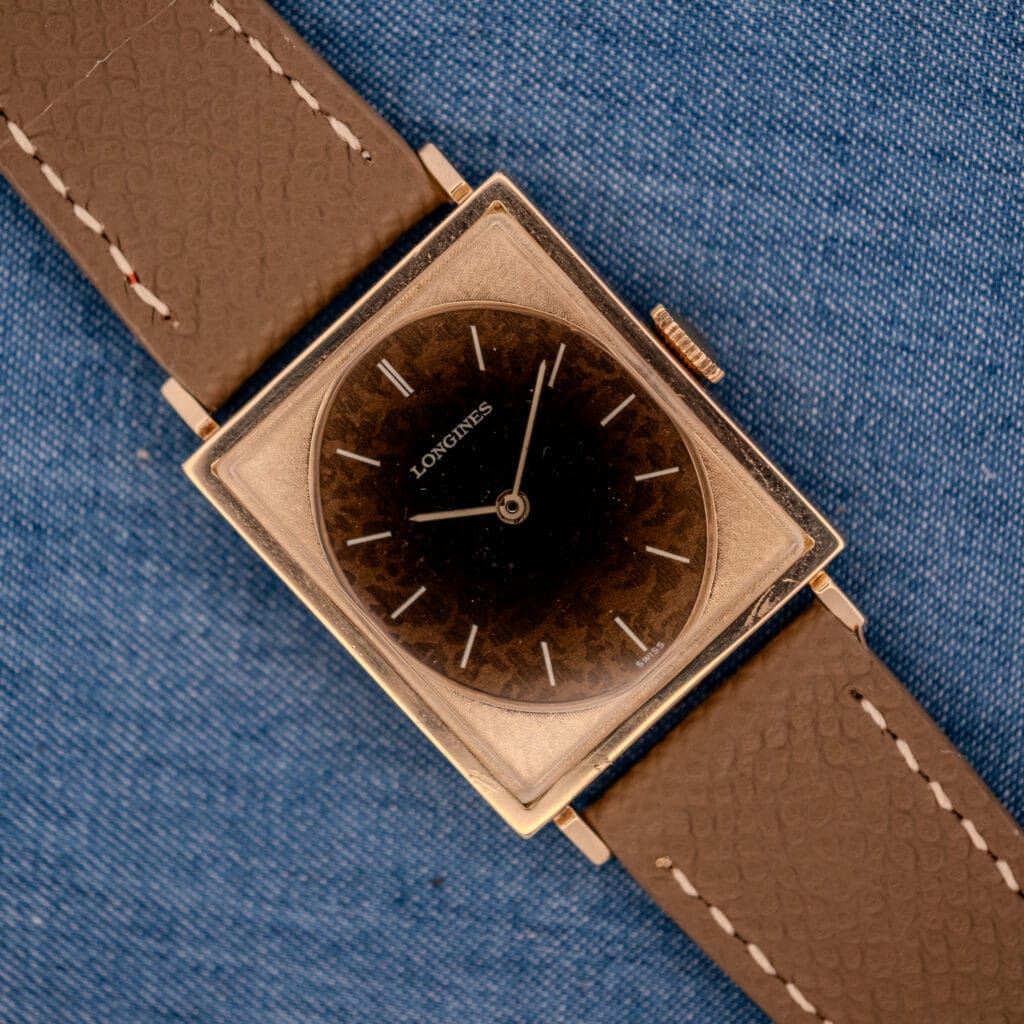
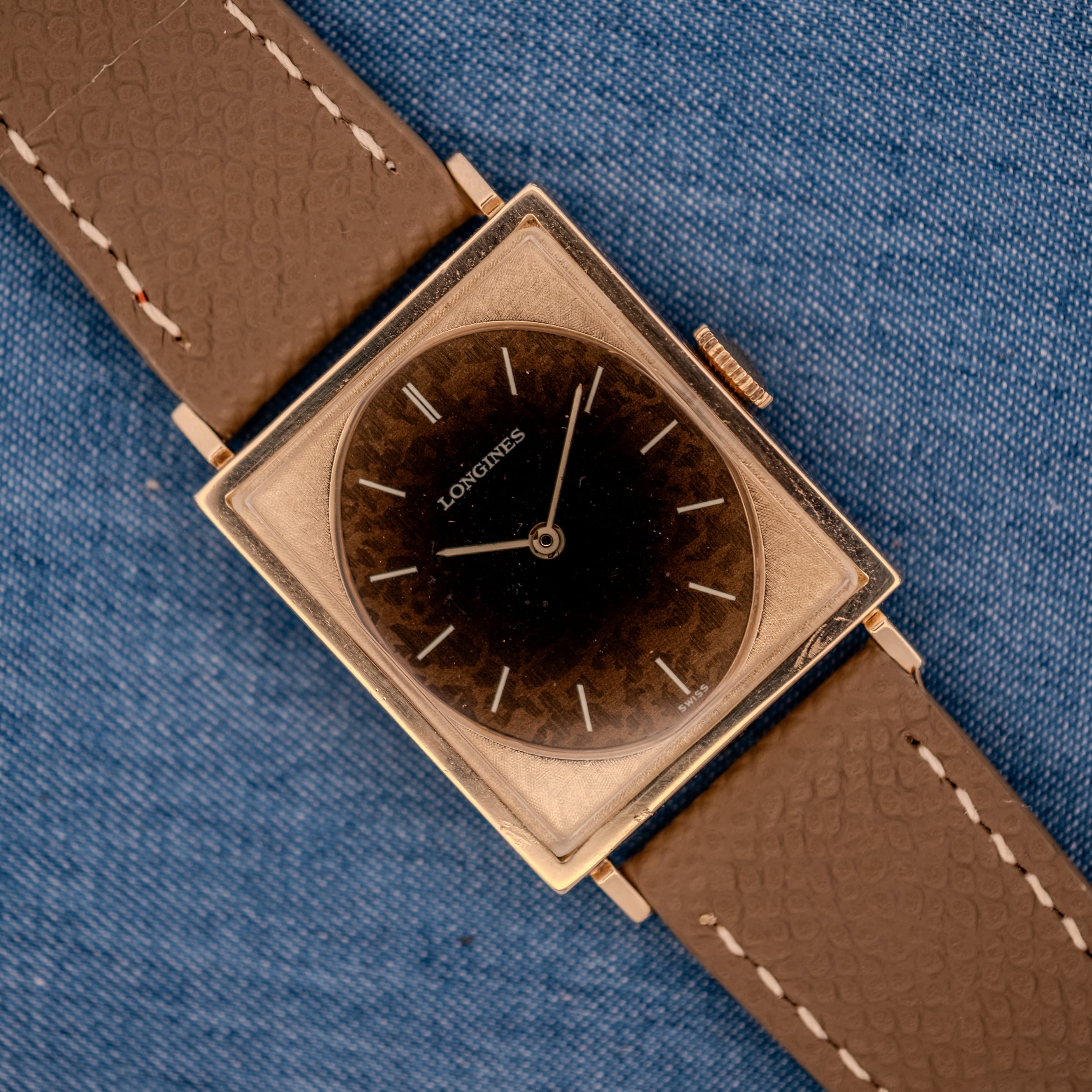
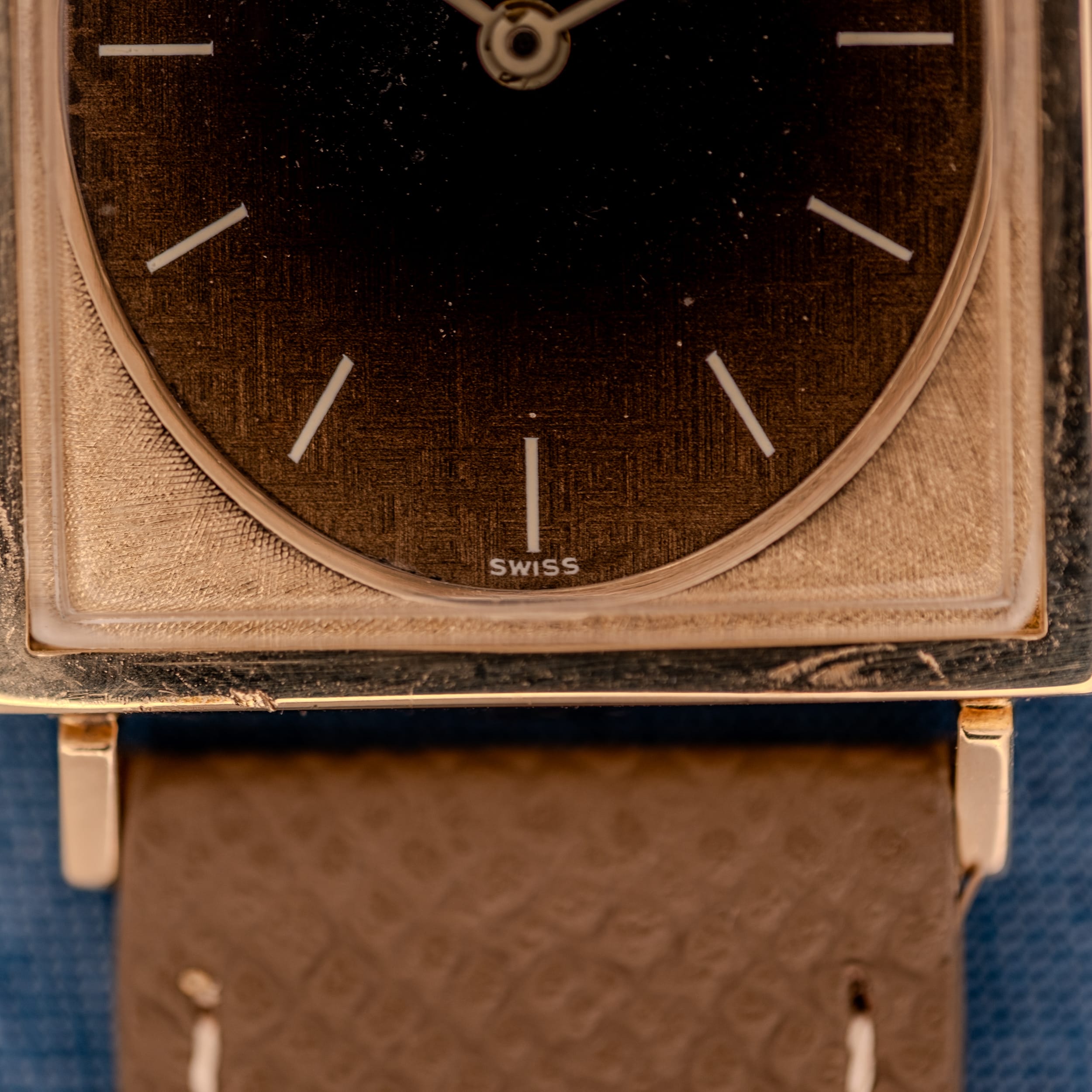
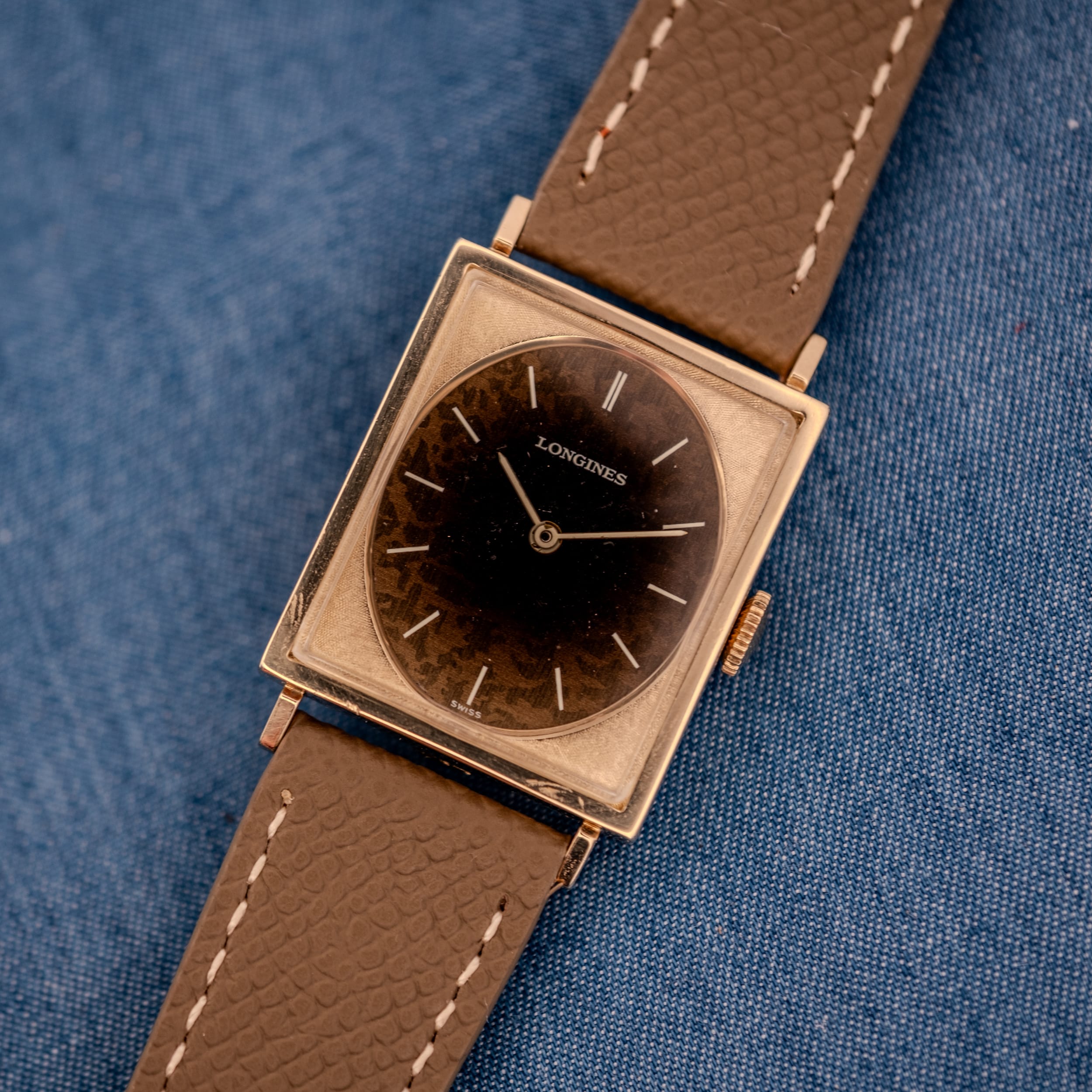
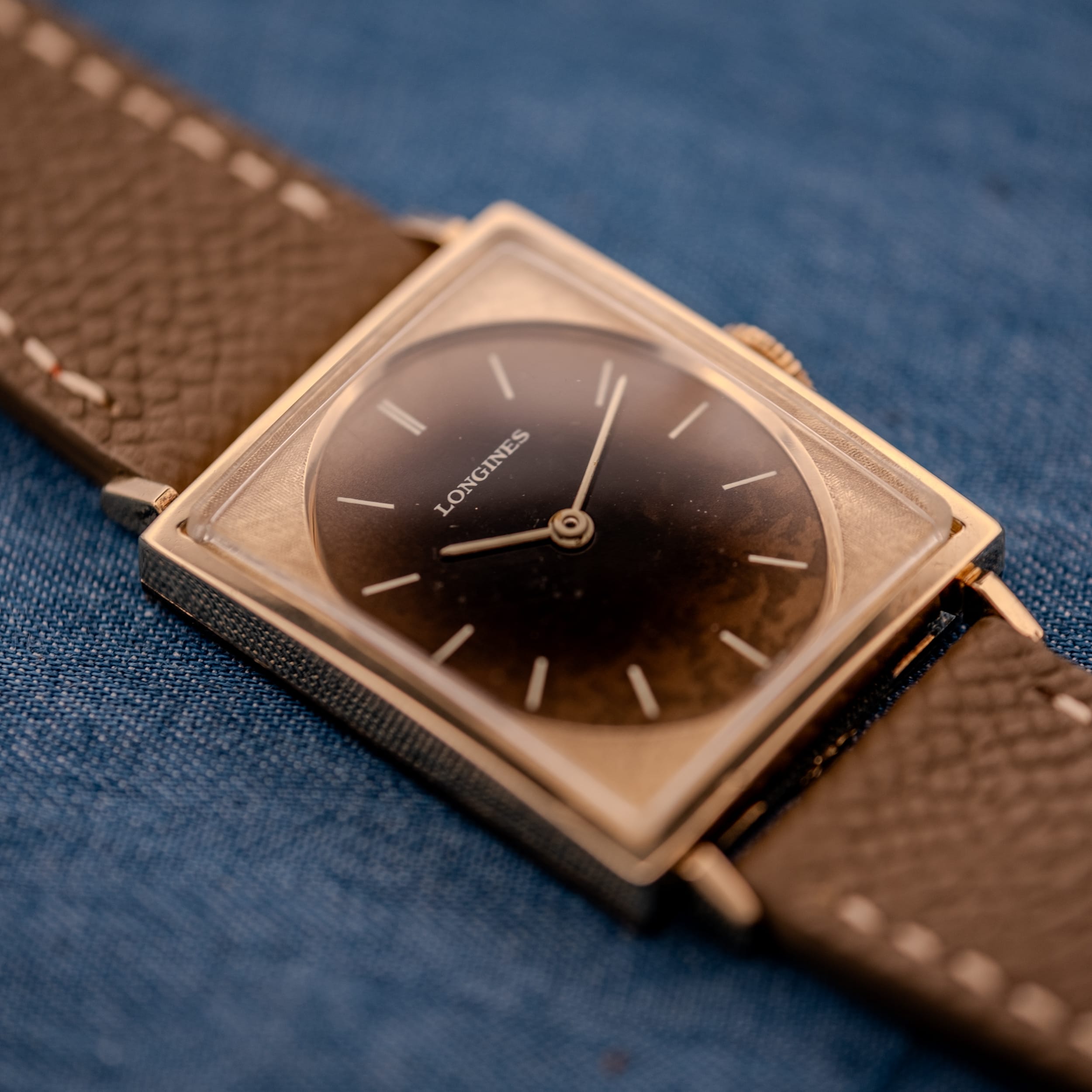
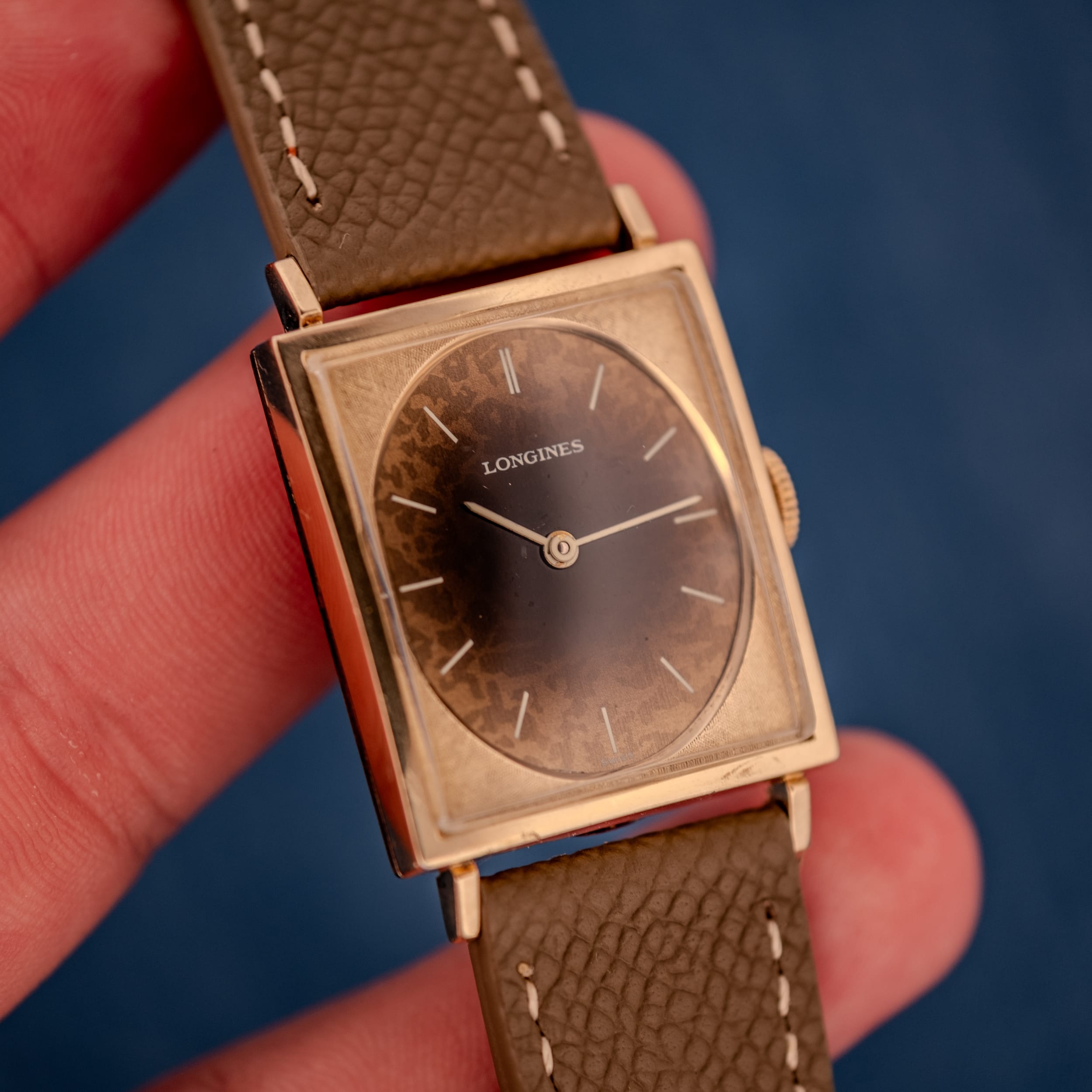
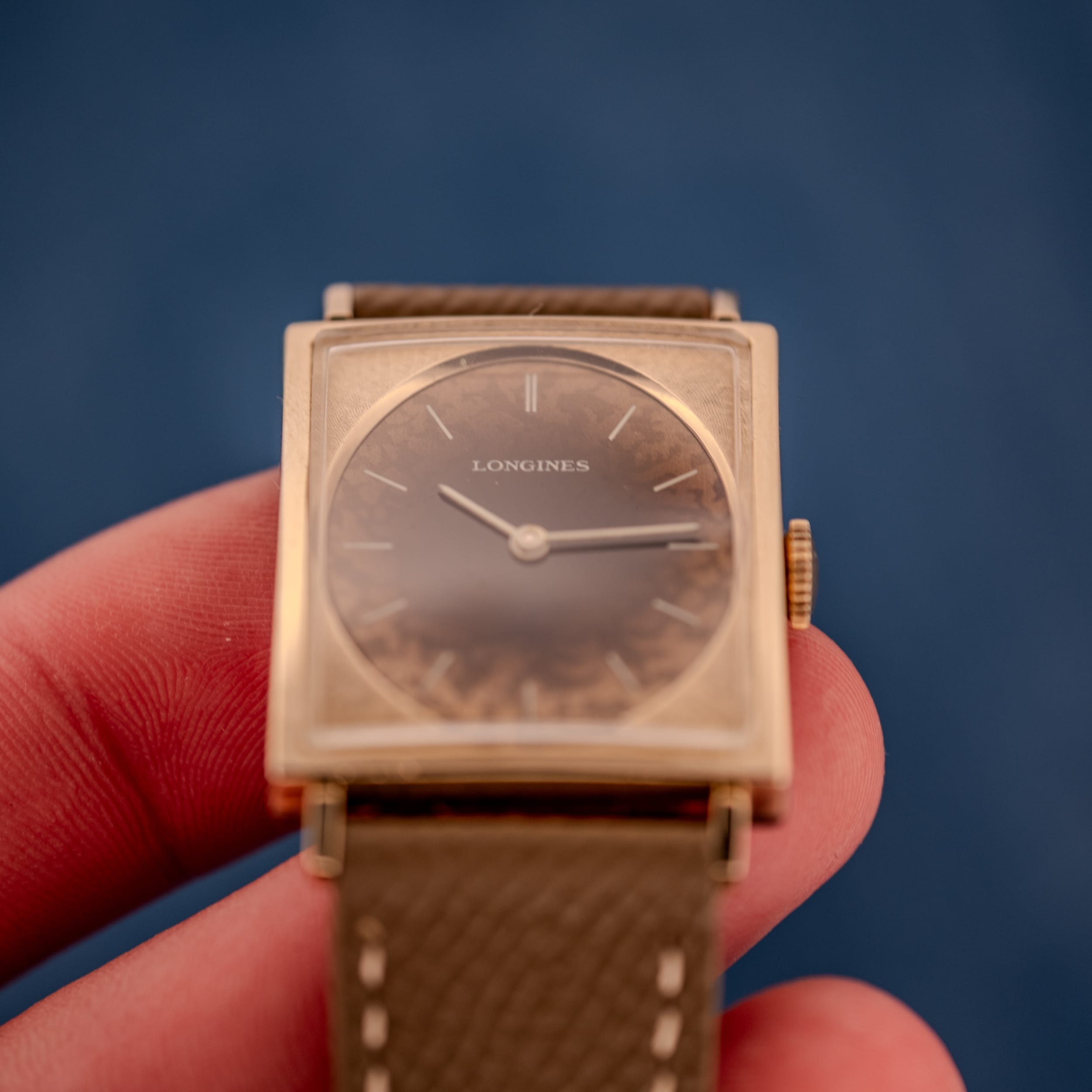
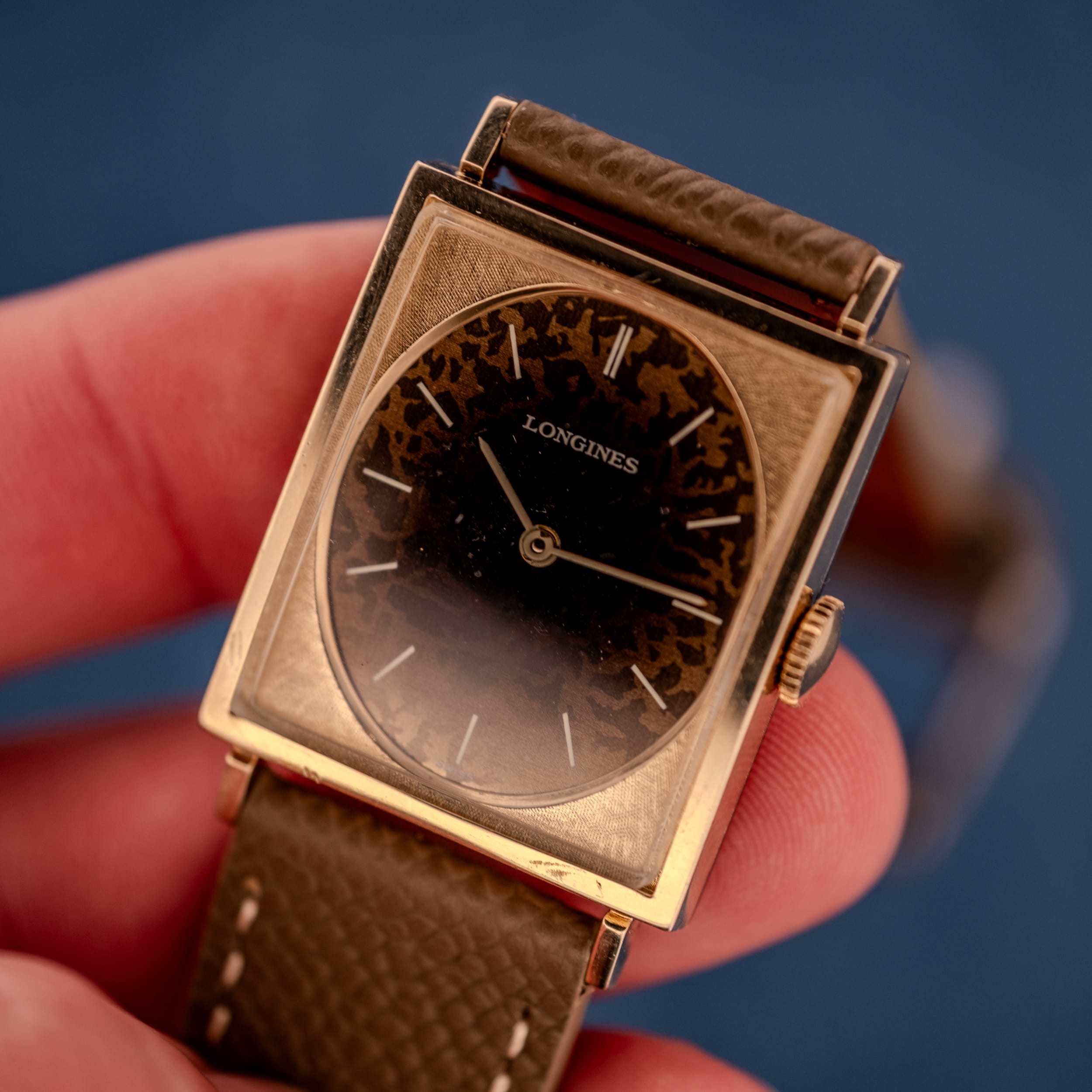
A square 10k yellow gold filled tank case wrapped around a circular dial cut-out, the frame finished in a fine cross-hatched florentine texture, and inside the cut-out a chocolate field patterned in tan, copper, and dark brown spotting like a leopard pelt across every visible inch. That is the reference 3217-428 in one sentence, and it is also why we keep an eye out for one whenever a Longines tank crosses the desk. To us, this is the moment Longines stopped trying to out-Cartier the Tank and started designing a tank case that only Longines could have drawn, and in our opinion the leopard dial is the part nobody else was drawing.
Longines spent most of the 1960s and early 1970s building a deep catalogue of rectangular and square dress references that lived alongside their better-known round Flagship and Conquest lines. The 3217-428 sits in that family of textured-frame tanks that the brand produced in the years immediately after its 1971 absorption into Ebauches SA, a period when the manufacture was still finishing and signing its own calibers but increasingly drawing on the wider Swiss group for ebauche supply. The result is a watch that reads as fully Longines on the wrist, in the case stampings, on the dial, and across the movement bridges, even as the industry around it was consolidating.
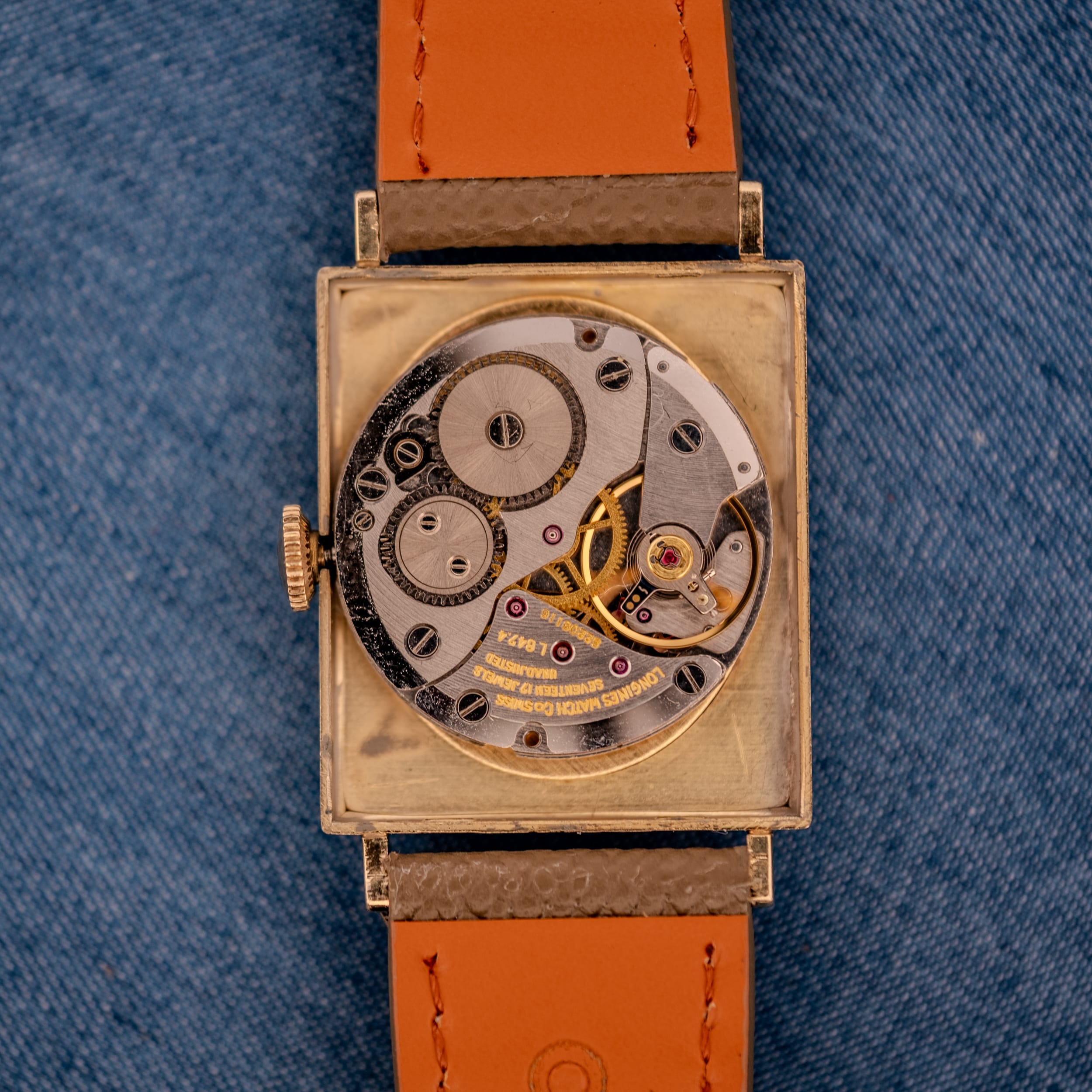
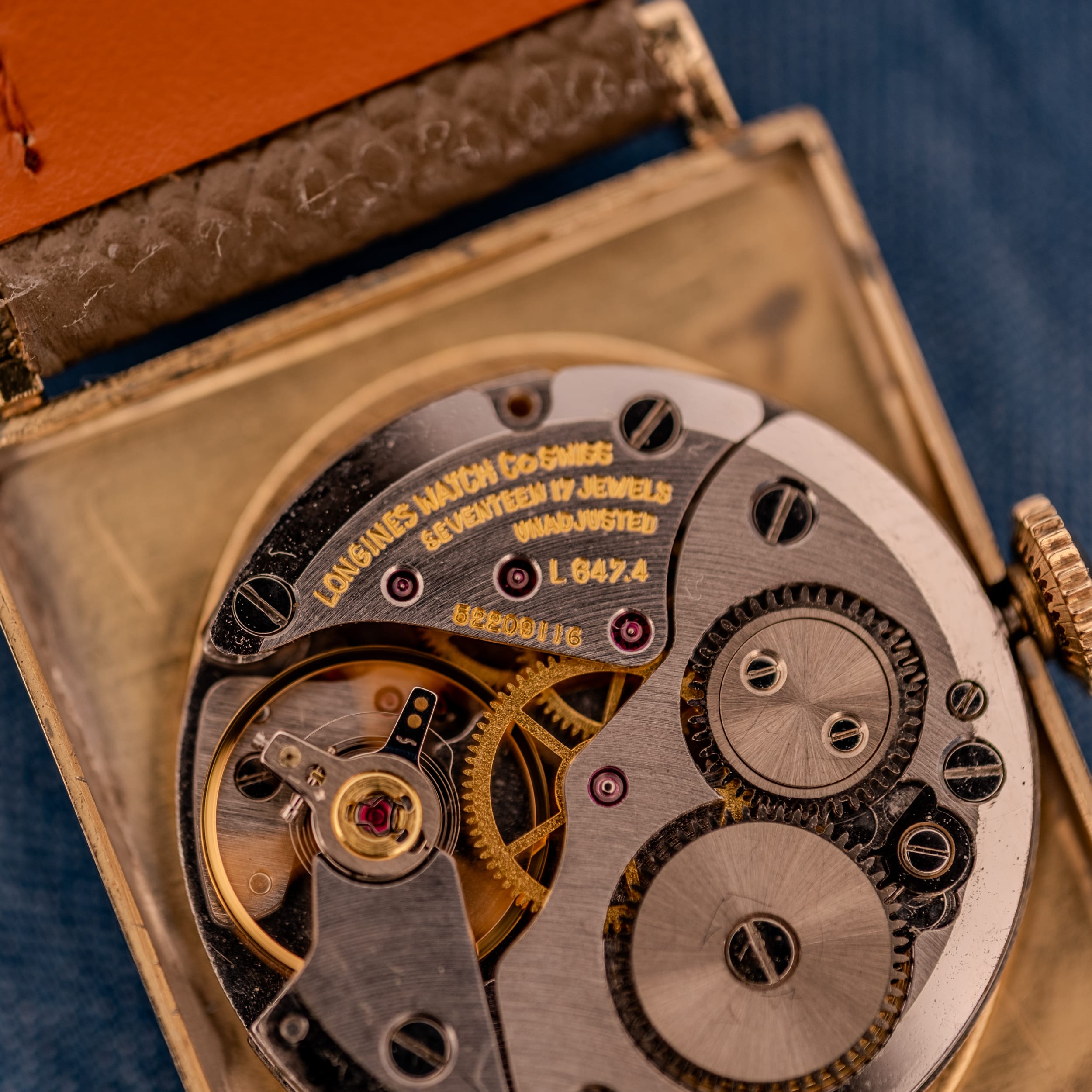
The caliber is the Longines L647.4, a manual-wind movement running at seventeen jewels with the brand’s signature engraving across the rhodium-finished bridges. Our service photograph reads “LONGINES WATCH CO SWISS” in a curved cartouche, with “SEVENTEEN 17 JEWELS UNADJUSTED” beneath, the caliber designation L647.4 marked in gold-toned text, and the matching factory serial running below. The seventeen-jewel layout was the workhorse standard for Longines dress calibers of this generation and the unadjusted notation is exactly what we would expect on a dress-grade tank of the period rather than on a chronometer-rated Flagship. The bridges carry the period rhodium finish with delicate cotes-style striping, and the click spring, ratchet wheel, and crown wheel all sit exactly where Longines drew them. To us, the L647.4 is the kind of period-correct dress caliber that gets quietly overlooked next to the brand’s chronometer references but that runs for half a century with nothing more than a clean and oil.
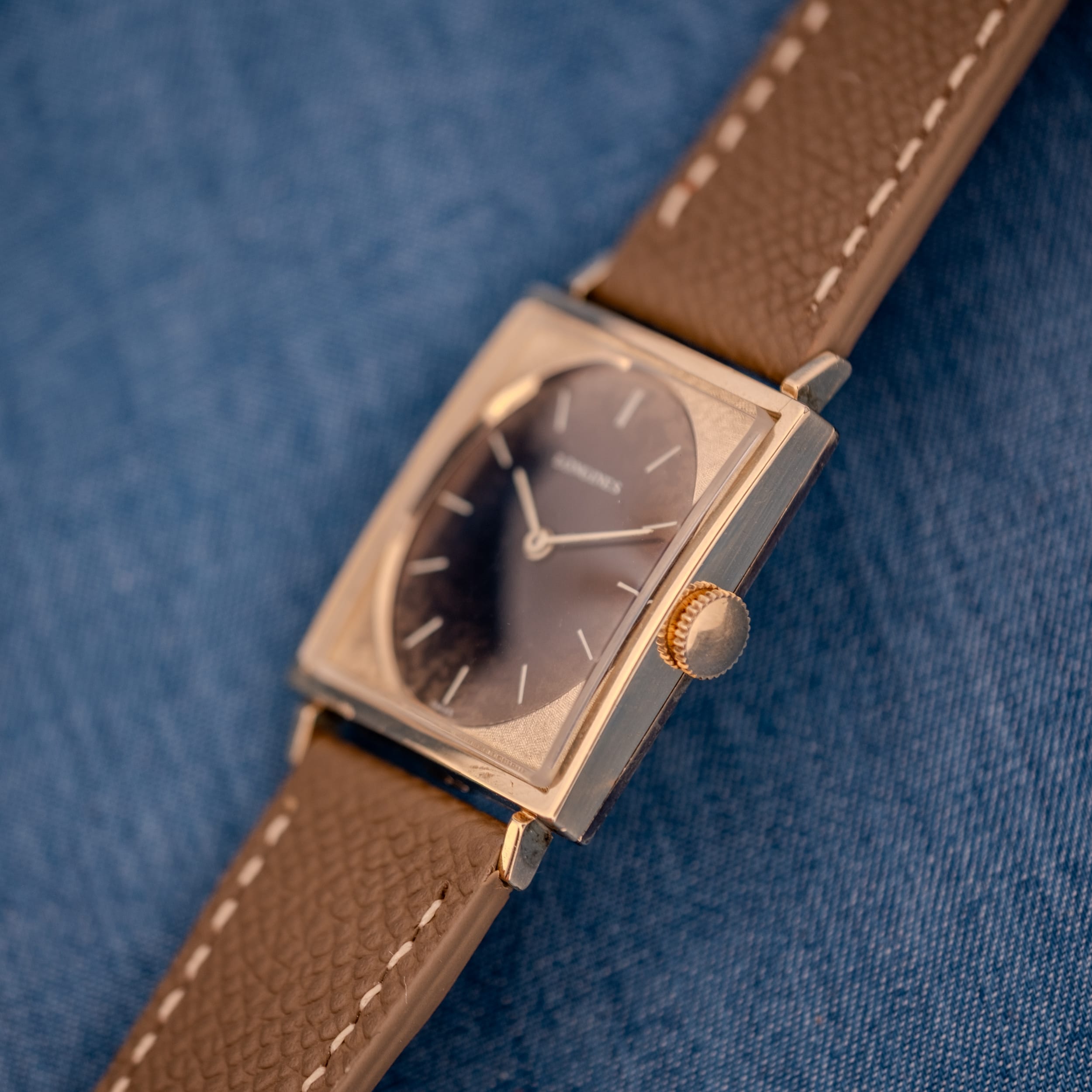
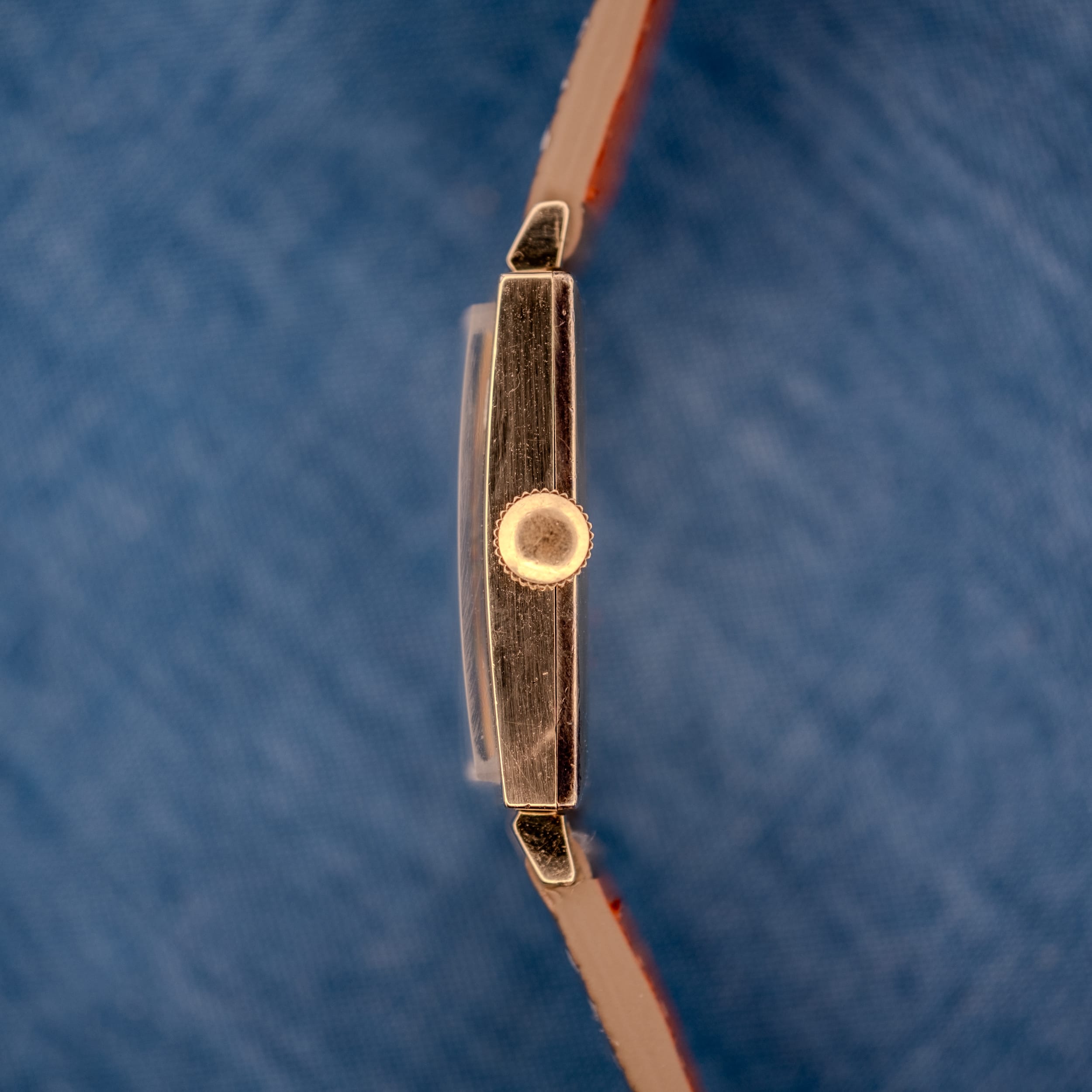
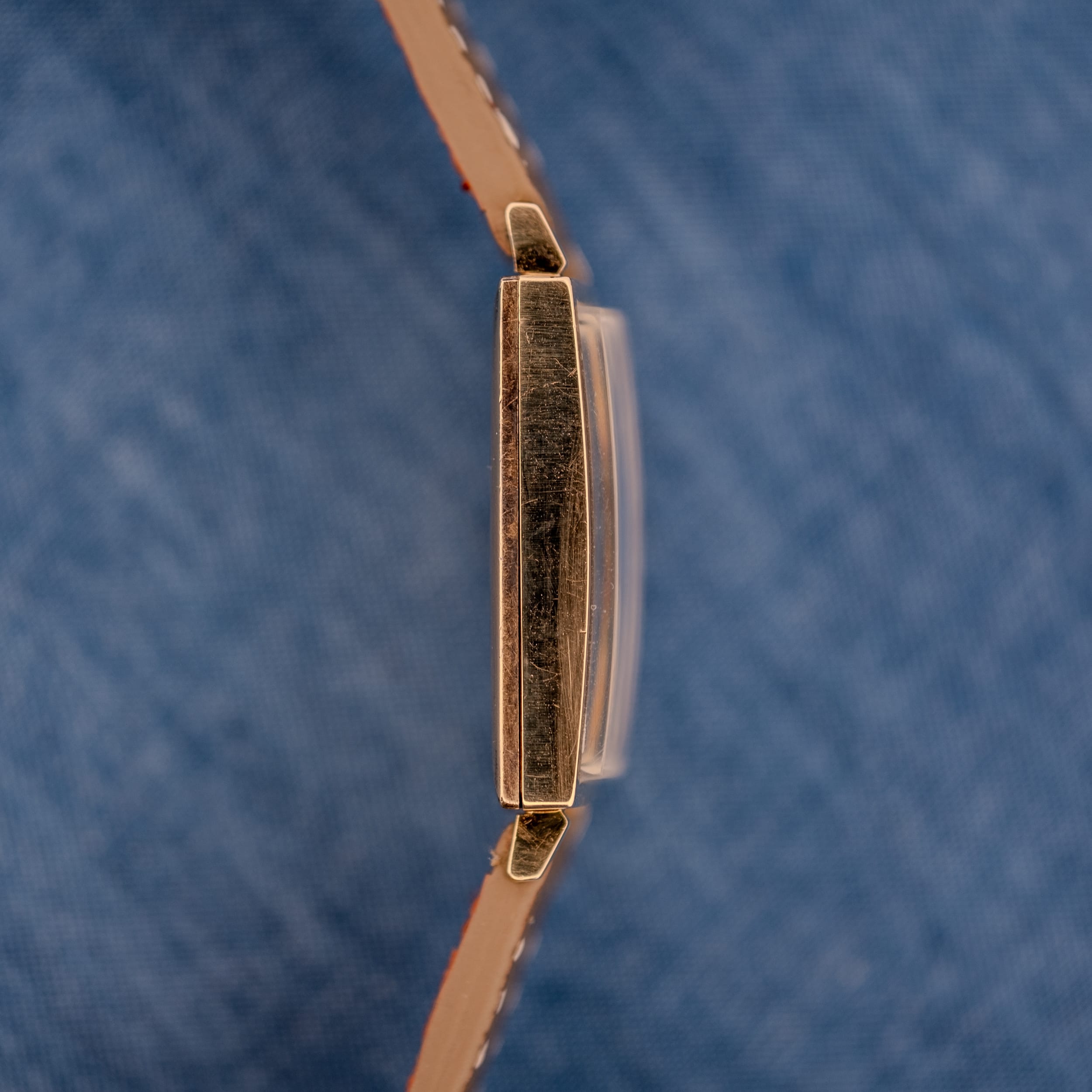
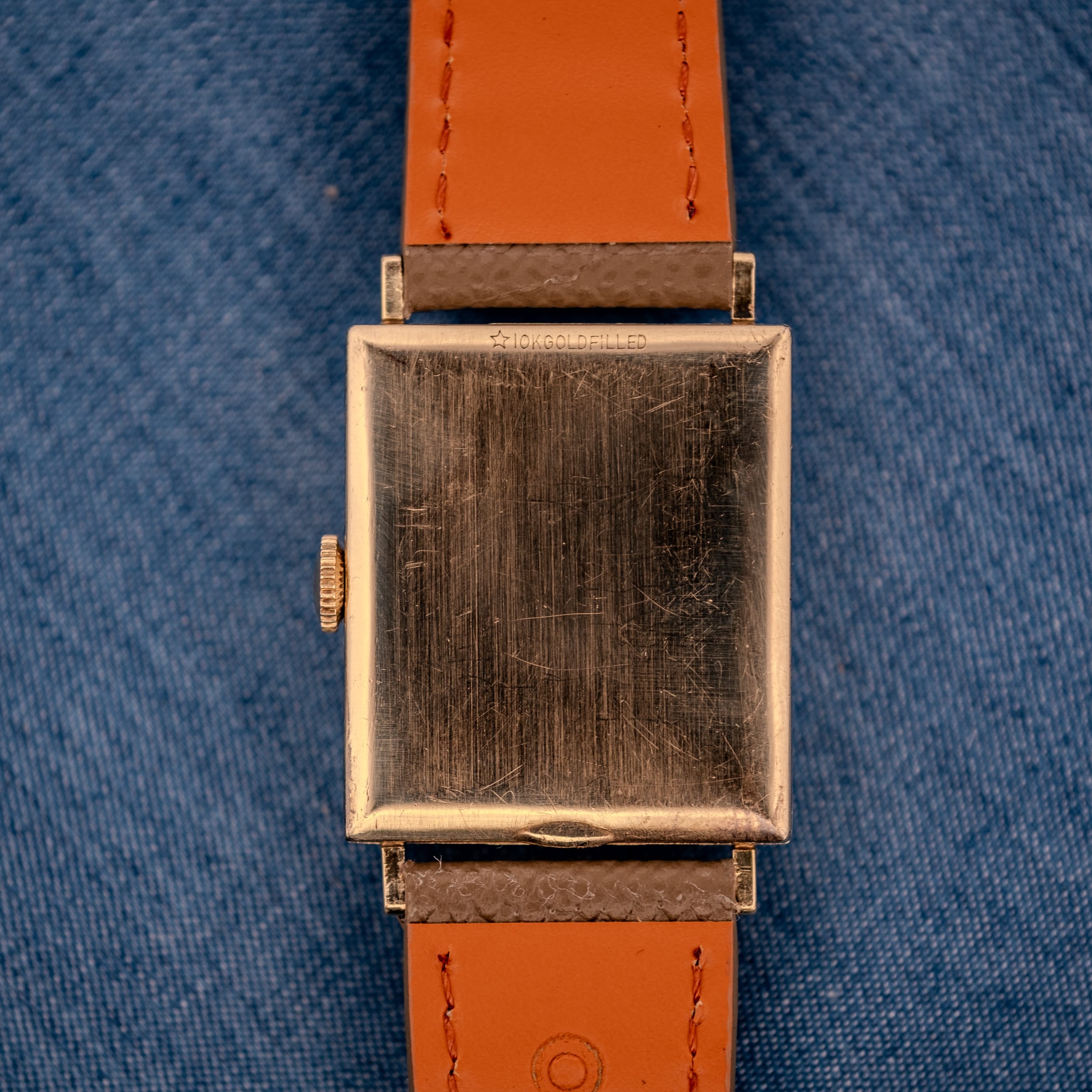
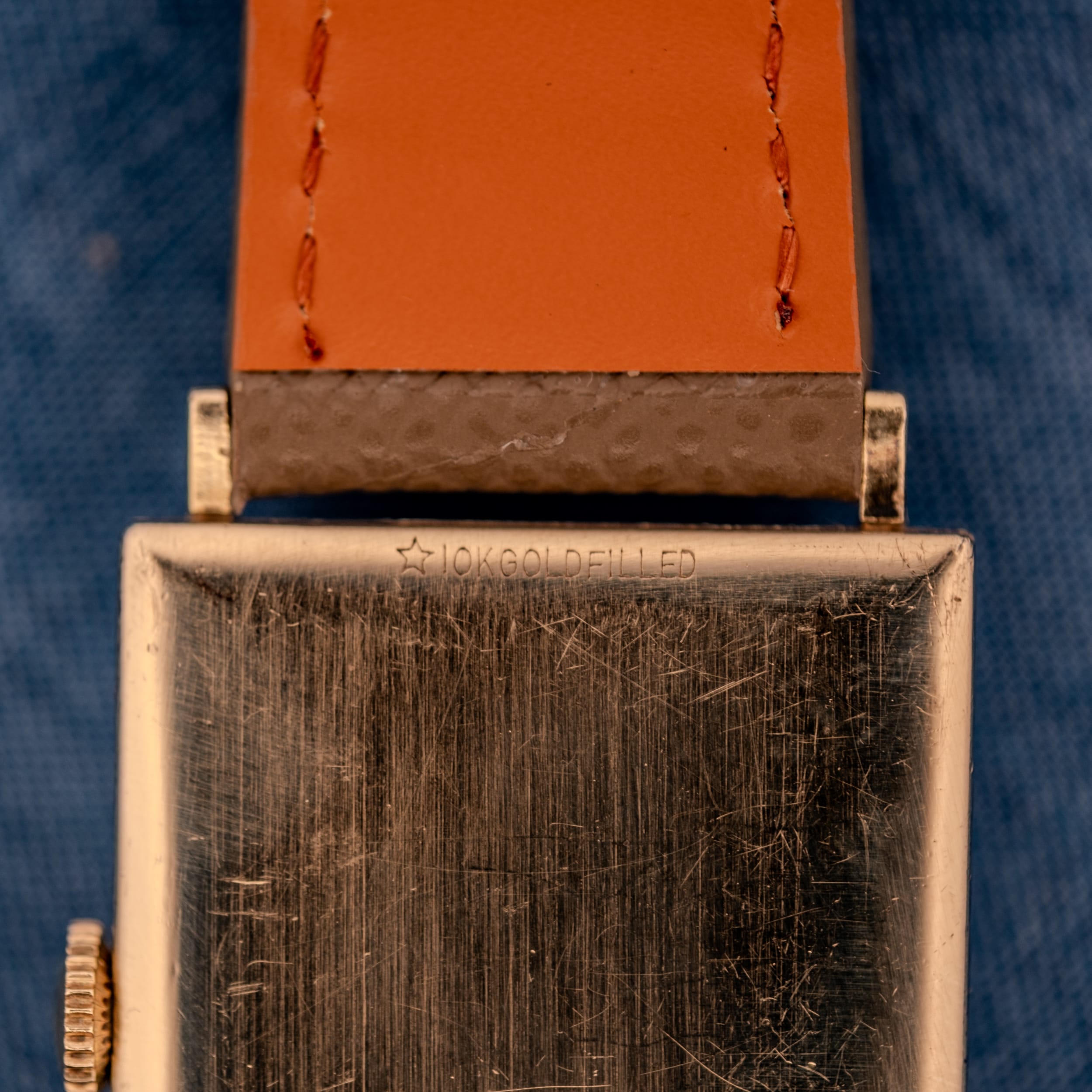
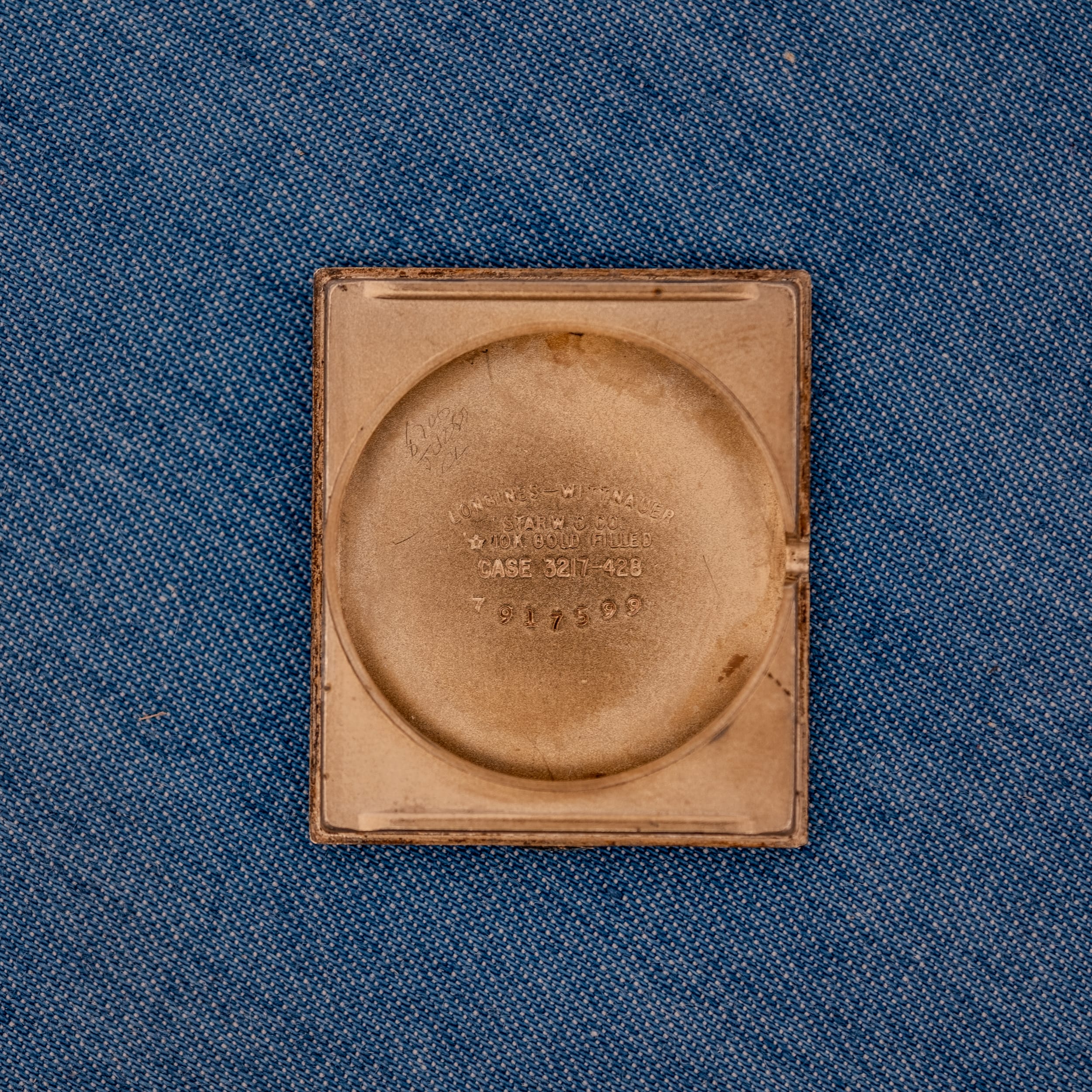
The case is where the design earns its keep. A square 10k yellow gold filled outer frame measures 26mm across with a 39.5mm lug-to-lug span and an 18mm lug width, the textured top surface bordered on the outer edge and around the central dial cut-out by mirror-polished gold. The lugs flare slightly downward to wrap a wrist, and the case sides are smooth polished gold filled that read tank-architectural rather than dress-thin. The outer caseback is stamped with a small star symbol followed by “10K GOLD FILLED” along the top edge, the standard period-correct designation that tells you this is the more substantial bonded gold construction rather than the thinner plated finishes that hit the market in the mid-1970s. Gold-filled construction means a thick layer of solid 10k gold metallurgically bonded to a base metal core, the kind of build that wears across decades rather than rubs off across years. Honest wear scatters across the outer caseback and the case sides exactly as a watch worn and loved for fifty years should look. Open the back and the inner caseback is stamped with the Longines house markings, “CASE 3217-428” reading clearly, and the matching case serial running below.
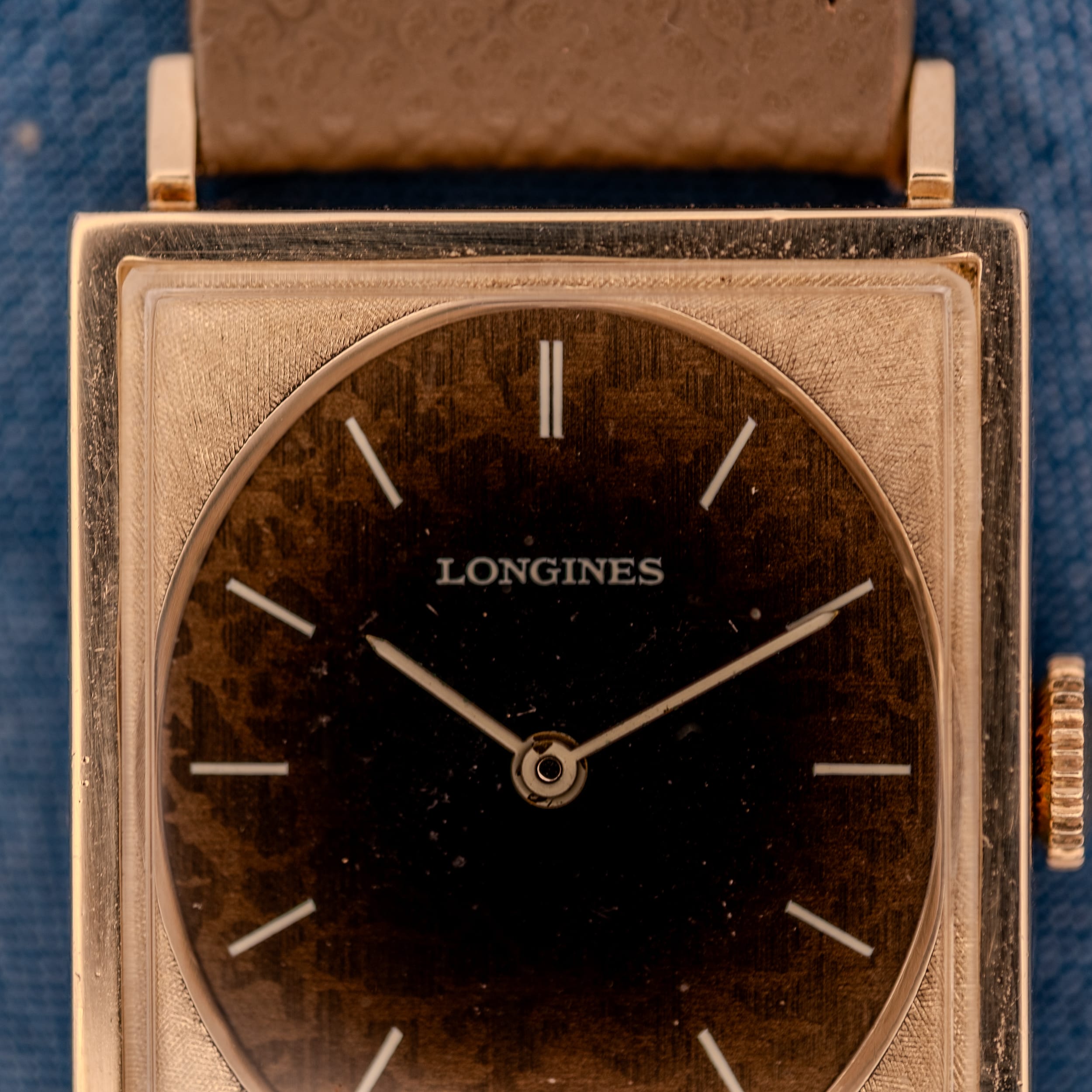
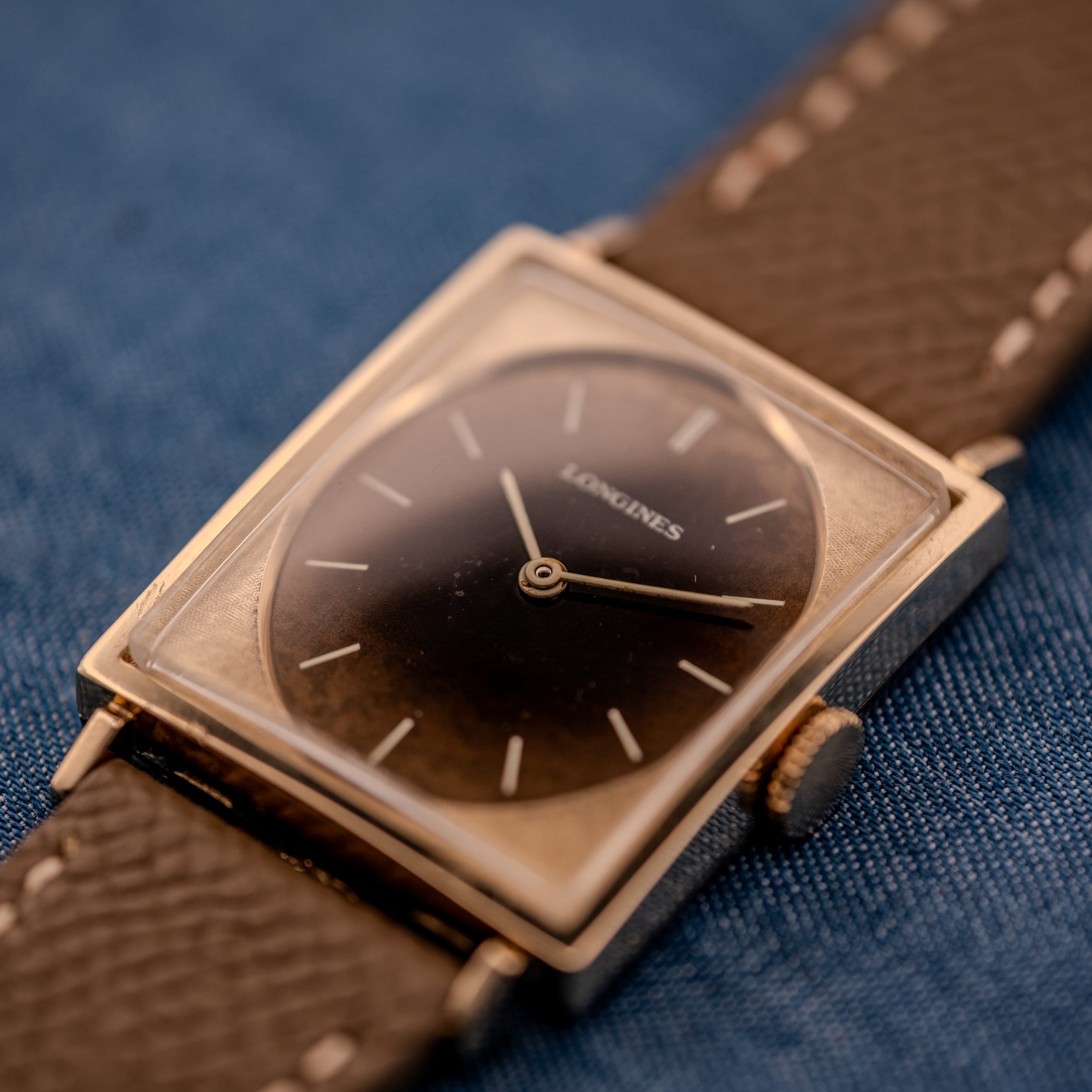
The dial is the headline. A circular sub-dial cut into the square frame carries a deep chocolate field patterned in tan, copper, and dark brown spotting across the entire visible surface, drawn this way by Longines and looking today essentially the way it did when it left Saint-Imier. This is the original factory dial in unrestored condition with the printed Longines wordmark fully intact across the upper half, applied gold stick markers ringing the dial at every hour position, and the printed “SWISS” designation reading clearly at the six o’clock position. The hands are the original slim Longines baton-style steel set, matched factory pair, with no replacement and no reluming. The pre-tritium signature at six tells us this is a dress dial built without luminous compound, exactly correct for a Longines tank of this period, and the originality story stays clean. To us, a factory leopard dial on a square Longines tank is the kind of design choice the brand only made for a brief window, and the value lives in leaving it alone.
The crown is the original Longines-signed component with the period-correct toothed edge intact and operates with the positive engagement a properly maintained L647.4 should give. The acrylic crystal sits clear above the dial with the gentle doming that helps the leopard pattern play across its surface in light.
We have paired the watch with one of our mud grey textured leather straps and an OTTUHR signed buckle. The cool grey reads as a deliberate counterweight to the warm gold case and the chocolate dial, the two-tone palette letting the leopard dial sit as the loudest element on the wrist exactly where it belongs.
Serviced in-house at OTTUHR and backed by our 2-year mechanical warranty, this is the kind of vintage Longines Tank watch we get genuinely excited about, an early-1970s reference where the dial story is the whole story. Factory original dial, factory hands, original signed crown, intact case stampings, and the Longines-signed L647.4 manual caliber running cleanly. For the collector who values originality over polish, who appreciates Longines making a design decision this confident in the early 1970s, and who wants a piece of Saint-Imier tank design with a real story attached, this is exactly the kind of watch we love bringing in.