

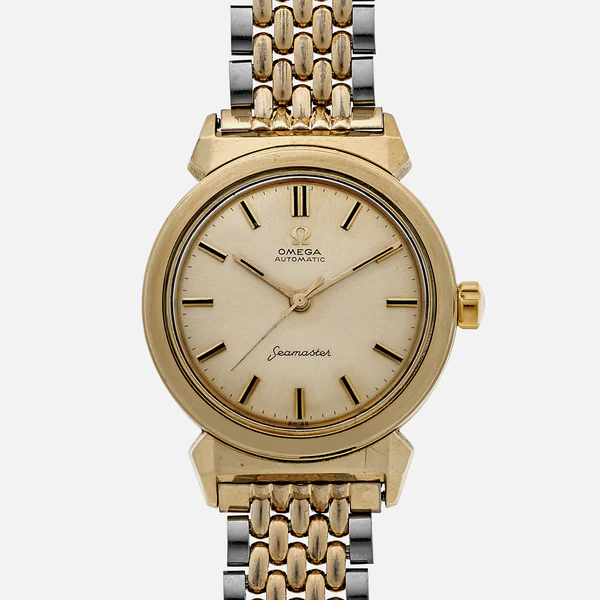
The Omega Seamaster 14363 represents a refined expression of 1950s watchmaking, embodying the era when Omega positioned the Seamaster collection as sophisticated, water-resistant dress watches rather than the professional dive tools they would later become. Distinguished by its elegant hooded lug case design and available in various gold-finished configurations, the ref. 14363 occupies a special place in the hearts of vintage Omega collectors who appreciate understated elegance paired with robust mechanical reliability.
What makes the 14363 particularly compelling is its distinctive visual character. The hooded or “scarab” lugs, sweeping gracefully over the case sides, give this 34mm watch a presence that belies its modest dimensions. When paired with textured waffle dials, crosshair motifs, or gilt detailing, these watches offer a level of visual sophistication that rewards close examination. For collectors seeking an entry point into vintage Omega or those who appreciate the design language of the 1950s, the ref. 14363 delivers both wearability and historical significance.
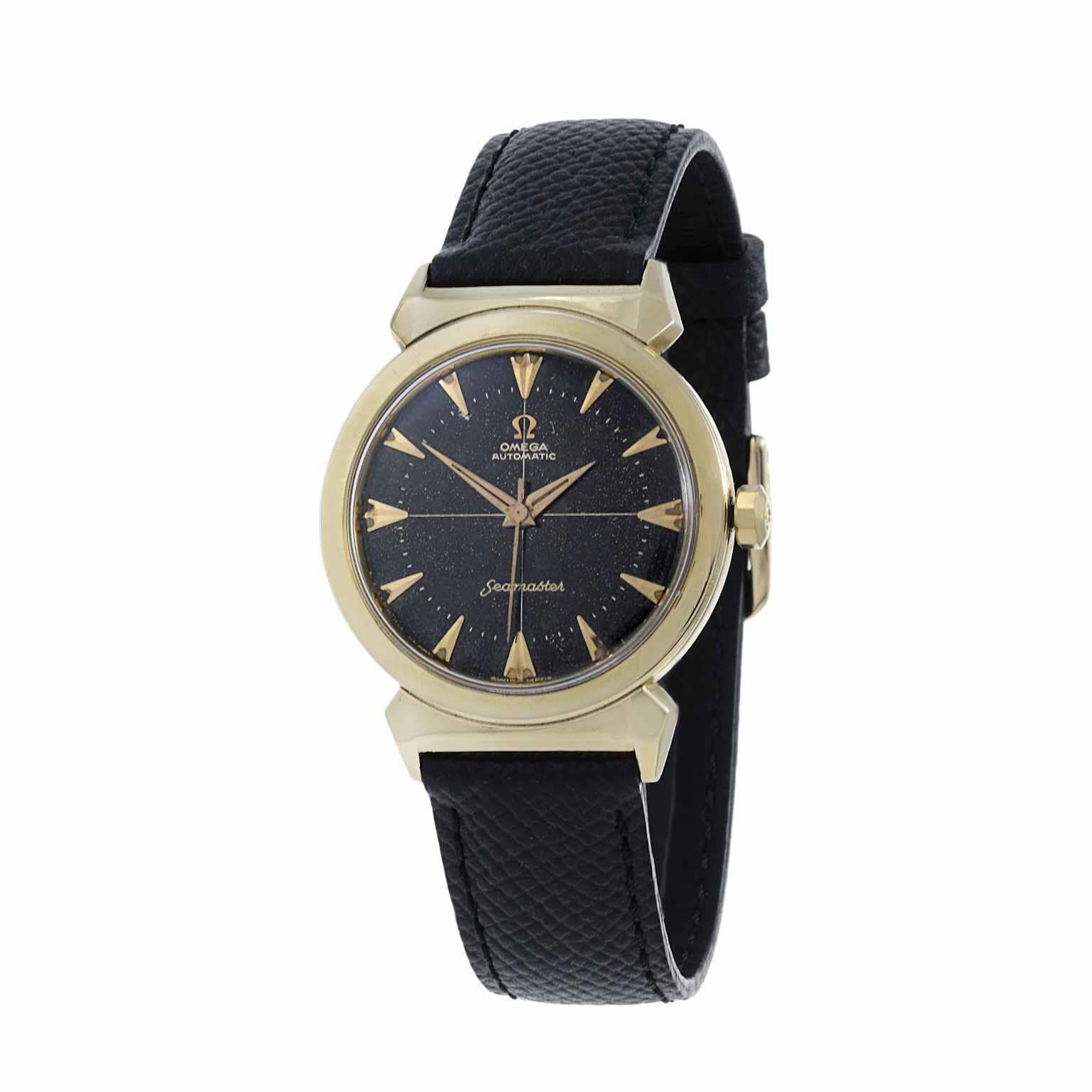
Omega Seamaster Reference 14363 Scarab Lugs Gilt Dial Automatic
History & Production Period
The Seamaster ref. 14363 emerged during the mid-1950s, a pivotal period in Omega’s evolution. The broader Seamaster line had been introduced in 1948 to commemorate Omega’s 100th anniversary, leveraging water-resistant technology derived from watches Omega supplied to the British Royal Air Force during World War II. These early Seamasters pioneered the use of rubber O-ring gaskets for water resistance, a technology borrowed from submarine engineering that represented a significant advancement over the lead or shellac-based seals used previously.
Production of the ref. 14363 spanned approximately 1954 to 1960, with the bulk of surviving examples dating from 1956 through 1958 based on movement serial number analysis. Watches bearing movement serial numbers in the 14 million range date to circa 1954, those in the 15 million range to 1956, and the 16 million range to 1958. This timeline positions the 14363 squarely within the golden age of mid-century Omega production, before the dramatic shift toward purpose-built tool watches that occurred with the 1957 introduction of the “Professional Trilogy” (Seamaster 300, Speedmaster, and Railmaster).
The ref. 14363 belonged to a family of related Seamaster references produced during this period, including the closely related ref. 2846 and 2848 models. These references shared similar mechanical specifications and case dimensions but differed in lug design and case finishing. While the 2846/2848 series featured more substantial, faceted “beefy” lugs, the 14363 distinguished itself with its hooded, scarab-style lugs that extended and curved over the case sides. This design choice gave the 14363 a more streamlined, elegant appearance compared to its siblings.
The “KO” prefix in the full reference designation (KO 14363) indicates a gold-capped case construction, one of Omega’s premium finishing options during this era. Understanding Omega’s material code system is essential for collectors: CK or MI denoted stainless steel, KO indicated gold cap, PK meant gold-filled, and OT or OJ signified solid gold. The gold cap construction involved bonding a thick layer of gold (significantly thicker than standard plating, typically 20+ microns) over a stainless steel base, offering durability and luxury at a more accessible price point than solid gold.
Production quantities for the ref. 14363 were never officially disclosed by Omega, but surviving examples suggest it was produced in moderate numbers. The watch was not positioned as a limited edition or special release but rather as part of Omega’s standard Seamaster dress watch lineup, offering customers an elegant option with enhanced water resistance compared to standard dress watches of the era.
![WTS] 1950s Omega 14363-3 “Hooded Lugs” Seamaster - Fresh](https://ottuhr.com/wp-content/uploads/2025/12/009d3f5ad7163e553c2d257b99b6a698de63d1bb.jpg)
WTS] 1950s Omega 14363-3 “Hooded Lugs” Seamaster – Fresh
Technical Specifications
The Omega Seamaster ref. 14363 was built to comfortable, versatile proportions that characterize classic 1950s watch design:
The 34mm case diameter, which might seem modest by contemporary standards, was standard for men’s dress watches during the 1950s. The hooded lug design and case proportions result in a watch that wears slightly larger than its diameter suggests, with good wrist presence for those with smaller to medium-sized wrists. The watch’s relatively slim profile made it ideal for sliding under a dress shirt cuff, consistent with its positioning as an elegant, water-resistant dress watch rather than a tool watch.
The acrylic crystal, standard for the era, is relatively soft and prone to scratching compared to modern sapphire but has the advantage of being easily polished to restore clarity. Many surviving examples have had their crystals replaced over the decades, which is acceptable provided the replacement maintains period-correct acrylic construction and proper domed profile.
The snap-on caseback features the Seamaster designation along with “Waterproof” text, reflecting the watch’s enhanced resistance to moisture compared to standard dress watches. Inside the caseback, collectors will find the reference number (14363), often followed by a suffix such as -1 SC, -2 SC, -3 SC, or -4 SC, which denoted specific dial, case, or movement combinations used by Omega for internal production tracking. The “SC” suffix likely indicates the snap-case construction, distinguishing these from models with screw-down casebacks.
Movements & Calibers
The ref. 14363 housed movements from Omega’s early 500 series, representing a significant technological leap forward when introduced in 1955. These calibers replaced Omega’s earlier bumper automatic movements with more efficient bidirectional rotor systems.
Omega Caliber 500
The caliber 500 was used in early production examples of the ref. 14363, typically dating to 1954-1955. Key specifications include:
- Jewel Count: 17 jewels
- Frequency: 19,800 vibrations per hour (2.75 Hz)
- Power Reserve: Approximately 46 hours
- Diameter: 28.0mm
- Features: Center seconds, automatic winding with bidirectional rotor
- Construction: Monometallic balance, self-compensating flat balance spring
Omega Caliber 501
The caliber 501, more commonly encountered in the ref. 14363, represented a refinement of the caliber 500 and became the standard movement for this reference from approximately 1956 onward:
- Jewel Count: 19 or 20 jewels (20 jewels more common)
- Frequency: 19,800 vibrations per hour (2.75 Hz)
- Power Reserve: 46 hours
- Diameter: 28.0mm
- Features: Center seconds, swan-neck micrometer regulator (on some examples), Incabloc shock protection
- Construction: Full-rotor automatic winding operating bidirectionally, copper-plated movement finish
Both calibers share the same fundamental architecture and dimensions, with the 501 representing an evolutionary refinement with additional jewels and, in many cases, the addition of Omega’s swan-neck regulator for more precise timing adjustments. The visually distinctive copper plating seen on these movements is a hallmark of Omega’s mid-1950s production and adds aesthetic appeal when viewed through exhibition casebacks (though the ref. 14363 typically featured solid casebacks).
These movements marked a watershed moment in Omega’s automatic watch development. Unlike the earlier bumper automatics that wound in only one direction through a limited 270-degree arc, the 500/501 calibers featured full 360-degree bidirectional rotor winding, significantly improving winding efficiency and reliability. This advancement made the watches more practical for everyday wear, as they maintained better power reserve through normal wrist movement.
The caliber 501 powered numerous important Omega references during this period, including early Constellation models, demonstrating Omega’s confidence in its reliability and performance. These movements were designed as robust, serviceable workhorses rather than high-complication marvels, prioritizing dependability over features. They lack date complications, chronometer certification in most examples, and hacking seconds (the ability to stop the seconds hand when the crown is pulled), features that would become common in later Omega calibers.
From a collector and maintenance perspective, the caliber 501 has both advantages and considerations. On the positive side, these movements are generally robust and can be serviced by competent watchmakers familiar with vintage Omega calibers. However, parts availability, particularly for rotor assemblies and certain bridge components, has become more limited over the decades. Omega’s service department has historically substituted certain worn assemblies with slightly different variants when original parts are unavailable, which is generally acceptable for a watch intended to be worn rather than preserved as a museum piece.

Omega Seamaster automatic ref. 2846 cal. 501 – Brussels
Dial Variations
The ref. 14363 was produced with a remarkable array of dial variations, reflecting Omega’s strategy of offering diverse aesthetic options within a core case design. This variety is part of what makes collecting vintage Seamasters so engaging, as no two examples are quite alike.
Base Colors and Finishes
The most commonly encountered dial colors include:
- Black: Often featuring gilt (gold) text and markers, these dials develop rich patina over time
- Champagne/Cream: Ranging from pale cream to deeper champagne tones, sometimes with two-tone configurations
- White/Silver: Clean, formal appearance with varying degrees of texture
- Grey: Less common, offering subtle sophistication
- Gold: Rare, typically found on solid gold examples
Textured Dial Patterns
Perhaps the most distinctive variations involve textured dial surfaces:
Waffle/Guilloché Dials: These feature a grid-like or honeycomb pattern across the dial surface, created through engine-turning or stamping techniques. The waffle texture catches light beautifully and has become one of the most sought-after dial variations among collectors. Examples with white waffle dials and gold-capped cases are particularly desirable.
Crosshair Dials: Featuring thin lines radiating from the center or crossing the dial, these designs evoke precision instrumentation and create a distinctive sonar or target-like appearance. The crosshair motif was used across various Seamaster references during the 1950s and adds visual interest without overwhelming the dial’s legibility.
Linen/Textured Finishes: Subtle diagonal or random texturing that adds depth and dimension to the dial surface.
Applied Markers and Hands
The ref. 14363 featured various marker configurations:
- Faceted Baton Markers: Multi-faceted applied hour markers, often in gold, sometimes with luminous material in the center
- Arabic Numerals: Applied Arabic numerals at cardinal positions (12, 3, 6, 9) or select positions
- Mixed Configurations: Combinations of batons and Arabic numerals
- Dauphine Hands: Elegant, faceted hour and minute hands in gold or steel, sometimes filled with luminous material
Luminous Material Considerations
The presence or absence of luminous material significantly affects the dial’s appearance and collector value:
Lume Dials: Earlier examples featured radium-based luminous material (pre-1962), which has often aged to a cream or beige color. Later examples used tritium (post-1962), typically marked with “T Swiss T” or “Swiss T” on the dial. The luminous material appears as dots or plots at the base of hour markers and fills portions of the hands.
No-Lume Dials: Some configurations, particularly those with two-tone designs and gilt details, featured no luminous material whatsoever. These “no-lume” dials paired with gold hands lacking lume plots represent more formal, dress-oriented configurations and are less common than their luminous counterparts. The absence of lume gives these dials a cleaner, more refined appearance.
Dial Condition and Patina
When evaluating a ref. 14363, dial condition represents one of the most critical factors affecting both value and authenticity. Original dials that have developed natural, even patina are highly prized by collectors. So-called “tropical” dials, which have turned various shades of brown or caramel due to UV exposure and aging, can command significant premiums when the aging pattern is attractive and consistent.
Conversely, refinished or “service” dials, where the original dial has been stripped and reprinted, significantly diminish value and collectibility. Signs of refinishing include overly bright printing, incorrect fonts or spacing, lack of appropriate aging, and inconsistent lume color compared to the hands. While service dials may be acceptable in watches intended purely for daily wear, collectors should be aware of their presence and price accordingly.
Case & Bezel Variations
The defining characteristic of the ref. 14363’s case design is its distinctive hooded or scarab lug construction. These lugs extend from the case and curve gracefully downward over the sides, creating an elegant, flowing appearance that distinguishes the 14363 from the more substantial, angular “beefy” lugs found on contemporary references like the 2846.
Case Materials and Reference Prefixes
The ref. 14363 was produced in several case material configurations:
KO (Gold Cap): The most commonly encountered variant, featuring a thick layer of gold bonded over a stainless steel base. The gold cap designation (KO prefix) indicates substantially thicker gold coverage than standard gold plating, typically 20+ microns, providing durability and luster that can withstand decades of wear. Gold-capped cases were available in yellow gold and, more rarely, pink/rose gold (KP designation).
Stainless Steel: Full stainless steel examples exist but appear less common in surviving specimens, possibly because gold-capped versions were the primary market offering for this particular reference.
Solid Gold: Rare examples in solid 14k (OJ prefix) or 18k (OT prefix) gold have been documented, representing the top tier of the range. A particularly uncommon variant features 14k rose gold shell construction (suffix -4 SC).
Case Finishing and Condition
The hooded lug design presents both aesthetic advantages and practical considerations for collectors. When original and unpolished, these cases feature crisp bevels along the lug edges and distinct separation between polished and brushed surfaces. Over-polishing, unfortunately common with vintage watches, can soften these edges and reduce the case’s visual definition.
Gold-capped cases develop their own unique patina over time. The thick gold layer is remarkably durable compared to thin plating, but high-wear areas such as lug edges and the caseback perimeter may show slight wear through to the steel base after seven decades of use. This honest wear is generally accepted and even appreciated by collectors as evidence of a watch’s genuine age and use. Some gold-capped cases can develop slight tarnishing or color shifts, particularly at solder points where the gold was bonded to the steel substrate. These can typically be cleaned using gentle methods like jeweler’s pickle (diluted vinegar solution) without damaging the case.
Bezel and Crown
The ref. 14363 features a flat, polished bezel integrated with the case construction. Unlike later professional Seamasters with rotating bezels, this dress-oriented design prioritizes elegance over tool-watch functionality.
The crown should be signed with the Omega logo, a detail collectors should verify. Original crowns are relatively compact, proportionate to the 34mm case, and feature the characteristic Omega symbol embossed on the crown face. The crown is not screw-down; it simply pulls out for hand-setting and pushes in for timekeeping, consistent with the watch’s modest water resistance specifications.
Caseback Details
The snap-on caseback typically features engraved text including “Seamaster,” “Waterproof,” and “Stainless Steel” (on steel or gold-capped examples). The caseback design is relatively flat with subtle beveling at the perimeter. Inside, collectors will find the reference number 14363, often followed by suffixes (-1 SC, -2 SC, -3 SC, etc.) that denote specific production variants, plus additional codes indicating case material.
An O-ring rubber gasket with approximately 0.921mm thickness provided the water resistance seal. While these gaskets have typically dried out or been replaced over the decades, proper service should include installation of a fresh gasket to maintain at least splash resistance.
Bracelet & Strap Options
Unlike modern Omega Seamasters, which are frequently encountered on integrated metal bracelets, the ref. 14363 was primarily delivered on leather straps during its original retail period. This reflected its positioning as a dress watch rather than a sport watch.
Period-Correct Leather Straps
Original or period-appropriate straps for the ref. 14363 would have included:
- Brown Leather: The most common pairing, particularly with gold-capped or gold dial watches
- Black Leather: Formal and versatile, appropriate for steel or two-tone examples
- Bordeaux/Burgundy: Occasionally seen, offering a distinctive look
Quality examples featured proper curved ends to match the hooded lug profile, signed Omega buckles, and clean edge finishing. Modern replacement straps should use 18mm width to fit the ref. 14363’s lugs properly.
Metal Bracelet Options
While less common than leather, some period metal bracelet options existed:
Beads of Rice (BOR) Bracelets: These articulated link bracelets with small, rice-shaped links were period-correct options for 1950s Omega watches. The BOR design offered flexibility and a subtle elegance appropriate for dress watches. Fitted with 18mm end links, they provide good integration with the hooded lug design.
Spiedel Expansion Bracelets: While not Omega-branded, these elasticated metal bracelets were popular aftermarket additions during the 1950s and 1960s. Collectors typically remove these in favor of leather straps or period-correct Omega bracelets to maintain authenticity.
Modern Alternatives: Contemporary collectors often fit vintage Seamasters with modern leather straps (calfskin, alligator), NATO straps for casual wear, or rubber/sailcloth options for sportier applications. While these are not period-correct, they offer variety and can protect original vintage bracelets from daily wear.
Strap Installation Considerations
The ref. 14363 uses standard spring bars for strap attachment. Collectors should exercise care during strap changes to avoid scratching the hooded lugs, as their curved profile can make spring bar removal slightly more challenging than on straight-lug designs. Using quality spring bar tools and protective tape on the lugs during changes is recommended.
Identifying Original vs. Replaced Parts
Authenticity assessment is crucial when acquiring a ref. 14363, as seven decades provide ample opportunity for parts replacement, restoration, or modification. Here’s what collectors should examine:
Dial Authenticity
Original Dial Indicators:
- Printing quality should be crisp but show period-appropriate technique (less perfect than modern pad printing)
- Text placement, font, and spacing should match known examples
- Patina and aging should appear natural and consistent across the dial surface
- Luminous material (if present) should match in color and aging between markers and hands
- Dial feet should align properly with movement pillar positions
- The Omega logo and text should show appropriate detail and not appear “soft” or poorly defined
Service/Refinished Dial Warning Signs:
- Overly bright, perfect printing that looks modern
- Incorrect fonts, particularly in the “Seamaster” script or “Omega” logo
- Luminous material that appears fresh or doesn’t match the hands
- No natural patina or artificial aging attempts
- Dial text that doesn’t align with known period-correct variations
Hands Assessment
Original hands should display:
- Consistent aging and patina matching the dial
- Proper length relative to dial markers
- Correct style for the period (typically faceted dauphine hands)
- Luminous material matching the dial’s lume in color and aging
Service replacement hands are sometimes necessary after seven decades, and while not ideal, they should at least be correct in style and properly lumed to match the dial.
Case Originality
Polishing Concerns: Over-polishing represents one of the most common issues with vintage cases. The hooded lugs should retain sharp, crisp bevels with distinct transitions between polished and brushed surfaces. Cases that appear overly rounded, lack definition in their lug chamfers, or show evidence of heavy buffing have reduced collector value.
Gold Cap Integrity: Gold-capped cases should show the gold layer intact across most surfaces, though high-wear areas (lug tops, caseback edges) may show slight breakthrough to steel after decades of use. Extensive wear-through or brass showing beneath the gold indicates incorrect restoration or non-original capping.
Case Engravings: Personal engravings on casebacks were common period additions and, while reducing value slightly, are generally accepted as part of a watch’s history. However, the presence or absence of factory engravings (“Seamaster,” “Waterproof”) should be verified.
Movement Verification
The movement should be caliber 500 or 501, with serial numbers appropriate to the case reference and period. Movement serial numbers beginning with 14, 15, or 16 million align with production dates of 1954, 1956, and 1958 respectively. The movement should display copper-plated finish characteristic of this era, proper Omega markings, and no obvious modern replacement parts unless disclosed.
Crown Authenticity
The crown should bear the Omega logo and be proportionate to the 34mm case. Oversized or unmarked crowns suggest replacement with incorrect parts. Original signed crowns are an important authenticity point.
Collector Notes & Market Context
Current Market Positioning
The Omega Seamaster ref. 14363 occupies an accessible entry point into vintage Omega collecting while offering genuine design distinction through its hooded lug case. Current market values for gold-capped examples in good condition range from approximately $1,100 to $2,350, depending on dial configuration, condition, and completeness. Factors driving value within this range include:
Premium Configurations:
- Waffle or guilloché dial textures
- Crosshair dial designs
- Original no-lume gilt dials
- Unpolished cases with sharp, crisp lug definition
- Complete with box and papers (exceptionally rare for watches of this age)
- Natural, attractive “tropical” patina development
Standard Configurations:
- Plain silver or champagne dials with standard markers
- Gold-capped cases with honest wear
- Service history documented with recent overhaul
- Replaced crystal or crown (acceptable if period-appropriate)
Value Detractors:
- Heavily polished cases with soft, rounded lugs
- Refinished or service replacement dials
- Incorrect replacement hands
- Missing or replaced crown without Omega logo
- Modified or incorrect strap/bracelet
Collecting Philosophy
The ref. 14363 appeals to several collector profiles. For those seeking an elegant, vintage Omega for regular wear, it offers comfortable sizing, distinctive design, and robust mechanical reliability when properly serviced. The 34mm case, while modest by modern standards, works beautifully on smaller to medium wrists and embodies classic mid-century proportions.
For collectors focused on design and historical significance, the hooded lug case represents an interesting evolutionary moment in Omega’s design language. The 14363 predates the tool-watch revolution of 1957 but incorporates enhanced water resistance, positioning it at the crossroads between traditional dress watches and the sport watches that would dominate the following decades.
Common Pitfalls to Avoid
Overpaying for Refinished Examples: Service dials significantly diminish value, yet sellers sometimes price refinished watches at original-dial levels. Carefully examine dial printing quality and authenticity markers before purchasing.
Confusing Gold Cap with Gold Plating: The KO gold cap designation indicates substantially thicker gold than standard plating, but sellers sometimes misrepresent plated watches as capped or vice versa. Verify case markings inside the caseback.
Assuming All Wear Indicates Poor Condition: Gold-capped cases naturally show some wear after 70 years; slight breakthrough at high-wear points is acceptable and preferable to over-polishing that destroys original case proportions.
Neglecting Service History: A vintage caliber 501 will need service after decades of operation. Factor the cost of professional servicing ($300-$600+) into purchase decisions if the watch hasn’t been recently overhauled.
Mixing References: The similar case dimensions and contemporary production of references 14363, 2846, 2848, and related models can create confusion. The hooded lug design distinguishes the 14363; verify reference numbers inside the caseback.
What Drives Premiums
Within the ref. 14363 collecting community, certain attributes command significant premiums:
- Dial Rarity: Waffle and crosshair dial configurations are significantly more desirable than plain dials
- Original Condition: Unpolished cases with intact bevels and sharp lug definition
- No-Lume Gilt Examples: These formal configurations with two-tone dials and gold hands are uncommon
- Natural Patina: Attractive, even tropical browning or honest aging without damage
- Complete Presentation: Original box, papers, purchase receipts, or period documentation (extremely rare)
Relative Value Proposition
Compared to other vintage Omega references, the 14363 offers strong value. Its contemporary sibling, the ref. 2846, trades at similar price points despite being more commonly encountered. The iconic 1957 Seamaster 300 or period Speedmasters command multiples of the 14363’s value, making the 14363 an accessible alternative for collectors appreciating 1950s design without stretching to five-figure acquisitions.
The hooded lug design’s relative scarcity compared to more common lug styles adds desirability without the premium demanded by true rarities. This positioning makes the ref. 14363 an excellent “collector’s watch” that rewards knowledge and careful selection without requiring extraordinary financial commitment.
Long-Term Outlook
Interest in vintage Omega watches has grown substantially over the past decade, with particular appreciation for pre-professional era Seamasters as collectors seek examples predating the dive watch transition. The ref. 14363’s distinctive design, wearable proportions, and relative accessibility position it well for continued collector interest. As supplies of original-condition examples dwindle and collector knowledge deepens, well-preserved examples with desirable dial configurations will likely appreciate.
Conclusion
The Omega Seamaster ref. 14363 represents mid-century Omega craftsmanship at its most refined. Neither a simple dress watch nor a purpose-built tool, it occupies that compelling space where elegance meets enhanced functionality, characteristic of an era when quality timepieces were expected to serve reliably across diverse situations rather than in specialized roles.
For contemporary collectors and enthusiasts, the 14363 offers numerous appeals: comfortable 34mm proportions ideal for classic styling, distinctive hooded lug architecture that sets it apart from more common references, diverse dial variations that reward knowledgeable hunting, and robust caliber 501 movements that can serve reliably with proper maintenance decades after manufacture. Whether selected for daily wear, as an entry into vintage Omega collecting, or as a representative example of 1950s design philosophy, the ref. 14363 delivers both visual satisfaction and mechanical competence.
The watch’s position in Omega’s timeline, emerging after the foundational 1948 Seamaster introduction but before the 1957 professional trilogy, gives it historical significance beyond its modest specifications. It represents Omega’s commitment to bringing enhanced water resistance to elegant timepieces for civilian markets, leveraging wartime technological developments for peacetime applications. The rubber O-ring gasket technology that made these watches “waterproof” by 1950s standards, the advancement to bidirectional automatic winding with the caliber 500/501, and the diversity of case finishing options all speak to Omega’s drive to offer both innovation and variety during this golden age of Swiss watchmaking.
When evaluating potential acquisitions, collectors should prioritize dial originality, case condition (particularly the integrity of those distinctive hooded lugs), movement authenticity, and service history. The difference between a well-preserved example with original dial and an over-polished watch with service replacements can be dramatic, both aesthetically and financially. Take time to research, compare multiple examples, and develop an eye for the subtleties that distinguish exceptional specimens from compromised ones.
The ref. 14363 rewards the patient collector who values understated elegance over obvious flash, who appreciates the technical story behind mid-century automatic movements, and who understands that true distinction often lies in details: the way light plays across a waffle-textured dial, the graceful arc of hooded lugs wrapping the wrist, the warm glow of decades-old gold capping developing natural patina. These are watches that quietly announce their quality to those who know, while remaining accessible to those just beginning their vintage Omega journey.