

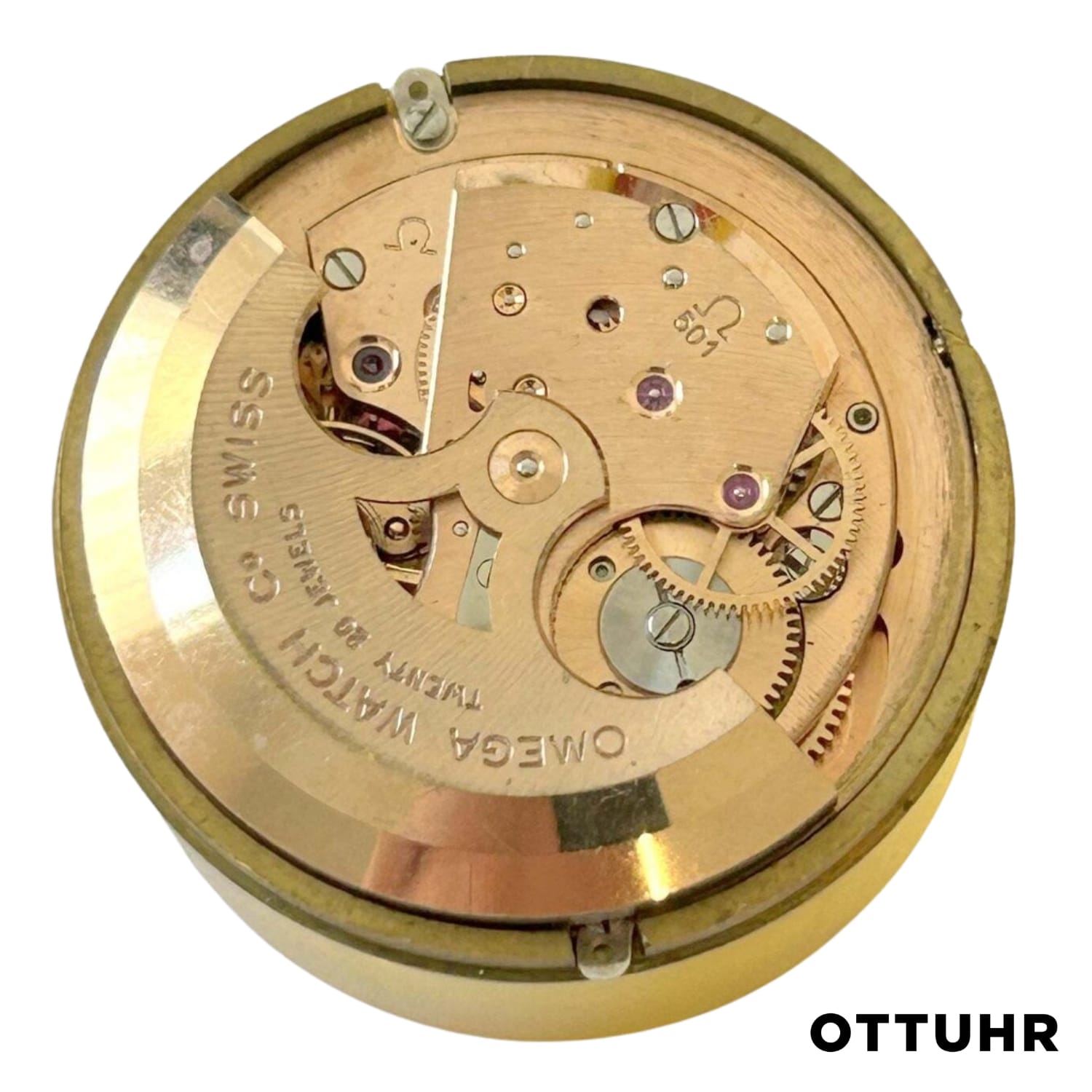
Omega’s Calibre 501 sits near the beginning of Omega’s fully rotor‑driven automatic era, and it underpins some of the brand’s most important mid‑century references, including early Seamaster 300 CK2913 divers and various Constellation and Seamaster models from the second half of the 1950s. Collectors often approach it as the archetypal early 500‑series workhorse: copper‑finished, robust, and visually and mechanically emblematic of Omega’s 1950s quality peak. It was one of the first mainstream Omega movements to combine a full 360‑degree rotor, central sweep seconds, and a relatively slim profile, all at a modernish 19,800 vph beat rate.
Comparison of Omega early 500-series automatic calibers related to Calibre 501
At its core, the 501 is a time‑only automatic movement designed for everyday wear in dress and tool watches, with center seconds and no calendar. It shares the basic architecture of the early 500‑series family, but adds refinements over the 500 and draws from the smaller 471 and the larger 490. Omega developed the 500‑series as a high‑volume, high‑precision in‑house family, intended to power both chronometer‑grade Constellations and more affordable Seamasters. As a result, the 501’s reputation among collectors and watchmakers is that of a capable, accurate, and durable calibre, provided the known weaknesses of its early rotor bearing and winding system are managed during service.
Production figures for the 501 alone are not published by Omega, but contextual data exist. The early rotor automatic family 470/490/500/501/502/503/504/505 is estimated to have been produced in quantities exceeding one million units between roughly 1955 and 1960. Within that family, the 501 is a central no‑date reference, used across Seamaster, Constellation, and early dive references, suggesting production likely runs into the several hundred thousand units range. That places the 501 as common in absolute terms, but relative scarcity arises once you filter for original dials, specific case references such as CK2913, and higher‑jewel or chronometer‑related executions. In most configurations, the 501 is best described as uncommon but not rare, with specific references or dial combinations driving collectibility rather than the calibre alone.
Today, the calibre’s standing in the collector market is tied closely to the watches it powers. Demand for 1950s Seamasters and early Seamaster 300 references is strong, and Constellations with correct early 500‑series movements have a dedicated collector base. Within that, the 19‑jewel 501 tends to be slightly less coveted than the higher‑jewel 504 and 505 chronometer siblings, yet a clean, correct 501 in a desirable case reference can still command a premium. Overall demand is stable to rising as collectors re‑evaluate 1950s Omega as a value proposition relative to later 55x / 56x movements, with specific premium attached to unmolested dials and original rotor assemblies, given the well‑documented parts substitution issues in service history.
Historical Context, Provenance, and Manufacturing Details
Development History and Design Intent
The 501 emerged as part of Omega’s response to two intertwined pressures in the early 1950s: the need to replace the older bumper automatics with more modern full‑rotor designs, and the desire to offer high‑precision automatic watches at scale for lines such as the Constellation and Seamaster. Prior to the 500‑series, Omega had used bumper calibers like 351, 352, and 354, which were accurate but mechanically more primitive and thicker. The 500‑series replaced these with bi‑directional, 360‑degree rotor movements built on a modern movement architecture designed explicitly for automatic winding.
Design work for the early rotor family is credited to Edouard Schwaar under the direction of Henri Gerber, with the 470/490 movements as forerunners and the 500/501/502/503/504/505 as the scaled‑up family that carried Omega into the late 1950s. The series incorporated a number of improvements, including an efficient automatic winding system and the use of a mobile balance spring stud holder, an innovation attributed to Jacques Ziegler that enhanced fine regulation. The 501 specifically synthesizes the lessons from the smaller 471 and the larger 490 in a 12.5 ligne package suitable for a wide range of mid‑size cases.
Predecessors and Successors
As a center‑seconds full‑rotor automatic, the 501 effectively replaces bumper movements like 354 in many product segments and directly evolves from the 471 and 490, which introduced rotor winding on different diameter bases. The 471 is often described as the first full‑rotor Omega automatic, while the 490 is a larger movement with a characteristic swan‑neck regulator. The early 500‑series then align these ideas into a coherent family: 500 and 501 for no‑date, 502 and 503 for date, and 504 and 505 for higher‑jewelled, often chronometer‑oriented executions.
By 1959, Omega introduced the mid‑500 series and then the 55x and 56x families. For no‑date applications the 551 and 552 are key successors, while the 561 and 562 cover date versions. In catalog terms, the 501 is out of new production by around 1960, even if service and parts replacement continued afterwards. Later chronometer developments, including 564 and the 700‑series superflat movements, further illustrate Omega’s push toward thinner and more advanced automatic calibres.
Manufacturing Context and Location
The 501 is a fully in‑house Omega movement, not an ebauche sourced from ETA, FHF, or other suppliers. It is part of Omega’s 1950s push to assert technical independence in automatic calibres through proprietary movement families. Manufacture took place in Switzerland, with production centered in Omega’s Biel/Bienne facilities that handled design and assembly of the 500‑series movements. The design philosophy emphasized robust industrial production combined with precision finishing, allowing Omega to use these calibres in both chronometer‑grade Constellation models and more utilitarian Seamasters.
In the wider horological landscape, the 501 belongs to a generation of post‑war automatic movements that mark the transition from early experiments to matured, standardized rotor systems. It is neither the thinnest nor the most technically advanced of its era, but it represents a sweet spot: robust, relatively slim, and accurate, enabling Omega to compete directly with contemporary Rolex and other Swiss manufacturers in the mid‑ to upper‑tier automatic segment.
Timeline
The key milestones in the calibre’s lifecycle are as follows.
Construction and Architecture
Plate and Bridge Layout
Calibre 501 uses a conventional full‑plate mainplate with separate train, barrel, and automatic winding bridges. The architecture can be described as a multi‑bridge layout rather than a three‑quarter or full plate in the classic pocket watch sense. The movement is typically copper‑plated brass, giving the characteristic reddish tone of mid‑century Omega automatics, with the automatic device and rotor mounted on additional bridges on the top side. The going train, balance, and keyless works are organized in a straightforward, serviceable layout, reflecting a design philosophy that prioritizes robustness and industrial manufacturability over decorative complexity.
The train bridge covers the center, third, and fourth wheels, while a separate barrel bridge houses the mainspring barrel and ratchet components. An automatic device bridge supports reverser wheels and the winding gear train feeding the ratchet wheel. A small balance cock carries the balance and Incabloc assembly, and a separate cock supports the sweep seconds pinion and associated friction spring. Overall, the layout is logical and relatively open, which aids watchmakers in servicing and diagnosing wear, particularly in the automatic winding system and rotor bearing.
Balance Wheel
The 501 uses a monometallic balance suitable for higher beat rates, typically fabricated from a nickel‑based alloy of the period, analogous in purpose to Glucydur type balances used elsewhere, although Omega’s documentation for the 500‑series emphasizes the monometallic construction and associated self‑compensating balance spring rather than naming a specific trade alloy. The balance is smooth or lightly armed, with timing screws either non‑functional (decorative / redundant) on some later chronometer‑oriented siblings or omitted on basic 501 executions. The regulator works with a mobile stud holder to allow fine positional adjustment. Exact diameter is not consistently published; it is sized to suit a 12.5 ligne movement running at 19,800 vph.
Balance Spring (Hairspring)
The hairspring is a flat, self‑compensating alloy spring, described in period sources as a “self‑compensating flat balance spring,” which is consistent with Nivarox‑type alloys used extensively across Swiss industry. The 500‑series benefited from Omega’s development of the Omegatronic torque measurement system for balance springs, which refined their consistency and performance. The 501 uses a flat spring rather than a Breguet overcoil, aligning with its role as a robust high‑volume movement rather than a top‑tier chronometer exclusive. The mobile stud carrier introduced in the series allows precise centering and adjustment of the spring, a notable technical refinement over earlier Omega movements.
Escapement
The escapement is a Swiss straight‑line lever escapement with jewelled pallet stones and an impulse jewel on the balance roller. It is configured for a 19,800 vph rate, which was considered relatively high for the period and contributes to improved isochronism and stability compared to lower‑beat calibres. The escapement is fully jewelled at the pallet and escape wheel pivots, with Incabloc shock protection protecting the balance staff pivots. The escapement design itself is conventional, which is advantageous for servicing and long‑term reliability, as it relies on well‑understood geometries and lubrication practices.
Shock Protection System
Calibre 501 employs Incabloc shock protection at the balance staff, with upper and lower cap jewels retained in characteristic lyre‑shaped springs. Parts catalogues and technical descriptions for the 470/490/500/501/502/503/504/505 family explicitly list Incabloc components, and modern parts suppliers stock Incabloc‑related parts for these calibres, confirming the system. The shock system focuses on the balance staff rather than extending to pallet or escape wheel in dedicated secondary systems, which is typical for the era. Identification of genuine movements is aided by the presence of authentic Incabloc settings and associated bridge markings.
Regulator Type
A hallmark of the early 500‑series, including the 501, is the swan‑neck micrometer regulator combined with a mobile stud holder. The swan‑neck spring applies controlled pressure against a fine adjustment screw that moves the regulator index in small increments, improving the ability to make fine rate corrections without disturbing the spring geometry. This arrangement became one of the visual signatures of high‑quality Omega automatics of the period and is often highlighted in collector literature as a point of difference from more basic designs. The mobile stud holder, credited to Jacques Ziegler, adds another degree of control, allowing the watchmaker to adjust beat and centering with greater precision.
Mainspring Material and Type
The 501 uses a white alloy automatic mainspring with a slipping bridle, designed to slide along the barrel wall as the watch reaches full wind, preventing overwinding when the rotor continues to supply energy. Parts listings indicate a mainspring shared across the 470/471/490/491/500/501/502/503/504/505 family, with dimensions around 1.20 mm width, 0.10 mm strength, and a length suitable for the 28.5 mm barrel, consistent with generic automatic mainsprings catalogued for these calibres. The barrel is marked in some related movements with instructions regarding lubrication and handling, and modern practice is to use braking grease sparingly on the barrel wall to balance sliding friction and torque consistency.
Gear Train Details
The going train follows standard automatic architecture: mainspring barrel drives the center wheel, which drives the third wheel, then the fourth wheel, and finally the escape wheel. In the 501, the layout is arranged so that the fourth wheel is at the center of the movement, allowing direct center seconds rather than an indirect center seconds module. This reduces friction and thickness compared to indirect center seconds designs, though it requires a specific train layout. The seconds hand is driven directly from the central fourth wheel pivot, and a separate friction element controls hand jitter and backlash. The center wheel is mounted at the geometric center of the movement and supports the cannon pinion on the dial side, as is typical.
Power from the automatic system is transmitted via an oscillating weight (rotor), through reverser and reduction gears, to the ratchet wheel on the barrel arbor. Collector and watchmaker commentary notes that early 500‑series calibres, including the 501, can suffer wear in the rotor bearing and reduction wheel teeth, leading to rotor wobble or rubbing on the mainplate and case back, a known service consideration.

Schematic gear train and automatic winding layout of Omega Calibre 501
Finishing Quality and Techniques
Finishing on calibre 501 is functional yet attractive. Movements receive copper plating on bridges and mainplate, with perlage on the mainplate in many examples and straight graining or light brushing on bridges. High‑grade versions and those destined for Constellation cases may exhibit more consistent decorative work, though the 501 itself is most often encountered in non‑chronometer configurations, leaving the top‑tier decorative focus to the 504 and 505. Screws and steel components are generally polished, and the swan‑neck regulator provides a visually appealing focal point. The overall finishing reflects Omega’s industrial yet quality‑oriented approach in the 1950s, balancing cost and aesthetics.
Cross‑Reference Data
Related Calibers and Family Relationships
The 501 belongs to the early full‑rotor Omega automatic family that includes 470, 471, 490, 491, 500, 501, 502, 503, 504, and 505. Within this family, many components are shared or compatible, including mainsprings, some train components, and various screws and small parts, as evidenced by parts catalogues and supplier listings. The 505 is often described as essentially a 501 with additional jeweling and chronometer adjustment.
Alternative Caliber Names and Rebranded Versions
Omega produced the 501 exclusively under its own brand, so there are no third‑party rebranded ebauche equivalents known. The same movement architecture underlies various model lines such as Seamaster, Constellation, and early Seamaster 300, but calibre markings remain “501” on the movement. Omega’s internal use of calibre families means you will not see the 501 sold as an ETA or FHF under a different name.
Base Caliber and Elaborated Versions
Within the Omega ecosystem, the 501 can be considered a mid‑level base for no‑date automatic applications, with elaborated siblings providing higher jeweling or chronometer certification. While the 501 itself is not typically documented as a chronometer calibre, the closely related 504 and 505 carry higher jewel counts and are associated with chronometer‑rated Constellations. The parts and architecture overlap heavily, and in some service contexts, rotors or bridges from higher‑jewelled versions have been substituted into 501 movements, complicating identification.
Compatible Case References by Brand
Omega used the 501 widely in its own watches, with notable references including:
- Seamaster 2846 and 2848, mid‑1950s automatic Seamasters with 34 mm “beefy lug” cases in steel and gold‑capped variants. These references often house either Cal. 500 or 501, indicating overlap and gradual evolution within the reference.
- Seamaster 2846‑2848 “12SC” and other suffix variants, as documented by dealers and collector reports.
- Seamaster 300 CK2913, early dive references from 1957 to circa 1961, where the 501 provided a robust automatic base for Omega’s new professional diver line.
- Early Constellation models transitioning from bumper automatics, where 501 appears as a non‑chronometer or early rotor solution before the mid‑500 and 55x/56x chronometer families took over.
These references place the 501 primarily within Omega’s own catalog; there is no evidence of the movement being supplied to other brands.
Dial Compatibility Notes
Because the 501 shares its 12.5 ligne, 28.5 mm diameter platform with calibres 500 and the date‑equipped 502/503 in the same family, dial foot positions are compatible within this group, provided the specific dial is intended for a central seconds, no‑date layout. Collectors and watchmakers report that dials from 500 and 501 can interchange, but care is required to ensure correct date‑window absence and branding. Dials for sub‑seconds 49x or other families are not compatible, despite occasional catalog confusion that lists 490/491 alongside 2846/2848 references. The 501 places the center seconds pinion at the geometric center, and dials must accommodate a central seconds hole.
Crown and Stem Specifications
Parts suppliers list a unified winding stem for the 490/491/500/501/502/503/504/505 family under Omega part number 1106. This indicates shared stem dimensions and threading across these calibres. Discussion among watchmakers indicates a stem diameter of approximately 0.9 mm with standard Swiss thread pitch, corresponding roughly to a TAP 10 standard. However, field reports show that third‑party replacement stems and crowns can have inconsistent thread pitches, leading to fitment issues even when nominal dimensions match. Crown dimensions vary by case reference; many Seamaster and Seamaster 300 applications use signed, waterproof crowns with appropriate tube and gasket combinations. In all cases, the setting mechanism is a sliding pinion and clutch system operated by a yoke, consistent with mid‑century Swiss keyless works.
Identification Marks
Caliber Number and Logo Placement
Authentic Calibre 501 movements carry the “OMEGA” wordmark and Ω logo engraved on the bridge or mainplate, typically near the rotor hub, together with the calibre designation “501” stamped on the automatic bridge or adjacent plate. Jewel count is usually engraved on the rotor or bridge as “19 JEWELS” or “20 JEWELS,” with some later service rotors marked “20 JEWELS” substituted onto earlier 19‑jewel movements during service. The presence, style, and placement of these markings are key in distinguishing genuine 501 movements from swapped or composite constructions.

Schematic identification zones for Omega Calibre 501 movement
Serial Numbers and Date Codes
Omega serial numbers are engraved on the movement, typically on the mainplate near the balance area or under the automatic assembly, depending on the exact bridge configuration. For 501 movements, serial ranges in the mid‑15 million to 18 million region are common, corresponding roughly to production from 1955 to 1960. Serial number format is purely numeric and lacks explicit date codes, but serial‑year charts allow approximate dating. There are no separate internal date codes on bridges analogous to some later Swiss practices; dating relies on serial numbers and case reference hallmarks.
Finishing Marks and Jewel Settings
Finishing patterns assist in identification. Expect copper‑plated bridges with perlage on the mainplate and simple brushing or light decorative work on bridges. The balance area should show an Incabloc assembly with polished cap jewel settings. Jewel settings are friction‑fit rather than in screwed chatons for this calibre, even in higher‑grade siblings; gold chatons are reserved for other Omega lines and are not a feature of standard 501 executions. The presence of anomalous chaton settings or inconsistent finishing can signal parts swaps or counterfeit components.
Adjustment Markings
As a rule, Calibre 501 is not marked as a chronometer calibre, and standard movements will lack “Adjusted” or “Adjusted to x positions” scripts on the rotor or bridges. In contrast, chronometer‑grade siblings like 505 may carry such engravings. If a 501 bridge set appears with adjustment markings inconsistent with the calibre number or jewel count, further investigation is warranted: it may be a 505 rotor or bridge transplanted onto a 501 base or an attempt to pass off a non‑chronometer movement as adjusted.
Serial Number Ranges and Fonts by Era
Across the 1955‑1960 production window, Omega’s engraving style evolves subtly. Early 501 movements typically use slightly thicker, serif‑like engraving for “OMEGA” and the calibre number, while later examples trend toward cleaner, more uniform sans‑serif scripts. The rotor text for jewel counts also evolves, with some later service rotors using standardized scripts and “UNADJUSTED” or similar markings. Most 501 serials fall into mid‑1950s ranges such as 15 million (circa 1956) and 16 million (circa 1958), which align with documented examples in Seamaster 2846/2848 and early Seamaster 300. Large deviations from expected serial ranges should prompt cross‑checking against case production dates and model histories.
Part Information
Key Part Numbers and Interchangeability
The 501 shares many components with the broader 470/490/500/502/503/504/505 family, and modern parts suppliers often list parts by family rather than by single calibre. Notable examples include:
- Mainspring: Generic mainspring WA31, width 1.20 mm, strength 0.10 mm, used across 470, 471, 490, 491, 500, 501, 502, 503, 504, 505.
- Mainspring barrel and arbor: Family‑wide barrel and arbor part numbers, with barrel assemblies and arbors listed for 470 and 500, implicitly covering 501 due to shared dimensions.
- Crown wheel and ratchet wheel: Crown wheel assemblies and ratchet wheels are listed under generic part numbers like 1100 (ratchet wheel), 1101 (crown wheel), and associated cores and rings, shared across early 500‑series calibres.
- Click and click spring: Click (1104) and click spring are common across related calibres.
- Winding and keyless: Stem 1106, clutch wheel 1107, winding pinion 1108, setting lever 1109, set bridge 1110, yoke 1111, and associated set springs and detent springs are catalogued as compatible across the family.
- Balance assembly: Balance staff, roller, and complete balances are listed for 470/490/500 family; specific 501 balance completes may share part numbers with 500.
- Escape wheel and pallet fork: Shared pivoted escape wheel and jewelled pallet forks appear in common family parts listings.
- Rotor and rotor bearings: Oscillating weight (rotor) and bearing assemblies are common family components; for 501, rotor and bearing wear is a known issue and sometimes leads to substitution with later patterns or “20 jewel” marked rotors.
These parts references underscore the high degree of commonality within the early rotor family, making donor movements a practical source for repairs provided jewel count and bridge configurations are matched judiciously.
Sourcing Notes and Failure Modes
Several component classes require special attention for the 501:
- Rotor bearing and reduction wheels: Early 500‑series winding systems can suffer from wear in the brass pinion that carries the steel rotor axle, leading to wobble and rotor rub. Replacement bearings and reduction wheels were once available as separate parts but have become scarce, prompting Omega service centers to substitute entire rotor assemblies, sometimes with different jewel or inscription configurations.
- Mainsprings: Generic mainsprings remain available and are often listed by family compatibility. Using incorrect dimensions can affect power reserve and amplitude.
- Stems and crowns: Genuine stems are still obtainable from some suppliers, but Omega’s restricted parts policy has tightened availability. Generic stems must match the 0.9 mm diameter and correct thread pitch; crown compatibility is case‑specific.
- Setting lever and detent springs: Shared across many Omega calibres, these parts are stocked by multiple suppliers, but incorrect substitutions or damaged springs can cause setting issues.
Common failures include worn rotor bearings, fatigued mainsprings, and damaged crown/stem interfaces, especially in watches that have seen heavy daily use without regular servicing. Generic replacements are acceptable for mainsprings and some screws; for rotor assemblies and branded components, collectors prefer genuine parts due to both functional and value considerations.
Performance Data
Manufacturer Specifications
Omega did not position the 501 itself as a flagship chronometer calibre; that role fell more clearly to higher‑jewel siblings and later 55x / 56x movements. However, as a 19,800 vph, 46‑hour automatic with Incabloc and a swan‑neck regulator, its design supports strong performance when new and properly adjusted. Factory‑fresh specifications for accuracy are not explicitly published for the 501 alone, but mid‑century Omega automatics in this class typically aimed for daily rate tolerances within a few seconds per day in multiple positions, with chronometer‑grade versions subject to more stringent COSC testing. The 501’s architecture aligns with such expectations, even if formal certification is absent in most executions.
The movement’s 19,800 vph beat rate improves isochronism compared to earlier, slower beats without pushing into high‑beat territory that can increase wear. Temperature compensation relies on the self‑compensating hairspring alloy and monometallic balance rather than older bimetallic constructions, aligning with broader industry trends of the period. The 46‑hour power reserve provides a comfortable margin for daily wear and overnight rest without stopping, and the automatic system is designed for efficient bi‑directional winding.
Observed Performance in the Field
Field experience with 501 movements shows that well‑serviced examples can run within ±5 to ±10 seconds per day in multiple positions, with amplitudes in the 270–300 degree range when fully wound, assuming proper lubrication and minimal rotor friction. Enthusiast reports include 501‑equipped Seamasters used as daily wearers with consistent, modest gains per day, provided the movements have been correctly serviced. Service write‑ups also illustrate cases where amplitude is suppressed (around 200–210 degrees) by issues such as beat error, dry lubrication, or worn mainsprings, with substantial improvement achievable after proper overhaul.
Typical performance degradation with age follows expected patterns:
- Amplitude decline as oils dry and friction increases in the gear train, escape, and rotor bearing.
- Irregular winding due to worn reduction wheels or rotor bearings, leading to inconsistent power levels and rate drift.
- Position sensitivity if balance pivots or jewels wear or if the balance spring is disturbed.
Well‑maintained 501 movements, especially those serviced by experienced watchmakers familiar with Omega’s 1950s architecture, remain capable of very respectable daily performance, and their behavior over the power reserve aligns with other automatic calibres of similar design.

Typical amplitude curve over the power reserve for Omega Calibre 501
Conclusion
Calibre 501 is a foundational Omega automatic movement, representing the brand’s transition from bumper automatics to modern full‑rotor, center‑seconds designs. It sits at the intersection of everyday robustness and mid‑century technical ambition, powering a wide spectrum of Seamasters, early Seamaster 300s, and transitional Constellations during a relatively short but intense production window. Its architecture, shared extensively with its 470/490/500/502/503/504/505 siblings, offers a balance of serviceability and performance, while its copper‑finished aesthetic and swan‑neck regulator make it visually compelling to collectors who appreciate the mechanical identity of their watches.
For collectors, the calibre’s value is driven less by extreme rarity and more by context: original dials, correct case references, and unmolested movements that retain their proper components, including rotor assemblies and jewel counts appropriate to production period. Awareness of known mechanical issues, particularly rotor bearing wear and the potential for parts substitution, is essential when assessing any 501‑powered watch. When these factors are properly accounted for, the 501 offers a compelling combination of historical significance, mechanical quality, and wearability, making it a strong choice for enthusiasts seeking to understand and collect Omega’s 1950s automatic era with technical clarity rather than mythology