

Last updated ~ February 2, 2026
Brand
Production Period
1951–1960
Model Line
Case Shape
Rectangle
Diameter
28mm
Lug to Lug
35mm
Lug Width
20mm
Case Thickness
10mm
Case Back
Snap-On
Caliber
Crystal
Bezel
Smooth
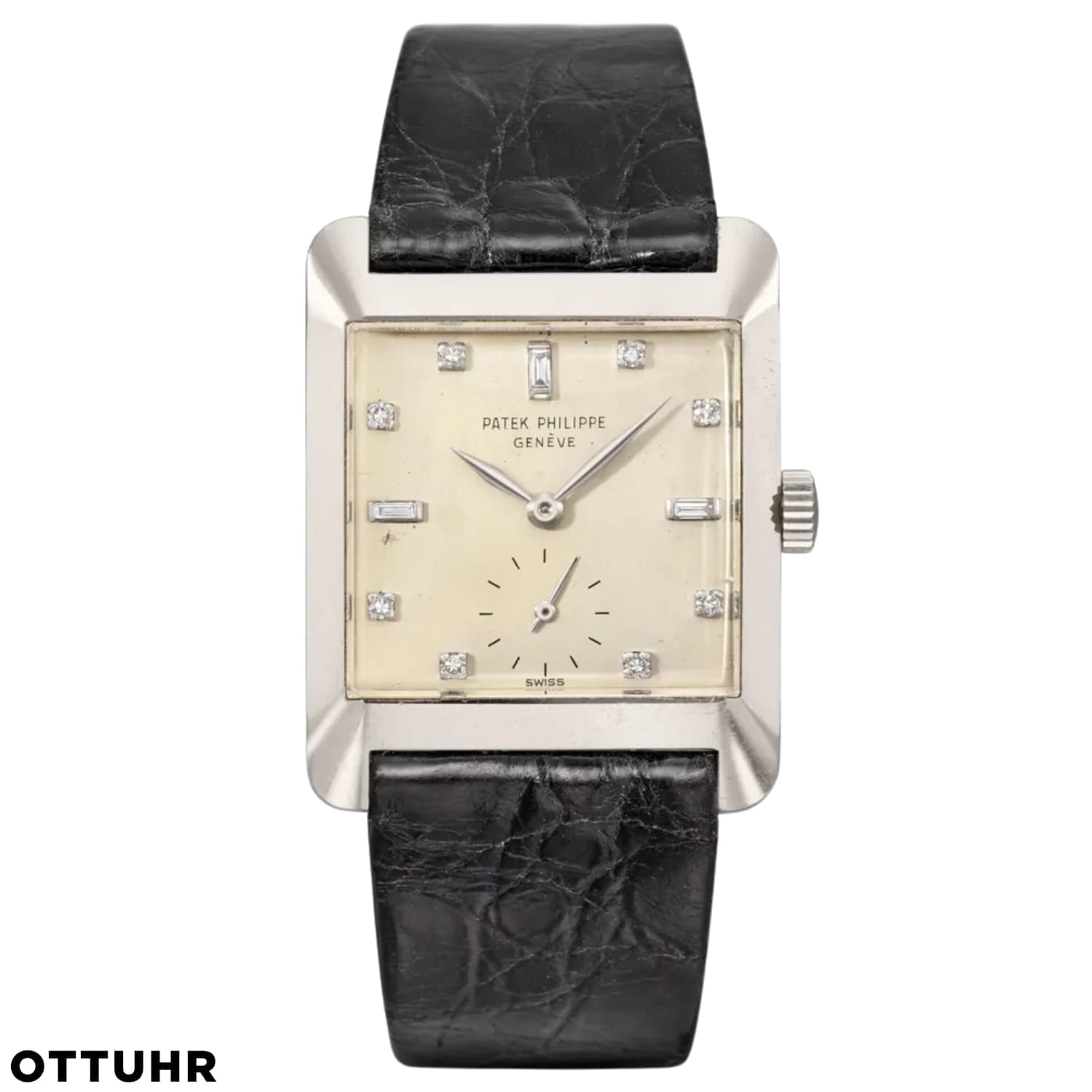
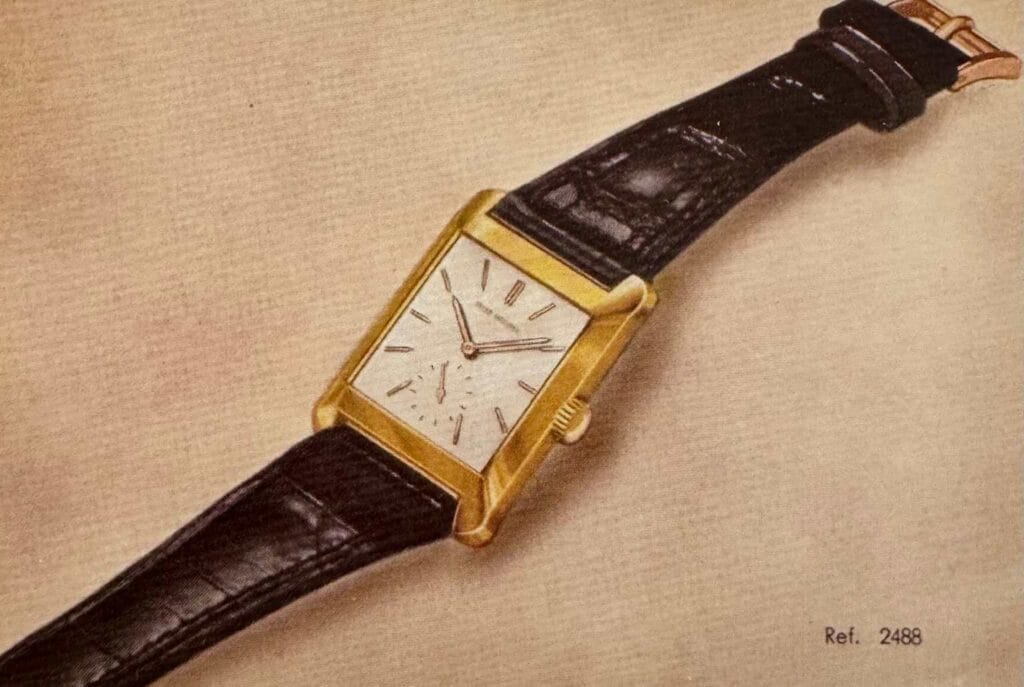
The Patek Philippe 2488, known informally as the “Carré-Tortue” (square turtle), represents an intriguing chapter in the manufacture’s mid-century exploration of non-round case designs. Produced from 1951 to 1960, this rectangular dress watch exemplifies the Art Deco-influenced geometric aesthetics that characterized Patek’s shaped watches during the post-war era, when the Geneva-based firm actively pursued alternatives to the dominant round Calatrava format.
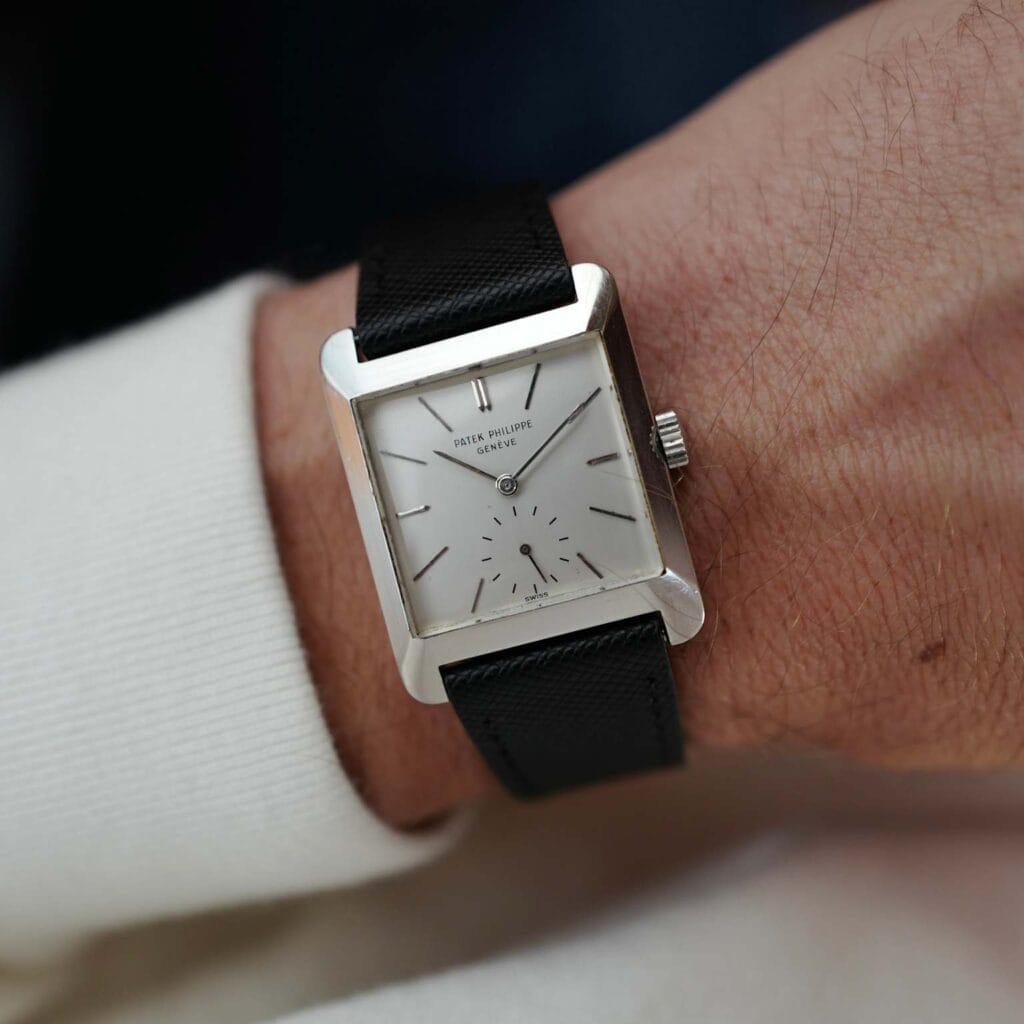
The 2488 occupies a compelling position within Patek Philippe’s catalog as a sophisticated dress piece powered by the exceptional caliber 10-200, one of the finest manual-winding movements of its generation. The case, manufactured by the prestigious Geneva case maker Wenger (identified by the Key Number 1 hallmark inside the case back), features the distinctive “Carré-Tortue” design language: a squared form with rounded corners and a dramatically sloped bezel that creates visual depth and architectural presence on the wrist. At 28mm wide and 35mm lug-to-lug, the watch achieves substantial wrist presence that belies its seemingly modest dimensions, with the diagonal measurement reaching approximately 42-43mm.
Production volume for the reference 2488 appears limited based on serial number evidence and market appearances. While Patek Philippe does not publish production figures, observed movement serial numbers ranging from approximately 680,000 to 955,000 suggest a production window aligned with the confirmed 1951-1960 timeframe. The reference was offered in 18k yellow gold, 18k rose gold, and platinum (the latter being particularly rare). No steel examples have been definitively confirmed, though at least one auction listing mentions a steel/gold combination of uncertain provenance. Given the case’s complex faceted construction and Wenger’s reputation for quality, production numbers likely remained in the low hundreds across all metal variants, making the 2488 scarce rather than rare, but decidedly uncommon in today’s market.
Collector interest in the 2488 has remained stable to modestly appreciating within the broader vintage Patek market. Values currently range from approximately $7,000 to $15,000 for yellow or rose gold examples in good condition, with platinum commanding significant premiums when examples surface. Double-signed dials (particularly Gübelin) add 20-40% to valuations, as do unpolished cases with sharp hallmarks and original unrestored dials. The reference benefits from its Wenger case provenance, Geneva Seal movement, and connection to Patek’s pre-modern Gondolo history, though it lacks the nickname recognition of siblings like the “Marilyn Monroe” (ref. 2442) or “Hour Glass” (ref. 1593). Demand has increased modestly as collectors seek entry points into vintage Patek ownership and appreciate shaped watches as a collecting category.
Historical Context, Provenance, and Manufacturing Details
The reference 2488 emerged during a transformative period for Patek Philippe. By 1951, the manufacture had been under Stern family ownership for nearly two decades, having been acquired in 1932 by Charles and Jean Stern, proprietors of Cadrans Stern Frères, Patek’s primary dial supplier. This transition proved pivotal: the Sterns brought manufacturing discipline, design vision, and crucially, the decision to produce movements in-house rather than sourcing blanks from suppliers like LeCoultre. The caliber 10-200, introduced in the mid-1940s and produced through approximately 1965, exemplifies this period’s commitment to high-grade manual-winding calibers.
The 2488’s development must be understood within Patek Philippe’s broader pursuit of rectangular and shaped case designs during the 1940s and 1950s. This was not a peripheral effort: shaped watches constituted a significant portion of the manufacture’s production during this era, reflecting period tastes that favored geometric, Art Deco-influenced aesthetics. References like the 2430, 2431, 2442, 2461, and 2468 explored various rectangular, tonneau, and cushion forms, each with distinct lug treatments and proportions. The 2488’s “Carré-Tortue” designation derives from its squared profile with curved corners and sides that taper inward toward the lugs, creating a subtle tortoise shell outline when viewed from certain angles.
The reference succeeded no direct predecessor and was itself succeeded by no single replacement. Rather, the 2488 existed within a constellation of shaped references produced concurrently and sequentially throughout the 1950s. By the 1960s, Patek Philippe’s emphasis gradually shifted back toward round cases and the emerging sports watch category, though shaped watches never entirely disappeared from the catalog. The modern Gondolo collection, launched in 1993, explicitly pays homage to this mid-century shaped watch heritage, though the contemporary references bear only aesthetic kinship to originals like the 2488.
All 2488 cases were manufactured by Wenger SA of Geneva, identifiable by the Key Number 1 stamp on the inside of the case back. Wenger, established in 1912 and registered as a trademark holder from 1920, ranked among Geneva’s most prestigious case makers. The firm supplied cases for some of Patek Philippe’s most iconic references, including the perpetual calendar chronograph reference 2499. Wenger’s mastery of the “acier inoxidable” steel process and reputation for precise precious metal work made them the natural choice for complex multi-faceted cases like the 2488. The Wenger hallmark serves as a quality indicator for collectors: the firm’s cases typically exhibit sharp edges, crisp hallmarks, and well-executed proportions that have proven durable over seven decades.
The 2488 represents neither a groundbreaking technical achievement nor a transitional compromise; it is, rather, a fully realized expression of mid-century dress watch design executed to Patek Philippe’s exacting standards. In the broader sweep of horological history, it occupies the space between the streamlined early Calatravas of the 1930s and the more diversified product range (including sports watches) that would emerge in the 1960s and beyond. For collectors, this positions the 2488 as a window into a specific aesthetic moment when geometric elegance and mechanical excellence converged in wearable, understated timepieces.
Construction and Architecture
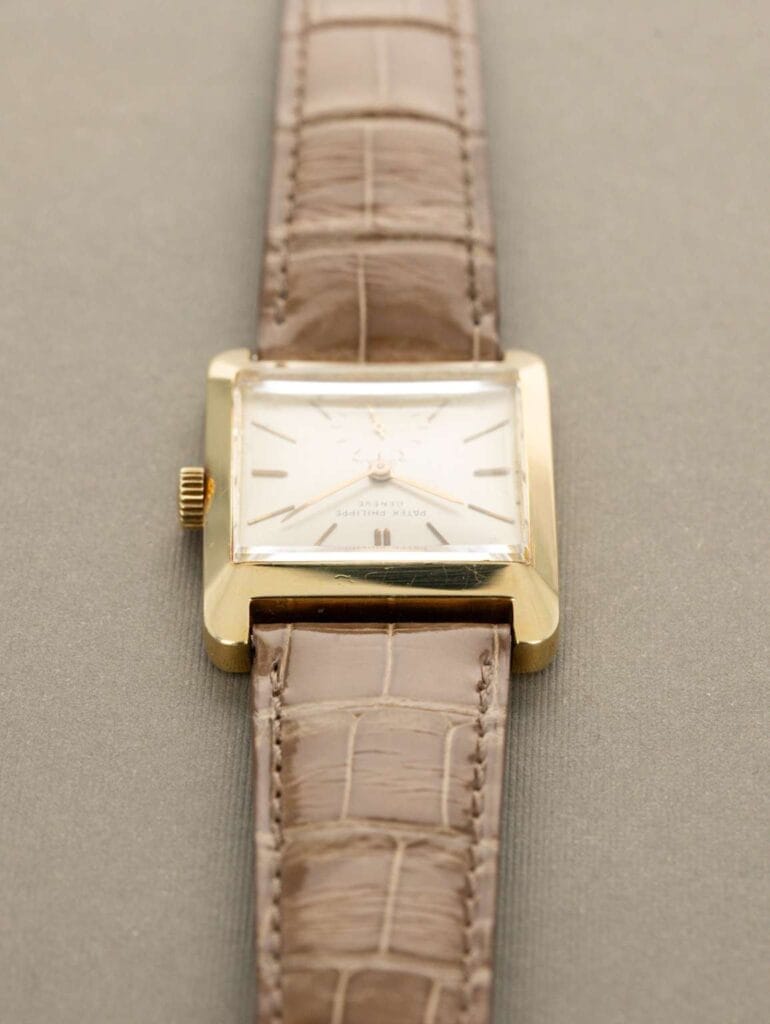
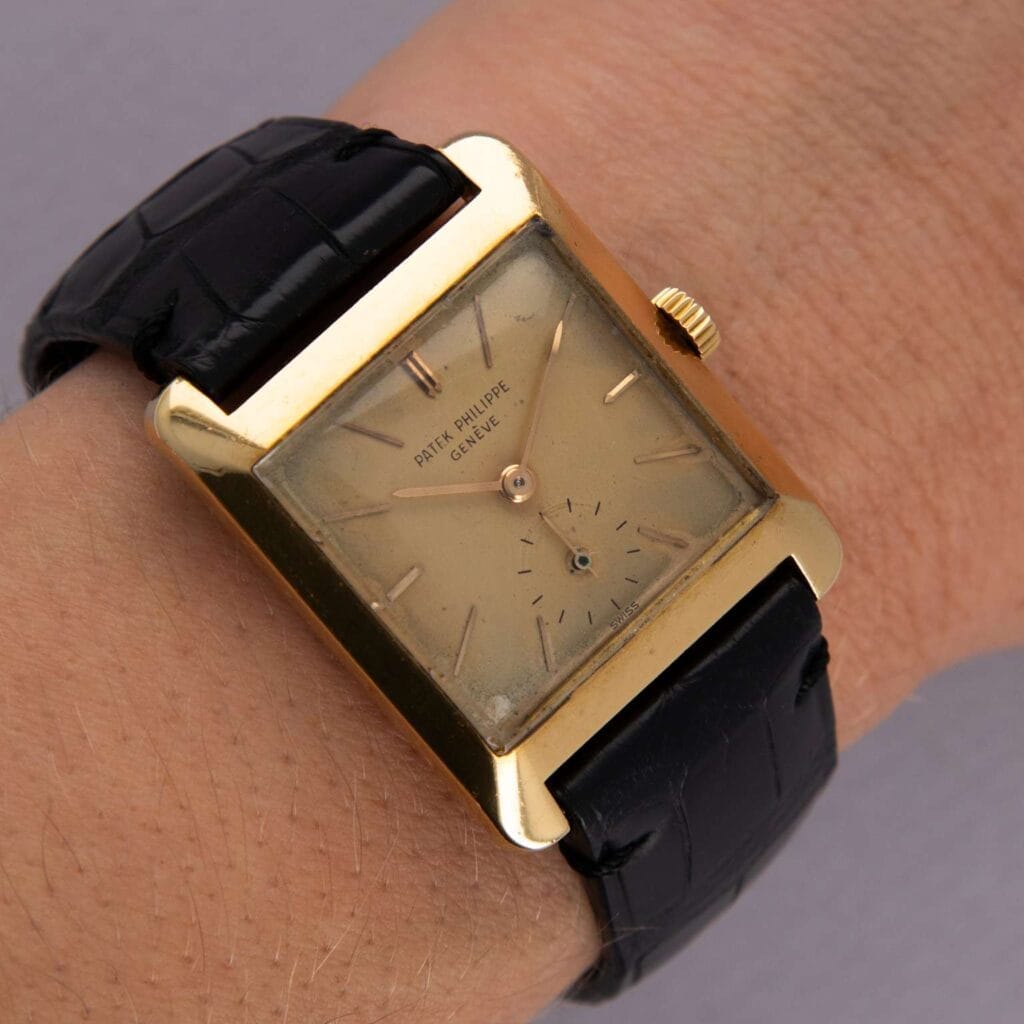
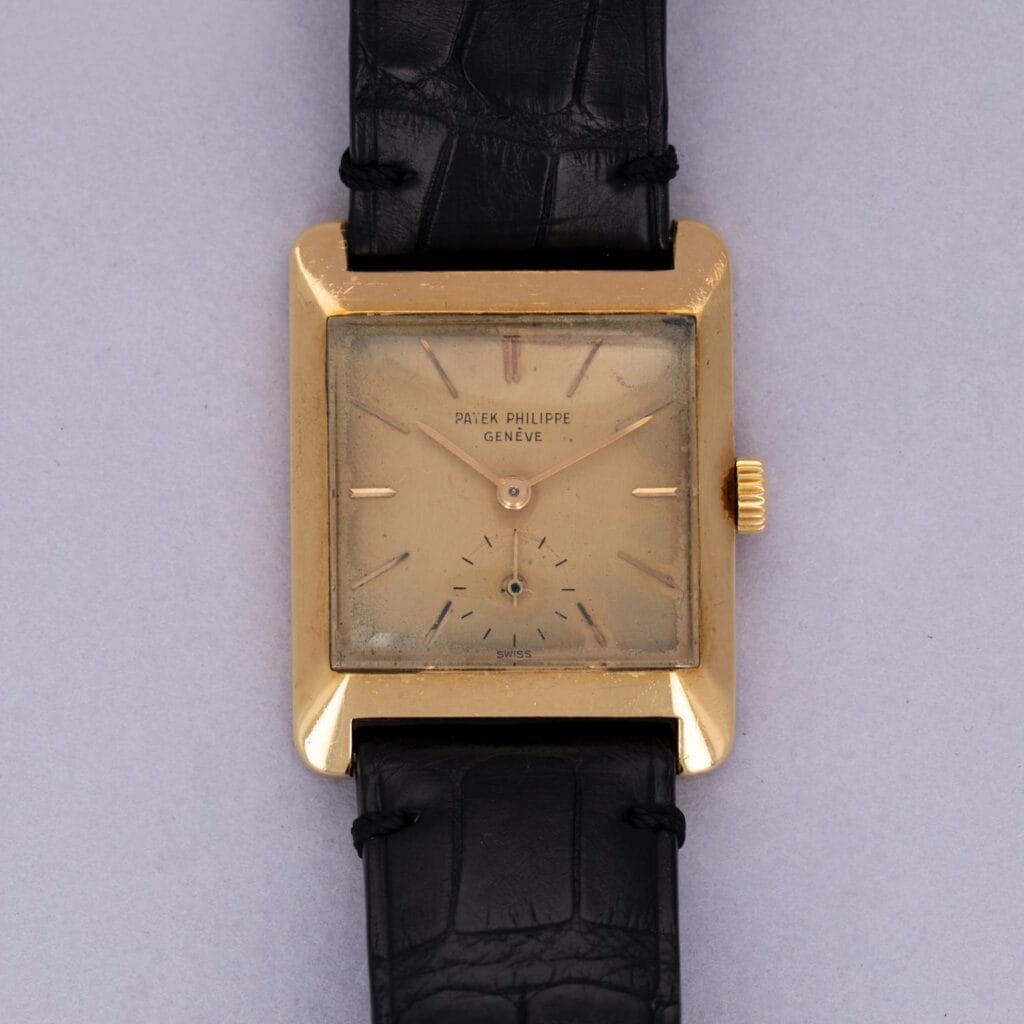
The visual and tactile character of the reference 2488 derives from its thoughtfully executed case architecture. The Wenger-manufactured 18k gold case measures 28mm wide, 35mm lug-to-lug, and approximately 10mm thick including the domed plexiglass crystal. The rectangular form with rounded corners features a broad, sloped bezel that sweeps dramatically away from the dial plane, creating shadow play and visual depth. This bezel treatment, combined with faceted case sides that taper inward toward the lugs, produces the “Carré-Tortue” (squared turtle) effect that distinguishes the reference from simpler rectangular designs.
The case construction is a two-piece snap-on design, with the case back secured by friction rather than threads or screws. Inside the case back, collectors will find several key markings: “Patek Philippe & Co.,” “Geneve,” “Swiss,” the 18k gold hallmark (typically the Swiss “750” standard or similar), the case serial number, the reference number “2488,” and crucially, the Wenger Key Number 1 hallmark. These markings confirm provenance and authenticity. The case back sits flush when properly closed, with no visible gaps when viewed from the side.
The crown varies by production period. Early examples (circa 1951-1958) typically feature an unsigned onion-style crown, consistent with Patek Philippe’s practice during this era. Later examples (circa 1959 onward) may exhibit the Calatrava cross-decorated crown, though this feature appeared inconsistently. Many 2488 examples show unsigned crowns, and this is period-correct; collectors should not automatically assume an unsigned crown indicates replacement, though verification against other originality indicators remains prudent.
Dial architecture centers on simplicity and legibility. The majority of 2488 examples feature silver or champagne dials supplied by Stern Frères, the dial manufacture owned by Patek Philippe’s proprietors. Applied gold baton hour markers, doubled at 12 o’clock, provide visual anchors. The signature “Patek Philippe” and “Geneve” appear in the upper dial quadrant, executed in hard raised enamel lettering that was standard for Patek dials through the mid-20th century. This enamel lettering process involved engraving dial signatures to depths of tenths of a millimeter, filling the engravings with enamel, and firing the dial at high heat. The result is a slightly raised signature with exceptional durability.
The small seconds subdial sits at 6 o’clock, featuring a printed railroad track or simple chapter ring. Hands are gold batons or pencil style, matching the dial indices. Importantly, period-correct 2488 watches lack luminous material; the indices and hands are non-luminous polished gold. Any example showing luminous treatment requires careful scrutiny for originality.
Dial color variations include silver (the most common), champagne/ivory-cream, and rarely, black or blue. Double-signed dials bearing prestigious retailer names like Gübelin or Tiffany & Co. occasionally appear and command premiums. These retailer signatures, when authentic, appear below the small seconds subdial and indicate the watch was sold through that specific jeweler.
The crystal is domed plexiglass (acrylic), providing a vintage aesthetic and gentle magnification effect when viewing the dial. The domed profile contributes to the watch’s overall depth and three-dimensionality. Modern replacements are readily available, and most surviving examples have had crystals replaced during service intervals.
The reference 2488 was originally sold on leather straps with Patek Philippe-signed 18k gold buckles matching the case metal. Strap width at the lugs is 20mm, providing ample options for period-appropriate or modern replacements. Given the watch’s dress character and mid-century provenance, collectors typically favor dark brown, black, or dark green crocodile or lizard straps.
Dial and Case Variants
| Variant Characteristics | Details |
|---|---|
| Dial Color | Silver (most common), champagne/ivory, black (rare), blue (extremely rare) |
| Dial Finish | Matte silver or subtle sunburst effect (often age-related) |
| Signatures | Standard Patek Philippe Geneve; Double-signed (Gübelin, Tiffany & Co., others) |
| Indices | Applied gold batons, doubled at 12 o’clock |
| Case Metal | 18k yellow gold (most common), 18k rose gold (scarce), platinum (rare) |
| Crown | Unsigned onion style (early production), Calatrava cross signed (late production) |
| Case Key Number | Wenger Key #1 (standard for all examples) |
Cross-Reference Data
The reference 2488 stands alone within Patek Philippe’s catalog with no direct variants or sub-references. However, several contemporaneous rectangular and square references share aesthetic kinship and comparable movements:
None of these references are functionally identical to the 2488, but they represent the broader family of shaped Patek Philippe watches from the same era and share similar construction principles, movements, and market positioning.
Movements & Calibers
The reference 2488 is exclusively powered by the Patek Philippe caliber 10-200, a manually-wound, time-only movement that exemplifies mid-20th-century Geneva watchmaking at its finest.
Caliber 10-200 Specifications
| Specification | Details |
|---|---|
| Diameter | 10 lignes (22.5-22.7mm) |
| Height | 3.65mm |
| Jewel Count | 18 jewels |
| Frequency | 19,800 vph (2.75 Hz) |
| Power Reserve | ~44 hours (some sources indicate 36 hours; variation may reflect mainspring condition) |
| Escapement | Straight-line lever |
| Balance | Gyromax, free-sprung with self-compensating Breguet balance spring |
| Regulator | Swan-neck micrometer regulator |
| Adjustment | Adjusted to heat, cold, isochronism, and five positions |
| Finishing | Geneva Seal (Poinçon de Genève); fausses côtes decoration on bridges and plates; beveled edges throughout |
The caliber 10-200 was produced between approximately 1946 and 1965, with an estimated 20,000 pieces manufactured across numerous references. Beyond the 2488, the movement appeared in Calatrava references 431, 482, 1419, 1458, 1519, 2407, 2408, 2440, 2496, 2501, 2525, 2527, 2528, 2530, 2546, 2547, 2548, 2549/1, 2549/2, 2573, and 3496. This widespread deployment reflects the caliber’s reliability and prestige.
The Geneva Seal (Poinçon de Genève) stamped on the movement signifies compliance with stringent quality standards established in 1886. Until 2009, when Patek Philippe introduced its own seal, the Geneva Seal represented the highest certification in Swiss watchmaking. Movements bearing this hallmark met rigorous criteria for material quality, finishing, and construction, all performed within the Canton of Geneva. Patek Philippe was virtually the sole user of the Geneva Seal from 1925 through the mid-20th century, making it a defining feature of the brand’s vintage movements.
The Gyromax balance wheel is a Patek Philippe innovation: a free-sprung balance (without an index regulator acting directly on the balance spring) that achieves rate adjustment through inertia modification using tiny weights on the balance rim. This system provides superior stability against shocks and position changes compared to index-regulated balances. Combined with the self-compensating Breguet overcoil balance spring and swan-neck fine regulator, the 10-200 achieves chronometric performance that remains impressive by modern standards.
Movement text varies slightly depending on production year and intended market, but typically includes: “PATEK, PHILIPPE & CO.” / “GENEVE” / “SWISS” / movement serial number / “EIGHTEEN (18) JEWELS” / Geneva Seal stamp / “10-200” / “ADJUSTED TO HEAT, COLD, ISOCRONISM & FIVE (5) POSITIONS”. Watches destined for the United States market may also bear “HOX,” a customs/tariff code.
No significant evolutionary changes occurred within the caliber 10-200 during the reference 2488’s production run. The movement remained mechanically consistent from introduction through discontinuation, a testament to the caliber’s well-executed design. Collectors should expect consistent finishing quality, though individual examples may show variation in wear and service history.
Identifying Original vs. Replaced Parts
Authenticating a reference 2488 requires attention to multiple details, as the watch’s value depends heavily on originality. Replacement or refinished components significantly impact collectibility and market value.
Dial Authenticity
Original 2488 dials feature hard raised enamel lettering for the “Patek Philippe” and “Geneve” signatures. This enamel work creates a slightly raised, three-dimensional effect visible under magnification and raking light. The enamel should appear smooth, consistent, and properly filled within engraved grooves. Refinished dials often exhibit:
- Flat, pad-printed lettering lacking the raised enamel texture
- Inconsistent letter spacing or font irregularities
- Overly bright, “fresh” appearance inconsistent with age
- Loss of original patina or uneven aging patterns
Original dials may show minor spotting, light oxidation of applied indices, or gentle patina development. These imperfections are acceptable and often preferable to aggressive restoration that removes the hard enamel signature. Some dealers and collectors specifically seek unrestored dials to preserve originality.
Dial restoration by Patek Philippe’s official service centers (or period-appropriate independent experts) is acceptable when professionally executed and disclosed. However, collector preference increasingly favors original unrestored dials with honest wear over refinished examples, particularly when the refinishing removes the hard enamel lettering.
Applied Indices and Hands
Original applied gold indices should match the case metal (18k gold) and exhibit consistent oxidation patterns if any aging has occurred. The indices attach to the dial via feet that penetrate the dial plate; refinished dials may show misaligned or poorly reattached indices.
Original hands are polished gold batons or pencil style, matching the dial indices in color and finish. Service replacement hands may differ slightly in shape, length, or finish. Critically, original hands lack luminous material; any luminous treatment suggests replacement.
Crown Originality
Period-correct crowns for the 2488 are either unsigned onion style (most common, particularly in earlier examples) or Calatrava cross-signed (later production). An unsigned crown is not automatically incorrect; Patek Philippe used unsigned crowns on many dress watches during this era. However, collectors should verify crown dimensions, tube threading (if any), and overall style against documented examples.
Replacement crowns often present different profiles, incorrect proportions, or anachronistic Calatrava cross application on early examples. Original crowns should show wear consistent with the case and should function smoothly for winding and setting.
Case Condition and Polishing
The 2488’s Wenger case features sharp, faceted edges, crisp hallmarks, and well-defined lug contours when unpolished. Excessive polishing rounds these edges, softens hallmarks, and diminishes the case’s architectural character. Collectors prioritize unpolished or lightly polished examples with visible, legible hallmarks on the inside case back and, sometimes, on the lugs.
Signs of excessive polishing include:
- Rounded bezel edges where sharp facets should exist
- Thin or illegible hallmarks inside the case back
- Softened transitions between case surfaces
- Lugs that appear thinner or less robust than original proportions
A well-preserved, unpolished case with crisp hallmarks commands significant premiums over polished examples. Some light professional polishing to remove scratches is acceptable if case architecture remains intact, but aggressive restoration that alters proportions damages value.
Movement Authenticity
The caliber 10-200 is well-documented, and genuine examples should exhibit:
- Geneva Seal stamp on the movement
- Correct movement serial number consistent with production period
- Proper text layout and font as described earlier
- High-quality Geneva stripes (fausses côtes) finishing on bridges
- Gyromax balance wheel with visible adjustment weights
Movement serial numbers should align logically with case serial numbers and production periods. Patek Philippe’s Extract from the Archives service provides official confirmation of original specifications, including movement number, case number, production date, and sale date. This document costs 500 Swiss francs and takes approximately 10 weeks to obtain.
Bracelet and Buckle
Original buckles are 18k gold (matching case metal) and signed “Patek Philippe” or “Patek Philippe & Co.”. Period-correct straps are leather (often crocodile or lizard) in dark colors. Most surviving examples have replacement straps due to normal wear, but original buckles should be preserved when present.
Collector Notes & Market Context
The reference 2488 occupies a nuanced position in the vintage Patek Philippe market. It is neither an entry-level reference nor a trophy piece, but rather a solid mid-tier collecting opportunity for enthusiasts seeking mechanical excellence and distinctive design without five-figure price tags.
Current Market Positioning and Values
As of January 2026, market values for the reference 2488 approximately range:
- Yellow gold, good condition: $7,000-$12,000
- Rose gold, good condition: $9,000-$15,000
- Platinum: Rare market appearances; estimated $15,000-$25,000+ depending on condition
- Double-signed dials (Gübelin, Tiffany): Add 20-40% premium
These values assume original dial, unpolished or lightly polished case with sharp hallmarks, correct crown, and complete service with Extract from the Archives. Refinished dials, heavily polished cases, or missing documentation reduce values by 20-40%.
The 2488 benefits from stable demand within the vintage Patek market but lacks the explosive appreciation seen in sport models like the Nautilus or rare complications. This stability offers collecting advantages: prices are predictable, inventory appears regularly (though not frequently), and the reference remains accessible to serious collectors without speculation-driven volatility.
Most Sought-After Configurations
Collectors prioritize:
- Unpolished cases with crisp Wenger Key #1 hallmarks: Preservation of factory condition drives premiums
- Original unrestored dials with intact hard enamel lettering: Authenticity over cosmetic perfection
- Rose gold or platinum cases: Scarcity increases desirability
- Double-signed dials: Gübelin, Tiffany, or other prestigious retailers add collector appeal
- Extract from the Archives: Official documentation confirming originality
- Original presentation box and papers: Complete sets command premiums, though most examples lack original packaging
Common Pitfalls to Avoid
- Refinished dials with lost hard enamel lettering: These may appear cosmetically superior but lack originality
- Heavily polished cases: Softened edges and thin hallmarks diminish value
- Mismatched components: Replacement dials, hands, or crowns from incorrect periods
- Service by unauthorized watchmakers: Improper servicing damages movements and cases
- Implausible configurations: Black dials, luminous markers, or other features inconsistent with period production
What Drives Premiums
Beyond rarity and condition, specific attributes amplify value:
- Provenance: Known ownership history or documented single-family ownership
- Unbroken originality: All factory components preserved through decades
- Retailer signatures: Double-signed dials from prestigious jewelers
- Complete documentation: Extract from Archives, service receipts, original sales documentation
- Exceptional aesthetic execution: Particularly attractive dial aging, perfectly preserved cases
Conversely, anonymous examples with refinished dials, polished cases, and no documentation trade at the lower end of the valuation range.
Wearability & Lifestyle Fit
The reference 2488 functions as a refined dress watch suited to specific wearing contexts. Its strengths and limitations should inform purchasing decisions for collectors considering daily wear versus occasional use.
The reference 2488 is best suited for collectors who:
- Appreciate vintage dress watches and can accommodate their wearing limitations
- Maintain a rotation of watches, wearing the 2488 selectively for appropriate occasions
- Accept the responsibility of regular winding and service maintenance
- Value mechanical heritage and aesthetic refinement over modern convenience
For collectors seeking a single daily-wear watch for all contexts, a modern Patek Philippe or a vintage reference with greater water resistance (e.g., certain Calatrava references with screw-down backs) may prove more practical. But for those who understand and embrace the 2488’s character as a refined dress piece, the watch rewards careful stewardship with timeless elegance and remarkable mechanical performance.
Daily Wearer Viability vs. Collector Piece
The 2488 can serve as a daily wearer with appropriate precautions, but it is fundamentally a dressy timepiece suited to office environments, formal occasions, and careful handling. The caliber 10-200 is mechanically robust, with consistent reports of excellent timekeeping when properly serviced. Vintage Patek Philippes from this era were built for daily use and have proven their durability over seven decades. However, the watch’s dress character, vintage construction, and collectible status argue for mindful wearing practices.
Collectors who wear vintage Patek Philippes daily emphasize that these watches survive decades of use because they are inherently durable. The 2488’s manual-winding movement has no rotor or complex automatic mechanisms to fail, making it mechanically straightforward and service-friendly. Regular winding (daily or every other day, given the ~44-hour power reserve) maintains the mainspring tension and keeps the movement running accurately.
The 2488 excels in formal and business-formal contexts. Its rectangular profile, polished gold case, and clean dial design pair naturally with suits, dress shirts, and tailored clothing. The watch’s 28mm width and 35mm lug-to-lug dimensions, while vintage-proportioned, create substantial wrist presence due to the diagonal measurement and visual impact of the rectangular form. On typical 6.5-7.5 inch wrists, the 2488 wears comfortably without overhang or awkward positioning.
The sloped bezel and polished case surfaces catch light beautifully, producing the visual drama and refinement expected from a mid-century Patek Philippe dress watch. This aesthetic sophistication positions the 2488 as appropriate for black-tie events, business meetings, and any situation requiring understated elegance.
The 2488 is not a tool watch and should not be treated as one. The reference lacks water resistance (effectively “not water resistant” or at most splash-resistant), making it unsuitable for swimming, showering, or sustained exposure to moisture. Vintage gaskets and seals degrade over time; even watches that were moderately water-resistant when new should not be assumed to maintain those specifications seven decades later.
The snap-on case back, while secure when properly closed, offers minimal water ingress protection compared to screw-down designs. The plexiglass crystal is vulnerable to scratching and cracking under impact. The manual-winding movement, while shock-resistant to period standards, should not be subjected to severe impacts or vibrations.
As stated, the 2488 should be kept dry. This means:
- Removing the watch before washing hands is prudent, though brief incidental water exposure (rain, hand-washing) is unlikely to cause immediate damage if dried promptly
- No showering, swimming, or immersion
- Avoiding humid environments where condensation could form inside the case
- Annual water resistance checks by a qualified watchmaker if planning occasional moisture exposure
Most collectors treat vintage Patek Philippes as fair-weather watches, reserving them for dry conditions and stable temperatures.
Comfort Factors
Weight: The 18k gold case provides satisfying heft without excessive weight, typically 40-50 grams depending on case metal and strap configuration.
Thickness: At approximately 10mm including crystal, the 2488 slides easily under shirt cuffs, a key consideration for dress watches.
Lug Curve: The Wenger case features gently curving lugs that follow wrist contours, improving comfort over flat-lugged designs.
Strap Integration: The 20mm lug width accepts a wide range of strap options, and the strap’s flexibility significantly affects comfort. Properly fitted crocodile or lizard straps conform to the wrist quickly, improving day-long wearability.
Strap Versatility
The 2488’s 20mm lug width and dress character suit leather straps in dark colors: black, dark brown, burgundy, or dark green crocodile, alligator, or lizard. Padded straps increase comfort; unpadded straps emphasize elegance at the cost of some wrist cushioning.
Contemporary strap options from specialist makers (Camille Fournet, Combat Straps, etc.) allow personalization while respecting the watch’s vintage dress character. Avoid overly casual options (canvas, NATO) that clash with the 2488’s formal aesthetic. The original 18k gold buckle should be preserved; if unavailable, period-style gold-plated or gold-filled buckles maintain authenticity.